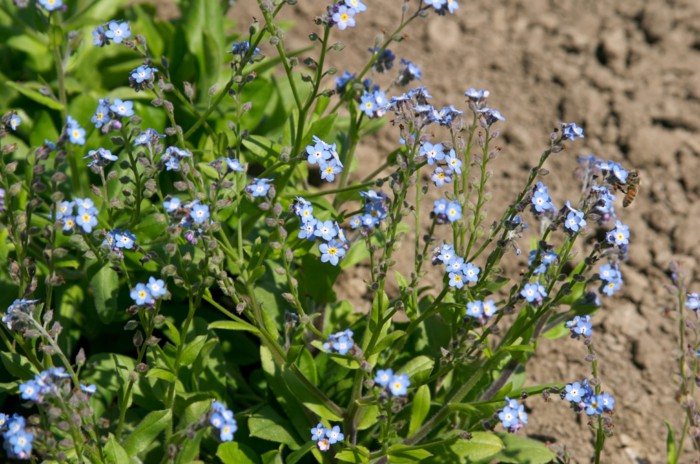
Myosotis

Wood forget-me-nots Myosotis sylvatica, from here.


Belongs within: Cynoglosseae.

Myosotis, the forget-me-nots, is a genus of herbaceous plants found in cooler regions of the world with mostly blue (occasionally white or yellow) flowers.

Characters (from Hickman 1993): Annual or perennial, glabrous to rough-hairy; roots generally diffuse. Stem decumbent to erect. Basal leaves generally oblong or oblanceolate; cauline leaves generally linear to elliptic. Inflorescence coiled, generally raceme-like, eventually more or less open; bracts absent (or leaf-like in lower half); flowers generally in upper half of plant. Flower with five calyx lobes, generally more or less equal; corolla salverform or widely funnel-shaped, white, yellow, or generally blue, tube five-appendaged at top, limb abruptly spreading, five-lobed; stamens 5, included; style generally included. Nutlets smooth, shiny, each with raised outer margin, scar lateral, at base, small.

<==Myosotis Linnaeus 1753 A61 [incl. M. sect. Eumyosotis C06, Exarrhena Brown 1810 A61; Myosotideae]
    |--M. albo-sericea Hooker 1867 A61
    |--M. amabilis Cheeseman 1906 A61
    |--M. angustata Cheeseman 1906 A61
    |--M. antarctica Hooker 1844 A61
    |--M. arnoldii Moore in Allan 1961 A61
    |--M. arvensis LC02
    |--M. australis Br. 1810 (see below for synonymy) A61
    |--M. caespitosa HE80
    |--M. capitata Hooker 1844 A61
    |--M. cheesemanii Petrie 1886 A61
    |--M. colensoi (Kirk) Macbride 1916 [=Exarrhena colensoi Kirk 1895; incl. M. decora Kirk ex Cheeseman 1906] A61
    |--M. collina C06
    |--M. concinna Cheeseman 1885 A61
    |--M. discolor [incl. M. versicolor] H93
    |--M. elderi Moore in Allan 1961 A61
    |--M. eximia Petrie 1916 A61
    |--M. explanata Cheeseman 1906 A61
    |--M. forsteri Lehm. 1818 (see below for synonymy) A61
    |--M. glabrescens Moore in Allan 1961 A61
    |--M. goyenii Petrie 1891 A61
    |--M. laeta Cheeseman 1885 A61
    |--M. laingii Cheeseman 1912 A61
    |--M. latifolia H93
    |--M. laxa H93
    |--M. lyallii Hooker 1853 A61 [=Exarrhena lyallii C06]
    |    |--M. l. var. lyallii A61
    |    `--M. l. var. townsonii (Cheeseman) Moore in Allan 1961 [=M. townsonii Cheeseman 1906] A61
    |--M. macrantha (Hooker) Benth. & Hooker 1876 (see below for synonymy) A61
    |--M. matthewsii Moore in Allan 1961 A61
    |--M. micrantha H93
    |--M. monroi Cheeseman 1906 A61
    |--M. oreophila Petrie 1896 A61 [=M. (Exarrhena) oreophila C06]
    |--M. palustris BR65
    |--M. petiolata Hooker 1853 A61 [=Exarrhena petiolata C06]
    |    |--M. p. var. petiolata A61
    |    |--M. p. var. pansa Moore in Allan 1961 A61
    |    `--M. p. var. pottsiana Moore in Allan 1961 A61
    |--M. pulvinaris Hooker 1864 [incl. M. hectori Hooker 1864] A61
    |--M. pygmaea Colenso 1884 (see below for synonymy) A61
    |    |--M. p. var. pygmaea A61
    |    |--M. p. var. drucei Moore in Allan 1961 A61
    |    |--M. p. var. glauca Simpson & Thomson 1943 A61
    |    `--M. p. var. minutiflora Simpson & Thomson 1943 A61
    |--M. rakiura Moore in Allan 1961 (see below for synonymy) A61
    |--M. ramosissima G88
    |--M. refracta C55
    |--M. saxosa Hooker 1853 [=Exarrhena saxosa Hooker 1864] A61
    |--M. scorpioides LDB98
    |--M. spathulata Forster 1786 A61 [=Anchusa spathulata C06; incl. M. orbiculata Simpson 1952 A61]
    |    |--M. s. var. spathulata A61
    |    `--M. s. var. radicata Moore in Allan 1961 A61
    |--M. stricta HE80
    |--*Exarrhena’ suaveolens A61
    |--M. suavis Petrie 1914 A61
    |--M. subvernicosa Colenso 1891 (n. d.) A61
    |--M. sylvatica BR65
    |--M. tenericaulis Petrie 1918 [=M. tenuicaulis (l. c.); incl. M. tenuis Simpson & Thomson 1944] A61
    |--M. traversii Hooker 1864 A61
    |    |--M. t. var. traversii (see below for synonymy) A61
    |    |--M. t. var. cantabrica Moore in Allan 1961 A61
    |    `--M. t. var. cinerascens (Petrie) Moore in Allan 1961 [=M. cinerascens Petrie 1918] A61
    |--M. uniflora Hooker 1864 A61
    |--M. venosa Colenso 1896 [incl. M. astonii Cheeseman 1910, M. diversifolia Petrie 1918] A61
    `--M. verna [incl. M. virginica] H93

Myosotis australis Br. 1810 [incl. M. australis var. conspicua Cheeseman 1906, M. australis var. lytteltonensis Laing & Wall 1924, M. saxatilis Petrie 1918 non Pallas 1795] A61

Myosotis forsteri Lehm. 1818 [incl. M. hamiltonii Colenso 1888, M. polyantha Colenso 1899, M. tenuifolia Colenso 1899] A61

Myosotis macrantha (Hooker) Benth. & Hooker 1876 [=Exarrhena macrantha Hooker 1864; incl. M. macrantha var. diversa Simpson & Thomson 1943, M. macrantha var. pulchra Cheeseman 1906, M. macrantha var. westlandica Petrie 1918] A61

Myosotis pygmaea Colenso 1884 [incl. M. ramificata Simpson 1952, M. antarctica ssp. traillii Kirk 1884, M. pygmaea var. traillii (Kirk) Ckn. 1921] A61

Myosotis rakiura Moore in Allan 1961 [=M. capitata var. albiflora Armstr. 1881 non M. albiflora Banks & Sol. ex Hooker 1847, M. capitata ssp. albida Kirk 1885, M. albida (Kirk) Cheeseman in Cockayne 1909 non Kunth in H.B. & K. 1818] A61

Myosotis traversii Hooker 1864 var. traversii [incl. M. cockayniana Petrie 1913, M. traversii var. cockayniana (Petrie) Cheeseman 1925] A61

*Type species of generic name indicated

REFERENCES

[A61] Allan, H. H. 1961. Flora of New Zealand vol. 1. Indigenous Tracheophyta: Psilopsida, Lycopsida, Filicopsida, Gymnospermae, Dicotyledones. R. E. Owen, Government Printer: Wellington (New Zealand).

[BR65] Black, J. M., & E. L. Robertson. 1965. Flora of South Australia. Part IV. Oleaceae–Compositae. W. L. Hawes, Government Printer: Adelaide.

[C55] Candolle, A. de. 1855. Géographie Botanique Raisonée: Ou exposition des faits principaux et des lois concernant la distribution géographique des plantes de l’époque actuelle vol. 2. Librairie de Victor Masson: Paris.

[C06] Cheeseman, T. F. 1906. Manual of the New Zealand Flora. John Mackay, Government Printer: Wellington.

[G88] Grubb, P. J. 1988. The uncoupling of disturbance and recruitment, two kinds of seed bank, and persistence of plant populations at the regional and local scales. Annales Zoologici Fennici 25: 23–26.

[HE80] Healy, A. J., & E. Edgar. 1980. Flora of New Zealand vol. 3. Adventive cyperaceous, petalous and spathaceous monocotyledons. P. D. Hasselberg, Government Printer: Wellington (New Zealand).

[H93] Hickman, J. C. (ed.) 1993. The Jepson Manual: Higher Plants of California. University of California Press: Berkeley (California).

[LC02] Långström, E., & M. W. Chase. 2002. Tribes of Boraginoideae (Boraginaceae) and placement of Antiphytum, Echiochilon, Ogastemma and Sericostoma: a phylogenetic analysis based on atpB plastid DNA sequence data. Plant Systematics and Evolution 234: 137–153.

[LDB98] Lenssen, J. P. M., G. E. ten Dolle & C. W. P. M. Blom. 1998. The effect of flooding on the recruitment of reed marsh and tall forb plant species. Plant Ecology 139: 13–23.

Trichodesmeae

Indian borage Trichodesma indica, copyright J. M. Garg.


Belongs within: Cynoglosseae.

The Trichodesmeae are an Old World group of robust herbs or shrubs with very short corolla tubes and mostly spreading corolla lobes with long, exserted anthers.

<==Trichodesmeae
    |--Caccinia LC02
    |--Suchtelenia LC02
    `--Trichodesma Brown 1810 [incl. Pollichia Medicus 1783 (nom. rej.)] BR65
         |--T. angustifolium CV06
         |    |--T. a. ssp. angustifolium CV06
         |    `--T. a. ssp. argenteum CV06
         |--T. indica PP07
         |    |--T. i. var. indica PP07
         |    `--T. i. var. amplexicaule PP07
         |--T. scottii LC02
         `--T. zeylanicum [=Pollichia zeylanica; incl. T. zeylanicum var. sericeum] BR65
              |--T. z. var. zeylanicum BR65
              `--T. z. var. latisepalum BR65

*Type species of generic name indicated

REFERENCES

[BR65] Black, J. M., & E. L. Robertson. 1965. Flora of South Australia. Part IV. Oleaceae–Compositae. W. L. Hawes, Government Printer: Adelaide.

[CV06] Craven, P., & P. Vorster. 2006. Patterns of plant diversity and endemism in Namibia. Bothalia 36 (2): 175–189.

[LC02] Långström, E., & M. W. Chase. 2002. Tribes of Boraginoideae (Boraginaceae) and placement of Antiphytum, Echiochilon, Ogastemma and Sericostoma: a phylogenetic analysis based on atpB plastid DNA sequence data. Plant Systematics and Evolution 234: 137–153.

[PP07] Pandey, R. P., & P. M. Padhye. 2007. Studies on phytodiversity of Arid Machia Safari Park-Kailana in Jodhpur (Rajasthan). Bulletin of the Botanical Survey of India 49: 15–78.

Mesothelae

Reconstruction of Arthrolycosa fortis, from Fritsch (1904).


Belongs within: Araneida.

The Mesothelae are a group of spiders in which the abdomen retains external segmentation, the fangs are obliquely angled and the spinnerets are more or less displaced to the centre of the abdomen (Wunderlich 2019). Living members of the group are restricted to eastern Asia and inhabit tubular burrows with a trapdoor (Jocqué & Dippenaar-Schoeman 2007).

<==Mesothelae [Liphistiomorphae, Verticulatae] S02
    |  i. s.: Palaeothele montceauensis SSS08
    |         Eothele Selden 2000 W19
    |         Vinathela nahang W19
    |--Arthromygalidae S93
    |    |--Protocteniza britannica Petrunkevitch 1949 S93
    |    `--Protolycosa S93
    |         |--P. anthracophyla Römer 1866 F04
    |         `--P. cebennensis Laurentiaux-Vieira & Laurentiaux 1963 S93
    |--Arthrolycosidae S93
    |    |--Geralycosa fritschii Kušta 1888 F04
    |    |--Rakovnicia antiqua Kušta 1884 F04
    |    |--Eotarbis litoralis Kušta 1888 F04
    |    |--Eocteniza silvicola Pocock 1911 S93
    |    `--Arthrolycosa [incl. Eolycosa Kušta 1885, Scudderia Kušta 1888] F04
    |         |--A. antiqua Harger 1874 S93
    |         |--A. beecheri Fritsch 1904 F04
    |         |--‘Palaranea’ borassifoliae [=Arthrolycosa palaranea Fritsch 1904] F04
    |         |--A. carbonaria (Kušta 1888) [=*Scudderia carbonaria] F04
    |         |--A. danielsi Petrunkevitch 1913 S93
    |         |--A. fortis Fritsch 1904 F04
    |         `--A. lorenzi (Kušta 1885) [=*Eolycosa lorenzi] F04
    |--Eomesothelidae W19
    |    |--Eomesothele Wunderlich 2019 W19
    |    |    `--*E. noninclinata Wunderlich 2019 W19
    |    `--Intermesothele Wunderlich 2019 W19
    |         `--*I. pulcher Wunderlich 2019 W19
    |--Heptathele Kishida 1923 JD-S07 [Heptathelidae W19]
    |    |--H. hangzhouensis WT06
    |    |--H. nishiharai H95
    |    `--H. kimurai FF99
    |--Burmathele Wunderlich 2017 [Burmathelidae] W19
    |    `--B. biseriata Wunderlich 2017 W19
    |--Cretaceothele [Cretaceothelidae] W19
    |    `--C. lata Wunderlich 2015 W19
    |--Parvithelidae W19
    |    |--Parvithele Wunderlich 2017 W19
    |    `--Pulvillothele haupti Wunderlich 2017 W19
    `--Liphistiidae JD-S07
         |--Nanthela Haupt 2003 JD-S07
         |--Songthela Ono 2000 JD-S07
         |--Palaeocteniza crassipes B86
         |--Ryuthela Haupt 1983 JD-S07
         |    `--R. nishihirai (Haupt 1969) H07
         `--Liphistius Schiödte 1849 JD-S07
              |--L. batuensis R95
              |--L. bicoloripes (Ono 1988) GE02
              |--L. desultor JD-S07
              |--L. lannaianus JD-S07
              |--L. malayanus WY88
              `--L. sumatranus JD-S07

*Type species of generic name indicated

REFERENCES

[B86] Bernini, F. 1986. Current ideas on the phylogeny and the adaptive radiations of Acarida. Bolletino di Zoologia 53: 279–313.

[FF99] Forster, R., & L. Forster. 1999. Spiders of New Zealand and their World-wide Kin. University of Otago Press: Dunedin (New Zealand).

[F04] Fritsch, A. 1904. Palaeozoische Arachniden. Selestverlag: Prague.

[GE02] Giribet, G., G. D. Edgecombe, W. C. Wheeler & C. Babbitt. 2002. Phylogeny and systematic position of Opiliones: a combined analysis of chelicerate relationships using morphological and molecular data. Cladistics 18: 5–70.

[H07] Haupt, J. 2007. The whipscorpion Minbosius manilanus (C. L. Koch 1843) on Panay Island (Philippines) (Arachnida, Uropygi, Thelyphonidae). Senckenbergiana Biologica 87 (2): 135–136.

[H95] Humphreys, W. F. 1995. Chorion surface features of chelicerate eggs. Records of the Western Australian Museum Supplement 52: 171–181.

[JD-S07] Jocqué, R., & A. S. Dippenaar-Schoeman. 2007. Spider Families of the World. Royal Museum for Central Africa: Tervuren (Belgium).

[R95] Raven, R. J. 1995. Coxal glands of spiders of the genera Bymainiella, Atrax and Namea (Hexathelidae, Dipluridae, Mygalomorphae). Records of the Western Australian Museum Supplement 52: 67–71.

[S93] Selden, P. A. 1993. Arthropoda (Aglaspidida, Pycnogonida and Chelicerata). In: Benton, M. J. (ed.) The Fossil Record 2 pp. 297–320. Chapman & Hall: London.

[SSS08] Selden, P. A., W. A. Shear & M. D. Sutton. 2008. Fossil evidence for the origin of spider spinnerets, and a proposed arachnid order. Proceedings of the National Academy of Sciences of the USA 105 (52): 20781–20785.

[WT06] Waeschenbach, A., M. J. Telford, J. S. Porter & D. T. J. Littlewood. 2006. The complete mitochondrial genome of Flustrellidra hispida and the phylogenetic position of Bryozoa among the Metazoa. Molecular Phylogenetics and Evolution 40 (1): 195–207.

[WY88] Welbourn, W. C., & O. P. Young. 1988. Mites parasitic on spiders, with a description of a new species of Eutrombidium (Acari, Eutrombidiidae). Journal of Arachnology 16: 373–385.

[W19] Wunderlich, J. 2019. What is a spider? Cretaceous fossils modify strongly phylogenetics as well as diagnoses of families, superfamilies and even suborders of spiders (Araneida) and other arthropods. Beiträge zur Araneologie 12: 1–32.

Idiopoidea

Cantuaria sp., copyright Steve Reekie.


Belongs within: Rastelloidina.
Contains: Ctenizinae.

The Idiopoidea are a clade of mygalomorph spiders in which the legs bear tarsal spines, females lack scopulae on the first and second tarsi, and the anterior metatarsi and tibiae of the female possess digging spines. They are trapdoor spiders, living in burrows closed with wafer- or cork-type lids. Within the clade, members of the family Ctenizidae possess a triangular sternum and relatively short legs with lateral bands of short thorn-like spines distally on the fore legs of females (Jocqué & Dippenaar-Schoeman 2007).

<==Idiopoidea JD-S07
    |--Ctenizidae [Ctenizoidea] JD-S07
    |    |  i. s.: Eucyrtops latior K77
    |    |         Actinoxia versicolor P72
    |    |--Ctenizinae JD-S07
    |    `--Pachylomerinae [Pachylomeri] JD-S07
    |         |--Conothele Thorell 1878 JD-S07
    |         |--Ummidia Thorell 1875 JD-S07
    |         |--Hebestatis Simon 1903 JD-S07
    |         |    `--H. theveneti JD-S07
    |         |--Pachylomerus S89
    |         |    |--P. aedificatorius S89
    |         |    `--P. asperulus S89
    |         `--Chorizops S89
    `--Idiopidae PVD10
         |  i. s.: Neocteniza mexicana P.-Cambridge 1897 R95
         |         Galeosoma JD-S07
         |         Ctenolophus JD-S07
         |         Misgolas rapax (Rainbow 1914) FF99, B96 [incl. Dyarcyops fuscipes B96]
         |         Cantuaria Hogg 1902 PVD10
         |           |--*C. dendyi (Hogg 1901) PVD10
         |           |--C. abdita Forster 1968 PVD10
         |           |--C. allani Forster 1967 PVD10
         |           |--C. aperta Forster 1968 PVD10
         |           |--C. apica Forster 1968 PVD10
         |           |--C. assimilis Forster 1968 PVD10 [=Misgolas assimilis FF99]
         |           |--C. borealis Forster 1968 PVD10
         |           |--C. catlinensis Forster 1968 PVD10
         |           |--C. cognata Forster 1968 PVD10
         |           |--C. collensis (Todd 1945) PVD10
         |           |--C. delli Forster 1968 PVD10
         |           |--C. depressa Forster 1968 PVD10
         |           |--C. dunedinensis Forster 1968 PVD10
         |           |--C. gilliesii (Pickard-Cambridge 1878) PVD10
         |           |--C. grandis Forster 1968 PVD10
         |           |--C. huttonii (Pickard-Cambridge 1879) PVD10 [=Misgolas huttoni H04]
         |           |--C. insulana Forster 1968 PVD10 [=Misgolas insulanus NS00]
         |           |--C. isolata Forster 1968 PVD10
         |           |--C. johnsi Forster 1968 PVD10 [=Misgolas johnsi NS00]
         |           |--C. kakahuensis Forster 1968 PVD10
         |           |--C. kakanuiensis Forster 1968 PVD10 [=Misgolas kakanuiensis NS00]
         |           |--C. lomasi Forster 1968 PVD10
         |           |--C. magna Forster 1968 PVD10
         |           |--C. marplesi (Todd 1945) PVD10
         |           |--C. maxima Forster 19068 PVD10
         |           |--C. medialis Forster 1968 PVD10
         |           |--C. minor Forster 1968 PVD10
         |           |--C. myersi Forster 1968 PVD10
         |           |--C. napua (Forster 1968) PVD10 [=Misgolas napua H04]
         |           |--C. orepukiensis Forster 1968 PVD10
         |           |--C. parrotti Forster 1968 PVD10
         |           |--C. pilama Forster 1968 PVD10
         |           |--C. prina Forster 1968 PVD10
         |           |--C. reducta Forster 1968 PVD10 [=Misgolas reductus NS00]
         |           |--C. secunda Forster 1968 PVD10
         |           |--C. sinclairi Forster 1968 PVD10
         |           |--C. stephenensis Forster 1968 PVD10 [=Misgolas stephenensis NS00]
         |           |--C. stewarti (Todd 1945) PVD10
         |           |--C. sylvatica Forster 1968 PVD10
         |           |--C. toddae Forster 1968 PVD10 [=Misgolas toddae FF99]
         |           |--C. vellosa Forster 1968 PVD10 [=Misgolas vellosa FF99]
         |           `--C. wanganuiensis (Todd 1945) PVD10
         |--Genysa R14 [Genyseae, Genysinae JD-S07]
         |--Idiopinae [Idiopes] JD-S07
         |    |--Idiops Perty 1833 JD-S07
         |    |    |--I. argus Simon 1889 S89
         |    |    |--I. bersebaensis Strand 1917 J98
         |    |    |--I. crassus S89
         |    |    |--I. fulvipes Simon 1889 S89
         |    |    `--I. syriacus S89
         |    |--Idiosoma S89
         |    |    |--I. nigrum Main 1952 DH10
         |    |    `--I. sigillatum K77
         |    `--Pseudidiops Simon 1889 S89
         |         `--*P. opifex Simon 1889 S89
         `--Arbanitis Koch 1874 R14 [Arbanitinae JD-S07, Arbaniteae]
              |--*A. longipes Koch 1874 R14
              |--A. fuscipes Rainbow 1914 R14
              |--A. gracilis (Rainbow & Pulleine 1918) B96
              |--A. hoggi K77
              |--A. inornatus Y95
              `--A. maculipes R14

*Type species of generic name indicated

REFERENCES

[B96] Brunet, B. 1996. Spiderwatch: A Guide to Australian Spiders. Reed New Holland: Sydney.

[DH10] Durrant, B. J., M. S. Harvey, V. W. Framenau, R. Ott & J. M. Waldock. 2010. Patterns in the composition of ground-dwelling spider communities in the Pilbara bioregion, Western Australia. Records of the Western Australian Museum Supplement 78 (1): 185–204.

[FF99] Forster, R., & L. Forster. 1999. Spiders of New Zealand and their World-wide Kin. University of Otago Press: Dunedin (New Zealand).

[H04] Harris, A. C. 2004. Priocnemis (Trichochurgus) monachus (Smith) (Hymenoptera: Pompilidae) preying on Misgolas napua Forster (Mygalomorphae: Idiophidae) after opening the lids of the prey’s burrows, and notes of the affinities of Trichocurgus Haupt. Weta 27: 13–14.

[J98] Jäger, P. 1998. Das Typenmaterial der Spinnentiere (Arachnida: Acari, Amblypygi, Araneae, Opiliones, Pseudoscorpiones, Scorpiones, Uropygi) aus dem Museum Wiesbaden. Jahrbuecher des Nassauischen Vereins fuer Naturkunde 119: 81–91.

[JD-S07 Jocqué, R., & A. S. Dippenaar-Schoeman. 2007. Spider Families of the World. Royal Museum for Central Africa: Tervuren (Belgium).

[K77] Koch, L. E. 1977. The taxonomy, geographic distribution and evolutionary radiation of Australo-Papuan scorpions. Records of the Western Australian Museum 5 (2): 83–367.

[NS00] Nicholls, D. C., P. J. Sirvid, S. D. Pollard & M. Walker. 2000. A list of arachnid primary types held in Canterbury Museum. Records of the Canterbury Museum 14: 37–48.

[PVD10] Paquin, P., C. J. Vink & N. Dupérré. 2010. Spiders of New Zealand: annotated family key and species list. Manaaki Whenua Press: Lincoln (New Zealand).

[P72] Powell, J. A. 1972. Additional prey records for the forest-dwelling spider wasp, Priocnemis oregona (Hymenoptera: Pompilidae). Pan-Pacific Entomologist 48 (4): 277–278.

[R14] Rainbow, W. J. 1914. Studies in Australian Araneidae, no. 6, the Terretelariae. Records of the Australian Museum 10 (8): 187–270.

[R95] Raven, R. J. 1995. Coxal glands of spiders of the genera Bymainiella, Atrax and Namea (Hexathelidae, Dipluridae, Mygalomorphae). Records of the Western Australian Museum Supplement 52: 67–71.

[S89] Simon, E. 1889. Voyage de M. E. Simon au Venezuela (Décembre 1887–Avril 1888). 4e mémoire. Arachnides. Annales de la Société Entomologique de France, 6e série 9: 169–220, pls 1–3.

[Y95] Yen, A. L. 1995. Australian spiders: an opportunity for conservation. Records of the Western Australian Museum Supplement 52: 39–47.

Last updated: 26 January 2022.

Basalhaplogynae

Desert bush spider Diguetia canities, from the National Park Service.


Belongs within: Araneida.
Contains: Scytodoidea, Pholcidae, Segestriidae, Dysderidae, Orsolobidae, Oonopidae.

The Basalhaplogynae are a clade of spiders in which the chelicerae are fused at the base and provided with a lamina; members of the clade also have the tegulum and subtegulum fused and the spinnerets lack tartipores (Jocqué & Dippenaar-Schoeman 2007).

<==Basalhaplogynae [Haplogynae, Pholcoidea] W19
    |--Filistatidae [Filistatomorpha] JD-S07
    |    |  i. s.: Misionella P05
    |    |           |--M. didicostae Penney 2005 P05
    |    |           `--M. mendensis R14
    |    |         Microfilistata Zohnstein 1990 G95
    |    |--Filistatinae G95
    |    |    |  i. s.: Zaituna Lehtinen 1967 G95
    |    |    |--Sahastata Benoit 1968 G95
    |    |    |    |--S. nigra G95
    |    |    |    `--S. sabaea Brignoli 1982
    |    |    `--+--Kukulcania Lehtinen 1967 G95
    |    |       |    `--K. hibernalis G95
    |    |       `--Filistata Latreille 1810 G95, JD-S07
    |    |            |--F. hibernalis B06
    |    |            `--F. insidiatrix (Forskål 1775) MG03
    |    `--Prithinae G95
    |         |  i. s.: Malalistata Mello-Leitão 1946 G95
    |         |         Tricalamus Wang 1987 G95
    |         |--+--Filistatinella Gertsch & Ivie 1936 G95
    |         |  `--+--Filistatoides P.-Cambridge 1899 G95
    |         |     `--Pikelinia Mello-Leitão 1946 G95
    |         |          `--P. tambilloi R14
    |         `--+--+--Andoharano Lehtinen 1967 G95
    |            |  `--Afrofilistata Benoit 1968 G95
    |            `--+--Pritha Lehtinen 1967 G95, MG03
    |               |    |--*P. nana (Simon 1868) MG03
    |               |    `--P. crosbyi (Spassky 1938) [=Filistata crosbyi] MG03
    |               `--+--Yardiella Gray 1994 G95
    |                  `--Wandella Gray 1994 G95
    |                       |--W. orana G95
    |                       `--W. waldockae MC13
    `--Synspermiata [Scytodiformes] W19
         |--+--Scytodoidea JD-S07
         |  `--+--Pholcidae JD-S07
         |     `--+--Plectreuridae JD-S07
         |        |    |--Kibramoa Chamberlin 1924 JD-S07
         |        |    `--Plectreurys Simon 1893 JD-S07
         |        |         `--P. tristis Simon 1893 HF08
         |        `--Diguetidae JD-S07
         |             |--Segestrioides Keyserling 1883 JD-S07
         |             |    `--S. bicolor JD-S07
         |             `--Diguetia Simon 1895 JD-S07
         |                  |--D. canities JD-S07
         |                  `--D. signata Gertsch 1958 HF08
         `--+--+--Dysderoidea JD-S07
            |  |    |  i. s.: Trogloraptor [Trogloraptoridae] R14
            |  |    |--Segestriidae JD-S07
            |  |    `--+--Dysderidae JD-S07
            |  |       `--+--Orsolobidae JD-S07
            |  |          `--Oonopidae JD-S07
            |  `--Tetrablemmidae JD-S07
            |       |--Shearella JD-S07
            |       |--Afroblemma JD-S07
            |       |--Tetrablemma P.-Cambridge 1873 [Tetrablemminae] JD-S07
            |       |--Paculla [Pacullinae] JD-S07
            |       `--Monoblemma spinosum Wunderlich 1988 S93
            `--Caponiidae JD-S07
                 |--Caponia Simon 1887 [Caponiinae] JD-S07
                 |--Calponia Platnick 1993 JD-S07
                 |--Diploglena Purcell 1904 JD-S07
                 |--Nopsides Chamberlin 1924 JD-S07
                 |--Notnops Platnick 1994 JD-S07
                 |--Orthonops Chamberlin 1924 JD-S07
                 |--Taintnops Platnick 1994 JD-S07
                 |--Tarsonops Platnick 1994 JD-S07
                 |--Tisentnops Platnick 1994 JD-S07
                 |--Caponina Simon 1887 JD-S07
                 |    `--C. notabilis (Mello-Leitão 1939) FM11
                 `--Nops MacLeay 1839 [Nopinae] JD-S07
                      |--N. lobatus Wunderlich 1988 S93
                      `--N. segmentatus Wunderlich 1988 S93

*Type species of generic name indicated

REFERENCES

[B06] Banks, N. 1906. Arachnida from the Bahamas. Bulletin of the American Museum of Natural History 22: 185–189.

[FM11] Freire-Jr, G. de B., & P. C. Motta. 2011. Effects of experimental fire regimes on the abundance and diversity of cursorial arachnids of Brazilian savannah (cerrado biome). Journal of Arachnology 39 (2): 263–272.

[G95] Gray, M. R. 1995. Morphology and relationships within the spider family Filistatidae (Araneae: Araneomorphae). Records of the Western Australian Museum Supplement 52: 79–89.

[HF08] Huber, B. A., & N. Fleckenstein. 2008. Comb-hairs on the fourth tarsi in pholcid spiders. Journal of Arachnology 36 (2): 232–240.

[JD-S07] Jocqué, R., & A. S. Dippenaar-Schoeman. 2007. Spider Families of the World. Royal Museum for Central Africa: Tervuren (Belgium).

[MC13] Majer, J. D., S. K. Callan, K. Edwards, N. R. Gunawardene & C. K. Taylor. 2013. Baseline survey of the terrestrial invertebrate fauna of Barrow Island. Records of the Western Australian Museum Supplement 83: 13–112.

[MG03] Marusik, Yu. M., & E. F. Guseinov. 2003. Spiders (Arachnida: Aranei) of Azerbaijan. 1. New family and genus records. Arthropoda Selecta 12 (1): 29–46.

[P05] Penney, D. 2005. Fossil blood droplets in Miocene Dominican amber yield clues to speed and direction of resin secretion. Palaeontology 48 (5): 925–927.

[R14] Ramírez, M. J. 2014. The morphology and phylogeny of dionychan spiders (Araneae: Araneomorphae). Bulletin of the American Museum of Natural History 390: 1–374.

[S93] Selden, P. A. 1993. Arthropoda (Aglaspidida, Pycnogonida and Chelicerata). In: Benton, M. J. (ed.) The Fossil Record 2 pp. 297–320. Chapman & Hall: London.

[W19] Wunderlich, J. 2019. What is a spider? Cretaceous fossils modify strongly phylogenetics as well as diagnoses of families, superfamilies and even suborders of spiders (Araneida) and other arthropods. Beiträge zur Araneologie 12: 1–32.

Scytodidae

Scytodes thoracica, copyright Tone Killick.


Belongs within: Scytodoidea.

The Scytodidae, spitting spiders, are a cosmopolitan (mostly tropical) group of spiders that capture prey by spraying it with gluey silk (Jocqué & Dippenaar-Schoeman 2007). The species Dictis striatipes, Scytodes longipes and S. thoracica have become widely introduced outside their native ranges in association with humans.

Characters (from Jocqué & Dippenaar-Schoeman 2007): Small to medium-sized; three tarsal claws; ecribeelate; haplogyne; six eyes in three diads; thoracic region domed, containing prosomal glands producing gluey silk; legs long and slender; body decorated with symmetrical dark pattern.

Scytodidae [Retitelariae]
    |--Phalangopus subtilis Menge 1854 D06
    |--Scyloxes Dunin 1992 JD-S07
    |--Soeuria Saaristo 1997 JD-S07
    |--Stedocys Ono 1995 JD-S07
    |    `--S. leopoldi R14
    |--Dictis Koch 1872 JD-S07
    |    |--D. domestica (Doleschall 1859) [=Scytodes domestica; incl. D. fumida Thorell 1891] T94
    |    `--D. striatipes Koch 1872 PVD10
    `--Scytodes Latreille 1804 PVD10
         |--*S. thoracica Latreille 1802 C01, PVD10 [=Aranea thoracica C01, Segestria (Scytodes) thoracica G20]
         |--S. bergeri Strand 1915 J98
         |--S. distincta Lucas 1846 E12
         |--S. fusca D95
         |--S. intricata R14
         |--S. itapevi Brescovit & Rheims 2000 FM11
         |--S. longipes B06
         |--S. marmorata Koch 1872 S99
         |--S. pallida Doleschall 1859 D59
         |--S. piliformis Wunderlich 1988 S93
         |--S. planithorax Wunderlich 1988 S93
         |--S. propinqua Stoliczka 1869 S69
         `--S. stridulans Wunderlich 1988 S93

*Type species of generic name indicated

REFERENCES

[B06] Banks, N. 1906. Arachnida from the Bahamas. Bulletin of the American Museum of Natural History 22: 185–189.

[C01] Cambridge, F. O. P. 1901. A revision of the genera of the Araneae or spiders with reference to their type species. Annals and Magazine of Natural History, series 7, 7: 51–65.

[D59] Doleschall, C. L. 1859. Tweede Bijdrage tot de kennis der Arachniden van den Indischen Archipel. Verhandelingen der Natuurkundige Vereeniging in Nederlandsch Indie [Acta Societatis Scientiarum Indo-Neêrlandicae] 5 (5): 1–60, pls 1–18.

[D95] Downes, M. F. 1995. Australasian social spiders: what is meant by 'social'? Records of the Western Australian Museum Supplement 52: 25–32.

[D06] Dunlop, J. A. 2006. Baltic amber harvestman types (Arachnida: Opiliones: Eupnoi and Dyspnoi). Fossil Record 9 (2): 167–182.

[E12] Evenhuis, N. L. 2012. Publication and dating of the Exploration Scientifique de l'Algérie: Histoire Naturelle des Animaux Articulés (1846–1849) by Pierre Hippolyte Lucas. Zootaxa 3448: 1–61.

[FM11] Freire-Jr, G. de B., & P. C. Motta. 2011. Effects of experimental fire regimes on the abundance and diversity of cursorial arachnids of Brazilian savannah (cerrado biome). Journal of Arachnology 39 (2): 263–272.

[G20] Goldfuss, G. A. 1820. Handbuch der Naturgeschichte vol. 3. Handbuch der Zoologie pt 1. Johann Leonhard Schrag: Nürnberg.

[J98] Jäger, P. 1998. Das Typenmaterial der Spinnentiere (Arachnida: Acari, Amblypygi, Araneae, Opiliones, Pseudoscorpiones, Scorpiones, Uropygi) aus dem Museum Wiesbaden. Jahrbuecher des Nassauischen Vereins fuer Naturkunde 119: 81–91.

[JD-S07] Jocqué, R., & A. S. Dippenaar-Schoeman. 2007. Spider Families of the World. Royal Museum for Central Africa: Tervuren (Belgium).

[PVD10] Paquin, P., C. J. Vink & N. Dupérré. 2010. Spiders of New Zealand: annotated family key and species list. Manaaki Whenua Press: Lincoln (New Zealand).

[R14] Ramírez, M. J. 2014. The morphology and phylogeny of dionychan spiders (Araneae: Araneomorphae). Bulletin of the American Museum of Natural History 390: 1–374.

[S93] Selden, P. A. 1993. Arthropoda (Aglaspidida, Pycnogonida and Chelicerata). In: Benton, M. J. (ed.) The Fossil Record 2 pp. 297–320. Chapman & Hall: London.

[S99] Simon, E. 1899. Ergebnisse einer Reise nach dem Pacific (Schauinsland 1896–1897. Zoologische Jahrbücher, Abteilung für Systematik, Geographie un Biologie der Thiere 12 (4): 411–437.

[S69] Stoliczka, F. 1869. Contribution to the knowledge of Indian Arachnoidea. Journal of the Asiatic Society of Bengal 38 pt 2 (4): 201–251, pls 18–20.

[T94] Thorell, T. 1894. Förteckning öfver Arachnider från Java och närgränsande öar, insamlade af docenten D:r Carl Aurivillius; jemte beskrifingar å några sydasiatiska och sydamerikanska Spindlar. Bihang till K. Svenska Vetenskaps-Akademiens Handlingar 20 pt 4 (4): 1–63.

Last updated: 25 January 2022.

Neocribellatae

Lampshade spider Hypochilus thorelli, copyright Marshal Hedin.


Belongs within: Araneida.
Contains: Argyronetidae, Hahniidae, Leptonetoidea, Plectana, Palpimanoidea, Eresoidea, Nicodamidae, Araneoidea, Austrochiloidea, Deinopoidea, Dictynidae, Amaurobioidea, Phyxelididae.

The Neocribellatae are a clade of spiders in which a sieve-like spinning plate, the cribellum, evolved in front of the spinnerets, though this feature has been secondarily lost in many derived subgroups. Members of this clade have a relatively short life cycle and do not moult subsequent to attaining maturity (Wunderlich 2019). Many members of this clade (most members of the subclade Praeentelegynae) have an entelegyne female reproductive system, with an epigyne bearing separate pairs of ducts for sperm transport during insemination and fertilisation, though it is debated whether such a system has arisen more than once.

<==Neocribellatae [Cleistospermiata] W19
    |  i. s.: Spinipalpus [Pholcochyroceridae] W19
    |           `--S. veta Wunderlich 2015 W19
    |--Hypochilidae [Palaearchaeidea, Paleocribellatae] W19
    |    |--Ectatosticta Simon 1892 [Ectatostictidae] JD-S07
    |    |    `--E. davidi A99
    |    `--Hypochilus Marx 1888 JD-S07
    |         |--H. coylei HR01
    |         |--H. gertschi FF99
    |         |--H. pococki FF99
    |         |--H. sheari HR01
    |         `--H. thorelli Marx 1888 HF08
    `--Praeentelegynae (see below for synonymy) W19
         |  i. s.: Argyronetidae S02
         |         Hahniidae S02
         |         Eurocoelotes inermis (Koch 1855) SL14
         |         Homalonychus Marx 1891 [Homalonychidae] JD-S07
         |           |--H. selenopoides R14
         |           `--H. theologus JD-S07
         |         Leptonetoidea W19
         |         Plectana D59
         |         Notocentria Thorell 1894 T94
         |           `--*N. sexspinosa Thorell 1894 T94
         |         Talthybia depressa Thorell 1898 GA11
         |--Palpimanoidea R14
         `--+--Eresoidea R14
            `--+--+--Nicodamidae R14
               |  `--+--Araneoidea R14
               |     `--+--Austrochiloidea R14
               |        `--+--Deinopoidea R14
               |           `--Dictynidae R14
               `--+--Amaurobioidea R14
                  `--Titanoecoidea JD-S07
                       |--Phyxelididae JD-S07
                       `--Titanoecidae JD-S07
                            |--Goeldia Keyserling 1891 JD-S07
                            |--Anuvinda Lehtinen 1967 JD-S07
                            |--Nurscia Simon 1874 JD-S07
                            |--Pandava Lehtinen 1967 JD-S07
                            `--Titanoeca Thorell 1869 R14, JD-S07
                                 |--T. americana R14
                                 `--T. obscura JD-S07

Praeentelegynae [Dictynoidea, Dipneumonomorpha, Entelegynae, Euetrioidae, Orbitelae, Orbiculariae, Orbitelariae] W19

*Type species of generic name indicated

REFERENCES

[A99] Ax, P. 1999. Das System der Metazoa II. Ein Lehrbuch der phylogenetischen Systematik. Gustav Fisher Verlag: Stuttgart (transl. 2000. Multicellular Animals: The phylogenetic system of the Metazoa vol. 2. Springer).

[D59] Doleschall, C. L. 1859. Tweede Bijdrage tot de kennis der Arachniden van den Indischen Archipel. Verhandelingen der Natuurkundige Vereeniging in Nederlandsch Indie [Acta Societatis Scientiarum Indo-Neêrlandicae] 5 (5): 1–60, pls 1–18.

[FF99] Forster, R., & L. Forster. 1999. Spiders of New Zealand and their World-wide Kin. University of Otago Press: Dunedin (New Zealand).

[GA11] Gregorič, M., I. Agnarsson, T. A. Blackledge & M. Kuntner. 2011. Darwin's bark spider: giant prey in giant orb webs (Caerostris darwini, Araneae: Araneidae)? Journal of Arachnology 39 (2): 287–295.

[HR01] Hale, R. J., & D. C. F. Rentz. 2001. The Gryllacrididae: an overview of the world fauna with emphasis on Australian examples. In: Field, L. H. (ed.) The Biology of Wetas, King Crickets and Their Allies pp. 95–110. CABI Publishing: Wallingford (UK).

[HF08] Huber, B. A., & N. Fleckenstein. 2008. Comb-hairs on the fourth tarsi in pholcid spiders. Journal of Arachnology 36 (2): 232–240.

[JD-S07] Jocqué, R., & A. S. Dippenaar-Schoeman. 2007. Spider Families of the World. Royal Museum for Central Africa: Tervuren (Belgium).

[R14] Ramírez, M. J. 2014. The morphology and phylogeny of dionychan spiders (Araneae: Araneomorphae). Bulletin of the American Museum of Natural History 390: 1–374.

[SL14] Samu, F., G. Lengyel, É. Szita, A. Bidló & P. Ódor. 2014. The effect of forest stand characteristics on spider diversity and species composition in deciduous-coniferous mixed forests. Journal of Arachnology 42 (2): 135–141.

[S02] Selden, P. A. 2002. Missing links between Argyroneta and Cybaeidae revealed by fossil spiders. Journal of Arachnology 30 (2): 189–200.

[T94] Thorell, T. 1894. Förteckning öfver Arachnider från Java och närgränsande öar, insamlade af docenten D:r Carl Aurivillius; jemte beskrifingar å några sydasiatiska och sydamerikanska Spindlar. Bihang till K. Svenska Vetenskaps-Akademiens Handlingar 20 pt. 4 (4): 1–63.

[W19] Wunderlich, J. 2019. What is a spider? Cretaceous fossils modify strongly phylogenetics as well as diagnoses of families, superfamilies and even suborders of spiders (Araneida) and other arthropods. Beiträge zur Araneologie 12: 1–32.