Showing posts with label Ditrysia. Show all posts

Erebinae

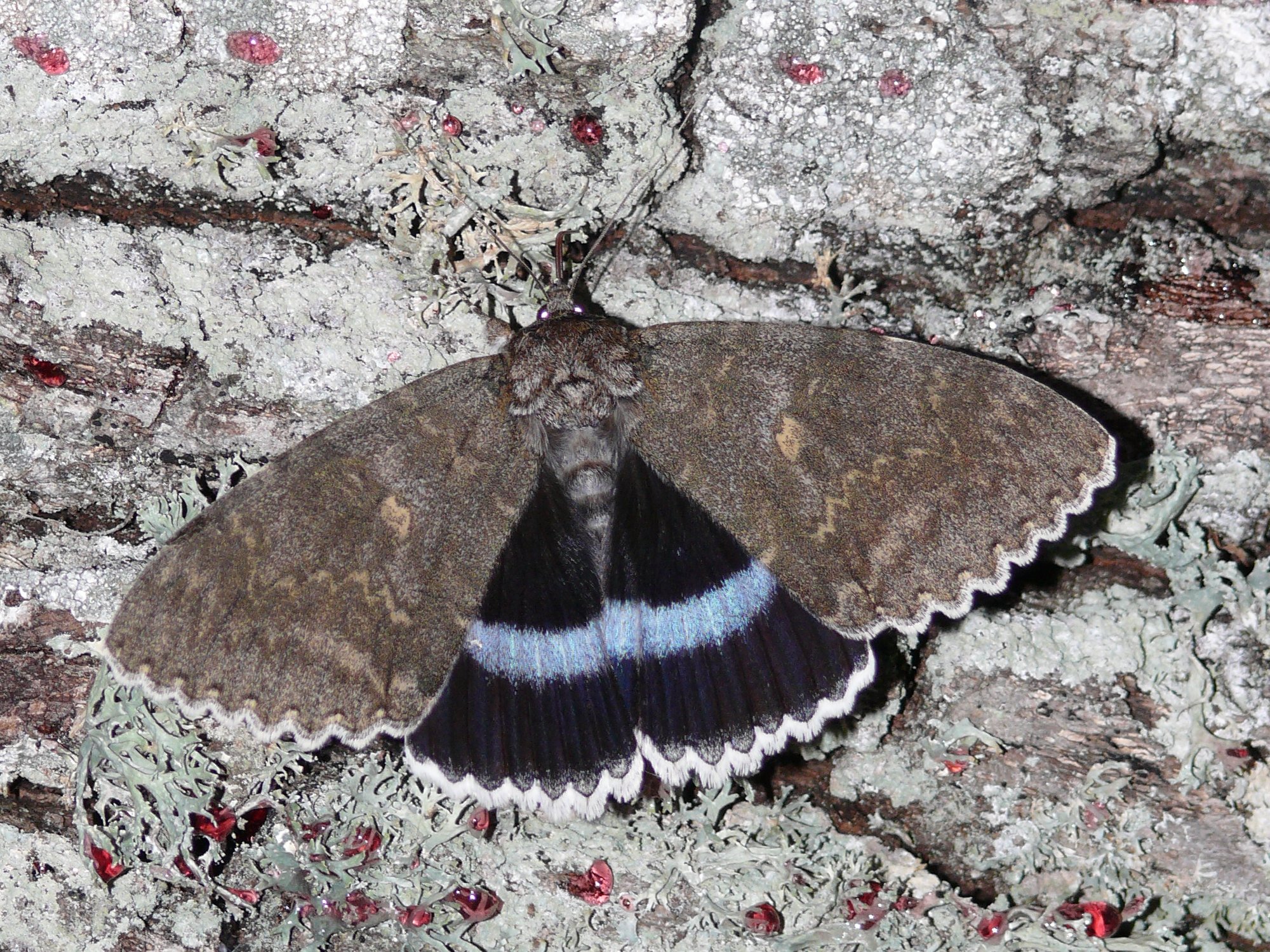
Blue underwing Catocala fraxini, copyright Harald Süpfle.


Belongs within: Erebidae.
Contains: Melipotini, Euclidiini, Ophiusini, Poaphilini.

The Erebinae are a clade of noctuoid moths identified by molecular data, members of which have a smooth apex on the proboscis with all the styloconic sensilla placed dorsally. Females have the seventh sternite reduced and divided into two lobes with with ostium bursae situated in the cleft between the lobes. Larvae are slender semi-loopers with a pair of dorsolateral tubercles on the eighth abdominal segment.

Erebinae [Catocalinae]
    |--+--Ugia Walker 1858 ZK11, Z21
    |  |    `--U. insuspecta ZK11
    |  `--Acantholipes Lederer 1857 ZK11, FL05 [Acantholipini]
    |       |--A. circumdata ZK11
    |       `--A. regularis ZK11
    `--+--Sypnini ZK11
       |    |--Sypnoides fumosa ZK11
       |    `--Sypna ZK11
       `--+--Thysania Dalman 1824 FL05 [Thysaniini ZK11]
          |    |--T. agrippina DS73
          |    `--T. zenobia DS73
          |--+--Pandesma [Pandesmini] ZK11
          |  |    |--P. costalis S01
          |  |    |--P. pagana Swinhoe 1901 S01
          |  |    |--P. robusta ZK11
          |  |    `--P. submurina MC13
          |  `--+--Heteropalpia acrosticta ZK11
          |     `--+--Pericyma Herrich-Schäffer 1851 FL05 [Pericymini ZK11]
          |        |    `--P. cruegeri ZK11
          |        `--+--Catephiini [Catephidae] ZK11
          |           |    |--Anophia acronyctoides WM66
          |           |    `--Catephia Ochsenheimer 1816 FL05
          |           |         `--C. alchymista ZK11
          |           `--Sphingomorpha chlorea ZK11
          `--+--+--+--+--Serrodes campana ZK11
             |  |  |  `--Melipotini ZK11
             |  |  `--+--Erebus Latreille 1910 FL05 [Erebini ZK11]
             |  |     |    |--E. ephesperis ZK11
             |  |     |    `--E. odora H01
             |  |     `--Erygia apicalis ZK11
             |  `--+--Sympis rufibasis ZK11
             |     `--+--Anisoneura salebrosa ZK11
             |        `--Hulodini [Hulodides] ZK11
             |             |--Ericeia subcinerea ZK11
             |             `--Hulodes Guenée 1852 FL05
             |                  `--H. caranea ZK11
             `--+--+--Hypopyrini [Hypopyridae] ZK11
                |  |    |--Hypopyra Guenée 1852 FL05
                |  |    |    `--H. capensis ZK11
                |  |    `--Spirama ZK11
                |  `--+--Ercheia Walker 1858 FL05 [Ercheini ZK11]
                |     |    `--E. cyllaria ZK11
                |     `--+--Pantydia ZK11
                |        |    |--P. capistrata MC13
                |        |    |--P. diemeni ZK11
                |        |    `--P. sparsa G84
                |        `--Euclidiini ZK11
                |--+--Catocalini [Catocalidi] ZK11
                |  |    |--Catocala Schrank 1802 FL05
                |  |    |    |--C. fraxini DS73
                |  |    |    |--C. koreana Staudinger 1892 I92
                |  |    |    |--C. nupta DS73
                |  |    |    |--C. promissa DS73
                |  |    |    `--C. sponsa (Linnaeus 1767) JP05
                |  |    `--Ulotrichopus Wallengren 1860 Z21
                |  |         |--U. macula ZK11
                |  |         `--U. variegata Hampson 1902 Z21
                |  `--Audeini ZK11
                |       |--Audea Walker 1858 Z21
                |       |    `--A. bipunctata ZK11
                |       `--Crypsotidia Rothschild 1901 Z21
                `--+--Ophiusini ZK11
                   `--Poaphilini LS13

Erebinae incertae sedis:
  Dasypodia selenophora NC91, MC13
  Diatenes MC13
    |--D. aglossoides MC13
    `--D. marmarinopa MC13
  Donuca memorabilis MC13
  Eudesmeola lawsoni MC13
  Prorocopis melanochorda MC13
  Lyncestis acontioides [=Melipotis acontioides] PP72
  Psorya hadesia PP72
  Leistera Swinhoe 1909 Z21
    `--*L. pulchristrigata (Bethune-Baker 1906) [=Catephia pulchristrigata] Z21
  Cosmophila Boisduval 1833 Z21
    `--C. flava (Fabr. 1775) P27
  Homodes Guenée 1852 Z21
  Hypocala Guenée 1852 [Hypocalini] Z21
  Tamba Hübner 1823 Z21
  Arytrura John 1912 [Arytrurini] FL05
  Brevipecten FL05
  Ascalapha Hübner 1809 FL05, Z21
  Hemeroblemma FL05
  Latebraria FL05
  Antiblemma FL05
  Athyrma FL05
  Omopterini Z21
    |--Zale Hübner 1818 FL05, Z21 [incl. Omoptera Guérin-Méneville 1832 FL05]
    `--Matigramma Grote 1872 Z21
  Amphigonia Guenée 1852 [Amphigoniidae] FL05
  Anydrophila John 1909 [Anydrophilini] FL05
  Ctenusa Hampson 1910 [Ctenusini] FL05
  Hypogramma Guenée 1852 [Hypogrammidae] FL05
  Ommatophora Guenée 1852 [Ommatophoridae] FL05
  Speiredonia Hübner 1823 [Speiredoniinae] FL05
    |--S. mutabilis ZS10
    `--S. zamis ZS10
  Tachosa Walker 1869 [Tachosini] FL05
  Tinolius Walker 1855 [Tinoliidae] FL05
  Yrias Guenée 1852 [Yriasidae] FL05
  Thermesia Hübner 1823 [Thermesidae] FL05

*Type species of generic name indicated

REFERENCES

[DS73] Dickens, M., & E. Storey. 1973. The World of Moths. Macmillan Publishing Co., Inc.: New York.

[FL05] Fibiger, M., & J. D. Lafontaine. 2005. A review of the higher classification of the Noctuoidea (Lepidoptera) with special reference to the Holarctic fauna. Esperiana 11: 7–92.

[G84] Gauld, I. D. 1984. An Introduction to the Ichneumonidae of Australia. British Museum (Natural History).

[H01] Hampson, G. F. 1901. The Lepidoptera-Phalaenae of the Bahamas. Annals and Magazine of Natural History, series 7, 7: 246–261.

[I92] Iwahashi, J. (ed.) 1992. Reddo Deeta Animaruzu: a pictorial of Japanese fauna facing extinction. JICC: Tokyo.

[JP05] Jungmann, E., & U. Poller. 2005. Neunachweise und Wiederfunde für die Schmetterlingsfauna (Insecta; Lepidoptera) des Altenburger Landes. Mauritiana 19 (2): 317–326.

[LS13] Lafontaine, J. D., & B. C. Schmidt. 2013. Comments on differences in classification of the superfamily Noctuoidea (Insecta, Lepidoptera) between Eurasia and North America. ZooKeys 264: 209–217.

[MC13] Majer, J. D., S. K. Callan, K. Edwards, N. R. Gunawardene & C. K. Taylor. 2013. Baseline survey of the terrestrial invertebrate fauna of Barrow Island. Records of the Western Australian Museum Supplement 83: 13–112.

[NC91] Nielsen, E. S., & I. F. B. Common. 1991. Lepidoptera (moths and butterflies). In: CSIRO. The Insects of Australia: A textbook for students and research workers 2nd ed. vol. 2 pp. 817–915. Melbourne University Press: Carlton (Victoria).

[PP72] Parkin, P., D. T. Parkin, A. W. Ewing & H. A. Ford. 1972. A report on the arthropods collected by the Edinburgh University Galapagos Islands expedition, 1968. Pan-Pacific Entomologist 48 (2): 100–107.

[P27] Philpott, A. 1927. New Zealand Lepidoptera: notes and descriptions. Transactions and Proceedings of the New Zealand Institute 57: 703–709.

[S01] Swinhoe, C. 1901. New genera and species of eastern and Australian moths (continued). Annals and Magazine of Natural History, series 7, 7: 489–501.

[WM66] Wallace, A. R., & F. Moore. 1866. List of lepidopterous insects collected at Takow, Formosa, by Mr. R. Swinhoe. Proceedings of the Zoological Society of London 1866: 355–365.

[ZK11] Zahiri, R., I. J. Kitching, J. D. Lafontaine, M. Mutanen, L. Kaila, J. D. Holloway & N. Wahlberg. 2011. A new molecular phylogeny offers hope for a stable family level classification of the Noctuoidea (Lepidoptera). Zoologica Scripta 40 (2): 158–173.

[ZS10] Zborowski, P., & R. Storey. 2010. A Field Guide to Insects in Australia 3rd ed. Reed New Holland: Sydney.

[Z21] Zilli, A. 2021. Tabwecala robinsoni gen. nov., sp. nov., from Vanuatu and its systematic postion in the 'Ophiusini-Poaphilini' clade (Lepidoptera, Erebidae). Nota Lepidopterologica 44: 193–211.

Ditrysia

Bucculatrix cristatella, copyright Ilia Ustyantsev.


Belongs within: Heteroneura.
Contains: Tineidae, Apoditrysia, Yponomeutoidea, Gracillariidae, Lyonetiidae, Psychinae.

The Ditrysia are a major clade of Lepidoptera accounting for some 98% of the species of the order. They are characterised by female genitalia with an internal connection between the copulatory opening and ovipore, as well as by large apodemes on the second abdominal sternite and short bands rather than long fibres in the proboscis muscles (Grimaldi & Engel 2005). Basal members of the clade, historically gathered into the superfamily Tineoidea (now recognised as non-monophyletic) are small to medium-sized species with narrow, typically grey fore wings that often retain the M vein in the discal cell. Most lack ocelli though prominent ocelli are retained in the Douglasiidae (Nielsen & Common 1991). The Simaethistiidae are a small, poorly known group of basal ditrysians found in eastern Asia and Australia

<==Ditrysia [Gracillarioidea, Papilionina, Tineina, Tineites, Tineoidea, Tortrices]
    |--Meessiinae [Meessiidae] KP19
    |    |--Meessia leopoldella YS10
    |    |--Demobrotis NC91
    |    `--Eudarcia simulatricella KP19
    `--+--+--+--Tineidae KP19
       |  |  `--Dryadaula [Dryadaulidae] KP19
       |  |       `--D. visaliella KP19
       |  `--+--Apoditrysia GE05
       |     `--+--+--Yponomeutoidea KP19
       |        |  `--Roeslerstammiidae [Amphitheridae, Amphitherinae] NC91
       |        |       |--Amphithera heteroleuca KP19, NC91
       |        |       |--Enchoptila idiopis P27
       |        |       |--Thereutis NC91
       |        |       |--Macarangela leucochrysa NC91, C91
       |        |       |--Nematobola NC91
       |        |       |--Chalcoteuches phlogera NC91
       |        |       `--Roeslerstammia NC91
       |        `--+--Gracillariidae KP19
       |           `--+--Bucculatricidae NC91
       |              |    |--Ogmograptis scribula NC91
       |              |    `--Bucculatrix KP19
       |              |         |--B. alaternella Constant 1890 C90
       |              |         |--B. cristatella KP19
       |              |         |--B. gossypii NC91
       |              |         |--B. helichrysella Constant 1890 C90
       |              |         `--B. platani RJ93
       |              `--+--Lyonetiidae KP19
       |                 |--Bedellia NC91 [Bedelliidae M03, Bedelliinae]
       |                 |    |--B. psamminella L27
       |                 |    `--B. somnulentella P27
       |                 `--Heliodinidae M03
       |                      |--Thylacosceles acridomima P27
       |                      |--Heliodines princeps NC91
       |                      |--Epicroesa ambrosia NC91
       |                      |--Baltonides roeselliformis RJ93
       |                      `--Vanicela P27
       |                           |--V. disjunctella P27
       |                           `--V. xenadelpha P27
       `--Psychidae B37
            |  i. s.: Liothula omnivora WFS04
            |         Solenobia triquetrella D51
            |         Iphierga macarista NC91
            |         Epichnopteryx plumella (Denis & Schiffermüller 1775) JP05
            |         Canephora JP05
            |           |--C. hirsuta Poda 1761 JP05
            |           `--C. unicolor RD77
            |         Paramictoides febretta YS10
            |         Pachythelia unicolor YS10
            |         Apterona YS10
            |         Plutorectis G84
            |         Paracharactis MC13
            |         Cryptothelea GE05
            |           |--C. cardiophaga IR05
            |           |--C. gloverii VC07
            |           `--C. junodi F92
            |         Luffia YS10
            |           |--L. ferchaultella BC91
            |           `--L. lapidella YS10
            |         Animula huebneri H01
            |         Cochliotheca RD77
            |           |--C. crenulella RD77
            |           `--C. helix RD77
            |         Acanthopsyche opacella [incl. A. atra] RD77
            |         Amicta RD77
            |         Sterrhopteryx pristinella Rebel 1934 P92
            |--Psychinae NC91
            |--Oiketicinae KP19
            |    |--Thyridopteryx ephemeraeformis KP19
            |    `--Oiketicus G84
            |         |--O. elongatus G84
            |         `--O. kirbyi L81
            `--Taleporiinae NC91
                 |--Ctenocompa C70
                 |--Narycia saxosa C70, P27
                 |--Trigonocyttara clandestina C70
                 |--Lepidoscia arctiella C70
                 |--Cebysa leucotelus C70, NC91
                 `--Taleporia JP05
                      |--T. cawthronella P27
                      `--T. tubulosa (Retzius 1783) JP05

Ditrysia incertae sedis:
  Azinis hilarella WM66
  Apoprogonidae NC91
  Cerostoma Latreille 1802 L02
    |--*C. dorsatum [=Ypsolophus dorsatus] L02
    `--C. persicella F92
  Simaethistiidae GE05
  Pseudarbelidae NC91
  Arrhenophanidae NC91
  Acrolophus D01 [Acrolophidae GE05]
    |--A. boucardi Druce 1901 D01
    |--A. linus Druce 1901 D01
    `--A. underwoodi Druce 1901 D01
  Eucryptogona [Eriocottidae] NC91
    `--E. trichobathra NC91
  Douglasiidae NC91
    |--Douglasia Stainton 1854 [=Douglassia (l. c.) non Bartsch 1934] P66
    |--Tinagma leucanthes NC91
    `--Klimeschia NC91
  Melusina [Compsoctenidae] RD77
    `--M. energa RD77
  Euplocamus guttella G20

*Type species of generic name indicated

REFERENCES

[BC91] Baker, G. T., & A. Chandrapatya. 1991. Fine structure of the chorion of the broak mite Polyphagotarsonemus latus (Prostigmata: Tarsonemidae). In: Dusbábek, F., & V. Bukva (eds) Modern Acarology: Proceedings of the VIII International Congress of Acarology, held in České Budĕjovice, Czechoslovakia, 6–11 August 1990 vol. 2 pp. 325–328. SPB Academic Publishing: The Hague.

[B37] Balduf, W. V. 1937. Bionomic notes on the common bagworm, Thyridopteryx ephemeraeformis Haw., (Lepid., Psychidae) and its insect enemies (Hym., Lepid.). Proceedings of the Entomological Society of Washington 39 (7): 169–184.

[C70] Common, I. F. B. 1970. Lepidoptera (moths and butterflies). In: CSIRO. The Insects of Australia: A textbook for students and research workers pp. 765–866. Melbourne University Press.

[C90] Constant, A. 1890. Description de dix espèces nouvelles de microlépidoptères de la faune française. Annales de la Société Entomologique de France, 6e série 9: cxxiv–cxxvi.

[C91] CSIRO. 1991. The Insects of Australia: A textbook for students and research workers 2nd ed. vol. 1. Melbourne University Press: Carlton (Victoria).

[D51] Dobzhansky, T. 1951. Genetics and the Origin of Species 3rd ed. Columbia University Press: New York.

[D01] Druce, H. 1901. Descriptions of some new species of Lepidoptera from east Africa and tropical America. Annals and Magazine of Natural History, series 7, 7: 432–444.

[F92] Fan Z. 1992. Key to the Common Flies of China 2nd ed. Science Press: Beijing.

[G84] Gauld, I. D. 1984. An Introduction to the Ichneumonidae of Australia. British Museum (Natural History).

[G20] Goldfuss, G. A. 1820. Handbuch der Naturgeschichte vol. 3. Handbuch der Zoologie pt 1. Johann Leonhard Schrag: Nürnberg.

[GE05] Grimaldi, D., & M. S. Engel. 2005. Evolution of the Insects. Cambridge University Press: New York.

[H01] Hampson, G. F. 1901. The Lepidoptera-Phalaenae of the Bahamas. Annals and Magazine of Natural History, series 7, 7: 246–261.

[IR05] Idris, A. B., & A. Rizki. 2005. Notes on the tribe Ephialtini (Hymenoptera: Ichneumonidae: Pimplinae) of Malaysia. Serangga 10 (1–2): 111–126.

[JP05] Jungmann, E., & U. Poller. 2005. Neunachweise und Wiederfunde für die Schmetterlingsfauna (Insecta; Lepidoptera) des Altenburger Landes. Mauritiana 19 (2): 317–326.

[KP19] Kawahara, A. Y., D. Plotkin, M. Espeland, K. Meusemann, E. F. A. Toussaint, A. Donath, F. Gimnich, P. B. Frandsen, A. Zwick, M. dos Reis, J. R. Barber, R. S. Peters, S. Liu, X. Zhou, C. Mayer, L. Podsiadlowski, C. Storer, J. E. Yack, B. Misof & J. W. Breinholt. 2019. Phylogenomics reveals the evolutionary timing and pattern of butterflies and moths. Proceedings of the National Academy of Sciences of the USA 116 (45): 22657–22663.

[L02] Latreille, P. A. 1802. Histoire Naturelle, générale et particulière des crustacés et des insectes vol. 3. Familles naturelles des genres. F. Dufart: Paris.

[L27] Lindsay, S. 1927. A list of the Lepidoptera of Deans Bush, Riccarton, Canterbury. Transactions and Proceedings of the New Zealand Institute 57: 693–696.

[L81] Long, J. L. 1981. Introduced Birds of the World: The worldwide history, distribution and influence of birds introduced to new environments. Reed: Sydney.

[MC13] Majer, J. D., S. K. Callan, K. Edwards, N. R. Gunawardene & C. K. Taylor. 2013. Baseline survey of the terrestrial invertebrate fauna of Barrow Island. Records of the Western Australian Museum Supplement 83: 13–112.

[M03] McQuillan, P. B. 2003. The giant Tasmanian ‘pandani’ moth Proditrix nielseni, sp. nov. (Lepidoptera: Yponomeutoidea: Plutellidae s. l.) Invertebrate Systematics 17: 59–66.

[NC91] Nielsen, E. S., & I. F. B. Common. 1991. Lepidoptera (moths and butterflies). In: CSIRO. The Insects of Australia: A textbook for students and research workers 2nd ed. vol. 2 pp. 817–915. Melbourne University Press: Carlton (Victoria).

[P27] Philpott, A. 1927. The maxillae in the Lepidoptera. Transactions and Proceedings of the New Zealand Institute 57: 721–746.

[P92] Poinar, G. O., Jr. 1992. Life in Amber. Stanford University Press: Stanford.

[P66] Powell, A. W. B. 1966. The molluscan families Speightiidae and Turridae: an evaluation of the valid taxa, both Recent and fossil, with lists of characteristic species. Bulletin of the Auckland Institute and Museum 5: 1–184, pls 1–23.

[RD77] Richards, O. W., & R. G. Davies. 1977. Imms' General Textbook of Entomology 10th ed. vol. 2. Classification and Biology. Chapman and Hall: London.

[RJ93] Ross, A. J., & E. A. Jarzembowski. 1993. Arthropoda (Hexapoda; Insecta). In: Benton, M. J. (ed.) The Fossil Record 2 pp. 363–426. Chapman & Hall: London.

[VC07] Villanueva, R. T., & C. C. Childers. 2007. Insect predators of eriophyids on Florida citrus including a new predacious Lepidoptera and two cecidomyiids. In: Morales-Malacara, J. B., V. M. Behan-Pelletier, E. Ueckermann, T. M. Pérez, E. G. Estrada-Venegas & M. Badii (eds) Acarology XI: Proceedings of the International Congress pp. 391–395. Instituto de Biología and Faculdad de Ciencias, Universidad Nacional Autónoma de México, Sociedad Latinoamericana de Acarología: México.

[WM66] Wallace, A. R., & F. Moore. 1866. List of lepidopterous insects collected at Takow, Formosa, by Mr. R. Swinhoe. Proceedings of the Zoological Society of London 1866: 355–365.

[WFS04] Winks, C. J., S. V. Fowler & L. A. Smith. 2004. Invertebrate fauna of boneseed, Chrysanthemoides monilifera ssp. monilifera (L.) T. Norl. (Asteraceae: Calenduleae), an invasive weed in New Zealand. New Zealand Entomologist 27: 61–72.

[YS10] Yefremova, Z. A., & I. S. Strakhova. 2010. A review of the species of the genus Elasmus Westwood (Hymenoptera, Eulophidae) from Russia and neighboring countries. Entomologicheskoe Obozrenie 89 (3): 634–661.

Last updated: 25 April 2022.

Oecophorinae

Barea consignatella, copyright Donald Hobern.


Belongs within: Gelechioidea.

The Oecophorinae are a group of moths in which Rs and M1 of the hind wing are nearly parallel, the abdominal terga are densely spinose, and the male usually has a beak-like gnathos (Nielsen & Common 1991).

<==Oecophorinae NC91
    |--Garrha carnea NC91
    |--Thema chlorochyta NC91
    |--Chrysonoma fascialis NC91
    |--Hippomacha callista NC91
    |--Aristeis hepialella NC91
    |--Heliocausta hemiteles NC91
    |--Hofmannophila pseudospretella NC91
    |--Endrosis sarcitrella NC91
    |--Oecophora Latreille 1802 L02
    |    |--*O. sulphurella [=Tinea sulphurella] L02
    |    `--O. linneella G20
    |--Philobota NC91
    |    |--P. disjunctella P27
    |    |--P. productella NC91
    |    `--P. xiphostola P27
    |--Wingia NC91
    |    |--W. aurata ZS10
    |    |--W. lambertella P27
    |    `--W. rectiorella NC91
    `--Barea NC91
         |--B. ambigua L27
         |--B. confusella L27
         |--B. consignatella NC91
         `--B. leucocephala P27

*Type species of generic name indicated

REFERENCES

[G20] Goldfuss, G. A. 1820. Handbuch der Naturgeschichte vol. 3. Handbuch der Zoologie pt 1. Johann Leonhard Schrag: Nürnberg.

[L02] Latreille, P. A. 1802. Histoire Naturelle, générale et particulière des crustacés et des insectes vol. 3. Familles naturelles des genres. F. Dufart: Paris.

[L27] Lindsay, S. 1927. A list of the Lepidoptera of Deans Bush, Riccarton, Canterbury. Transactions and Proceedings of the New Zealand Institute 57: 693–696.

[NC91] Nielsen, E. S., & I. F. B. Common. 1991. Lepidoptera (moths and butterflies). In: CSIRO. The Insects of Australia: A textbook for students and research workers 2nd ed. vol. 2 pp. 817–915. Melbourne University Press: Carlton (Victoria).

[P27] Philpott, A. 1927. The maxillae in the Lepidoptera. Transactions and Proceedings of the New Zealand Institute 57: 721–746.

[ZS10] Zborowski, P., & R. Storey. 2010. A Field Guide to Insects in Australia 3rd ed. Reed New Holland: Sydney.

Stathmopodinae

Stathmopoda melanochra, copyright Donald Hobern.


Belongs within: Gelechioidea.

The Stathmopodinae are a group of usually very small moths that commonly rest with the hind wings raised (Nielsen & Common 1991).

Characters (from Nielsen & Common 1991): Usually very small; head smooth-scaled; wings very narrow; fore wing lacking pterostigma, R2 well before upper angle of discal cell, female with subcubital retinaculum only; hind tibiae and tarsi usually bearing whorls of stiff bristles.

<==Stathmopodinae [Stathmopodidae, Tinaegeriidae] NC91
    |--Snellenia lineata NC91
    |--Pseudaegeria phlogina NC91
    |--Coracistis erythrocosma NC91
    |--Hieromantis NC91
    |--Calicotis NC91
    |--Vanacela C70
    `--Stathmopoda NC91
         |--S. arachnophthora NC91
         |--S. callichrysa NC91
         |--S. cephalaea NC91
         |--S. chalcotypa NC91
         |--S. coracodes P27
         |--S. crocophanes NC91
         |--S. melanochra NC91
         |--S. phlegyra L27
         `--S. skelloni L27

*Type species of generic name indicated

REFERENCES

[C70] Common, I. F. B. 1970. Lepidoptera (moths and butterflies). In: CSIRO. The Insects of Australia: A textbook for students and research workers pp. 765–866. Melbourne University Press.

[L27] Lindsay, S. 1927. A list of the Lepidoptera of Deans Bush, Riccarton, Canterbury. Transactions and Proceedings of the New Zealand Institute 57: 693–696.

[NC91] Nielsen, E. S., & I. F. B. Common. 1991. Lepidoptera (moths and butterflies). In: CSIRO. The Insects of Australia: A textbook for students and research workers 2nd ed. vol. 2 pp. 817–915. Melbourne University Press: Carlton (Victoria).

[P27] Philpott, A. 1927. The maxillae in the Lepidoptera. Transactions and Proceedings of the New Zealand Institute 57: 721–746.

Xyloryctinae

Cryptophasa rubescens, copyright Donald Hobern.


Belongs within: Gelechioidea.

The Xyloryctinae are a group of small to medium-sized moths in which the hind wings have veins Rs and M1 stalked or arising from the same point and divergent, and Sc+R1 diverging from Rs well before the end of the cell. The gnathos in the male is not spinose (Nielsen & Common 1991).

<==Xyloryctinae [Xyloryctidae] NC91
    |--Telecrates laetiorella NC91
    |--Odites pudica P27
    |--Chalarotona intabescens NC91
    |--Eschatura lemurias P27
    |--Uzucha humeralis NC91
    |--Catoryctis eugramma NC91, P27
    |--Neodrepta luteotactella G84
    |--Oegocniites borisjaki RJ93
    |--Lichenaula NC91
    |    |--L. choriodes NC91
    |    `--L. lichenea NC91
    |--Scieropepla NC91
    |    |--S. reversella P27
    |    `--S. typhicola NC91
    |--Maroga NC91
    |    |--M. melanostigma NC91
    |    `--M. unipunctana P27
    |--Xylorycta NC91
    |    |--X. luteotactella NC91
    |    |--X. melaleuca P27
    |    `--X. strigata NC91
    `--Cryptophasa NC91
         |--C. ecclesiastis Meyrick 1887 M87
         |--C. irrorata M87
         |--C. leucadelpha Meyrick 1887 M87
         |--C. melanostigma C70
         |--C. nubila P27
         `--C. rubescens NC91

*Type species of generic name indicated

REFERENCES

[C70] Common, I. F. B. 1970. Lepidoptera (moths and butterflies). In: CSIRO. The Insects of Australia: A textbook for students and research workers pp. 765–866. Melbourne University Press.

[M87] Meyrick, E. 1887. Descriptions of new Lepidoptera. Proceedings of the Linnean Society of New South Wales, series 2, 1 (4): 1037–1048.

[NC91] Nielsen, E. S., & I. F. B. Common. 1991. Lepidoptera (moths and butterflies). In: CSIRO. The Insects of Australia: A textbook for students and research workers 2nd ed. vol. 2 pp. 817–915. Melbourne University Press: Carlton (Victoria).

[P27] Philpott, A. 1927. The maxillae in the Lepidoptera. Transactions and Proceedings of the New Zealand Institute 57: 721–746.

[RJ93] Ross, A. J., & E. A. Jarzembowski. 1993. Arthropoda (Hexapoda; Insecta). In: Benton, M. J. (ed.) The Fossil Record 2 pp. 363–426. Chapman & Hall: London.

Gracillariidae

Cocoa pod borer Acrocercops cramerella, from the Papua Insects Foundation.


Belongs within: Ditrysia.

The Gracillariidae are very small moths with long antennae and long fringes on the hind wings (Nielsen & Common 1991).

Characters (from Nielsen & Common 1991): Very small, slender; head usually smooth scaled; ocelli and chaetosemata absent; antennae nearly as long as, or longer than, fore wing, filiform, scape slender, usually without pecten, sometimes with small eye-cap; proboscis present, unsealed; maxillary palps slender, porrect or ascending, four-segmented, or reduced; labial palps slender, porrect or ascending; epiphysis present, spurs 0-2-4, hind tibiae smooth or with dorsal row of stiff bristles, never hairy, fore and mid tibiae sometimes thickened with scales; fore wing lanceolate or linear-lanceolate with long fringing piliform scales, R5 to costa or apex, some veins often lost, 1A+2A without basal fork; hind wing lanceolate or linear, venation often reduced; male abdomen often with coremata on segments 7 and 8. Larva leaf- or gall-mining, at least in early stages, with heteromorphosis; early instars flattened, with large blade-like mandibles, sap-feeding, thoracic legs and prolegs absent; after second or third ecdysis larvae often feed on parenchyma, body cylindrical, thoracic legs present, prolegs on abdominal segments 3–5, crochets usually in lateral penellipse. Pupa with antennae and proboscis often extending beyond wing tips; abdomen with fine scattered dorsal spines, segments 5–7 movable in male, 5–6 in female; usually in flattened cocoon.

<==Gracillariidae [Lithocolletidae]
    |  i. s.: Parectopa formosa P27
    |         Epicephala P27
    |           |--E. chalybacma VHK02
    |           `--E. frugicola B88
    |         Geometridites larentiiformis RJ93
    |         Ornativalva plutelliformis SKR96
    |         Gracillariites P92
    |--Gracillariinae NC91
    |    |--Macarostola formosa NC91
    |    |--Caloptilia KP19
    |    |    |--C. alchimiella [=Gracilaria alchimiella] V09
    |    |    |--C. azaleella NC91
    |    |    |--C. elaeas M83
    |    |    `--C. triadicae KP19
    |    `--Gracilaria GE05
    |         |--G. chrysitis L27
    |         |--G. elaeas L27
    |         |--G. linearis P27
    |         |--G. ononidis R13
    |         |--G. selenitis P27
    |         `--G. xylophanes P27
    `--+--+--Philodoria [Ornixolinae] KP19
       |  `--Lithocolletinae KP19
       |       |--Cameraria ohridella KP19
       |       |--Lithocolletis B88
       |       |    |--L. aglaozona C70
       |       |    |--L. hamadryadella G17c
       |       |    `--L. populifolia [=Gracilaria populifolia] H04
       |       `--Phyllonorycter NC91
       |            |--P. aglaozona NC91
       |            |--P. blancardella MC02
       |            |--P. crataegella G17b
       |            |--P. hamadryadella RD77
       |            `--P. messaniella NC91
       `--+--Phyllocnistis [Phyllocnistidae, Phyllocnistinae] KP19
          |    |--P. citrella NC91
          |    |--P. diaugella NC91
          |    `--P. suffusella B88
          `--Acrocercops KP19
               |--A. antimima NC91
               |--A. calicella NC91
               |--A. chionosoma B88
               |--A. cramerella G17a
               |--A. diffluella B88
               |--A. ordinatella P27
               |--A. plebeia NC91
               |--A. transecta KP19
               `--A. tricuneatella NC91

*Type species of generic name indicated

REFERENCES

[B88] Bouček, Z. 1988. Australasian Chalcidoidea (Hymenoptera): A biosystematic revision of genera of fourteen families, with a reclassification of species. CAB International: Wallingford (UK).

[C70] Common, I. F. B. 1970. Lepidoptera (moths and butterflies). In: CSIRO. The Insects of Australia: A textbook for students and research workers pp. 765–866. Melbourne University Press.

[G17a] Girault, A. A. 1917a. New Javanese Hymenoptera. Privately published (reprinted Gordh, G., A. S. Menke, E. C. Dahms & J. C. Hall. 1979. The privately printed papers of A. A. Girault. Memoirs of the American Entomological Institute 28: 59–71).

[G17b] Girault, A. A. 1917b. New chalcid flies. Privately published (reprinted Gordh, G., A. S. Menke, E. C. Dahms & J. C. Hall. 1979. The privately printed papers of A. A. Girault. Memoirs of the American Entomological Institute 28: 72–77).

[G17c] Girault, A. A. 1917c. Descriptiones hymenopterorum chalcidoidicarum variorum cum observationibus. V. Privately published (reprinted Gordh, G., A. S. Menke, E. C. Dahms & J. C. Hall. 1979. The privately printed papers of A. A. Girault. Memoirs of the American Entomological Institute 28: 116–131).

[GE05] Grimaldi, D., & M. S. Engel. 2005. Evolution of the Insects. Cambridge University Press: New York.

[H04] Haeckel, E. 1899–1904. Kunstformen der Natur. Bibliographisches Institut: Leipzig und Wien.

[KP19] Kawahara, A. Y., D. Plotkin, M. Espeland, K. Meusemann, E. F. A. Toussaint, A. Donath, F. Gimnich, P. B. Frandsen, A. Zwick, M. dos Reis, J. R. Barber, R. S. Peters, S. Liu, X. Zhou, C. Mayer, L. Podsiadlowski, C. Storer, J. E. Yack, B. Misof & J. W. Breinholt. 2019. Phylogenomics reveals the evolutionary timing and pattern of butterflies and moths. Proceedings of the National Academy of Sciences of the USA 116 (45): 22657–22663.

[L27] Lindsay, S. 1927. A list of the Lepidoptera of Deans Bush, Riccarton, Canterbury. Transactions and Proceedings of the New Zealand Institute 57: 693–696.

[M83] Martin, N. A. 1983. Miscellaneous observations on a pasture fauna: An annotated species list. DSIR Entomology Division Report 3: 1–98.

[MC02] Miliczky, E. R., & C. O. Calkins. 2002. Spiders (Araneae) as potential predators of leafroller larvae and egg masses (Lepidoptera: Tortricidae) in central Washington apple and pear orchards. Pan-Pacific Entomologist 78 (2): 140–150.

[NC91] Nielsen, E. S., & I. F. B. Common. 1991. Lepidoptera (moths and butterflies). In: CSIRO. The Insects of Australia: A textbook for students and research workers 2nd ed. vol. 2 pp. 817–915. Melbourne University Press: Carlton (Victoria).

[P27] Philpott, A. 1927. The maxillae in the Lepidoptera. Transactions and Proceedings of the New Zealand Institute 57: 721–746.

[P92] Poinar, G. O., Jr. 1992. Life in Amber. Stanford University Press: Stanford.

[R13] Reuter, O. M. 1913. Lebensgewohnheiten und Instinkte der Insekten bis zum Erwachen der sozialen Instinkte. R. Friedländer & Sohn: Berlin.

[RD77] Richards, O. W., & R. G. Davies. 1977. Imms' General Textbook of Entomology 10th ed. vol. 2. Classification and Biology. Chapman and Hall: London.

[RJ93] Ross, A. J., & E. A. Jarzembowski. 1993. Arthropoda (Hexapoda; Insecta). In: Benton, M. J. (ed.) The Fossil Record 2 pp. 363–426. Chapman & Hall: London.

[SKR96] Sobhian, R., L. Knutson & J. S. Rodier. 1996. Biology and host specificity notes on Styphlus penicillus Gyllenhal (Coleoptera: Curculionidae), examined as a biological control agent for Crupina vulgaris in the United States with remarks on its host plant. Proceedings of the Entomological Society of Washington 98 (2): 317–323.

[V09] Verdcourt, B. (ed.) 2009. Additions to the Wild Fauna and Flora of the Royal Botanic Gardens, Kew. XXVI. Miscellaneous records. Kew Bulletin 64 (1): 183–194.

[VHK02] Verma, M., M. Hayat & S. I. Kazmi. 2002. The species of Elasmus from India (Hymenoptera: Chalcidoidea: Eulophidae). Oriental Insects 36: 245–306.

Eucosmini

Macadamia nut-borer Cryptophlebia ombrodelta, copyright Victor Fazio.


Belongs within: Tortricidae.

The Eucosmini are a group of tortricid moths characterised by male genitalia with a one‐branched protuberance on the valve, and reduced gnathos and uncus.

<==Eucosmini NC91
    |--Bathrotoma constrictana NC91
    |--Crocidosema plebejana NC91
    |--Epinotia NC91
    |    |--E. aporema J-PWM04
    |    `--E. lantana NC91
    |--Eucosma KN03
    |    |--E. coniogramma Clarke 1976 [incl. E. okubiensis Kawabe 1987] KN03
    |    |--E. critica VHK02
    |    |--E. querula L27
    |    |--E. sordidana F92
    |    `--E. triangulana C70
    `--Cryptophlebia NC91
         |--C. amamiana Komai & Nasu 2003 KN03
         |--C. horii Kawabe 1987 KN03
         |--C. lasiandra KN03
         |--C. leucotreta B88
         |--C. ombrodelta KN03
         |--C. palustris Komai & Nasu 2003 KN03
         `--C. rhizophorae Vári 1981 KN03

*Type species of generic name indicated

REFERENCES

[B88] Bouček, Z. 1988. Australasian Chalcidoidea (Hymenoptera): A biosystematic revision of genera of fourteen families, with a reclassification of species. CAB International: Wallingford (UK).

[C70] Common, I. F. B. 1970. Lepidoptera (moths and butterflies). In: CSIRO. The Insects of Australia: A textbook for students and research workers pp. 765–866. Melbourne University Press.

[F92] Fan Z. 1992. Key to the Common Flies of China 2nd ed. Science Press: Beijing.

[J-PWM04] Jiménez-Pérez, A., Q. Wang & N. Markwick. 2004. Intrinsic rate of increase in ‘Cnephasia’ jactatana Walker (Lepidoptera: Tortricidae), a pest of kiwifruit. New Zealand Entomologist 27: 109–112.

[KN03] Komai, F., & Y. Nasu. 2003. Four species of Olethreutinae (Lepidoptera: Tortricidae) associated with viviparous seedlings of the mangrove Rhizophoraceae in the Ryukyu Islands, Japan. Invertebrate Systematics 17: 75–87.

[L27] Lindsay, S. 1927. A list of the Lepidoptera of Deans Bush, Riccarton, Canterbury. Transactions and Proceedings of the New Zealand Institute 57: 693–696.

[NC91] Nielsen, E. S., & I. F. B. Common. 1991. Lepidoptera (moths and butterflies). In: CSIRO. The Insects of Australia: A textbook for students and research workers 2nd ed. vol. 2 pp. 817–915. Melbourne University Press: Carlton (Victoria).

[VHK02] Verma, M., M. Hayat & S. I. Kazmi. 2002. The species of Elasmus from India (Hymenoptera: Chalcidoidea: Eulophidae). Oriental Insects 36: 245–306.

Archipini

Tea tortrix Homona coffearia, copyright Challiyil Eswaramangalath Pavithran Vipin.

Belongs within: Tortricidae.

The Archipini are a group of tortricid moths whose larvae feed between joined, living leaves (Nielsen & Common 1991). Many species have wings marked with a distinct basal and median fascia and a dark costal spot.

<==Archipini NC91
    |--Epiphyas postvittana NC91
    |--Archips G05
    |    |--A. argyrospila G05
    |    `--A. eucrora F92
    |--Cryptoptila australana NC91, C70
    |--Arotrophora NC91
    |    |--A. arcuatalis NC91 [=Scopula arcuatalis M86; incl. Crambus submarginellus M86, Eromene transcissella M86]
    |    `--A. siniocosma C70
    |--Merophyas NC91
    |    |--M. divulsana NC91
    |    `--M. leucariana M83
    `--Homona NC91
         |--H. coffearia VHK02
         |--H. similans P27
         `--H. spargotis NC91

*Type species of generic name indicated

REFERENCES

[C70] Common, I. F. B. 1970. Lepidoptera (moths and butterflies). In: CSIRO. The Insects of Australia: A textbook for students and research workers pp. 765–866. Melbourne University Press.

[F92] Fan Z. 1992. Key to the Common Flies of China 2nd ed. Science Press: Beijing.

[G05] Grissell, E. E. 2005. A review of North American species of Microdontomerus Crawford (Torymidae: Hymenoptera). Journal of Hymenoptera Research 14 (1): 22–65.

[M83] Martin, N. A. 1983. Miscellaneous observations on a pasture fauna: an annotated species list. DSIR Entomology Division Report 3: 1–98.

[M86] Meyrick, E. 1886. Notes on synonymy of Australian micro-Lepidoptera. Proceedings of the Linnean Society of New South Wales, series 2, 1 (3): 803–806.

[NC91] Nielsen, E. S., & I. F. B. Common. 1991. Lepidoptera (moths and butterflies). In: CSIRO. The Insects of Australia: A textbook for students and research workers 2nd ed. vol. 2 pp. 817–915. Melbourne University Press: Carlton (Victoria).

[P27] Philpott, A. 1927. The maxillae in the Lepidoptera. Transactions and Proceedings of the New Zealand Institute 57: 721–746.

[VHK02] Verma, M., M. Hayat & S. I. Kazmi. 2002. The species of Elasmus from India (Hymenoptera: Chalcidoidea: Eulophidae). Oriental Insects 36: 245–306.

Pterophoridae

Triangle plume Platyptilia gonodactyla, copyright Ilia Ustyantsev.


Belongs within: Obtectomera.

The Pterophoridae, plume moths, are a group of small moths in which the hind wings are usually deeply cleft into three plumes.

Characters (from Nielsen & Common 1991): Small; head usually smooth-scaled; ocelli and chaetosemata absent; antennae filiform; proboscis unsealed; maxillary palps minute, one-segmented; labial palps slender or stout, porrect or upturned; legs long, slender; epiphysis present; spurs 0-2-4, prominent; hind tibiae sometimes with specialised scaling; fore wing divided by terminal clefts into two or three plumes, rarely four plumes, or entire; with complex wing-folding mechanism, pterostigma sometimes present, wing-locking microtrichia absent, chorda and M absent in cell, one branch of R often absent, M1 and M2 weak or absent, CuP usually present, 1A+2A without fork; hind wing deeply cleft into three plumes, rarely entire, underside with double series of specialised scales along M3 and CuA2 or CuA1, CuP absent, female frenulum of one or two bristles; abdomen long and slender, tympanal organs absent. Eggs of flat type, oval, smooth. Larva usually with numerous secondary, often modified setae, sometimes on verrucae, prothorax with 3 L setae, ventral prolegs long, crochets uniordinal in mesoseries or mesal penellipse; larvae usually leaf-mining at first, later exposed, eroding surface of leaves or burrowing in flower buds or in stems. Pupa slender, smooth or spined, often with numerous setae on head, thorax and abdomen, pilifers present; fully exposed, attached by hooked setae on underside of abdominal segments 9 and 10.

<==Pterophoridae
    |  i. s.: Exelastis atomosa B88
    |         Buckleria paludum RD77
    |--Agdistinae NC91
    |    |--Ochyrotica kurandica NC91
    |    |--Agdistopis halieutica NC91
    |    `--Agdistis staticis RD77
    |--Pterophorinae KP19
    |    |--Lantanophaga pusillidactyla KP19
    |    `--+--Emmelina monodactyla KP19
    |       `--Pterophorus KP19
    |            |--P. aptalis NC91
    |            |--P. didactylus L02
    |            |--P. oligocenicus Bigot et al. 1986 RJ93
    |            |--P. pentadactyla KP19 [=Aciptilia pentadactyla H04]
    |            `--P. rhododactylus [=Cnaemidophorus rhododactylus] H04
    `--Platyptilinae NC91
         |--Cosmoclostis aglaodesma NC91, ZS10
         |--Stangeia xerodes NC91
         |--Stenoptilia NC91
         |    |--S. lithoxesta P27
         |    `--S. zophodactyla NC91
         |--Sphenarches C70
         |    |--S. anisodactylus NC91
         |    `--S. caffer P27
         |--Trichoptilus C70
         |    |--T. adelphodes P27
         |    `--T. wahlbergi C70
         `--Platyptilia NC91
              |--P. acanthodactyla M38
              |--P. aeolodes L27
              |--P. falcatalis P27
              |--P. gonodactyla P01
              `--P. omissalis NC91

*Type species of generic name indicated

REFERENCES

[B88] Bouček, Z. 1988. Australasian Chalcidoidea (Hymenoptera): A biosystematic revision of genera of fourteen families, with a reclassification of species. CAB International: Wallingford (UK).

[C70] Common, I. F. B. 1970. Lepidoptera (moths and butterflies). In: CSIRO. The Insects of Australia: A textbook for students and research workers pp. 765–866. Melbourne University Press.

[H04] Haeckel, E. 1899–1904. Kunstformen der Natur. Bibliographisches Institut: Leipzig und Wien.

[KP19] Kawahara, A. Y., D. Plotkin, M. Espeland, K. Meusemann, E. F. A. Toussaint, A. Donath, F. Gimnich, P. B. Frandsen, A. Zwick, M. dos Reis, J. R. Barber, R. S. Peters, S. Liu, X. Zhou, C. Mayer, L. Podsiadlowski, C. Storer, J. E. Yack, B. Misof & J. W. Breinholt. 2019. Phylogenomics reveals the evolutionary timing and pattern of butterflies and moths. Proceedings of the National Academy of Sciences of the USA 116 (45): 22657–22663.

[L02] Latreille, P. A. 1802. Histoire Naturelle, générale et particulière des crustacés et des insectes vol. 3. Familles naturelles des genres. F. Dufart: Paris.

[L27] Lindsay, S. 1927. A list of the Lepidoptera of Deans Bush, Riccarton, Canterbury. Transactions and Proceedings of the New Zealand Institute 57: 693–696.

[M38] Muesebeck, C. F. W. 1938. Three new reared species of Apanteles from California (Hymenoptera: Braconidae). Proceedings of the Entomological Society of Washington 40 (7): 201–204.

[NC91] Nielsen, E. S., & I. F. B. Common. 1991. Lepidoptera (moths and butterflies). In: CSIRO. The Insects of Australia: A textbook for students and research workers 2nd ed. vol. 2 pp. 817–915. Melbourne University Press: Carlton (Victoria).

[P01] Pável, J. 1901. Lepkék [Lepidopteren]. In: Horváth, G. (ed.) Zichy Jenő Gróf Harmadik Ázsiai Utazása [Dritte Asiatische Forschungsreise des Grafen Eugen Zichy] vol. 2. Zichy Jenő Gróf Harmadik Ázsiai Utazásának Állattani Eredményei [Zoologische Ergebnisse der Dritten Asiatischen Forschungsreise des Grafen Eugen Zichy] pp. 171–177. Victor Hornyánszky: Budapest, and Karl W. Hierseman: Leipzig.

[P27] Philpott, A. 1927. The maxillae in the Lepidoptera. Transactions and Proceedings of the New Zealand Institute 57: 721–746.

[RD77] Richards, O. W., & R. G. Davies. 1977. Imms' General Textbook of Entomology 10th ed. vol. 2. Classification and Biology. Chapman and Hall: London.

[RJ93] Ross, A. J., & E. A. Jarzembowski. 1993. Arthropoda (Hexapoda; Insecta). In: Benton, M. J. (ed.) The Fossil Record 2 pp. 363–426. Chapman & Hall: London.

[ZS10] Zborowski, P., & R. Storey. 2010. A Field Guide to Insects in Australia 3rd ed. Reed New Holland: Sydney.

Alucitoidea

Alucita xanthodes, copyright Alison Pearson.


Belongs within: Obtectomera.

The Alucitoidea are a group of moths in which the hind wing is deeply divided into six or seven plumes.

Characters (from Nielsen & Common 1991): Small, head smooth scaled, ocelli present or absent; chaetosemata absent; scape without pecten; proboscis unsealed; epiphysis present; spurs 0-2-4 or 0-0-2; wings often divided into plumes, CuP absent in fore wing; tympanal organs absent; S2 with V-shaped sclerotisation, T3–6 and sometimes T2–7 with anterior, transverse, sclerotised band set with spines. Larva densely spinulose, without secondary setae, L group on prothorax bisetose on one pinaculum, ventral prolegs with uniordinal crochets. Pupa without dorsal abdominal spines, in cocoon, not protruded at ecdysis.

<==Alucitoidea NC91
    |--Tineodidae [Oxychirotidae] NC91
    |    |--Tineodes adactylalis NC91
    |    |--Tanycnema anomala NC91
    |    |--Cenoloba obliteralis NC91
    |    |--Oxychirota paradoxa NC91
    |    |--Palaeodes samealis NC91
    |    `--Euthrausta NC91
    |         |--E. holophaea C70
    |         `--E. oxyprora NC91
    `--Alucita [Alucitidae] GE05
         |--A. cereella Bosc 1800 B00
         |--A. desmodactyla KP19
         |--A. monospilalis P27
         |--A. phricodes NC91
         |--A. pygmaea NC91
         |--A. vittata G20
         |--A. vitella L02
         |--A. xanthodes C70
         `--A. xylostella L02

*Type species of generic name indicated

REFERENCES

[B00] Bosc, C. 1800. Description de trois espèces de lepidoptères de la Caroline. Bulletin des Sciences, par la Societé Philomathique de Paris 2 (39): 114–115.

[C70] Common, I. F. B. 1970. Lepidoptera (moths and butterflies). In: CSIRO. The Insects of Australia: A textbook for students and research workers pp. 765–866. Melbourne University Press.

[G20] Goldfuss, G. A. 1820. Handbuch der Naturgeschichte vol. 3. Handbuch der Zoologie pt 1. Johann Leonhard Schrag: Nürnberg.

[GE05] Grimaldi, D., & M. S. Engel. 2005. Evolution of the Insects. Cambridge University Press: New York.

[KP19] Kawahara, A. Y., D. Plotkin, M. Espeland, K. Meusemann, E. F. A. Toussaint, A. Donath, F. Gimnich, P. B. Frandsen, A. Zwick, M. dos Reis, J. R. Barber, R. S. Peters, S. Liu, X. Zhou, C. Mayer, L. Podsiadlowski, C. Storer, J. E. Yack, B. Misof & J. W. Breinholt. 2019. Phylogenomics reveals the evolutionary timing and pattern of butterflies and moths. Proceedings of the National Academy of Sciences of the USA 116 (45): 22657–22663.

[L02] Latreille, P. A. 1802. Histoire Naturelle, générale et particulière des crustacés et des insectes vol. 3. Familles naturelles des genres. F. Dufart: Paris.

[NC91] Nielsen, E. S., & I. F. B. Common. 1991. Lepidoptera (moths and butterflies). In: CSIRO. The Insects of Australia: A textbook for students and research workers 2nd ed. vol. 2 pp. 817–915. Melbourne University Press: Carlton (Victoria).

[P27] Philpott, A. 1927. The maxillae in the Lepidoptera. Transactions and Proceedings of the New Zealand Institute 57: 721–746.

Obtectomera

Twenty-plume moth Orneodes hexadactyla, copyright Entomart.


Belongs within: Apoditrysia.
Contains: Copromorphoidea, Pyraloidea, Macroheterocera, Gelechioidea, Thyrididae, Alucitoidea, Pterophoridae, Papilionidae, Hesperiidae, Pieridae, Nymphalidae, Riodinidae, Lycaenidae.

The Obtectomera are a clade of Lepidoptera united in its circumscription below by molecular phylogenetic analysis (Kawahara et al. 2019). Historically, the clade has been characterised by pupae with abdominal segments 1–4 immobile and without a dorsal row of spines on the tergites (Grimaldi & Engel 2005); however, Obtectomera in this sense may not be monophyletic. Representatives of the Obtectomera include the Calliduloidea, a small group of diurnal moths with simple antennae and wings held back to back at rest, resembling small butterflies (Common 1970). Members of the superfamilies Alucitoidea and Pterophoroidea, plume moths, often have the fore and hind wings deeply cleft into multiple plumes. Pterophoroidea usually possess vein CuP in the fore wing whereas this vein is absent in Alucitoidea (Nielsen & Common 1991). The Papilionoidea, butterflies and skippers, are diurnal Lepidoptera with a pouch on abdominal tergite 1 that lay eggs upright and have a girdle around the pupa (Grimaldi & Engel 2005).

Obtectomera [Bombycina, Bombycites, Macrolepidoptera, Pyralidina] KP19
    |  i. s.: Hyblaea IR05 [Hyblaeidae, Hyblaeoidea NC91]
    |           |--H. ibidias NC91
    |           `--H. pleura IR05
    |         Copromorphoidea GE05
    |         Whalleyaniidae GE05
    |         Cypra delicatula [incl. Cozistra membranacea] M86
    |         Artaxa M86
    |           |--A. lutea M86
    |           `--A. paraneura Meyrick 1886 M86
    |--+--+--Pyraloidea KP19
    |  |  `--+--Macroheterocera KP19
    |  |     `--Mimallonidae [Lacosomidae, Mimallonoidea] KP19
    |  |          |--Bedosia strigifera (Felder & Felder 1874) [=Perophora strigifera] NSp07
    |  |          |--Lacosoma chiridota KP19
    |  |          |--Menevia lantona KP19
    |  |          `--Cicinnus NSp07
    |  |               |--C. despecta (Walker 1855) [incl. Perophora sanguinolenta Felder & Felder 1874] NSp07
    |  |               `--C. melsheimeri P27
    |  `--+--Gelechioidea KP19
    |     `--+--+--Thyrididae KP19
    |        |  `--Calliduloidea KP19
    |        |       |--Pterothysanus [Pterothysanidae] RD77
    |        |       `--Callidulidae KP19
    |        |            |--Cleis scotti C70
    |        |            `--Pterodecta [Callidulinae] KP19
    |        |                 `--P. felderi KP19
    |        `--+--Alucitoidea KP19
    |           `--Pterophoroidea [Pterophorii] GE05
    |                |--Pterophoridae GE05
    |                `--Orneodes Latreille 1802 L02 [Orneodidae P27]
    |                     |--*O. hexadactyla L02, RD77 [=Pterophorus hexadactylus L02, Alucita hexadactyla H04]
    |                     |--O. objurgatella B88
    |                     |--O. phricodes P27
    |                     `--O. pygmaea RD77
    `--Papilionoidea [Papilionides, Rhopalocera] KP19
         |  i. s.: Thanatites vetula GE05
         |         Corades B66a
         |           |--C. cybele Butler 1866 B66a
         |           `--C. sareba B66a
         |         Daedelma B66a
         |           |--D. doraete B66a
         |           `--D. emilia Butler 1866 B66a
         |         Debis B66a
         |           |--D. chandica B66a
         |           |--D. europa WM66
         |           |--‘Papilio’ halyma Fabricius 1793 [=Neonympha halyma, Satyrus halyma] B66b
         |           |--D. isabella Butler 1866 B66a
         |           `--D. portlandia B66b
         |         Hetaera B66a
         |           |--H. aurora [incl. H. andromeda] B66a
         |           |--H. esmeralda B66a
         |           |--H. harpalyce Butler 1866 B66a
         |           |--H. pellucida Butler 1866 B6a
         |           |--H. philis B66a
         |           `--H. pireta B66a
         |         Callidryas WM66
         |           |--C. alcmeone WM66
         |           |--C. pyranthe WM66
         |           `--C. scylla R13
         |         Messaris erymanthus WM66
         |         Diadema WM66
         |           |--D. auge WM66
         |           |--D. bolina WM66
         |           `--D. dexithea O90
         |         Hestina assimilis WM66
         |           |--H. a. assimilis Iw92
         |           `--H. a. shirakii Shirôzu 1955 Iw92
         |         Athyma leucothoe WM66
         |         Ergolis WM66
         |           |--E. coryta WM66
         |           `--E. merione A73
         |         Cyllo leda WM66
         |         Pterygospidea folus [incl. P. cicero] WM66
         |         Chionobas bore [incl. Papilio polixenes Fabricius 1793, Neonympha polixenes] B66b
         |         Enodia creola C37
         |         Amblyscirtes carolina C37
         |         Sarangesa eliminata B01
         |         Argyrophenga antipodum P27
         |         Archaeprepona GE05
         |         Heraclides cresphontes Im92
         |         Ericina G20
         |           |--E. cupido G20
         |           `--E. lysippus G20
         |         Telchinia violae [=Acraea violae] A73
         |         Chilasa clytia [incl. C. clytia f. dissimilis] A73
         |         Ixias pyrene A73
         |         Stallingsia maculosa EN20
         |         Aegiale hesperiaris EN20
         |         Meneris tulbaghia [=Aeropetes tulbaghia] EN20
         |--Papilionidae KP19
         `--+--+--Hesperiidae KP19
            |  `--Hedylidae [Hedyloidea] GE05
            |       |--Hedyle Guenée 1857 BR05
            |       `--Macrosoma hedylaria KP19, GE05
            `--+--Pieridae KP19
               `--+--Nymphalidae GE05
                  `--+--Riodinidae J03
                     `--Lycaenidae GE05

*Type species of generic name indicated

REFERENCES

[A73] Ashton, R. 1973. Butterflies of New Delhi (Papilionoidea). Journal of the Bombay Natural History Society 69 (3): 502–509.

[B88] Bouček, Z. 1988. Australasian Chalcidoidea (Hymenoptera): A biosystematic revision of genera of fourteen families, with a reclassification of species. CAB International: Wallingford (UK).

[BR05] Bouchet, P., & J.-P. Rocroi. 2005. Classification and nomenclator of gastropod families. Malacologia 47 (1–2): 1–397.

[B66a] Butler, A. G. 1866a. Descriptions of some new exotic butterflies in the National Collection. Proceedings of the Zoological Society of London 1866: 39–42.

[B66b] Butler, A. G. 1866b. A monograph of the genus Euptychia, a numerous race of butterflies belonging to the family Satyridae; with descriptions of sixty species new to science, and notes on their affinities &c. Proceedings of the Zoological Society of London 1866: 458–504.

[B01] Butler, A. G. 1901. On a collection of butterflies from the Uganda Protectorate, forwarded by C. Steuart Betton, Esq., in 1900. Annals and Magazine of Natural History, series 7, 7: 562.

[C37] Clark, A. H. 1937. The butterflies of Virginia. Proceedings of the Entomological Society of Washington 39 (5): 116.

[C70] Common, I. F. B. 1970. Lepidoptera (moths and butterflies). In: CSIRO. The Insects of Australia: A textbook for students and research workers pp. 765–866. Melbourne University Press.

[EN20] Eggli, U., & R. Nyffeler (eds) 2020. Illustrated Handbook of Succulent Plants: Monocotyledons 2nd ed. Springer.

[G20] Goldfuss, G. A. 1820. Handbuch der Naturgeschichte vol. 3. Handbuch der Zoologie pt 1. Johann Leonhard Schrag: Nürnberg.

[GE05] Grimaldi, D., & M. S. Engel. 2005. Evolution of the Insects. Cambridge University Press: New York.

[H04] Haeckel, E. 1899–1904. Kunstformen der Natur. Bibliographisches Institut: Leipzig und Wien.

[IR05] Idris, A. B., & A. Rizki. 2005. Notes on the tribe Ephialtini (Hymenoptera: Ichneumonidae: Pimplinae) of Malaysia. Serangga 10 (1–2): 111–126.

[Im92] Imes, R. 1992. The Practical Entomologist. Aurum Press: London.

[Iw92] Iwahashi, J. (ed.) 1992. Reddo Deeta Animaruzu: a pictorial of Japanese fauna facing extinction. JICC: Tokyo.

[J03] Jong, R. de. 2003. Are there butterflies with Gondwanan ancestry in the Australian region? Invertebrate Systematics 17: 143–156.

[KP19] Kawahara, A. Y., D. Plotkin, M. Espeland, K. Meusemann, E. F. A. Toussaint, A. Donath, F. Gimnich, P. B. Frandsen, A. Zwick, M. dos Reis, J. R. Barber, R. S. Peters, S. Liu, X. Zhou, C. Mayer, L. Podsiadlowski, C. Storer, J. E. Yack, B. Misof & J. W. Breinholt. 2019. Phylogenomics reveals the evolutionary timing and pattern of butterflies and moths. Proceedings of the National Academy of Sciences of the USA 116 (45): 22657–22663.

[L02] Latreille, P. A. 1802. Histoire Naturelle, générale et particulière des crustacés et des insectes vol. 3. Familles naturelles des genres. F. Dufart: Paris.

[M86] Meyrick, E. 1886. On some Lepidoptera from the Fly River. Proceedings of the Linnean Society of New South Wales, series 2, 1 (2): 241–258.

[NC91] Nielsen, E. S., & I. F. B. Common. 1991. Lepidoptera (moths and butterflies). In: CSIRO. The Insects of Australia: A textbook for students and research workers 2nd ed. vol. 2 pp. 817–915. Melbourne University Press: Carlton (Victoria).

[O90] Oberthür, C. 1890. Note suivante. Annales de la Société Entomologique de France, 6e série 9: ccxli–ccxlii.

[P27] Philpott, A. 1927. The maxillae in the Lepidoptera. Transactions and Proceedings of the New Zealand Institute 57: 721–746.

[R13] Reuter, O. M. 1913. Lebensgewohnheiten und Instinkte der Insekten bis zum Erwachen der sozialen Instinkte. R. Friedländer & Sohn: Berlin.

[RD77] Richards, O. W., & R. G. Davies. 1977. Imms' General Textbook of Entomology 10th ed. vol. 2. Classification and Biology. Chapman and Hall: London.

[WM66] Wallace, A. R., & F. Moore. 1866. List of lepidopterous insects collected at Takow, Formosa, by Mr. R. Swinhoe. Proceedings of the Zoological Society of London 1866: 355–365.

Last updated: 24 April 2022.