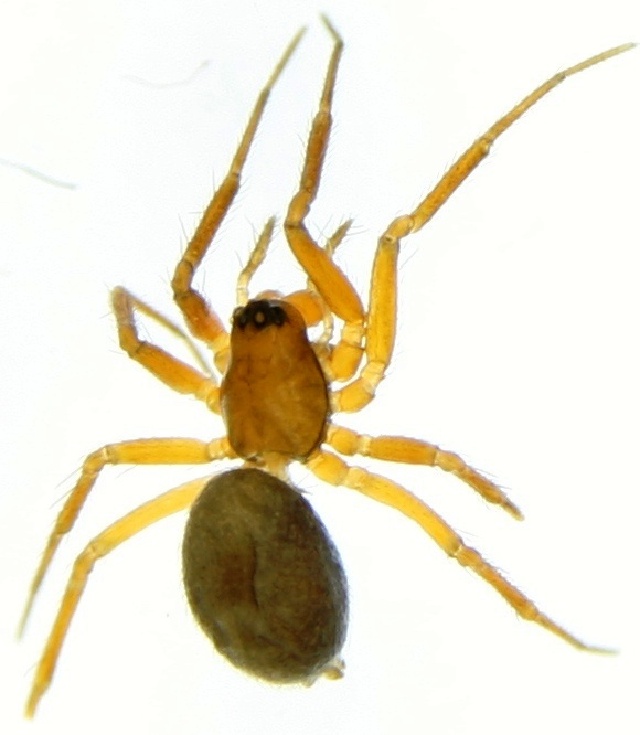
Showing posts with label Orbiculariae. Show all posts

Plectana

Plectana arcuata, copyright Arthur Anker.


Belongs within: Entelegynae.

Plectana was established by Walckenaer as a genus of orb-weaving spiders with spinose abdomens; it is no longer recognised as valid, with most species distributed between various genera of the Gasteracanthinae.

<==Plectana Walckenaer 1841 K92
    |--P. acuminata D59
    |--P. arcuata D59
    |--P. argoides Doleschall 1857 D57
    |--P. bleekeri Doleschall 1857 D57
    |--P. centrum Doleschall 1857 D57
    |--P. clavatrix Walckenaer 1841 [=Gasteracantha clavatrix; incl. G. (Tatacantha) remifera Butl. 1873] K92
    |--P. flavida Doleschall 1859 D59
    |--P. mediofusca Doleschall 1859 D59
    |--P. praetextata D59
    |--P. roseolimbata Doleschall 1859 D59
    |--P. sturii Doleschall 1857 D57
    `--P. tricolor Doleschall 1859 D59

*Type species of generic name indicated

REFERENCES

[D57] Doleschall, C. L. 1857. Bijdrage tot de kennis der Arachniden van den Indischen Archipel. Natuurkundig Tijdschrift voor Nederlandsch Indië, series 3, 3 (5–6): 399–434, pls 1–2.

[D59] Doleschall, C. L. 1859. Tweede Bijdrage tot de kennis der Arachniden van den Indischen Archipel. Verhandelingen der Natuurkundige Vereeniging in Nederlandsch Indie [Acta Societatis Scientiarum Indo-Neêrlandicae] 5 (5): 1–60, pls 1–18.

[K92] Karsch, F. 1892. Arachniden von Ceylon und von Minikoy gesammelt von den Herren Doctoren P. und F. Sarasin. Berliner Entomologische Zeitschrift 36 (2): 267–310.

Phycosoma

Female Phycosoma martinae, copyright Akio Tanikawa.


Belongs within: Theridiidae.

Phycosoma is a cosmopolitan genus of cobweb spiders with a high, almost cylindrical carapace in the males.

Characters (from Fitzgerald & Sirvid 2004): Male carapace often very high, near cylindrical when viewed from above, marked with dorsal grooves and depressions; female carapace, if high, is only so anteriorly. Eye region often projecting beyond clypeus; clypeus often slightly concave. Chelicerae very small, without teeth; fangs long and flat. Legs 4 1 2 3, with leg 4 slightly the longest. Female palpal claw simple. Abdomen often partially covered by dorsal scutum; colulus absent. Male palp lacking a median apophysis; conductor and embolus small. Female with two pairs of seminal receptacles; epigynal opening leading to pair of ducts connecting to posterior receptacles, with second pair of ducts connecting posterior to anterior receptacles. Epigynum with small scape.

<==Phycosoma Cambridge 1879 [incl. Trigonobothrys Simon 1889] FS04
    |--*P. oecobioides Cambridge 1879 FS04
    |--P. alta (Keyserling 1886) [=Dipoena alta] FS04
    |--P. amamiensis (Yoshida 1985) FS04
    |--P. excisum (Simon 1889) [=*Trigonobothrys excisus] FS04
    |--P. flavomarginatum (Bösenberg & Strand 1906) FS04
    |--P. inornata (Cambridge 1861) [=Theridion inornatum, Dipoena inornata] FS04
    |--P. jamesi (Roberts 1979) [=Dipoena jamesi] FS04
    |--P. japonicum (Yoshida 1985) FS04
    |--P. lineatipes (Bryant 1933) [=Dipoena lineatipes] FS04
    |--P. martinae (Roberts 1983) FS04
    |--P. menustya (Roberts 1979) [=Dipoena menustya] FS04
    |--P. mustelinum (Simon 1889) FS04
    `--P. nigromaculatum (Yoshida 1987) FS04

*Type species of generic name indicated

REFERENCES

[FS04] Fitzgerald, B. M., & P. J. Sirvid. 2004. Notes on the genus Phycosoma Cambridge, 1879, senior synonym of Trigonobothrys Simon, 1889 (Theridiidae: Araneae). Tuhinga 15: 7–12.

Enoplognatha

Female Enoplognatha mordax, from Pavouci.


Belongs within: Theridiidae.

Enoplognatha is a cosmopolitan genus of cobweb spiders that commonly have patterned abdomens. Males of this genus have large spines on the front margin of the chelicerae; females have a single tooth on the hind margin of the cheliceral furrow (Wunderlich 1976).

<==Enoplognatha Pavesi 1880 W76
    |--*E. ovata (Clerck 1757) [incl. Theridion redimitum (Linnaeus 1758)] W76
    |--E. ambigua Kulczynski 1894 W76
    |--E. camtschadalica Kulczynski 1885 W76
    |--E. crucifera (Thorell 1875) [incl. E. maritima Simon 1884, E. schaufussi (Koch 1882)] W76
    |--E. deserta Levy & Amitai 1981 PO08
    |--E. diversa (Blackwall 1859) W76
    |--E. gemina Bosmans & Van Keer 1999 PO08
    |--E. hungarica Kolosvary 1934 W76
    |--E. intrepida (Sørensen 1898) PS08
    |--E. jacksoni Schenkel 1927 W76
    |--E. japonica Bösenberg & Strand 1906 W76
    |--E. macrochelis Levy & Amitai 1981 PO08
    |--E. mandibularis (Lucas 1846) [incl. E. mandibularis nigrocincta Simon 1884] W76
    |--E. marmorata (Hentz 1850) W76
    |--E. mordax (Thorell 1875) W76
    |--E. oelandica (Thorell 1875) [incl. Drepanodus corollatus Bertkau 1883, E. corollata] W76
    |--E. robusta Simon 1884 W76
    |--E. sattleri Bösenberg 1895 W76
    |--E. selma Chamberlin & Ivie 1946 W76
    |--E. serratostignata (Koch 1879) W76
    |--E. tecta (Keyserling 1884) W76
    |--E. testacea Simon 1884 W76
    |--E. thoracica (Hahn 1833) BBM02
    |--E. thoracicoides Nosek 1905 W76
    `--E. transiversifoveata (Bösenberg & Strand 1906) [=Teutana transiversifoveata] W76

*Type species of generic name indicated

REFERENCES

[BBM02] Bonte, D., L. Baert & J.-P. Maelfait. 2002. Spider assemblage structure and stability in a heterogeneous coastal dune system (Belgium). Journal of Arachnology 30 (2): 331–343.

[PS08] Pinzón, J., & J. Spence. 2008. Performance of two arboreal pitfall trap designs in sampling cursorial spiders from tree trunks. Journal of Arachnology 36 (2): 280–286.

[PO08] Pluess, T., I. Opatovsky, E. Gavish-Regev, Y. Lubin & M. H. Schmidt. 2008. Spiders in wheat fields and semi-desert in the Negev (Israel). Journal of Arachnology 36 (2): 368–373.

[W76] Wunderlich, J. 1976. Zur Spinnenfauna Deutschlands, XVI. Zur Kenntnis der mitteleuropäischen Arten der Gattungen Enoplognatha Pavesi und Robertus O. Pick.-Cambridge (Araneida: Theridiidae). Senckenbergiana Biologica 57 (1–3): 97–112.

Robertus

Robertus lividus, from here.


Belongs within: Theridiidae.

Robertus is a primarily Holarctic genus of cobweb spiders with a plain-coloured opisthosoma. Males have only small marginal teeth on the chelicerae; females have two teeth on the rear margin of the cheliceral furrow (Wunderlich 1976). Members of this genus are commonly found in ground-level habitats such as among leaf litter, moss or grasses, or under stones.

<==Robertus Cambridge 1879 GGG04 [incl. Ctenium D90]
    |--R. arundineti (Cambridge 1871) W76
    |--R. frivaldszkyi (Chyzer 1894) W76
    |--R. grasshoffi Wunderlich 1973 W76
    |--R. insignis Pick.-Cambridge 1907 W76
    |--R. lividus (Blackwall 1836) W76
    |--R. lyrifer Holm 1939 W76
    |--R. mazaurici (Simon 1901) W76
    |--R. neglectus (Pick.-Cambridge 1871) W76
    |--R. riparius JVHN90
    |--R. scoticus Jackson 1914 [incl. R. monticola Simon 1914] W76
    |--R. truncorum (Koch 1872) W76
    `--R. ungulatus Vogelsanger 1944 [incl. R. paradoxus Miller 1967] W76

*Type species of generic name indicated

REFERENCES

[D90] Dondale, C. D. 1990. Litter Araneae (Araneida). In: Dindal, D. L. (ed.) Soil Biology Guide pp. 477–502. John Wiley & Sones: New York.

[GGG04] Garb, J. E., A. González & R. G. Gillespie. 2004. The black widow spider genus Latrodectus (Araneae: Theridiidae): phylogeny, biogeography, and invasion history. Molecular Phylogenetics and Evolution 31: 1127–1142.

[JVHN90] Jennings, D. T., W. M. Vander Haegen & A. M. Narahara. 1990. A sampling of forest-floor spiders (Araneae) by expellant, Moosehorn National Wildlife Refuge, Maine. Journal of Arachnology 18: 173–180.

[W76] Wunderlich, J. 1976. Zur Spinnenfauna Deutschlands, XVI. Zur Kenntnis der mitteleuropäischen Arten der Gattungen Enoplognatha Pavesi und Robertus O. Pick.-Cambridge (Araneida: Theridiidae). Senckenbergiana Biologica 57 (1–3): 97–112.

Last updated: 25 May 2017.

Mughiphantes

Mughiphantes sp., copyright Biodiversity Institute of Ontario.


Belongs within: Linyphiidae.

Mughiphantes is a genus of small spiders in the Lepthyphantes complex.

Characters (from Tanasevitch & Saaristo 2006): Proscapus disc-like or pear-shaped, more or less thickened; scape more or less rigid, moving only at its base and only very slightly, middle part extremely short or absent.

<==Mughiphantes Saaristo & Tanasevitch 1999 TS06
    |--M. alticola (Tanasevitch 1987) [=Lepthyphantes alticola] TS06
    |--M. anachoretus (Tanasevitch 1987) [=Lepthyphantes anachoretus] TS06
    |--M. ancoriformis (Tanasevitch 1987) [=Lepthyphantes ancoriformis] TS06
    |--M. bicornis Tanasevitch & Saaristo 2006 TS06
    |--M. cuspidatus Tanasevitch & Saaristo 2006 TS06
    |--M. falxus Tanasevitch & Saaristo 2006 TS06
    |--M. faustus (Tanasevitch 1987) [=Lepthyphantes faustus] TS06
    |--M. inermus Tanasevitch & Saaristo 2006 TS06
    |--M. longiproper Tanasevitch & Saaristo 2006 TS06
    |--M. numilionis (Tanasevitch 1987) [=Lepthyphantes numilionis] TS06
    |--M. occultus (Tanasevitch 1987) [=Lepthyphantes occultus] TS06
    |--M. restrictus Tanasevitch & Saaristo 2006 TS06
    |--M. rotundatus (Tanasevitch 1987) [=Lepthyphantes rotundatus] TS06
    |--M. setifer (Tanasevitch 1987) [=Lepthyphantes setifer] TS06
    |--M. setosus Tanasevitch & Saaristo 2006 TS06
    |--M. sherpa (Tanasevitch 1987) [=Lepthyphantes sherpa] TS06
    `--M. yeti (Tanasevitch 1987) [=Lepthyphantes yeti] TS06

*Type species of generic name indicated

REFERENCES

[TS06] Tanasevitch, A. V., & M. I. Saaristo. 2006. Reassessment of the Nepalese species of the genus Lepthyphantes Menge s. l. with descriptions of new Micronetinae genera and species (Araneae, Linyphiidae, Micronetinae). Senckenbergiana Biologica 86 (1): 11–38.

Lepthyphantes

Lepthyphantes minutus, copyright AfroBrazilian.


Belongs within: Linyphiidae.

Lepthyphantes is a diverse genus of small spiders.

Characters (from here): Legs long and thin, tibia I about 10× width; femur I without dorsal bristles; tibia I with lateral bristle; metatarsus I with dorsal bristle; tibia IV with two dorsal bristles. Embolus very short; paracymbium complex. Epigyne complex; scapus folded.

<==Lepthyphantes Menge 1866 TS06
    |--L. angulatus (Cambridge 1881) K02
    |--L. cristatus RKD02
    |--L. ericaeus (Blackwall 1853) BH02
    |--L. flavipes V09
    |--L. hamifer Simon 1884 TS06
    |--L. improbulus Simon 1979 RL11
    |--L. insignis Cambridge 1913 BH02
    |--L. leprosus V09
    |--L. luteipes (Koch 1879) MKD01
    |--L. mengei Kulczynski 1887 K02
    |--L. minutus (Blackwall 1833) SL14
    |--L. nanus SS02
    |--L. obscurus BV00
    |--L. pallidus (Cambridge 1871) BH02
    |--L. pinicola Simon 1884 TS06 [incl. L. tauricola Strand 1910 J98]
    |--L. spelaeorum Kulczynski 1914 UO05
    |--L. taczanowskii (P.-Cambridge 1873) MKD01
    |--L. tenuis (Blackwall 1852) SS02
    |--L. uzbekistanicus Tanasevitch 1983 TS06
    |--L. zebra JVHN90
    `--L. zimmermanni IR05

*Type species of generic name indicated

REFERENCES

[BV00] Bayram, A., & M. İ. Varol. 2000. Spiders active on snow in eastern Turkey. Zoology in the Middle East 21: 133–137.

[BH02] Bell, J. R., A. J. Haughton, N. D. Boatman & A. Wilcox. 2002. Do incremental increases of the herbicide glyphosate have indirect consequences for spider communities? Journal of Arachnology 30 (2): 288–297.

[IR05] Idris, A. B., & A. Rizki. 2005. Notes on the tribe Ephialtini (Hymenoptera: Ichneumonidae: Pimplinae) of Malaysia. Serangga 10 (1–2): 111–126.

[J98] Jäger, P. 1998. Das Typenmaterial der Spinnentiere (Arachnida: Acari, Amblypygi, Araneae, Opiliones, Pseudoscorpiones, Scorpiones, Uropygi) aus dem Museum Wiesbaden. Jahrbuecher des Nassauischen Vereins fuer Naturkunde 119: 81–91.

[JVHN90] Jennings, D. T., W. M. Vander Haegen & A. M. Narahara. 1990. A sampling of forest-floor spiders (Araneae) by expellant, Moosehorn National Wildlife Refuge, Maine. Journal of Arachnology 18: 173–180.

[K02] Koponen, S. 2002. Ground-living spiders in bogs in northern Europe. Journal of Arachnology 30 (2): 262–267.

[MKD01] Marusik, Y. M., S. Koponen & S. N. Danilov. 2001. Taxonomic and faunistic notes on linyphiids of Transbaikalia and South Siberia (Araneae, Linyphiidae). Bulletin of the British Arachnological Society 12 (2): 83–92.

[RKD02] Relys, V., S. Koponen & D. Dapkus. 2002. Annual differences and species turnover in peat bog spider communities. Journal of Arachnology 30 (2): 416–424.

[RL11] Růžička, V., V. Laška, J. Mikula & I. H. Tuf. 2011. Morphological adaptations of Porrhoma spiders (Araneae: Linyphiidae) inhabiting soil. Journal of Arachnology 39 (2): 355–257.

[SL14] Samu, F., G. Lengyel, É. Szita, A. Bidló & P. Ódor. 2014. The effect of forest stand characteristics on spider diversity and species composition in deciduous-coniferous mixed forests. Journal of Arachnology 42 (2): 135–141.

[SS02] Samu, F., & C. Szinetár. 2002. On the nature of agrobiont spiders. Journal of Arachnology 30 (2): 389–402.

[TS06] Tanasevitch, A. V., & M. I. Saaristo. 2006. Reassessment of the Nepalese species of the genus Lepthyphantes Menge s. l. with descriptions of new Micronetinae genera and species (Araneae, Linyphiidae, Micronetinae). Senckenbergiana Biologica 86 (1): 11–38.

[UO05] Ubick, D., & R. Ozimec. 2005. On the harvestman genus Lola Kratochvíl (Opiliones: Laniatores). Natura Croatica 14 (3): 161–174.

[V09] Verdcourt, B. (ed.) 2009. Additions to the Wild Fauna and Flora of the Royal Botanic Gardens, Kew. XXVI. Miscellaneous records. Kew Bulletin 64 (1): 183–194.

Agyneta

Agyneta mossica, copyright Marko Mutanen.


Belongs within: Linyphiidae.

Agyneta is a cosmopolitan genus of small spiders, mostly found among leaf litter.

Characters (from Miller 2011): Eyes subequal or anterior median eyes smallest, chelicerae may be somewhat excavated mesally, tibiae I-IV with two dorsal macrosetae, usually no other tibial or metatarsal macrosetae, pedipalp of adult female may be swollen. Abdomen typically uniform dark or with indistinct pattern. Male pedipalp with cymbium often somewhat raised and excavated basally, retrolateral margin with a distally-projecting process; lamella typically large and membranous, may be fringed; paracymbium complex and somewhat characteristic; tibial apophysis absent. Epigynum typically with two conspicuous atria that may be connected medially below the tip of a small, sinuous scape.

<==Agyneta Hull 1911 TS06
    `--A. (Meioneta Hull 1920) W76
         |--A. (M.) affinis (Kulczyński 1898) RKD02, MKD01
         |--‘Meioneta’ beata V09
         |--A. (M.) mossica (Schikora 1993) RKD02, K02
         |--‘Meioneta’ mollis V09
         |--‘Meioneta’ pseudorurestris (Wunderlich 1980) PO08
         |--‘Meioneta’ rurestris (Koch 1836) SS02 [=Microneta rurestris V09]
         |--‘Meioneta’ saxatilis (Blackwall 1844) BBM02
         |--‘Meioneta’ simplicitarsis (Simon 1884) SS02
         `--A. (M.) vera Wunderlich 1976 W76

Agyneta incertae sedis:
  A. affinisoides Tanasevitch 1984 MKD01
  A. alaskensis (Holm 1960) [=Meioneta alaskensis] MKD01
  A. allosubtilis Loksa 1965 MKD01
  A. buetko Wunderlich 1983 TS06
  A. cauta (Cambridge 1902) K02
  A. conigera (Cambridge 1863) BBM02
  A. decora (Cambridge 1871) BBM02
  A. formicaria (Balogh 1938) [=Microneta formicaria] W76
  A. jiriensis Wunderlich 1983 TS06
  A. laetesiformis Wunderlich 1976 W76
  A. maritima (Emerton 1919) MKD01
  A. muriensis Wunderlich 1983 TS06
  A. nigripes (Simon 1884) MKD01
  A. olivacea (Emerton 1882) MKD01
  A. pseudofuscipalpa Wunderlich 1983 TS06
  A. subtilis (Cambridge 1847) BBM02
  A. tuasivia (Marples 1956) [=Linyphia tuasivia] W76
  A. yulungiensis Wunderlich 1983 TS06

*Type species of generic name indicated

REFERENCES

[BBM02] Bonte, D., L. Baert & J.-P. Maelfait. 2002. Spider assemblage structure and stability in a heterogeneous coastal dune system (Belgium). Journal of Arachnology 30 (2): 331–343.

[K02] Koponen, S. 2002. Ground-living spiders in bogs in northern Europe. Journal of Arachnology 30 (2): 262–267.

[MKD01] Marusik, Y. M., S. Koponen & S. N. Danilov. 2001. Taxonomic and faunistic notes on linyphiids of Transbaikalia and South Siberia (Araneae, Linyphiidae). Bulletin of the British Arachnological Society 12 (2): 83–92.

[PO08] Pluess, T., I. Opatovsky, E. Gavish-Regev, Y. Lubin & M. H. Schmidt. 2008. Spiders in wheat fields and semi-desert in the Negev (Israel). Journal of Arachnology 36 (2): 368–373.

[RKD01] Relys, V., S. Koponen & D. Dapkus. 2002. Annual differences and species turnover in peat bog spider communities. Journal of Arachnology 30 (2): 416–424.

[SS02] Samu, F., & C. Szinetár. 2002. On the nature of agrobiont spiders. Journal of Arachnology 30 (2): 389–402.

[TS06] Tanasevitch, A. V., & M. I. Saaristo. 2006. Reassessment of the Nepalese species of the genus Lepthyphantes Menge s. l. with descriptions of new Micronetinae genera and species (Araneae, Linyphiidae, Micronetinae). Senckenbergiana Biologica 86 (1): 11–38.

[V09] Verdcourt, B. (ed.) 2009. Additions to the Wild Fauna and Flora of the Royal Botanic Gardens, Kew. XXVI. Miscellaneous records. Kew Bulletin 64 (1): 183–194.

[W76] Wunderlich, J. 1976. Spinnen aus Australien. 2. Linyphiidae (Arachnida: Araneida). Senckenbergiana Biologica 57 (1–3): 125–142.

Walckenaeria

Male Walckenaeria acuminata, copyright Richard Gallon.


Belongs within: Linyphiidae.

Walckenaeria is a primarily Holarctic genus of small spiders, the males of some species of which have the eyes placed on elongated turrets.

Characters (from here): Tibial spination 2-2-1-1; metatarsus IV bearing a trichobothrium; paired tarsal teeth comb-shaped.

Walckenaeria
    |--W. acuminata Blackwall 1833 BBM02
    |--W. alticeps (Denis 1952) RKD02
    |--W. antica (Wider 1834) K02 [=Wideria antica V09]
    |--W. atrotibialis (Cambridge 1878) BBM2
    |--W. auranticeps (Emerton 1882) PS08
    |--W. capito (Westring 1861) K02
    |--W. cucullata (Koch 1836) MKD01
    |--W. cuspidata (Blackwall 1833) BH02
    |--W. directa JVHN90
    |--W. fraudatrix Millidge 1983 MKD01
    |--W. karpinskii (P.-Cambridge 1873) MKD01
    |--W. monoceros (Wider 1834) BBM02
    |--W. nodosa RKD02
    |--W. nudipalpis (Westring 1851) K02
    |--W. stylifrons (Cambridge 1875) BBM02
    `--W. unicornis Cambridge 1861 BH02

*Type species of generic name indicated

REFERENCES

[BH02] Bell, J. R., A. J. Haughton, N. D. Boatman & A. Wilcox. 2002. Do incremental increases of the herbicide glyphosate have indirect consequences for spider communities? Journal of Arachnology 30 (2): 288–297.

[BBM02] Bonte, D., L. Baert & J.-P. Maelfait. 2002. Spider assemblage structure and stability in a heterogeneous coastal dune system (Belgium). Journal of Arachnology 30 (2): 331–343.

[JVHN90] Jennings, D. T., W. M. Vander Haegen & A. M. Narahara. 1990. A sampling of forest-floor spiders (Araneae) by expellant, Moosehorn National Wildlife Refuge, Maine. Journal of Arachnology 18: 173–180.

[K02] Koponen, S. 2002. Ground-living spiders in bogs in northern Europe. Journal of Arachnology 30 (2): 262–267.

[MKD01] Marusik, Y. M., S. Koponen & S. N. Danilov. 2001. Taxonomic and faunistic notes on linyphiids of Transbaikalia and South Siberia (Araneae, Linyphiidae). Bulletin of the British Arachnological Society 12 (2): 83–92.

[PS08] Pinzón, J., & J. Spence. 2008. Performance of two arboreal pitfall trap designs in sampling cursorial spiders from tree trunks. Journal of Arachnology 36 (2): 280–286.

[RKD02] Relys, V., S. Koponen & D. Dapkus. 2002. Annual differences and species turnover in peat bog spider communities. Journal of Arachnology 30 (2): 416–424.

[V09] Verdcourt, B. (ed.) 2009. Additions to the Wild Fauna and Flora of the Royal Botanic Gardens, Kew. XXVI. Miscellaneous records. Kew Bulletin 64 (1): 183–194.

Anapidae

Comaroma simoni, copyright Pierre Oger.


Belongs within: Araneoidea.

The Anapidae are a group of minute spiders found in litter and moss, usually in moist forests. Many species construct small horizontal orb webs (Jocqué & Dippenaar-Schoeman 2007). Females lack palpi and also have secondarily haplogyne genitalia without surface expression on the abdomen (Paquin et al. 2010).

Characters (from Jocqué & Dippenaar-Schoeman 2007): Body size <2 mm. Carapace with ocular region elevated; pedicel arising from circular rimmed cavity on posterior declivity; glandular openings often present, situated in hollow pits on edge of carapace at anterolateral corners. Six or eight eyes present; anterior median eyes often reduced or absent; other eyes arranged in three pairs. Chelicerae with teeth on both margins. Labrum bearing anterior spur projecting forward between chelicerae, sometimes reduced to a small crest. Female palp reduced in size or absent, without claw. Sternum as broad as long, broadly fused to carapace. Relative leg lengths (longest to shortest) 4123 or 1423; legs short, without spines; metatarsi shorter than tarsi; tarsi with three claws; tarsal organ capsulate and domed; femora I of male with short spine ventrally. Abdomen of male with large dorsal scutum, or two or three scuta, or dorsal region with scattered small sclerotised areas; ventral scutum surrounding pedicel. Abdomen of female soft or with small, brown sclerotised ring. Two booklungs present or anterior tracheae opening through spiracles on either side of genital opening. Anterior spinnerets small, close together; spinnerets together with colulus surrounded by a sclerotised ring; posterior lateral spinnerets with triplet of one flagelliform and two aggregate gland spigots in both sexes, aggregate gland spigot larger than accompanying flagelliform spigot; piriform gland spigots with reduced base. Genitalia haplogyne; spermathecae well separated; male palp variable, femur and patella sometimes with bristles or apophyses, embolus varying from spiniform to short and wide.

<==Anapidae [Amazulinae, Anapeae, Anapinae]
    |--Comaroma Bertkau 1889 S03
    |    `--C. simoni Bertkau 1889 S03
    `--+--Anapis Simon 1895 S03
       |    `--A. amazonas Platnick & Shadab 1978 S03
       `--Crozetulus Hickman 1939 S03
            |--*C. minutus Hickman 1939 H39
            `--C. rhodesiensis Brignoli 1981 S03

Anapidae incertae sedis:
  Sofanapis antillanca Platnick & Forster 1989 A02
  Crassanapis chilensis R14
  Pseudanapis Simon 1905 S03
    `--P. burra Forster 1959 W76
  Chasmocephalon O.P.-Cambridge 1889 S03
    `--C. crassifemoralis Wunderlich 1976 W76
  Anapisona S03
  Novanapis Platnick & Forster 1989 PVD10
    `--*N. spinipes Platnick & Forster 1989 PVD10
  Gertschanapis shantzi BS09
  Paranapis Platnick & Forster 1989 PVD10
    |--*P. insula (Forster 1951) PVD10
    `--P. isolata Platnick & Forster 1989 PVD10
  Zealanapis Platnick & Forster 1989 PVD10
    |--*Z. armata (Forster 1951) PVD10
    |--Z. australis (Forster 1951) PVD10
    |--Z. conica (Forster 1951) PVD10
    |--Z. insula Platnick & Forster 1989 PVD10
    |--Z. kuscheli Platnick & Forster 1989 PVD10
    |--Z. matua Platnick & Forster 1989 PVD10
    |--Z. montana Platnick & Forster 1989 PVD10
    |--Z. otago Platnick & Forster 1989 PVD10
    |--Z. punta Platnick & Forster 1989 PVD10
    `--Z. waipoua Platnick & Forster 1989 PVD10
  Palaeoanapis nana Wunderlich 1988 S93

*Type species of generic name indicated

REFERENCES

[A02] Agnarsson, I. 2002. Sharing a web—on the relation of sociality and kleptoparasitism in theridiid spiders (Theridiidae, Araneae). Journal of Arachnology 30 (2): 181–188.

[BS09] Blackledge, T. A., N. Scharff, J. A. Coddington, T. Szüts, J. W. Wenzel, C. Y. Hayashi & I. Agnarsson. 2009. Reconstructing web evolution and spider diversification in the molecular era. Proceedings of the National Academy of Sciences of the USA 106 (13): 5229–5234.

[H39] Hickman, V. V. 1939. Opiliones and Araneae. British, Australian and New Zealand Antarctic Research Expedition Reports Series B 4: 157–188.

[PVD10] Paquin, P., C. J. Vink & N. Dupérré. 2010. Spiders of New Zealand: annotated family key and species list. Manaaki Whenua Press: Lincoln (New Zealand).

[R14] Ramírez, M. J. 2014. The morphology and phylogeny of dionychan spiders (Araneae: Araneomorphae). Bulletin of the American Museum of Natural History 390: 1–374.

[S03] Schütt, K. 2003. Phylogeny of Symphytognathidae s.l. (Araneae, Araneoidea). Zoologica Scripta 32 (2): 129–151.

[S93] Selden, P. A. 1993. Arthropoda (Aglaspidida, Pycnogonida and Chelicerata). In: Benton, M. J. (ed.) The Fossil Record 2 pp. 297–320. Chapman & Hall: London.

[W76] Wunderlich, J. 1976. Spinnen aus Australien. 1. Uloboridae, Theridiosomatidae und Symphytognathidae (Arachnida: Araneida). Senckenbergiana Biologica 57 (1–3): 113–124.

Last updated: 15 January 2022.

Cyrtophora

Tent-web spider Cyrtophora citricola, copyright Ed Nieuwenhuys.


Belongs within: Araneidae.

Cyrtophora is a mostly Indo-Australian genus of spiders (with some species in Africa and the New World) whose members construct a horizontal orbweb with a tightly woven mesh and an extremely tight, permanent non-sticky spiral (Framenau & Scharff 2009).

Characters (from Framenau & Scharff 2009): Lateral eyes slightly separated; posterior eye row recurved or straight; legs relatively heavy; fourth leg with combined patella and tibia slightly shorter than femur, and shorter than combined metatarsus and tarsus; male pedipalp with embolus placed near median apophysis, supported by a conductor, basal cymbium concavity absent; female epigyne lacking a scape.

<==Cyrtophora Simon 1864 [incl. Euetria Thorell 1890, Suzumia Nakatsudi 1943] FS09
    |--*C. citricola (Forsskål 1775) [=Aranea citricola; incl. C. sculptilis Koch 1872] FS09
    |--C. beccarii (Thorell 1878) FS09
    |--C. cicatrosa (Stoliczka 1869) FS09
    |--C. cordiformis (Koch 1871) FS09
    |--C. crassipes (Rainbow 1897) [=Epeira crassipes, Aranea crassipes, Araneus crassipes] FS09
    |--C. cylindroides (Walckenaer 1842) FS09 (see below for synonymy)
    |--C. exanthematica (Doleschall 1859) FS09
    |--C. feai (Thorell 1887) AM11
    |--C. gazellae (Karsch 1878) [=Epeira gazellae, Aranea gazellae, Araneus gazellae] FS09
    |--C. hirta Koch 1872 FS09
    |--C. moluccensis (Doleschall 1857) FS09
    |--C. monulfi Chrysanthus 1960 FS09
    |--C. parnasia Koch 1872 FS09
    |--C. rainbowi (Roewer 1955) [=Cyclosa rainbowi, Epeira pallida Rainbow 1897 non Walckenaer 1805, Cyc. pallida] FS09
    |--C. trigona (Koch 1871) [=Epeira trigona, Aranea trigona, Araneus trigonus] FS09
    `--C. unicolor (Doleschall 1857) FS09

Cyrtophora cylindroides (Walckenaer 1842) FS09 [=Epeira cylindroides R13; incl. E. nephilina Koch 1871 FS09, E. viridipes Doleschall 1859 FS09]

*Type species of generic name indicated

REFERENCES

[AM11] Araujo, D., V. F. Mattos, A. M. Giroti, M. G. Kraeski, L. S. Carvalho & A. D. Brescovit. 2011. Cytogenetical characterization of six orb-weaver species and review of cytogenetical data for Araneidae. Journal of Arachnology 39 (2): 337–344.

[FS09] Framenau, V. W. & N. Scharff. 2009. Cyrtobill darwini, a new species in a new orb-weaving spider genus from Australia (Araneae: Araneidae: Cyrtophorinae). Records of the Western Australian Museum 25 (3): 315–328.

[R13] Rainbow, W. J. 1913. Arachnida from the Solomon Islands. Records of the Australian Museum 10 (1): 1–16.