Showing posts with label Polyneoptera. Show all posts

Coptotermes

Castes of Coptotermes acinaciformis, from CSIRO.


Belongs within: Rhinotermitidae.

Coptotermes is a genus of drywood termites in which soldiers bear a large fontanelle opening near the front of the head.

Characters (from Maiti 2006): Imago with head dark to dark brown, head and pronotum fairly densely and abdomen densely hairy. Head subround. Eyes of medium size. Ocelli either subround or elongately oval, either almost touching or slightly separated from eyes. Fontanelle minute, placed almost at middle of head. Mandibles each with an apical and three marginal teeth. Left with apical only slightly longer than first marginal and almost equal to or slightly shorter than or subequal to second and third marginal. Right with apical thinner and slightly shorter than second, first marginal rudimentary placed at anterior base of second, third smaller with long posterior margin, generally longer than molar plate. Postclypeus flat or weakly swollen with or without median line. Apical tibial spur formula 3:2:2. Wings generally moderate to densely hairy, all veins arising independently from scale. In fore wing, costa and subcosta merged, strongly chitinised, running along anterior margin. Radius thick and running parallel and close to costa and subcosta. Medial thin and with one to three branches distally, cubitus also weak and with six to thirteen branches to posterior margin. Hind wing as in fore wing except medial arising from radius just outside scale. Soldier with head light yellow to deep brown in colour, moderately to densely hair, pyriform to broadly oval. Eyes generally absent, eye spots at times visible. Ocelli absent. Fontanelle large with round to oval large opening placed far anteriorly. Mandibles sabre-shaped, gradually narrowing anteriorly and strongly to weakly hooked at apices, left with a few to maximum of four crenulations in basal half and with a large knob-like projection. Right with a few basal crenulations also. Antennae with 13–17 segments, 3–4 variable in shape and size. Postmentum long and club-shaped with distinct widest and narrowest width, sometimes with hairs anteriorly. Pronotum narrower than head, flat, sometimes a little raised on anterior margin, anterior margin with median notch and posterior margin with weak median emargination.

<==Coptotermes Wasmann 1896 M06 (see below for synonymy)
    |--C. sjostedti Holmgren 1911 IVE07, M06 [incl. C. sjostedti var. modica M06]
    `--+--C. acinaciformis (Froggatt 1898) IVE07, M06 (see below for synonymy)
       |    |--C. a. acinaciformis M06
       |    `--C. a. raffrayi Wasmann 1900 [=Termes (Coptotermes) raffrayi] M06
       `--+--C. niger Snyder 1922 IVE07, M06
          `--C. testaceus (Linnaeus 1758) IVE07, M06 (see below for synonymy)

Coptotermes incertae sedis:
  *C. gestroi (Wasmann 1896) [=Termes (*Coptotermes) gestroi] M06
  C. amanii (Sjöstedt 1911) (see below for synonymy) M06
  C. amboinensis Kemner 1931 M06
  C. bannaensis Xia & He 1986 [=[=C. (Oligocrinitermes) bannaensis] XH86
  C. beckeri Mathur & Chhotani 1969 M06
  C. bentongensis Krishna 1956 M06 [=C. (Polycrinitermes) bentongensis XH86]
  C. boetonensis Kemner 1934 M06 [=C. (Polycrinitermes) boetonensis XH86]
  C. bornensis Oshima 1914 M06
  C. brevis DAF07
  C. brunneus Gay 1955 M06
  C. ceylonicus Holmgren 1911 XH86, M06 [=C. (Oligocrinitermes) ceylonicus] XH86
  C. changtaiensis Xia & He 1986 [=C. (Polycrinitermes) changtaiensis] XH86
  C. chaoxianensis Huang & Li 1985 [=C. varicapitatus chaoxianensis, [=C. (Polycrinitermes) chaoxianensis] XH86
  C. cochlearus Xia & He 1986 [=C. (Oligocrinitermes) cochlearus] XH86
  C. communis Xia & He 1986 [=C. (Polycrinitermes) communis] XH86
  C. crassus Snyder 1922 M06
  C. ‘crassus’ Ping 1985 non Snyder 1922 M06
  C. curvignathus Holmgren 1913 M06 (see below for synonymy)
  C. cyclocoryphus Zhu et al. 1984 [=C. (Polycrinitermes) cyclocoryphus] XH86
  C. dimorphus Xia & He 1986 [=C. (Oligocrinitermes) dimorphus] XH86
  C. dobonicus Oshima 1914 M06 [=C. (Polycrinitermes) dobonicus XH86]
  C. dreghorni Hill 1942 M06
  C. elisae (Desneux 1905) M06 [=Termes (Coptotermes) elisae M06; incl. C. hyaloapex Holmgren 1911 M06, H42]
  C. emersoni Ahmad 1953 M06
  C. eucalyptus Ping 1984 [=C. (Polycrinitermes) eucalyptus] XH86
  C. formosanus Shiraki 1909 XH86 (see below for synonymy)
  C. gaurii Roonwal & Krishna 1956 [incl. C. exignus Jepson 1930, C. exiguus] M06
  C. grandiceps Snyder 1925 [incl. C. froggatti Light & Davis 1929, C. solomonensis Snyder 1925] M06
  C. grandis Li & Huang 1985 [=C. (Polycrinitermes) grandis] XH86
  C. guangdongensis Ping 1985 M06
  C. guanzhouensis Ping 1985 M06
  C. hainanensis Li & Tsai 1985 [=C. (Polycrinitermes) hainanensis] XH86
  C. harrisi M06
  C. havilandi Holmgren 1911 [incl. C. javanicus Kemner 1934, C. pacificus Light 1932] M06
  C. heimi (Wasmann 1902) [=*Arrhinotermes heimi; incl. C. parvulus Holmgren 1913] M06
  C. hekouensis Xia & He 1986 [=C. (Polycrinitermes) hekouensis] XH86
  C. heteromorphus Ping 1985 M06
  C. intermedius Silvestri 1912 [incl. C. truncatus var. reducta Sjostedt 1926, C. reductus] M06
  C. jiaxingensis Xia & He 1986 [=C. (Polycrinitermes) jiaxingensis] XH86
  C. kalshoveni Kemner 1934 M06
  C. kishori Roonwal & Chhotani 1962 M06
  C. labiosus Hill 1926 H42 [incl. C. flavus Hill 1926 non Bugnion & Popeff 1910 M06, C. frenchi Hill 1932 M06]
  C. lacteus (Froggatt 1898) [=Termes lacteus; incl. C. sedulus Hill 1923] M06
  C. longignathus Xia & He 1986 [=C. (Oligocrinitermes) longignathus] XH86
  C. longistriatus Li & Huang 1985 [=C. (Polycrinitermes) longistriatus] XH86
  C. menadoensis Oshima 1914 M06
  C. menglunensis Tsai & Huang 1985 (see below for synonymy) XH86
  C. michaelseni Silvestri 1909 M06
  C. minutissimus Kemner 1934 M06
  C. minutus Li & Huang 1985 [=C. varicapitatus minutus, C. (Polycrinitermes) minutus] XH86
  C. monosetosus Tsai & Li 1985 [=C. (Oligocrinitermes) monosetosus] XH86
  C. obiratus Hill 1927 M06
  C. obliquus Xia & He 1986 [=[=C. (Oligocrinitermes) obliquus] XH86
  C. ochraceus Ping & Xu 1986 M06
  C. pamuae Snyder 1925 M06
  C. parradoxus M06
  C. perigrenator Kemner 1943 M06
  C. premrasmii Ahmad 1965 XH86, M06 [=C. (Oligocrinitermes) premrasmii XH86]
  C. priscus Emerson 1971 P92
  C. rectangularis Ping & Xu 1986 M06
  C. remotus Hill 1927 M06
  C. reticulatus M06
  C. sepangensis Krishna 1956 M06
  C. shanghaiensis Xia & He 1986 [=C. (Polycrinitermes) shanghaiensis] XH86
  C. sinabangensis Oshima 1923 M06 [=C. (Polycrinitermes) sinabangensis XH86]
  C. sucineus Emerson 1971 P92
  C. suzhouensis Xia & He 1986 [=C. (Polycrinitermes) suzhouensis] XH86
  C. travians (Haviland 1898) [=Termes (Coptotermes) travians] M06
  C. truncatus (Wasmann 1897) [=Termes (Coptotermes) truncatus, Eutermes truncatus] M06
  C. vastator Light 1929 M06
  C. xiaoliangensis Ping 1984 [=C. (Polycrinitermes) xiaoliangensis] XH86

Coptotermes Wasmann 1896 M06 [incl. Arrhinotermes Wasmann 1902 M06, Oligocrinitermes Xia & He 1986 (n. n.) XH86, Polycrinitermes Xia & He 1986 (n. n.) XH86, Vastitermes Sjöstedt 1926 M06; Coptotermitinae]

Coptotermes acinaciformis (Froggatt 1898) IVE07, M06 [=Termes acinaciformis M06, T. (Eutermes) acinaciformis M06]

Coptotermes amanii (Sjöstedt 1911) [=Eutermes (Coptotermes) amanii; incl. C. sjostedti var. subintactae Silvestri 1914-1915] M06

Coptotermes curvignathus Holmgren 1913 M06 [=C. (Polycrinitermes) curvignathus XH86; incl. C. robustus Holmgren 1913 M06]

Coptotermes formosanus Shiraki 1909 XH86 [=[=C. (Polycrinitermes) formosanus XH86; incl. C. formosae Holmgren 1911 M06, C. hongkonensis Oshima 1914 M06, C. intrudens Oshima 1920 M06]

Coptotermes menglunensis Tsai & Huang 1985 [=C. monosetosus menglunensis, [=C. (Oligocrinitermes) menglunensis] XH86

Coptotermes testaceus (Linnaeus 1758) IVE07, M06 [=Hemerobius testaceus M06, Termes (Eutermes) testaceus M06; incl. Perla fusca De Geer 1778 M06, T. (E.) marabitanus Hagen 1858 M06, Coptotermes marabitanus M06, T. morio Fabricius 1793 M06]

*Type species of generic name indicated

REFERENCES

[DAF07] Department of Agriculture and Food. 2007. Common Seasonal Pests. State of Western Australia.

[H42] Hill, G. F. 1942. Termites (Isoptera) from the Australian Region (including Australia, New Guinea and islands south of the Equator between 140°E. longitude and 170°W. longitude). Commonwealth of Australia Council for Scientific and Industrial Research: Melbourne.

[IVE07] Inward, D. J. G., A. P. Vogler & P. Eggleton. 2007. A comprehensive phylogenetic analysis of termites (Isoptera) illuminates key aspects of their evolutionary biology. Molecular Phylogenetics and Evolution 44: 953–967.

[M06] Maiti, P. K. 2006. A taxonomic monograph on the world species of termites of the family Rhinotermitidae (Isoptera: Insecta). Memoirs of the Zoological Survey of India 20 (4): i–viii, 1–272.

[P92] Poinar, G. O., Jr. 1992. Life in Amber. Stanford University Press: Stanford.

[XH86] Xia K.-L. & He X.-S. 1986. Study on the genus Coptotermes from China (Isoptera: Rhinotermitidae). Contr. Shanghai Inst. Entomol. 6: 157–182.
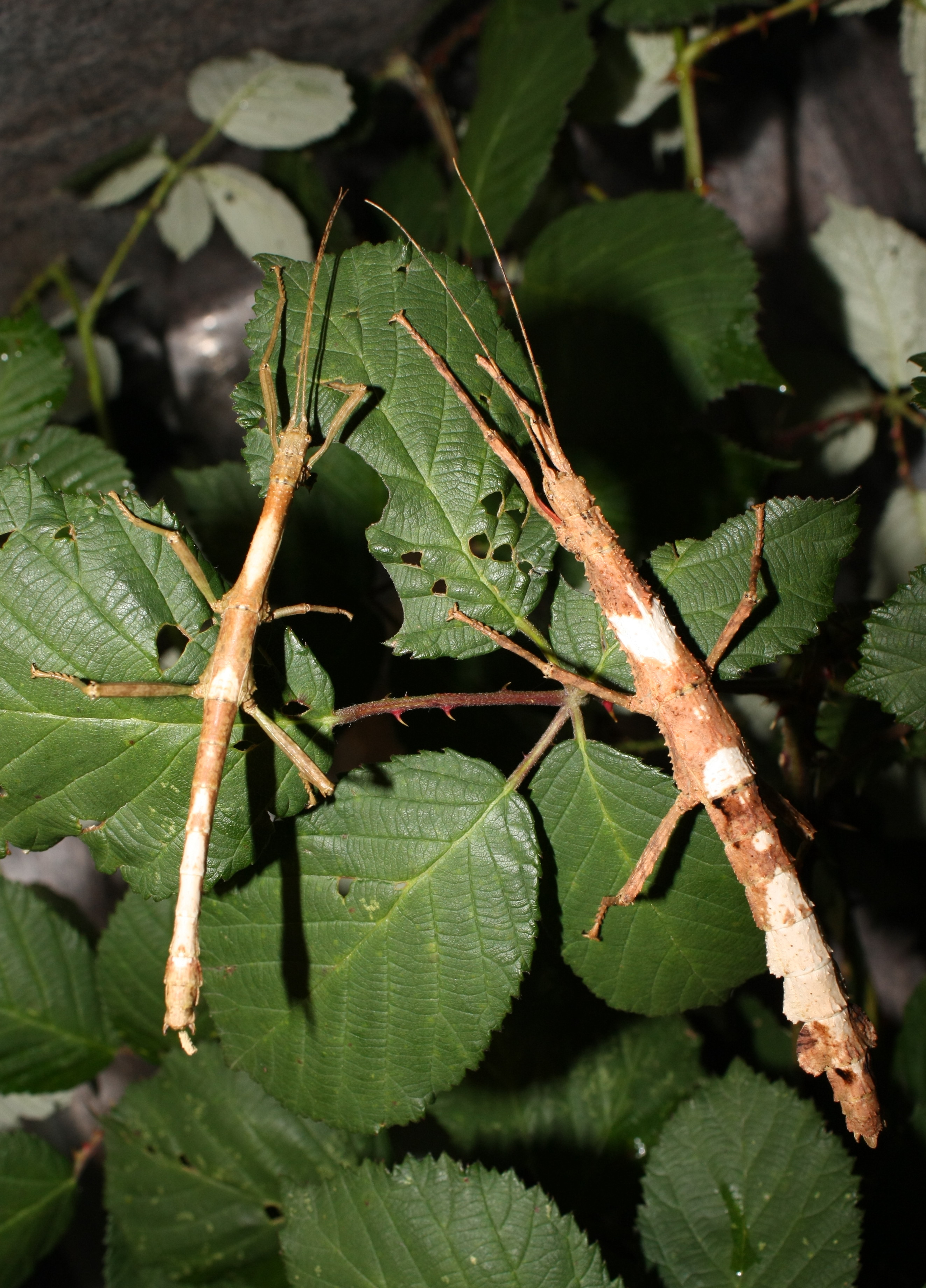
Pseudophasmatidae

Guadeloupe stick insects Lamponius guerini, copyright Drägüs.


Belongs within: Phasmatodea.

The Pseudophasmatidae are a group of stick insects in which the femora of the fore legs have four distinct edges.

<==Pseudophasmatidae Z04
    |--Pseudophasmatinae WBM03
    |    |--Pseudophasma rufipes WBM03
    |    |--Paraphasma rufipes TW05
    |    `--Anisomorpha WBM03
    |         |--A. buprestoides K91
    |         `--A. ferruginea WBM03
    `--Xerosomatinae Z04
         |--Xerosomatini Z04
         `--Hesperophasmatini Z04
              |--Hesperophasma Rehn 1904 Z04
              |--Rhynchacris Redtenbacher 1908 Z04
              |--Taraxippus Moxey 1971 Z04
              |--Agamemnon Z04
              `--Lamponius Stål 1875 [incl. Antillophilus Carl 1913, Hypocyrtus Redtenbacher 1908] Z04
                   |--*L. guerini (Saussure 1868) [=Pygirhynchus guerini] Z04
                   |--*Antillophilus’ brevitarsus Carl 1913 Z04
                   `--*Hypocyrtus’ substrumosus Redtenbacher 1908 Z04

*Type species of generic name indicated

REFERENCES

[K91] Key, K. H. L. 1991. Phasmatodea (stick-insects). In: CSIRO. The Insects of Australia: A textbook for students and research workers vol. 1 pp. 394–404. Melbourne University Press: Carlton (Victoria).

[TW05] Terry, M. D., & M. F. Whiting. 2005. Mantophasmatodea and phylogeny of the lower neopterous insects. Cladistics 21: 240–257.

[WBM03] Whiting, M. F., S. Bradler & T. Maxwell. 2003. Loss and recovery of wings in stick insects. Nature 421: 264–267.

[Z04] Zompro, O. 2004. A key to the stick-insect genera of the ‘Anareolatae’ of the New World, with descriptions of several new taxa (Insecta: Phasmatodea). Studies on Neotropical Fauna and Environment 39 (2): 133–144.

Phaneropterinae

Caedicia simplex, copyright Donald Hobern.


Belongs within: Tettigonioidea.

The Phaneropterinae are a group of katydids characterised by a round, globular head, an unarmed prosternum, tibiae that are usually rectangular in cross-section, and a usually short, upcurved ovipositor (Rentz 1996).

<==Phaneropterinae R96
    |--Acripeza reticulata R96
    |--Alectoria superba R96
    |--Elephantodeta nobilis R96
    |--Torbia viridissima R96
    |--Psyra R96
    |--Paracaedicia serrata R96
    |--Ducetia japonica R96
    |--Parableta integricauda Brunner 1878 R18
    |--Aganacris micans Walker 1871 R18
    |--Stilpnochlora marginella (Serville 1839) [=Phylloptera marginella] R18
    |--Viadana myrtifolia (Linnaeus 1758) [=Gryllus (Tettigonia) myrtifolius] R18
    |--Dichopetala BM76
    |--Holochlora BM76
    |--Tylopsis lilifolia BM76, I92
    |--Amblycorypha rotundifolia BM76, G37
    |--Platylyra BM76
    |--Burgilis missionum R15
    |--Hyperophora major R15
    |--Ligocatinus olivaceus R15
    |--Homotoicha fuscopunctata R15
    |--Theudoria melanocnemis R15
    |--Ephippithytha [incl. Ochrida] R96
    |    `--E. trigintiduoguttata R96
    |--Tinzeda R96
    |    |--T. albosignata R96
    |    `--T. eburneata C70
    |--Polichne R96
    |    |--P. argentata R96
    |    `--P. parvicauda R96
    |--Poecilimon P05
    |    |--P. sanctipauli Brunner von Wattenwyl 1878 P05
    |    `--P. veluchianus FJ01
    |--Ceraia R18
    |    |--C. capra Rehn 1918 R18
    |    `--C. punctulata R18
    |--Anaulacomera R18
    |    |--A. albonodulosa R18
    |    `--A. nodulosa Stål 1873 R18
    |--Coelophyllum R18
    |    |--C. coriaceum (Pictet 1888) [=Prosagoga coriacea] R18
    |    `--C. rectinerve (Brunner 1891) [=Prosagoga rectinervis] R18
    |--Grammadera R15
    |    |--G. albida R15
    |    `--G. clara R15
    |--Phylloptera R15
    |    |--P. alliedea R15
    |    |--P. laurifolia B00
    |    `--P. spinulosa R15
    |--Microcentrum R15
    |    |--M. angustatum R15
    |    `--M. rhombifolium TW05
    |--Phaneroptera R96
    |    |--P. falcata K09
    |    |--P. gracilis R96
    |    `--P. quadripunctata R13
    |--Scaphura R18
    |    |--S. nigra R15
    |    |--S. nitida R18
    |    `--S. sphex Rehn 1918 R18
    `--Caedicia R96
         |--C. araucariae R96
         |--C. major R91
         |--C. marginata R96
         `--C. simplex R96

*Type species of generic name indicated

REFERENCES

[BM76] Bohart, R. M., & A. S. Menke. 1976. Sphecid Wasps of the World. University of California Press: Berkeley.

[B00] Bordage, E. 1900. On the absence of regeneration in the posterior limbs of the Orthoptera saltatoria and its probable causes. Annals and Magazine of Natural History, series 7, 5: 234–236.

[C70] CSIRO. 1970. The Insects of Australia: A textbook for students and research workers. Melbourne University Press.

[FJ01] Field, L. H., & T. H. Jarman. 2001. Mating behaviour. In: Field, L. H. (ed.) The Biology of Wetas, King Crickets and Their Allies pp. 317–332. CABI Publishing: Wallingford (UK).

[G37] Gurney, A. B. 1937. Collecting and biological notes on some minor orders of insects. Proceedings of the Entomological Society of Washington 39 (8): 239.

[I92] Imes, R. 1992. The Practical Entomologist. Aurum Press: London.

[K09] Köhler, G. 2009. Heuschrecken (Saltatoria) und Ohrwürmner (Dermaptera) im Immissionsgebiet des Düngemittelwerkes Steudnitz/Thüringen—eine Langzeitstudie (1978–2001). Mauritiana 20 (3): 601–646.

[P05] Papapavlou, K. P. 2005. New distributional data on the Orthoptera (Saltatoria) of the northern Dodecanese (“southern Sporadhes”) archipelago, Greece. Graellsia 61 (1): 3–11.

[R15] Rehn, J. A. G. 1915. A further contribution to the knowledge of the Orthoptera of Argentina. Proceedings of the Academy of Natural Sciences of Philadelphia 67 (2): 270–292.

[R18] Rehn, J. A. G. 1918. On a collection of Orthoptera from the State of Pará, Brazil. Proceedings of the Academy of Natural Sciences of Philadelphia 70: 144–236, pls 1–2.

[R91] Rentz, D. C. F. 1991. Orthoptera (grasshoppers, locusts, katydids, crickets). In: CSIRO. The Insects of Australia: A textbook for students and research workers vol. 1 pp. 369–393. Melbourne University Press: Carlton (Victoria).

[R96] Rentz, D. 1996. Grasshopper Country: The abundant orthopteroid insects of Australia. University of New South Wales Press: Sydney.

[R13] Reuter, O. M. 1913. Lebensgewohnheiten und Instinkte der Insekten bis zum Erwachen der sozialen Instinkte. R. Friedländer & Sohn: Berlin.

[TW05] Terry, M. D., & M. F. Whiting. 2005. Mantophasmatodea and phylogeny of the lower neopterous insects. Cladistics 21: 240–257.

Tridactyloidea

Koch's sandgroper Cylindraustralia kochii, photographed by Terry Houston.


Belongs within: Caelifera.

The Tridactyloidea are a group of burrowing, cricket-like orthopterans characterised by tarsi with two segments in the fore and mid legs, and only a single segment (if tarsi are present at all) in the hind legs (Rentz 1996).

<==Tridactyloidea
    |--Rhipipteryx R18 [Rhipipterygidae GE05]
    |    `--R. circumcincta Saussure 1874 R18
    |--Cylindrachetidae [Oryttica] GE05
    |    |--Cylindroryctes spegazzinii R96
    |    |--Cylindracheta R96
    |    |    |--C. campbelli R96
    |    |    |--C. kochii R96
    |    |    `--C. psammophila R91
    |    `--Cylindraustralia R96
    |         |--C. acuta R96
    |         |--C. arenivaga R96
    |         |--C. cookensis R96
    |         |--C. divisa R96
    |         |--C. granulata R96
    |         |--C. karumbensis R96
    |         |--C. kochii R96
    |         |--C. parakochia R96
    |         |--C. parvitarsata R96
    |         |--C. setosa R96
    |         |--C. tindalei R96
    |         `--C. ustulata R96
    `--Tridactylidae TW05
         |  i. s.: Monodactylus dolichopterus GR02
         |         Mongoloxya ponomarenkoi GR02
         |         Ellipes TW05
         |           |--E. gurneyi K02
         |           `--E. minutus TW05
         |         Cratodactylus ferreirai Martins-Neto 1990 RJ93
         |--Dentridactylus [Dentridactylinae] R96
         |    |--D. albosignatus R96
         |    `--D. keyi R96
         `--Tridactylinae R96
              |--Tridactylus R96
              |    |--T. australicus R96
              |    |--T. mutus R96
              |    `--T. paradoxus L02
              `--Xya R96
                   |--X. muta R96
                   |--X. nautarrae R96
                   |--X. nitobae R96
                   |--X. pseudomuta R96
                   |--X. smithersi R96
                   `--X. unicolor R96

*Type species of generic name indicated

REFERENCES

[GR02] Gorochov, A. V., & A. P. Rasnitsyn. 2002. Superorder Gryllidea Laicharting, 1781 (=Orthopteroidea Handlirsch, 1903). In: Rasnitsyn, A. P., & D. L. J. Quicke (eds) History of Insects pp. 293–303. Kluwer Academic Publishers: Dordrecht.

[GE05] Grimaldi, D., & M. S. Engel. 2005. Evolution of the Insects. Cambridge University Press: New York.

[K02] Katovich, K. 2002. Heteroceridae MacLeay 1825. In: Arnett, R. H., Jr, M. C. Thomas, P. E. Skelley & J. H. Frank (eds) American Beetles vol. 2. Polyphaga: Scarabaeoidea through Curculionoidea pp. 127–132. CRC Press.

[L02] Latreille, P. A. 1802. Histoire Naturelle, générale et particulière des crustacés et des insectes vol. 3. Familles naturelles des genres. F. Dufart: Paris.

[R18] Rehn, J. A. G. 1918. On a collection of Orthoptera from the State of Pará, Brazil. Proceedings of the Academy of Natural Sciences of Philadelphia 70: 144–236, pls 1–2.

[R91] Rentz, D. C. F. 1991. Orthoptera (grasshoppers, locusts, katydids, crickets). In: CSIRO. The Insects of Australia: A textbook for students and research workers vol. 1 pp. 369–393. Melbourne University Press: Carlton (Victoria).

[R96] Rentz, D. 1996. Grasshopper Country: The abundant orthopteroid insects of Australia. University of New South Wales Press: Sydney.

[RJ93] Ross, A. J., & E. A. Jarzembowski. 1993. Arthropoda (Hexapoda; Insecta). In: Benton, M. J. (ed.) The Fossil Record 2 pp. 363–426. Chapman & Hall: London.

[TW05] Terry, M. D., & M. F. Whiting. 2005. Mantophasmatodea and phylogeny of the lower neopterous insects. Cladistics 21: 240–257.

Cyrtacanthacridinae

American bird grasshopper Schistocerca americana, copyright Judy Gallagher.


Belongs within: Acridoidea.

The Cyrtacanthacridinae are a group of often large grasshoppers characterised by mesosternal lobes with their mesal margins separate and parallel or converging posteriorly with their inner posterior angles acute, and a pronotum lacking lateral carinae (Rentz 1996).

<==Cyrtacanthacridinae [Cyrtacanthacridini]
    |--Valanga R96
    |    |--V. irregularis R96
    |    `--V. meleager K91
    |--Paraidemona BM76
    |--Trigonophymus BM76
    |--Pezotettix giournai (Rossi 1794) E66, D95
    |--Anacridium P05
    |    |--A. aegyptium (Linnaeus 1764) P05
    |    `--A. moestum F92
    |--Nomadacris R96
    |    |--N. basalis K90
    |    |--N. proxima K91
    |    `--N. septemfasciata Y70
    |--Austracris R96
    |    |--A. basalis R96
    |    |--A. guttulosa R96 [=Nomadacris guttulosa R91]
    |    `--A. proxima R96
    |--Oedaleonotus SH72
    |    |--O. borckii SH72
    |    |--O. enigma SH72
    |    |--O. orientis SH72
    |    `--O. phryneicus SH72
    `--Schistocerca Y70
         |--S. americana D01
         |--S. gregaria (Forskål 1775) SB05
         |--S. melanocera PP72
         |--S. nitens HSS13
         |--S. paranensis R15
         |--S. peregrina F92
         |--S. piceifrons HSS13
         `--S. tartarica WB37

*Type species of generic name indicated

REFERENCES

[BM76] Bohart, R. M., & A. S. Menke. 1976. Sphecid Wasps of the World. University of California Press: Berkeley.

[D95] Damerdji, A. 1995. Bio-écologie du peuplement des orthoptères de la région de Ghazaouet (Tlemcen, Algérie). Mésogée 54: 73–80.

[D01] Dohle, W. 2001. Are the insects terrestrial crustaceans? A discussion of some new facts and arguments and the proposal of the proper name ‘Tetraconata’ for the monophyletic unit Crustacea + Hexapoda. Annales de la Société Entomologique de France (N.S.) 37 (1–2): 85–103.

[E66] Evans, H. E. 1966. The Comparative Ethology and Evolution of the Sand Wasps. Harvard University Press: Cambridge (Massachusetts).

[F92] Fan Z. 1992. Key to the Common Flies of China 2nd ed. Science Press: Beijing.

[HSS13] Hirschfeld, E., A. Swash & R. Still. 2013. The World's Rarest Birds. Princeton University Press: Princeton (New Jersey).

[K90] Key, K. H. L. 1990. Host relations and distribution of species of Caeculisoma (Acarina: Erythraeidae) parasitising grasshoppers in Australia, with supplementary information for the genus Trombella (Trombellidae). Australian Journal of Zoology 38: 11–18.

[K91] Key, K. H. L. 1991. Host relations and distribution of Australian species of Charletonia (Acarina: Erythraeidae) parasitising grasshoppers. Australian Journal of Zoology 39: 31–43.

[P05] Papapavlou, K. P. 2005. New distributional data on the Orthoptera (Saltatoria) of the northern Dodecanese (“southern Sporadhes”) archipelago, Greece. Graellsia 61 (1): 3–11.

[PP72] Parkin, P., D. T. Parkin, A. W. Ewing & H. A. Ford. 1972. A report on the arthropods collected by the Edinburgh University Galapagos Islands expedition, 1968. Pan-Pacific Entomologist 48 (2): 100–107.

[R15] Rehn, J. A. G. 1915. A further contribution to the knowledge of the Orthoptera of Argentina. Proceedings of the Academy of Natural Sciences of Philadelphia 67 (2): 270–292.

[R91] Rentz, D. C. F. 1991. Orthoptera (grasshoppers, locusts, katydids, crickets). In: CSIRO. The Insects of Australia: A textbook for students and research workers vol. 1 pp. 369–393. Melbourne University Press: Carlton (Victoria).

[R96] Rentz, D. 1996. Grasshopper Country: The abundant orthopteroid insects of Australia. University of New South Wales Press: Sydney.

[SB05] Sala, J., & D. Boix. 2005. Presence of the Nearctic water boatman Trichocorixa verticalis verticalis (Fieber, 1851) (Heteroptera, Corixidae) in the Algarve region (S Portugal). Graellsia 61 (1): 31–36.

[SH72] Schroeter, G. L., & G. M. Hewitt. 1972. Cytology of some California grasshoppers. 1. Taxonomic considerations (Orthoptera: Acridoidea). Pan-Pacific Entomologist 48 (1): 27–36.

[WB37] Walton, W. R., & F. C. Bishopp. 1937. Dr. L. O. Howard and the Entomological Society of Washington. Proceedings of the Entomological Society of Washington 39 (6): 121–132.

[Y70] Yinon, U. 1970. Electrophysiological evidence of relationships in acridid insects. Systematic Zoology 19 (4): 397–398.

Mantoidea

Pygmy ground mantis Bolbe sp., possibly B. nigra, copyright Steve Kerr.


Belongs within: Mantodea.
Contains: Mantinae.

The Mantoidea are a major clade of mantids characterised by a long pronotum and the presence of a unique hearing organ (the 'cyclopean' ear) on the metathorax between the sternites and just anterior to the hind coxae (Grimaldi & Engel 2005).

<==Mantoidea GE05
    |  i. s.: Prochaeradodis enigmaticus G03
    |--Empusidae GE05
    |    |--Gongylus gongyloides TW05
    |    |--Empusa R13
    |    |    |--E. egena R13
    |    |    |--E. gongylodes G20
    |    |    `--E. pauperata R13
    |    `--Idolum de Saussure 1870 L89
    |         `--*I. diabolicum de Saussure 1870 L89
    |--Hymenopodidae GE05
    |    |--Chrysomantis TW05
    |    |--Hymenopus coronatus GE05
    |    |--Oxypilus RD77
    |    `--Acromantis [Acromantinae] TW05
    |         `--A. australis R96
    `--Mantidae [Manteidae] GE05
         |  i. s.: Tarachodes [Tarachodidae] Z02
         |         Myomantis caffra H04
         |         Prochaerododis enigmaticus GE05
         |         Iris [Irides] AN-A04
         |           `--L. oratoria AN-A04
         |         Ameles AN-A04
         |           |--A. abjecta AN-A04
         |           |--A. decolor AN-A04
         |           `--A. spallanzania AN-A04
         |         Pyrgomantis RD77
         |         Miomantis RD77
         |         Stagmomantis carolina RD77, BB16
         |--Choeradodis [Choeradodinae] Z02
         |--Comsothespinae Z02
         |--Liturgusinae [Liturgusidae] Z02
         |--Toxoderinae Z02
         |--Thespinae B91
         |--Compsothespinae B91
         |--Mantinae Z02
         |--Vatinae [Vatidae] Z02
         |    |--Stagmatoptera hyaloptera Z02, R15
         |    `--Parastagmatoptera Z02
         |         |--P. flavoguttata (Serville 1839) [=Mantis flavoguttata] R18
         |         `--P. unipunctata R15
         |--Miopteryginae R18
         |    |--Miopteryx argentina R15
         |    `--Musonia [=Promusonia Giglio-Tos 1916; incl. Mionyx] R18
         |         |--*M. surinama [=*Promusonia surinama] R18
         |         |--M. lineativentris [=*Mionyx lineativentris] R18
         |         `--M. major Saussure & Zehntner 1894 R18
         |--Orthoderinae Z02
         |    |--Orthoderina straminea R96
         |    `--Orthodera H04
         |         |--O. gunnii W70
         |         |--O. ministralis R96
         |         `--O. novaezealandiae H04
         |--Photinainae SB07
         |    |--Coptopteryx [Coptopteriges, Coptopterygini] SB07
         |    |    |--C. argentina R15
         |    |    |--C. crenaticollis BM76
         |    |    `--C. gayi BM76
         |    `--Photinaini [Orthoderellae] SB07
         |         |--Orthoderella ornata R15
         |         `--Photina Burmeister 1838 SB07
         |              `--*P. vitrea (Burmeister 1838) (see below for synonymy) SB07
         `--Iridopteryginae R96
              |--Ciulfina R96
              |--Neomantis australis R96
              |--Kongobatha diademata R96
              |--Calofulcinia R96
              |--Ima fusca R96
              `--Bolbe R96
                   |--B. maia B91
                   |--B. nigra R96
                   `--B. pallida K70

*Photina vitrea (Burmeister 1838) [=Mantis (*Photina) vitrea (nom. cons.) non Stoll 1813, Cardioptera vitrea, Metriomantis vitrea; incl. Photina amplipennis Stål 1877] SB07

*Type species of generic name indicated

REFERENCES

[AN-A04] Askew, R. R., & J. L. Nieves-Aldrey. 2004. Further observations on Eupelminae (Hymenoptera, Chalcidoidea, Eupelmidae) in the Iberian Peninsula and Canary Islands, including descriptions of new species. Graellsia 60 (1): 27–39.

[BB16] Bai, M., R. G. Beutel, K.-D. Klass, W. Zhang, X. Yang & B. Wipfler. 2016. Alienoptera—a new insect order in the roach-mantodean twilight zone. Gondwana Research 39: 317–326.

[B91] Balderson, J. 1991. Mantodea (praying mantids). In: CSIRO. The Insects of Australia: A textbook for students and research workers vol. 1 pp. 348–356. Melbourne University Press: Carlton (Victoria).

[BM76] Bohart, R. M., & A. S. Menke. 1976. Sphecid Wasps of the World. University of California Press: Berkeley.

[G20] Goldfuss, G. A. 1820. Handbuch der Naturgeschichte vol. 3. Handbuch der Zoologie pt 1. Johann Leonhard Schrag: Nürnberg.

[G03] Grimaldi, D. 2003. A revision of Cretaceous mantises and their relationships, including new taxa (Insecta: Dictyoptera: Mantodea). American Museum Novitates 3412: 1–47.

[GE05] Grimaldi, D., & M. S. Engel. 2005. Evolution of the Insects. Cambridge University Press: New York.

[H04] Harris, A. C. 2004. Range extensions of Ancistrocerus gazella (Hymenoptera: Eumenidae) and Myomantis caffra (Mantodea: Mantidae). Weta 27: 31–32.

[K70] Key, K. H. L. 1970. Mantodea (praying mantids). In: CSIRO. The Insects of Australia: A textbook for students and research workers pp. 294–301. Melbourne University Press.

[L89] Lucas, H. 1889. Notes suivantes. Annales de la Société Entomologique de France, 6e série 9: lxxxii–lxxxiii.

[R15] Rehn, J. A. G. 1915. A further contribution to the knowledge of the Orthoptera of Argentina. Proceedings of the Academy of Natural Sciences of Philadelphia 67 (2): 270–292.

[R18] Rehn, J. A. G. 1918. On a collection of Orthoptera from the State of Pará, Brazil. Proceedings of the Academy of Natural Sciences of Philadelphia 70: 144–236, pls 1–2.

[R96] Rentz, D. 1996. Grasshopper Country: The abundant orthopteroid insects of Australia. University of New South Wales Press: Sydney.

[R13] Reuter, O. M. 1913. Lebensgewohnheiten und Instinkte der Insekten bis zum Erwachen der sozialen Instinkte. R. Friedländer & Sohn: Berlin.

[RD77] Richards, O. W., & R. G. Davies. 1977. Imms' General Textbook of Entomology 10th ed. vol. 2. Classification and Biology. Chapman and Hall: London.

[SB07] Svenson, G. J., & M. A. Branham. 2007. Photinini LeConte, 1881 (Insecta, Coleoptera) and Photininae Giglio-Tos, 1915 (Insecta, Mantodea): proposed resolution of homonymy between family-group names. Bulletin of Zoological Nomenclature 64 (4): 243–251.

[TW05] Terry, M. D., & M. F. Whiting. 2005. Mantophasmatodea and phylogeny of the lower neopterous insects. Cladistics 21: 240–257.

[W70] White, M. J. D. 1970. Cytogenetics. In: CSIRO. The Insects of Australia: A textbook for students and research workers pp. 72–82. Melbourne University Press.

[Z02] Zherikhin, V. V. 2002. Order Mantida Latreille, 1802. The mantises (=Mantodea Burmeister, 1838). In: Rasnitsyn, A. P., & D. L. J. Quicke (eds) History of Insects pp. 273–276. Kluwer Academic Publishers: Dordrecht.

Blattellidae

Little gem cockroach Aglaopteryx gemma, copyright Jeff Garner.


Belongs within: Blattaria.
Contains: Ischnoptera, Parcoblattini.

The Blattellidae are a diverse group of small to medium-sized, mostly fast-running cockroaches.

Characters (from Roth 1991): Size usually small to medium; antennae longer than half body length. Legs long, slender, spiny, ventral surfaces of tarsi spined. Tegmina and wings fully developed or with reduced wings in both sexes, sometimes with small tegmina only. In fully alate forms, hind wings with or without an apical triangle; R usually well developed, with simple, regularly spaced anterior rami; CuA unbranched (simple), or with complete branches only, or with both complete and incomplete rami. Cerci fairly long, tapering, extending well beyond body. Male abdominal terga unspecialised, or with one or two modified terga used in sexual behaviour. Male subgenital plate (S9) asymmetrical or symmetrical, usually with two styles; hooklike genital phallomere on right or left sides. Female subgenital plate broad, rounded, rarely bivalvular. Oviparous or ovoviparous.

<==Blattellidae [Phyllodromiidae] BP10
    |--Nyctiborinae BP10
    |    |--Paratropes elegans (Burmeister 1838) [=Phoraspis elegans] R18
    |    `--Nyctibora glabra R15
    |--Anaplecta Burmeister 1838 [Anaplectidae, Anaplectinae] BP10
    |    |--A. bivittata Brunner 1865 R18
    |    |--A. lateralis R18
    |    |--A. minutissima [=Holocompsa minutissima] R18
    |    |--A. pumila R18
    |    `--A. replicata Saussure & Zehntner 1893 R18
    |--Attaphila Wheeler 1900 G37 [Attaphilinae BP10]
    |    |--*A. fungicola Wheeler 1900 G37
    |    |--A. bergi Bolivar 1901 G37
    |    |    |--A. b. bergi G37
    |    |    `--A. b. minor Bruch 1916 G37
    |    |--A. fiava Gurney 1937 G37
    |    |--A. schuppi Bolivar 1905 G37
    |    `--A. sexdentis Bolivar 1905 G37
    |--Ectobiinae [Ectobiidae] BP10
    |    |--Choristima Tepper 1895 BP10
    |    |--Choristimoides R96
    |    |--Ectoneura Shelford 1907 BP10
    |    |--Stenectoneura Hebard 1943 BP10
    |    |--Phyllodromica Fieber 1853 BP10
    |    |    `--P. megerlei BM76
    |    |--Ectobius Stephens 1835 BP10
    |    |    |--‘Ectobia’ ericetorum (Wesm. 1838) [=Blatta ericetorum] K00
    |    |    |--E. germanicus B88
    |    |    |--E. lapponica A99 [=Phyllodromia lapponica B01; incl. P. hemiptera B01]
    |    |    |--E. lividus BM76
    |    |    `--E. silvestris BB16
    |    `--Aphlebia K00
    |         |--A. bicolor Kirby 1900 K00
    |         `--A. transvaaliensis Kirby 1900 K00
    |--Pseudophyllodromiinae [Plectopteridae, Plectopterinae] BP10
    |    |--Balta bicolor R96
    |    |--Allacta R96
    |    |--Margattea R96
    |    |--Mediastinia R96
    |    |--Megamareta phaneropyga R96
    |    |--Nahublattella Brujining 1959 BP10
    |    |--Shelfordina Hebard 1929 R96, V10
    |    |    `--S. orchidae [=Imblattella orchidae] R96
    |    |--Ellipsidion R96
    |    |    |--E. australe R96
    |    |    |--E. bicolor R96
    |    |    |--E. humerale R96
    |    |    |--E. magnificum C91
    |    |    `--E. pellucidum B88
    |    `--Supella Shelford 1911 BP10
    |         |--S. longipalpa TW05
    |         `--S. supellectilium (see below for synonymy) B37
    |--Pseudomopinae R90
    |    |--Xestoblatta nyctiboroides (Rehn 1906) [=Ischnoptera nyctiboroides] R18
    |    |--Pseudomops R18
    |    |    |--P. affinis (Burmeister 1838) [=Thyrsocera affinis] R18
    |    |    |--P. angusta Walker 1868 R18
    |    |    |--P. annulicornis (Burmeister 1838) [=Thyrsocera annulicornis; incl. P. deceptura] R18
    |    |    `--P. neglecta R15
    |    |--Neoblattella R18
    |    |    |--N. conspersa (Brunner 1865) [=Phyllodromia conspersa] R18
    |    |    |--N. pellucida (Burmeister 1838) [=Blatta pellucida] R18
    |    |    `--N. titania (Rehn 1903) [=Blatella titania] R18
    |    |--Cariblatta R18
    |    |    |--C. fossicauda Hebard 1916 R18
    |    |    |--C. igarapensis Rehn 1918 R18
    |    |    |--C. lutea BM76
    |    |    `--C. minima BM76
    |    |--Ceratinoptera R15
    |    |    |--C. otomia (Saussure 1868) R15
    |    |    `--C. puerilis Rehn 1915 R15
    |    |--Ischnoptera R18
    |    `--Aglaopteryx Hebard 1917 G37
    |         |--*A. gemma Hebard 1917 G37
    |         |--A. absimilis Gurney 1937 G37
    |         |--A. devia G37
    |         |--A. diaphana G37
    |         |--A. lita Hebard 1919 G37
    |         |--A. mira G37
    |         |--A. notabilis Gurney 1937 G37
    |         |--A. occulta G37
    |         `--A. vegeta G37
    `--Blattellinae BP10
         |  i. s.: Carbrunneria R96
         |         Dyakinides R96
         |         Eowilsonia biglandulifera R96
         |         Escala R96
         |         Hensaussurea R96
         |         Johnrehnia R96
         |         Richanistchia R96
         |         Robshelfordia circumducta R96
         |         Hemithyrsocera Saussure 1893 BP10
         |         Symplocodes Hebard 1929 BP10
         |         Pseudothyrsocera Shelford 1906 BP10
         |         Burchellia Rehn 1933 BP10
         |         Beybienkoa Roth 1991 R96, V10
         |           `--B. kurandaensis R96
         |         Saltoblattella Bohn, Picker et al. 2010 BP10
         |           `--*S. montistabularis Bohn, Picker et al. 2010 BP10
         |         Blattella BP10
         |           |--B. conspersa R15
         |           |--B. germanica Linnaeus 1767 W08
         |           `--B. signata BM76
         `--Parcoblattini RD77

Blattellidae incertae sedis:
  Piniblattella vitimica VVR02
  Theganopteryx BP10
  Richanitschia luteomarginata R91
  Stavella R91
  Phyllodromia D51
    |--P. bivittata (Serv. 1839) [=Blatta bivittata] K00
    |--P. delta Kirby 1900 K00
    |--P. germanica D51
    |--P. ruficeps Kirby 1900 K00
    |--P. supellectilium K00
    `--P. vinula [incl. P. amoena] K00
  Blattina P92
  Temnopteryx variegata P92, K00

Supella supellectilium [incl. Blatta capensis, B. cubensis, Phlodromia delta, B. extenuata, B. figurata, B. incisa, B. phalerata, Ischnoptera quadriplaga, B. subsastiata, B. transversalis] B37

*Type species of generic name indicated

REFERENCES

[A99] Ax, P. 1999. Das System der Metazoa II. Ein Lehrbuch der phylogenetischen Systematik. Gustav Fisher Verlag: Stuttgart (translated: 2000. Multicellular Animals: The phylogenetic system of the Metazoa vol. 2. Springer).

[B37] Back, E. A. 1937. The increasing importance of the cockroach, Supella supellectilium Serv., as a pest in the United States. Proceedings of the Entomological Society of Washington 39 (8): 205–213.

[BB16] Bai, M., R. G. Beutel, K.-D. Klass, W. Zhang, X. Yang & B. Wipfler. 2016. Alienoptera—a new insect order in the roach-mantodean twilight zone. Gondwana Research 39: 317–326.

[BM76] Bohart, R. M., & A. S. Menke. 1976. Sphecid Wasps of the World. University of California Press: Berkeley.

[BP10] Bohn, H., M. Picker, K.-D. Klass & J. Colville. 2010. A jumping cockroach from South Africa, Saltoblattella montistabularis, gen. nov., spec. nov. (Blattodea: Blattellidae). Arthropod Systematics and Phylogeny 68 (1): 53-69.

[B01] Bolivar, I. 1901. Orthopterák [Orthoptères]. In: Horváth, G. (ed.) Zichy Jenő Gróf Harmadik Ázsiai Utazása [Dritte Asiatische Forschungsreise des Grafen Eugen Zichy] vol. 2. Zichy Jenő Gróf Harmadik Ázsiai Utazásának Állattani Eredményei [Zoologische Ergebnisse der Dritten Asiatischen Forschungsreise des Grafen Eugen Zichy] pp. 223–243. Victor Hornyánszky: Budapest, and Karl W. Hierseman: Leipzig.

[B88] Bouček, Z. 1988. Australasian Chalcidoidea (Hymenoptera): A biosystematic revision of genera of fourteen families, with a reclassification of species. CAB International: Wallingford (UK).

[C91] CSIRO. 1991. The Insects of Australia: A textbook for students and research workers vol. 1. Melbourne University Press: Carlton (Victoria).

[D51] Dobzhansky, T. 1951. Genetics and the Origin of Species 3rd ed. Columbia University Press: New York.

[G37] Gurney, A. B. 1937. Studies in certain genera of American Blattidae (Orthoptera). Proceedings of the Entomological Society of Washington 39 (5): 101–112.

[K00] Kirby, W. F. 1900. Notes on a collection of African Blattidae, chiefly from the Transvaal, formed by Mr. W. L. Distant. Annals and Magazine of Natural History, series 7, 5: 277–294.

[P92] Poinar, G. O., Jr. 1992. Life in Amber. Stanford University Press: Stanford.

[R15] Rehn, J. A. G. 1915. A further contribution to the knowledge of the Orthoptera of Argentina. Proceedings of the Academy of Natural Sciences of Philadelphia 67 (2): 270–292.

[R18] Rehn, J. A. G. 1918. On a collection of Orthoptera from the State of Pará, Brazil. Proceedings of the Academy of Natural Sciences of Philadelphia 70: 144–236, pls 1–2.

[R96] Rentz, D. 1996. Grasshopper Country: The abundant orthopteroid insects of Australia. University of New South Wales Press: Sydney.

[RD77] Richards, O. W., & R. G. Davies. 1977. Imms' General Textbook of Entomology 10th ed. vol. 2. Classification and Biology. Chapman and Hall: London.

[R90] Roth, L. M. 1990. A revision of the Australian Parcoblattini (Blattaria: Blattellidae: Blattellinae). Memoirs of the Queensland Museum 28 (2): 531–596.

[R91] Roth, L. M. 1991. Blatttodea. Blattaria (cockroaches). In: CSIRO. The Insects of Australia: A textbook for students and research workers vol. 1 pp. 320–329. Melbourne University Press: Carlton (Victoria).

[TW05] Terry, M. D., & M. F. Whiting. 2005. Mantophasmatodea and phylogeny of the lower neopterous insects. Cladistics 21: 240–257.

[V10] Vršanský, P. 2010. Cockroach as the earliest eusocial animal. Acta Geologica Sinica (English Edition) 84 (4): 793–808.

[VVR02] Vršanský, P., V. N. Vishniakova & A. P. Rasnitsyn. 2002. Order Blattida Latreille, 1810. The cockroaches (=Blattodea Brunner von Wattenvill, 1882). In: Rasnitsyn, A. P., & D. L. J. Quicke (eds) History of Insects pp. 263–270. Kluwer Academic Publishers: Dordrecht.

[W08] Wetterer, J. K. 2008. Worldwide spread of the longhorn crazy ant, Paratrechina longicornis (Hymenoptera: Formicidae). Myrmecological News 11: 137–149.

Polyzosteriinae

Platyzosteria secunda, copyright CSIRO.


Belongs within: Blattaria.

The Polyzosteriinae are a group of commonly flightless cockroaches, many of which produce foul-smelling defensive chemicals. Diurnal species are often stikingly coloured whereas nocturnal species are more usually black or brownish (Rentz 1996).

Characters (from Rentz 1996): Tarsi usually short, unspined (hind and sometimes mid metatarsi spined), occasionally second hind tarsal segment spined, third hind tarsal segment bare; pulvilli and arolia large; claws usually asymmetrical; cerci often short with indistinct segmentation; male styles simple, symmetrical; left lateral phallomere with extensible hook, right phallomere heavily sclerotised; smooth, lobiform ventral phallomere present; female subgenital plate bivalvular.

<==Polyzosteriinae R96
    |--Methanini R96
    |    |--Scabina R96
    |    |--Temnelytra truncata R96
    |    |--Methana R96
    |    |    |--M. curvigera R96
    |    |    `--M. marginalis R96
    |    `--Drymaplaneta R96
    |         |--D. communis R96
    |         `--D. variegata WPT01
    `--Polyzosteriini R96
         |--Desmozosteria cincta R96
         |--Pseudolampra R96
         |--Eppertia R96
         |--Zonioploca medilinea R96, M74
         |--Megazosteria R96
         |--Euzosteria R96
         |--Anamesia R96
         |    |--A. polyzona C91
         |    `--A. uniformis MC13
         |--Cosmozosteria R96
         |    |--C. gloriosa R96
         |    |--C. sloanei R96
         |    |--C. subzonata R96
         |    `--C. zonata R96
         |--Polyzosteria R96
         |    |--P. limbata R96
         |    |--P. metallica R96
         |    |--P. mitchelli R96
         |    |--P. pubescens M74
         |    `--P. viridissima R96
         `--Platyzosteria R96
              |  i. s.: P. melanaria R91
              |         P. sublobata (Princis 1954) T13
              |         P. tibialis MC13
              |         P. tricaudata MC13
              `--P. (Melanozosteria) R96
                   |--P. (M.) castanea K91
                   |--P. (M.) circumducta R96
                   |--P. (M.) nitidella R96
                   `--P. (M.) secunda R96

*Type species of generic name indicated

REFERENCES

[C91] CSIRO. 1991. The Insects of Australia: A textbook for students and research workers 2nd ed. vol. 1. Melbourne University Press: Carlton (Victoria).

[K91] Kathirithamby, J. 1991. Strepsiptera. In: CSIRO. The Insects of Australia: A textbook for students and research workers 2nd ed. vol. 2 pp. 684–695. Melbourne University Press: Carlton (Victoria).

[M74] Mackerras, M. J. 1974. Blattodea (cockroaches). In: CSIRO. The Insects of Australia: A textbook for students and research workers. Supplement 1974 pp. 37.Melbourne University Press.

[MC13] Majer, J. D., S. K. Callan, K. Edwards, N. R. Gunawardene & C. K. Taylor. 2013. Baseline survey of the terrestrial invertebrate fauna of Barrow Island. Records of the Western Australian Museum Supplement 83: 13–112.

[R96] Rentz, D. 1996. Grasshopper Country: The abundant orthopteroid insects of Australia. University of New South Wales Press: Sydney.

[R91] Roth, L. M. 1991. Blatttodea. Blattaria (cockroaches). In: CSIRO. The Insects of Australia: A textbook for students and research workers 2nd ed. vol. 1 pp. 320–329. Melbourne University Press: Carlton (Victoria).

[T13] Taylor, C. K. 2013. Annotated bibliography for Barrow Island terrestrial invertebrates. Records of the Western Australian Museum Supplement 83: 135–144.

[WPT01] Wharton, D. A., R. Poulin & C. L. Tyrell. 2001. Parasites of anostostomatid insects. In: Field, L. H. (ed.) The Biology of Wetas, King Crickets and Their Allies pp. 259–267. CABI Publishing: Wallingford (UK).

Last updated: 21 May 2022.

Embiidae

Embia ramburi, copyright Guillaume Jacquemin.


Belongs within: Embiidina.

The Embiidae are a group of webspinners known from Africa and Asia, characterised by males with two-segmented cerci and a more or less straight base to the tenth tergite (Ross 2007).

Characters (from Ross 2007): Adult males monochromatic brown, alate or apterous, robust, body length averaging 12 mm. Cranium longer than broad, eyes small. Mandibles usually elongate, parallel-sided, distal teeth usually curled ventrad, subapical teeth usually obscured by dorsal. Antennal setae short. Wing vein MA forked. Hind basitarsi short, with one or two median papillae. Terminalia with hemitergites narrowly spaced; medial sclerite inconspicuous; flap-like projection partly extending over epiproct. Cerci two-segmented, basal segment often globose, always echinulated, occasionally bilobed.

Embiidae [Embiomorpha]
    |--Lithembia Ross 1984 R00
    |    `--L. florissantensis (Cockerell 1908) EG06 [=Embia florissantensis R00]
    |--Embia R00
    |    |--E. mauritanica Lucas 1847 E12
    |    |--E. michaeli McLachlan 1877 R00
    |    |--E. ramburi R00
    |    |--E. sabulosa R00
    |    |--E. savignyi R00
    |    |--E. silvestrii R00
    |    |--E. sjoestedti Silvestri 1908 S08
    |    |--E. solieri D49
    |    `--E. surcoufi R00
    |--Neorhagadochir salvini R00, F09
    |--Electroembia Ross 1956 R00
    |    `--E. antiqua (Pictet 1854) [=Embia antiqua] R00
    |--Dihybocercus R07
    |    |--D. collaris (Navás 1923) [=Haploembia collaris, Oligotoma collaris] R07
    |    `--D. lunaris R00
    |--Cleomia guareschii R00
    |--Donaconethis R00
    |--Machadoembia R00
    |--Parembia Davis 1939 R07
    |    |--P. major R00 [=Embia major D40]
    |    |--P. persica [incl. P. producta] R00
    |    `--P. valida D40
    |--Dinembia R00
    |--Oedembia Ross 2007 R07
    |    |--*O. dilatamenta Ross 2007 R07
    |    |--O. burmana Ross 2007 R07
    |    `--O. dobhali [=Embia (Parembia) dobhali] R07
    |--Pararhagadochir TW05
    |    |--P. bicingillata R00
    |    |--P. birabeni R00
    |    |--P. minuta TW05
    |    |--P. trachelia R00
    |    `--P. trinitatis R00
    `--Biguembia multivenosa TW05

*Type species of generic name indicated

REFERENCES

[D40] Davis, C. 1940. Taxonomic notes on the order Embioptera. XVIII. The genus Oligotoma Westwood. Proceedings of the Linnean Society of New South Wales 65: 362–387.

[D49] Dumbleton, L. J. 1949. Diplocystis oxycani n.sp.—a gregarine parasite of Oxycanus cervinatus Walk. Transactions and Proceedings of the Royal Society of New Zealand 77 (4): 530–532.

[EG06] Engel, M. S., & D. A. Grimaldi. 2006. The earliest webspinners (Insecta, Embiodea). American Museum Novitates 3514: 1–15.

[E12] Evenhuis, N. L. 2012. Publication and dating of the Exploration Scientifique de l'Algérie: Histoire Naturelle des Animaux Articulés (1846–1849) by Pierre Hippolyte Lucas. Zootaxa 3448: 1–61.

[F09] Fisher, E. M. 2009. Asilidae (robber flies, assassin flies, moscas cazadoras, moscas ladronas). In: Brown, B. V., A. Borkent, J. M. Cumming, D. M. Wood, N. E. Woodley & M. A. Zumbado (eds) Manual of Central American Diptera vol. 1 pp. 585–632. NRC Research Press: Ottawa.

[R00] Ross, E. S. 2000. Embia: Contributions to the biosystematics of the insect order Embiidina. Occasional Papers of the California Academy of Sciences 149: 1–53, 1–36.

[R07] Ross, E. S. 2007. The Embiidina of eastern Asia, part I. Proceedings of the California Academy of Sciences, Fourth Series 58 (29): 575–600.

[S08] Silvestri, F. 1908. Wissenschaftliche Ergebnisse der Schwedischen Zoologischen Expedition nach dem Kilimandjaro, dem Meru und den Umgebenden Massaisteppen Deutsch-Ostafrikas 1905–1906 vol. 15. Corrodentia, 3. Embiidae. Almquist & Wiksells Boktryckeri-A. B.: Uppsala.

[TW05] Terry, M. D., & M. F. Whiting. 2005. Mantophasmatodea and phylogeny of the lower neopterous insects. Cladistics 21: 240–257.

Oedipodinae

Locusta migratoria, copyright Alpsdake.


Belongs within: Acridoidea.

The Oedipodinae are a group of grasshoppers characterised by male genitalia in which the ventral aedeagal valves are very closely associated with the dorsal valves, and the narrow ventral lobe appears to participate in directing the neck of the spermatophore into the spermathecal duct (Eades 2000).

<==Oedipodinae P05
    |--Dissosteira carolina E00
    |--Camnula pellucida E00
    |--Arphia BM76
    |--Celes variabilis BM76, B01
    |--Encoptolophus BM76
    |--Pardalophora BM76
    |--Sciretetica BM76
    |--Spharagemon BM76
    |--Trilophida annulata BM76
    |--Xyleus BM76
    |--Duroniella P05
    |    |--D. fracta (Kraus 1890) P05
    |    `--D. laticornis (Karus 1909) P05
    |--Acrotylus P05
    |    |--A. insubricus (Scopoli 1786) P05
    |    |--A. patruelis Y70
    |    `--A. strepens D95
    |--Aiolopus P05
    |    |--A. strepens (Latreille 1804) P05
    |    |--A. tamulus BM76
    |    `--A. thalassinus (Fabricius 1781) P05
    |--Trimerotropis BM76
    |    |--T. citrina D37
    |    |--T. cyaneipennis SM87
    |    |--T. suffusa SM87
    |    `--T. pallidipennis Z94
    |--Sphingonotus P05
    |    |--S. erythropterus R96
    |    |--S. lucasii Saussure 1888 D95
    |    |--S. rubescens (Walker 1870) D95
    |    `--S. tricinctus D95
    |--Oedaleus P05
    |    |--O. australis R96
    |    |--O. decorus (Germar 1817) P05
    |    |--O. infernalis B01
    |    |--O. marmoratus B01
    |    `--O. mlokosiewiczi B01
    |--Oedipoda BM76
    |    |--O. albolineata Lucas 1847 E12
    |    |--O. algeriana Lucas 1847 E12
    |    |--O. arenaria Lucas 1847 E12
    |    |--O. coerulescens D95
    |    |    |--O. c. coerulescens D95
    |    |    `--O. c. sulfurescens Saussure 1884 D95
    |    |--O. fuscocincta Lucas 1847 E12
    |    |--O. mauritanica Lucas 1847 E12
    |    |--O. miniata (Pallas 1771) D95
    |    `--O. virescens Lucas 1847 E12
    |--Papipappus clarazianus R15
    `--Locusta E00
         |--L. acuminata L02
         |--L. citrifolia L02
         |--L. coronata (Linnaeus 1758) L02, L58 [=Gryllus coronatus L02]
         |--L. migratoria E00
         |    |--L. m. migratoria E00
         |    |--L. m. manilensis K-P83
         |    `--L. m. migratorioides E00
         |--L. savignyi Lucas 1847 E12
         |--L. verrucivora (Linnaeus 1758) L02, L58 [=Gryllus verrucivorus L02]
         |--L. viridis L02
         `--L. viridissima B01

*Type species of generic name indicated

REFERENCES

[BM76] Bohart, R. M., & A. S. Menke. 1976. Sphecid Wasps of the World. University of California Press: Berkeley.

[B01] Bolivar, I. 1901. Orthopterák [Orthoptères]. In: Horváth, G. (ed.) Zichy Jenő Gróf Harmadik Ázsiai Utazása [Dritte Asiatische Forschungsreise des Grafen Eugen Zichy] vol. 2. Zichy Jenő Gróf Harmadik Ázsiai Utazásának Állattani Eredményei [Zoologische Ergebnisse der Dritten Asiatischen Forschungsreise des Grafen Eugen Zichy] pp. 223–243. Victor Hornyánszky: Budapest, and Karl W. Hierseman: Leipzig.

[D95] Damerdji, A. 1995. Bio-écologie du peuplement des orthoptères de la région de Ghazaouet (Tlemcen, Algérie). Mésogée 54: 73–80.

[D37] Dobzhansky, T. 1937. Genetics and the Origin of Species. Columbia University Press: New York.

[E00] Eades, D. C. 2000. Evolutionary relationships of phallic structures of Acridomorpha (Orthoptera). Journal of Orthoptera Research 9: 181–210.

[E12] Evenhuis, N. L. 2012. Publication and dating of the Exploration Scientifique de l'Algérie: Histoire Naturelle des Animaux Articulés (1846–1849) by Pierre Hippolyte Lucas. Zootaxa 3448: 1–61.

[K-P83] Kukalová-Peck, J. 1983. Origin of the insect wing and wing articulation from the arthropodan leg. Canadian Journal of Zoology 61: 1618–1669.

[L02] Latreille, P. A. 1802. Histoire Naturelle, générale et particulière des crustacés et des insectes vol. 3. Familles naturelles des genres. F. Dufart: Paris.

[L58] Linnaeus, C. 1758. Systema Naturae per Regna Tria Naturae, secundum classes, ordines, genera, species, cum characteribus, differentiis, synonymis, locis. Tomus I. Editio decima, reformata. Laurentii Salvii: Holmiae.

[P05] Papapavlou, K. P. 2005. New distributional data on the Orthoptera (Saltatoria) of the northern Dodecanese (“southern Sporadhes”) archipelago, Greece. Graellsia 61 (1): 3–11.

[R15] Rehn, J. A. G. 1915. A further contribution to the knowledge of the Orthoptera of Argentina. Proceedings of the Academy of Natural Sciences of Philadelphia 67 (2): 270–292.

[R96] Rentz, D. 1996. Grasshopper Country: The abundant orthopteroid insects of Australia. University of New South Wales Press: Sydney.

[SM87] Sites, J. W., Jr & C. Moritz. 1987. Chromosomal evolution and speciation revisited. Systematic Zoology 36 (2): 153–174.

[Y70] Yinon, U. 1970. Electrophysiological evidence of relationships in acridid insects. Systematic Zoology 19 (4): 397–398.

[Z94] Zhang, Z.-Q. 1994. Neothrombiidae (Acari: Trombidioidea) of the world: systematic review with a phylogenetic analysis and descriptions of two new genera. Oriental Insects 28: 205–237.

Stenobothrus

Male Stenobothrus lineatus, copyright Gilles San Martin.


Belongs within: Acridoidea.

Stenobothrus is a genus of grasshoppers found in Eurasia and Africa, characterised by the presence of a tooth on the ovipositor.

<==Stenobothrus
    |--S. apricarius B01
    |--S. bicolor B01
    |--S. cognatus B01
    |--S. dorsatus B01
    |--S. elegans B01
    |--S. horvathi Bolivar 1901 B01
    |--S. lineatus F01
    |--S. morio B01
    |--S. nigromaculatus B01
    |--S. parallelus B01
    |--S. petraeus B01
    |--S. simplex B01
    `--S. vagans B01

*Type species of generic name indicated

REFERENCES

[B01] Bolivar, I. 1901. Orthopterák [Orthoptères]. In: Horváth, G. (ed.) Zichy Jenő Gróf Harmadik Ázsiai Utazása [Dritte Asiatische Forschungsreise des Grafen Eugen Zichy] vol. 2. Zichy Jenő Gróf Harmadik Ázsiai Utazásának Állattani Eredményei [Zoologische Ergebnisse der Dritten Asiatischen Forschungsreise des Grafen Eugen Zichy] pp. 223–243. Victor Hornyánszky: Budapest, and Karl W. Hierseman: Leipzig.

[F01] Field, L. H. 2001. Stridulatory mechanisms and associated behaviour in New Zealand wetas. In: Field, L. H. (ed.) The Biology of Wetas, King Crickets and Their Allies pp. 271–295. CABI Publishing: Wallingford (UK).