I'm moving house.
Over the past few years, Blogger has become somewhat less user-friendly behind the scenes. Nothing major, and certainly nothing I'm going to bore you with here, but enough that I've finally decided to take the step of breaking out and moving to my own site: varietyoflife.com.au. This site will incorporate material from both Catalogue of Organisms and Variety of Life, progressively merging them into a single guide to global biodiversity. Posts from both blogs have already been migrated over, though now I have the long task of editing and updating them to match the new format. In the meantime, check out the page on Prostigmata to get an idea of what I'm planning to do. New content will also be appearing regularly.
Thank you for reading Variety of Life, and I hope to see you there!
Bdellodes


Belongs within: Bdelloidea.
Bdellodes is a genus of snout mites with eight pairs of setae on the hypostome, one or two setae on each chelicera, and five pairs of leg trichobothria (Grandjean 1938, as Odontoscirinae except Molgus).
<==Bdellodes Oudemans 1937 H98 (see below for synonymy)
|--*B. longirostris (Hermann 1804) SB63 (see below for synonymy)
|--B. affinis Atyeo 1963 H98
|--B. agrestis Atyeo 1963 [=B. (Hoploscirus) agrestis] SL71
|--B. alacris Atyeo 1963 H98
|--‘Odontoscirus’ alpinus S76
|--B. ancelae Atyeo 1963 [=B. (Hoploscirus) ancelae] SL71
|--B. australica (Womersley 1933) [=Biscirus australicus] H98
|--B. bidentata Wallace & Mahon 1976 H98
|--B. bryi Atyeo 1963 [=B. (Hoploscirus) bryi] SL71
|--B. californica S91
|--B. camellae Atyeo 1963 [=B. (Hoploscirus) camellae] SL71
|--B. conformis Atyeo 1963 [=B. (Hoploscirus) conformis] SL71
|--B. consanguinea Atyeo 1963 H98
|--B. copiosa Atyeo 1963 [=B. (Hoploscirus) copiosa] SL71
|--B. currax Atyeo 1963 H98
|--B. curvus Atyeo 1963 [=B. (Hoploscirus) curvus] L90
|--B. dubitata (Womersley 1933) [=Scirus dubitatus, Hoploscirus dubitatus] H98
|--B. flexuosa Atyeo 1963 [=B. (Hoploscirus) flexuosa] SL71
|--B. graminis Wallace & Mahon 1976 H98
|--B. gressitti Atyeo 1963 [=B. (Hoploscirus) gressitti] SL71
|--B. hadroseta Wallace & Mahon 1976 H98
|--B. haramotoi S91
|--B. harpax Atyeo 1963 H98
|--B. hessei (Womersley 1933) [=Scirus hessei] H98
|--B. hickmani (Womersley 1933) [=Biscirus hickmani] H98
|--B. hospita (Banks 1916) [=Bdella hospita] H98
|--B. hygrotes S91
|--B. inflata Wallace & Mahon 1976 H98
|--B. inticata Atyeo 1963 [=B. (Hoploscirus) intricata] SL71
|--B. koloseta Wallace & Mahon 1976 H98
|--B. lapidaria (Kramer 1881) H98 (see below for synonymy)
|--B. macquariensis Atyeo 1963 [=B. (Hoploscirus) macquariensis] SL71
|--‘Odontoscirus’ malayensis Shiba 1976 S76
|--B. meridionalis (Thor 1931) H98 (see below for synonymy)
|--B. multicia Atyeo 1963 [=B. (Hoploscirus) multicia] SL71
|--B. nimia Atyeo 1963 H98
|--B. odonata Wallace & Mahon 1976 H98
|--B. oraria Atyeo 1963 SL71
|--B. pacifica Atyeo 1963 H98
|--B. paganus Atyeo 1963 H98
|--B. petila Atyeo 1963 [=B. (Hoploscirus) petila] SL71
|--B. pilahensis Shiba 1976 S76
|--B. procincta Atyeo 1963 [=B. (Hoploscirus) procincta] SL71
|--B. raeticus Schweizer & Bader 1963 SB63
|--B. reticulata (Atyeo 1960) [=B. (Hoploscirus) reticulata] SL71
|--B. sabulosa Wallace & Mahon 1976 H98
|--B. serpentinus Atyeo 1963 [=B. (Hoploscirus) serpentinus] SL71
|--B. tanta Atyeo 1963 H98
|--B. tasmaniensis Wallace & Mahon 1976 H98
|--B. tellustris Atyeo 1963 [=B. (Hoploscirus) tellustris] SL71
|--B. vireti Atyeo 1963 SL71
|--B. virgulata (Canestrini & Fanzago 1876) H98 (see below for synonymy)
|--B. watsoni Atyeo 1963 [=B. (Hoploscirus) watsoni] L90
`--B. womersleyi Atyeo 1963 H98
Bdellodes Oudemans 1937 H98 [incl. Hoploscirus Thor 1937 H98, Odontoscirus Thor 1913 SB63, Thoribdella Grandjean 1938 G38]
Bdellodes lapidaria (Kramer 1881) H98 [=Bdella lapidarius H98, Bdellodes (Hoploscirus) lapidaria SL71, Biscirus lapidaria H98, Bi. lapidarius H98, Thoribdella lapidaria H98]
*Bdellodes longirostris (Hermann 1804) SB63 [=Scirus longirostris V25, Bdella longirostris S22; incl. Bdella ornata CF77]
Bdellodes meridionalis (Thor 1931) H98 [=Biscirus meridionalis H98, Neomolgus meridionalis H98, *Thoribdella meridionalis G38]
Bdellodes virgulata (Canestrini & Fanzago 1876) H98 [=Bdella virgulata H98, Biscirus virgulatus H98, *Odontoscirus virgulatus SB63, Scirus virgulatus S22]
*Type species of generic name indicated
REFERENCES
[CF77] Canestrini, G., & F. Fanzago. 1877. Intorno agli Acari Italiani. Atti del Reale Istituto Veneto di Scienze, Lettere ed Arti, Serie 5, 4: 69–208, pls 2–7.
[G38] Grandjean, F. 1938. Observations sur les bdelles (acariens). Annales de la Société Entomologique de France 107: 1–24.
[H98] Halliday, R. B. 1998. Mites of Australia: A checklist and bibliography. CSIRO Publishing: Collingwood.
[L90] Luxton, M. 1990. The marine littoral mites of the New Zealand region. Journal of the Royal Society of New Zealand 20 (4): 367–418.
[S22] Schweizer, J. 1922. Beitrag zur Kenntnis der terrestrischen Milbenfauna der Schweiz. Verhandl. Naturf. Ges. Basel 33: 23–112, 4 pls.
[SB63] Schweizer, J., & C. Bader. 1963. Die Landmilben der Schweiz (Mittelland, Jura und Alpen): Trombidiformes Reuter, mit 217 Arten und Unterarten und 193 Originalzeichnungen. Denkschriften der Schweizerischen Naturforschenden Gesellschaft [Mémoires de la Société Helvétique des Sciences Naturelles] 84 (2): i–vi, 209–378.
[S76] Shiba, M. 1976. Taxonomic investigation on free-living Prostigmata from the Malay Peninsula. Nature and Life in Southeast Asia 7: 83–229.
[SL71] Spain, A. V., & M. Luxton. 1971. Catalog and bibliography of the Acari of the New Zealand subregion. Pacific Insects Monograph 25: 179–226.
[S91] Swift, S. F. 1991. Some observations on the podocephalic canals and tarsal claws of Bdellidae (Acari: Actinedida). In: Dusbábek, F., & V. Bukva (eds) Modern Acarology: Proceedings of the VIII International Congress of Acarology, held in České Budĕjovice, Czechoslovakia, 6–11 August 1990 vol. 2 pp. 249–252. SPB Academic Publishing: The Hague.
[V25] Vitzthum, H. 1925. Fauna sumatrensis. (Beitrag no. 5). Acarinae. Supplementa Entomologica 11: 1–79.
Rhombognathus

_(cropped).jpeg)
Belongs within: Halacaridae.
Rhombognathus is a genus of halacarid mites with minute palpi and two setae each on the ocular plates (Luxton 1990).
Characters (from Luxton 1990): Dorsal plates well developed; ventral plates often fused; ocular plates each with two setae; genital opening of female ventral; legs bidactylous; sclerite between end of leg and base of claws rod-like.
<==Rhombognathus Trouessart 1888 [incl. Aletes Lohmann 1889 nec Rafinesque 1815 nec Carpenter 1857 nec Chapuis 1874] N47
|--*R. notops (Gosse 1855) (see below for synonymy) N47
|--R. apsteini Lohmann 1907 N47
|--R. biscutatus Bartsch 1993 H98
|--R. caribaeus Bartsch 2007 B07
|--R. foveolatus Bartsch 1993 H98
|--R. fractus Bartsch 1979 L90
|--R. gressitti Newell 1967 [incl. R. magnirostris var. lionyx Trouessart 1914] SL71
|--R. intermedius Schulz 1933 N47
|--R. lacunosus Bartsch 1979 L90
|--R. latens Bartsch 1993 H98
|--R. latibulus Bartsch 1993 H98
|--R. lepidus Bartsch 1993 H98
|--R. leurodactylus WL09
|--R. levigatoides DPD16
|--R. magnirostris Trouessart 1889 B07 [=R. magnipalpus (l. c.) N47]
| |--R. m. magnirostris N47
| |--R. m. plumifer Trouessart 1889 N47
| `--R. m. praegracilis Viets 1939 N47
|--R. marginalis Bartsch 1993 H98
|--R. novaezelandicus Bartsch 1986 L90
|--R. parvulus Viets 1939 N47
|--R. pectinatus Viets 1936 B07
|--R. peltatus Viets 1939 B07
|--R. placidus Bartsch 1993 H98
|--R. psammophilus Bartsch 1993 H98
|--R. pseudolionyx Newell & André 1959 B07
|--R. reticulatus WL09
|--R. scutulatus Bartsch 1983 H98
|--R. sphaerorhynchus Police 1909 N47
|--R. spinipes Viets 1933 N47
|--R. thalassinus Bartsch 1993 H98
|--R. uniscutatus Viets 1939 N47
`--R. validipes Bartsch 2000 B07
*Rhombognathus notops (Gosse 1855) [=Pachygnathus notops, *Aletes notops; incl. A. gracilis Lohmann 1889, Rhombognathus longirostris Lohmann 1889] N47
*Type species of generic name indicated
REFERENCES
[B07] Bartsch, I. 2007. Rhombognathus from the Caribbean area, with the description of a new species (Arachnida, Acari, Halacaridae). Senckenbergiana Biologica 87 (1): 17–22.
[DPD16] Dabert, M., H. Proctor & J. Dabert. 2016. Higher-level molecular phylogeny of the water mites (Acariformes: Prostigmata: Parasitengonina: Hydrachnidiae). Molecular Phylogenetics and Evolution 101: 75–90.
[H98] Halliday, R. B. 1998. Mites of Australia: A checklist and bibliography. CSIRO Publishing: Collingwood.
[L90] Luxton, M. 1990. The marine littoral mites of the New Zealand region. Journal of the Royal Society of New Zealand 20 (4): 367–418.
[N47] Newell, I. M. 1947. A systematic and ecological study of the Halacaridae of eastern North America. Bulletin of the Bingham Oceanographic Collection 10 (3): 1–232.
[SL71] Spain, A. V., & M. Luxton. 1971. Catalog and bibliography of the Acari of the New Zealand subregion. Pacific Insects Monograph 25: 179–226.
[WL09] Walter, D. E., E. E. Lindquist, I. M. Smith, D. R. Cook & G. W. Krantz. 2009. Order Trombidiformes. In: Krantz, G. W., & D. E. Walter (eds) A Manual of Acarology 3rd ed. pp. 233–420. Texas Tech University Press.
Halacarus


Belongs within: Halacaridae.
Halacarus is a genus of halacarid mites in which genu I is subequal in length to the adjoining femur and tibia (Luxton 1990).
Characters (from Luxton 1990): Ocular and posterior dorsal plates may be reduced or absent; anterior epimeral plates not divided into two parts; five large dorsal pores often present; palps four-segmented, penultimate segment with a spiniform seta; genu I subequal in length to femur I and tibia I, genu I with one pair of spiniform setae and tibia I with two pairs.
<==Halacarus Gosse 1855 B05
|--H. (Halacarus) N47
| |--*H. (H.) ctenopus Gosse 1855 N47
| |--H. (H.) actenos Trouessart 1889 N47
| |--H. (H.) anomalus Trouessart 1894 N47
| |--H. (H.) frontiporus Newell 1947 N47
| |--H. (H.) oblongus Lohmann 1893 N47
| `--H. (H.) subtilis Viets 1940 N47
`--H. (Thalassarachna Packard 1871) (see below for synonymy) N47
|--H. (*T.) basteri (Johnston 1836) (see below for synonymy) N47
| |--H. b. basteri M62
| `--H. b. affinis M62
|--H. (T.) longipes (Trouessart 1888) (see below for synonymy) N47
|--‘Thalassarachna’ lubricus (Bartsch 1984) [=Halacarellus lubricus] H98
|--H. (T.) novus Lohmann 1908 SL71
|--H. (T.) procerus Viets 1927 N47
|--H. (T.) psammophilus Bartsch 1993 H98, WL09, H98 [=Thalassarachna psammophila WL09]
`--‘Thalassarachna’ raphidochela WL09
Halacarus incertae sedis:
H. abyssorum Trouessart 1896 T96
H. arenarius Bartsch 1993 H98
H. bisulcus Viets 1927 M62
H. borealis Trouessart 1894 T05
H. caudani Trouessart 1896 T96
H. celatus Bartsch 1993 H98
H. chevreuxi T96
H. discophorus Bartsch 1993 H98
H. fabricii T96
H. flavellus Bartsch 1993 H98
H. fuscatus Bartsch 1993 H98
H. gracileunguiculatus Lohmann 1908 SL71
H. gracilipes [incl. H. gracilipes var. quadricostatus Trouessart 1896] T96
H. harioti Trouessart 1889 SL71
H. helenae Bartsch 1993 H98
H. humerosus M62
|--H. h. humerosus M62
`--H. h. graveolus Monniot 1962 M62
H. longior Bartsch 1981 B05
H. mitrellus Bartsch 1993 H98
H. nitidus Bartsch 1979 L90
H. parvulus Bartsch 1993 H98
H. striatus T96
Halacarus (Thalassarachna Packard 1871) [incl. Leptopsalis Trouessart 1888 non Thorell 1882, Leptosalis (l. c.), Leptospathis Trouessart 1894] N47
Halacarus (*Thalassarachna) basteri (Johnston 1836) [=Acarus basteri, Bdella basteri, Halacarellus basteri; incl. H. spinifer Lohmann 1889, H. spiniger, Thalassarachna verrilli Packard 1871, Halacarus verrilli] N47
Halacarus (Thalassarachna) longipes (Trouessart 1888) [=*Leptopsalis longipes, Halacarellus longipes, *Leptospathis longipes; incl. Halacarus levipes Trouessart 1889, Halacarus murrayi Lohmann 1889] N47
*Type species of generic name indicated
REFERENCES
[B05] Bartsch, I. 2005. Halacaridae from the depths of western Antarctica (Arachnida, Acari). Senckenbergiana Biologica 85 (1): 31–41.
[H98] Halliday, R. B. 1998. Mites of Australia: A checklist and bibliography. CSIRO Publishing: Collingwood.
[L90] Luxton, M. 1990. The marine littoral mites of the New Zealand region. Journal of the Royal Society of New Zealand 20 (4): 367–418.
[M62] Monniot, F. 1962. Recherches sur les graviers a Amphioxus de la région de Banyuls-sur-Mer. Vie et Milieu 13: 231–322.
[N47] Newell, I. M. 1947. A systematic and ecological study of the Halacaridae of eastern North America. Bulletin of the Bingham Oceanographic Collection 10 (3): 1–232.
[SL71] Spain, A. V., & M. Luxton. 1971. Catalog and bibliography of the Acari of the New Zealand subregion. Pacific Insects Monograph 25: 179–226.
[T05] Trägårdh, I. 1905. Monographie der arktischen Acariden. In: Römer, F., & F. Schaudinn (eds) Fauna Arctica. Eine Zusammenstellun der arktischen Tierformen, mit besonder Berücksichtigung des Spitzbergen-Gebietes auf Grund der Ergebnisse der Deutschen Expedition in das Nördliche Eismeer im Jahre 1898 vol. 4 pp. 1–78. Gustav Fischer: Jena.
[T96] Trouessart, E. 1896. Resultats scientifiques de la campagne du "Caudan" dans le Golfe de Gascogne: Halacariens. Annales de l'Universite de Lyon 26: 325–353, pls 9–11.
[WL09] Walter, D. E., E. E. Lindquist, I. M. Smith, D. R. Cook & G. W. Krantz. 2009. Order Trombidiformes. In: Krantz, G. W., & D. E. Walter (eds) A Manual of Acarology 3rd ed. pp. 233–420. Texas Tech University Press.
Agauopsis


Belongs within: Halacaridae.
Agauopsis is a genus of halacarid mites in which the first pair of legs is armed with stout, peg-like setae (Luxton 1990).
Characters (from Luxton 1990): Female with three pairs of perigenital setae; moveable digits of chelicerae denticulate; palps four-segmented, penultimate segment with a spiniform seta; tibia I with unpaired spiniform setae, genu I shorter than femur I or tibia I.
<==Agauopsis Viets 1927 H98
|--*A. brevipalpus (Trouessart 1889) [=Agaue brevipalpus, Agauopsis brevirostris (l. c.)] N47
| |--A. b. brevipalpus N47
| `--A. b. pontica (Cichkoff 1907) N47
|--A. aequilivestita Bartsch 1996 H98
|--A. australiensis Bartsch 1996 H98
|--A. borealis Newell 1947 N47
|--A. collaris Otto 1994 H98
|--A. curvata WP99
|--A. elaborata Bartsch 1996 H98
|--A. filirostris WP99
|--A. luxtoni Bartsch 1986 L90
|--A. microrhyncha (Trouessart 1889) [=Agaue microrhyncha] H98
|--A. mokari Otto 1994 H98
|--A. novaezelandiae Bartsch 1986 L90
|--A. ornatella Bartsch 1996 H98
`--A. similis Bartsch 1979 H98
*Type species of generic name indicated
REFERENCES
[H98] Halliday, R. B. 1998. Mites of Australia: A checklist and bibliography. CSIRO Publishing: Collingwood.
[L90] Luxton, M. 1990. The marine littoral mites of the New Zealand region. Journal of the Royal Society of New Zealand 20 (4): 367–418.
[N47] Newell, I. M. 1947. A systematic and ecological study of the Halacaridae of eastern North America. Bulletin of the Bingham Oceanographic Collection 10 (3): 1–232.
[WP99] Walter, D. E., & H. C. Proctor. 1999. Mites: Ecology, Evolution and Behaviour. CABI Publishing: Wallingford (UK).
Penthaleidae
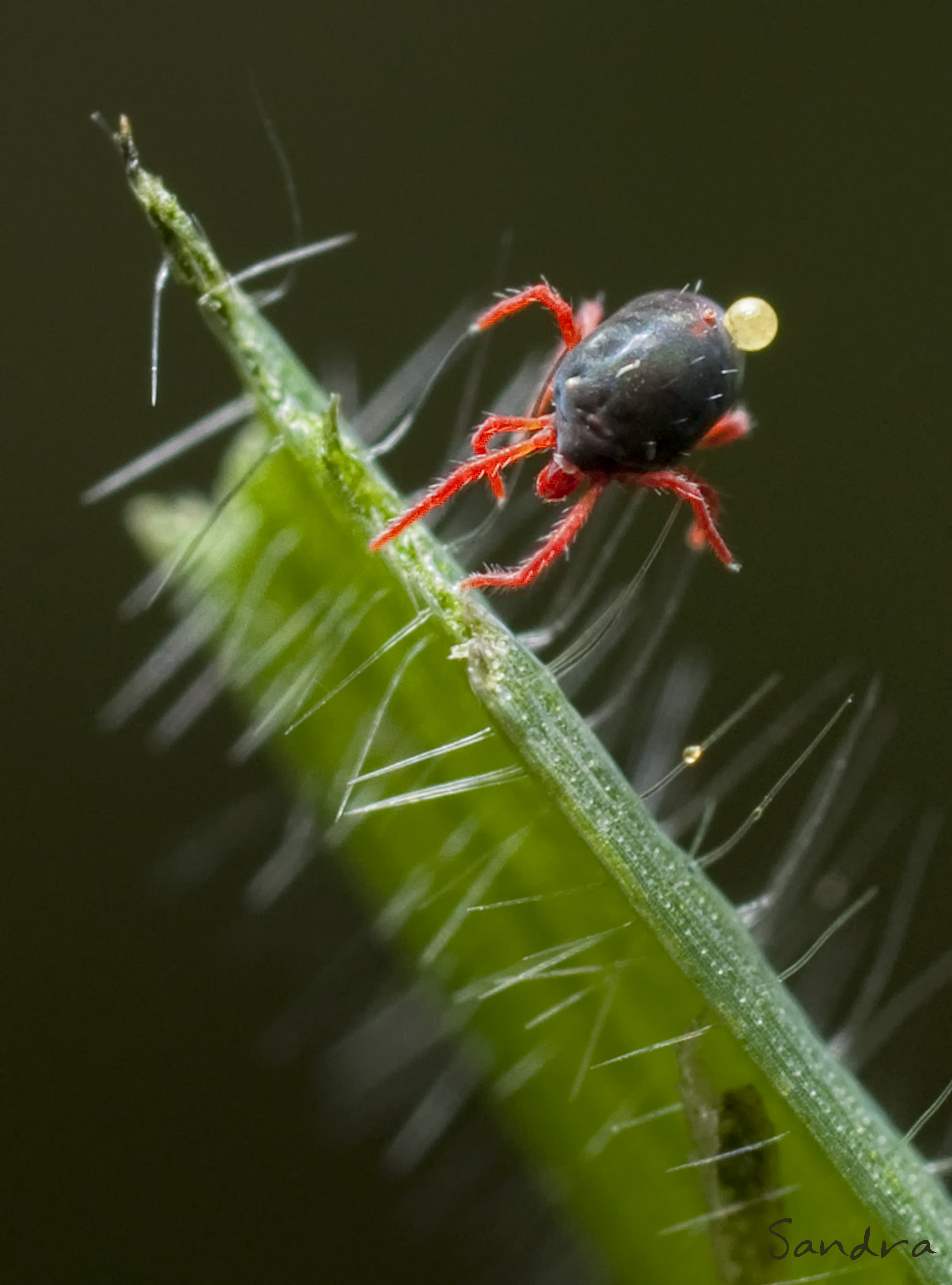
Belongs within: Eupodoidea.
The Penthaleidae are a group of often phytophagous mites, some of which are significant agricultural pests. They are soft-bodied with weakly chelate chelicerae, fifteen or more pairs of setae in the intercoxal region, and a dorsal or dorsoterminal anal opening (Walter et al. 2009).
<==Penthaleidae
|--Chromotydaeus Berlese 1903 H98
| |--C. arcticus (Trägårdh 1900) [=Penthaleus arcticus] T05
| |--C. egregius (Berlese 1891) WL09, SB63 (see below for synonymy)
| |--C. ovatus T05
| |--C. quartus Qin & Halliday 1996 H98
| `--C. villosus [=Penthaleus villosus] T05
|--Halotydeus Berlese 1891 H98
| |--*H. hydrodromus (Berlese & Trouessart 1889) [=Notophallus hydrodromus] QH96
| | |--H. h. hydrodromus QH96
| | `--H. h. albolineatus Halbert 1915 QH96, B96
| |--H. anthropus Qin & Halliday 1996 QH96
| |--H. bakerae Qin & Halliday 1996 H98
| |--H. castellus Qin & Halliday 1996 H98
| |--H. destructor (Tucker 1925) H98 [=Penthaleus destructor H98, Halotydaeus (l. c.) destructor H01]
| |--H. mollis Luxton 1986 L86
| |--H. signiensis WL09
| `--H. spectatus Qin & Halliday 1996 QH96
|--Linopenthaloides novaezealandicus QH96, WL09
`--Penthaleus Koch 1836 [incl. Notophallus Canestrini 1886] H98
|--*P. major (Dugès 1834) SB63 (see below for synonymy)
|--P. crinitus Narayan 1957 N57
|--P. falcatus Qin & Halliday 1996 H98
|--P. haematopus Koch 1840 [=Notophallus haematopus] T05
|--P. illustris Berlese 1916 B16
|--P. insulanus Thorell 1871 [=Notophallus insulanus; incl. Tetranychus borealis Koch 1878] T05
|--P. longipilis (Canestrini 1886) SB63 (see below for synonymy)
|--P. medius Schweizer & Bader 1963 SB63
|--P. minor (Canestrini 1886) [=Notophallus minor] H98
|--P. ovatus CF77
`--P. tectus WL09
Chromotydaeus egregius (Berlese 1891) WL09, SB63 [=Penthaleus egregius SB63, Halotydeus egregius B96, Penthalodes egregius SB63]
Penthaleus longipilis (Canestrini 1886) SB63 [=Notophallus longipilis SB63; incl. P. longilis (l. c.) var. longipes Schweizer 1951 S51]
*Penthaleus major (Dugès 1834) SB63 [=Tetranychus majeur H98, P. maior (l. c.) H98; incl. Notophallus bicolor Froggatt 1921 H98, Notophallus bicolour (l. c.) H98, Notophalus dicolor (l. c.) H98, Penthaleus bicolor H98]
*Type species of generic name indicated
REFERENCES
[B96] Baker, A. S. 1996. On the status of some species of Eupodoidea (Acariformes: Prostigmata) represented in the Berlese Acaroteca. In: Mitchell, R., D. J. Horn, G. R. Needham & W. C. Welbourn (eds) Acarology IX vol. 1. Proceedings pp. 373–375. Ohio Biological Survey: Columbus (Ohio).
[B16] Berlese, A. 1916. Centuria terza di Acari nuovi. Redia 12: 289–338.
[CF77] Canestrini, G., & F. Fanzago. 1877. Intorno agli Acari Italiani. Atti del Reale Istituto Veneto di Scienze, Lettere ed Arti, Serie 5, 4: 69–208, pls 2–7.
[H98] Halliday, R. B. 1998. Mites of Australia: A checklist and bibliography. CSIRO Publishing: Collingwood.
[H01] Halliday, R. B. 2001. 250 years of Australian acarology. In: Halliday, R. B., D. E. Walter, H. C. Proctor, R. A. Norton & M. J. Colloff (eds) Acarology: Proceedings of the 10th International Congress pp. 3–16. CSIRO Publishing: Melbourne.
[L86] Luxton, M. 1986. Mites (Arachnida: Acari) from the coast of Hong Kong. In: B. Morton (ed.) Proceedings of the Second International Marine Biological Workshop: The Marine Flora and Fauna of Hong Kong and Southern China, Hong Kong, 1986 pp. 667–671. Hong Kong University Press.
[N57] Narayan, D. S. 1957. A new species of Penthaleus from Mexico (Acarina: Penthaleidae). Journal of the Kansas Entomological Society 30 (3): 111–113.
[QH96] Qin, T. K., & R. B. Halliday. 1996. Revision of the Australian and South African species of Halotydeus (Acarina: Penthaleidae). Bulletin of Entomological Research 86: 441–450.
[S51] Schweizer, J. 1951. Die Landmilben des schweizerischen Nationalparkes. 2. Teil: Trombidiformes. Ergebnisse der wissenschaftlichen Untersuchung des schweizerischen Nationalparks [Résultats des recherches scientifiques entreprises au Parc National Suisse] 3 (Neue Folge): 51–172.
[SB63] Schweizer, J., & C. Bader. 1963. Die Landmilben der Schweiz (Mittelland, Jura und Alpen): Trombidiformes Reuter, mit 217 Arten und Unterarten und 193 Originalzeichnungen. Denkschriften der Schweizerischen Naturforschenden Gesellschaft [Mémoires de la Société Helvétique des Sciences Naturelles] 84 (2): i–vi, 209–378.
[T05] Trägårdh, I. 1905. Monographie der arktischen Acariden. In: Römer, F., & F. Schaudinn (eds) Fauna Arctica. Eine Zusammenstellun der arktischen Tierformen, mit besonder Berücksichtigung des Spitzbergen-Gebietes auf Grund der Ergebnisse der Deutschen Expedition in das Nördliche Eismeer im Jahre 1898 vol. 4 pp. 1–78. Gustav Fischer: Jena.
[WL09] Walter, D. E., E. E. Lindquist, I. M. Smith, D. R. Cook & G. W. Krantz. 2009. Order Trombidiformes. In: Krantz, G. W., & D. E. Walter (eds) A Manual of Acarology 3rd ed. pp. 233–420. Texas Tech University Press.
Speleognathinae

Belongs within: Procurvata.
The Speleognathinae are a group of mites endoparasitic in the nasal mucosa of birds and mammals. They have no active instars between larva and adult with all three nymphal instars being calyptostatic within the larval skin (Walter et al. 2009).
<==Speleognathinae [Speleognathidae] AF00
| i. s.: Meropiboydaia Fain 1985 AF00, H98
| `--M. merops (Fain 1955) [=Boydaia merops, Aureliania merops, Neoboydaia merops] H98
| Speleochir aitkeni AF00
| Speleognathopsis Cooreman 1954 AF00, H98
| |--S. accipitris (Domrow 1969) [=Ophthalmognathus accipitris] H98
| |--S. benoiti Fain 1955 H98
| `--S. galli AF00
| Trispeleognathini WL09
|--Astrida parrae AF00
`--+--Psyttaboidaia AF00
|--+--Speleognathus Womersley 1936 AF00
| | |--*S. australis Womersley 1936 AF00
| | `--S. schoutedeni Fain 1955 AF00, H98 (see below for synonymy)
| `--Neoboydaia Fain 1958 AF00, H98
| |--N. colymbiformi Clark 1964 H98
| `--N. philomachi (Fain 1956) [=Boydaia philomachi] H98
`--Boydaia Womersley 1953 AF00, H98 [Boydaiini]
|--B. aratingae AF00
|--B. clavata AF00
|--B. crassipes (Berlese & Trouessart 1889) [=Ereynetes crassipes, Riccardoella crassipes] H98
|--B. falconis Fain 1956 H98
|--B. hirundoae Fain 1956 H98
|--B. maluri Domrow 1969 H98
|--B. myzomelae Domrow 1969 H98
|--B. nigra WL09
|--B. podargi Fain & Lukoschus 1979 H98
|--B. spatulata Fain 1955 [=B. sturni var. spatulata] H98
|--B. sturnellae WL09
|--B. sturni (Boyd 1948) [=Speleognathus sturni] H98
|--B. trochila A91
|--B. zosteropis Fain 1963 H98
`--B. zumpti AF00
Speleognathus schoutedeni Fain 1955 AF00, H98 [=Neoboydaia schoutedeni H98, Ophthalmognathus schoutedeni H98, Trispeleognathus schoutedeni H98]
*Type species of generic name indicated
REFERENCES
[A91] André, H. M. 1991. The Tydeoidea: a striking exception to the Oudemans-Grandjean rule. In: Dusbábek, F., & V. Bukva (eds) Modern Acarology: Proceedings of the VIII International Congress of Acarology, held in České Budĕjovice, Czechoslovakia, 6–11 August 1990 vol. 2 pp. 293–296. SPB Academic Publishing: The Hague.
[AF00] André, H. M., & A. Fain. 2000. Phylogeny, ontogeny and adaptive radiation in the superfamily Tydeoidea (Acari: Actinedida), with a reappraisal of morphological characters. Zoological Journal of the Linnean Society 130: 405–448.
[H98] Halliday, R. B. 1998. Mites of Australia: A checklist and bibliography. CSIRO Publishing: Collingwood.
[WL09] Walter, D. E., E. E. Lindquist, I. M. Smith, D. R. Cook & G. W. Krantz. 2009. Order Trombidiformes. In: Krantz, G. W., & D. E. Walter (eds) A Manual of Acarology 3rd ed. pp. 233–420. Texas Tech University Press.
Subscribe to:
Posts (Atom)