Showing posts with label Eupodoidea. Show all posts

Penthaleidae

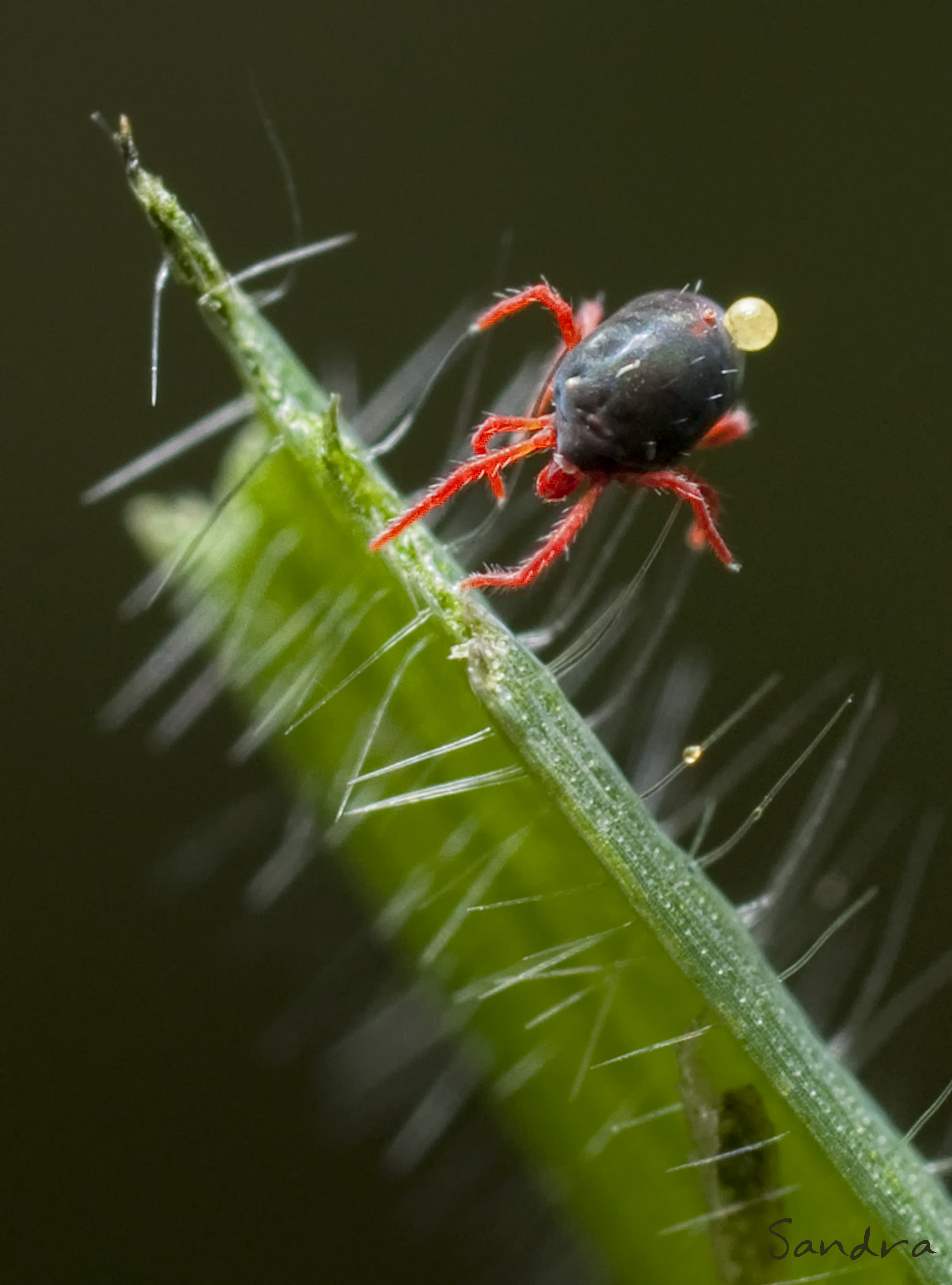
Blue oat mite Penthaleus major, copyright Sandra-Photographie.


Belongs within: Eupodoidea.

The Penthaleidae are a group of often phytophagous mites, some of which are significant agricultural pests. They are soft-bodied with weakly chelate chelicerae, fifteen or more pairs of setae in the intercoxal region, and a dorsal or dorsoterminal anal opening (Walter et al. 2009).

<==Penthaleidae
    |--Chromotydaeus Berlese 1903 H98
    |    |--C. arcticus (Trägårdh 1900) [=Penthaleus arcticus] T05
    |    |--C. egregius (Berlese 1891) WL09, SB63 (see below for synonymy)
    |    |--C. ovatus T05
    |    |--C. quartus Qin & Halliday 1996 H98
    |    `--C. villosus [=Penthaleus villosus] T05
    |--Halotydeus Berlese 1891 H98
    |    |--*H. hydrodromus (Berlese & Trouessart 1889) [=Notophallus hydrodromus] QH96
    |    |    |--H. h. hydrodromus QH96
    |    |    `--H. h. albolineatus Halbert 1915 QH96, B96
    |    |--H. anthropus Qin & Halliday 1996 QH96
    |    |--H. bakerae Qin & Halliday 1996 H98
    |    |--H. castellus Qin & Halliday 1996 H98
    |    |--H. destructor (Tucker 1925) H98 [=Penthaleus destructor H98, Halotydaeus (l. c.) destructor H01]
    |    |--H. mollis Luxton 1986 L86
    |    |--H. signiensis WL09
    |    `--H. spectatus Qin & Halliday 1996 QH96
    |--Linopenthaloides novaezealandicus QH96, WL09
    `--Penthaleus Koch 1836 [incl. Notophallus Canestrini 1886] H98
         |--*P. major (Dugès 1834) SB63 (see below for synonymy)
         |--P. crinitus Narayan 1957 N57
         |--P. falcatus Qin & Halliday 1996 H98
         |--P. haematopus Koch 1840 [=Notophallus haematopus] T05
         |--P. illustris Berlese 1916 B16
         |--P. insulanus Thorell 1871 [=Notophallus insulanus; incl. Tetranychus borealis Koch 1878] T05
         |--P. longipilis (Canestrini 1886) SB63 (see below for synonymy)
         |--P. medius Schweizer & Bader 1963 SB63
         |--P. minor (Canestrini 1886) [=Notophallus minor] H98
         |--P. ovatus CF77
         `--P. tectus WL09

Chromotydaeus egregius (Berlese 1891) WL09, SB63 [=Penthaleus egregius SB63, Halotydeus egregius B96, Penthalodes egregius SB63]

Penthaleus longipilis (Canestrini 1886) SB63 [=Notophallus longipilis SB63; incl. P. longilis (l. c.) var. longipes Schweizer 1951 S51]

*Penthaleus major (Dugès 1834) SB63 [=Tetranychus majeur H98, P. maior (l. c.) H98; incl. Notophallus bicolor Froggatt 1921 H98, Notophallus bicolour (l. c.) H98, Notophalus dicolor (l. c.) H98, Penthaleus bicolor H98]

*Type species of generic name indicated

REFERENCES

[B96] Baker, A. S. 1996. On the status of some species of Eupodoidea (Acariformes: Prostigmata) represented in the Berlese Acaroteca. In: Mitchell, R., D. J. Horn, G. R. Needham & W. C. Welbourn (eds) Acarology IX vol. 1. Proceedings pp. 373–375. Ohio Biological Survey: Columbus (Ohio).

[B16] Berlese, A. 1916. Centuria terza di Acari nuovi. Redia 12: 289–338.

[CF77] Canestrini, G., & F. Fanzago. 1877. Intorno agli Acari Italiani. Atti del Reale Istituto Veneto di Scienze, Lettere ed Arti, Serie 5, 4: 69–208, pls 2–7.

[H98] Halliday, R. B. 1998. Mites of Australia: A checklist and bibliography. CSIRO Publishing: Collingwood.

[H01] Halliday, R. B. 2001. 250 years of Australian acarology. In: Halliday, R. B., D. E. Walter, H. C. Proctor, R. A. Norton & M. J. Colloff (eds) Acarology: Proceedings of the 10th International Congress pp. 3–16. CSIRO Publishing: Melbourne.

[L86] Luxton, M. 1986. Mites (Arachnida: Acari) from the coast of Hong Kong. In: B. Morton (ed.) Proceedings of the Second International Marine Biological Workshop: The Marine Flora and Fauna of Hong Kong and Southern China, Hong Kong, 1986 pp. 667–671. Hong Kong University Press.

[N57] Narayan, D. S. 1957. A new species of Penthaleus from Mexico (Acarina: Penthaleidae). Journal of the Kansas Entomological Society 30 (3): 111–113.

[QH96] Qin, T. K., & R. B. Halliday. 1996. Revision of the Australian and South African species of Halotydeus (Acarina: Penthaleidae). Bulletin of Entomological Research 86: 441–450.

[S51] Schweizer, J. 1951. Die Landmilben des schweizerischen Nationalparkes. 2. Teil: Trombidiformes. Ergebnisse der wissenschaftlichen Untersuchung des schweizerischen Nationalparks [Résultats des recherches scientifiques entreprises au Parc National Suisse] 3 (Neue Folge): 51–172.

[SB63] Schweizer, J., & C. Bader. 1963. Die Landmilben der Schweiz (Mittelland, Jura und Alpen): Trombidiformes Reuter, mit 217 Arten und Unterarten und 193 Originalzeichnungen. Denkschriften der Schweizerischen Naturforschenden Gesellschaft [Mémoires de la Société Helvétique des Sciences Naturelles] 84 (2): i–vi, 209–378.

[T05] Trägårdh, I. 1905. Monographie der arktischen Acariden. In: Römer, F., & F. Schaudinn (eds) Fauna Arctica. Eine Zusammenstellun der arktischen Tierformen, mit besonder Berücksichtigung des Spitzbergen-Gebietes auf Grund der Ergebnisse der Deutschen Expedition in das Nördliche Eismeer im Jahre 1898 vol. 4 pp. 1–78. Gustav Fischer: Jena.

[WL09] Walter, D. E., E. E. Lindquist, I. M. Smith, D. R. Cook & G. W. Krantz. 2009. Order Trombidiformes. In: Krantz, G. W., & D. E. Walter (eds) A Manual of Acarology 3rd ed. pp. 233–420. Texas Tech University Press.

Eupodidae

Holotype of Eupodes longisetatus, copyright Museum of New Zealand Te Papa Tongarewa.


Belongs within: Eupodoidea.

The Eupodidae are a group of mites commonly found in soil and low vegetation in temperate and boreal climates. Many eupodids have the femora of the last pair of legs swollen as an adaptation to jumping or rapid rearwards movement to escape threats. Members of the genus Linopodes have particularly long legs and are commonly found in association with fungi (Walter et al. 2009).

Characters (from Walter et al. 2009): Soft-bodied; chelicerae freely articulating; naso not enlarged; palptibia without clawlike setae or thumblike palptarsus; peritremes absent; prodorsal bothridia present; intercoxal region with fewer than 10 pairs of setae; postpedal furrows absent; anal opening ventral or terminal; leg trichobothria absent; tarsus I with a famulus; femora IV normal or strongly swollen, used in jumping.

<==Eupodidae [Eupodini]
    |--Claveupodes delicatus Strandtmann & Prasse 1977 J91
    |--*Benoinyssus najae WL09
    |--Aethosolenia WL09
    |--Hawaiieupodes thermophilus WL09
    |--Protopenthalodes coniunctus WL09
    |--Egypteupodes Abou-Awad 1984 ZF11
    |--Linopenthaleus Willmann 1951 SB63
    |    `--*L. irki Willmann 1951 SB63
    |--Linopodes Koch 1836 SB63
    |    |--L. agitatorius Berlese 1916 B16
    |    |--L. antennapes WL09
    |    |--L. cameronensis Shiba 1976 S76
    |    |--L. eupodoides Canestrini 1886 SB63
    |    |--L. iwatensis WL09
    |    `--L. motatorius (Linnaeus 1758) SB63 (see below for synonymy)
    |--Caleupodes Baker 1987 AF00
    `--Eupodes Koch 1836 SB63
         |--*E. hiemalis Koch 1838 SB63
         |--E. angardi WL09
         |--E. berensis Shiba 1976 S76
         |--E. berlesei Sig Thor 1891 SB63
         |--E. boerneri WL09
         |--E. cozetensis M83
         |--E. ereynetoides Strandtmann & Prasse 1976 J91
         |--E. fusiferellus S76
         |--E. longisetatus WL09
         |--E. lumbarus Shiba 1976 S76
         |--E. minipilus Oliver & Theron 1998 E-VVM-M07
         |--E. minutus WL09
         |--E. onoi Shiba 1976 S76
         |--E. parafusifer S76
         |--E. pasohenis Shiba 1976 S76
         |--E. paulinae WL09
         |--E. pseudolumbarus Shiba 1976 S76
         |--E. pusillus Shiba 1976 S76
         |--E. sigmoidensis Strandtmann & Goff 1978 E-VVM-M07
         |--E. strandtmanni WL09
         |--E. tottanfiella WL09
         |--E. unifasciatus [incl. E. formosulus, E. leucomelas, E. modicellus] CF77
         |--E. vallombrosae Sig Thor 1934 SB63
         |--E. variegatus DW10 [incl. E. versicolor CF77]
         `--E. voxencollinus Sig Thor 1934 J91

Linopodes motatorius (Linnaeus 1758) SB63 [=Acarus motatorius SB63; incl. Trombidium longipes CF77, Linopodes longipes CF77, L. lutescens CF77]

*Type species of generic name indicated

REFERENCES

[AF00] André, H. M., & A. Fain. 2000. Phylogeny, ontogeny and adaptive radiation in the superfamily Tydeoidea (Acari: Actinedida), with a reappraisal of morphological characters. Zoological Journal of the Linnean Society 130: 405–448.

[B16] Berlese, A. 1916. Centuria terza di Acari nuovi. Redia 12: 289–338.

[CF77] Canestrini, G., & F. Fanzago. 1877. Intorno agli Acari Italiani. Atti del Reale Istituto Veneto di Scienze, Lettere ed Arti, Serie 5, 4: 69–208, pls 2–7.

[DW10] Dabert, M., W. Witalinski, A. Kazmierski, Z. Olszanowski & J. Dabert. 2010. Molecular phylogeny of acariform mites (Acari, Arachnida): strong conflict between phylogenetic signal and long-branch attraction artifacts. Molecular Phylogenetics and Evolution 56 (1): 222–241.

[E-VVM-M07] Estrada-Venegas, E. G., I. M. Vázquez & J. A. Moreno-Moreno. 2007. Prostigmatid mites (Acarida: Prostigmata) in decaying wood from “La Mancha” Veracruz, Mexico. In: Morales-Malacara, J. B., V. M. Behan-Pelletier, E. Ueckermann, T. M. Pérez, E. G. Estrada-Venegas & M. Badii (eds) Acarology XI: Proceedings of the International Congress pp. 691–695. Instituto de Biología and Faculdad de Ciencias, Universidad Nacional Autónoma de México, Sociedad Latinoamericana de Acarología: México.

[J91] Jesionowska, K. 1991. Morphology of the Eupodidae (Actinotrichida, Actinedida, Eupodoidea). In: Dusbábek, F., & V. Bukva (eds) Modern Acarology: Proceedings of the VIII International Congress of Acarology, held in České Budĕjovice, Czechoslovakia, 6–11 August 1990 vol. 2 pp. 265–278. SPB Academic Publishing: The Hague.

[M83] Martin, N. A. 1983. Miscellaneous observations on a pasture fauna: an annotated species list. DSIR Entomology Division Report 3: 1–98.

[SB63] Schweizer, J., & C. Bader. 1963. Die Landmilben der Schweiz (Mittelland, Jura und Alpen): Trombidiformes Reuter, mit 217 Arten und Unterarten und 193 Originalzeichnungen. Denkschriften der Schweizerischen Naturforschenden Gesellschaft [Mémoires de la Société Helvétique des Sciences Naturelles] 84 (2): i–vi, 209–378.

[S76] Shiba, M. 1976. Taxonomic investigation on free-living Prostigmata from the Malay Peninsula. Nature and Life in Southeast Asia 7: 83–229.

[WL09] Walter, D. E., E. E. Lindquist, I. M. Smith, D. R. Cook & G. W. Krantz. 2009. Order Trombidiformes. In: Krantz, G. W., & D. E. Walter (eds) A Manual of Acarology 3rd ed. pp. 233–420. Texas Tech University Press.

[ZF11] Zhang, Z.-Q., Q.-H. Fan, V. Pesic, H. Smit, A. V. Bochkov, A. A. Khaustov, A. Baker, A. Wohltmann, T. Wen, J. W. Amrine, P. Beron, J. Lin, G. Gabryś & R. Husband. 2011. Order Trombiformes Reuter, 1909. In: Zhang, Z.-Q. (ed.) Animal biodiversity: an outline of higher-level classification and survey of taxonomic richness. Zootaxa 3148: 129–138.

Last updated: 24 February 2019.

Eupodoidea

Poecilophysis sp., copyright Marco Salemi.


Belongs within: Prostigmata.
Contains: Penthalodidae, Cocceupodidae, Eupodidae, Penthaleidae, Rhagidia.

The Eupodoidea are a group of mostly soft-bodied mites including predatory, fungivorous and phytophagous forms. Members of the family Rhagidiidae produce silk that they use to protect themselves during moulting, and also in at least some cases in prey capture. They have strongly chelate chelicerae, and multiple solenidia on both the tibia and tarsus of the first pair of legs. Smaller families of the Eupodoidea include Eriorhynchus, large (up to 1.8 mm) mites known only from Australia. They are conspicuously hairy with a hypertrichous naso, six or seven setae on the palptibia (three or fewer in other families) and more than fifteen setae on the subcapitulum (typically two or four in other families). Pilorhagidia and Pentapalpus unguempodius resemble Rhagidiidae in the possession of chelate chelicerae and are probably also predators. Pentapalpus unguempodius possesses palpi with five free segments, claw-like empodia, and two solenidia on tarsus I whereas Pilorhagidia and Rhagidiidae have palpi with four free segments, pad-like empodia, and three or more solenidia on tarsus I (Walter et al. 2009).

See also: The Eupodoidea: earth mites and silk-weaving mites.

Characters (from Kethley 1990): Body usually weakly sclerotised (except in Penthalodidae). Rutellum absent. Palps with four segments; palpal tibia without a clawlike seta. Naso usually present; peritreme absent; one pair of prodorsal trichobothria present. Leg trichobothria absent. Tarsus I usually with at least one recumbent solenidion; famulus present on tarsus I, often stellate-shaped.

<==Eupodoidea [Eupodinae]
    |--+--Eupodidae DW10
    |  `--Penthaleidae DW10
    `--Rhagidiidae DW10
         |--Foveacheles Z01
         |    |--F. terricola (Koch 1835) Z01
         |    `--F. (Mediostella) willmanni NK94
         |--Evadorhagidia Z01
         |--Troglocheles gineti Z01, WL09
         |--Arhagidia monothrix NK94
         |--Shibaia heteropoda (Berlese 1910) (see below for synonymy) B96
         |--Krantzia quadriseta WL09
         |--Robustocheles WL09
         |    |--R. hilli Strandtmann 1971 E-VVM-M07
         |    `--R. mucronata WL09
         |--Tuberostoma WL09
         |    |--T. keithi WL09
         |    `--T. leechi WP99
         |--Coccorhagidia Z01
         |    |--C. clavifrons WL09
         |    |--C. pittardi Strandtmann 1971 Z01
         |    `--C. subterranea (Berlese 1905) [=Rhagidia subterranea; incl. Brevipalpia minima Zacharda 1980] B96
         |--Poecilophysis Z01
         |    |--P. (Dentocheles) pratensis NK94
         |    |--P. recussa (Thor 1909) Z01
         |    |--P. spelaea (Wankel 1861) Z01
         |    `--P. weyerensis WL09
         |--Hammenia WHE88
         |--Rhagidia SB63
         `--Lindquistula multisolenidiata NK94

Eupodoidea incertae sedis:
  Paraprotacarus hirsti Dubinin 1962 AF00
  Palaeotydeus devonicus Dubinin 1962 AF00
  Pilorhagidia Strandtmann & Goff 1977 K90 [incl. Strandtmannia Zacharda 1978 K90; Strandtmanniidae ZF11]
    |--P. celtarum WL09
    `--P. hirsuta WL09
  Eriorhynchus Qin & Halliday 1997 H98 [Eriorhynchidae ZF11]
    |--E. australicus (Womersley 1941) [=Penthalodes australicus] H98
    |--E. hades Qin & Halliday 1997 H98
    |--E. ramosus Qin & Halliday 1997 H98
    |--E. walteri Qin & Halliday 1997 H98
    `--E. womersleyi Qin & Halliday 1997 H98
  Penthalodidae ZF11
  Pentapalpus WL09 [Pentapalpidae ZF11]
    `--P. unguempodius WL09
  Cocceupodidae ZF11
  Dendrochaetidae ZF11

Shibaia heteropoda (Berlese 1910) [=Rhagidia heteropoda; incl. R. longisensilla Shiba 1969, *Shibaia longisensilla] B96

*Type species of generic name indicated

REFERENCES

[AF00] André, H. M., & A. Fain. 2000. Phylogeny, ontogeny and adaptive radiation in the superfamily Tydeoidea (Acari: Actinedida), with a reappraisal of morphological characters. Zoological Journal of the Linnean Society 130: 405–448.

[B96] Baker, A. S. 1996. On the status of some species of Eupodoidea (Acariformes: Prostigmata) represented in the Berlese Acaroteca. In: Mitchell, R., D. J. Horn, G. R. Needham & W. C. Welbourn (eds) Acarology IX vol. 1. Proceedings pp. 373–375. Ohio Biological Survey: Columbus (Ohio).

[DW10] Dabert, M., W. Witalinski, A. Kazmierski, Z. Olszanowski & J. Dabert. 2010. Molecular phylogeny of acariform mites (Acari, Arachnida): strong conflict between phylogenetic signal and long-branch attraction artifacts. Molecular Phylogenetics and Evolution 56 (1): 222–241.

[E-VVM-M07] Estrada-Venegas, E. G., I. M. Vázquez & J. A. Moreno-Moreno. 2007. Prostigmatid mites (Acarida: Prostigmata) in decaying wood from “La Mancha” Veracruz, Mexico. In: Morales-Malacara, J. B., V. M. Behan-Pelletier, E. Ueckermann, T. M. Pérez, E. G. Estrada-Venegas & M. Badii (eds) Acarology XI: Proceedings of the International Congress pp. 691–695. Instituto de Biología and Faculdad de Ciencias, Universidad Nacional Autónoma de México, Sociedad Latinoamericana de Acarología: México.

[H98] Halliday, R. B. 1998. Mites of Australia: A checklist and bibliography. CSIRO Publishing: Collingwood.

[K90] Kethley, J. 1990. Acarina: Prostigmata (Actinedida). In: Dindal, D. L. (ed.) Soil Biology Guide pp. 667–756. John Wiley & Sones: New York.

[NK94] Norton, R. A., & J. B. Kethley. 1994. Ecdysial cleavage lines of acariform mites (Arachnida, Acari). Zoologica Scripta 23 (3): 175–191.

[SB63] Schweizer, J., & C. Bader. 1963. Die Landmilben der Schweiz (Mittelland, Jura und Alpen): Trombidiformes Reuter, mit 217 Arten und Unterarten und 193 Originalzeichnungen. Denkschriften der Schweizerischen Naturforschenden Gesellschaft [Mémoires de la Société Helvétique des Sciences Naturelles] 84 (2): i–vi, 209–378.

[WHE88] Walter, D. E., H. W. Hunt & E. T. Elliott. 1988. Guilds or functional groups? An analysis of predatory arthropods from a shortgrass steppe soil. Pedobiologia 31: 247–260.

[WL09] Walter, D. E., E. E. Lindquist, I. M. Smith, D. R. Cook & G. W. Krantz. 2009. Order Trombidiformes. In: Krantz, G. W., & D. E. Walter (eds) A Manual of Acarology 3rd ed. pp. 233–420. Texas Tech University Press.

[WP99] Walter, D. E., & H. C. Proctor. 1999. Mites: Ecology, Evolution and Behaviour. CABI Publishing: Wallingford (UK).

[Z01] Zacharda, M. 2001. Talus formations—remarkable biotopes for acarological research, with examples from the Rhagidiidae (Acari: Prostigmata). In: Halliday, R. B., D. E. Walter, H. C. Proctor, R. A. Norton & M. J. Colloff (eds) Acarology: Proceedings of the 10th International Congress pp. 269–271. CSIRO Publishing: Melbourne.

[ZF11] Zhang, Z.-Q., Q.-H. Fan, V. Pesic, H. Smit, A. V. Bochkov, A. A. Khaustov, A. Baker, A. Wohltmann, T. Wen, J. W. Amrine, P. Beron, J. Lin, G. Gabryś & R. Husband. 2011. Order Trombidiformes Reuter, 1909. In: Zhang, Z.-Q. (ed.) Animal biodiversity: an outline of higher-level classification and survey of taxonomic richness. Zootaxa 3148: 129–138.

Last updated: 21 July 2022.