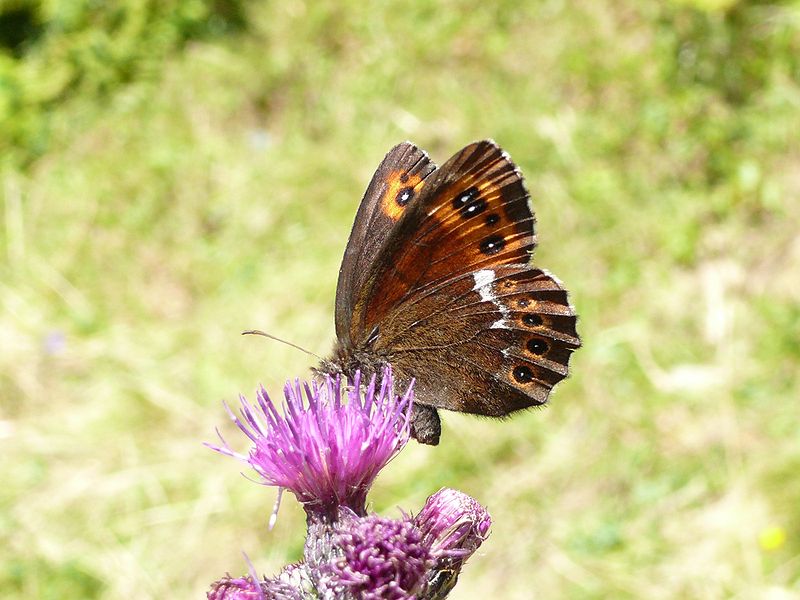
Showing posts with label Macrolepidoptera. Show all posts

Lycaena

Scarce copper Lycaena virgaureae, copyright Algirdas.


Belongs within: Lycaenidae.

Lycaena, coppers, is a genus of butterflies found primarily in the Holarctic region. Males of this genus usually have the ground colour of the upper wing surface orange.

<==Lycaena
    |--L. admetus [incl. L. admetus var. ripperti] P01
    |--L. aegon P01
    |--L. amanda P01
    |--L. argiades [incl. L. argiades ab. coretas] P01
    |--L. argus P01
    |--L. arion [incl. L. arion var. cyanecula, L. arion var. obscura] P01
    |--L. boldenarum O81
    |--L. cnejus WM66
    |--L. damon P01
    |--L. elpis WM66
    |--L. eros P01
    |--L. eumedon P01
    |--L. icarus P01
    |--L. iolas Ochsenheimer 1816 B08
    |--L. kandarpa WM66
    |--L. karsandra Moore 1865 WM66
    |--L. nisa Wallace & Moore 1866 WM66
    |--L. parrhasius WM66
    |--L. plinius WM66
    |--L. pluto WM66
    |--L. sangra Moore 1865 WM66
    |--L. semiargus P01
    |--L. varunana Moore 1865 WM66
    `--L. virgaureae (Linnaeus 1758) JP05

*Type species of generic name indicated

REFERENCES

[B08] Bálint, Z. 2008. Lepidoptera collections of historical importance in the Hungarian Natural History Museum. Annales Historico-Naturales Musei Nationalis Hungarici 100: 17–35.

[JP05] Jungmann, E., & U. Poller. 2005. Neunachweise und Wiederfunde für die Schmetterlingsfauna (Insecta; Lepidoptera) des Altenburger Landes. Mauritiana 19 (2): 317–326.

[O81] O’Brien, C. O. 1981. A. A. Book of New Zealand Wildlife: A guide to the native and introduced animals of New Zealand. Lansdowne Press: Auckland.

[P01] Pável, J. 1901. Lepkék [Lepidopteren]. In: Horváth, G. (ed.) Zichy Jenő Gróf Harmadik Ázsiai Utazása [Dritte Asiatische Forschungsreise des Grafen Eugen Zichy] vol. 2. Zichy Jenő Gróf Harmadik Ázsiai Utazásának Állattani Eredményei [Zoologische Ergebnisse der Dritten Asiatischen Forschungsreise des Grafen Eugen Zichy] pp. 171–177. Victor Hornyánszky: Budapest, and Karl W. Hierseman: Leipzig.

[WM66] Wallace, A. R., & F. Moore. 1866. List of lepidopterous insects collected at Takow, Formosa, by Mr. R. Swinhoe. Proceedings of the Zoological Society of London 1866: 355–365.

Agrotis

Heart and dart Agrotis exclamationis, copyright Entomart.


Belongs within: Macrolepidoptera.

Agrotis, cutworms, is a genus of moths with ground-dwelling larvae that feed on plants from the base.

Characters (from Hampson 1892): Eyes naked and without lashes. Proboscis well developed. Palpi obliquely porrect, with second segment evenly scaled and third segment prominent. Thorax and abdomen without tufts. Abdomen somewhat flattened. Tibia very strongly spined. Fore wings with non-crenulate outer margin. Hind wings with veins 3 and 4 from cell.

<==Agrotis [Agrotiinae, Agrotini]
    |--A. crinigera SS96
    |--A. exclamationis V09
    |--A. infusa G84
    |--A. islandica [incl. A. islandica var. rossica] P01
    |--A. lycarum P01
    |--A. munda G84
    |--A. prasina P01
    |--A. putris P01
    `--A. ypsilon C90
         |--A. y. ypsilon M83
         `--A. y. anietuma M83

*Type species of generic name indicated

REFERENCES

[C90] Crawford, C. S. 1990. Scorpiones, Solifugae, and associated desert taxa. In: Dindal, D. L. (ed.) Soil Biology Guide pp. 421–475. John Wiley & Sones: New York.

[G84] Gauld, I. D. 1984. An Introduction to the Ichneumonidae of Australia. British Museum (Natural History).

[M83] Martin, N. A. 1983. Miscellaneous observations on a pasture fauna: an annotated species list. DSIR Entomology Division Report 3: 1–98.

[P01] Pável, J. 1901. Lepkék [Lepidopteren]. In: Horváth, G. (ed.) Zichy Jenő Gróf Harmadik Ázsiai Utazása [Dritte Asiatische Forschungsreise des Grafen Eugen Zichy] vol. 2. Zichy Jenő Gróf Harmadik Ázsiai Utazásának Állattani Eredményei [Zoologische Ergebnisse der Dritten Asiatischen Forschungsreise des Grafen Eugen Zichy] pp. 171–177. Victor Hornyánszky: Budapest, and Karl W. Hierseman: Leipzig.

[SS96] Simberloff, D., & P. Stilling. 1996. How risky is biological control? Ecology 77 (7): 1965–1974.

[V09] Verdcourt, B. (ed.) 2009. Additions to the Wild Fauna and Flora of the Royal Botanic Gardens, Kew. XXVI. Miscellaneous records. Kew Bulletin 64 (1): 183–194.

Rhopalocera

Macrosoma hedylaria, photographed by Lars Andersen.


Belongs within: Macrolepidoptera.
Contains: Hesperioidea, Papilionidae, Pieridae, Nymphalidae, Lycaenidae, Nymphidiini.

The Rhopalocera includes the butterflies and skippers. The butterflies and most skippers are the best known of the day-flying Lepidoptera, but the basal Hedylidae are nocturnal.

Synapomorphies (from Grimaldi & Engel 2005): Abdominal tergite 1 pouched; eggs resting upright; pupa girdled.

<==Rhopalocera
    |--Hedylidae GE05
    |    |--Hedyle Guenée 1857 BR05
    |    `--Macrosoma hedylaria GE05
    `--+--Hesperioidea GE05
       `--Papilionoidea GE05
            |  i. s.: Pamphila P27
            |           |--P. augias WM66
            |           |--P. hobomoc P27
            |           `--P. maesa Moore 1865 WM66
            |         Signeta tymbophora P27
            |         Motasingha dominula P27
            |         Argyrophenga antipodum P27
            |         Archaeprepona GE05
            |--Papilionidae GE05
            `--+--Pieridae V-W04
               `--+--Nymphalidae GE05
                  `--+--Lycaenidae GE05
                     `--Riodinidae J03
                          |  i. s.: Petrocerus catiena HH02
                          |         Callistium HH02
                          |         Emesis HH02
                          |           |--E. guttata [=Audre guttata] HH02
                          |           |--E. mandana (Cramer 1780) S55
                          |           `--E. xanthosa HH02
                          |         Calydna caieta HH02
                          |         Stalachtis HH02
                          |         Apodemia mormo HH02
                          |           |--A. m. mormo USDI77
                          |           `--A. m. langei USDI77
                          |         Polystichtis S55
                          |           |--P. emylius S55
                          |           |    |--P. e. emylius S55
                          |           |    `--P. e. crispinella Stichel 1911 S55
                          |           `--P. lasthenes FS54
                          |                |--P. l. lasthenes FS54
                          |                `--P. l. zeurippa Boisduval 1836 FS54
                          |         Calephelis virginiensis FS54
                          |           |--C. v. virginiensis FS54
                          |           `--C. v. laverna (Godman & Salvin 1886) FS54
                          |         Lymnas FS54
                          |           |--L. cephise (Ménétriés 1855) FS54
                          |           `--L. pixe (Boisduval 1910) FS54
                          |         Esthemopsis caeruleata (Godman & Salvin 1878) FS54
                          |         Mesosemia S55
                          |           |--M. jeziella S55
                          |           |    |--M. j. jeziella S55
                          |           |    `--M. j. thyestes Druce 1878 S55
                          |           `--M. judicialis Butler 1874 S55
                          |         Lyropteryx apollonia Westwood 1851 GE05, S55
                          |         Cyrenia martia Westwood 1851 S55
                          |         Ancyluris S55
                          |           |--A. aulestes S55
                          |           |    |--A. a. aulestes S55
                          |           |    `--A. a. eryxo (Saunders 1858) S55
                          |           `--A. inca GE05
                          |         Rhetus S55
                          |           |--R. arcius GE05
                          |           `--R. periander (Cramer 1777) S55
                          |         Caria S55
                          |           |--C. mantinea (Felder 1861) S55
                          |           `--C. trochilus S55
                          |                |--C. t. trochilus S55
                          |                `--C. t. arete (Felder 1861) S55
                          |         Baeotis nesaea S55
                          |           |--B. n. nesaea S55
                          |           `--B. n. bacaenita Schaus 1902 S55
                          |         Amarynthis meneria (see below for synonymy) S55
                          |         Peplia lamis [incl. P. lamis f. molpe (Hübner 1816)] S55
                          |         Helicopis cupido GE05
                          |         Riodinella nympha GE05
                          |         Voltinia GE05
                          |           |--V. danforthi V-W04
                          |           `--V. dramba GE05
                          |         Euselasia GE05
                          |         Mesenopsis melanochlora GE05
                          |         Eurybiini HH02
                          |           |--Alesa amesis HH02
                          |           `--Eurybia S55
                          |                |--E. nicaea (Fabricius 1775) S55
                          |                `--E. patrona GE05
                          |--Nymphidiini HH02
                          `--Hamearinae J03
                               |--Abisara J03
                               `--Zemeros J03

Rhopalocera incertae sedis:
  Thanatites vetula GE05
  Corades B66a
    |--C. cybele Butler 1866 B66a
    `--C. sareba B66a
  Daedelma B66a
    |--D. doraete B66a
    `--D. emilia Butler 1866 B66a
  Debis B66a
    |--D. chandica B66a
    |--D. europa WM66
    |--‘Papilio’ halyma Fabricius 1793 [=Neonympha halyma, Satyrus halyma] B66b
    |--D. isabella Butler 1866 B66a
    `--D. portlandia B66b
  Hetaera B66a
    |--H. aurora [incl. H. andromeda] B66a
    |--H. esmeralda B66a
    |--H. harpalyce Butler 1866 B66a
    |--H. pellucida Butler 1866 B6a
    |--H. philis B66a
    `--H. pireta B66a
  Callidryas WM66
    |--C. alcmeone WM66
    `--C. pyranthe WM66
  Messaris erymanthus WM66
  Diadema WM66
    |--D. auge WM66
    `--D. bolina WM66
  Hestina assimilis WM66
    |--H. a. assimilis I92
    `--H. a. shirakii Shirôzu 1955 I92
  Neptis aceris WM66
  Athyma leucothoe WM66
  Ergolis coryta WM66
  Cyllo leda WM66
  Pterygospidea folus [incl. P. cicero] WM66
  Ismene ladon WM66
  Chionobas bore [incl. Papilio polixenes Fabricius 1793, Neonympha polixenes] B66b
  Paralucia pyrodiscus NS04
    |--P. p. pyrodiscus NS04
    `--P. p. lucida NS04
  Hesperilla NS04
    |--H. flavescens NS04
    |    |--H. f. flavescens NS04
    |    `--H. f. flavia NS04
    `--H. idothea NS04
         |--H. i. idothea NS04
         `--H. i. clara NS04
  Anisynta cynone NS04
  Herimosa albovenata NS04
  Argyreus hyperbius NS04
    |--A. h. hyperbius NS04
    `--A. h. inconstans NS04
  Oreixenica NS04
    |--O. kershawi NS04
    |    |--O. k. kershawi NS04
    |    `--O. k. kanunda NS04
    `--O. ptunarra NS04
         |--O. p. ptunarra NS04
         `--O. p. roonina NS04
  Candalides noelkeri NS04
  Jalmenus NS04
    |--J. aridus NS04
    |--J. evagoras NS04
    |    |--J. e. evagoras NS04
    |    `--J. e. eubulus NS04
    `--J. lithochroa NS04
  Pseudalmenus chlorinda NS04
    |--P. c. chlorinda NS04
    `--P. c. myrsilus NS04

Amarynthis meneria [incl. A. meneria f. maecenas (Fabricius 1793), A. meneria f. micalia (Cramer 1776)] S55

*Type species of generic name indicated

REFERENCES

[BR05] Bouchet, P., J.-P. Rocroi, J. Frýda, B. Hausdorf, W. Ponder, Á. Valdés & A. Warén. 2005. Classification and nomenclator of gastropod families. Malacologia 47 (1-2): 1-397.

[B66a] Butler, A. G. 1866a. Descriptions of some new exotic butterflies in the National Collection. Proceedings of the Zoological Society of London 1866: 39-42.

[B66b] Butler, A. G. 1866b. A monograph of the genus Euptychia, a numerous race of butterflies belonging to the family Satyridae; with descriptions of sixty species new to science, and notes on their affinities &c. Proceedings of the Zoological Society of London 1866: 458-504.

[FS54] Franz, E., & H. Schröder. 1954. Tagfalter (Lep. Rhopalocera) aus El Salvador. Senckenbergiana Biologica 35: 75-87.

[GE05] Grimaldi, D., & M. S. Engel. 2005. Evolution of the Insects. Cambridge University Press: New York.

[HH02] Hall, J. P. W., & D. J. Harvey. 2002. Basal subtribes of the Nymphidiini (Lepidoptera: Riodinidae): phylogeny and myrmecophily. Cladistics 18: 539-569.

[I92] Iwahashi, J. (ed.) 1992. Reddo Deeta Animaruzu: a pictorial of Japanese fauna facing extinction. JICC: Tokyo.

[J03] Jong, R. de. 2003. Are there butterflies with Gondwanan ancestry in the Australian region? Invertebrate Systematics 17: 143-156.

[NS04] New, T. R., & D. P. A. Sands. 2004. Management of threatened insect species in Australia, with particular reference to butterflies. Australian Journal of Entomology 43 (3): 258-270.

[P27] Philpott, A. 1927. The maxillae in the Lepidoptera. Transactions and Proceedings of the New Zealand Institute 57: 721-746.

[S55] Schröder, H. 1955. Eine Falter-Ausbeute aus dem westlichen Bolivien. (Ins. Lepid. Rhopal.) Senckenbergiana Biologica 36: 329-338.

[USDI77] USDI (United States Department of the Interior). 1977. Endangered and threatened wildlife and plants - republication of list of species. Federal Register 42: 36420-36431.

[V-W04] Vane-Wright, D. 2004. Butterflies at that awkward age. Nature 428: 477-480.

[WM66] Wallace, A. R., & F. Moore. 1866. List of lepidopterous insects collected at Takow, Formosa, by Mr. R. Swinhoe. Proceedings of the Zoological Society of London 1866: 355-365.

Colias

Dark clouded yellow Colias croceus, photographed by Hans Hillewaert.


Belongs within: Pieridae.

Colias, the clouded yellows, is a subcosmopolitan genus of butterflies with larvae feeding on Vicia species and other Papilionaceae. The dark clouded yellow C. croceus is widespread across most of the Holarctic region; in the western part of its range, it breeds in northern Africa and southern Europe, migrating into the northern parts of Europe over summer.

<==Colias Fabricius 1807 F55
    |--C. alexandra K09
    |--C. baeckeri Kotzsch 1929 F55
    |--C. caesonia [=Zerene caesonia] FS54
    |    |--C. c. caesonia FS54
    |    `--C. c. centralamericana Röber 1909 FS54
    |--C. chlorocoma F55
    |    |--C. c. chlorocoma F55
    |    `--C. c. thatschukovi Bang-Haas 1936 F55
    |--C. cocandica F55
    |    |--C. c. cocandica F55
    |    |--C. c. culminicola Kotzsch 1936 [incl. C. cocandica culminicola ab. xantha Kotzsch 1936] F55
    |    `--C. c. tartarica Bang-Haas 1915 F55
    |--C. croceus (Fourcroy 1785) (see below for synonymy) F55
    |--C. eogene F55
    |    |--C. e. eogene F55
    |    `--C. e. francesca [incl. C. eogene francesca ab. mahdii Bang-Haas 1936] F55
    |--C. europomone Ochsenheimer 1808 B08
    |--C. eurytheme BM76
    |--C. heos F55
    |    |--C. h. heos F55
    |    `--C. h. thia Bang-Haas 1934 [=C. aurora thia] F55
    |--C. hyale (Linnaeus 1760) F55
    |--C. myrmidone P01
    |--C. palaeno F55
    |    |--C. p. palaeno F55
    |    |--C. p. aias Fruhstorfer 1903 I92
    |    |--C. p. poktussana Bang-Haas 1934 F55
    |    `--C. p. sugitanii Esaki 1929 I92
    |--C. staudingeri F55
    |    |--C. s. staudingeri F55
    |    `--C. s. leechi (see below for synonymy) F55
    `--C. wiskotti F55
         |--C. w. wiskotti F55
         `--C. w. aurea Kotzsch 1937 [incl. C. wiskotti aurea ab. blanda Kotzsch 1937] F55

Colias croceus (Fourcroy 1785) [incl. C. edusa ab. decurtata Kitt 1924, C. croceus f. decurtata, C. croceus f. helice (Hübner 1799)] F55

Colias staudingeri leechi [incl. C. leechi ab. carnea Bang-Haas 1937, C. leechi ab. flammula Bang-Haas 1937, C. leechi ab. impunctata Bang-Haas 1937, C. leechi ab. nana Bang-Haas 1937] F55

*Type species of generic name indicated

REFERENCES

[B08] Bálint, Z. 2008. Lepidoptera collections of historical importance in the Hungarian Natural History Museum. Annales Historico-Naturales Musei Nationalis Hungarici 100: 17–35.

[BM76] Bohart, R. M., & A. S. Menke. 1976. Sphecid Wasps of the World. University of California Press: Berkeley.

[F55] Franz, E. 1955. Die Typen und Typoide des Natur-Museums Senckenberg, 16). Insecta, Lepidoptera, Pieridae. Senckenbergiana Biologica 36: 339–367.

[FS54] Franz, E., & H. Schröder. 1954. Tagfalter (Lep. Rhopalocera) aus El Salvador. Senckenbergiana Biologica 35: 75–87.

[I92] Iwahashi, J. (ed.) 1992. Reddo Deeta Animaruzu: a pictorial of Japanese fauna facing extinction. JICC: Tokyo.

[K09] Krantz, G. W. 2009. Habits and habitats. In: Krantz, G. W., & D. E. Walter (eds) A Manual of Acarology 3rd ed. pp. 64–82. Texas Tech University Press.

[P01] Pável, J. 1901. Lepkék [Lepidopteren]. In: Horváth, G. (ed.) Zichy Jenő Gróf Harmadik Ázsiai Utazása [Dritte Asiatische Forschungsreise des Grafen Eugen Zichy] vol. 2. Zichy Jenő Gróf Harmadik Ázsiai Utazásának Állattani Eredményei [Zoologische Ergebnisse der Dritten Asiatischen Forschungsreise des Grafen Eugen Zichy] pp. 171–177. Victor Hornyánszky: Budapest, and Karl W. Hierseman: Leipzig.

Last updated: 20 August 2017.

Satyrini

Arran brown Erebia ligea, photographed by Harald Süpfle.


Belongs within: Satyrinae.
Contains: Euptychia.

The Satyrini are a diverse group of butterflies with larvae that feed mostly on grasses. Members of the Satyrini include the ringlets of the Holarctic genus Erebia, which are mostly dark brown to black butterflies with submarginal orange blotches or bands on the wings.

<==Satyrini
    |--+--Dirina J03
    |  |--Melanargia P01 [Melanargiina J03]
    |  |    `--M. japygia [incl. M. japygia var. suwarovia] P01
    |  `--+--Pronophilina J03
    |     `--Satyrus P01 [Satyrina J03]
    |          |--S. autonoe [incl. S. autonoe var. sibirica] P01
    |          `--S. dryas [incl. S. dryas var. sibirica non S. autonoe var. sibirica] P01
    |--Hypocystina J03
    |    |--Zipaetis J03
    |    |--Lamprolenis J03
    |    |--Xenica J03
    |    `--Hypocysta Westwood 1851 B00
    |         |--H. adiante (Hübner 1831) B00
    |         |    |--H. a. adiante B12
    |         |    `--H. a. antirius Butler 1868 B12
    |         |--H. angustata Waterhouse & Lyell 1914 B00
    |         |--H. euphemia Westwood 1851 B00
    |         |--H. irius (Fabricius 1775) B00
    |         |--H. metirius Butler 1875 B00
    |         `--H. pseudirius Butler 1875 B00
    `--+--+--Maniola WWN03 [Maniolina J03]
       |  |    `--M. jurtina WWN03
       |  `--Coenonympha B66 [Coenonymphina J03]
       |       |--C. hero P01
       |       |--C. iphis P01
       |       |--C. oedipus [=Neonympha oedipus] B66
       |       |    |--C. o. oedipus I92
       |       |    `--C. o. annulifer Butler 1877 I92
       |       `--C. pamphilus P01
       |--+--Euptychia J03
       |  `--Ypthimina J03
       |       |--Austroypthima J03
       |       `--Ypthima Hübner 1818 B00 [incl. Xois Hewitson 1865 J03]
       |            |--Y. arctous (Fabricius 1775) [=Xois arctous] B00
       |            |--‘Xois’ fulvida PP02
       |            |--Y. masakii Ito 1947 I92
       |            |--Y. pusilla B00
       |            |--Y. riukiuana Matsumura 1906 I92
       |            |--‘Xois’ sesara PP02
       |            `--Y. yayeyamana Nire 1920 I92
       `--Erebia B66 [Erebiina J03]
            |--E. afra P01
            |--E. cassioides P74
            |--E. euryale P01
            |--‘Papilio’ florimel Fabricius 1793 [=Neonympha florimel, Satyrus florimel] B66
            |--E. ligea I92
            |    |--E. l. ligea I92
            |    |--E. l. rishirizana Matsumura 1928 I92
            |    `--E. l. takanonis Matsumura 1909 I92
            |--E. niphonica I92
            |--E. nivalis P74
            |--E. palarica WWN03
            `--E. theano NT77

Satyrini incertae sedis:
  Heteronympha Wallengren 1858 WWN03, B00
    |--H. banksii (Leach 1814) B00
    |    |--H. b. banksii B00
    |    |--H. b. mariposa Tindale 1953 B00
    |    `--H. b. nevina Tindale 1953 B00
    |--H. cordace (Geyer 1832) B00
    |    |--H. c. cordace B00
    |    |--H. c. comptena Couchman 1954 B00
    |    |--H. c. kurena Couchman 1954 B00
    |    |--H. c. legana Couchman 1954 B00
    |    `--H. c. wilsoni Burns 1948 B00
    |--H. merope (Fabricius 1775) B00
    |    |--H. m. merope B00
    |    |--H. m. duboulayi (Butler 1867) B00
    |    `--H. m. salazar Fruhstorfer 1911 B00
    |--H. mirifica (Butler 1866) B00
    |--H. paradelpha Lower 1893 [incl. H. paradelpha deervalensis Burns 1946] B00
    |--H. penelope Waterhouse 1937 B00
    |    |--H. p. penelope [incl. H. penelope maraia Tindale 1952, H. penelope sterope Waterhouse 1937] B00
    |    |--H. p. alope Waterhouse 1937 B00
    |    |--H. p. diemeni Waterhouse 1937 B00
    |    `--H. p. panope Waterhouse 1937 B00
    `--H. solandri Waterhouse 1904 [incl. H. solandri angela Tindale 1953] B00
  Cercyonis pegala WWN03
  Aphantopus hyperanthus WWN03

*Type species of generic name indicated

REFERENCES

[B00] Braby, M. F. 2000. Butterflies of Australia: their identification, biology and distribution vol. 2. CSIRO Publishing: Collingwood (Victoria).

[B12] Braby, M. F. 2012. The butterflies of El Questro Wilderness Park, with remarks on the taxonomy of the Kimberley fauna, Australia. Records of the Western Australian Museum 27 (2): 161–175.

[B66] Butler, A. G. 1866. A monograph of the genus Euptychia, a numerous race of butterflies belonging to the family Satyridae; with descriptions of sixty species new to science, and notes on their affinities &c. Proceedings of the Zoological Society of London 1866: 458–504.

[I92] Iwahashi, J. (ed.) 1992. Reddo Deeta Animaruzu: a pictorial of Japanese fauna facing extinction. JICC: Tokyo.

[J03] Jong, R. de. 2003. Are there butterflies with Gondwanan ancestry in the Australian region? Invertebrate Systematics 17: 143–156.

[NT77] Nixon, S. E., & R. J. Taylor. 1977. Large genetic distances associated with little morphological variation in Polycelis coronata and Dugesia tigrina (Planaria). Systematic Zoology 26 (2): 152–164.

[PP02] Patrick, B., & H. Patrick. 2002. Butterflies of Fiji. Weta 24: 5–12.

[P74] Paulson, D. R. 1974. Reproductive isolation in damselflies. Systematic Zoology 23 (1): 40–49.

[P01] Pável, J. 1901. Lepkék [Lepidopteren]. In: Horváth, G. (ed.) Zichy Jenő Gróf Harmadik Ázsiai Utazása [Dritte Asiatische Forschungsreise des Grafen Eugen Zichy] vol. 2. Zichy Jenő Gróf Harmadik Ázsiai Utazásának Állattani Eredményei [Zoologische Ergebnisse der Dritten Asiatischen Forschungsreise des Grafen Eugen Zichy] pp. 171–177. Victor Hornyánszky: Budapest, and Karl W. Hierseman: Leipzig.

[WWN03] Wahlberg, N., E. Weingartner & S. Nylin. 2003. Towards a better understanding of the higher systematics of Nymphalidae (Lepidoptera: Papilionoidea). Molecular Phylogenetics and Evolution 28: 473–484.

Last updated: 19 August 2017.

Nymphalini

Red admiral Vanessa atalanta, photographed by Beentree.


Belongs within: Nymphalinae.

The Nymphalini is a cosmopolitan group of butterflies including such taxa as the admirals and painted ladies (Vanessa) and the anglewings (Polygonia). Members of the genus Vanessa are colourful, often migratory butterflies that feed as larvae on plants of the families Urticaceae and Asteraceae.

<==Nymphalini
    |  i. s.: Hypna [incl. Hecalene] B66
    |           |--H. clytemnestra [=Papilio clytemnestra] B66
    |           |--H. elongata Butler 1866 B66
    |           |--H. globosa Butler 1866 B66
    |           |--H. huebneri Butler 1866 [incl. H. clytemnestra var. iphigenia, H. clytemnestra var. negra] B66
    |           |--H. rufescens Butler 1866 B66
    |           `--H. velox Butler 1866 B66
    |--Antanartia schaenia WWN03
    `--+--+--Polygonia c-album WWN03
       |  `--Nymphalis antiopa WWN03
       `--+--Bassaris Hübner 1821 J03, B00
          |    |--B. gonerilla (Fabricius 1775) J03, B00 [=Vanessa gonerilla J03]
          |    |    |--B. g. gonerilla C88
          |    |    `--B. g. ida C88
          |    `--B. itea (Fabricius 1775) J03, B00 [=Vanessa itea J03]
          `--Vanessa Fabricius 1807 WWN03, B00 [incl. Cynthia Fabricius 1807 B00]
               |--V. amerindica GE05
               |--V. atalanta WWN03
               |--V. callirhoe P01
               |--V. cardui (Linnaeus 1758) B00 [=Cynthia cardui I92]
               |--V. indica P93
               |--V. io P01
               |--V. karagancia GE05
               |--V. kershawi McCoy 1868 PP02 [=Cynthia kershawi O81]
               |--V. levana P01
               `--V. urticae TYM08
                    |--V. u. urticae TYM08
                    `--V. u. nekkana Kishida & Nakamura 1934 TYM08

*Type species of generic name indicated

REFERENCES

[B00] Braby, M. F. 2000. Butterflies of Australia: their identification, biology and distribution vol. 2. CSIRO Publishing: Collingwood (Victoria).

[B66] Butler, A. G. 1866. A revision of the genus Hypna, with descriptions of the new species. Proceedings of the Zoological Society of London 1866: 206–210.

[C88] Craw, R. 1988. Continuing the synthesis between panbiogeography, phylogenetic systematics and geology as illustrated by empirical studies on the biogeography of New Zealand and the Chatham Islands. Systematic Zoology 37 (3): 291–310.

[GE05] Grimaldi, D., & M. S. Engel. 2005. Evolution of the Insects. Cambridge University Press: New York.

[I92] Imes, R. 1992. The Practical Entomologist. Aurum Press: London.

[J03] Jong, R. de. 2003. Are there butterflies with Gondwanan ancestry in the Australian region? Invertebrate Systematics 17: 143–156.

[O81] O’Brien, C. O. 1981. A. A. Book of New Zealand Wildlife: A guide to the native and introduced animals of New Zealand. Lansdowne Press: Auckland.

[PP02] Patrick, B., & H. Patrick. 2002. Butterflies of Fiji. Weta 24: 5–12.

[P01] Pável, J. 1901. Lepkék [Lepidopteren]. In: Horváth, G. (ed.) Zichy Jenő Gróf Harmadik Ázsiai Utazása [Dritte Asiatische Forschungsreise des Grafen Eugen Zichy] vol. 2. Zichy Jenő Gróf Harmadik Ázsiai Utazásának Állattani Eredményei [Zoologische Ergebnisse der Dritten Asiatischen Forschungsreise des Grafen Eugen Zichy] pp. 171–177. Victor Hornyánszky: Budapest, and Karl W. Hierseman: Leipzig.

[P93] Pittaway, A. R. 1993. The Hawkmoths of the Western Palaearctic. Harley Books: Colchester.

[TYM08] Tennent, W. J., M. Yasuda & K. Morimoto. 2008. Lansania Journal of arachnology and zoology—a rare and obscure Japanese natural history journal. Archives of Natural History 35 (2): 252–280.

[WWN03] Wahlberg, N., E. Weingartner & S. Nylin. 2003. Towards a better understanding of the higher systematics of Nymphalidae (Lepidoptera: Papilionoidea). Molecular Phylogenetics and Evolution 28: 473–484.

Last updated: 19 August 2017.

Melitaeini

Northern crescent Phyciodes cocyta, photographed by Gilles Gonthier.


Belongs within: Nymphalinae.

The Melitaeini include the checkerspots, a primarily Nearctic group of butterflies. Checkerspots generally have wings marked with red, orange and black or brown. The genus Melitaea, fritillaries, contains about 80 species found in the Palaearctic region.

<==Melitaeini
    |--Euphydryas WWN03
    |    |--E. aurinia [=Melitaea aurinia] G91
    |    |--E. chalcedona D37
    |    |--E. desfontainii WWN03
    |    `--E. editha S85
    |         |--E. e. editha D37
    |         `--E. e. wrightii D37
    `--+--Chlosyne WWN03
       |    |--C. janais Drury 1782 FS54
       |    `--C. lacinia (Geyer 1837) FS54
       `--+--Melitaea WWN03
          |    |--M. arcesia P01
          |    |--M. athalia [incl. M. athalia ab. navarina] P01
          |    |--M. cinxia P01
          |    |--M. didyma [incl. M. didyma var. alpina] P01
          |    |--M. didymoides WWN03
          |    |--M. neumoegeni D37
          |    |--M. scotosia Butler 1878 I92
          |    |--M. theona (Ménétriés 1857) FS54
          |    `--M. wrightii D37
          `--Phyciodes WWN03
               |--P. albescens Röber 1913 FS54
               |--P. cocyta WWN03
               |--P. elaphiaea Hewitson 1868 S55
               |--P. liriope S55
               |    |--P. l. liriope S55
               |    `--P. l. fragilis (Bates 1864) S55
               `--P. perilla S55
                    |--P. p. perilla S55
                    `--P. p. lugubris Röber 1913 S55

*Type species of generic name indicated

REFERENCES

[D37] Dobzhansky, T. 1937. Genetics and the Origin of Species. Columbia University Press: New York.

[FS54] Franz, E., & H. Schröder. 1954. Tagfalter (Lep. Rhopalocera) aus El Salvador. Senckenbergiana Biologica 35: 75–87.

[G91] Groves, C. P. 1991. A Theory of Human and Primate Evolution, revised ed. Clarendon Press: Oxford.

[I92] Iwahashi, J. (ed.) 1992. Reddo Deeta Animaruzu: a pictorial of Japanese fauna facing extinction. JICC: Tokyo.

[P01] Pável, J. 1901. Lepkék [Lepidopteren]. In: Horváth, G. (ed.) Zichy Jenő Gróf Harmadik Ázsiai Utazása [Dritte Asiatische Forschungsreise des Grafen Eugen Zichy] vol. 2. Zichy Jenő Gróf Harmadik Ázsiai Utazásának Állattani Eredményei [Zoologische Ergebnisse der Dritten Asiatischen Forschungsreise des Grafen Eugen Zichy] pp. 171–177. Victor Hornyánszky: Budapest, and Karl W. Hierseman: Leipzig.

[S55] Schröder, H. 1955. Eine Falter-Ausbeute aus dem westlichen Bolivien. (Ins. Lepid. Rhopal.) Senckenbergiana Biologica 36: 329–338.

[S85] Slatkin, M. 1985. Gene flow in natural populations. Annual Review of Ecology and Systematics 16: 393–430.

[WWN03] Wahlberg, N., E. Weingartner & S. Nylin. 2003. Towards a better understanding of the higher systematics of Nymphalidae (Lepidoptera: Papilionoidea). Molecular Phylogenetics and Evolution 28: 473–484.

Last updated: 18 August 2017.

Polyommatus

Common blue Polyommatus icarus, photographed by Ernst Vikne.


Belongs within: Polyommatini.

Polyommatus is a large genus of blue butterflies found throughout the Old World. The common blue Polyommatus icarus has also been been introduced to North America, first being recorded in Canada in the early 2000s.

Characters (from Bingham 1907): Fore wing with costa very slightly arched, nearly straight; apex well-marked but not acute; termen convex; tornus obtuse; dorsum straight; cell not quite half length of wing; veins 6 and 7 closely approximate almost from a point; middle and lower discocellulars attenuate; vein 8 absent, vein 9 from middle of vein 7, veins 10 and 11 from apical half of subcostal; vein 12 bent towards vein 1l, very close, touching but not anastomosed; vein 12 long, terminates on costa opposite apex of cell. Hind wing with costa slightly arched; apex rounded; termen rather straight especially in the female, in the male slightly convex; tornus well-marked, angulate, dorsum rather long; cell very short, not nearly half length of wing; middle and lower discocellulars attenuate; veins 3 and 4 from lower apex of cell, vein 7 from only a little before upper apex of cell; vein 8 strongly arched at base, terminating on costal margin well before apex of wing. Antenna short, not quite half length of fore wing, club long and gradual, pointed at apex; eyes hairy; palpi porrect or subporrect, fringed anteriorly; third joint rather short, bare, aciculate; body comparatively robust. Male with sex-mark: fore and hind wings thickly overlaid with hair-like scales that give a frosted appearance to the upperside; underside of fore wing with a patch of specialized scales at bases of interspaces 2 and 3.

<==Polyommatus Latreille 1804 BH07
    |--*P. icarus (Rottemburg 1775) [=Papilio icarus] BH07
    |--P. admetus (Esper 1782) BH07
    |--P. amanda (Schneider 1792) BH07
    |--P. amphidamas P01
    |--P. ariana (Moore 1865) BH07
    |--P. bellargus (Rottemburg 1775) BH07
    |--P. coridon (Poda 1761) BH07
    |--P. damon (Denis & Schiffermüller 1775) BH07
    |--P. daphnis (Denis & Schiffermüller 1775) BH07
    |--P. dorylas (Denis & Schiffermüller 1775) BH07
    |--P. eroides (Frivaldszky 1835) BH07
    |--P. eros (Ochsenheimer 1808) BH07
    |--P. erotides (Staudinger 1894) BH07
    |--P. mauritanicus Lucas 1849 E12
    |--P. phlaeas [incl. P. phlaeas var. eleus] P01
    |--P. polonus (Zeller 1848) BH07
    |--P. poseidon (Herrich-Schäffer 1851) BH07
    |--P. rutilus P01
    |--P. stoliczkanus BH07
    |--P. thersites (Cantener 1834) BH07
    `--P. virgaureae [incl. P. virgaureae var. oranula] P01

*Type species of generic name indicated

REFERENCES

[BH07] Bálint, Z., Z. E. Horváth, K. Kertész, Z. Vértesy & L. P. Biró. 2007. Observations on scale structures and spectroscopic properties of Polyommatus lycaenid butterflies (Lepidoptera: Lycaenidae). Annales Historico-Naturales Musei Nationalis Hungarici 99: 115–127.

Bingham, C. T. 1907. The Fauna of British India, including Ceylon and Burma. Butterflies vol. 2. Taylor and Francis: London.

[E12] Evenhuis, N. L. 2012. Publication and dating of the Exploration Scientifique de l’Algérie: Histoire Naturelle des Animaux Articulés (1846–1849) by Pierre Hippolyte Lucas. Zootaxa 3448: 1–61.

[P01] Pável, J. 1901. Lepkék [Lepidopteren]. In: Horváth, G. (ed.) Zichy Jenő Gróf Harmadik Ázsiai Utazása [Dritte Asiatische Forschungsreise des Grafen Eugen Zichy] vol. 2. Zichy Jenő Gróf Harmadik Ázsiai Utazásának Állattani Eredményei [Zoologische Ergebnisse der Dritten Asiatischen Forschungsreise des Grafen Eugen Zichy] pp. 171–177. Victor Hornyánszky: Budapest, and Karl W. Hierseman: Leipzig.

Last updated: 18 August 2017.

Eupithecia

Currant pug Eupithecia assimilata, photographed by Ben Smart.


Belongs within: Geometridae.

Eupithecia, pugs, is a large and cosmopolitan genus of moths, most species of which are however small and difficult to distinguish. Larvae of most species feed on the flowers and seeds of their preferred food plants.

Characters (from Watson & Dallwitz): Antennae of males simple; simply-ciliate. Face rough (with a short cone of scales). Wingspan 16–28(–36) mm. Forewings relatively narrow-elongate to relatively broad. The outer margin of the forewing convexly curved, or convexly curved to more or less straight. Forewings not predominantly green, yellow, or black; diverse in colour but not green, usually more or less conspicuously transversely patterned; predominantly whitish, or pale ochreous, or ochreous, or cream, or light brown, or brown, or pale fuscous, or fuscous, or pale grey, or grey; with a clear discal mark, or without a clear discal mark; with a distinct median band (very rarely, with a dark band), or without a median band. Outer margin of the hindwings smooth. Hindwings conspicuously patterned to plain (like or unlike the forewings); diverse in colour but not green, like or somewhat unlike the forewings; not predominantly green, yellow, or black; with a clear discal mark to without a clear discal mark; transversely lined (usually, the lines sharp to faint), or without transverse lines. Vein 10 of the forewings arising independently of 9; arising independently, anastomosing with 11 and 9 to form a double areole, or arising out of 11 and anastomosing with 9 to form a simple areole (mostly). Hindwings exhibiting a tubular vein 5. Vein 5 of the hindwings arising from about the middle of the transverse vein, or arising from below the middle of the transverse vein. Vein 8 of the hindwings approximated to or anastomosed with the upper margin of the cell to the middle or beyond. Hindwing veins 6 and 7 stalked. Posterior tibiae of males 4-spurred. Abdomen conspicuously patterned, or plain.

<==Eupithecia
    |--E. abietaria (Goeze 1781) JP05
    |--E. andrea Weisert 2005 F05
    |--E. assimilata (Doubleday 1856) JP05
    |--E. cauchiata (Duponchel 1830) JP05
    |--E. coronata P01
    |--E. expallidata (Doubleday 1856) JP05
    |--E. extraversaria (Herrich-Schäffer 1852) JP05
    |--E. goossensiata (Mabille 1869) JP05
    |--E. intricata (Zetterstedt 1839) JP05
    |--E. laquaearia Herrich-Schäffer 1848 JP05
    |--E. nanata (Hübner 1813) JP05
    |--E. pusillata (Denis & Schiffermüller 1775) JP05
    |--E. satyrata (Hübner 1813) JP05
    |--E. simpliciata (Haworth 1809) JP05
    |--E. sinuosaria P01
    |--E. subfuscata (Haworth 1809) JP05
    |--E. trisignaria Herrich-Schäffer 1848 JP05
    |--E. venosata (Fabricius 1787) JP05
    `--E. virgaureata Doubleday 1861 JP05

*Type species of generic name indicated

REFERENCES

[F05] Fernández, J. 2005. Noticia de nuevos táxones para la ciencia en el ámbito Íbero-Balear y Macaronésico. Nuevos táxones animales descritos en la península Ibérica y Macaronesia desde 1994 (IX). Graellsia 61 (2): 261–282.

[JP05] Jungmann, E., & U. Poller. 2005. Neunachweise und Wiederfunde für die Schmetterlingsfauna (Insecta; Lepidoptera) des Altenburger Landes. Mauritiana 19 (2): 317–326.

[P01] Pável, J. 1901. Lepkék [Lepidopteren]. In: Horváth, G. (ed.) Zichy Jenő Gróf Harmadik Ázsiai Utazása [Dritte Asiatische Forschungsreise des Grafen Eugen Zichy] vol. 2. Zichy Jenő Gróf Harmadik Ázsiai Utazásának Állattani Eredményei [Zoologische Ergebnisse der Dritten Asiatischen Forschungsreise des Grafen Eugen Zichy] pp. 171–177. Victor Hornyánszky: Budapest, and Karl W. Hierseman: Leipzig.

Last updated: 16 August 2017.

Smerinthini

Smerinthus planus, photographed by yyzz2.


Belongs within: Sphingidae.

The Smerinthini is a group of hawk moths with a commonly reduced proboscis. Members of the subtribe Smerinthina do not feed as adults, but members of the Ambulycina do so.

See also: The sphinxes that aren't like the others.

Characters (from here): Forewing primarily yellow-brown, greyish lilac or green, with a few crossbands and spots. Hindwing usually with a brownish or reddish brown field; crossbands reduced to a pale or ocellate spot at anal angle. Proboscis often atrophied. Spines on caudal margins of abdominal terga generally diffuse. Male with uncus variable, with a flat, entire or split tip; gnathos absent, bilobate or entire; sacculus with two simple or bilobate processes and pectens; saccus not well developed; aedeagus relatively short and often with a stout apical cornutus. Valva often with pouches on inner surface distally. Female with ductus bursa usually broad and short. Larva with horn usually developed; cuticle rough with fine tubercles; oblique lateral stripes present, sometimes in combination with longitudinal lines; body usually tapering forward from abdominal segment 5. Pupa with proboscis fused to body; labrum displaced ventrally; abdominal segments 5-7 with 1-4 interrupted, punctate furrows over each spiracle.

<==Smerinthini
    |  i. s.: Amplypterus panopus AJ05
    |         Daphnusa ocellaris AJ05
    |         Pachysphinx modesta (Harris 1839) P93
    |--Ambulycina [Ambulicinae] P93
    |    |--Akbesia Rothschild & Jordan 1903 P93
    |    |    `--*A. davidi (Oberthür 1884) [=Smerinthus davidi] P93
    |    `--Ambulyx Walker 1856 [incl. Protambulyx Rothschild & Jordan 1903] P93
    |         |--A. canescens AJ05
    |         |--‘Protambulyx’ carteri DS73
    |         |--A. joiceyi AJ05
    |         |--A. lahora (Butler 1875) P93
    |         |--A. moorei Moore 1858 [incl. A. subocellata Felder & Felder 1874] NS07
    |         |--A. pryeri AJ05
    |         `--‘Protambulyx’ strigilis DS73
    |              |--P. s. strigilis DS73
    |              `--P. s. rubripennis DS73
    `--Smerinthina P93
         |--Mimas Hübner 1819 [incl. Lucena Rambur 1840] P93
         |    `--*M. tiliae (Linnaeus 1758) P93 (see below for synonymy)
         |--Marumba Moore 1882 [incl. Burrowsia Tutt 1902, Kayeia Tutt 1902, Sichia Tutt 1902] P93
         |    |--*M. dyras (Walker 1856) [=Smerinthus dyras] P93
         |    |--M. gaschkewitschii P93
         |    |--M. jankowskii P93
         |    |--M. maacki P93
         |    `--M. quercus (Denis & Schiffermüller 1775) (see below for synonymy) P93
         |--Laothoe Fabricius 1807 [incl. Amorpha Hübner 1806 (nom. inv.)] P93
         |    |--*L. populi (Linnaeus 1758) [=Sphinx populi] P93
         |    |    |--L. p. populi (see below for synonymy) P93
         |    |    `--L. p. populeti (Bienert 1870) (see below for synonymy) P93
         |    |--L. amurensis (Staudinger 1892) (see below for synonymy) P93
         |    |--L. austauti (Staudinger 1877) (see below for synonymy) P93
         |    |--L. philerema (Djakonov 1923) [=Amorpha populi philerema, L. populi philerema] P93
         |    `--L. sinica (Rothschild & Jordan 1903) [=L. amurensis sinica] P93
         `--Smerinthus Latreille 1802 (see below for synonymy) P93
              |--*S. ocellatus (Linnaeus 1758) [=Sphinx ocellata] P93
              |    |--S. o. ocellatus (see below for synonymy) P93
              |    `--S. o. atlanticus Austaut 1890 [incl. S. ocellata protai Speidel & Kaltenbach 1981] P93
              |--S. caecus Ménétriés 1857 P93
              |--S. jamaicensis (Drury 1773) ONE03
              |--S. kindermanni Lederer 1853 P93
              |    |--S. k. kindermanni P93
              |    |--S. k. meridionalis Gehlen 1931 P93
              |    |--S. k. obsoletus Staudinger 1901 P93
              |    `--S. k. orbatus Grum-Grshimailo 1890 [=S. kindermanni var. orbata] P93
              |--S. minor P93
              |--S. planus Walker 1856 P93
              `--S. tatarinovii P01

Laothoe amurensis (Staudinger 1892) [=Smerinthus tremulae var. amurensis; incl. L. tremulae baltica Viĭdalep 1979, S. tremulae Boisduval 1828 non Sphinx tremulae Borkhausen 1793] P93

Laothoe austauti (Staudinger 1877) [=Smerinthus austauti, L. populi austauti; incl. S. poupillieri Bellier 1878] P93

Laothoe populi populeti (Bienert 1870) [=Smerinthus populeti; incl. S. populi var. populetorum Staundinger 1887, Amorpha populi syriaca Gehlen 1932] P93

Laothoe populi populi (Linnaeus 1758) [incl. L. populi iberica Eitschberger, Danner & Surholt 1989, Amorpha populi intermedia Gehlen 1934, A. populi lappona Rangnow 1935, A. palustris Holle 1865, Sphinx tremulae Borkhausen 1793] P93

Marumba quercus (Denis & Schiffermüller 1775) [=Sphinx quercus; incl. M. quercus mesopotamica Bang-Haas 1938, M. quercus schirasi Bang-Haas 1938] P93

*Mimas tiliae (Linnaeus 1758) P93 [=Sphinx tiliae P93, Smerinthus tiliae L02; incl. M. tiliae f. brunnea P93, M. tiliae f. lutescens P93, M. tiliae montana Daniel & Wolfsberger 1955 P93, M. tiliae f. obsoleta P93, M. tiliae f. pallida P93, M. tiliae f. transversa P93, Papilio ulmi Lucas 1864 P93, M. tiliae f. virescens P93]

Smerinthus Latreille 1802 [incl. Bebroptera Sodoffsky 1837, Bellia Tutt 1902 (preoc.), Bellinca Strand 1943, Copismerinthus Grote 1886, Daddia Tutt 1902, Dilina Dalman 1816, Eusmerinthus Grote 1877, Merinthus Meigen 1830] P93

Smerinthus ocellatus ocellatus (Linnaeus 1758) [incl. Sm. ocellatus ocellatus f. albescens, Sm. cinerescens Staudinger 1879, Sm. ocellatus ocellatus f. flavescens, Sm. ocellatus ocellatus f. ollivryi, Sm. ocellatus ocellatus f. pallida, Sm. ocellatus ocellatus f. rosea, Sphinx salicis Hübner 1805, Sp. semipavo Retzius 1783] P93

*Type species of generic name indicated

REFERENCES

[AJ05] Abang, F., & A. M. Jackson. 2005. A list of hawk-moths (Lepidoptera: Sphingidae) from Gunung Murud, Sarawak. Serangga 10 (1-2): 127–132.

[DS73] Dickens, M., & E. Storey. 1973. The World of Moths. Macmillan Publishing Co., Inc.: New York.

[L02] Latreille, P. A. 1802. Histoire Naturelle, générale et particulière des crustacés et des insectes vol. 3. Familles naturelles des genres. F. Dufart: Paris.

[NS07] Nässig, W. A., & W. Speidel. 2007. On the authorships of the Lepidoptera Atlas of the “Reise der Novara”, with a list of the taxa of Bombycoidea [s. l.] therein described (Insecta, Lepidoptera, Bombycoidea). Senckenbergiana Biologica 87 (1): 63–74.

[ONE03] Oberprieler, R. G., W. A. Nässig & E. D. Edwards. 2003. Ebbepterote, a new genus for the Australian ‘Eupterote’ expansa (T. P. Lucas), with a revised classification of the family Eupterotidae (Lepidoptera). Invertebrate Systematics 17: 99–110.

[P01] Pável, J. 1901. Lepkék [Lepidopteren]. In: Horváth, G. (ed.) Zichy Jenő Gróf Harmadik Ázsiai Utazása [Dritte Asiatische Forschungsreise des Grafen Eugen Zichy] vol. 2. Zichy Jenő Gróf Harmadik Ázsiai Utazásának Állattani Eredményei [Zoologische Ergebnisse der Dritten Asiatischen Forschungsreise des Grafen Eugen Zichy] pp. 171–177. Victor Hornyánszky: Budapest, and Karl W. Hierseman: Leipzig.

[P93] Pittaway, A. R. 1993. The Hawkmoths of the Western Palaearctic. Harley Books: Colchester.

Last updated: 15 August 2017.