Showing posts with label Diptera. Show all posts

Phorinae

Phora sp., copyright Eugene K.


Belongs within: Phoridae.

The Phorinae are a group of scuttle flies characterised by more or less distinct bristles on the tibiae, particularly a proximodorsal pair on the mid tibia (Peterson 1987).

Characters (from Peterson 1987): Frons bristled along entire lateral margins; supra-antennal bristles, when present, reclinate. Wing fully developed in both sexes. Tibiae with distinct, though sometimes short or weak, bristles; mid tibia always with at least a closely situated dorsal pair on basal half; other tibiae sometimes with similar bristles.

<==Phorinae B10
    |--Crinophleba rostrata P87
    |--Spiniphora spinulosa P87, B10
    |--Abaristophora diversipennis P87, B10
    |--Hypocerides nearcticus P87
    |--Stichillus adamsi P87
    |--Coniceromyia pilipleura P87
    |--Chaetopleurophora Schmitz 1927 H02
    |--Caenophorites Hong 2002 H02
    |    `--*C. xilutianensis Hong 2002 H02
    |--Huaxiaphoritis Hong 2002 H02
    |    `--*H. longispina (Hong 1981) [=Chaetopleurophora longispina] H02
    |--Fushunophoritis Hong 2002 H02
    |    `--*F. gastrocanthoidis (Hong 1981) [=Chaetopleurophora gastrocanthoidis] H02
    |--Fushuniclavicornia Hong 2002 H02
    |    `--*F. sinica (Hong 1981) [=Chaetopleurophora sinica] H02
    |--Rhoptrocera Hong 1981 H02
    |    `--*R. eocenica Hong 1981 H02
    |--Dohrniphora P87
    |    |--D. cornuta B10
    |    `--D. poinari P92
    |--Anevrina P87
    |    |--A. spinipes P87
    |    `--A. unispinosa B10
    |--Triphleba [incl. Citrago] P87
    |    |--T. pachyneura B10
    |    `--‘Citrago’ politifrons P87
    |--Borophaga P87
    |    |--B. incrassata [=Hypocera incrassata] A71
    |    `--B. verticalis B10
    |--Diplonevra P87
    |    |--D. florea WJ18
    |    |--D. nitidula B10
    |    `--D. setigera B10
    `--Phora Latreille 1796 BR05
         |--P. aterima (Fabricius 1794) [=Musca aterima] H02
         |--P. atra G20
         |--P. cara R35
         |--P. hybosa Hong 1981 H02
         |--P. occidentata B10
         |--P. putris (Linnaeus 758) L02, L58 [=Musca putris L02]
         `--P. viridinota P87

*Type species of generic name indicated

REFERENCES

[A71] Askew, R. R. 1971. Parasitic Insects. Heinemann Educational Books: London.

[BR05] Bouchet, P., & J.-P. Rocroi. 2005. Classification and nomenclator of gastropod families. Malacologia 47 (1–2): 1–397.

[B10] Brown, B. V. 2010. Phoridae (hump-backed flies, scuttle flies). In: Brown, B. V., A. Borkent, J. M. Cumming, D. M. Wood, N. E. Woodley & M. A. Zumbado (eds) Manual of Central American Diptera vol. 2 pp. 725–761. NRC Research Press: Ottawa.

[G20] Goldfuss, G. A. 1820. Handbuch der Naturgeschichte vol. 3. Handbuch der Zoologie pt 1. Johann Leonhard Schrag: Nürnberg.

[H02] Hong Y. 2002. Amber Insect of China. Beijing Scientific and Technological Publishing House.

[L02] Latreille, P. A. 1802. Histoire Naturelle, générale et particulière des crustacés et des insectes vol. 3. Familles naturelles des genres. F. Dufart: Paris.

[L58] Linnaeus, C. 1758. Systema Naturae per Regna Tria Naturae, secundum classes, ordines, genera, species, cum characteribus, differentiis, synonymis, locis. Tomus I. Editio decima, reformata. Laurentii Salvii: Holmiae.

[P87] Peterson, B. V. 1987. Phoridae. In: McAlpine, J. F. (ed.) Manual of Nearctic Diptera vol. 2 pp. 689–712. Research Branch, Agriculture Canada.

[P92] Poinar, G. O., Jr. 1992. Life in Amber. Stanford University Press: Stanford.

[R35] Rayment, T. 1935. A Cluster of Bees: Sixty essays on the life-histories of Australian bees, with specific descriptions of over 100 new species. Endeavour Press: Sydney.

[WJ18] Wahlberg, E., & K. A. Johanson. 2018. Molecular phylogenetics reveals novel relationships within Empidoidea (Diptera). Systematic Entomology 43: 619–636.

Cerioidini

Cerioides ornata, copyright Gail Hampshire.


Belongs within: Syrphoidea.

The Cerioidini are a group of hover flies that closely mimic wasps in their appearance.

Characters (from Vockeroth & Thompson 1987): Length 8 mm or more. Antenna long; scape three to four times as long as wide; first flagellomere shorter than scape and pedicel combined; with terminal stylus. Head not strongly concave, postpronota clearly exposed. Crossvein r-m beyond middle of cell dm. Male abdomen with tergite 5 not visible in dorsal view.

<==Cerioidini [Cerioidinae]
    |--Polybiomyia townsendi VT87, TRZ10
    |--Sphiximorpha VT87
    |--Monoceromyia floridensis VT87
    |--Ceriana VT87
    |    |--C. abbreviata VT87
    |    `--C. cacica TRZ10
    `--Cerioides [incl. Pterygophoromyia Shannon 1927] R54
         |  i. s.: C. ablepta Riek 1954 R54
         |         C. fascialis (Kertesz 1903) [=Ceria fascialis] R54
         |         C. ornatifrons R35
         |--C. subarmata group R54
         |    |--C. procapna Riek 1954 R54
         |    `--C. subarmata Curran 1926 [incl. Monoceromyia austeni Shannon 1927] R54
         |--C. macleayi group R54
         |    |--C. alaplicata Hardy 1945 R54
         |    |--C. atacta Riek 1954 [=C. fascialis Ferguson 1926 non Ceria fascialis Kertesz 1903] R54
         |    |--C. breviscapa (Saunders 1845) [=Ceria breviscapa; incl. Cerioides victoria Curran 1925] R54
         |    |--C. doddi Ferguson 1926 R54
         |    |--C. euchroma Riek 1954 R54
         |    |--C. macleayi Ferguson 1926 [incl. Monoceromyia hardyi Shannon 1927] R54
         |    `--C. phya Riek 1954 R54
         `--C. ornata group R54
              |--C. alboseta Ferguson 1926 R54
              |--C. apicalis Ferguson 1926 R54
              |--C. euphara Riek 1954 [=C. variabilis Ferguson 1926 non Kertesz 1903] R54
              |--C. lypra Riek 1954 R54
              |--C. mastersi Ferguson 1926 R54
              |--C. mellivora (Shannon 1927) [=Tenthredomyia (Pterygophoromyia) mellivora] R54
              |--C. optata Riek 1954 R54
              |--C. opuntiae Ferguson 1926 R54
              |--C. ornata (Saunders 1845) (see below for synonymy) R54
              |    |--C. o. ornata R54
              |    `--C. o. australis (Macquart 1850) [=Ceria australis, Tenthredomyia australis] R54
              |--C. picta Riek 1954 R54
              |--C. platypus Ferguson 1926 R54
              |--C. saundersi (Shannon 1925) [=Tenthredomyia saundersi, T. (*Pterygophoromyia) saundersi] R54
              |--C. sphenotoma Riek 1954 R54
              `--C. tolmera Riek 1954 R54

Cerioides ornata (Saunders 1845) [=Ceria ornata, Cerioides ornatus, Tenthredomyia (Pterygophoromyia) ornata] R54

*Type species of generic name indicated

REFERENCES

[R35] Rayment, T. 1935. A Cluster of Bees: Sixty essays on the life-histories of Australian bees, with specific descriptions of over 100 new species. Endeavour Press: Sydney.

[R54] Riek, E. F. 1954. The Australian syrphid flies of the subfamily Cerioidinae (Diptera: Syrphidae): systematics and wing folding. Australian Journal of Zoology 2 (1): 100–130.

[TRZ10] Thompson, E. C., G. E. Rotheray & M. A. Zumbado. 2010. Syrphidae (flower flies). In: Brown, B. V., A. Borkent, J. M. Cumming, D. M. Wood, N. E. Woodley & M. A. Zumbado (eds) Manual of Central American Diptera vol. 2 pp. 763–792. NRC Research Press: Ottawa.

[VT87] Vockeroth, J. R., & F. C. Thompson. 1987. Syrphidae. In: McAlpine, J. F. (ed.) Manual of Nearctic Diptera vol. 2 pp. 713–743. Research Branch, Agriculture Canada.

Liriomyza

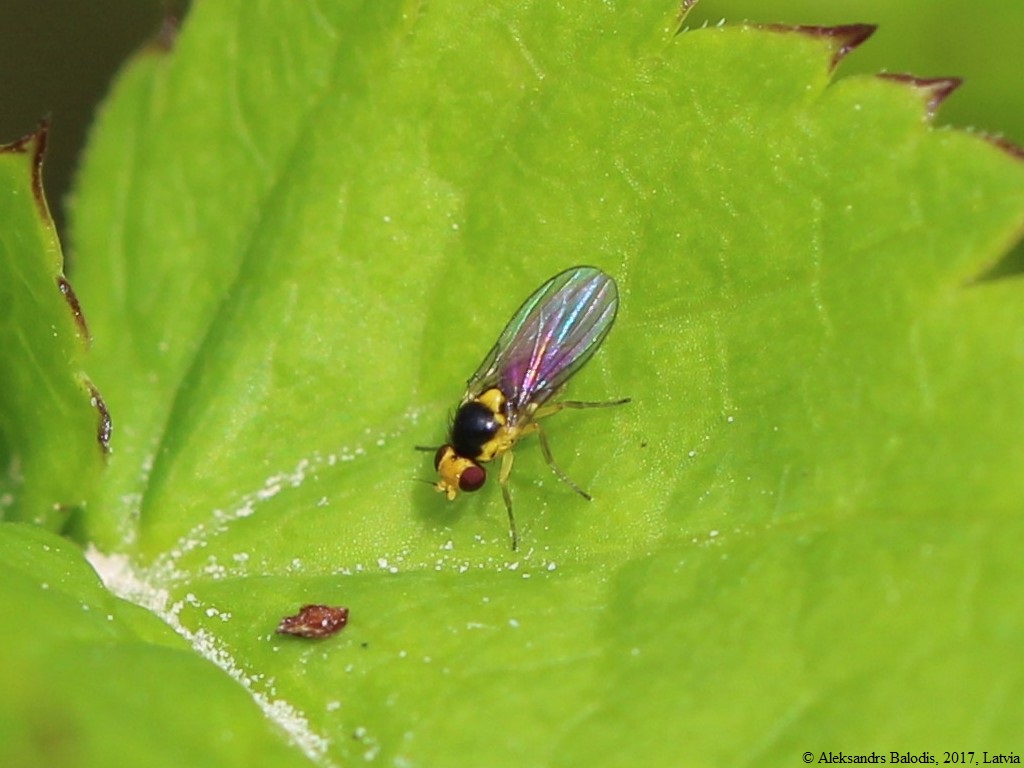
Liriomyza pusilla, copyright Aleksandrs Balodis.


Belongs within: Agromyzidae.

Liriomyza is a diverse genus of leaf-mining flies feeding on a wide range of plant hosts, with the highest diversity of species found in northern temperate regions (Boucher 2010).

Characters (from Boucher 2010): Frons and scutellum usually bright yellow (either or both occasionally dark); lunule not especially high or large; three (sometimes two) postsutural and one presutural dorsocentral bristles; M1 ending closer to wing tip than R4+5; knob of halter completely white or yellow; male usually with stridulatory mechanism on membrane connecting abdominal tergites and sternites; surstylus usually present, with one or two (rarely three) spines and sometimes few weak hairs; epandrium often with one or two (sometimes more) spines at posteroventral margin, or conspicuously sclerotised on inner margin.

<==Liriomyza [incl. Praspedomyza] S87
    |--L. arctii B10
    |--L. brassicae B88
    |--L. chenopodii M83
    |--L. cortesi B10
    |--L. fricki S87
    |--L. galiivora S87
    |--L. helichrysi B88
    |--L. huidobrensis B10
    |--L. philadelphivora S87
    |--L. pusilla RD77
    |--L. septentrionalis B10
    |--L. sativae B10
    |--L. schmidti S87
    |--L. singula S87
    `--L. trifolii B10

*Type species of generic name indicated

REFERENCES

[B88] Bouček, Z. 1988. Australasian Chalcidoidea (Hymenoptera): A biosystematic revision of genera of fourteen families, with a reclassification of species. CAB International: Wallingford (UK).

[B10] Boucher, S. 2010. Agromyzidae (leaf-mining flies). In: Brown, B. V., A. Borkent, J. M. Cumming, D. M. Wood, N. E. Woodley & M. A. Zumbado (eds) Manual of Central American Diptera vol. 2 pp. 1057–1071. NRC Research Press: Ottawa.

[M83] Martin, N. A. 1983. Miscellaneous observations on a pasture fauna: an annotated species list. DSIR Entomology Division Report 3: 1–98.

[RD77] Richards, O. W., & R. G. Davies. 1977. Imms' General Textbook of Entomology 10th ed. vol. 2. Classification and Biology. Chapman and Hall: London.

[S87] Spencer, K. A. 1987. Agromyzidae. In: McAlpine, J. F. (ed.) Manual of Nearctic Diptera vol. 2 pp. 869–879. Research Branch, Agriculture Canada.

Cerodontha

Cerodontha sp., copyright Steve Kerr.


Belongs within: Agromyzidae.

Cerodontha is a genus of leaf-mining flies that develop on species of Monocotyledoneae. The genus is characterised by the presence in the male terminalia of L-shaped subepandrial sclerites (Boucher 2010).

<==Cerodontha B10
    |  i. s.: C. australis [=C. denticornis] M83
    |         C. flavocingulata S87
    |         C. frankensis S87
    |         C. robusta CM91
    |         C. scirpivora S87
    |--C. (Cerodontha) dorsalis B10
    |--C. (Dizygomyza) B10
    |    |--‘Dizygomyza’ cambii [=Phytobia cambii] RD77
    |    `--C. (D.) luctuosa B10
    `--C. (Poemyza) B10
         |--C. (P.) muscina B10
         `--C. (P.) pygmaea B10

*Type species of generic name indicated

REFERENCES

[B10] Boucher, S. 2010. Agromyzidae (leaf-mining flies). In: Brown, B. V., A. Borkent, J. M. Cumming, D. M. Wood, N. E. Woodley & M. A. Zumbado (eds) Manual of Central American Diptera vol. 2 pp. 1057–1071. NRC Research Press: Ottawa.

[CM91] Colless, D. H., & D. K. McAlpine. 1991. Diptera (flies). In: CSIRO. The Insects of Australia: A textbook for students and research workers 2nd ed. vol. 2 pp. 717–786. Melbourne University Press: Carlton (Victoria).

[M83] Martin, N. A. 1983. Miscellaneous observations on a pasture fauna: an annotated species list. DSIR Entomology Division Report 3: 1–98.

[RD77] Richards, O. W., & R. G. Davies. 1977. Imms' General Textbook of Entomology 10th ed. vol. 2. Classification and Biology. Chapman and Hall: London.

[S87] Spencer, K. A. 1987. Agromyzidae. In: McAlpine, J. F. (ed.) Manual of Nearctic Diptera vol. 2 pp. 869–879. Research Branch, Agriculture Canada.

Anthomyzidae

Anthomyza gracilis, copyright Aleksandrs Balodis.


Belongs within: Heleomyzidae.

The Anthomyzidae are a group of small, usually slender flies that are mostly found in damp habitats (Barber & Roháček 2010).

Characters (from Barber & Roháček 2010): Small (body length 1.1–3.4 mm), usually slender flies, ranging in colour from yellow to black, shiny to distinctly microtomentose; wings usually long, narrow, sometimes marked, or brachypterous. Head sometimes distinctly elongate; antenna short with pedicel not swollen or caplike, first flagellomere turned downward, arista pubescent to pectinate. One or three reclinate fronto-orbital setae with short setulae anteriorly on fronto-orbital plates and usually on frons. Ocellar and vertical setae always present; postocellar setae short, convergent, exceptionally absent. Fore femur usually with pronounced posteroventral ctenidial spine; sometimes fore tibia and some tarsomeres black, contrasting with pale femur. Mid tibia with distinct ventroapical seta. Hind femur in male usually with posteroventral row of shortened, thickened setae. Vein R1 of wing with distinctive preapical kink. Male genitalia characterised by phallapodeme with robust ventral modified phallic guide (fulcrum) connected with hypandrium and by distiphallus bifid apically (composed of membranous saccus and slender sclerotised filum). Female tergite 7 entire or medially split (rarely desclerotised or missing), sometimes fusing with sternite 7 in various ways.

<==Anthomyzidae
    |  i. s.: Melananthomyza V87
    |         Waterhouseia V87
    |--Protanthomyza [Protanthomyzinae] BR10
    `--Anthomyzinae BR10
         |--Typhamyza BR10
         |--Paranthomyza BR10
         |--Anagnota BR10
         |--Fungomyza BR10
         |--Grimalantha BR10
         |--Margdalops BR10
         |--Epischnomyia BR10
         |--Receptrixa BR10
         |--Zealantha BR10
         |--Ischnomyia BR10
         |--Apterosepsis BR10
         |--Santhomyza Roháček 1984 BR10
         |--Amygdalops BR10
         |    |--A. simplicior Rohácek 2004 F05
         |    `--A. thomasseti O98
         |--Chamaebosca BR10
         |    |--C. cursor BR10
         |    `--C. microptera BR10
         |--Mumetopia BR10
         |    |--M. nigrimana BR10
         |    |--M. occipitalis BR10
         |    `--M. terminalis BR10
         |--Stiphrosoma BR10
         |    |--S. lucipetum BR10
         |    |--S. pullum BR10
         |    `--S. sororium BR10
         `--Anthomyza Fallén 1810 C-T92
              |--A. albimana (Meigen 1830) C-T92
              |--A. collini Andersson 1976 C-T92
              |--A. gracilis V87
              `--A. sabulosa V87

*Type species of generic name indicated

REFERENCES

[BR10] Barber, K. N., & J. Roháček. 2010. Anthomyzidae (anthomyzid flies). In: Brown, B. V., A. Borkent, J. M. Cumming, D. M. Wood, N. E. Woodley & M. A. Zumbado (eds) Manual of Central American Diptera vol. 2 pp. 1073–1081. NRC Research Press: Ottawa.

[C-T92] Carles-Tolrá, M. 1992. New and interesting records of Diptera Acalyptrata from Spain. Part I: Acartophthalmidae, Opomyzidae, Anthomyzidae, Asteiidae, Carnidae, Tethinidae, Milichiidae and Cryptochetidae. Bull. Annls Soc. R. Belge Ent. 128: 343–353.

[F05] Fernández, J. 2005. Noticia de nuevos táxones para la ciencia en el ámbito Íbero-Balear y Macaronésico. Nuevos táxones animales descritos en la península Ibérica y Macaronesia desde 1994 (IX). Graellsia 61 (2): 261–282.

[O98] Oosterbroek, P. 1998. The Families of Diptera of the Malay Archipelago. Brill: Leiden.

[V87] Vockeroth, J. R. 1987. Anthomyzidae. In: McAlpine, J. F. (ed.) Manual of Nearctic Diptera vol. 2 pp. 887–890. Research Branch, Agriculture Canada.

Tetanocerini

Tetanocera ferruginea, copyright Aleksandrs Balodis.


Belongs within: Sciomyzidae.

The Tetanocerini are a group of snail-killing flies whose larvae are active predators of terrestrial or aquatic mollusks. Adults are characterised by a head with an antero-dorsally projecting profile, a pedicel subequal to or twice the length of the first flagellomere, and absence of a proepisternal seta (Marinoni & Knutson 2010).

<==Tetanocerini [Tetanocerinae] MK10
    |--Limnia unguicornis K87, K01
    |--Sepedoninus MK10
    |--Sepedonella nana MK10
    |--Euthycera arcuata MK10
    |--Tetanoceroides MK10
    |--Anticheta testacea K87
    |--Poecilographa decora K87
    |--Dictyacium ambiguum K87
    |--Pherbecta limenitis K87
    |--Trypetoptera canadensis K87
    |--Hedria mixta K87
    |--Thecomyia MK10
    |    |--T. chrysacra MK10
    |    `--T. longicornis MK10
    |--Sepedomerus MK10
    |    |--S. bipuncticeps MK10
    |    `--S. macropus MK10
    |--Elgiva K87
    |    |--E. rufa K01
    |    `--E. solicita K87
    |--Hoplodictya MK10
    |    |--H. setosa K87
    |    `--H. spinicornis MK10
    |--Teutoniomyia MK10
    |    |--T. costaricensis MK10
    |    `--T. plaumanni MK10
    |--Guatemalia MK10
    |    |--G. nigritarsis MK10
    |    `--G. straminata MK10
    |--Sepedonea MK10
    |    |--S. guatemalana MK10
    |    |--S. isthmi MK10
    |    `--S. lagoa MK10
    |--Protodictya MK10
    |    |--P. brasiliensis MK10
    |    |--P. iguassu MK10
    |    `--P. nubilipennis MK10
    |--Dictya MK10
    |    |--D. bergi MK10
    |    |--D. expansa K87
    |    |--D. guatemalana MK10
    |    |--D. matthewsi K87
    |    `--D. umbrarum MK10
    |--Sepedon [Sepedoninae] MK10
    |    |--S. armipes S68
    |    |--S. fuscipennis M90
    |    |--S. knutsoni MK10
    |    |--S. relictus K87
    |    |--S. rufipes [=Oscinis (Sepedon) rufipes] G20
    |    |--S. spinipes K87
    |    |    |--S. s. spinipes K87
    |    |    `--S. s. americana K87
    |    |--S. tenuicornis K87
    |    `--S. tenuipes S68
    `--Tetanocera WT11
         |--T. algira Macquart 1847 E12
         |--T. ferruginea WT11
         |--T. griseicollis K87
         |--T. marginata [=Oscinis (Tetanocera) marginata] G20
         |--T. montana K87
         |--T. phyllophora K87
         |--T. plebeja K87
         |--T. plumosa MK10
         |--T. punctulata K01
         |--T. reticulata K01
         |--T. spreta MK10
         |--T. unipunctata Macquart 1847 E12
         |--T. valida K87
         `--T. vittigera K01

*Type species of generic name indicated

REFERENCES

[E12] Evenhuis, N. L. 2012. Publication and dating of the Exploration Scientifique de l’Algérie: Histoire Naturelle des Animaux Articulés (1846–1849) by Pierre Hippolyte Lucas. Zootaxa 3448: 1–61.

[G20] Goldfuss, G. A. 1820. Handbuch der Naturgeschichte vol. 3. Handbuch der Zoologie pt 1. Johann Leonhard Schrag: Nürnberg.

[K01] Kertész, K. 1901. Legyek [Dipteren]. In: Horváth, G. (ed.) Zichy Jenő Gróf Harmadik Ázsiai Utazása [Dritte Asiatische Forschungsreise des Grafen Eugen Zichy] vol. 2. Zichy Jenő Gróf Harmadik Ázsiai Utazásának Állattani Eredményei [Zoologische Ergebnisse der Dritten Asiatischen Forschungsreise des Grafen Eugen Zichy] pp. 179–201. Victor Hornyánszky: Budapest, and Karl W. Hierseman: Leipzig.

[K87] Knutson, L. V. 1987. Sciomyzidae. In: McAlpine, J. F. (ed.) Manual of Nearctic Diptera vol. 2 pp. 927–940. Research Branch, Agriculture Canada.

[MK10] Marinoni, L., & L. Knutson. 2010. Sciomyzidae (snail-killing flies, marsh flies). In: Brown, B. V., A. Borkent, J. M. Cumming, D. M. Wood, N. E. Woodley & M. A. Zumbado (eds) Manual of Central American Diptera vol. 2 pp. 1017–1024. NRC Research Press: Ottawa.

[M90] McAlpine, J. F. 1990. Insecta: Diptera adults. In: Dindal, D. L. (ed.) Soil Biology Guide pp. 1211–1252. John Wiley & Sones: New York.

[S68] Steyskal, G. C. 1968. The number and kind of characters needed for significant numerical taxonomy. Systematic Zoology 17 (4): 474–477.

[WT11] Wiegmann, B. M., M. D. Trautwein, I. S. Winkler, N. B. Barr, J.-W. Kim, C. Lambkin, M. A. Bertone, B. K. Cassel, K. M. Bayless, A. M. Heimberg, B. M. Wheeler, K. J. Peterson, T. Pape, B. J. Sinclair, J. H. Skevington, V. Blagoderov, J. Caravas, S. N. Kutty, U. Schmidt-Ott, G. E. Kampmeier, F. C. Thompson, D. A. Grimaldi, A. T. Beckenbach, G. W. Courtney, M. Friedrich, R. Meier & D. K. Yeates. 2011. Episodic radiations in the fly tree of life. Proceedings of the National Academy of Sciences of the USA 108 (14): 5690–5695.

Trigonometopini

Tetroxyrhina sauteri, from Shi et al. (2017).


Belongs within: Lauxaniidae.

The Trigonometopini are a group of lauxaniid flies with an elongate head bearing broad, setose fronto-orbital plates (Papp 2007).

Characters (from Papp 2007): Body yellow, ochre, seldom dark. Head elongated, usually longer than high. Broad, setose fronto-orbital plates present. Anterior orbital seta reclinate, inclinate or absent. Ocellar setae mostly absent or minute, seldom strong. Postocellars normal, minute or absent. Cheek and gena usually without a separate row of setae. Facial keel distinct or not developed. Scape with or without a strong ventroapical seta. First flagellomere various: short and rounded or long with sharp apex. Thorax more or less elongated. Posthumeral setae present or absent. 0–1 + 2–3 dorsocentral pairs. One or two pairs of katepisternals. Acrostichals absent, two-seriate, four-seriate or present in two, not well-ordered rows. Wings clear or with diffuse brown spots. Stronger costal fringe restricted to a short proximal part of the R2+3–R4+5 section, or this section is completely free of stronger fringe. Abdomen never much flattened. Tergite 7 (“protandrium”) fused to epandrium, at least centrally. Tergite 6 ocassionally also fused to tergite 7 centrally. Male genitalia surprisingly uniform: no surstylus or distinct surstylar lobe on epandrium (that is mostly rounded apically). Dorsal wall of male genital pouch membranous, rarely a distinct, sclerotised, supragenital (subepandrial) sclerite present. Gonites mostly fused (at least partly) to hypandrium. Phallapodeme (aedeagal apodeme) usually short, rod-like in ventral view, sometimes forming a lamella sitting on thicker ventral lath. Ejaculatory apodeme significant. Phallus (aedeagus) wholly membranous. Female genitalia with three spermathecae.

<==Trigonometopini P07
    |--Kerteszomyia Malloch 1929 P07
    |    `--*K. maculifrons (Malloch 1929) [=Trigonometopus maculifrons] P07
    |--Neotrigonometopus Malloch 1928 P07
    |    |--*N. fuscifrons (Malloch 1926) [=Trigonometopus fuscifrons] P07
    |    |--N. albibasis (Malloch 1928) [=Trigonometopus (Neotrigonometopus) albibasis] P07
    |    `--N. breviceps (Hennig 1948) P07
    |--Trigonometopsis Malloch 1925 P07
    |    |--*T. binotata (Thomson 1869) [=Oxyrhina binotata] P07
    |    |--T. abnormis Shatalkin 1999 P07
    |    `--T. punctipennis Malloch 1929 P07
    |--Trigonometopus Macquart 1835 P08
    |    |--*T. frontalis (Meigen 1830) [=Tetanocera frontalis] P07
    |    |--T. canus De Meijere 1916 P07
    |    |--T. eborifacies Shatalkin 1997 P07
    |    `--T. vittatus S87
    |--Protrigonometopus Hendel 1938 P07
    |    |--*P. maculifrons Hendel 1938 P07
    |    |--P. ornatus Papp 2007 P07
    |    |--P. sexlituris (Shatalkin 1992) [=Sapromyxa sexlituris] P07
    |    `--P. shatalkini Papp 2007 P07
    |--Shaltalkinella Papp 2007 P07
    |    |--*S. marginata Papp 2007 P07
    |    |--S. deceptor (Malloch 1927) [=Sapromyza deceptor] P07
    |    |--S. okinawanus (Shatalkin 1998) [=Protrigonometopus okinawanus, Trigonometopsis okinawanus] P07
    |    |--S. punctipennis Papp 2007 P07
    |    |--S. ronkayi Papp 2007 P07
    |    `--S. thailandica Papp 2007 P07
    |--Luzonomyza Malloch 1929 P07
    |    |--*L. bakeri (Bezzi 1913) [=Trigonometopus bakeri] P07
    |    |--L. japonica (Sasakawa 2002) [=Trigonometopus (Luzonomyia) japonica] P07
    |    |--L. nigripalpis (Shatalkin 1997) [=Trigonometopus (Tetroxyrhina) nigripalpis] P07
    |    |--L. pseudoforficula Papp 2007 P07
    |    |--L. sasakawai Papp 2007 P07
    |    |--L. sinica Shatalkin 1998 P07
    |    `--L. vietnamensis Papp 2007 P07
    |--Maquilingia Malloch 1929 P07
    |    |--*M. hirticeps Malloch 1929 P07
    |    |--M. biroi Papp 2007 P07
    |    |--M. facialis Malloch 1929 P07
    |    |--M. malaita Curran 1936 P07
    |    |--M. matema Curran 1936 P07
    |    |--M. serristylis Sasakawa 2003 P07
    |    `--M. thaii Papp 2007 P07
    |--Diplochasma Knab 1914 P08
    |    |--D. (Diplochasma) P08
    |    |    |--*D. (D.) monochaeta (Hendel 1909) [=Trigonometopus monochaeta] P08
    |    |    `--D. (D.) australis Papp 2007 P07
    |    `--D. (Sauteromyia Malloch 1927) P08
    |         |--D. (*S.) alboapicata (Malloch 1927) [=*Sauteromyia alboapicata] P08
    |         |--D. (S.) albomarginata Papp 2008 P08
    |         |--D. (S.) aphaniosignata Papp 2008 P08
    |         |--D. (S.) clara Papp 2008 P08
    |         |--D. (S.) occidentalis Papp 2008 P08
    |         |--D. (S.) punctata Papp 2008 P08
    |         |--D. (S.) shewelli Papp 2008 P08
    |         |--D. (S.) stuckenbergi Papp 2008 P08
    |         `--D. (S.) variegata Papp 2008 P08
    `--Tetroxyrhina Hendel 1938 P07
         |--*T. submaculipennis (Malloch 1927) [=Trigonometopus submaculipennis] P07
         |--T. albiseta (Bezzi 1913) [=Trigonometopus albiseta] P07
         |--T. alboapicalis (Shatalkin 1997) [=Trigonometopus alboapicalis] P07
         |--T. brevicornis (De Meijere 1911) [=Trigonometopus brevicornis] P07
         |--T. brunneicosta (Malloch 1927) [=Trigonometopus brunneicosta] P07
         |--T. cuneata (Shatalkin 1997) [=Trigonometopus cuneatus] P07
         |--T. forficula (Shatalkin 1997) [=Trigonometopus forficula] P07
         |--T. gressitti (Sasakawa 2002) [=Trigonometopus gressitti] P07
         |--T. interrupta (Sasakawa 2005) [=Luzonomyza (Tetroxyrhina) interrupta] P07
         |--T. peregovitsi Papp 2007 P07
         |--T. sauteri (Hendel 1912) [=Trigonometopus sauteri, Diplochasma sauteri] P08
         |--T. tinctipennis (De Meijere 1924) [=Trigonometopus tinctipennis] P07
         `--T. zeylanica (Senior-White 1921) [=Trigonometopus zeylanicus] P07

*Type species of generic name indicated

REFERENCES

[P07] Papp, L. 2007. A review of the Old World Trigonometopini Becker (Diptera: Lauxaniidae). Annales Historico-Naturales Musei Nationalis Hungarici 99: 129–169.

[P08] Papp, L. 2008. Afrotropical species of the genus Diplochasma, subgenus Sauteromyia (Diptera: Lauxaniidae). Annales Historico-Naturales Musei Nationalis Hungarici 100: 307–330.

[S87] Shewell, G. E. 1987. Lauxaniidae. In: McAlpine, J. F. (ed.) Manual of Nearctic Diptera vol. 2 pp. 951–964. Research Branch, Agriculture Canada.

Pallopteridae

Palloptera umbellatarum, copyright Donald Hobern.


Belongs within: Schizophora.

The Pallopteridae, flutter flies, are a group of medium-sized flies whose larvae (where known) are found within flower head and stems and under bark of plants, at least some being predators of burrowing insect larvae (McAlpine 1987).

Characters (from McAlpine 1987): Medium-sized flies, 3-5 mm long, grayish or yellowish, usually with brownish-marked wings and simple legs. Head scarcely as broad as thorax, usually higher than long. Frons broader than high, usually of same width in both sexes, always yellowish at least on anterior half; interfrontal area finely setulose or bare; orbital plate usually weakly differentiated, reaching only slightly below level of anterior ocellus; a single reclinate or lateroreclinate orbital bristle present; ocellar and inner and outer vertical bristles strong; postocellar bristles present but weaker, slightly divergent; lunule linear, unexposed, without setulae. Face somewhat sunken, gently convex, always yellowish, usually with a weak median carina, without hairs or bristles; parafacial linear to moderately broad, without hairs or bristles. Clypeus moderately large; oral vibrissae absent; cheek almost linear to about half height of eye in width; series of fine subvibrissal setulae present, among which are two outstanding distantly separated genal bristles. Compound eye usually nearly round, bare, unpatterned. Antenna short; scape very short, with few fine setulae; pedicel notched on apicodorsal margin, with one bristle and a row of fine setulae along apical margins; first flagellomere usually slightly longer than broad; arista almost bare to shortly plumose. Proboscis short, with well-developed labella; palpus usually moderately large, rarely strongly enlarged. Thorax blackish to yellowish in background color, usually pruinose, sometimes polished, occasionally patterned in black and yellow, with yellowish or blackish setulae or bristles or some combination of them. Scutum moderately strongly arched; scutellum usually with convex disc; prescutellum undeveloped; subscutellum moderately well-developed. Prosternum rather narrow, free from proepisternum. Chaetotaxy one of postpronotal and one presutural intra-alar bristle, one presutural and three postsutural dorsocentral bristles, one or two prescutellar acrostichal and two supra-alar bristles, one postsutural intra-alar bristle, one lateral and one subapical scutellar bristle, and two notopleural bristles present; one strong to weakproepisternal bristle present; one weak proepimeral bristle present or absent; anepisternum setulose or bare, with or without one or more strong bristles posteriorly; katepisternum with one bristle and numerous setulae; anepimeron bare; prosternum usually with a few fine setulae; metasternal area bare. Wing moderately long, usually rather narrow but with well-developed anal angle and alula, and variously patterned with brown spots to almost entirely hyaline; cell sc always darkened. C with costagial, humeral, and subcostal weakenings or breaks, and ending rather abruptly just beyond insertion of R4+5; Sc complete; base of R bare, with R1 ending well beyond insertion of Sc but far before middle of wing; cells bm and dm present and separated by crossvein bm-cu; crossvein r-m joining cell dm at or near midpoint; crossvein dm-cu nearly parallel to crossvein r-m, always closer than its own length to wing margin; cell cup convexly closed; A1 reaching or nearly reaching wing margin at least as a fold. Alula large. Upper calypter moderately large, with fringe of longish silky hairs; lower calypter linear. Halter entirely whitish. Legs fairly slender. Fore femur with a row of posterodorsal and posteroventral bristles; mid femur usually with one preapical dorsal, one or two anterodorsal, and one anteroventral bristle. Tibiae usually yellowish, usually without preapical dorsal bristles; mid tibia with a fairly strong apicoventral bristle. Tarsi slender, frequently mainly yellowish. Abdomen subcylindrical, dark brown to yellow, seldom patterned. Male usually with five pairs of spiracles in membrane (six pairs in Eurygnathomyia). Tergite 6 usually absent; sternite 6 asymmetric, shifted into left side of abdomen. Syntergosternite 7+8 large, setulose dorsally. Epandrium large, with rather globose sides. Surstylus often absent or indistinguishably fused with lateral margins of epandrium, occasionally well-developed. Hypandrium small, with large median hypandrial apodeme; gonopod small, finely setulose, weakly sclerotized and lobe-like or divided and complex; paramere usually extremely reduced and finely setulose, rarely absent or strongly developed; aedeagus long, finely to coarsely setulose or almost bare, frequently with an enlarged complicated apical glans; epiphallus absent or present; aedeagal apodeme rod-like; ejaculatory apodeme heavily sclerotised, usually rather large. Sternite 10 sometimes with paired stout spines at anterior margin. Cerci small and lobelike or large and elongate. Female with sternite 7 and tergite 7 fused laterally to form stout oviscape and enclosing seventh pair of abdominal spiracles. Ovipositor shaft-like, with cerci fused to form apical point. Two or three sclerotized spermathecae present. Larva with cephalopharyngeal skeleton consisting of paired simple mandibles and dental sclerites, parastomal bars, and a hypopharyngeal sclerite that is clearly separated from pale tentoropharyngeal sclerite. Anterior spiracles fan-shaped, each with five or six papillae. Creeping spines present only anteroventrally on seven or eight abdominal segments. Terminal abdominal segment bluntly rounded posteriorly, without tubercles, but with stump-like projections bearing spiracles.

<==Pallopteridae M87
    |  i. s.: Hypsomyia goilala O98
    |--Eurygnathomyia [Eurygnathomyiinae] M87
    |    `--E. bicolor M87
    `--Pallopterinae M87
         |--Temnosira subarcuata M87
         |--Neomaorina M87
         |--Glaesolonchaea electrica M87
         |--Toxoneura superba M87
         |--Sciochthis M87
         |--Aenigmatomyia M87
         |--Heloparia M87
         |--Homaroides M87
         |--Pseudopyrgota M87
         |--Pallopterites electrica M87
         |--Morgea M87
         |    |--M. freidbergi P92
         |    `--M. mcalpinei M87
         `--Palloptera M87
              |--P. claripennis M87
              |--P. scutellata M87
              |--P. superba M81
              `--P. umbellatarum WT11

*Type species of generic name indicated

REFERENCES

[M81] McAlpine, J. F. 1981. Key to families—adults. In: McAlpine, J. F., B. V. Peterson, G. E. Shewell, H. J. Teskey, J. R. Vockeroth & D. S. Wood (eds) Manual of Nearctic Diptera vol. 1 pp. 89–124. Research Branch, Agriculture Canada.

[M87] McAlpine, J. F. 1987. Pallopteridae. In: McAlpine, J. F. (ed.) Manual of Nearctic Diptera vol. 2 pp. 839–843. Research Branch, Agriculture Canada.

[O98] Oosterbroek, P. 1998. The Families of Diptera of the Malay Archipelago. Brill: Leiden.

[P92] Poinar, G. O., Jr. 1992. Life in Amber. Stanford University Press: Stanford.

[WT11] Wiegmann, B. M., M. D. Trautwein, I. S. Winkler, N. B. Barr, J.-W. Kim, C. Lambkin, M. A. Bertone, B. K. Cassel, K. M. Bayless, A. M. Heimberg, B. M. Wheeler, K. J. Peterson, T. Pape, B. J. Sinclair, J. H. Skevington, V. Blagoderov, J. Caravas, S. N. Kutty, U. Schmidt-Ott, G. E. Kampmeier, F. C. Thompson, D. A. Grimaldi, A. T. Beckenbach, G. W. Courtney, M. Friedrich, R. Meier & D. K. Yeates. 2011. Episodic radiations in the fly tree of life. Proceedings of the National Academy of Sciences of the USA 108 (14): 5690–5695.

Sympycninae

Sympycnus colliepa, from Bickel (2013).


Belongs within: Dolichopodidae.

The Sympycninae are a group of long-legged flies in which the head is generally ovate in anterior view, distinctly higher than wide, and males have vein M reaching the wing margin near the apex (Bickel 2013).

<==Sympycninae B13
    |--Teuchophorus Loew 1857 B13
    |    `--T. signatus B09
    |--Chaetogonopteron de Meijere 1914 B13
    |    |--C. bartaki Olejníček & Kubík 2007 B13
    |    |--C. capricorne Bickel 2013 B13
    |    `--C. vexillum Bickel 2013 B13
    `--Sympycnus Loew 1857 B13
         |--S. allectorius CM91
         |--S. anomalipennis B13
         |--S. colliepa Bickel 2013 B13
         |--S. ephydroides Bickel 2013 B13
         |--S. hamulitarsus Bickel 2013 B13
         |--S. inornatus (Botosaneanu & Vaillant 1973) [=Campsicnemus inornatus] B09
         |--S. lacrimulus Bickel 2013 B13
         |--S. marginatus B13
         |--S. pistillus Bickel 2013 B13
         `--S. weano Bickel 2013 B13

*Type species of generic name indicated

REFERENCES

[B09] Bickel, D. J. 2009. Dolichopodidae (long-legged flies). In: Brown, B. V., A. Borkent, J. M. Cumming, D. M. Wood, N. E. Woodley & M. A. Zumbado (eds) Manual of Central American Diptera vol. 1 pp. 671–694. NRC Research Press: Ottawa.

[B13] Bickel, D. J. 2013. The family Dolichopodidae (Diptera) of the Pilbara region, Western Australia in its Australasian biogeographic context, with the description of 19 new species. Records of the Western Australian Museum Supplement 83: 291–348.

[CM91] Colless, D. H., & D. K. McAlpine. 1991. Diptera (flies). In: CSIRO. The Insects of Australia: A textbook for students and research workers 2nd ed. vol. 2 pp. 717–786. Melbourne University Press: Carlton (Victoria).

Syrphoidea

Paragus haemorrhous, copyright Aleksandrs Balodis.


Belongs within: Cyclorrhapha.
Contains: Pipunculinae, Microdon, Eristalini, Cerioidini, Syrphus.

The Syrphoidea are a group of flies including two distinctive families, the Syrphidae and Pipunculidae, that lack a ptilinal fissure and possess wings with a very long cell CuP (Colless & McAlpine 1991). The Syrphidae, hover flies, are often strikingly coloured flies, a number of which mimic bees or wasps in their appearance. Most visit flowers as adults and many are important pollinators (Thompson et al. 2010). The larvae of Syrphidae are predatory or detritivores; larvae of the Eristalinae are the 'rat-tailed maggots' that live in anoxic mud. Adults of Microdon and Eristalinae have the postpronota exposed behind the head and bearing at least a few suberect or appressed hairs whereas Syrphinae have the postpronota bare and hidden by the rear of the posteriorly concave, closely appressed head (Vockeroth & Thompson 1987).

The Pipunculidae, big-headed flies, are small flies with large compound eyes occupying most of the globose to semiglobose head. Their larvae develop as endoparasitoids, mostly of Auchenorrhyncha except Nephrocerus species that attack crane flies. The Nephrocerinae are distinguished from other subfamilies by a deep medial incision on the hind margin of the eye and a reniform first flagellomere whereas other pipunculids have the hind margin of the eye more or less straight and the first flagellomere is acute (Rafael & Skevington 2010).

<==Syrphoidea RS10
    |--Pipunculidae [Dorilaidae] RS10
    |    |  i. s.: Alloneura A71
    |    |         Collinias RS10
    |    |         Beckerias CM91
    |    |         Metanephrocerus P92
    |    |--Pipunculinae RS10
    |    |--Nephrocerinae [Nephrocerini] RS10
    |    |    |--Protonephrocerus collini RS10, H87
    |    |    `--Nephrocerus RS10
    |    |         |--N. daeckei H87
    |    |         `--N. slossonae RS10
    |    `--Chalarinae RS10
    |         |--Chalarus spurius RS10, H87
    |         |--Jassidophaga RS10
    |         `--Verrallia RS10
    |              |--V. aucta H87
    |              `--V. virginica RS10
    `--Syrphidae [Syrphiae] RS10
         |  i. s.: Helophilina Becker 1922 KS05
         |         Episyrphus balteatus WT11
         |         Syritta TRZ10
         |           |--S. flaviventris TRZ10
         |           `--S. pipiens VT87
         |         Eristalinus TRZ10
         |           |--E. aenus TRZ10
         |           `--E. punctulatus ZS10
         |         Metasyrphus RD77
         |           |--M. americanus E66
         |           |--M. lapponicus E66
         |           |--M. meadii E66
         |           `--M. nitens RD77
         |         Neocnemodon G84
         |         Eumerus TRZ10
         |           |--E. quadrimaculatus G89
         |           |--E. sabulonum K01
         |           `--E. strigatus TRZ10
         |         Volucella VT87
         |           |--V. bombylans VT87
         |           |--V. facialis C00
         |           |--V. inanis (Linnaeus 1758) RD77, L58 [=Musca inanis L02, Syrphus (Volucella) inanis G20]
         |           |--V. mexicana E66
         |           |--V. nigra E66
         |           |--V. obesa BM76
         |           |--V. pellucens WJ18
         |           `--V. zonaria RD77
         |         Chrysogaster VT87
         |           |--C. antitheus VT87
         |           `--C. chalybeata K01
         |         Brachyopa VT87
         |           |--B. (Brachyopa) notata VT87
         |           `--B. (Hammerschmidtia) ferruginea VT87
         |         Ascia dispar K01
         |         Melithreptus K01
         |           |--M. scriptus K01
         |           `--M. strigatus K01
         |         Pipizella K01
         |           |--P. maculata K01
         |           `--P. virens K01
         |         Pipiza TRZ10
         |           |--P. femoralis E66
         |           |--P. noctiluca K01
         |           `--P. quadrimaculata VT87
         |         Lycastrirhyncha TRZ10
         |           |--L. nitens TRZ10
         |           `--L. willistoni TRZ10
         |         Cheilosia TRZ10
         |           |--C. antiqua K01
         |           |--C. capillata TRZ10
         |           |--C. sialia VT87
         |           |--C. velutina K01
         |           |--C. viduata K01
         |           `--C. zetterstedti K01
         |         Cepa alex [=Xela alex] TRZ10
         |         Nothomicrodon aztecarum Wheeler 1924 TRZ10
         |         Rhopalosyrphus TRZ10
         |           |--R. carolae VT87
         |           `--R. guentherii TRZ10
         |         Paramicrodon TRZ10
         |         Argentinomyia rugosonasus TRZ10
         |         Aristosyrphus TRZ10
         |         Mixogaster TRZ10
         |           |--M. conopsoides TRZ10
         |           |--M. delongi TRZ10
         |           |--M. mexicana TRZ10
         |           `--M. orpheus TRZ10
         |         Paragodon paragoides TRZ10
         |         Cacoceria cressoni TRZ10
         |         Mutillimyia auricaudata TRZ10
         |         Allobaccha CM91
         |         Simosyrphus CM91
         |         Temnostoma VT87
         |         Neoascia VT87
         |           |--N. distincta VT87
         |           `--N. metallica VT87
         |         Palumbia inflata VT87
         |         Hiatomyia VT87
         |         Hadromyia (Hadromyia) grandis VT87
         |         Psilota VT87
         |           |--P. rubra CM70
         |           `--P. thatuna VT87
         |         Pelecocera pergandei VT87
         |         Chamaesyrphus willistonii VT87
         |         Sphegina VT87
         |           |--S. (Sphegina) keeniana VT87
         |           `--S. (Asiosphegina) petiolata VT87
         |         Cynorhinella VT87
         |           |--C. bella VT87
         |           `--C. longinasus VT87
         |         Tropidia quadrata VT87
         |         Merapioidus villosus VT87
         |         Brachypalpus VT87
         |           |--B. (Brachypalpus) oarus VT87
         |           `--B. (Crioprora) femoratus VT87
         |         Somula decora VT87
         |         Pyritis kincaidii VT87
         |         Heringia [incl. Cnemodon] VT87
         |         Ferdinandea VT87
         |         Lejota VT87
         |         Blera badia VT87
         |         Sphecomyia VT87
         |         Pocota bomboides VT87
         |         Pterallastes thoracicus VT87
         |         Paramixogaster icariiformis R78
         |         Mesogramma polita RD77
         |         Graptomyza GC99
         |         Cheilosialepta P92
         |         Doliomyia P92
         |         Eoxylota P92
         |         Megaxylota P92
         |         Palaeoascia P92
         |         Palaeopipiza P92
         |         Palaeosphegina P92
         |         Protorhingia P92
         |         Pseudosphegina P92
         |         Ptilocephala P92
         |         Spheginascia P92
         |         Mesograpta E66
         |           |--M. geminata E66
         |           `--M. marginata E66
         |         Stenosyrphus pullulus E66
         |         Orthoprosopa nigra F96
         |--Microdon TRZ10
         |--Eristalinae TRZ10
         |    |  i. s.: Alipumilio TRZ10
         |    |           |--A. femoratus TRZ10
         |    |           `--A. nigrocoeruleus TRZ10
         |    |         Orthonevra pulchella TRZ10, VT87
         |    |         Myolepta varipes TRZ10, VT87
         |    |         Quichuana angustiventris TRZ10
         |    |         Chalcosyrphus TRZ10
         |    |           |--C. (Chalcosyrphus) depressus VT87
         |    |           `--C. (Neplas) TRZ10
         |    |                |--C. (N.) pauxillus VT87
         |    |                `--C. (N.) schildi TRZ10
         |    |         Criorhina TRZ10
         |    |         Nausigaster TRZ10
         |    |           |--N. meridionalis TRZ10
         |    |           `--N. punctulata TRZ10
         |    |         Callicera TRZ10
         |    |           |--C. aenea [=Syrphus (Callicera) aenea] G20
         |    |           |--C. erratica TRZ10
         |    |           `--C. poultoni TRZ10
         |    |         Milesia TRZ10
         |    |           |--M. (Aphritis) apiaria G20
         |    |           |--M. nigra TRZ10
         |    |           |--M. (Milesia) pipiens G20
         |    |           |--M. pulchra TRZ10
         |    |           `--M. virginiensis VT87
         |    |         Spilomyia TRZ10
         |    |         Ornidia TRZ10
         |    |           |--O. major TRZ10
         |    |           `--O. obesa TRZ10
         |    |         Copestylum TRZ10
         |    |         Sterphus (Sterphus) stimulans TRZ10
         |    |         Xylota barbata TRZ10, VT87
         |    |         Lepidomyia Bigot 1857 TRZ10, B89
         |    |           `--L. micheneri TRZ10
         |    |         Palpada TRZ10
         |    |           |--P. mexicana TRZ10
         |    |           `--P. scutellaris TRZ10
         |    |         Habromyia coeruleithorax TRZ10
         |    |         Meromacrus TRZ10
         |    |           |--M. acutus E66
         |    |           `--M. loewi TRZ10
         |    |         Lycopale TRZ10
         |    |           |--L. chrysotaenia TRZ10
         |    |           `--L. wygodzinskyi TRZ10
         |    |         Teuchocnemis lituratus VT87
         |    |--Eristalini KS05
         |    |--Cerioidini TRZ10
         |    |--Merodon [Merodontini] TRZ10
         |    |    |--M. clavipes [=Milesia (Merodon) clavipes] G20
         |    |    |--M. equestris VT87
         |    |    `--M. pumilus Macquart 1849 E12
         |    |--Rhingia [Rhingiini] TRZ10
         |    |    |--R. nasica VT87
         |    |    |--R. nigra TRZ10
         |    |    `--R. rostrata L02
         |    `--Sericomyia TRZ10 [Sericomyiina, Sericomyini KS05]
         |         |--S. (Sericomyia) lapponum [=Syrphus (S.) lapponum] G20
         |         `--S. (Arctophila) TRZ10
         |              |--S. (A.) fairmanorum TRZ10
         |              `--S. (A.) meyersi TRZ10
         `--Syrphinae TRZ10
              |--Syrphus TRZ10
              |--Trichopsomyia TRZ10
              |--Dasysyrphus tricinctus TRZ10, RD77
              |--Xanthandrus mexicanus TRZ10, VT87
              |--Pseudodoros clavatus TRZ10
              |--Ischiodon VT87
              |--Parasyrphus tarsatus VT87
              |--Meliscaeva cinctella VT87
              |--Leucopodella marmorata VT87
              |--Doros aequalis VT87
              |--Xanthogramma flavipes VT87
              |--Leucozona (Leucozona) lucorum VT87
              |--Scaeva pyrastri VT87
              |--Eriozona (Megasyrphus) erraticus VT87
              |--Sphaerophoria VT87
              |    |--S. contigua TRZ10
              |    `--S. robusta E66
              |--Toxomerus [Toxomerini] TRZ10
              |    |--T. geminatus TRZ10
              |    `--T. politus TRZ10
              |--Baccha VT87
              |    |--B. elongata VT87
              |    `--B. norina MM96
              |--Didea VT87
              |    |--D. alneti K01
              |    `--D. fuscipes VT87
              |--Epistrophe VT87
              |    |--E. (Epistrophe) grossulariae VT87
              |    `--E. (Epistrophella) emarginata VT87
              |--Melangyna VT87
              |    |--M. (Melangyna) lasiophthalma VT87
              |    `--M. (Austrosyrphus) novaezealandiae M83
              |--Dideomima VT87
              |    |--D. coquilletti VT87
              |    `--D. vockerothi TRZ10
              |--Melanostoma VT87
              |    |--M. bellum TRZ10
              |    |--M. fasciatum BWT03
              |    `--M. mellinum TRZ10
              |--Allograpta TRZ10
              |    |--A. (Allograpta) armillata TRZ10
              |    |--A. exotica TRZ10
              |    |--A. neotropica TRZ10
              |    `--A. obliqua TRZ10
              |--Eupeodes TRZ10
              |    |--E. (Eupeodes) VT87
              |    |    |--E. (E.) americanus VT87
              |    |    `--E. (E.) volucris VT87
              |    `--E. (Lapposyrphus) lapponicus VT87
              |--Ocyptamus TRZ10
              |    |  i. s.: O. wulpianus BR09
              |    `--O. (Mimocalla) TRZ10
              |         |--O. (M.) bonariensis TRZ10
              |         `--O. (M.) tristani TRZ10
              |--Platycheirus TRZ10
              |    |--P. brunnifrons Nielsen 2004 F05
              |    |--P. caesius Nielsen & Stuke 2004 F05
              |    |--P. clypeatus K01
              |    |--P. quadratus TRZ10
              |    `--P. stegnus VT87
              |--Chrysotoxum TRZ10
              |    |--C. bicinctum K01 [=Mulio bicinctus L02, Syrphus (Chrysotoxum) bicinctus G20]
              |    |--C. derivatum TRZ10
              |    |--C. festivum K01
              |    |--C. integre VT87
              |    |--C. sibiricum K01
              |    `--C. ypsilon E66
              |--Salpingogaster VT87
              |    |--S. (Salpingogaster) TRZ10
              |    |    |--S. (S.) nigra TRZ10
              |    |    `--S. (S.) punctifrons TRZ10
              |    `--S. (Eosalpingogaster) TRZ10
              |         |--S. (E.) cochenillivorus TRZ10
              |         `--S. (E.) nepenthe VT87
              `--Paragus TRZ10
                   |--P. algirus Macquart 1847 E12
                   |--P. (Pandasyophthalmus) haemorrhous TRZ10
                   |--P. lacerus K01
                   |--P. numida Macquart 1847 E12
                   |--P. serratus TRZ10
                   |--P. (Paragus) thymastri [=Syrphus (P.) thymastri] G20
                   `--P. tibialis K01

*Type species of generic name indicated

REFERENCES

[A71] Askew, R. R. 1971. Parasitic Insects. Heinemann Educational Books: London.

[B89] Bigot, J.-M.-F. 1889. Diptères nouveaux ou peu connus. 34e partie. XLII. Empidi. Annales de la Société Entomologique de France, 6e série 9: 111–134.

[BM76] Bohart, R. M., & A. S. Menke. 1976. Sphecid Wasps of the World. University of California Press: Berkeley.

[BR09] Borkent, A., & G. Rotheray. 2009. Key to Diptera families—larvae. In: Brown, B. V., A. Borkent, J. M. Cumming, D. M. Wood, N. E. Woodley & M. A. Zumbado (eds) Manual of Central American Diptera vol. 1 pp. 157–191. NRC Research Press: Ottawa.

[BWT03] Bowie, M., S. Wratten & J. Tylianakis. 2003. An introduction to entomological research on Kowhai Farm—the Heinz Wattie’s Organic Farm at Lincoln University. Weta 25: 18–23.

[C00] Cockerell, T. D. A. 1900. Observations on bees collected at Las Vegas, New Mexico, and in the adjacent mountains. Annals and Magazine of Natural History, series 7, 5: 401–416.

[CM70] Colless, D. H., & D. K. McAlpine. 1970. Diptera (flies). In: CSIRO. The Insects of Australia: A textbook for students and research workers pp. 656–740. Melbourne University Press.

[CM91] Colless, D. H., & D. K. McAlpine. 1991. Diptera (flies). In: CSIRO. The Insects of Australia: A textbook for students and research workers 2nd ed. vol. 2 pp. 717–786. Melbourne University Press: Carlton (Victoria).

[E66] Evans, H. E. 1966. The Comparative Ethology and Evolution of the Sand Wasps. Harvard University Press: Cambridge (Massachusetts).

[E12] Evenhuis, N. L. 2012. Publication and dating of the Exploration Scientifique de l’Algérie: Histoire Naturelle des Animaux Articulés (1846–1849) by Pierre Hippolyte Lucas. Zootaxa 3448: 1–61.

[F05] Fernández, J. 2005. Noticia de nuevos táxones para la ciencia en el ámbito Íbero-Balear y Macaronésico. Nuevos táxones animales descritos en la península Ibérica y Macaronesia desde 1994 (IX). Graellsia 61 (2): 261–282.

[F96] Froggatt, W. W. 1896. The entomology of the grass-trees (Xanthorrhoea). Proceedings of the Linnean Society of New South Wales 21 (1): 74–87, pl. 9.

[G84] Gauld, I. D. 1984. An Introduction to the Ichneumonidae of Australia. British Museum (Natural History).

[G89] Gestro, R. 1889. Viaggio ab Assab nel Mar Rosso dei signori G. Doria ed O. Beccari con il R. Avviso “Esploratore” dal 16 Novembre 1879 al 26 Febbraio 1880.—IV. Coleotteri. Annali del Museo Civico di Storia Naturale di Genova, Serie 2a, 7: 5–72.

[G20] Goldfuss, G. A. 1820. Handbuch der Naturgeschichte vol. 3. Handbuch der Zoologie pt 1. Johann Leonhard Schrag: Nürnberg.

[GC99] Grimaldi, D., & J. Cumming. 1999. Brachyceran Diptera in Cretaceous ambers and Mesozoic diversification of the Eremoneura. Bulletin of the American Museum of Natural History 239: 1–124.

[H87] Hardy, D. E. 1987. Pipunculidae. In: McAlpine, J. F. (ed.) Manual of Nearctic Diptera vol. 2 pp. 745–748. Research Branch, Agriculture Canada.

[K01] Kertész, K. 1901. Legyek [Dipteren]. In: Horváth, G. (ed.) Zichy Jenő Gróf Harmadik Ázsiai Utazása [Dritte Asiatische Forschungsreise des Grafen Eugen Zichy] vol. 2. Zichy Jenő Gróf Harmadik Ázsiai Utazásának Állattani Eredményei [Zoologische Ergebnisse der Dritten Asiatischen Forschungsreise des Grafen Eugen Zichy] pp. 179–201. Victor Hornyánszky: Budapest, and Karl W. Hierseman: Leipzig.

[KS05] Kotthoff, U., & U. Schmid. 2005. A new fossil hoverfly (Insecta, Diptera: Syrphidae) from the Randeck Maar (Early Miocene, south-west Germany). Palaeontology 48 (5): 1091–1096.

[L02] Latreille, P. A. 1802. Histoire Naturelle, générale et particulière des crustacés et des insectes vol. 3. Familles naturelles des genres. F. Dufart: Paris.

[L58] Linnaeus, C. 1758. Systema Naturae per Regna Tria Naturae, secundum classes, ordines, genera, species, cum characteribus, differentiis, synonymis, locis. Tomus I. Editio decima, reformata. Laurentii Salvii: Holmiae.

[M83] Martin, N. A. 1983. Miscellaneous observations on a pasture fauna: an annotated species list. DSIR Entomology Division Report 3: 1–98.

[MM96] Mound, L. A., & R. Marullo. 1996. The thrips of Central and South America: an introduction (Insecta: Thysanoptera). Memoirs on Entomology, International 6: 1–487.

[P92] Poinar, G. O., Jr. 1992. Life in Amber. Stanford University Press: Stanford.

[RS10] Rafael, J. A., & J. H. Skevington. 2010. Pipunculidae (big-headed flies). In: Brown, B. V., A. Borkent, J. M. Cumming, D. M. Wood, N. E. Woodley & M. A. Zumbado (eds) Manual of Central American Diptera vol. 2 pp. 793–803. NRC Research Press: Ottawa.

[R78] Richards, O. W. 1978. The Australian social wasps (Hymenoptera: Vespidae). Australian Journal of Zoology, Supplementary Series 61: 1–132.

[RD77] Richards, O. W., & R. G. Davies. 1977. Imms' General Textbook of Entomology 10th ed. vol. 2. Classification and Biology. Chapman and Hall: London.

[TRZ10] Thompson, E. C., G. E. Rotheray & M. A. Zumbado. 2010. Syrphidae (flower flies). In: Brown, B. V., A. Borkent, J. M. Cumming, D. M. Wood, N. E. Woodley & M. A. Zumbado (eds) Manual of Central American Diptera vol. 2 pp. 763–792. NRC Research Press: Ottawa.

[VT87] Vockeroth, J. R., & F. C. Thompson. 1987. Syrphidae. In: McAlpine, J. F. (ed.) Manual of Nearctic Diptera vol. 2 pp. 713–743. Research Branch, Agriculture Canada.

[WJ18] Wahlberg, E., & K. A. Johanson. 2018. Molecular phylogenetics reveals novel relationships within Empidoidea (Diptera). Systematic Entomology 43: 619–636.

[WT11] Wiegmann, B. M., M. D. Trautwein, I. S. Winkler, N. B. Barr, J.-W. Kim, C. Lambkin, M. A. Bertone, B. K. Cassel, K. M. Bayless, A. M. Heimberg, B. M. Wheeler, K. J. Peterson, T. Pape, B. J. Sinclair, J. H. Skevington, V. Blagoderov, J. Caravas, S. N. Kutty, U. Schmidt-Ott, G. E. Kampmeier, F. C. Thompson, D. A. Grimaldi, A. T. Beckenbach, G. W. Courtney, M. Friedrich, R. Meier & D. K. Yeates. 2011. Episodic radiations in the fly tree of life. Proceedings of the National Academy of Sciences of the USA 108 (14): 5690–5695.

[ZS10] Zborowski, P., & R. Storey. 2010. A Field Guide to Insects in Australia 3rd ed. Reed New Holland: Sydney.

Last updated: 24 April 2022.