Showing posts with label Lilianae. Show all posts

Aporum

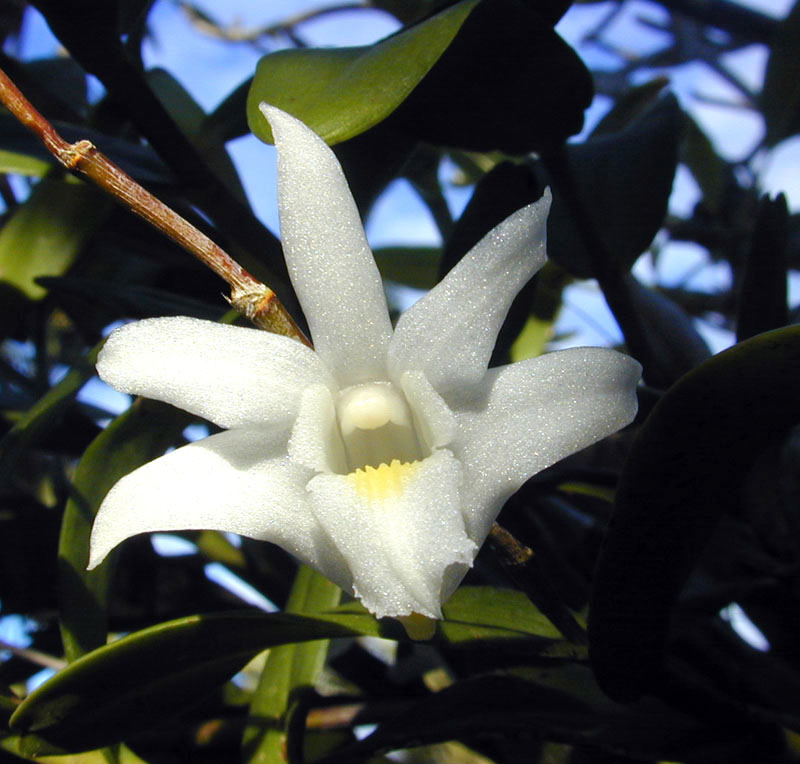
Aporum leonis, from MillFa Wild Orchid.


Belongs within: Dendrobium.

Aporum is a genus of orchids with fleshy, equitant leaves found in south-east Asia and Malesia (Clements 2003).

See also: Succulent orchids.

Characters (from Clements 2003): Erect, porrect or pendulous, small to large, epiphytic or lithophytic, herbs. Roots thin wiry, divided. Stems thin, wiry, covered with lead sheaths for most of their length but exposed in most species towards the apex, often branching. Leaves equitant, hard, fleshy, broadest near the basal half of each stem, then tapering towards the apex, with a distinct abscission layer, apices acute, persistent for several years, those nearest the apex becoming increasingly smaller and bract like. Inflorescence lateral on exposed apical part of stem, the bract from successive flowering forming a tuft at each node, comprising one or a few flowers. Flowers solitary arising from a lateral meristematic persistent inflorescence, lasting only a few days, synchronous with other plants of the same species in the immediate vicinity; fleshy. Lateral sepals connate at base and spreading towards the apices, together with the labellum and column-foot forming a small spur or saccate base. Dorsal sepal free often much smaller than the lateral sepals. Petals free and often smaller than the dorsal sepal. Labellum fleshy, sessile, rigid with distinct thickened callus of small glands on the laminar surface. Column short with truncate apex, and prominent staminodes. Pollinia small, hard waxy, yellow in two globose hemipollinia. Protocorm-seedling type narrowly isobilateral.

Aporum Blume 1825 (see below for synonymy) C03
    |--A. leonis Lindley in Edwards 1840 [=Dendrobium leonis] C03
    `--+--A. confusum (Schlechter) Clements 2003 [=Dendrobium confusum Schlechter 1911] C03
       `--+--A. aloifolium (Blume) Brieger 1981 [=*Macrostomium aloifolium Blume 1825, Dendrobium aloifolium] C03
          `--+--A. anceps (Swartz) Lindley 1830 [=Dendrobium anceps, *Ditulima anceps Rafinesque 1838] C03
             `--A. indivisum Blume 1825 [=Dendrobium indivisum] C03

Aporum incertae sedis:
  *A. lobatum Blume 1825 C03
  A. acinaciforme (Roxburgh) Griffiths 1845 C03
  A. albayense (Ames) Clements 2003 [=Dendrobium albayense Ames 1912] C03
  A. auyongii (Yukawa) Clements 2003 [=Dendrobium auyongii Yukawa 1998] C03
  A. babiense (Smith) Rauschert 1983 C03
  A. banaense (Gagnepain) Rauschert 1983 C03
  A. basilanense (Ames) Clements 2003 [=Dendrobium basilanense Ames 1912] C03
  A. bicornutum (Schlechter) Rauschert 1983 C03
  A. bilobulatum (Seidenf.) Clements 2003 [=Dendrobium bilobulatum Seidenf. 1985] C03
  A. brevimentum (Seidenf.) Clements 2003 [=Dendrobium brevimentum Seidenf. 1985] C03
  A. calceolariae (König) Clements 2003 (see below for synonymy) C03
  A. capitellatoides (Smith) Rauschert 1983 C03
  A. capitellatum (Smith) Rauschert 1983 C03
  A. cochinchinense (Ridl.) Rauschert 1983 C03
  A. compressistylum (Smith) Rauschert 1983 C03
  A. concavum (Smith) Rauschert 1983 C03
  A. crucilabre (Smith) Rauschert 1983 C03
  A. curviflorum (Rolfe) Clements 2003 [=Dendrobium curviflorum Rolfe 1805] C03
  A. dalatense (Gagnepain) Rauschert 1983 C03
  A. diaphanum (Schlechter) Rauschert 1983 C03
  A. distichum (Presl.) Rauschert 1983 [=*Schismoceras disticha Presl 1827] C03
  A. escritorii (Ames) Clements 2003 [=Dendrobium escritorii Ames 1915] C03
  A. ferdinandi (Kraenzlin) Clements 2003 [=Dendrobium ferdinandi Kraenzlin in Engl. 1910] C03
  A. flexile (Ridl.) Rauschert 1983 C03
  A. fuscum (O’Byrne) Clements 2003 [=Dendrobium indivisum var. fuscum O’Byrne 1997] C03
  A. grande (Hooker) Rauschert 1983 C03
  A. jenkinsii Griffiths 1854 [incl. Dendrobium parciflroum Reichenb. ex Lindley 1859] C03
  A. jennae (O’Byrne) Clements 2003 [=Dendrobium jennae O’Byrne 1996] C03
  A. keithii (Ridl.) Clements 2003 [=Dendrobium keithii Ridl. 1896] C03
  A. kentrophyllum (Hooker) Brieger 1981 C03
  A. kiauense (Ames & Schweinfurth) Clements 2003 [=Dendrobium kiauense Ames & Schweinfurth 1920] C03
  A. kjellbergii (Smith) Rauschert 1983 C03
  A. korthalsii (Smith) Rauschert 1983 C03
  A. kuyperi (Smith) Rauschert 1983 C03
  A. litoreum (Bailey) Clements 2003 [=Dendrobium litoreum Bailey 1906] C03
  A. lobbii Clements 2003 [=Dendrobium lobbii Lindley 1859 non Teijsm. & Binn. 1853] C03
  A. lobulatum (Rolfe ex Smith) Brieger 1981 C03
  A. lunatum (Lindley) Clements 2003 [=Dendrobium lunatum Lindley 1859] C03
  A. macgregorii Clements 2003 (see below for synonymy) C03
  A. mannii (Ridl.) Rauschert 1983 C03
  A. marivelense (Ames) Rauschert 1983 C03
  A. merrillii (Ames) Clements 2003 [=Dendrobium merrillii Ames 1908] C03
  A. mindanaense (Ames) Clements 2003 [=Dendrobium mindanaense Ames 1914] C03
  A. mirandum (Schlechter) Rauschert 1983 C03
  A. modestissimum (Kraenzlin) Clements 2003 [=Dendrobium modestissimum Kraenzlin in Engl. 1910] C03
  A. nathanielis (Reichenb.) Clements 2003 [=Dendrobium nathanielis Reichenb. in Schill. 1857] C03
  A. nycteridoglossum (Reichenb.) Rauschert 1983 C03
  A. pendulicaule (Hayata) Rauschert 1983 C03
  A. porphyrophyllum (Guillaumin) Clements 2003 [=Dendrobium porphyrophyllum Guillaumin 1955] C03
  A. prostratum (Ridl.) Rauschert 1983 C03
  A. pseudoaloifolium (Wood) Clements 2003 [=Dendrobium pseudoaloifolium Wood 1984] C03
  A. pseudoequitans (Fessel & Lückel) Clements 2003 (see below for synonymy) C03
  A. quadrilobatum (Carr) Rauschert 1983 C03
  A. ramificans (Smith) Rauschert 1983 C03
  A. reflexibarbatulum (Smith) Clements 2003 [=Dendrobium reflexibarbatulum Smith 1927] C03
  A. reflexitepalum (Smith) Rauschert 1983 C03
  A. rhodostele (Ridl.) Rauschert 1983 C03
  A. rhombopetalum (Kraenzlin) Rauschert 1983 C03
  A. rosellum (Ridl.) Rauschert 1983 C03
  A. roseonervatum (Schlechter) Rauschert 1983 C03
  A. roseostriatum (Ridl.) Rauschert 1983 C03
  A. sagittatum (Smith) Rauschert 1983 C03
  A. salicornioides (Teijsm. & Binn.) Brieger in Schlechter 1981 C03
  A. sambasanum (Smith) Clements 2003 [=Dendrobium sambasanum Smith 1909] C03
  A. shompenii (Sinha & Rao) Clements 2003 [=Dendrobium shompenii Sinha & Rao 1998] C03
  A. sinuosum (Ames) Clements 2003 [=Dendrobium sinuosum Ames 1922] C03
  A. smithianum (Schlechter) Rauschert 1983 C03
  A. spatella (Reichenb.) Clements 2003 [=Dendrobium spatella Reichenb. 1865] C03
  A. sphenochilum (von Mueller & Kraenzlin) Clements 2003 (see below for synonymy) C03
  A. subpandifolium (Smith) Rauschert 1983 C03
  A. subulatoides (Schlechter) Rauschert 1983 C03
  A. subulatum (Blume) Rauschert 1983 C03
  A. teloense (Smith) Rauschert 1983 C03
  A. teres Rauschert 1983 C03
  A. terminale (Par. & Reichenb.) Clements 2003 [=Dendrobium terminale Par. & Reichenb. 1874] C03
  A. tetralobum (Schlechter) Rauschert 1983 C03
  A. thysanophorum (Schlechter) Rauschert 1983 C03
  A. uncatum (Lindley) Brieger in Schlechter 1981 C03
  A. vanhulstijnii (Smith) Rauschert 1983 C03
  A. wenzelii (Ames) Clements 2003 [=Dendrobium wenzelii Ames 1915] C03
  A. xanthoacron (Schlechter) Clements 2003 [=Dendrobium xanthoacron Schlechter 1906] C03
  A. xiphophyllum (Schlechter) Clements 2003 [=Dendrobium xiphophyllum Schlechter 1911] C03

Aporum Blume 1825 [=Dendrobium sect. Aporum (Blume) Lindl. in Paxt. 1851; incl. Ditulima Rafinesque 1836, Macrostomium Blume 1825, Aporum sect. Macrostomium (Blume) Bieger 1981, Schismoceras Presl 1827] C03

Aporum calceolariae (König) Clements 2003 [=Epidendrum calceolariae König 1791; incl. Dendrobium acerosum Lindley 1841] C03

Aporum macgregorii Clements 2003 [=Dendrobium macgregorii Ames 1912 non von Mueller & Kraenzlin 1894, D. quisumbingii Hawkes & Heller 1957] C03

Aporum pseudoequitans (Fessel & Lückel) Clements 2003 [=Dendrobium pseudoequitans Fessel & Lückel 2000, Ceraia pseudoequitans (Fessel & Lückel) Clements 2003] C03

Aporum sphenochilum (von Mueller & Kraenzlin) Clements 2003 [=Dendrobium sphenochilum von Mueller & Kraenzlin 1894] C03

*Type species of generic name indicated

REFERENCES

[C03] Clements, M. A. 2003. Molecular phylogenetic systematics in the Dendrobiinae (Orchidaceae), with emphasis on Dendrobium section Pedilonum. Telopea 10 (1): 247–298.

Epidendroideae

Common twayblade Listera ovata, copyright Orchi.


Belongs within: Monandrae.
Contains: Corallorhizinae, Pleurothallidinae, Dendrobieae, Gastrodieae, Coelogyninae, Arethuseae, Malaxideae, Cymbidieae, Epidendreae, Eriinae, Vandeae.

The Epidendroideae are a group of mostly epiphytic orchids in which roots bear a multi-layered, spongy epidermis (the velamen), and floral abscission often occurs (Freudenstein & Rasmussen 1999).

Epidendroideae [Coelogyneae, Limodorinae, Neottioideae, Pleuranthae, Sympodiales, Vandoideae]
    |--+--Palmorchideae [Palmorchidinae] RG07
    |  |    |--Palmorchis RG07
    |  |    `--Diceratostele A86
    |  `--+--Epipactis RG07
    |     |    |--E. gigantea H93
    |     |    `--E. helleborine DS04
    |     `--Listera [Listerinae] RG07
    |          |--L. auriculata V72
    |          |--L. caurina H93
    |          |--L. convallarioides H93
    |          |--L. cordata
    |          |--L. kuanshanensis CP02
    |          |--L. ovata TG88
    |          `--L. × veltmanii [L. auriculata × L. convallarioides] V72
    `--+--Cephalanthera austiniae FR99, H93 [=Eburophyton austiniae H93]
       `--+--Tropidioideae [Tropidieae, Tropidiinae] FR99
          |    |--Corymborkis FR99
          |    `--Tropidia FR99
          |         |--T. curculigoides P03
          |         `--T. effusa FR99
          `--+--+--Gastrodieae FR99
             |  |--Epipogieae A86
             |  |    |--Epipogium roseum (Don) Lindley 1857 FR99, SBY02 (see below for synonymy)
             |  |    `--Stereosandra A86
             |  `--Sobraliinae A86
             |       |--Sobralia RG07
             |       |--Elleanthus tetrogeiton A86, RJ11
             |       |--Sertifera A86
             |       `--Xerorchis A86
             `--+--Glomerinae A86
                |    |--Glomera erythrosma FR99, P03
                |    |--Aglossorhyncha A86
                |    |--Glossorhyncha A86
                |    |--Ischnocentrum A86
                |    |--Sepalosiphon A86
                |    `--Earina Lindl. 1834 A86, ME70
                |         |--*E. mucronata Lindl. 1834 (see below for synonymy) ME70
                |         `--E. autumnalis (Forst. f.) Hook. f. 1853 ME70 (see below for synonymy)
                `--+--+--Coelogyninae RG07
                   |  `--+--Wullschlaegelia [Wullschlaegelieae] RG07
                   |     `--Arethuseae EN20
                   `--+--Malaxideae EN20
                      `--+--Cymbidieae EN20
                         `--+--+--Masdevallia RG07
                            |  `--Epidendreae EN20
                            `--+--Collabieae EN20
                               `--+--Podochileae EN20
                                  |    |--Eriinae RG07
                                  |    `--Podochilinae C03
                                  |         |--Podochilus gracilis P03
                                  |         |--Pseuderia C03
                                  |         |--Chitonochilus A86
                                  |         |--Cyphochilus A86
                                  |         `--Poaephyllum A86
                                  `--+--Telipogoninae A86
                                     |    |--Telipogon FR99
                                     |    |--Dipterostele A86
                                     |    |--Stellilabium A86
                                     |    `--Trichoceros A86
                                     `--+--Vandeae EN20
                                        `--Polystachyeae [Polystachyinae] A86
                                             |--Neobenthamia A86
                                             |--Hederorkis A86
                                             |--Imerinaea A86
                                             `--Polystachya FR99
                                                  |--P. luteola C55
                                                  `--P. zeylanica [=Dendrobium polystachyum] C55

Epidendroideae incertae sedis:
  Limodorum abortivum A86, H91
  Thaia [Thaieae] A86
  Neottia nidus-avis R02
  Govenia FR99
  Jensoa FR99
  Corallorhizinae FR99
  Adrorhizinae A86
    |--Adrorhiza A86
    `--Sirhookera FR99
  Cryptarrhena [Cryptarrheneae] FR99
  Eriodes FR99
  Ceratostylis FR99
  Isochilus FR99
  Pleurothallidinae FR99
  Dendrobieae FR99
  Dactylostalix FR99
  Thelasiinae A86
    |--Thelasis pygmaea FR99
    |--Chitonanthera A86
    |--Octarrhena A86
    |--Oxyanthera A86
    |--Phreatia A86
    |--Rhynchophreatia A86
    `--Ridleyella A86

Earina autumnalis (Forst. f.) Hook. f. 1853 ME70 [=Epidendrum autumnale Forst. f. 1786 ME70, Cymbidium autumnale Swartz 1799 C06; incl. Ea. alba Col. 1886 ME70, Ea. suaveolens Lindl. 1843 ME70]

*Earina mucronata Lindl. 1834 [incl. E. aestivalis Cheesem. 1919, E. quadrilobata Col. 1883] ME70

Epipogium roseum (Don) Lindley 1857 FR99, SBY02 [=Limodorum roseum Don 1825 SBY02, Galera rosea Bl. 1825 SBY02; incl. Epipogium nutans Reichenbach 1890 SBY02]

*Type species of generic name indicated

REFERENCES

[A86] Atwood, J. T. 1986. The size of the Orchidaceae and the systematic distribution of epiphytic orchids. Selbyana 9: 171–186.

[C55] Candolle, A. de. 1855. Géographie Botanique Raisonée: Ou exposition des faits principaux et des lois concernant la distribution géographique des plantes de l’époque actuelle vol. 2. Librairie de Victor Masson: Paris.

[C06] Cheeseman, T. F. 1906. Manual of the New Zealand Flora. John Mackay, Government Printer: Wellington.

[CP02] Chung, S.-W., & C.-I. Peng. 2002. Senecio kuanshanensis (Asteraceae), a new species from southern Taiwan. Botanical Bulletin of Academia Sinica 43: 155–159.

[C03] Clements, M. A. 2003. Molecular phylogenetic systematics in the Dendrobiinae (Orchidaceae), with emphasis on Dendrobium section Pedilonum. Telopea 10 (1): 247–298.

[DS04] Davis, J. I., D. W. Stevenson, G. Petersen, O. Seberg, L. M. Campbell, J. V. Freudenstein, D. H. Goldman, C. R. Hardy, F. A. Michelangeli, M. P. Simmons, C. D. Specht, F. Vergara-Silva & M. Gandolfo. 2004. A phylogeny of the monocots, as inferred from rbcL and atpA sequence variation, and a comparison of methods for calculating jackknife and bootstrap values. Systematic Botany 29 (3): 467–510.

[EN20] Eggli, U., & R. Nyffeler (eds) 2020. Illustrated Handbook of Succulent Plants: Monocotyledons 2nd ed. Springer.

[FR99] Freudenstein, J. V., & F. N. Rasmussen. 1999. What does morphology tell us about orchid relationships?—a cladistic analysis. American Journal of Botany 86: 225–248.

[H93] Hickman, J. C. (ed.) 1993. The Jepson Manual: Higher Plants of California. University of California Press: Berkeley (California).

[ME70] Moore, L. B., & E. Edgar. 1970. Flora of New Zealand vol. 2. Indigenous Tracheophyta: Monocotyledones except Gramineae. A. R. Shearer, Government Printer: Wellington (New Zealand).

[P03] Partomihardjo, T. 2003. Colonisation of orchids on the Krakatau Islands. Telopea 10 (1): 299–310.

[RG07] Ramírez, S. R., B. Gravendeel, R. B. Singer, C. R. Marshall & N. E. Pierce. 2007. Dating the origin of the Orchidaceae from a fossil orchid with its pollinator. Nature 448: 1042–1045.

[R02] Raven, J. A. 2002. Selection pressures on stomatal evolution. New Phytologist 153: 371–386.

[RJ11] Rising, J. D., A. Jaramillo, J. L. Copete, P. G. Ryan & S. C. Madge. 2011. Family Emberizidae (buntings and New World sparrows). In: Hoyo, J. del, A. Elliott & D. A. Christie (eds) Handbook of the Birds of the World vol. 16. Tanagers to New World Blackbirds pp. 428–683. Lynx Edicions: Barcelona.

[SBY02] Sardesai, M. M., M. P. Bachulkar & S. R. Yadav. 2002. Additions to the orchid flora of Maharashtra. Journal of the Bombay Natural History Society 99 (3): 564–566.

[TG88] Tepfer, D., A. Goldmann, N. Pamboukdjian, M. Maille, A. Lepingle, D. Chevalier, J. Dénarié & C. Rosenberg. 1988. A plasmid of Rhizobium meliloti 41 encodes catabolism of two compounds from root exudate of Calystegium sepium. Journal of Bacteriology 170 (3): 1153–1161.

[V72] Voss, E. G. 1972. Michigan Flora. Part I. Gymnosperms and Monocots. Cranbrook Institute of Science and University of Michigan Herbarium.

Ceraia

Pigeon orchid Ceraia saaronica, copyright Eric Guinther.


Belongs within: Dendrobium.

Ceraia is a genus of epiphytic or lithophytic orchids found from south-east Asia to Papua New Guinea, characterised by the presence of at least three or four swollen, leafless internodes at the base of the stem (Clements 2003).

Characters (from Clements 2003): Epiphytic or lithophytic herb; pseudobulbous stems to c. 1m long, the swollen part comprising three or four nodes and internodes at least four nodes from the base of a shoot; aerial growths arising above the swollen pseudobulb, capable of forming a swollen pseudobulb; roots arising from the nodes at the base of each shoot; sheaths overlapping; inflorescence enclosed in a covering sheath, a highly reduced indeterminate, raceme; flowers one to three per inflorescence, spontaneous at any time following a drop in air temperature, and synchronous for all plants in the same area; flowers lasting only a few hours in a single day, of superficial substance; very fragrant perfume; labellum non-articulate, attached directly to base of column-foot where it forms a short spur containing nectar; column-foot longer than column. Stelidia reduced not divided. Pollinia four, obliquely elliptical, loosely held together in two groups of two. Capsule fusiforme. Protocorm-seedling type, narrowly isobilateral.

Ceraia Loureiro 1790 (see below for synonymy) C03
    |--C. saaronica (König) Clements & Jones 2002 (see below for synonymy) C03
    `--+--+--‘Dendrobium’ (sect. Bolbidium) quadrangulare C03
       |  `--C. truncata (Lindley) Clements 2003 [=Dendrobium truncatum Lindley 1859] C03
       `--+--+--C. goldfinchii (von Mueller) Clements 2003 [=Dendrobium goldfinchii von Mueller 1883] C03
          |  `--C. philippinensis (Ames) Clements 2003 [=Dendrobium philippinense Ames 1914] C03
          `--+--C. juncea (Lindley) Clements 2003 [=Dendrobium junceum Lindley 1842] C03
             `--C. usterioides (Ames) Clements 2003 [=Dendrobium usterioides Ames 1915] C03

Ceraia incertae sedis:
  *C. simplicissima Loureiro 1790 [incl. Dendrobium podagraria Hooker 1890] C03
  C. acaciifolia (Smith) Clements 2003 [=Dendrobium acaciifolium Smith 1917] C03
  C. acicularis (Lindley) Clements 2003 [=Dendrobium aciculare Lindley 1840] C03
  C. alabensis (Wood) Clements 2003 [=Dendrobium alabense Wood 1990] C03
  C. aurantiflammea (Wood) Clements 2003 [=Dendrobium aurantiflammeum Wood 1998] C03
  C. batanensis (Ames & Quisumb.) Clements 2003 [=Dendrobium batanense Ames & Quisumb. 1932] C03
  C. boothii (Teijsm. & Binn.) Clements 2003 [=Dendrobium boothii Tijsm. & Binn. 1862] C03
  C. bukidnonensis (Ames & Quisumb.) Clements 2003 [=Dendrobium bukidnonense Ames & Quisumb. 1936] C03
  C. calceola (Roxburgh) Clements 2003 [=Dendrobium calceolum Roxburgh 1832] C03
  C. carinata (Linnaeus) Clements 2003 (see below for synonymy) C03
  C. chrysotainia (Schlechter) Clements 2003 [=Dendrobium chrysotainium Schlechter 1910] C03
  C. cinnabarina (Reichenb.) Clements 2003 [=Dendrobium cinnabarinum Reichenb. 1880] C03
  C. clavator (Ridl.) Clements 2003 [=Dendrobium clavator Ridl. 1896] C03
  C. compressicaulis (Smith) Clements 2003 [=Dendrobium compressicaule Smith 1928] C03
  C. confunda (Kraenzlin) Clements 2003 [=Dendrobium confundens Kraenzlin in Engl. 1910] C03
  C. cultrifolia (Schlechter) Clements 2003 [=Dendrobium cultrifolium Schlechter 1919] C03
  C. cuneata (Schlechter) Clements 2003 [=Dendrobium cuneatum Schlechter 1906] C03
  C. cuneilabra (Smith) Clements 2003 [=Dendrobium cuneilabrum Smith 1906] C03
  C. cymbulipes (Smith) Clements 2003 [=Dendrobium cymbulipes Smith 1927] C03
  C. dentata (Seidenf.) Clements 2003 [=Dendrobium dentatum Seidenf. 1981] C03
  C. eboracensis (Kraenzlin) Clements 2003 [=Dendrobium eboracense Kraenzlin 1894] C03
  C. ephemera (Smith) Clements 2003 [=Dendrobium ephemerum Smith in Merrill 1917] C03
  C. equitans (Kraenzlin) Clements 2003 [=Dendrobium equitans Kraenzlin in Engl. 1910] C03
  C. exilis (Schlechter) Clements 2003 [=Dendrobium exile Schlechter 1906] C03
  C. facifera (Smith) Clements 2003 [=Dendrobium faciferum Smith 1908] C03
  C. fimbriata (Blume) Clements 2003 [=Onychium fimbriatum Blume 1825, Dendrobium blumei Lindley 1830] C03
  C. fugax Clements 2003 [=Dendrobium fugax Schlechter 1906 non Reichenb. 1871] C03
  C. gedeana (Smith) Clements 2003 [=Dendrobium gedeanum Smith 1907] C03
  C. gerlandiana (Kraenzlin) Clements 2003 [=Dendrobium gerlandianum Kraenzlin 1909] C03
  C. gracilis (Blume) Clements 2003 [=Onychium gracile, Aporum (sect. *Linearifolia) gracile] C03
  C. grootingsii (Smith) Clements 2003 [=Dendrobium grootingsii Smith 1917] C03
  C. gynoglottis (Carr) Clements 2003 [=Dendrobium gynoglottis Carr 1935] C03
  C. humboldtensis (Smith) Clements 2003 [=Dendrobium humboldtense Smith 1912] C03
  C. hymenocentra (Schlechter) Clements 2003 [=Dendrobium hymenocentrum Schlechter 1912] C03
  C. hymenopetala (Schlechter) Clements 2003 [=Dendrobium hymenopetalum Schlechter 1911] C03
  C. hypopoga (Kraenzlin) Clements 2003 [=Dendrobium hypopogon Kraenzlin in Engl. 1910] C03
  C. inconcinna (Ridl.) Clements 2003 [=Dendrobium inconcinnum Ridl. 1896] C03
  C. inconspicua (Smith) Clements 2003 [=Dendrobium inconspicuum Smith in Gibbs 1917] C03
  C. incurvociliata (Smith) Clements 2003 [=Dendrobium incurvociliatum Smith 1931] C03
  C. juncifolia (Schlechter) Clements 2003 [=Dendrobium juncifolium Schlechter 1911] C03
  C. koeteiana (Schlechter) Clements 2003 [=Dendrobium koeteianum Schlechter 1906] C03
  C. kohlmeyeriana (Teijsm. & Binn.) Clements 2003 (see below for synonymy) C03
  C. kurashigei (Yakawa) Clements 2003 [=Dendrobium kurashigei Yakawa 1998] C03
  C. lagara (Schlechter) Clements 2003 [=Dendrobium lagarum Seidenf. 1985] C03
  C. lamatochila (Seidenf.) Clements 2003 [=Dendrobium lamatochilum Seidenf. 1981] C03
  C. lamellifera (Carr) Clements 2003 [=Dendrobium cinnabarinum var. lamelliferum Carr 1935] C03
  C. lamellulifera (Smith) Clements 2003 [=Dendrobium lamelluliferum Smith 1927] C03
  C. lanciloba (Wood) Clements 2003 [=Dendrobium lancilobum Wood 1990] C03
  C. lawiensis (Smith) Clements 2003 [=Dendrobium lawiense Smith 1912] C03
  C. limii (Wood) Clements 2003 [=Dendrobium limii Wood in Wood & Cribb 1994] C03
  C. linearifolia (Teijsm. & Binn.) Clements 2003 [=Dendrobium linearifolium Teijsm. & Binn. 1862] C03
  C. litoralis (Schlechter) Clements 2003 [=Dendrobium litorale Schlechter 1912] C03
  C. macfarlanei (von Mueller) Clements 2003 (see below for synonymy) C03
  C. macrapora (Smith) Clements 2003 [=Dendrobium macraporum Smith 1912] C03
  C. maleolens (Kraenzlin) Clements 2003 [=Dendrobium maleolens Kraenzlin in Engl. 1910] C03
  C. minima (Ames & Schweinfurth) Clements 2003 [=Dendrobium minimum Ames & Schweinfurth 1920] C03
  C. modesta (Reichenb.) Clements 2003 [=Dendrobium modestum Reichenb. 1855] C03
  C. multiramosa (Ames) Clements 2003 [=Dendrobium multiramosum Ames 1915] C03
  C. odorata (Schlechter) Clements 2003 [=Dendrobium odoratum] C03
  C. ovatipetala (Smith) Clements 2003 [=Dendrobium ovatipetalum Smith 1932] C03
  C. papilionifera (Smith) Clements 2003 [=Dendrobium papilioniferum Smith 1905] C03
  C. parviflora (Ames & Schweinfurth) Clements 2003 (see below for synonymy) C03
  C. patentiloba (Ames & Schweinfurth) Clements 2003 [=Dendrobium patentilobum Ames & Schweinfurth 1920] C03
  C. peculiaris (Smith) Clements 2003 [=Dendrobium peculiare Smith 1928] C03
  C. planibulbis (Lindley) Clements 2003 [=Dendrobium (sect. *Ampullaria) planibulbe Lindley 1843] C03
  C. platybasis (Ridl.) Clements 2003 [=Dendrobium platybasis Ridl. 1916] C03
  C. plebeja (Smith) Clements 2003 [=Dendrobium plebejum Smith 1907] C03
  C. polytricha (Ames) Clements 2003 [=Dendrobium polytrichum Ames 1908] C03
  C. pseudocalceola (Smith) Clements 2003 [=Dendrobium pseudocalceolum Smith 1907] C03
  C. pseudotenella (Guillaumin) Clements 2003 [=Dendrobium pseudotenellum Guillaumin 1965] C03
  C. puberilinguis (Smith) Clements 2003 [=Dendrobium puberilingue Smith 1927] C03
  C. ridleyana Clements 2003 [=Dendrobium ridleyanum Kerr 1927 non Schlechter 1905] C03
  C. robinsonii (Ames) Clements 2003 [=Dendrobium robinsonii Ames 1914] C03
  C. sanguinea Clements 2003 [=Dendrobium sanguineum Rolfe 1895 non Swartz 1799] C03
  C. scirpoides (Schlechter) Clements 2003 [=Dendrobium scirpoides Schlechter 1911] C03
  C. setifera Clements 2003 (see below for synonymy) C03
  C. setifolia (Ridl.) Clements 2003 [=Dendrobium setifolium Ridl. 1896] C03
  C. stelidiifera (Smith) Clements 2003 [=Dendrobium stelidiiferum Smith 1920] C03
  C. strigosa (Schlechter) Clements 2003 [=Dendrobium strigosum Schlechter 1911] C03
  C. tenella (Blume) Clements 2003 [=Onychium tenellum Blume 1825] C03
  C. tenuis (Smith) Clements 2003 [=Dendrobium tenue Smith 1917] C03
  C. tenuicaulis (Hooker) Clements 2003 [=Dendrobium tenuicaule Hooker 1890] C03
  C. tetraedris (Blume) Clements 2003 (see below for synonymy) C03
  C. torajaensis (O’Byrne) Clements 2003 [=Dendrobium torajaense O’Byrne 1999] C03
  C. tricuspis (Blume) Clements 2003 [=Onychium tricuspe Blume 1825] C03
  C. tridentata (Ames & Schweinfurth) Clements 2003 [=Dendrobium tridentatum Ames & Schweinfurth 1920] C03
  C. usterii (Schlechter) Clements 2003 [=Dendrobium usterii Schlechter 1906] C03
  C. ventricosa (Kraenzlin) Clements 2003 [=Dendrobium ventricosum Kraenzlin in Engl. 1910] C03
  C. ventripes (Carr) Clements 2003 [=Dendrobium ventripes Carr 1935] C03

Ceraia Loureiro 1790 [=Ceraja; incl. Dendrobium sect. Ampullaria Pfitzer in Engl. & Prantl. 1889, D. subsect. Aporopsis Schlechter 1912 (n. n.), Aporum sect. Aporopsis (Schlechter) Brieger 1981 (nom. inv.), Aporopsis (Schlechter) Clements & Jones 2002 (nom. inv.), Dendrobium sect. Ceraia Schlechter 1914, D. sect. Crumenata Pfitzer in Engl. & Prantl. 1889, Aporum sect. Crumenata (Pfitzer) Brieger 1981, D. subg. Crumenata Kraenzl. in Engl. 1910, Aporum sect. Linearifolia Brieger in Schlechter 1981, D. sect. Rhopalanthe] C03

Ceraia carinata (Linnaeus) Clements 2003 [=Epidendrum carinatum Linnaeus 1753, Dendrobium carinatum (Linnaeus) von Willdenow 1805] C03

Ceraia kohlmeyeriana (Teijsm. & Binn.) Clements 2003 [=Dendrobium kohlmeyerianum Teijsm. & Binn. ex Miquel 1867] C03

Ceraia macfarlanei (von Mueller) Clements 2003 [=Dendrobium macfarlanei von Mueller 1875, *Aporopsis [(Schlechter) Clements & Jones] macfarlanei] C03

Ceraia parviflora (Ames & Schweinfurth) Clements 2003 [=Dendrobium crumenatum var. parviflorum Ames & Schweinfurth 1920] C03

Ceraia saaronica (König) Clements & Jones 2002 [=Epidendrum saaronicum König 1791; incl. Angraecum crumenatum Rumphius 1750 (nom. illeg.), Dendrobium (sect. *Crumenata) crumenatum Swartz 1799, Aporum crumenatum, D. (subg. *Rhopalobium) crumenatum] C03

Ceraia setifera Clements 2003 [=Dendrobium tenellum var. setifolium Guillaumin 1956 non D. setifolium Ridl. 1896] C03

Ceraia tetraedris (Blume) Clements 2003 [=Onychium tetraedre Blume 1825, Aporum (sect. *Aporopsis (Schlechter) Brieger) tetraedre] C03

*Type species of generic name indicated

REFERENCES

[C03] Clements, M. A. 2003. Molecular phylogenetic systematics in the Dendrobiinae (Orchidaceae), with emphasis on Dendrobium section Pedilonum. Telopea 10 (1): 247–298.

Eriinae

Oxystophyllum carnosum, copyright Gerard Chartier.


Belongs within: Epidendroideae.

The Eriinae are a group of orchids bearing flowers with a hinged, motile lip and a usually short, massive column with a prominent column foot.

<==Eriinae
    |  i. s.: Epiblastus A86
    |         Mediocalcar A86
    |         Porpax A86
    |         Sarcostoma A86
    |         Stolzia A86
    |--Eria C03
    |    |--E. alba SS72
    |    |--E. andamanica DAC05
    |    |--E. annulata P03
    |    |--E. bractescens DAC05
    |    |    |--E. b. var. bractescens DAC05
    |    |    `--E. b. var. kurzii DAC05
    |    |--E. (sect. Conchidium) extinctoria (Lindley) Oliv. 1871 [=Dendrobium extinctorium Lindley 1836] DAC05
    |    |--E. javanica C03
    |    |--E. oblitterata P03
    |    |--E. retusa P03
    |    `--E. verruculosa P03
    `--+--Bryobium pubescens C03
       `--Oxystophyllum Blume 1825 (see below for synonymy) C03
            |--*O. rigidum Blume 1825 (see below for synonymy) C03
            |--O. acanthium (Schlechter) Clements 2003 [=Dendrobium acanthium Schlechter 1912] C03
            |--O. ambotiense (Smith) Clements 2003 [=Dendrobium ambotiense Smith 1928] C03
            |--O. araneum (Smith) Clements 2003 [=Dendrobium araneum Smith 1913] C03
            |--O. atropurpureum Blume 1858 [=Dendrobium atropurpureum (Blume) Miquel 1855] C03
            |--O. atrorubens (Ridl.) Clements 2003 [=Dendrobium atrorubens Ridl. 1896] C03
            |--O. bipulvinatum (Smith) Clements 2003 [=Dendrobium bipulvinatum Smith 1913] C03
            |--O. buruense (Smith) Clements 2003 [=Dendrobium excavatum var. buruense Smith 1928] C03
            |--O. capitellatum Clements 2003 [=Dendrobium capitellatum Kraenzlin in Engl. 1910 non Smith 1906] C03
            |--O. carnosum Blume 1825 (see below for synonymy) C03
            |--O. changjiangense (Cheng & Tang) Clements 2003 [=Dendrobium changjiangense Cheng & Tang 1980] C03
            |--O. cultratum (Schlechter) Clements 2003 [=Dendrobium cultratum Schlechter 1911] C03
            |--O. cuneatipetalum (Smith) Clements 2003 [=Dendrobium cuneatipetalum Smith 1927] C03
            |--O. deliense (Schlechter) Clements 2003 [=Dendrobium deliense Schlechter 1912] C03
            |--O. elmeri (Ames) Clements 2003 [=Dendrobium elmeri Ames 1912] C03
            |--O. excavatum Blume 1825 [=Dendrobium excavatum (Blume) Miquel 1855] C03
            |--O. floridanum (Guillaumin) Clements 2003 [=Dendrobium floridanum Guillaumin 1965] C03
            |--O. govidjoae (Schlechter) Clements 2003 [=Dendrobium govidjoae Schlechter 1912] C03
            |--O. hagerupii (Smith) Clements 2003 [=Dendrobium hagerupii Smith 1922] C03
            |--O. helvolum (Smith) Clements 2003 [=Dendrobium helvolum Smith 1912] C03
            |--O. hypodon (Schlechter) Clements 2003 (see below for synonymy) C03
            |--O. kaudernii (Smith) Clements 2003 [=Dendrobium kaudernii Smith 1927] C03
            |--O. lepoense (Schlechter) Clements 2003 [=Dendrobium lepoense Schlechter 1911] C03
            |--O. lockhartioides (Schlechter) Clements 2003 [=Dendrobium lockhartioides Schlechter 1910] C03
            |--O. longipecten (Smith) Clements 2003 [=Dendrobium longipecten Smith 1928] C03
            |--O. minutigibbum (Smith) Clements 2003 [=Dendrobium minutigibbum Smith 1914] C03
            |--O. moluccense (Smith) Clements 2003 [=Dendrobium moluccense Smith 1914] C03
            |--O. nitidiflorum (Smith) Clements 2003 [=Dendrobium nitidiflorum Smith 1913] C03
            |--O. oblongum (Ames & Schweinfurth) Clements 2003 [=Dendrobium oblongum Ames & Schweinfurth 1920] C03
            |--O. oligadenium (Schlechter) Clements 2003 [=Dendrobium oligadenium Schlechter 1910] C03
            |--O. paniferum (Smith) Clements 2003 [=Dendrobium paniferum Smith 1914] C03
            |--O. sinuatum (Lindley) Clements 2003 [=Aporum sinuatum Lindley 1841, Dendrobium sinuatum] C03
            |--O. speculigerum (Schlechter) Clements 2003 [=Dendrobium speculigerum Schlechter 1910] C03
            |--O. subsessile (Schlechter) Clements 2003 [=Dendrobium subsessile Schlechter 1912] C03
            |--O. torricellianum (Kraenzlin) Clements 2003 (see below for synonymy) C03
            |--O. tropidoneuron (Schlechter) Clements 2003 [=Dendrobium tropidoneuron Schlechter 1911] C03
            |--O. tumoriferum (Smith) Clements 2003 [=Dendrobium tumoriferum Smith 1910] C03
            `--O. validipecten (Smith) Clements 2003 [=Dendrobium validipecten Smith 1928] C03

Oxystophyllum Blume 1825 [=Aporum sect. Oxystophyllum (Blume) Brieger 1981, Dendrobium sect. Oxystophyllum (Blume) Miq. 1855] C03

Oxystophyllum carnosum Blume 1825 [=Dendrobium carnosum (Blume) Reichenb. in Walpers 1861 nec Presl. 1827 nec Teijsm. & Binn. 1853] C03

Oxystophyllum hypodon (Schlechter) Clements 2003 [=Dendrobium hypodon Schlechter 1910, Aporum hypodon (Schlechter) Rauschert 1983] C03

*Oxystophyllum rigidum Blume 1825 [=Dendrobium rigidum (Blume) Miquel 1859 nec Brown 1810 nec Lindley 1830, Aporum rigidum (Blume) Brieger 1981] C03

Oxystophyllum torricellianum (Kraenzlin) Clements 2003 [=Dendrobium torricellianum Kraenzlin in Engl. 1910, Aporum torricellianum (Kraenzlin) Rauschert 1983; incl. D. atrorubens Schlechter in Schumann & Lauterb. 1905 non Ridl. 1896, D. simile Schlechter 1906 non Schlechter 1905] C03

*Type species of generic name indicated

REFERENCES

[A86] Atwood, J. T. 1986. The size of the Orchidaceae and the systematic distribution of epiphytic orchids. Selbyana 9: 171–186.

[C03] Clements, M. A. 2003. Molecular phylogenetic systematics in the Dendrobiinae (Orchidaceae), with emphasis on Dendrobium section Pedilonum. Telopea 10 (1): 247–298.
[DAC05] Diwakar, P. G., D. K. Agrawala & H. J. Chowdhery. 2005. Eria extinctoria (Lindl.) Oliv. (Orchidaceae)—a new record for India from Andaman & Nicobar Islands. Bulletin of the Botanical Survey of India 47: 197–200.

[P03] Partomihardjo, T. 2003. Colonisation of orchids on the Krakatau Islands. Telopea 10 (1): 299–310.

[SS72] Singh, V., & H. Singh. 1972. A contribution to the flora of Gangolihat block in Pithoragarh District. Journal of the Bombay Natural History Society 69 (2): 352–368.

Epidendreae

Cattleya labiata, copyright Tarciso Leão.


Belongs within: Epidendroideae.

The Epidendreae are a group of orchids bearing pollinia fused with sticky caudicles.

<==Epidendreae [Epidendrinae, Laeliinae]
    |--Appendicula FR99
    |    |--A. hexandra FR99
    |    `--A. reflexa P03
    `--+--Agrostophyllum FR99
       |    |--A. bicuspidatum P03
       |    |--A. denbergeri P03
       |    `--A. majus P03
       `--+--Arpophyllum FR99
          `--+--Epidendrum FR99
             |    |--E. atropurpureum H04
             |    `--E. nocturnum FS90
             `--+--+--Schomburgkia FR99
                |  `--+--Chysis FR99
                |     `--Meiracyllium [Meiracylliinae] FR99
                `--Cattleya FR99
                     |--C. ballantiniana H04
                     |--C. labiata H04
                     |--C. mendellii H04
                     `--C. rochellensis H04

Epidendreae incertae sedis:
  Alamania A86
  Artorima A86
  Basiphyllaea A86
  Brassavola A86
  Broughtonia A86
  Caularthron A86
  Constantia A86
  Dilomilis A86
  Dimerandra A86
  Diothonaea A86
  Domingoa A86
  Encyclia A86
  Epidanthus A86
  Hagsatera A86
  Helleriella A86
  Hexisea A86
  Homalopetalum A86
  Isabelia Barbosa-Rodrigues 1877 A86, FT93
  Jacquiniella A86
  Loefgrenianthus A86
  Nageliella A86
  Neocogniauxia A86
  Neowilliamsia A86
  Nidema A86
  Oerstedella A86
  Orleanesia A86
  Pinelia A86
  Platyglottis A86
  Pseudolaelia A86
  Quisqueya A86
  Reichenbachanthus A86
  Rhyncholaelia A86
  Scaphyglottis A86
  Sophronitis A86
  Tetramicra A86

*Type species of generic name indicated

REFERENCES

[A86] Atwood, J. T. 1986. The size of the Orchidaceae and the systematic distribution of epiphytic orchids. Selbyana 9: 171–186.

[FT93] Fensome, R. A., F. J. R. Taylor, G. Norris, W. A. S. Sarjeant, D. I. Wharton & G. L. Williams. 1993. A classification of living and fossil dinoflagellates. Micropaleontology Special Publication 7: i–viii, 1–351.

[FS90] Fleutiaux, E., & A. Sallé. 1890. Liste des coléoptères de la Guadeloupe et descriptions d’espèces nouvelles. Annales de la Société Entomologique de France, 6e série 9: 351–484.

[FR99] Freudenstein, J. V., & F. N. Rasmussen. 1999. What does morphology tell us about orchid relationships?—a cladistic analysis. American Journal of Botany 86: 225–248.

[H04] Haeckel, E. 1899–1904. Kunstformen der Natur. Bibliographisches Institut: Leipzig und Wien.

[P03] Partomihardjo, T. 2003. Colonisation of orchids on the Krakatau Islands. Telopea 10 (1): 299–310.

Asteliaceae

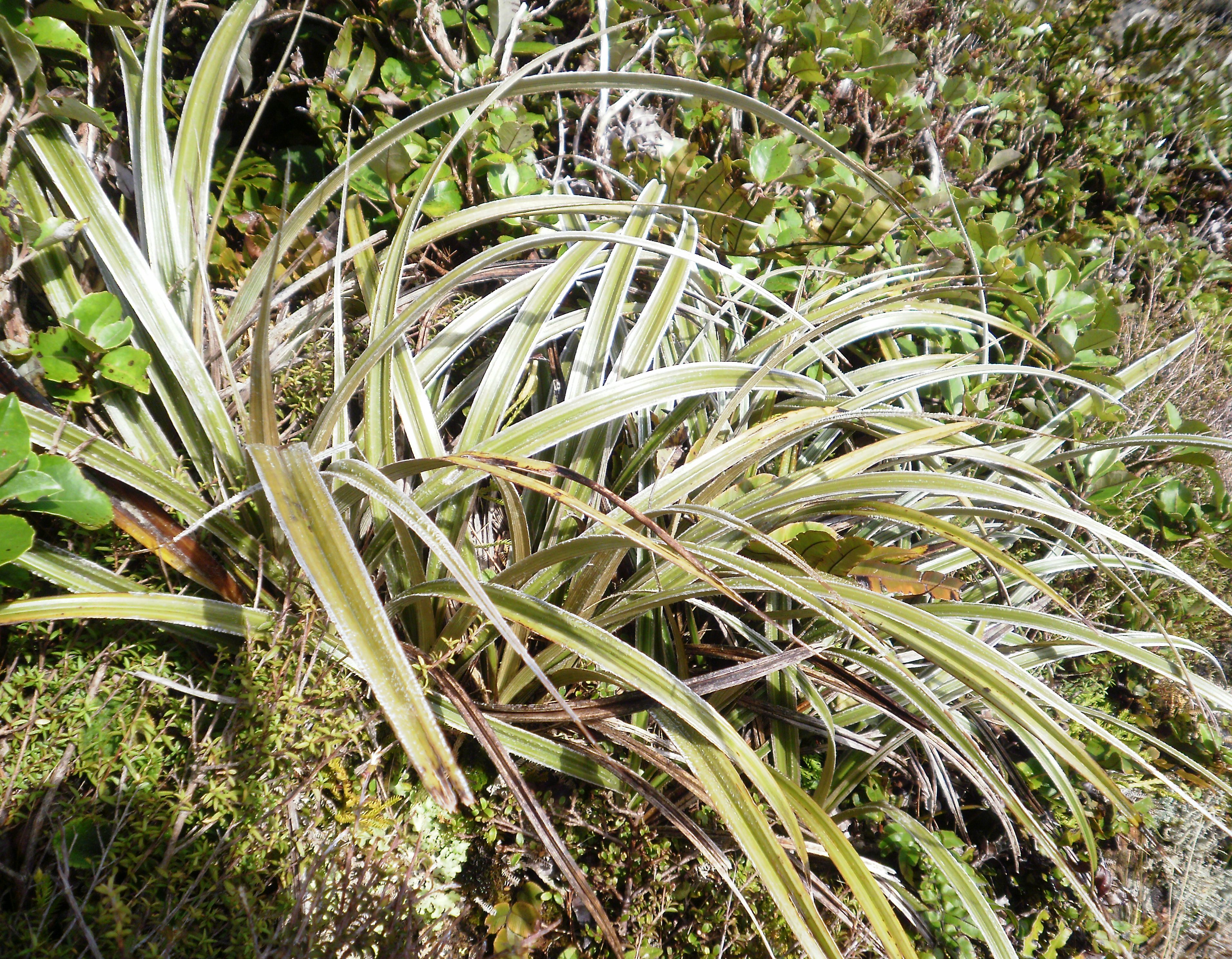
Mountain astelia Astelia nervosa, copyright Rudolph89.


Belongs within: Petrosaviidae.

The Asteliaceae are a Southern Hemisphere group of tufted, often epiphytic herbs characterised by an indumentum of surface scales on at least young growth (Moore & Edgar 1970).

<==Asteliaceae [Astelieae, Astelioideae, Milliganieae]
    |--Neoastelia Williams 1987 DS04, CC87
    |    `--*N. spectabilis Williams 1987 CC87
    |--Collospermum Skottsb. 1934 ME70
    |    |--C. hastatum (Col.) Skottsb. 1934 [=Astelia hastata Col. 1887] ME70
    |    |--C. microspermum (Col.) Skottsb. 1934 (see below for synonymy) ME70
    |    |--‘Astelia’ planifolia Col. 1888 (n. d.) ME70
    |    `--C. spicatum (Col.) Skottsb. 1934 (n. d.) [=Astelia spicata Col. 1882; incl. A. nana Carse 1926] ME70
    |--Milligania Hook. 1853 (nom. cons.) B78, CC87
    |    |--*M. longifolia Hook. 1853 CC87
    |    |--M. densiflora Hook. 1853 CC87
    |    |--M. johnstonii Muell. ex Benth. 1878 CC87
    |    |--M. lindoniana Rodway ex Curtis 1972 CC87
    |    `--M. stylosa (Muell. ex Hook.) Muell. ex Benth. 1878 [=Astelia stylosa Muell. ex Hook. 1858] CC87
    `--Astelia Banks & Sol. ex Br. 1810 (nom. cons.) [incl. Funckia Willd. 1808 (nom. rej.)] CC87
         |  i. s.: *Funckia’ magellanica Willd. 1808 CC87
         |         A. pumila DS04
         |--A. subg. Astelia ME70
         |    |--A. sect. Astelia ME70
         |    |    |--*A. alpina Br. 1810 [=Funckia alpina (Br.) Kuntze 1891] CC87
         |    |    |    |--A. a. var. alpina CC87
         |    |    |    `--A. a. var. novae-hollandiae Skottsb. 1934 CC87
         |    |    |--A. linearis Hook. f. 1844 ME70 [incl. A. minima Col. 1896 C06]
         |    |    |    |--A. l. var. linearis ME70
         |    |    |    `--A. l. var. novae-zelandiae Skottsb. 1934 ME70
         |    |    `--A. subulata (Hook. f.) Cheesem. in Chilton 1909 [=A. linearis var. subulata Hook. f. 1844] ME70
         |    `--A. sect. Desmoneuron ME70
         |         |--A. solandri Cunn. 1837 (see below for synonymy) ME70
         |         `--A. trinervia Kirk 1872 ME70
         |--A. (subg. Asteliopsis sect. Isoneuron) banksii Cunn. 1837 (see below for synonymy) ME70
         `--A. subg. Tricella Skottsb. 1934 CC87
              |--A. (subg. *T.) nervosa Hook. f. 1853 CC87, ME70 (see below for synonymy)
              |--A. australiana (Willis) Moore 1939 [=A. nervosa var. australiana Willis 1939] CC87
              |--A. chathamica (Skottsb.) Moore 1966 [=A. nervosa var. chathamica Skottsb. 1934] ME70
              |--A. fragrans Col. 1883 [incl. A. nervosa var. sylvestris Ckn. & Allan 1926] ME70
              |--A. graminea Moore 1966 ME70
              |--A. grandis Hook. f. ex Kirk 1872 [=A. nervosa var. grandis (Kirk) Ckn. & Allan 1926] ME70
              |--A. nivicola Ckn. ex Cheesem. 1925 ME70
              |    |--A. n. var. nivicola ME70
              |    `--A. n. var. moriceae Moore 1966 ME70
              |--A. petriei Ckn. 1899 ME70
              |--A. psychrocharis Muell. 1855 CC87
              `--A. skottsbergii Moore 1966 ME70

Astelia banksii Cunn. 1837 [incl. A. latifolia Jacques 1862, A. richardii Kunth 1841, Hamelinia veratroides Rich. 1832 non Astelia veratroides Gaud. 1829] ME70

Astelia nervosa Hook. f. 1853 CC87, ME70 [incl. A. cockaynei Cheesem. 1925 ME70, A. nervosa var. montana Kirk ex Cheesem. 1906 ME70, A. montana (Kirk) Ckn. 1908 non Seem. 1868 ME70]

Astelia solandri Cunn. 1837 [incl. A. cunninghamii Hook. f. 1853, A. cunninghamii ssp. hookeriana Kirk 1872, A. solandri ssp. hookerana (Kirk) Moore 1966, A. polyneuron Col. 1882, A. subrigida Col. 1887] ME70

Collospermum microspermum (Col.) Skottsb. 1934 [=Astelia microspermum Col. 1885; incl. A. albicans Col. 1885, A. graminifolia Col. 1887] ME70

*Type species of generic name indicated

REFERENCES

[B78] Bentham, G. 1878. Flora Australiensis: A description of the plants of the Australian Territory vol. 7. Roxburghiaceae to Filices. L. Reeve & Co.: London.

[C06] Cheeseman, T. F. 1906. Manual of the New Zealand Flora. John Mackay, Government Printer: Wellington.

[CC87] Clifford, H. T., J. G. Conran, J. B. Williams, R. J. F. Henderson, H. J. Hewson, E. M. Watson, G. J. Keighery, D. M. Churchill, I. R. H. Telford, A. Thongpukdee, N. H. Brittan, A. S. George, W. T. Stearn & T. D. Macfarlane. 1987. Liliaceae. Flora of Australia 45: 148–419.

[DS04] Davis, J. I., D. W. Stevenson, G. Petersen, O. Seberg, L. M. Campbell, J. V. Freudenstein, D. H. Goldman, C. R. Hardy, F. A. Michelangeli, M. P. Simmons, C. D. Specht, F. Vergara-Silva & M. Gandolfo. 2004. A phylogeny of the monocots, as inferred from rbcL and atpA sequence variation, and a comparison of methods for calculating jackknife and bootstrap values. Systematic Botany 29 (3): 467–510.

[ME70] Moore, L. B., & E. Edgar. 1970. Flora of New Zealand vol. 2. Indigenous Tracheophyta: Monocotyledones except Gramineae. A. R. Shearer, Government Printer: Wellington (New Zealand).

Crocus

Spring crocus Crocus vernus, copyright Franz Xaver.


Belongs within: Iridaceae.

Crocus is a genus of low-growing herbs in which flowers arise at ground level with a subterranean ovary (Healy & Edgar 1980).

Characters (from Healy & Edgar 1980): Low-growing, more or less inconspicuous; flowers arising singly, one to several from a corm, at first stalkless and ovary subterranean; perianth-tube long, funnel-shaped, perianth lobes more or less spreading.

<==Crocus
    |--C. angustifolius V09
    |--C. cancellatus PT98
    |    |--C. c. ssp. cancellatus PT98
    |    `--C. c. ssp. mazziariacus PT98
    |--C. chrysanthus V09
    |--C. cyprius D30
    |--C. flavus HE80
    |--C. multifidus Ramond 1800 R00
    |--C. nudiflorus V09
    |--C. sativus C55
    |--C. speciosus V09
    |--C. × stellaris [C. angustifolius × C. flavus] V09
    |--C. susianus KSM06
    |--C. tommasinianus V09
    `--C. vernus V09

*Type species of generic name indicated

REFERENCES

[C55] Candolle, A. de. 1855. Géographie Botanique Raisonée: Ou exposition des faits principaux et des lois concernant la distribution géographique des plantes de l’époque actuelle vol. 2. Librairie de Victor Masson: Paris.

[D30] Druce, G. C. 1930. Account of a botanical tour in Cyprus. Proceedings of the Linnean Society of London 141: 50–52.

[HE80] Healy, A. J., & E. Edgar. 1980. Flora of New Zealand vol. 3. Adventive cyperaceous, petalous and spathaceous monocotyledons. P. D. Hasselberg, Government Printer: Wellington (New Zealand).

[KSM06] King, R. C., W. D. Stansfield & P. K. Mulligan. 2006. A Dictionary of Genetics 7th ed. Oxford University Press.

[PT98] Panitsa, M., & D. Tzanoudakis. 1998. Contribution to the study of the Greek flora: flora and vegetation of the E Aegean islands Agathonisi and Pharmakonisi. Willdenowia 28: 95–116.

[R00] Ramond, C. 1800. Plantes inédites des Hautes-Pyrénées. Bulletin des Sciences, par la Societé Philomathique de Paris 2 (41): 129–133.

[V09] Verdcourt, B. (ed.) 2009. Additions to the wild fauna and flora of the Royal Botanic Gardens, Kew. XXVI. Miscellaneous records. Kew Bulletin 64 (1): 183–194.

Iris

Yellow flag iris Iris pseudacorus, copyright James St. John.


Belongs within: Iridaceae.

Iris is a genus of monocotyledons found primarily in northern temperate regions, bearing showy flowers with petal-like style branches (Hickman 1993).

Characters (from Hickman 1993): Perennial; rhizome creeping or more or less tuber-like. Inflorescence with flowers 1-many. Flowers with perianth parts clawed, sepals (wider, spreading or reflexed) unlike petals (generally narrower, erect); style branches more or less petal-like, arching over stamens, each with flat, scale-like stigma on surface facing stamen, just below generally 2-lobed tip (crest). Seeds compressed, pitted.

<==Iris [Irideae]
    |--I. sect. Californicae H93
    |    |--I. bracteata H93
    |    |--I. chrysophylla H93
    |    |--I. douglasiana [incl. I. douglasiana var. altissima, I. douglasiana var. oregonensis] H93
    |    |--I. fernaldii H93
    |    |--I. hartwegii H93
    |    |    |--I. h. ssp. hartwegii H93
    |    |    |--I. h. ssp. australis H93
    |    |    |--I. h. ssp. columbiana H93
    |    |    `--I. h. ssp. pinetorum H93
    |    |--I. innominata H93
    |    |--I. macrosiphon H93
    |    |--I. munzii H93
    |    |--I. purdyi H93
    |    |--I. tenax H93
    |    |    |--I. t. ssp. tenax H93
    |    |    `--I. t. ssp. klamathensis H93
    |    `--I. tenuissima H93
    |         |--I. t. ssp. tenuissima H93
    |         `--I. t. ssp. purdyiformis H93
    `--I. sect. Longipetalae H93
         |--I. longipetala H93
         |--I. missouriensis H93
         `--I. pseudacorus Linnaeus 1753 H93, HE80

Iris incertae sedis:
  I. cristata V72
  I. decora O88
  I. florentina BW64
  I. foetidissima Linnaeus 1753 HE80
  I. fulva D51
  I. germanica Linnaeus 1753 HE80
  I. goniocarpa O88
  I. hexagona L03
    |--I. h. var. hexagona D51
    `--I. h. var. gigantocaerulea D51
  I. kemaonensis O88
  I. lacustris V72
  I. laevigata HE80
  I. monnieri HE80
  I. × monspur [I. monnieri × I. spuria] CA26
  I. orientalis Miller 1768 HE80
  I. pumila V72
  I. × robusta [I. versicolor × I. virginica] V72
  I. ruthenica H09
  I. setosa D37
    |--I. s. var. setosa D37
    `--I. s. var. interior D37
  I. sibirica JK80
  I. spuria Linnaeus 1753 HE80
  I. susiana HE80
  I. tectorum BW64
  I. tuberosa C55
  I. versicolor D37
  I. virginica D37
    |--I. v. var. versicolor V72
    `--I. v. var. shrevei V72
  I. xiphioides C55

*Type species of generic name indicated

REFERENCES

[BW64] Booth, C., & J. M. Waterston. 1964. Fusarium redolens. C.M.I. Descriptions of Pathogenic Fungi and Bacteria 27.

[C55] Candolle, A. de. 1855. Géographie Botanique Raisonée: Ou exposition des faits principaux et des lois concernant la distribution géographique des plantes de l’époque actuelle vol. 2. Librairie de Victor Masson: Paris.

[CA26] Cockayne, L., & H. H. Allan. 1926. The present taxonomic status of the New Zealand species of Hebe. Transactions and Proceedings of the New Zealand Institute 57: 11–47.

[D37] Dobzhansky, T. 1937. Genetics and the Origin of Species. Columbia University Press: New York.

[D51] Dobzhansky, T. 1951. Genetics and the Origin of Species 3rd ed. Columbia University Press: New York.

[HE80] Healy, A. J., & E. Edgar. 1980. Flora of New Zealand vol. 3. Adventive cyperaceous, petalous and spathaceous monocotyledons. P. D. Hasselberg, Government Printer: Wellington (New Zealand).

[H09] Heltmann, H. 2009. Der Königstein (Piatra Craiului), die Perle der Burzenländer Gebirge. Mauritiana 20 (3): 515–527.

[H93] Hickman, J. C. (ed.) 1993. The Jepson Manual: Higher Plants of California. University of California Press: Berkeley (California).

[JK80] John, J., & K.-P. Kolbe. 1980. The systematic position of the “Theales” from the viewpoint of serology. Biochemical Systematics and Ecology 8: 241–248.

[L03] Leschen, R. A. B. 2003. Erotylidae (Insecta: Coleoptera: Cucujoidea): phylogeny and review. Fauna of New Zealand 47: 1–108.

[O88] Ohba, H. 1988. The alpine flora of the Nepal Himalayas: an introductory note. In: Ohba, H., & S. B. Malla (eds) The Himalayan Plants vol. 1. The University Museum, University of Tokyo, Bulletin 31: 19–46.

[V72] Voss, E. G. 1972. Michigan Flora. Part I. Gymnosperms and Monocots. Cranbrook Institute of Science and University of Michigan Herbarium.

Romulea

Romulea toximontana, copyright Dwergenpaartje.


Belongs within: Iridaceae.

Romulea, star-grass, is a genus of grass-like herbs found primarily in southern Africa with a smaller number of species extending into Europe (Healy & Edgar 1980).

Characters (from Healy & Edgar 1980): Summer-green perennial. Corm small; tunic hard, woody, brown, usually smooth. Stem often not protruding above ground or else hidden by sheathing leaf-bases, occasionally elongate. Leaves few, much longer than stems, channelled, filiform, terete or compressed-cylindrical. Scape 1–several, emerging successively. Flower solitary, terminal, actinomorphic, often brightly coloured, usually funnel-shaped, with two spathe-valves; tube usually very short; lobes usually equal, more or less spreading. Stamens symmetrical. Style-branches 3, usually deeply bifid. Capsule shortly cylindrical or ellipsoid, coriaceous. Seeds numerous, globose or angled.

<==Romulea Maratti 1802 [incl. Trichonema Ker Gawl. 1802] C-SCL16
    |  i. s.: R. alba MG06
    |         R. bulbocodium Y98
    |         R. hantamensis MG06
    |         R. rosea (Linnaeus) Ecklon 1827 HE80 [incl. R. longifolia H93]
    |           |--R. r. var. rosea HE80
    |           `--R. r. var. australis HE80
    |         R. stellata MG06
    |         R. syringodeoflora MG06
    |         R. tempskyana PT98
    `--R. subgen. Romulea sect. Ciliatae MG06
         |--R. kamisensis MG06
         |--R. namaquensis MG06
         |--R. singularis Manning & Goldblatt 2006 MG06
         `--R. toximontana MG06

*Type species of generic name indicated

REFERENCES

[C-SCL16] Cavalier-Smith, T., E. E. Chao & R. Lewis. 2016. 187-gene phylogeny of protozoan phylum Amoebozoa reveals a new class (Cutosea) of deep-branching, ultrastructurally unique, enveloped marine Lobosa and clarifies amoeba evolution. Molecular Phylogenetics and Evolution 99: 275–296.

[HE80] Healy, A. J., & E. Edgar. 1980. Flora of New Zealand vol. 3. Adventive cyperaceous, petalous and spathaceous monocotyledons. P. D. Hasselberg, Government Printer: Wellington (New Zealand).

[H93] Hickman, J. C. (ed.) 1993. The Jepson Manual: Higher Plants of California. University of California Press: Berkeley (California).

[MG06] Manning, J. C., & P. Goldblatt. 2006. New species of Iridaceae from the Hantam-Roggeveld Centre of Endemism, and the Bokkeveld, Northern Cape, South Africa. Bothalia 36 (2): 139–145.

[PT98] Panitsa, M., & D. Tzanoudakis. 1998. Contribution to the study of the Greek flora: flora and vegetation of the E Aegean islands Agathonisi and Pharmakonisi. Willdenowia 28: 95–116.

[Y98] Yannitsaros, A. 1998. Additions to the flora of Kithira (Greece) I. Willdenowia 28: 77–94.

Asphodelaceae

Fuzzy cape-spinach Trachyandra hispida, from here.


Belongs within: Petrosaviidae.
Contains: Bulbine, Alooideae.

The Asphodelaceae are a group of monocotyledons found in warmer regions of the Old World, characterised by the possession of hemitropous ovules and arillate seeds (Eggli & Nyffeler 2020).

Characters (from Eggli & Nyffeler 2020): Perennial, rarely annual, small, rhizomatous mesophytic to xerophytic herbs, acaulescent geophytes or small herbaceous to rarely erect subshrubs, shrubs, herbaceous, shrubby or pachycaul arborescent, succulent-leaved rosette plants, sometimes with a bulbous base; roots often yellowish inside, sometimes inflated and fusiform or with multi-layered velamen, fibrous, usually terete, sometimes tuberously thickened, fleshy or fusiform; basal stem parts rarely swollen (caudiciform); stem stout or slender, simple or branched, erect, decumbent or pendulous, short to several metres tall, sometimes so short that the plants are described as acaulescent; leaves simple, usually spirally set, occasionally distichous, alternate, linear, deltoid, falcate, lanceolate, oblong, triangular, subulate to thickly conical or elliptic, crowded in dense rosettes at tips of stems and branches higher up or at ground-level, sometimes widely spaced along stem, generally dorsiventral, with sheathing base, usually persistent for several years, usually distinctly succulent and mottled with whitish spots or striations, sometimes terete, often prickly along the margins and sometimes on both faces, apical tip usually ending in a weak to fairly strong spine, surfaces smooth or rough, leaf tissue usually with coloured exudate when broken, amplexicaul, veins longitudinal but indistinct when leaves are succulent; inflorescence terminal or axillary, simple racemes, panicles or rarely spikes on scape-like peduncle, peduncle massive or slender, leafless or with bracteal leaves, nodes unibracteate; flowers bisexual, hypogynous, 3-merous throughout, actinomorphic to conspicuously zygomorphic, sometimes stellate, pedicels often without articulation, red, orange, yellow, white, pinkish or mauve, never blue-violet, rarely green; tepals in 2 whorls of 3, petaloid, oblong to oblong-elongated, often fleshy, free or fused or nearly free and connate into a straight or curved sometimes ventricose tube, limb regular or sometimes bilabiate; stamens 6, free, arising at or near the base of ovary; filaments free, linear, smooth or occasionally hairy; anthers with 2 thecae, dorsifixed-epipeltate, introrse, opening by longitudinal slits, included or exserted, microsporogenesis simultaneous; ovary compound, superior, 3-locular, sometimes with septal nectary; placentation axile; ovules 2-many per locule; style distinct, filiform, terminal; stigma small, punctate or discoid, apical; fruit 3-locular, loculicidally dehiscent capsules, rarely fleshy, indehiscent berries; seeds arillate, elongated to angular-ovoid, usually flattened or winged, sometimes prominently so.

<==Asphodelaceae [Asphodelineae, Asphodeloideae] APG16
    |--+--Asphodeline lutea TS03
    |  `--Asphodelus L. 1753 TS03, CC87
    |       |--*A. ramosus L. 1753 CC87
    |       |--A. aestivus TS03
    |       |--A. fistulosus Linnaeus 1753 HE80
    |       |--A. microcarpus B28
    |       `--A. tenuifolius AGF98
    `--+--+--Bulbine TS03
       |  `--Alooideae TS03
       `--+--+--Kniphofia Moench 1794 TS03, EN20 [incl. Notosceptrum Bentham 1883 EN20]
          |  |    |  i. s.: K. benguellensis [=*Notosceptrum benguellense] EN20
          |  |    |         K. typhoides Codd 1964 [incl. Notosceptrum natalense Baker 1896] EN20
          |  |    |--+--K. galpinii TS03
          |  |    |  `--K. triangularis TS03
          |  |    `--+--K. uvaria TS03 [incl. *K. alooides Moench 1794 (nom. illeg.) EN20]
          |  |       `--K. praecox TS03
          |  `--Bulbinella Kunth 1843 TS03, ME70
          |       |--*B. triquetra [=Anthericum triquetrum] EN20
          |       |--B. angustifolia (Ckn. & Laing) Moore 1964 [=B. hookeri var. angustifolia Ckn. & Laing 1911] ME70
          |       |--B. calcicola Manning & Goldblatt 2010 EN20
          |       |--B. floribunda CC87
          |       |--B. gibbsii Ckn. 1909 ME70
          |       |    |--B. g. var. gibbsii ME70
          |       |    `--B. g. var. balanifera Moore 1964 ME70
          |       |--B. hookeri (Hook.) Cheesem. 1906 (see below for synonymy) ME70
          |       |--B. modesta Moore 1964 ME70
          |       |--B. nana TS03
          |       |--B. rossii (Hook. f.) Cheesem. 1906 (see below for synonymy) ME70
          |       `--B. talbotii Moore 1964 ME70
          `--+--Eremurus TS03
             |    |--E. anigapterus P93
             |    |--E. himalaicus TS03
             |    `--E. stenophyllus TS03
             `--Trachyandra Kunth 1843 TS03, CC87 (see below for synonymy)
                  |  i. s.: T. adamsonii (Compton) Obermeyer 1962 [=Liriothamnus adamsonii Compton 1931] EN20
                  |         T. aridimontana Manning 1990 EN20
                  |         T. ciliata (Linné) Kunth 1843 (see below for synonymy) EN20
                  |         T. divaricata (Jacq.) Kunth 1843 [=Anthericum divaricatum Jacq. 1804] CC87
                  |         T. ensifolia CV06
                  |         T. falcata (Linné) Kunth 1843 (see below for synonymy) EN20
                  |         T. glandulosa CV06
                  |         T. lanata CV06
                  |         T. peculiaris CV06
                  |         *Dilanthes’ revoluta Salisbury 1866 EN20
                  |         ‘Anthericum’ squameum [=*Lepicaulon squameum] EN20
                  |         T. tabularis (Baker) Obermeyer 1962 (see below for synonymy) EN20
                  |         T. tortilis (Baker) Obermeyer 1962 (see below for synonymy) EN20
                  |--*T. (sect. Trachyandra) hispida [=Anthericum hispidum, *Obsitila hispida] EN20
                  |--T. sect. Glandulifera Obermeyer 1962 EN20
                  `--T. sect. Liriothamnus (Schlechter) Obermeyer 1962 [=Liriothamnus Schlechter 1924] EN20
                       `--T. involucrata (Baker) Obermeyer 1962 (see below for synonymy) EN20

Bulbinella hookeri (Hook.) Cheesem. 1906 [=Chrysobactron hookeri Col. ex. Hook. 1851, Anthericum hookeri (Col. ex. Hook.) Hook. f. 1864] ME70

Bulbinella rossii (Hook. f.) Cheesem. 1906 [=Chrysobactron rossii Hook. f. 1844, Anthericum rossii (Hook. f.) Hook. f. 1864] ME70

Trachyandra Kunth 1843 TS03, CC87 [=Obsitila Rafinesque 1837 (nom. rej.) EN20; incl. Dilanthes Salisbury 1866 EN20, Lepicaulon Rafinesque 1837 (nom. rej.) EN20]

Trachyandra ciliata (Linné) Kunth 1843 [=Anthericum ciliatum Linné 1781, Bulbine ciliata (Linné) Link 1821; incl. A. blepharophoron Roemer & Schultes 1829, Trachyandra blepharophora (Roemer & Schultes) Kunth 1843, T. bracteosa Kunth 1843, A. canaliculatum Aiton 1789, Bulbine canaliculata (Aiton) Sprengel 1825, Phalangium canaliculatum (Aiton) Poiret 1804, Trachyandra canaliculata (Aiton) Kunth 1843, Anthericum hamatum Von Poellnitz 1942, A. longifolium Jacquin 1786, Phalangium longifolium (Jacquin) Poiret 1804, Trachyandra longifolia (Jacquin) Kunth 1843, Anthericum maculatum Von Poellnitz 1942, A. pilosiflorum Von Poellnitz 1942, A. recurvatum Dinter 1931, A. spongiosum Von Poellnitz 1942, A. pilosiflorum var. subpapillosum Von Poellnitz 1942, A. vespertinum Jacquin 1804, Phalangium vespertinum (Jacquin) Poiret 1804, Trachyandra vespertina (Jacquin) Kunth 1843] EN20

Trachyandra falcata (Linné) Kunth 1843 [=Anthericum falcatum Linné 1782, Bulbine falcata (Linné) Schultes 1829; incl. Chlorophytum drepanophyllum Baker 1897, Anthericum drepanophyllum (Baker) Schlechter 1907, A. weissianum Dinter 1931] EN20

Trachyandra involucrata (Baker) Obermeyer 1962 [=Anthericum involucratum Baker 1876, *Liriothamnus involucratus (Baker) Schlechter 1924] EN20

Trachyandra tabularis (Baker) Obermeyer 1962 [=Anthericum tabulare Baker 1897; incl. A. glabrum Adamson 1941, A. palustre Adamson 1941] EN20

Trachyandra tortilis (Baker) Obermeyer 1962 [=Anthericum tortile Baker 1904; incl. A. oocarpum Schlechter ex Von Poellnitz 1942, A. salteri Leighton 1938] EN20

*Type species of generic name indicated

REFERENCES

[AGF98] Abd El-Ghani, M. M., & A. G. Fahmy. 1998. Composition of and changes in the spontaneous flora of Feiran Oasis, S Sinai, Egypt, in the last 60 years. Willdenowia 28: 123–134.

[APG16] Angiosperm Phylogeny Group. 2016. An update of the Angiosperm Phylogeny Group classification for the orders and families of flowering plants: APG IV. Botanical Journal of the Linnean Society 181: 1–20.

[B28] Betrem, J. G. 1928. Monographie der Indo-Australischen Scoliiden mit zoogeographischen Betrachtungen. H. Veenman & Zonen: Wageningen.

[CC87] Clifford, H. T., J. G. Conran, J. B. Williams, R. J. F. Henderson, H. J. Hewson, E. M. Watson, G. J. Keighery, D. M. Churchill, I. R. H. Telford, A. Thongpukdee, N. H. Brittan, A. S. George, W. T. Stearn & T. D. Macfarlane. 1987. Liliaceae. Flora of Australia 45: 148–419.

[CV06] Craven, P., & P. Vorster. 2006. Patterns of plant diversity and endemism in Namibia. Bothalia 36 (2): 175–189.

[EN20] Eggli, U., & R. Nyffeler (eds) 2020. Illustrated Handbook of Succulent Plants: Monocotyledons 2nd ed. Springer.

[HE80] Healy, A. J., & E. Edgar. 1980. Flora of New Zealand vol. 3. Adventive cyperaceous, petalous and spathaceous monocotyledons. P. D. Hasselberg, Government Printer: Wellington (New Zealand).

[ME70] Moore, L. B., & E. Edgar. 1970. Flora of New Zealand vol. 2. Indigenous Tracheophyta: Monocotyledones except Gramineae. A. R. Shearer, Government Printer: Wellington (New Zealand).

[P93] Pittaway, A. R. 1993. The Hawkmoths of the Western Palaearctic. Harley Books: Colchester.

[TS03] Treutlein, J., G. F. Smith, B.-E. van Wyk & M. Wink. 2003. Phylogenetic relationships in Asphodelaceae (subfamily Aloooideae) inferred from chloroplast DNA sequences (rbcL, matK) and from genomic fingerprinting (ISSR). Taxon 52: 193–207.