Showing posts with label Cnidaria. Show all posts

Hydrozoa

Rhizophysa, copyright L. Madin.


Belongs within: Medusozoa.
Contains: Limnomedusae, Narcomedusae, Trachymedusae, Halammohydra, Thecata, Capitata, Filifera, Codonophora.

The Hydrozoa is a group of cnidarians ancestrally exhibiting a life-cycle alternating between a medusoid and a polypoid phase, though one or the other of these phases has been lost in a number of derived subgroups. They may be divided between the Trachylina, in which statocysts are of ecto-endodermal origin, and Hydroidolina, whose statocysts (if present) are of ectodermal origin (Daly et al. 2007).

Characters (from Daly et al. 2007): Gametogenic tissue usually of ectodermal origin and location. Medusae, if present, possessing velum and two nerve rings; budded laterally from polyps. Polyps, if present, lacking septae.

Hydrozoa [Craspedotae, Hydroida, Hydroidomedusae, Hydromedusae]
    |--Trachylina DB07
    |    |--Limnomedusae DB07
    |    |--Narcomedusae DB07
    |    |--Trachymedusae DB07
    |    `--Actinulida [Halammohydrida, Halammohydrina] DB07
    |         |--Halammohydra DB07
    |         `--Otohydra Swedmark & Teissier 1958 CS-P86 [Otohydridae DB07]
    |              |--O. tremulans Lacassagne 1973 CS-P86
    |              `--O. vagans Swedmark & Teissier 1958 CS-P86
    `--Hydroidolina DB07
         |--Thecata DB07
         |--Anthoathecata [Anthomedusae, Athecata] DB07
         |    |  i. s.: Gemmaria McCrady 1857 H04, RL03
         |    |           `--G. sagittaria H04
         |    |         Tiara pileata H04
         |    |         Stomotoca pterophylla H04
         |    |         Thamnostylus dinema H04
         |    |--Capitata P79
         |    `--Filifera P79
         `--Siphonophorae [Physophorae, Physophorina, Siphonantha, Siphonophora] DB07
              |  i. s.: Diphyopsis B26
              |           |--D. dispar B26
              |           `--D. major B26
              |         Anthophysa formosa B26
              |--Codonophora DPH05
              `--Cystonectae DPH05
                   |--Epibulia ritteriana H04
                   |--Cystalia monogastrica H04
                   |--Salacia polygastrica H04
                   |--Physalia [Physaliidae] DPH05
                   |    |--P. pelagica C45
                   |    `--P. physalis (Linnaeus 1758) [=Holothuria physalis] DB07
                   `--Rhizophysa [Rhizophysidae] DPH05
                        |--R. eysenhardti DPH05
                        `--R. filiformis DPH05

Hydrozoa incertae sedis:
  Rhabdohydra tridens BU02
  Chaunograptus Hall 1883 BU02, B70 [Chaunograptidae]
    `--*C. novellus (Hall 1883) [=Dendrograptus (Chaunograptus) novellus] B70
  Conchopeltidae [Tetradialomorpha] IF02
    |--Conchopeltis Walcott 1879 KC60
    `--Conomedusites Glaessner & Wade 1966 IF02, G79
         `--*C. lobatus Glaessner & Wade 1966 G79
  Heterastridium Reuss 1865 [Heterastridiidae] SG-M98
    `--*H. conglobatum Reuss 1865 SG-M98
         |--H. c. conglobatum SG-M98
         `--H. c. disciforme SG-M98
  Plumaria undulata B79
  Stephanidium H15
  Perigonimus cidaridis BK77
  Cuspidella BK77
  Distichopora violacea VV77
  Radiotrabeculopora Fan, Rigby & Zhang 1991 (see below for synonymy) RLS04
    |--*R. xiangboensis Fan, Rigby & Zhang 1991 RLS04
    `--R. reticulata Fan, Rigby & Zhang 1991 RLS04
  Cassiniastraea Volz 1896 RS01
  Parkeria sphaerica S02
  ‘Turris’ neglectus Lesson 1837 F27
  Phialidium B26
    |--P. hemisphericum D56
    `--P. languidum B26
  Staurophora mertensii [incl. S. falklandica Browne 1902] B26
  Cambrohydra EL11
  Keramosphaerina Stache 1913 [=Bradya Stache 1889 nec Boeck 1872 nec Carter 1877] LT64
    `--*K. tergestina (Stache 1889) [=*Bradya tergestina] LT64
  Rhaptapagis cantacuzenei CS-P86
  Ceratella Gray 1868 B86
    `--C. fusca Gray 1868 B86
  Dehitella atrorubens B86
  Craspedonites Haeckel 1865 [=Craspedites (l. c.) non Pavlow 1892] WCH96
  Haliscera BP00
    |--H. bigelowi Kramp 1947 BP00
    `--H. racovitzae (Maas 1906) BP00
  Arctapodema australis (Vanhöffen 1902) BP00
  Sminthea eurygaster Gegenbauer 1857 BP00
  Amphinema rubra (Kramp 1957) BP00
  Ventromma halecioides PP64
  Monotheca posidoniae PP64
  Polyplumaria secundaria PP64

Radiotrabeculopora Fan, Rigby & Zhang 1991 [incl. Flabellisclera Wu 1991, Fungispongia Wu 1991, Gigantosclera Wu 1991, Tubulispongia Wu 1991; Disjectoporidae] RLS04

*Type species of generic name indicated

REFERENCES

[BK77] Barel, C. D. N., & P. G. N. Kramers. 1977. A survey of the echinoderm associates of the north-east Atlantic area. Zoologische Verhandelingen 156: 1–159.

[BU02] Bates, D. E. B., & A. Urbanek. 2002. The ultrastructure, development, and systematic position of the graptolite genus Mastigograptus. Acta Palaeontologica Polonica 47 (3): 445–458.

[B26] Bigelow, H. B. 1926. Plankton of the offshore waters of the Gulf of Maine. Bulletin of the Bureau of Fisheries 40 (2): 1–509.

[BP00] Bouillon, J., F. Pagès, J.-M. Gili, A. Palanques, P. Puig & S. Heussner. 2000. Deep-water hydromedusae from the Lacaze-Duthiers submarine canyon (Banyuls, northwestern Mediterranean) and description of two new genera, Guillea and Parateclaia. Scientia Marina 64 (Suppl. 1): 87–95.

[B86] Brazier, J. 1886. Notes on the distribution of Ceratella fusca, Gray. Proceedings of the Linnean Society of New South Wales, series 2, 1 (2): 575–576.

[B70] Bulman, O. M. B. 1970. Graptolithina with sections on Enteropneusta and Pterobranchia. In: Teichert, T. (ed.) Treatise on Invertebrate Paleontology pt V 2nd ed. pp. V1–V149. The Geological Society of America, Inc.: Boulder (Colorado), and the University of Kansas: Lawrence (Kansas).

[B79] Buss, L. W. 1979. Habitat selection, directional growth and spatial refuges: why colonial animals have more hiding places. In: Larwood, G., & B. R. Rosen (eds) Biology and Systematics of Colonial Organisms pp. 459–497. Academic Press: London.

[CS-P86] Clausen, C., & L. v. Salvini-Plawen. 1986. Cnidaria. In: Botosaneanu, L. (ed.) Stygofauna Mundi: A Faunistic, Distributional, and Ecological Synthesis of the World Fauna inhabiting Subterranean Waters (including the Marine Interstitial) pp. 33–42. E. J. Brill/Dr W. Backhuys: Leiden.

[C45] Colenso, W. 1845. Memoranda of an excursion, made in the Northern Island of New Zealand, in the summer of 1841–2; intended as a contribution towards the natural productions of the New Zealand groupe: with particular reference to their botany (concluded). Tasmanian Journal of Natural Science 2: 241–308.

[DB07] Daly, M., M. R. Brugler, P. Cartwright, A. G. Collins, M. N. Dawson, D. G. Fautin, S. C. France, C. S. McFadden, D. M. Opresko, E. Rodriguez, S. L. Romano & J. L. Stake. 2007. The phylum Cnidaria: a review of phylogenetic patterns and diversity 300 years after Linnaeus. Zootaxa 1668: 127–182.

[D56] Dawes, B. 1956. The Trematoda with special reference to British and other European forms. University Press: Cambridge.

[DPH05] Dunn, C. W., P. R. Pugh & S. H. D. Haddock. 2005. Molecular phylogenetics of the Siphonophora (Cnidaria), with implications for the evolution of functional specialization. Systematic Biology 54 (6): 916–935.

[EL11] Erwin, D. H., M. Laflamme, S. M. Tweedt, E. A. Sperling, D. Pisani & K. J. Peterson. 2011. The Cambrian conundrum: early divergence and later ecological success in the early history of animals. Science 334: 1091–1097.

[F27] Finlay, H. J. 1927. New specific names for austral Mollusca. Transactions and Proceedings of the New Zealand Institute 57: 488–533.

[G79] Glaessner, M. F. 1979. Precambrian. In: Robison, R. A., & C. Teichert (eds) Treatise on Invertebrate Paleontology pt A. Introduction. Fossilisation (Taphonomy), Biogeography and Biostratigraphy pp. A79–A118. The Geological Society of America, Inc.: Boulder (Colorado), and The University of Kansas: Lawrence (Kansas).

[H04] Haeckel, E. 1899–1904. Kunstformen der Natur. Bibliographisches Institut: Leipzig und Wien.

[H15] Harmer, S. F. 1915. The Polyzoa of the Siboga Expedition—Part I. Entoprocta, Ctenostomata and Cyclostomata. E. J. Brill: Leyden.

[IF02] Ivantsov, A. Yu., & M. A. Fedonkin. 2002. Conulariid-like fossil from the Vendian of Russia: A metazoan clade across the Proterozoic/Palaeozoic boundary. Palaeontology 45 (6): 1219–1229.

[KC60] Knight, J. B., L. R. Cox, A. M. Keen, R. L. Batten, E. L. Yochelson & R. Robertson. 1960. Gastropoda: systematic descriptions. In: Moore, R. C. (ed.) Treatise on Invertebrate Paleontology pt I. Mollusca 1: Mollusca—General Features, Scaphopoda, Amphineura, Monoplacophora, Gastropoda—General Features, Archaeogastropoda and some (mainly Paleozoic) Caenogastropoda and Opisthobranchia pp. I169–I331. Geological Society of America, and University of Kansas Press.

[LT64] Loeblich, A. R., Jr & H. Tappan. 1964. Sarcodina: chiefly “thecamoebians” and Foraminiferida. In Moore, R. C. (ed.) Treatise on Invertebrate Paleontology pt C. Protista 2 vol. 2. The Geological Society of America and The University of Kansas Press.

[PP64] Peres, J. M., & J. Picard. 1964. Nouveau manuel de bionomie benthique de la mer Mediterranee. Recueil des Travaux de la Station Marine d'Endoume, Bulletin 31 (27): 5–137.

[P79] Petersen, K. W. 1979. Development of coloniality in Hydrozoa. In: Larwood, G., & B. R. Rosen (eds) Biology and Systematics of Colonial Organisms pp. 105–139. Academic Press: London.

[RLS04] Rigby, J. K., G. A. Linder & C. H. Stevens. 2004. A new occurrence of the “hydrozoan” Radiotrabeculopora reticulata Fan, Rigby, and Zhang, 1991 in the Permian of California. Journal of Paleontology 78 (2): 410–413.

[RS01] Roniewicz, E., & J. Stolarski. 2001. Triassic roots of the amphiastraeid scleractinian corals. Journal of Paleontology 75 (1): 34–45.

[RL03] Ryland, J. S., & J. E. Lancaster. 2003. Revision of methods for separating species of Protopalythoa (Hexacorallia: Zoanthidea) in the tropical West Pacific. Invertebrate Systematics 17: 407–428.

[SG-M98] Schäfer, P., & J. A. Grant-Mackie. 1998. Revised systematics and palaeobiogeography of some Late Triassic colonial invertebrates from the Pacific region. Alcheringa 22 (2): 87–122.

[S02] Scott, R. W. 2002. Albian caprinid rudists from Texas re-evaluated. Journal of Paleontology 76 (3): 408–423.

[VV77] Vervoort, W., & P. Vasseur. 1977. Hydroids from French Polynesia with notes on distribution and ecology. Zoologische Verhandelingen 159: 1–98.

[WCH96] Wright, C. W., J. H. Calloman & M. K. Howarth. 1996. Treatise on Invertebrate Paleontology pt L. Mollusca 4, revised vol. 4. Cretaceous Ammonoidea. The Geological Society of America, Inc.: Boulder (Colorado), and The University of Kansas: Lawrence (Kansas).

Last updated: 29 November 2017.

Scyphozoa

Helmet jelly Periphylla periphylla, copyright Erling Svensen.


Belongs within: Medusozoa.
Contains: Ulmaridae.

The Scyphozoa are a group of cnidarians including the typical jellyfish and related taxa, united by the presence of polydisc strobilation in metamorphosing polyps (further modified in some rhizostomes), rhopalia and ephyrae. Most scyphozoans have a life-cycle alternating between a sexually reproducing planktonic medusa and an asexually reproducing benthic polyp (Daly et al. 2007).

Scyphozoa
    |  i. s.: Stylocoronella Salvini-Plawen 1966 CS-P86
    |           |--S. riedli Salvini-Plawen 1966 CS-P86
    |           `--S. variabilis Salvini-Plawen 1984 CS-P86
    |         Phacellophora ornata B26
    |         Dactylometra quinquecirrha B26
    |         Brachina Wade 1972 G79
    |           `--*B. delicata Wade 1972 G79
    |--Coronatae [Cannostomae] W79
    |    |  i. s.: Palephyra primigenia H04
    |    |         Zonephyra zonaria H04
    |    |         Strobila Sars 1829 H04, BR05
    |    |           `--S. monodisca H04
    |    |         Nauphanta challengeri H04
    |    |--Linuchidae W79
    |    |    |--Linuche unguiculata (Schwartz 1788) [incl. Stephanoscyphus komaii Leloup 1937] W79
    |    |    `--Linantha lunulata DB07, H04
    |    |--Nausithoidae W79
    |    |    |--Nausithoe W79
    |    |    |    |--N. punctata Kölliker 1853 [incl. Stephanoscyphus mirabilis Allman 1874] W79
    |    |    |    `--N. sorbei Jarms, Tiemann & Prados 2003 F05
    |    |    `--Stephanoscyphus Allman 1874 W79
    |    |         |--S. allmani Kirkpatrick 1890 W79
    |    |         |--S. corniformis Komai 1936 W79
    |    |         |--S. racemosus Komai 1936 W79
    |    |         `--S. simplex Kirkpatrick 1890 [incl. S. bianconis, S. sibogae, S. striatus] W79
    |    |--Atolla H04 [Atollidae DB07]
    |    |    |--A. vanhoeffeni DM01
    |    |    `--A. wyvillei DM01
    |    |--Atorellidae DB07
    |    |--Paraphyllinidae DB07
    |    `--Periphylla DM01 [Periphyllidae DB07, Peromedusae]
    |         |--*P. periphylla DM01
    |         |--P. hyacinthina [=Charybdea hyacinthina] B26
    |         |--P. mirabilis H04
    |         `--P. peronii H04
    `--Discomedusae DB07
         |--Rhizostomeae W79
         |    |  i. s.: Pilema giltschii H04
         |    |         Brachiolophus collaris H04
         |    |         Cannorrhiza connexa H04
         |    |         Rhopilema H04
         |    |           |--R. frida H04
         |    |           `--R. hispidum BK77
         |    |         Toreuma H04
         |    |           |--T. bellagemma H04
         |    |           `--T. thamnostoma H04
         |    |--Kolpophorae DB07
         |    |    |--Cassiopea W79 [Cassiopeidae DB07]
         |    |    |    |--C. andromeda W79
         |    |    |    `--C. cyclobalia H04
         |    |    |--Mastigias MH96 [Mastigiidae DB07]
         |    |    |    `--M. quinquecirrha MH96
         |    |    |--Thysanostomatidae DB07
         |    |    `--Versurigidae DB07
         |    `--Daktyliophorae DB07
         |         |--Lychnorhizidae DB07
         |         |--Catostylus G75 [Catostylidae DB07]
         |         |    `--C. mosaicus G75
         |         |--Lobonematidae DB07
         |         |--Rhizostomatidae DB07
         |         `--Stomolophus DM01 [Stomolophidae DB07]
         |              `--S. meleagris DM01
         `--Semaeostomeae RM04
              |  i. s.: Desmonema annasethe H04
              |         Floscula promethea H04
              |         Chrysaora H04
              |           |--C. mediterranea H04
              |           `--C. quinquecirrha CH97
              |         Floresca parthenia H04
              |         Drymonema victoria H04
              |         Procyanea protosema H04
              |--Ulmaridae RM04
              |--Cyanea DM01 [Cyaneidae DB07]
              |    `--C. capillata DM01 (see below for synonymy)
              `--Pelagia H04 [Pelagiidae DB07]
                   |--P. cyanella B26
                   |--P. noctiluca (Forsskål 1775) P79
                   `--P. perla H04

Cyanea capillata DM01 [incl. C. capillata var. arctica B26, C. capillata var. fulva B26, C. versicolor B26]

*Type species of generic name indicated

REFERENCES

[BK77] Barel, C. D. N., & P. G. N. Kramers. 1977. A survey of the echinoderm associates of the north-east Atlantic area. Zoologische Verhandelingen 156: 1–159.

[B26] Bigelow, H. B. 1926. Plankton of the offshore waters of the Gulf of Maine. Bulletin of the Bureau of Fisheries 40 (2): 1–509.

[BR05] Bouchet, P., & J.-P. Rocroi. 2005. Classification and nomenclator of gastropod families. Malacologia 47 (1–2): 1–397.

[CH97] Castro, P., & M. E. Huber. 1997. Marine Biology 2nd ed. WCB McGraw-Hill: Boston.

[CS-P86] Clausen, C., & L. v. Salvini-Plawen. 1986. Cnidaria. In: Botosaneanu, L. (ed.) Stygofauna Mundi: A Faunistic, Distributional, and Ecological Synthesis of the World Fauna inhabiting Subterranean Waters (including the Marine Interstitial) pp. 33–42. E. J. Brill/Dr W. Backhuys: Leiden.

[DB07] Daly, M., M. R. Brugler, P. Cartwright, A. G. Collins, M. N. Dawson, D. G. Fautin, S. C. France, C. S. McFadden, D. M. Opresko, E. Rodriguez, S. L. Romano & J. L. Stake. 2007. The phylum Cnidaria: a review of phylogenetic patterns and diversity 300 years after Linnaeus. Zootaxa 1668: 127–182.

[DM01] Dawson, M. N., & L. E. Martin. 2001. Geographic variation and ecological adaptation in Aurelia (Scyphozoa, Semaeostomeae): some implications from molecular phylogenetics. Hydrobiologia 451: 259–273.

[F05] Fernández, J. 2005. Noticia de nuevos táxones para la ciencia en el ámbito Íbero-Balear y Macaronésico. Nuevos táxones animales descritos en la península Ibérica y Macaronesia desde 1994 (IX). Graellsia 61 (2): 261–282.

[G79] Glaessner, M. F. 1979. Precambrian. In: Robison, R. A., & C. Teichert (eds) Treatise on Invertebrate Paleontology pt A. Introduction. Fossilisation (Taphonomy), Biogeography and Biostratigraphy pp. A79–A118. The Geological Society of America, Inc.: Boulder (Colorado), and The University of Kansas: Lawrence (Kansas).

[G75] Grant, E. M. 1975. Guide to Fishes. The Co-ordinator-General's Department: Brisbane (Australia).

[H04] Haeckel, E. 1899–1904. Kunstformen der Natur. Bibliographisches Institut: Leipzig und Wien.

[MH96] Miller, S. A., & J. P. Harley. 1996. Zoology (3rd ed.) Wm. C. Brown Publishers: Dubuque (Iowa).

[P79] Petersen, K. W. 1979. Development of coloniality in Hydrozoa. In: Larwood, G., & B. R. Rosen (eds) Biology and Systematics of Colonial Organisms pp. 105–139. Academic Press: London.

[RM04] Raskoff, K. A., & G. I. Matsumoto. 2004. Stellamedusa ventana, a new mesopelagic scyphomedusa from the eastern Pacific representing a new subfamily, the Stellamedusinae. Journal of the Marine Biological Association of the United Kingdom 84: 37–42.

[W79] Werner, B. 1979. Coloniality in the Scyphozoa: Cnidaria. In: Larwood, G., & B. R. Rosen (eds) Biology and Systematics of Colonial Organisms pp. 81–103. Academic Press: London.

Capitata

Branching fire coral Millepora alcicornis, copyright Nick Hobgood.


Belongs within: Hydrozoa.
Contains: Tubulariida.

The Capitata are a group of hydrozoans united by the possession of stenotele nematocysts and capitate tentacles (ending in knobs) on the polyps or filiform tentacles in separated whorls (Daly et al. 2007).

<==Capitata
    |  i. s.: Boeromedusidae DB07
    |         Halimedusidae DB07
    |         Pennariidae DB07
    |         Polyorchidae DB07
    |         Zancleopsidae DB07
    |         Scrippsia pacifica LS09
    |         Staurocladia wellingtoni LS09
    |--Moerisiida [Moerisioidea] P79
    |    |--Sphaerocorynidae P79
    |    |    |--Linvillea agassizi (McCrady 1857) P79
    |    |    `--Sphaerocoryne Pictet 1893 P79
    |    |         |--S. bedoti Pictet 1893 P79
    |    |         `--S. multitentaculata (Warren 1908) P79
    |    `--Moerisiidae P79
    |         |--Halmomises von Kennel 1891 P79
    |         |--Tiaricodon Browne 1902 P79
    |         |--Odessia Paspaleff 1937 P79
    |         |    `--*O. maeotica (Ostroumoff 1896) P79
    |         `--Moerisia Boulenger 1908 [incl. Ostroumovia Hadzi 1928] P79
    |              |--M. hori (Uchida & Uchida 1929) P79
    |              |--M. inkermanica Paltschikowa-Ostoumova 1925 P79
    |              |--M. lyonsi Boulenger 1908 P79
    |              `--M. pallasi (Derzhavin 1912) P79
    `--+--Tubulariida P79
       `--Zancleida P79
            |--Porpitoidea [Chondrophora, Chondrophorae, Chondrophorina, Disconantha, Disconectae, Velelloidea] FS04
            |    |  i. s.: Archaeonectris G79
            |    |         Discophyllum Hall 1847 G79, FS04
            |    |           `--D. peltatum FS04
            |    |         Palaeonectris G79
            |    |         Plectodiscus discoideus FS04
            |    |         Paropsonema G79
            |    |           |--P. cryptophya Clarke 1902 FS04
            |    |           `--P. mirabile FS04
            |    |         Pseudodiscophyllum Fryer & Stanley 2004 FS04
            |    |           `--*P. windermerensis Fryer & Stanley 2004 FS04
            |    |         Discalia medusina H04
            |    |         Disconalia gastroblasta H04
            |    |--Velella G79 [Velellidae P79]
            |    |    `--V. velella (Linnaeus 1758) [=Medusa velella] DB07
            |    |--Chondroplidae G79
            |    |    |--Chondroplon Wade 1971 G79
            |    |    |    `--*C. bilobatum Wade 1971 G79
            |    |    `--Ovatoscutum Glaessner & Wade 1966 G79
            |    |         `--*O. concentricum Glaessner & Wade 1966 G79
            |    `--Porpitidae G79
            |         |--Porpita porpita (Linnaeus 1758) [=Medusa porpita] DB07
            |         |--Porpema medusa H04
            |         |--Porpalia prunella H04
            |         `--Eoporpita Wade 1972 G79
            |              `--*E. medusa Wade 1972 G79
            `--Zancleoidea P79
                 |--Cladocorynidae P79
                 |    |--Lobocoryne travancorensis Mammen 1963 P79
                 |    |--Asyncoryne Warren 1908 [Asyncorynidae] P79
                 |    |    `--A. ryniensis Warren 1908 P79
                 |    `--Cladocoryne P79
                 |         |--C. floccosa Rotch 1871 P79
                 |         `--C. littoralis (Mammen 1963) P79
                 `--+--Zancleidae P79
                    |    |--Zanclea Gegenbaur 1856 P79
                    |    `--Pteroclava Weill 1931 P79
                    `--+--Teissieridae P79
                       |    |--Rosalinda Totton 1949 P79
                       |    |    |--R. incrustans (Kramp 1947) P79
                       |    |    `--R. williami Totton 1949 P79
                       |    `--Teissiera Bouillon 1974 P79
                       |         |--T. australe Bouillon 1978 P79
                       |         |--T. medusifera Bouillon 1978 P79
                       |         `--T. milleporoides Bouillon 1974 P79
                       `--Millepora Linnaeus 1758 [Milleporidae] P79
                            |--M. alcicornis Linnaeus 1758 L58
                            |--M. boschmai CG99
                            |--M. cellulosa Linnaeus 1758 L58
                            |--M. complanata W01
                            |--M. compressa Linnaeus 1758 L58
                            |--M. crustacea Linnaeus 1758 L58
                            |--M. eschara Linnaeus 1758 L58
                            |--M. intricata (Milne Edwards 1857) Z03
                            |--M. lichenoides Linnaeus 1758 L58
                            |--M. lineata Linnaeus 1758 L58
                            |--M. muricata Linnaeus 1758 L58
                            `--M. reticulata Linnaeus 1758 L58

*Type species of generic name indicated

REFERENCES

[CS99] Carlton, J. T., J. B. Geller, M. L. Reaka-Kudla & E. A. Norse. 1999. Historical extinctions in the sea. Annual Review of Ecology and Systematics 30: 315–338.

[DB07] Daly, M., M. R. Brugler, P. Cartwright, A. G. Collins, M. N. Dawson, D. G. Fautin, S. C. France, C. S. McFadden, D. M. Opresko, E. Rodriguez, S. L. Romano & J. L. Stake. 2007. The phylum Cnidaria: a review of phylogenetic patterns and diversity 300 years after Linnaeus. Zootaxa 1668: 127–182.

[FS04] Fryer, G., & G. D. Stanley Jr. 2004. A Silurian porpitoid hydrozoan from Cumbria, England, and a note on porpitoid relationships. Palaeontology 47 (5): 1109–1119.

[G79] Glaessner, M. F. 1979. Precambrian. In: Robison, R. A., & C. Teichert (eds) Treatise on Invertebrate Paleontology pt A. Introduction. Fossilisation (Taphonomy), Biogeography and Biostratigraphy pp. A79–A118. The Geological Society of America, Inc.: Boulder (Colorado), and The University of Kansas: Lawrence (Kansas).

[H04] Haeckel, E. 1899–1904. Kunstformen der Natur. Bibliographisches Institut: Leipzig und Wien.

[LS09] Leclère, L., P. Schuchert, C. Cruaud, A. Couloux & M. Manuel. 2009. Molecular phylogenetics of Thecata (Hydrozoa, Cnidaria) reveals long-term maintenance of life history traits despite high frequency of recent character changes. Systematic Biology 58 (5): 509–526.

[L58] Linnaeus, C. 1758. Systema Naturae per Regna Tria Naturae, secundum classes, ordines, genera, species, cum characteribus, differentiis, synonymis, locis. Tomus I. Editio decima, reformata. Laurentii Salvii: Holmiae.

[P79] Petersen, K. W. 1979. Development of coloniality in Hydrozoa. In: Larwood, G., & B. R. Rosen (eds) Biology and Systematics of Colonial Organisms pp. 105–139. Academic Press: London.

[W01] Williams, J. D. 2001. Polydora and related genera associated with hermit crabs from the Indo-West Pacific (Polychaeta: Spionidae), with descriptions of two new species and a second polydorid egg predator of hermit crabs. Pacific Science 55 (4): 429–465.

[Z03] Zhukova, N. V. 2003. A biochemical approach for assessment of the diversity of symbiotic dinoflagellates. Russian Journal of Marine Biology 29 (5): 328–332.

Faviina

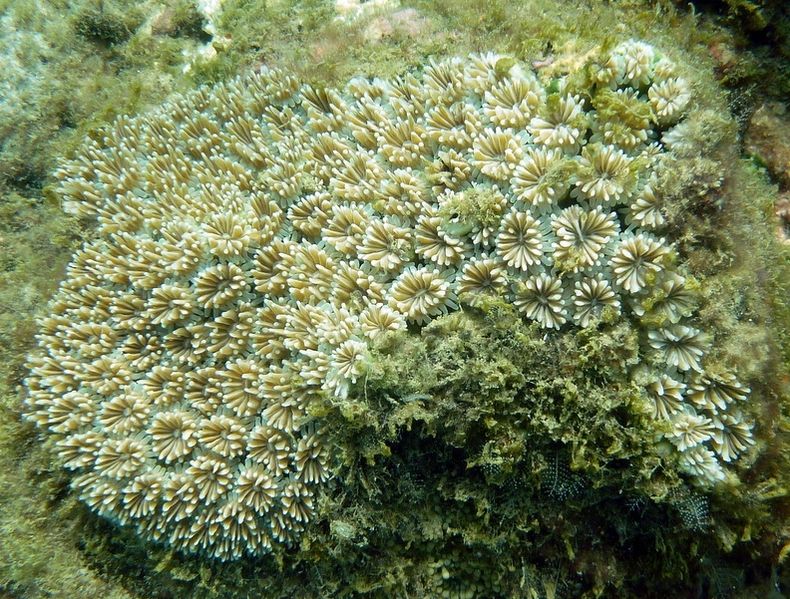
Galaxea fascicularis, copyright David Witherall and Jacob Crabtree.


Belongs within: Hexacorallia.
Contains: Montastreinae, Faviinae.

The Faviina are a group of corals characterised by septa formed of one or more fan systems of simple or compound trabeculae, with synapticulae absent and disseptiments well developed. Septal margins are regularly dentate (Cairns 2002).

<==Faviina [Faviida]
    |--Meandrina PR72 [Meandrinidae DB07, Meandrininae]
    |    |--M. danae SC62
    |    `--M. meandrites PR72
    |--Dichocoeniinae [Trochosmilidae] PR72
    |    |--Dichocoenia stokesii PR72
    |    `--Dendrogyra cylindrus PR72
    |--Rhizangiidae C77
    |    |--Astrangia [Astrangiidae] C77
    |    |    |--A. astreiformis Milne-Edwards & Haime 1849 C77
    |    |    `--A. solitaria (Lesueur 1817) C77
    |    `--Phyllangia C77
    |         |--P. americana Milne-Edwards & Haime 1849 C77
    |         |--P. mouchezi S00
    |         `--P. papuensis Struder 1878 MG-H11
    |--Mussidae PR72
    |    |--Mussa angulosa PR72
    |    |--Isophyllastrea rigida PR72
    |    |--Mycetophyllia lamarckiana PR72
    |    |--Australomussa rowleyensis Veron 1985 M09
    |    |--Isophyllia PR72
    |    |    |--I. multiflora PR72
    |    |    `--I. sinuosa PR72
    |    |--Acanthastrea M09
    |    |    |--A. brevis Milne Edwards & Haime 1849 M09
    |    |    `--A. echinata (Dana 1846) M09
    |    |--Lobophyllia M09
    |    |    |--L. hataii Yabe & Sugiyama 1936 M09
    |    |    `--L. hemprichii (Ehrenberg 1834) M09
    |    `--Symphyllia M09
    |         |--S. agaricia Milne Edwards & Haime 1849 M09
    |         |--S. radians Milne Edwards & Haime 1849 M09
    |         |--S. recta (Dana 1846) M09
    |         `--S. valenciennesii Milne Edwards & Haime 1849 M09
    |--Oculinidae C77
    |    |--Bathelia candida SR01
    |    |--Cyathelia SR01
    |    |--Neohelia SR01
    |    |--Schizoculina africana SR01
    |    |--Sclerhelia hirtella SR01
    |    |--Lophohelia prolifera H04
    |    |--Stephanophyllia H04
    |    |    |--S. complicata H04
    |    |    `--S. elegans H04
    |    |--Oculina SR01
    |    |    |--O. diffusa Lamarck 1816 D84
    |    |    |--O. patagonica SR01
    |    |    `--O. tenella Pourtalès 1871 C77
    |    |--Madrepora MG-H11
    |    |    |--M. carolina (Pourtalès 1871) C77
    |    |    |--M. durvillei N79
    |    |    |--M. fruticosa H04
    |    |    `--M. oculata Linnaeus 1758 MG-H11
    |    `--Galaxea M09
    |         |--G. aspera B79
    |         |--G. astreata (Lamarck 1816) M09
    |         |--G. fascicularis (Linnaeus 1767) M09
    |         |--G. horrescens (Dana 1846) M09
    |         `--G. longisepta Fenner & Veron 2000 M09
    `--Faviidae M09
         |  i. s.: Amphimeandra Beauvais & Mori 1988 SR01
         |           `--A. eguchii (Mori 1963) SR01
         |         Plesiastrea versipora (Lamarck 1816) M09
         |         Caulastrea M09
         |           |--C. furcata Dana 1846 M09
         |           `--C. tumida Matthai 1928 M09
         |         Diploastrea heliopora (Lamarck 1816) M09
         |         Echinopora M09
         |           |--E. ashmorensis Veron 1990 M09
         |           |--E. gemmacea Lamarck 1816 M09
         |           |--E. hirsutissima Milne Edwards & Haime 1849 M09
         |           |--E. horrida Dana 1846 M09
         |           |--E. lamellosa (Esper 1795) M09
         |           `--E. mammiformis (Nemenzo 1959) M09
         |         Favites M09
         |           |--F. abdita (Ellis & Solander 1786) M09
         |           |--F. chinensis (Verrill 1866) M09
         |           |--F. complanata (Ehrenberg 1834) M09
         |           |--F. flexuosa (Dana 1846) M09
         |           |--F. halicora (Ehrenberg 1834) M09
         |           |--F. pentagona (Esper 1794) M09
         |           |--F. russelli (Wells 1954) M09
         |           `--F. stylifera (Yabe & Sugiyama 1937) M09
         |         Goniastrea M09
         |           |--G. aspera Verrill 1905 M09
         |           |--G. australensis (Milne Edwards & Haime 1857) M09
         |           |--G. edwardsi Chevalier 1971 M09
         |           |--G. favulus (Dana 1846) M09
         |           |--G. palauensis (Yabe & Sugiyama 1936) M09
         |           |--G. pectinata (Ehrenberg 1834) M09
         |           `--G. retiformis (Lamarck 1816) M09
         |         Leptoria phrygia (Ellis & Solander 1786) M09
         |         Oulophyllia M09
         |           |--O. bennettae (Veron & Pichon 1977) M09
         |           |--O. crispa (Lamarck 1816) M09
         |           `--O. levis (Nemenzo 1959) M09
         |         Platygyra M09
         |           |--P. daedalea (Ellis & Solander 1786) M09
         |           |--P. lamellina (Ehrenberg 1834) M09
         |           |--P. pini Chevalier 1975 M09
         |           |--P. ryukyuensis Yabe & Sugiyama 1936 M09
         |           |--P. sinensis (Milne Edwards & Haime 1849) M09
         |           `--P. verweyi Wijsman-Best 1976 M09
         |--Montastreinae PR72
         `--Faviinae PR72

*Type species of generic name indicated

REFERENCES

[B79] Buss, L. W. 1979. Habitat selection, directional growth and spatial refuges: why colonial animals have more hiding places. In: Larwood, G., & B. R. Rosen (eds) Biology and Systematics of Colonial Organisms pp. 459–497. Academic Press: London.

[C77] Cairns, S. D. 1977. Stony corals. I. Caryophylliina and Dendrophylliina (Anthozoa: Scleractinia). Memoirs of the Hourglass Cruises 3 (4): 1–27.

[DB07] Daly, M., M. R. Brugler, P. Cartwright, A. G. Collins, M. N. Dawson, D. G. Fautin, S. C. France, C. S. McFadden, D. M. Opresko, E. Rodriguez, S. L. Romano & J. L. Stake. 2007. The phylum Cnidaria: a review of phylogenetic patterns and diversity 300 years after Linnaeus. Zootaxa 1668: 127–182.

[D84] Dardeau, M. R. 1984. Synalpheus shrimps (Crustacea: Decapoda: Alpheidae). I. The Gambarelloides group, with a description of a new species. Memoirs of the Hourglass Cruises 7 (2): 1–125.

[H04] Haeckel, E. 1899–1904. Kunstformen der Natur. Bibliographisches Institut: Leipzig und Wien.

[MG-H11] McEnnulty, F. R., K. L. Gowlett-Holmes, A. Williams, F. Althaus, J. Fromont, G. C. B. Poore, T. D. O'Hara, L. Marsh, P. Kott, S. Slack-Smith, P. Alderslade & M. V. Kitahara. 2011. The deepwater megabenthic invertebrates on the western continental margin of Australia (100–1100 m depths): composition, distribution and novelty. Records of the Western Australian Museum Supplement 80: 1–191.

[M09] McKinney, D. 2009. A survey of the scleractinian corals at Mermaid, Scott, and Seringapatam Reefs, Western Australia. Records of the Western Australian Museum Supplement 77: 105–143.

[N79] Nudds, J. R. 1979. Coloniality in the Lithostrotionidae (Rugosa). In: Larwood, G., & B. R. Rosen (eds) Biology and Systematics of Colonial Organisms pp. 173–192. Academic Press: London.

[PR72] Powers, D. A., & F. J. Rohlf. 1972. A numerical taxonomic study of Caribbean and Hawaiian reef corals. Systematic Zoology 21 (1): 53–64.

[SC62] Starck, W. A., II & W. R. Courtenay, Jr. 1962. Chorististium eukrines, a new serranid fish from Florida, with notes on related species. Proceedings of the Biological Society of Washington 75: 159–168.

[S00] Stolarski, J. 2000. Origin and phylogeny of Guyniidae (Scleractinia) in the light of microstructural data. Lethaia 33: 13–38.

[SR01] Stolarski, J., & A. Russo. 2001. Evolution of the post-Triassic pachythecaliine corals. Bulletin of the Biological Society of Washington 10: 242–256.

Hexacorallia

Calyx of Anthemiphyllia dentata, from here.


Belongs within: Cnidaria.
Contains: Actiniaria, Antipatharia, Zoanthidea, Pectiniidae, Merulinidae, Faviina, Caryophylliina, Dendrophylliidae, Fungiina, Astrocoeniina, Stylophyllidae.

The Hexacorallia are a major group of cnidarians including the stony corals, sea anemones and related taxa. Most species have hexamerous symmetry, though some are octomerous or decamerous. The group is more reliably characterised by the presence of spirocysts, cnidae with a single-walled capsule and a tubule composed of tiny entangling subthreads (Daly et al. 2007). Subgroups of the Hexacorallia include the Ceriantharia, which are solitary, elongate polyps that live burrowed into sediment and contained within a flexible tube constructed from discharged cnidae and mucus (Daly et al. 2007).

<==Hexacorallia [Ceriantipatharia]
    |--Ceriantharia DB07
    |    |--Isarachnanthus RB14 [Arachnanthidae DB07, Penicillaria]
    |    `--Spirularia DB07
    |         |--Botrucnidiferidae DB07
    |         |    |--Botruanthus DB07
    |         |    `--Botrucnidifer DB07
    |         `--Cerianthidae DB07
    |              |--Cerianthus filiformis BH88
    |              |--Ceriantheomorphe brasiliensis RB14
    |              `--Pachycerianthus RB14
    `--+--Actiniaria RB14
       `--+--+--Antipatharia RB14
          |  `--+--Zoanthidea RB14
          |     `--Relicanthus Rodríguez & Daly in Rodríguez, Barbeitos et al. 2014 [Relicanthidae] RB14
          |          `--*R. daphneae [=Boloceroides daphneae] RB14
          `--+--Corallimorpharia RB14
             |    |--Corallimorphus [Corallimorphidae] RB14
             |    |    `--C. profundus RB14
             |    |--Discosomatidae DB07
             |    |--Ricordea H94 [Ricordeidae DB07]
             |    |    `--R. florida H94
             |    |--Sideractiidae DB07
             |    `--Corynactis [Corynactinidae] RB14
             |         |--C. californic MH96
             |         `--C. viridis RB14
             `--Scleractinia [Madreporaria] RB14
                  |  i. s.: Microsolena HS02
                  |         Discocyathus Milne Edwards & Haime 1848 SR02
                  |         Schizophyllum fissilis Pourtalès 1874 SR02
                  |         Palaeomussa Alloiteau 1952 SR02
                  |         Vaughanella SR02
                  |         Ceratotrochus magnaghii SR02
                  |         Polycyathus muellerae (Abel 1959) S00
                  |         Astraeomorpha Reuss 1854 CS04
                  |         Pseudoastraeopora Russo 1979 SR01
                  |           `--P. hortensis (Oppenheim 1900) SR01
                  |         Agathelia Reuss 1854 SR01
                  |         Stylohelia de Fromentel 1861 SR01
                  |         Bracthelia Beauvais & Beauvais 1975 SR01
                  |         Palaeohelia albiensis Beauvais 1982 SR01
                  |         Etallonasteria minima (Étallon 1864) SR01
                  |         Paretallonia SR01
                  |         Orbicillidae PR72
                  |         Eupsammidae PR72
                  |         Pectiniidae M09
                  |         Euphyllidae M09
                  |           |--Physogyra lichtensteini (Milne Edwards & Haime 1851) M09
                  |           |--Plerogyra sinuosa (Dana 1846) M09
                  |           `--Euphyllia M09
                  |                |--E. ancora Veron & Pichon 1980 M09
                  |                |--E. cristata Chevalier 1971 M09
                  |                |--E. glabrescens (Chamisso & Eysenhardt 1821) M09
                  |                `--E. striata H04
                  |         Merulinidae M09
                  |         Solenosmilia variabilis MG-H11
                  |         Hoplangia durotrix Gosse 1860 S00
                  |         Diaseris S00
                  |           |--D. distorta S00
                  |           `--D. fragilis S00
                  |         Retiophyllia frechi S00
                  |         Manacina mayori SC62
                  |         Fungiacyathus MG-H11 [Fungiacyathidae DB07]
                  |           |--F. crispus (Pourtalès 1871) C77
                  |           |--F. fragilis Sars 1872 MG-H11
                  |           |--F. marenzelleri RB14
                  |           `--F. stephanus (Alcock 1893) MG-H11
                  |         Trachyphylliidae DB07
                  |--Faviina SR02
                  |--Caryophylliina RS01
                  |--Dendrophylliidae C77
                  |--Fungiina C77
                  |--Astrocoeniina C77
                  |--Rhipidogyrina SR01
                  |    |--Aulastraeopora deangelisi Prever 1909 SR01
                  |    |--Preverastraea diplothecata (Hackemesser 1936) SR01
                  |    |--Bodeurina languedociensis Beauvais 1980 SR01
                  |    `--Aplosmilia coalescens Eliášová 1973 SR01
                  `--+--Stylophyllina SR02
                     |    |--Stylophyllidae SR02
                     |    `--Gigantostylis [Gigantostyliidae] SR02
                     |         `--G. epigonus Frech 1890 SR02
                     `--+--Thecocyathidae SR07
                        |    |  i. s.: ‘Microsmilia’ matheyi Koby 1888 S00
                        |    `--Thecocyathus tintinabulum Goldfuss 1826 SR02
                        `--Anthemiphyllia [Anthemiphylliidae] SR02
                             |--A. catinata Wells 1907 SR02
                             |--A. dentata Alcock 1902 SR02
                             |--A. patera De Pourtalès 1878 SR02
                             `--A. spinifera SR02

Hexacorallia incertae sedis:
  Caninia G02
    |--C. cornucopiae G02
    `--C. dorlodoti ZP86
  Leolasma G02
  Streptelasmatida G02
    |--Domophyllum G02
    |--Acrophyllum oneidaense G02, N79
    |--Compressiphyllum G02
    |--Lobocorallium trilobatum G02
    |--Densigrewingkia G02
    `--Borelasma G02
  Aulosmilia SR02
  Hughaea Lamouroux 1821 RL03
    `--H. caribaeorum Duchassaing 1850 RL03
  Maeandrina filograna H04
  Lophoseris H04
    |--L. divaricata H04
    `--L. frondifera H04
  Tridacophyllia lactuca H04
  Lithophyllia lacera H04
  Astraea H04
    |--A. expansa H04
    `--A. magnifica H04
  Pterogyra laxa H04
  Numidiaphyllidae G02
  Kilbuchophyllidae G02

*Type species of generic name indicated

REFERENCES

[BH88] Boxshall, G. A., & A. G. Humes. 1988. A new genus of Lichomolgidae (Copepoda: Poecilostomatoida) associated with a phoronid in Hong Kong. Bulletin of the British Museum (Natural History), Zoology Series 54 (6): 301–307.

[C77] Cairns, S. D. 1977. Stony corals. I. Caryophylliina and Dendrophylliina (Anthozoa: Scleractinia). Memoirs of the Hourglass Cruises 3 (4): 1–27.

[CS04] Carter, J. G., & G. D. Stanley Jr. 2004. Late Triassic gastrochaenid and lithophaginid borings (Mollusca: Bivalvia) from Nevada (USA) and Austria. Journal of Paleontology 78 (1): 230–234.

[DB07] Daly, M., M. R. Brugler, P. Cartwright, A. G. Collins, M. N. Dawson, D. G. Fautin, S. C. France, C. S. McFadden, D. M. Opresko, E. Rodriguez, S. L. Romano & J. L. Stake. 2007. The phylum Cnidaria: a review of phylogenetic patterns and diversity 300 years after Linnaeus. Zootaxa 1668: 127–182.

[G02] Gudo, M. 2002. Soft body reconstructions of Palaeozoic corals: Implications for the system of Anthozoa (Coelenterata). Lethaia 35: 328–344.

[H04] Haeckel, E. 1899–1904. Kunstformen der Natur. Bibliographisches Institut: Leipzig und Wien.

[HS02] Höfling, R., & R. W. Scott. 2002. Early and Mid-Cretaceous buildups. SEPM Special Publication 72: 521–548.

[H94] Humes, A. G. 1994. Two species of Paramolgus (Copepoda: Poecilostomatoida: Lichomolgidae) associated with the scleractinian Pavona in New Caledonia with a key to the females of Paramolgus. Beaufortia 44 (1): 1–9.

[MG-H11] McEnnulty, F. R., K. L. Gowlett-Holmes, A. Williams, F. Althaus, J. Fromont, G. C. B. Poore, T. D. O'Hara, L. Marsh, P. Kott, S. Slack-Smith, P. Alderslade & M. V. Kitahara. 2011. The deepwater megabenthic invertebrates on the western continental margin of Australia (100–1100 m depths): composition, distribution and novelty. Records of the Western Australian Museum Supplement 80: 1–191.

[M09] McKinney, D. 2009. A survey of the scleractinian corals at Mermaid, Scott, and Seringapatam Reefs, Western Australia. Records of the Western Australian Museum Supplement 77: 105–143.

[MH96] Miller, S. A., & J. P. Harley. 1996. Zoology 3rd ed. Wm. C. Brown Publishers: Dubuque (Iowa).

[N79] Norris, A. W. 1979. Devonian in the Western Hemisphere. In: Robison, R. A., & C. Teichert (eds) Treatise on Invertebrate Paleontology pt A. Introduction. Fossilisation (Taphonomy), Biogeography and Biostratigraphy pp. A218–A253. The Geological Society of America, Inc.: Boulder (Colorado), and The University of Kansas: Lawrence (Kansas).

[PR72] Powers, D. A., & F. J. Rohlf. 1972. A numerical taxonomic study of Caribbean and Hawaiian reef corals. Systematic Zoology 21 (1): 53–64.

[RB14] Rodríguez, E., M. S. Barbeitos, M. R. Brugler, L. M. Crowley, A. Grajales, L. Gusmão, V. Häussermann, A. Reft & M. Daly. 2014. Hidden among sea anemones: the first comprehensive phylogenetic reconstruction of the order Actiniaria (Cnidaria, Anthozoa, Hexacorallia) reveals a novel group of hexacorals. PLoS One 9 (5): e96998.

[RS01] Roniewicz, E., & J. Stolarski. 2001. Triassic roots of the amphiastraeid scleractinian corals. Journal of Paleontology 75 (1): 34–45.

[RL03] Ryland, J. S., & J. E. Lancaster. 2003. Revision of methods for separating species of Protopalythoa (Hexacorallia: Zoanthidea) in the tropical West Pacific. Invertebrate Systematics 17: 407–428.

[SC62] Starck, W. A., II & W. R. Courtenay Jr. 1962. Chorististium eukrines, a new serranid fish from Florida, with notes on related species. Proceedings of the Biological Society of Washington 75: 159–168.

[S00] Stolarski, J. 2000. Origin and phylogeny of Guyniidae (Scleractinia) in the light of microstructural data. Lethaia 33: 13–38.

[SR01] Stolarski, J., & A. Russo. 2001. Evolution of the post-Triassic pachythecaliine corals. Bulletin of the Biological Society of Washington 10: 242–256.

[SR02] Stolarski, J., & A. Russo. 2002. Microstructural diversity of the stylophyllid (Scleractinia) skeleton. Acta Palaeontologica Polonica 47 (4): 651–666.

[ZP86] Zhang, R., & J. Pojeta, Jr. 1986. New bivalves from the Datang Stage, Lower Carboniferous, Guangdong Province, China. Journal of Paleontology 60 (3): 669–679.

Dendrophylliidae

Cup coral Balanophyllia sp., copyright Toby Hudson.


Belongs within: Hexacorallia.

The Dendrophylliidae are a group of corals characterised by irregularly porous thecal walls. Most species lack zooxanthellae, and include both solitary and colonial forms.

Characters (from Cairns 2002): Thecal wall irregularly porous (synapticulotheca), with pores and tissue lining pores being continuous from outside to inside of corallum; thin epitheca sometimes overlaying part or all of synapticulotheca; septa lamellar, smooth-edged (minitrabeculate), sometimes porous, often arranged according to 'Pourtalès plan', with septa of higher cycles longer and fusing in front of septa of lower cycles in a distinctive pattern.

<==Dendrophylliidae [Dendrophyllida, Dendrophylliina]
    |--Dendrophyllia manni B79
    |--Bathypsammia tintinnabulum (Pourtalès 1868) C77
    |--Enallopsammia profunda (Pourtalès 1867) C77
    |--Astroides calycularis (Pallas 1766) RL04
    |--Heteropsammia cochlea (Spengler 1781) MG-H11
    |--Tubastraea RB14
    |    |--T. coccinea RB14
    |    |--T. aurea PR72
    |    `--T. tenuilamellosa (Milne Edwards & Haime 1848) BC01
    |--Rhizopsammia C77
    |    |--R. manuelensis Chevalier 1966 C77
    |    `--R. minuta C-SC03
    |--Turbinaria M09
    |    |--T. frondens (Dana 1846) M09
    |    |--T. mesenterina (Lamarck 1816) M09
    |    |--T. peltata (Esper 1794) M09
    |    |--T. reniformis Bernard 1896 M09
    |    |--T. robusta H04
    |    |--T. stellulata (Lamarck 1816) M09
    |    `--T. transformis H04
    `--Balanophyllia Wood 1844 C77
         |--B. carinata (Semper 1872) MG-H11
         |--B. cornu Moseley 1881 MG-H11
         |--B. cyathoides (Pourtalès 1871) C77
         |--B. dentata Tenison Woods 1879 MG-H11
         |--B. desmophyllioides Vaughan 1907 MG-H11
         |--B. floridana Pourtalès 1868 [=B. florideana (l. c.)] C77
         `--B. palifera Pourtalès 1878 C77

*Type species of generic name indicated

REFERENCES

[BC01] Boyko, C. B., & J. R. Cordeiro. 2001. Catalog of Recent type specimens in the Division of Invertebrate Zoology, American Museum of Natural History. V. Mollusca, part 2 (class Gastropoda [exclusive of Opisthobranchia and Pulmonata], with supplements to Gastropoda [Opisthobranchia], and Bivalvia). Bulletin of the American Museum of Natural History 262: 1–170.

[B79] Buss, L. W. 1979. Habitat selection, directional growth and spatial refuges: why colonial animals have more hiding places. In: Larwood, G., & B. R. Rosen (eds) Biology and Systematics of Colonial Organisms pp. 459–497. Academic Press: London.

[C77] Cairns, S. D. 1977. Stony corals. I. Caryophylliina and Dendrophylliina (Anthozoa: Scleractinia). Memoirs of the Hourglass Cruises 3 (4): 1–27.

[C-SC03] Cavalier-Smith, T., & E. E.-Y. Chao. 2003. Phylogeny of Choanozoa, Apusozoa, and other Protozoa and early eukaryote megaevolution. Journal of Molecular Evolution 56: 540–563.

[H04] Haeckel, E. 1899–1904. Kunstformen der Natur. Bibliographisches Institut: Leipzig und Wien.

[MG-H11] McEnnulty, F. R., K. L. Gowlett-Holmes, A. Williams, F. Althaus, J. Fromont, G. C. B. Poore, T. D. O'Hara, L. Marsh, P. Kott, S. Slack-Smith, P. Alderslade & M. V. Kitahara. 2011. The deepwater megabenthic invertebrates on the western continental margin of Australia (100–1100 m depths): composition, distribution and novelty. Records of the Western Australian Museum Supplement 80: 1–191.

[M09] McKinney, D. 2009. A survey of the scleractinian corals at Mermaid, Scott, and Seringapatam Reefs, Western Australia. Records of the Western Australian Museum Supplement 77: 105–143.

[PR72] Powers, D. A., & F. J. Rohlf. 1972. A numerical taxonomic study of Caribbean and Hawaiian reef corals. Systematic Zoology 21 (1): 53–64.

[RL04] Richter, A., & Á. A. Luque. 2004. Epitonium dendrophylliae (Gastropoda: Epitoniidae) feeding on Astroides calycularis (Anthozoa, Scleractinia). Journal of Molluscan Studies 70: 99–101.

[RB14] Rodríguez, E., M. S. Barbeitos, M. R. Brugler, L. M. Crowley, A. Grajales, L. Gusmão, V. Häussermann, A. Reft & M. Daly. 2014. Hidden among sea anemones: the first comprehensive phylogenetic reconstruction of the order Actiniaria (Cnidaria, Anthozoa, Hexacorallia) reveals a novel group of hexacorals. PLoS One 9 (5): e96998.

Antipatharia

Antipathella subpinnata, from here.


Belongs within: Hexacorallia.
Contains: Myriopathes.

The Antipatharia, black corals, are a group of colonial cnidarians with a proteinaceous skeleton found primarily in deeper waters.

See also: Antipatharia: the black corals.

Characters (from Daly et al. 2007): Noncalcareous, colonial, with a spiny, proteinaceous skeleton (corallum) that can be unbranched and wire-like or simply to complexly dendritic; skeleton secreted by axial epithelial tissue of polyps in concentric layers around a small central hollow core. Polyps each usually no more than a few millimeters in diameter (maximum size about 1 cm in diameter), possessing six simple tentacles, six primary mesenteries, and zero, four, or six secondary mesenteries.

<==Antipatharia
    |  i. s.: Stylopathidae DB07
    |--+--Cladopathidae DB07
    |  |    |--Cladopathes Brook 1889 [Cladopathinae] O01
    |  |    |--Sibopathes van Pesch 1914 [Sibopathinae] O01
    |  |    |--Hexapathes Kinoshita 1910 [Hexapathinae] O01
    |  |    |--Chrysopathes formosa RB14
    |  |    `--Trissopathes pseudotristicha RB14
    |  `--Schizopathidae DB07
    |       |--Schizopathes Brook 1889 [Schizopathinae] O01
    |       |--Bathypathes Brook 1889 O01
    |       |--Taxipathes Brook 1889 O01
    |       |--Parantipathes Brook 1889 O01 [Parantipathinae DB07]
    |       |    |--P. helicostricha Opresko 1999 MG-H11
    |       |    `--P. hirondelle RB14
    |       |--Dendrobathypathes boutillieri RB14
    |       `--Stauropathes punctata RB14
    |--+--Leiopathes RB14 [Leiopathidae DB07]
    |  |    `--L. glaberrima RB14
    |  `--Antipathidae DB07
    |       |--Cirrhipathes Blainville 1857 O01
    |       |    |--C. anguina RB14
    |       |    |--C. lutkeni OI05
    |       |    `--C. spiralis (Linnaeus 1758) [=Gorgonia spiralis] DB07
    |       |--Stichopathes Brook 1889 O01
    |       |    |--S. ceylonensis MG-H11
    |       |    |--S. dissimilis RB14
    |       |    `--S. flagellum RB14
    |       `--Antipathes Pallas 1766 O01
    |            |--A. abies H94
    |            |--A. atlantica RB14
    |            |--A. ericoides H94
    |            |--A. galapagensis C-SC03
    |            `--A. griggi RB14
    `--+--Aphanipathidae DB07
       |    |--Aphanipathes Brook 1889 O01
       |    |    `--A. verticillata RB14
       |    |         |--A. v. verticillata RB14
       |    |         `--A. v. mauiensis RB14
       |    |--Acanthopathes thyoides RB14
       |    |--Elatopathes abietina RB14
       |    `--Phanopathes expansa RB14
       `--Myriopathidae DB07
            |--Myriopathes O01
            |--Plumapathes Opresko 2001 O01
            |    |--*P. pennacea (Pallas 1766) [=Antipathes pennacea] O01
            |    `--P. fernandezi (Pourtalès 1874) [=Antipathes fernandezi] O01
            |--Cupressopathes Opresko 2001 O01
            |    |--*C. abies (Linnaeus 1758) [=Gorgonia abies] O01
            |    |--C. gracilis (Thomson & Simpson 1905) [=Antipathes gracilis] O01
            |    |--C. paniculata (Esper 1796) [=Antipathes paniculata] O01
            |    `--C. pumila (Brook 1889) [=Antipathes pumila] O01
            |--Antipathella Brook 1889 O01
            |    |--*A. subpinnata (Ellis & Solander 1786) [=Antipathes subpinnata] O01
            |    |--A. aperta (Totton 1923) [=Antipathes aperta] O01
            |    |--A. fiordensis (Grange 1990) [=Antipathes fiordensis] O01
            |    |--A. strigosa (Brook 1889) [=Antipathes strigosa] O01
            |    `--A. wollastoni (Gray 1857) [=Antipathes wollastoni] O01
            `--Tanacetipathes Opresko 2001 O01
                 |--*T. tanacetum (Pourtalès 1880) [=Antipathes tanacetum] O01
                 |--T. barbadensis (Brook 1889) [=Antipathes barbadensis] O01
                 |--T. cavernicola Opresko 2001 O01
                 |--T. hirta (Gray 1857) [=Antipathes hirta] O01
                 |--T. spinescens (Gray 1857) [=Antipathes spinescens] O01
                 |--T. thamnea (Warner 1981) [=Antipathes thamnea] O01
                 `--T. wirtzi Opresko 2001 O01

*Type species of generic name indicated

REFERENCES

[C-SC03] Cavalier-Smith, T., & E. E.-Y. Chao. 2003. Phylogeny of Choanozoa, Apusozoa, and other Protozoa and early eukaryote megaevolution. Journal of Molecular Evolution 56: 540–563.

[DB07] Daly, M., M. R. Brugler, P. Cartwright, A. G. Collins, M. N. Dawson, D. G. Fautin, S. C. France, C. S. McFadden, D. M. Opresko, E. Rodriguez, S. L. Romano & J. L. Stake. 2007. The phylum Cnidaria: a review of phylogenetic patterns and diversity 300 years after Linnaeus. Zootaxa 1668: 127–182.

[H94] Humes, A. G. 1994. Two species of Paramolgus (Copepoda: Poecilostomatoida: Lichomolgidae) associated with the scleractinian Pavona in New Caledonia with a key to the females of Paramolgus. Beaufortia 44 (1): 1–9.

[MG-H11] McEnnulty, F. R., K. L. Gowlett-Holmes, A. Williams, F. Althaus, J. Fromont, G. C. B. Poore, T. D. O'Hara, L. Marsh, P. Kott, S. Slack-Smith, P. Alderslade & M. V. Kitahara. 2011. The deepwater megabenthic invertebrates on the western continental margin of Australia (100–1100 m depths): composition, distribution and novelty. Records of the Western Australian Museum Supplement 80: 1–191.

[OI05] Okamoto, N., & I. Inouye. 2005. The katablepharids are a distant sister group of the Cryptophyta: a proposal for Katablepharidophyta divisio nova/Kathablepharida phylum novum based on SSU rDNA and beta-tubulin phylogeny. Protist 156: 163–179.

[O01] Opresko, D. M. 2001. Revision of the Antipatharia (Cnidaria: Anthozoa). Part I. Establishment of a new family, Myriopathidae. Zoologische Mededelingen 75 (17): 343–370.

[RB14] Rodríguez, E., M. S. Barbeitos, M. R. Brugler, L. M. Crowley, A. Grajales, L. Gusmão, V. Häussermann, A. Reft & M. Daly. 2014. Hidden among sea anemones: the first comprehensive phylogenetic reconstruction of the order Actiniaria (Cnidaria, Anthozoa, Hexacorallia) reveals a novel group of hexacorals. PLoS One 9 (5): e96998.