Showing posts with label Boraginaceae. Show all posts

Myosotis

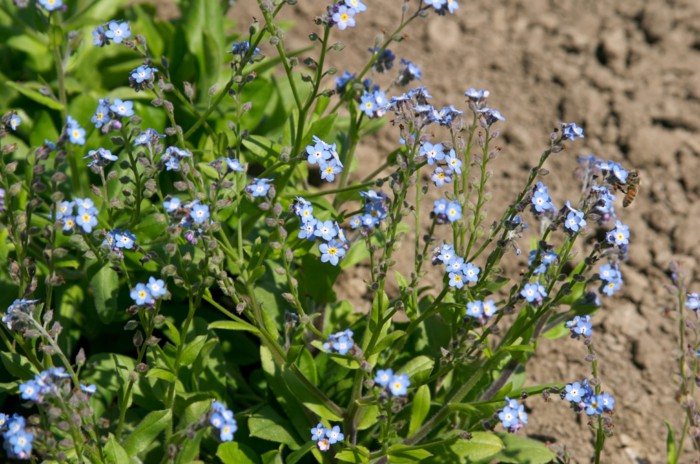
Wood forget-me-nots Myosotis sylvatica, from here.


Belongs within: Cynoglosseae.

Myosotis, the forget-me-nots, is a genus of herbaceous plants found in cooler regions of the world with mostly blue (occasionally white or yellow) flowers.

Characters (from Hickman 1993): Annual or perennial, glabrous to rough-hairy; roots generally diffuse. Stem decumbent to erect. Basal leaves generally oblong or oblanceolate; cauline leaves generally linear to elliptic. Inflorescence coiled, generally raceme-like, eventually more or less open; bracts absent (or leaf-like in lower half); flowers generally in upper half of plant. Flower with five calyx lobes, generally more or less equal; corolla salverform or widely funnel-shaped, white, yellow, or generally blue, tube five-appendaged at top, limb abruptly spreading, five-lobed; stamens 5, included; style generally included. Nutlets smooth, shiny, each with raised outer margin, scar lateral, at base, small.

<==Myosotis Linnaeus 1753 A61 [incl. M. sect. Eumyosotis C06, Exarrhena Brown 1810 A61; Myosotideae]
    |--M. albo-sericea Hooker 1867 A61
    |--M. amabilis Cheeseman 1906 A61
    |--M. angustata Cheeseman 1906 A61
    |--M. antarctica Hooker 1844 A61
    |--M. arnoldii Moore in Allan 1961 A61
    |--M. arvensis LC02
    |--M. australis Br. 1810 (see below for synonymy) A61
    |--M. caespitosa HE80
    |--M. capitata Hooker 1844 A61
    |--M. cheesemanii Petrie 1886 A61
    |--M. colensoi (Kirk) Macbride 1916 [=Exarrhena colensoi Kirk 1895; incl. M. decora Kirk ex Cheeseman 1906] A61
    |--M. collina C06
    |--M. concinna Cheeseman 1885 A61
    |--M. discolor [incl. M. versicolor] H93
    |--M. elderi Moore in Allan 1961 A61
    |--M. eximia Petrie 1916 A61
    |--M. explanata Cheeseman 1906 A61
    |--M. forsteri Lehm. 1818 (see below for synonymy) A61
    |--M. glabrescens Moore in Allan 1961 A61
    |--M. goyenii Petrie 1891 A61
    |--M. laeta Cheeseman 1885 A61
    |--M. laingii Cheeseman 1912 A61
    |--M. latifolia H93
    |--M. laxa H93
    |--M. lyallii Hooker 1853 A61 [=Exarrhena lyallii C06]
    |    |--M. l. var. lyallii A61
    |    `--M. l. var. townsonii (Cheeseman) Moore in Allan 1961 [=M. townsonii Cheeseman 1906] A61
    |--M. macrantha (Hooker) Benth. & Hooker 1876 (see below for synonymy) A61
    |--M. matthewsii Moore in Allan 1961 A61
    |--M. micrantha H93
    |--M. monroi Cheeseman 1906 A61
    |--M. oreophila Petrie 1896 A61 [=M. (Exarrhena) oreophila C06]
    |--M. palustris BR65
    |--M. petiolata Hooker 1853 A61 [=Exarrhena petiolata C06]
    |    |--M. p. var. petiolata A61
    |    |--M. p. var. pansa Moore in Allan 1961 A61
    |    `--M. p. var. pottsiana Moore in Allan 1961 A61
    |--M. pulvinaris Hooker 1864 [incl. M. hectori Hooker 1864] A61
    |--M. pygmaea Colenso 1884 (see below for synonymy) A61
    |    |--M. p. var. pygmaea A61
    |    |--M. p. var. drucei Moore in Allan 1961 A61
    |    |--M. p. var. glauca Simpson & Thomson 1943 A61
    |    `--M. p. var. minutiflora Simpson & Thomson 1943 A61
    |--M. rakiura Moore in Allan 1961 (see below for synonymy) A61
    |--M. ramosissima G88
    |--M. refracta C55
    |--M. saxosa Hooker 1853 [=Exarrhena saxosa Hooker 1864] A61
    |--M. scorpioides LDB98
    |--M. spathulata Forster 1786 A61 [=Anchusa spathulata C06; incl. M. orbiculata Simpson 1952 A61]
    |    |--M. s. var. spathulata A61
    |    `--M. s. var. radicata Moore in Allan 1961 A61
    |--M. stricta HE80
    |--*Exarrhena’ suaveolens A61
    |--M. suavis Petrie 1914 A61
    |--M. subvernicosa Colenso 1891 (n. d.) A61
    |--M. sylvatica BR65
    |--M. tenericaulis Petrie 1918 [=M. tenuicaulis (l. c.); incl. M. tenuis Simpson & Thomson 1944] A61
    |--M. traversii Hooker 1864 A61
    |    |--M. t. var. traversii (see below for synonymy) A61
    |    |--M. t. var. cantabrica Moore in Allan 1961 A61
    |    `--M. t. var. cinerascens (Petrie) Moore in Allan 1961 [=M. cinerascens Petrie 1918] A61
    |--M. uniflora Hooker 1864 A61
    |--M. venosa Colenso 1896 [incl. M. astonii Cheeseman 1910, M. diversifolia Petrie 1918] A61
    `--M. verna [incl. M. virginica] H93

Myosotis australis Br. 1810 [incl. M. australis var. conspicua Cheeseman 1906, M. australis var. lytteltonensis Laing & Wall 1924, M. saxatilis Petrie 1918 non Pallas 1795] A61

Myosotis forsteri Lehm. 1818 [incl. M. hamiltonii Colenso 1888, M. polyantha Colenso 1899, M. tenuifolia Colenso 1899] A61

Myosotis macrantha (Hooker) Benth. & Hooker 1876 [=Exarrhena macrantha Hooker 1864; incl. M. macrantha var. diversa Simpson & Thomson 1943, M. macrantha var. pulchra Cheeseman 1906, M. macrantha var. westlandica Petrie 1918] A61

Myosotis pygmaea Colenso 1884 [incl. M. ramificata Simpson 1952, M. antarctica ssp. traillii Kirk 1884, M. pygmaea var. traillii (Kirk) Ckn. 1921] A61

Myosotis rakiura Moore in Allan 1961 [=M. capitata var. albiflora Armstr. 1881 non M. albiflora Banks & Sol. ex Hooker 1847, M. capitata ssp. albida Kirk 1885, M. albida (Kirk) Cheeseman in Cockayne 1909 non Kunth in H.B. & K. 1818] A61

Myosotis traversii Hooker 1864 var. traversii [incl. M. cockayniana Petrie 1913, M. traversii var. cockayniana (Petrie) Cheeseman 1925] A61

*Type species of generic name indicated

REFERENCES

[A61] Allan, H. H. 1961. Flora of New Zealand vol. 1. Indigenous Tracheophyta: Psilopsida, Lycopsida, Filicopsida, Gymnospermae, Dicotyledones. R. E. Owen, Government Printer: Wellington (New Zealand).

[BR65] Black, J. M., & E. L. Robertson. 1965. Flora of South Australia. Part IV. Oleaceae–Compositae. W. L. Hawes, Government Printer: Adelaide.

[C55] Candolle, A. de. 1855. Géographie Botanique Raisonée: Ou exposition des faits principaux et des lois concernant la distribution géographique des plantes de l’époque actuelle vol. 2. Librairie de Victor Masson: Paris.

[C06] Cheeseman, T. F. 1906. Manual of the New Zealand Flora. John Mackay, Government Printer: Wellington.

[G88] Grubb, P. J. 1988. The uncoupling of disturbance and recruitment, two kinds of seed bank, and persistence of plant populations at the regional and local scales. Annales Zoologici Fennici 25: 23–26.

[HE80] Healy, A. J., & E. Edgar. 1980. Flora of New Zealand vol. 3. Adventive cyperaceous, petalous and spathaceous monocotyledons. P. D. Hasselberg, Government Printer: Wellington (New Zealand).

[H93] Hickman, J. C. (ed.) 1993. The Jepson Manual: Higher Plants of California. University of California Press: Berkeley (California).

[LC02] Långström, E., & M. W. Chase. 2002. Tribes of Boraginoideae (Boraginaceae) and placement of Antiphytum, Echiochilon, Ogastemma and Sericostoma: a phylogenetic analysis based on atpB plastid DNA sequence data. Plant Systematics and Evolution 234: 137–153.

[LDB98] Lenssen, J. P. M., G. E. ten Dolle & C. W. P. M. Blom. 1998. The effect of flooding on the recruitment of reed marsh and tall forb plant species. Plant Ecology 139: 13–23.

Trichodesmeae

Indian borage Trichodesma indica, copyright J. M. Garg.


Belongs within: Cynoglosseae.

The Trichodesmeae are an Old World group of robust herbs or shrubs with very short corolla tubes and mostly spreading corolla lobes with long, exserted anthers.

<==Trichodesmeae
    |--Caccinia LC02
    |--Suchtelenia LC02
    `--Trichodesma Brown 1810 [incl. Pollichia Medicus 1783 (nom. rej.)] BR65
         |--T. angustifolium CV06
         |    |--T. a. ssp. angustifolium CV06
         |    `--T. a. ssp. argenteum CV06
         |--T. indica PP07
         |    |--T. i. var. indica PP07
         |    `--T. i. var. amplexicaule PP07
         |--T. scottii LC02
         `--T. zeylanicum [=Pollichia zeylanica; incl. T. zeylanicum var. sericeum] BR65
              |--T. z. var. zeylanicum BR65
              `--T. z. var. latisepalum BR65

*Type species of generic name indicated

REFERENCES

[BR65] Black, J. M., & E. L. Robertson. 1965. Flora of South Australia. Part IV. Oleaceae–Compositae. W. L. Hawes, Government Printer: Adelaide.

[CV06] Craven, P., & P. Vorster. 2006. Patterns of plant diversity and endemism in Namibia. Bothalia 36 (2): 175–189.

[LC02] Långström, E., & M. W. Chase. 2002. Tribes of Boraginoideae (Boraginaceae) and placement of Antiphytum, Echiochilon, Ogastemma and Sericostoma: a phylogenetic analysis based on atpB plastid DNA sequence data. Plant Systematics and Evolution 234: 137–153.

[PP07] Pandey, R. P., & P. M. Padhye. 2007. Studies on phytodiversity of Arid Machia Safari Park-Kailana in Jodhpur (Rajasthan). Bulletin of the Botanical Survey of India 49: 15–78.

Heliotropioideae

Garden heliotrope Heliotropium arborescens, copyright Aleksandrs Balodis.


Belongs within: Boraginaceae.

The Heliotropioideae are a group of flowering plants in which the flowers have a terminal style with a conical stigmatic head having a basal ring-shaped stigma and sterile apex.

<==Heliotropioideae [Heliotropiaceae]
    |--Ixorhea T00
    |--Nogalia T00
    `--Heliotropium LC02
         |--H. aenigmatum LK14
         |--H. albiflorum CV06
         |--H. ammophilum KM08
         |--H. amplexicaule Vahl. 1794 (see below for synonymy) BR65
         |--H. apertum LK14
         |--H. arborescens OA02 [incl. H. peruvianum BR65]
         |--H. asperrimum BR65
         |--H. brachythrix LK14
         |--H. conocarpum LK14
         |--H. convolvulaceum H93
         |    |--H. c. var. convolvulaceum H93
         |    `--H. c. var. californicum H93
         |--H. cunninghamii LK14
         |--H. curassavicum [incl. H. curassavicum var. oculatum] H93
         |--H. dichotomum LK14
         |--H. discorde LK14
         |--H. europaeum BR65
         |--H. filaginoides BR65
         |--H. foliatum LK14
         |--H. galioides LK14
         |--H. glabellum LK14
         |--H. heteranthum [=H. filaginoides var. heteranthum] BR65
         |--H. indicum P03 [=Heliophytum indicum C55b]
         |--H. lasiocarpum LC02 [=H. europaeum var. lasiocarpum PP07]
         |--H. leptaleum LK14
         |--H. marifolium PP07
         |    |--H. m. var. marifolium PP07
         |    `--H. m. var. wallichii PP07
         |--H. messerschmidioides LC02
         |--H. microsalsoloides LK14
         |--H. muelleri LK14
         |--H. nesopelydum LK14
         |--H. ovalifolium BR65
         |--H. paniculatum LK14
         |--H. peckhamii LK14
         |--H. protensum LK14
         |--H. ramosissimum C55a
         |--H. ramulipatens LK14
         |--H. rariflorum PP07
         |--H. strigosum PP07
         |    |--H. s. ssp. strigosum PP07
         |    `--H. s. ssp. brevifolium PP07
         |--H. subulatum PP07
         |--H. supinum BR65
         |--H. tenuifolium BR65
         |--H. undulatum BR65
         |--H. ventricosum LK14
         `--H. zeylanicum PP07

Heliotropium amplexicaule Vahl. 1794 [incl. H. anchusifolium Poiret 1813, Cochranea anchusifolia, Tournefortia heliotropioides] BR65

*Type species of generic name indicated

REFERENCES

[BR65] Black, J. M., & E. L. Robertson. 1965. Flora of South Australia. Part IV. Oleaceae–Compositae. W. L. Hawes, Government Printer: Adelaide.

[C55a] Candolle, A. de. 1855a. Géographie Botanique Raisonée: Ou exposition des faits principaux et des lois concernant la distribution géographique des plantes de l’époque actuelle vol. 1. Librairie de Victor Masson: Paris.

[C55b] Candolle, A. de. 1855b. Géographie Botanique Raisonée: Ou exposition des faits principaux et des lois concernant la distribution géographique des plantes de l’époque actuelle vol. 2. Librairie de Victor Masson: Paris.

[CV06] Craven, P., & P. Vorster. 2006. Patterns of plant diversity and endemism in Namibia. Bothalia 36 (2): 175–189.

[H93] Hickman, J. C. (ed.) 1993. The Jepson Manual: Higher Plants of California. University of California Press: Berkeley (California).

[KM08] Keighery, G. J., & W. Muir. 2008. Vegetation and vascular flora of Faure Island, Shark Bay, Western Australia. Records of the Western Australian Museum Supplement 75: 11–19.

[LC02] Långström, E., & M. W. Chase. 2002. Tribes of Boraginoideae (Boraginaceae) and placement of Antiphytum, Echiochilon, Ogastemma and Sericostoma: a phylogenetic analysis based on atpB plastid DNA sequence data. Plant Systematics and Evolution 234: 137–153.

[LK14] Lyons, M. N., G. J. Keighery, L. A. Gibson & T. Handasyde. 2014. Flora and vegetation communities of selected islands off the Kimberley coast of Western Australia. Records of the Western Australian Museum Supplement 81: 205–244.

[OA02] Ochoa, J. A., & L. E. Acosta. 2002. Orobothriurus atiquipa, a new bothriurid species (Scorpiones) from Lomas in southern Peru. Journal of Arachnology 30: 98–103.

[P03] Paul, T. K. 2003. Botanical observations on the Purulia pumped storage hydropower project area, Bagmundi Hills, Purulia district, West Bengal. Bulletin of the Botanical Survey of India 45: 121–142.

[PP07] Pandey, R. P., & P. M. Padhye. 2007. Studies on phytodiversity of Arid Machia Safari Park-Kailana in Jodhpur (Rajasthan). Bulletin of the Botanical Survey of India 49: 15–78.

[T00] Thorne, R. F. 2000. The classification and geography of the flowering plants: dicotyledons of the class Angiospermae (subclasses Magnoliidae, Ranunculidae, Caryophyllidae, Dilleniidae, Rosidae, Asteridae, and Lamiidae). The Botanical Review 66: 441–647.

Boragineae

Italian bugloss Anchusa azurea, copyright Alberto Salguero Quiles.


Belongs within: Boraginaceae.

The Boragineae is a group of plants in the family Boraginaceae found almost entirely in Eurasia, characterised by flowers with a simple style and usually well-developed faucal appendages (Långström & Chase 2002). Borage Borago officinalis is a native of the Mediterranean region that is cultivated as a vegetable green.

Characters (from Långström & Chase 2002): Flowers with usually well-developed faucal appendages; style simple, with one or two stigmas; pollen colporate; nutlets with basal scar often surrounded by annular rim, gynobase flat.

<==Boragineae [Anchusae, Borageae]
    |--Borago officinalis Linnaeus 1753 LC02, CD07
    `--+--+--Nonea versicolor LC02
       |  `--Pentaglottis sempervirens LC02
       `--Anchusa LC02
            |--A. arvensis [=Lycopsis arvensis] H93
            |--A. azurea H91
            |--A. caespitosa SL06
            |--A. capensis BR65
            |--A. officinalis [incl. A. procera] H93
            `--A. ovata O88

Boragineae incertae sedis:
  Anchusella LC02
  Brunnera LC02
  Caryolopha sempervirens LC02, C55b [=Anchusa sempervirens C55b]
  Cynoglottis barrelieri LC02, GR98
  Elizaldia LC02
  Oskampia LC02
  Psilostemon LC02
  Stomotechium LC02
  Trachystemon LC02
  Symphytum LC02
    |--S. asperum H93
    |--S. caucasicum V09
    |--S. cordatum H09
    `--S. officinale C55b
  Lycopsis LC02
    |--L. orientalis C55b
    `--L. variegata C55a
  Pulmonaria LC02
    |--P. mollis C55a
    |--P. officinalis C55b
    |--P. rubra H09
    `--P. virginica C55b

*Type species of generic name indicated

REFERENCES

[BR65] Black, J. M., & E. L. Robertson. 1965. Flora of South Australia. Part IV. Oleaceae–Compositae. W. L. Hawes, Government Printer: Adelaide.

[C55a] Candolle, A. de. 1855a. Géographie Botanique Raisonée: Ou exposition des faits principaux et des lois concernant la distribution géographique des plantes de l’époque actuelle vol. 1. Librairie de Victor Masson: Paris.

[C55b] Candolle, A. de. 1855b. Géographie Botanique Raisonée: Ou exposition des faits principaux et des lois concernant la distribution géographique des plantes de l’époque actuelle vol. 2. Librairie de Victor Masson: Paris.

[CD07] Cantino, P. D., J. A. Doyle, S. W. Graham, W. S. Judd, R. G. Olmstead, D. E. Soltis, P. S. Soltis & M. J. Donoghue. 2007. Towards a phylogenetic nomenclature of Tracheophyta. Taxon 56 (3): E1–E44.

[GR98] Greuter, W., & T. Raus (eds.) 1998. Med-Checklist Notulae, 17. Willdenowia 28: 163–174.

[H09] Heltmann, H. 2009. Der Königstein (Piatra Craiului), die Perle der Burzenländer Gebirge. Mauritiana 20 (3): 515–527.

[H93] Hickman, J. C. (ed.) 1993. The Jepson Manual: Higher Plants of California. University of California Press: Berkeley (California).

[H91] Hubálek, Z. 1991. Biogeographic indication of natural foci of tick-borne infections. In: Dusbábek, F., & V. Bukva (eds) Modern Acarology: Proceedings of the VIII International Congress of Acarology, held in České Budĕjovice, Czechoslovakia, 6–11 August 1990 vol. 1 pp. 255–260. SPB Academic Publishing: The Hague.

[LC02] Långström, E., & M. W. Chase. 2002. Tribes of Boraginoideae (Boraginaceae) and placement of Antiphytum, Echiochilon, Ogastemma and Sericostoma: a phylogenetic analysis based on atpB plastid DNA sequence data. Plant Systematics and Evolution 234: 137–153.

[O88] Ohba, H. 1988. The alpine flora of the Nepal Himalayas: an introductory note. In: Ohba, H., & S. B. Malla (eds) The Himalayan Plants vol. 1. The University Museum, University of Tokyo, Bulletin 31: 19–46.

[SL06] Schulz, H.-J., & P. Lymberakis. 2006. First contribution to the knowledge of the Collembola fauna of the White Mountains (Lefká Óri) in west Crete (Insecta, Collembola, Isotomidae). Senckenbergiana Biologica 86 (2): 229–234.

[V09] Verdcourt, B. (ed.) 2009. Additions to the wild fauna and flora of the Royal Botanic Gardens, Kew. XXVI. Miscellaneous records. Kew Bulletin 64 (1): 183–194.

Last updated: 27 October 2019.

Lithospermeae

Viper's bugloss Echium vulgare, copyright Emily Kloosterman.


Belongs within: Boraginaceae.

The Lithospermeae are a clade of plants in the Boraginaceae which have the style usually divided, and nutlets with a broad basal attachment scar (Långström & Chase 2002). This group includes the viper's buglosses of the genus Echium, some of which are widely grown as ornamentals though a few have become invasive species in some parts of the world. Lithospermum, the stoneseeds and gromwells, bear yellow (sometimes white) flowers in which the corolla tube is longer than the free petals (Hickman 1993).

Characters (from Långström & Chase 2002): Style usually divided at apex, with two to four stigmas; pollen colporate, heteropolar or prolate; nutlets with broad basal attachment scar, flat gynobase.

<==Lithospermeae
    |--Buglossoides purpureo-caeruleum LC02 [=Lithospermum purpureocaeruleum H91]
    `--+--Cystostemon heliocaris LC02
       |--Lithodora diffusa LC02
       |--Cerinthe [Cerintheae] LC02
       |    `--C. major LC02
       |--Lithospermum LC02
       |    |--L. arvense [=Buglossoides arvensis] H93
       |    |--L. californicum H93
       |    |--L. cobrense BT72
       |    |--L. incisum H93
       |    |--L. incrassatum C55b
       |    |--L. officinale C55b
       |    |--L. prostratum C55a
       |    `--L. ruderale H93
       `--Echieae LC02
            |--Lobostemon fruticosus LC02
            |--Megacaryon LC02
            |--Zwackhia LC02
            `--Echium LC02
                 |--E. arenarium PT98
                 |--E. candicans [incl. E. pininana, E. strictum] H93
                 |--E. italicum BR65
                 |--E. maritimum C55b
                 |--E. plantagineum BR65
                 |--E. pyramidatum C55a
                 |--E. violaceum BR65
                 `--E. vulgare LC02

Lithospermeae incertae sedis:
  Alkanna LC02
    |--A. graeca Boissier & Spruner 1844 PL04
    |    |--A. g. ssp. graeca PL04
    |    `--A. g. ssp. baeotica (de Candolle) Nyman 1881 PL04
    `--A. tinctoria C74
  Ancistrocarya LC02
  Arnebia LC02
    |--A. euchroma O88
    `--A. nepalensis O88
  Choriantha LC02
  Colsmannia LC02
  Halacsya LC02
  Lasiarrhenum LC02
  Macromeria LC02
  Macrotomia LC02
  Maharanga emodi LC02, O88
  Meratia LC02
  Onosmodium LC02
  Pentalophus LC02
  Stenosolenium LC02
  Onosma LC02
    |--O. bracteatum O88
    |--O. fruticosum D30
    `--O. hookeri O88

*Type species of generic name indicated

REFERENCES

[BT72] Baker, E. W., & D. M. Tuttle. 1972. New species and further notes on the Tetranychoidea mostly from the southwestern United States (Acarina: Tetranychidae and Tenuipalpidae). Smithsonian Contributions to Zoology 116: 1–37.

[BR65] Black, J. M., & E. L. Robertson. 1965. Flora of South Australia. Part IV. Oleaceae–Compositae. W. L. Hawes, Government Printer: Adelaide.

[C55a] Candolle, A. de. 1855a. Géographie Botanique Raisonée: Ou exposition des faits principaux et des lois concernant la distribution géographique des plantes de l’époque actuelle vol. 1. Librairie de Victor Masson: Paris.

[C55b] Candolle, A. de. 1855b. Géographie Botanique Raisonée: Ou exposition des faits principaux et des lois concernant la distribution géographique des plantes de l’époque actuelle vol. 2. Librairie de Victor Masson: Paris.

[C74] Coineau, Y. 1974. Éléments pour une monographie morphologique, écologique et biologique des Caeculidae (Acariens). Mémoires du Muséum National d'Histoire Naturelle, nouvelle série, Série A, Zoologie 81: 1–299, 24 pls.

[D30] Druce, G. C. 1930. Account of a botanical tour in Cyprus. Proceedings of the Linnean Society of London 141: 50–52.

[H93] Hickman, J. C. (ed.) 1993. The Jepson Manual: Higher Plants of California. University of California Press: Berkeley (California).

[H91] Hubálek, Z. 1991. Biogeographic indication of natural foci of tick-borne infections. In: Dusbábek, F., & V. Bukva (eds) Modern Acarology: Proceedings of the VIII International Congress of Acarology, held in České Budĕjovice, Czechoslovakia, 6–11 August 1990 vol. 1 pp. 255–260. SPB Academic Publishing: The Hague.

[LC02] Långström, E., & M. W. Chase. 2002. Tribes of Boraginoideae (Boraginaceae) and placement of Antiphytum, Echiochilon, Ogastemma and Sericostoma: A phylogenetic analysis based on atpB plastid DNA sequence data. Plant Systematics and Evolution 234: 137–153.

[O88] Ohba, H. 1988. The alpine flora of the Nepal Himalayas: an introductory note. In: Ohba, H., & S. B. Malla (eds) The Himalayan Plants vol. 1. The University Museum, University of Tokyo, Bulletin 31: 19–46.

[PT98] Panitsa, M., & D. Tzanoudakis. 1998. Contribution to the study of the Greek flora: Flora and vegetation of the E Aegean islands Agathonisi and Pharmakonisi. Willdenowia 28: 95–116.

[PL04] Pohl, G., & I. Lenski. 2004. Zur Verbreitung und Vergesellschaftung von Pennisetum orientale Rich. in Nordeuböa (Griechenland) (Poaceae, Paniceae). Senckenbergiana Biologica 83 (2): 209–223.

Last updated: 16 October 2019.

Ehretioideae

Mallee blue-flower Halgania cyanea, photographed by Judy.


Belongs within: Boraginaceae.

The Ehretioideae are a group of mostly tropical trees and shrubs with flowers bearing a cleft style bearing two stigmas, and fruit a drupe divided between two (two-seeded) or four (one-seeded) pyrenes. Members include Ehretia, a pantropical genus with white or yellow tubular or bell-shaped flowers.

<==Ehretioideae
    |--Saccellium lanceolatum LC02
    |--Coldenia BR65
    |    |--C. greggi BTA75
    |    `--C. procumbens BR65
    |--Halgania BR65
    |    |--H. andromedifolia G04
    |    |--H. corymbosa BR65
    |    |--H. cyanea Lindley 1839 [incl. H. preissiana Lehmann 1844-1845, H. strigosa Schlechtendal 1847] BR65
    |    |--H. glabra Black 1936 BR65
    |    |--H. integerrima G04
    |    |--H. lavandulacea BR65
    |    `--H. littoralis BR65
    |--Tiquilia LC02
    |    |  i. s.: T. atacamensis P05
    |    |--T. (sect. Stegnocarpus) canescens [=Coldenia canescens] H93
    |    |    |--T. c. var. canescens H93
    |    |    `--T. c. var. pulchella H93
    |    `--T. sect. Tiquiliopsis H93
    |         |--T. nuttallii [=Coldenia nuttallii] H93
    |         |--T. palmeri [=Coldenia palmeri] H93
    |         `--T. plicata [=Coldenia plicata] H93
    `--Ehretia LC02
         |--E. acuminata BB07
         |--E. cymosa LC02
         |--‘Davisella’ ehretioides Reid & Chandler 1933 CBH93
         |--E. laevis KJ05
         |--E. namibiensis CV06
         |    |--E. n. ssp. namibiensis CV06
         |    `--E. n. ssp. kaokoensis CV06
         |--E. saligna VT13
         `--E. tinifolia F11

*Type species of generic name indicated

REFERENCES

[BB07] Baishya, A. K., & P. J. Bora. 2007. Cross community ethno-medico botany of Dibru-Saikhowa Biosphere Reserve, Assam. Bulletin of the Botanical Survey of India 49: 121–154.

[BTA75] Baker, E. W., D. M. Tuttle & M. J. Abbatiello. 1975. The false spider mites of northwestern and north central Mexico (Acarina: Tenuipalpidae). Smithsonian Contributions to Zoology 194: 1–23.

[BR65] Black, J. M., & E. L. Robertson. 1965. Flora of South Australia. Part IV. Oleaceae–Compositae. W. L. Hawes, Government Printer: Adelaide.

[CBH93] Collinson, M. E., M. C. Boulter & P. L. Holmes. 1993. Magnoliophyta (‘Angiospermae’). In: Benton, M. J. (ed.) The Fossil Record 2 pp. 809–841. Chapman & Hall: London.

[CV06] Craven, P., & P. Vorster. 2006. Patterns of plant diversity and endemism in Namibia. Bothalia 36 (2): 175–189.

[F11] Fraga, R. M. 2011. Family Icteridae (New World blackbirds). In: Hoyo, J. del, A. Elliott & D. A. Christie (eds) Handbook of the Birds of the World vol. 16. Tanagers to New World Blackbirds pp. 684–807. Lynx Edicions: Barcelona.

[G04] Gibson, N. 2004. Flora and vegetation of the Eastern Goldfields Ranges: part 7. Middle and South Ironcap, Digger Rock and Hatter Hill. Journal of the Royal Society of Western Australia 87 (2): 49–62.

[H93] Hickman, J. C. (ed.) 1993. The Jepson Manual: Higher Plants of California. University of California Press: Berkeley (California).

[KJ05] Katewa, S. S., A. Jain, B. L. Chaudhary & P. Galav. 2005. Some unreported medicinal uses of plants from the tribal area of Southern Rajasthan. Bulletin of the Botanical Survey of India 47: 121–130.

[LC02] Långström, E., & M. W. Chase. 2002. Tribes of Boraginoideae (Boraginaceae) and placement of Antiphytum, Echiochilon, Ogastemma and Sericostoma: a phylogenetic analysis based on atpB plastid DNA sequence data. Plant Systematics and Evolution 234: 137–153.

[P05] Packer, L. 2005. A new species of Geodiscelis (Hymenoptera: Colletidae: Xeromelissinae) from the Atacama Desert of Chile. Journal of Hymenoptera Research 14 (1): 84–91.

[VT13] Vigilante, T., J. Toohey, A. Gorring, V. Blundell, T. Saunders, S. Mangolamara, K. George, J. Oobagooma, M. Waina, K. Morgan & K. Doohan. 2013. Island country: aboriginal connections, values and knowledge of the Western Australian Kimberley islands in the context of an island biological survey. Records of the Western Australian Museum Supplement 81: 145–182.

Last updated: 13 September 2019.

Cynoglosseae

Trigonotis peduncularis, copyright Dalgial.


Belongs within: Boraginaceae.
Contains: Pectocarya, Plagiobothrys, Amsinckia, Hackelia, Trichodesmeae, Myosotis, Cryptantha, Cynoglossum.

The Cynoglosseae were recognised by Långström & Chase (2002) as a clade within the Boraginaceae containing taxa with heterocolpate pollen, an undivided style with one stigma, and usually well-developed appendages or wings on the nutlets. A previously recognised division between tribes Cynoglosseae, Eritrichieae and Myosotideae was not supported by Långström & Chase's (2002) molecular analysis. Members of the clade include the stickseeds of the genus Lappula, a Northern Hemisphere genus of annual herbs producing nutlet fruits covered more or less long, barbed prickles (Hickman 1993).

See also: Sending forget-me-nots.

<==Cynoglosseae [Eritrichieae]
    |--Omphalodes verna LC02
    `--+--Trichodesmeae LC02
       `--+--Lappula LC02
          |    |--L. barbata GR98
          |    |--L. microcarpa O88
          |    |--L. redowskii H93
          |    |    |--L. r. var. redowskii H93
          |    |    `--L. r. var. cupulata [incl. L. redowskii var. desertorum] H93
          |    `--L. squarrosa [incl. L. echinata] H93
          `--+--Myosotis LC02
             |--+--Pardoglossum cheirifolium LC02
             |  |--Cryptantha LC02
             |  `--+--Lindelofia longiflora LC02
             |     `--Cynoglossum LC02
             `--Trigonotis LC02
                  |--T. brevipes LC02
                  |--T. multicaulis O88
                  |--T. ovalifolia O88
                  |--T. peduncularis LC02
                  |--T. rotundifolia O88
                  `--T. tibetica O88

Cynoglosseae incertae sedis:
  Actinocarya LC02
  Afrotysonia LC02
  Antiotrema LC02
  Diploloma LC02
  Gyrocaryum LC02
  Harpagonella palmeri LC02, H93
  Heliocarya LC02
  Heterocaryum LC02
  Krynitzkia LC02
  Kuschakewiczia LC02
  Mattia LC02
  Mattiastrum LC02
  Paracaryum LC02
  Pectocarya LC02
  Rindera LC02
  Solenanthus LC02
  Thyrocarpus LC02
  Trachelanthus LC02
  Tysonia LC02
  Anoplocaryum LC02
  Asperugo procumbens LC02, C55
  Bothriospermum LC02
  Craniospermum LC02
  Echiochospermum LC02
  Eremocarya LC02
  Lepechiniella LC02
  Myosotidium Hooker 1859 LC02, A61
    `--M. hortensia (Decne) Baill. 1891 (see below for synonymy) A61
  Nesocaryum LC02
  Omphalolappula Brand 1931 LC02, BR65
    `--O. concava (Mueller) Brand 1931 (see below for synonymy) BR65
  Oreocarya LC02
  Plagiobothrys LC02
  Pseudomertensia LC02
  Rochelia stellulata LC02, C55
  Schistocaryum LC02
  Tianschaniella LC02
  Tretocarya LC02
  Amsinckia LC02
  Hackelia LC02
  Echinospermum LC02
    |--E. deflexum C55
    `--E. lappula C55
  Microula LC02
    |--M. pustulosa O88
    |--M. sikkimensis O88
    `--M. tibetica O88
  Eritrichium LC02
    |--E. canum O88
    |--E. fulvum C55
    |--E. minimum O88
    |--E. nanum H09
    |    |--E. n. ssp. nanum H09
    |    `--E. n. ssp. jankae H09
    `--E. thomsonii O88

Myosotidium hortensia (Decne) Baill. 1891 [=Myosotis hortensia Decne in Deless. 1846; incl. Cynoglossum nobile Hooker 1858, Myosotidium nobile Hook. 1859] A61

Omphalolappula concava (Mueller) Brand 1931 [=Echinospermum concavum Mueller 1860, Cynoglossum concavum Kuntze 1891, Lappula concava Mueller 1882] BR65

*Type species of generic name indicated

REFERENCES

[A61] Allan, H. H. 1961. Flora of New Zealand vol. 1. Indigenous Tracheophyta: Psilopsida, Lycopsida, Filicopsida, Gymnospermae, Dicotyledones. R. E. Owen, Government Printer: Wellington (New Zealand).

[BR65] Black, J. M., & E. L. Robertson. 1965. Flora of South Australia. Part IV. Oleaceae–Compositae. W. L. Hawes, Government Printer: Adelaide.

[C55] Candolle, A. de. 1855. Géographie Botanique Raisonée: Ou exposition des faits principaux et des lois concernant la distribution géographique des plantes de l’époque actuelle vol. 2. Librairie de Victor Masson: Paris.

[GR98] Greuter, W., & T. Raus (eds.) 1998. Med-Checklist Notulae, 17. Willdenowia 28: 163–174.

[H09] Heltmann, H. 2009. Der Königstein (Piatra Craiului), die Perle der Burzenländer Gebirge. Mauritiana 20 (3): 515–527.

[H93] Hickman, J. C. (ed.) 1993. The Jepson Manual: Higher Plants of California. University of California Press: Berkeley (California).

[LC02] Långström, E., & M. W. Chase. 2002. Tribes of Boraginoideae (Boraginaceae) and placement of Antiphytum, Echiochilon, Ogastemma and Sericostoma: a phylogenetic analysis based on atpB plastid DNA sequence data. Plant Systematics and Evolution 234: 137–153.

[O88] Ohba, H. 1988. The alpine flora of the Nepal Himalayas: an introductory note. In: Ohba, H., & S. B. Malla (eds) The Himalayan Plants vol. 1. The University Museum, University of Tokyo, Bulletin 31: 19–46.

Last updated: 27 October 2019.

Boraginaceae

Few-flowered bushy bugloss Echiochilon pauciflorum, copyright Ankush Dave.


Belongs within: Lamiidae.
Contains: Ehretioideae, Hydrophylloideae, Heliotropioideae, Cordioideae, Boragineae, Cynoglosseae, Lithospermeae.

The Boraginaceae as recognised herein is a clade supported by molecular analyses (Långström & Chase 2002). It combines older concepts of the Boraginaceae with the Hydrophylloideae, previously treated as a separate family distinguished by the possession of capsular fruits. Some members of the family are grown as herbs (such as borage Borago officinalis) or ornamentals (such as forget-me-nots, Myosotis, and heliotropes, Heliotropium). Subfamilies within the Boraginaceae other than the Hydrophylloideae are primarily separated by characters of the gynoecium. Boraginoideae, for instance, have a deeply four-lobed ovary maturing to four nutlets and a basifixed style. Within Boraginoideae, the Echiochileae are a clade found in southern North America, northern Africa and south-western Asia, characterised by a bifid style with two stigmas, a basal or submedial attachment scar, a flat to pyramidal gynobase, and more or less spherical or square pollen (Långström & Chase 2002).

Synapomorphies (from www.mobot.org): Plant more or less herbaceous; pyrrolizidine alkaloids; cork superficial to mid-cortical (pericyclic); sieve tubes with nuclear non-dispersive protein bodies; nodes 1:1; petiole bundle(s) arcuate; plant more or less roughly hairy, hairs with a basal cystolith or cystolith-like body, and/or walls calcified; leaves spiral; inflorescences terminal, cymose, cyme scorpioid; calyx free, corolla tube formation late; anther placentoid absent; nectary not vascularized; ovary with secondary septae, stigma dry; ovules 2/carpel, apical, pendulous; calyx persistent in fruit; micropylar endosperm haustoria present.

Boraginaceae [Codonaceae, Ehretiaceae, Lennoaceae] APG16
    |--+--Ehretioideae LC02
    |  |--Hydrophylloideae LC02
    |  `--+--Heliotropioideae LC02
    |     `--Cordioideae LC02
    `--Boraginoideae [Trigonotideae] LC02
         |  i. s.: Amphibologyne LC02
         |         Brachybotrys LC02
         |         Decalepidanthus LC02
         |         Mairetis LC02
         |         Mertensia LC02
         |           |  i. s.: M. cryptocarpa D03
         |           |         M. maritima C55
         |           |         M. paniculata PSM96
         |           |--M. sect. Mertensia H93
         |           |    |--M. ciliata [incl. M. ciliata var. stomatechoides] H93
         |           |    |--M. cusickii H93
         |           |    |--M. longiflora H93
         |           |    `--M. oblongifolia H93
         |           |         |--M. o. var. oblongifolia H93
         |           |         |--M. o. var. amoena H93
         |           |         `--M. o. var. nevadensis H93
         |           `--M. (sect. Neuranthia) bella H93
         |         Moltkiopsis LC02
         |         Moritzia LC02
         |         Neatostema Johnston 1953 LC02, BR65
         |           `--N. apulum (Linnaeus) Johnston 1953 (see below for synonymy) BR65
         |         Omphalotrigonotis LC02
         |         Sinojohnstonia LC02
         |         Thaumatocaryum LC02
         |         Trigonocaryum LC02
         |         Zoelleria LC02
         |         Embadium Black 1931 BR65
         |           `--E. stagnense Black 1931 BR65
         |--Boragineae LC02
         |--Cynoglosseae LC02
         `--+--Lithospermeae LC02
            `--Echiochileae LC02
                 |--Antiphytum hintoniorum LC02
                 |--Ogastemma pusillum LC02
                 `--Echiochilon [Echiochilinae] LC02
                      |--E. collenettei LC02
                      |--E. kotschyi [incl. Sericostoma pauciflorum var. qeshmensis Ghahreman & Attar 1996] LC02
                      `--E. pauciflorum (Stocks ex Wight) Långström & Chase 2002 (see below for synonymy) LC02

Boraginaceae incertae sedis:
  Chionocharis hookeri O88
  Lasiocaryum O88
    |--L. densiflorum O88
    |--L. diffusum O88
    `--L. munroi O88
  Microcaryum pygmaeum O88
  Wellstedia [Wellstediaceae, Wellstedioideae] T00
  Tournefortia J87
    |--T. argentea H09
    |--T. bicolor J87
    |--T. glabra J87
    |--T. gnaphalodes RJ11
    |--T. hirsutissima J87
    |--T. laurifolia C55
    `--T. selleana J87
  Messerschmidia argentea SJP60
  Codon T00
  Lennoa T00
  Pholisma T00
    |--P. arenarium H93
    `--P. sonorae [=Ammobroma sonorae] H93
  Argusia argentea CBH93, NC91
  Cienkowskia Regel & Rach 1859 KC01

Echiochilon pauciflorum (Stocks ex Wight) Långström & Chase 2002 [=Sericostoma pauciflorum Stocks ex Wight 1848] LC02

Neatostema apulum (Linnaeus) Johnston 1953 [=Myosotis apula Linnaeus 1753, Lithospermum apulum (Linnaeus) Vahl. 1938, Rhytispermum apulum (Linnaeus) Reichenbach 1858] BR65

*Type species of generic name indicated

REFERENCES

[APG16] Angiosperm Phylogeny Group. 2016. An update of the Angiosperm Phylogeny Group classification for the orders and families of flowering plants: APG IV. Botanical Journal of the Linnean Society 181: 1–20.

[BR65] Black, J. M., & E. L. Robertson. 1965. Flora of South Australia. Part IV. Oleaceae–Compositae. W. L. Hawes, Government Printer: Adelaide.

[C55] Candolle, A. de. 1855. Géographie Botanique Raisonée: Ou exposition des faits principaux et des lois concernant la distribution géographique des plantes de l’époque actuelle vol. 1. Librairie de Victor Masson: Paris.

[CBH93] Collinson, M. E., M. C. Boulter & P. L. Holmes. 1993. Magnoliophyta (‘Angiospermae’). In: Benton, M. J. (ed.) The Fossil Record 2 pp. 809–841. Chapman & Hall: London.

[D03] Dusén, P. 1903. The vegetation of western Patagonia. In: Scott, W. B. (ed.) Reports of the Princeton University Expeditions to Patagonia, 1896–1899 vol. 8. Botany pp. 1–34. The University: Princeton (New Jersey).

[H09] Hedley, C. 1909. The Marine Fauna of Queensland: Address by the President of Section D. Australasian Association for the Advancement of Science: Brisbane.

[H93] Hickman, J. C. (ed.) 1993. The Jepson Manual: Higher Plants of California. University of California Press: Berkeley (California).

[J87] Judd, W. S. 1987. Floristic study of Morne La Visite and Pic Macaya National Parks, Haiti. Bulletin of the Florida State Museum—Biological Sciences 32 (1): 1–136.

[KC01] Kirk, P. M., P. F. Cannon, J. C. David & J. A. Stalpers. 2001. Ainsworth & Bisby's Dictionary of the Fungi 9th ed. CAB International: Wallingford (UK).

[LC02] Långström, E., & M. W. Chase. 2002. Tribes of Boraginoideae (Boraginaceae) and placement of Antiphytum, Echiochilon, Ogastemma and Sericostoma: a phylogenetic analysis based on atpB plastid DNA sequence data. Plant Systematics and Evolution 234: 137–153.

[NC91] Nielsen, E. S., & I. F. B. Common. 1991. Lepidoptera (moths and butterflies). In: CSIRO. The Insects of Australia: A textbook for students and research workers 2nd ed. vol. 2 pp. 817–915. Melbourne University Press: Carlton (Victoria).

[O88] Ohba, H. 1988. The alpine flora of the Nepal Himalayas: an introductory note. In: Ohba, H., & S. B. Malla (eds) The Himalayan Plants vol. 1. The University Museum, University of Tokyo, Bulletin 31: 19–46.

[RJ11] Rising, J. D., A. Jaramillo, J. L. Copete, P. G. Ryan & S. C. Madge. 2011. Family Emberizidae (buntings and New World sparrows). In: Hoyo, J. del, A. Elliott & D. A. Christie (eds) Handbook of the Birds of the World vol. 16. Tanagers to New World Blackbirds pp. 428–683. Lynx Edicions: Barcelona.

[SJP60] St. John, H., & W. R. Philipson. 1960. List of the flora of Oeno Atoll, Tuamotu Archipelago, south-central Pacific Ocean. Transactions of the Royal Society of New Zealand 88 (3): 401–403.

[T00] Thorne, R. F. 2000. The classification and geography of the flowering plants: dicotyledons of the class Angiospermae (subclasses Magnoliidae, Ranunculidae, Caryophyllidae, Dilleniidae, Rosidae, Asteridae, and Lamiidae). The Botanical Review 66: 441–647.

Last updated: 27 October 2019.