Showing posts with label Holophasmatodea. Show all posts

Pseudophasmatidae

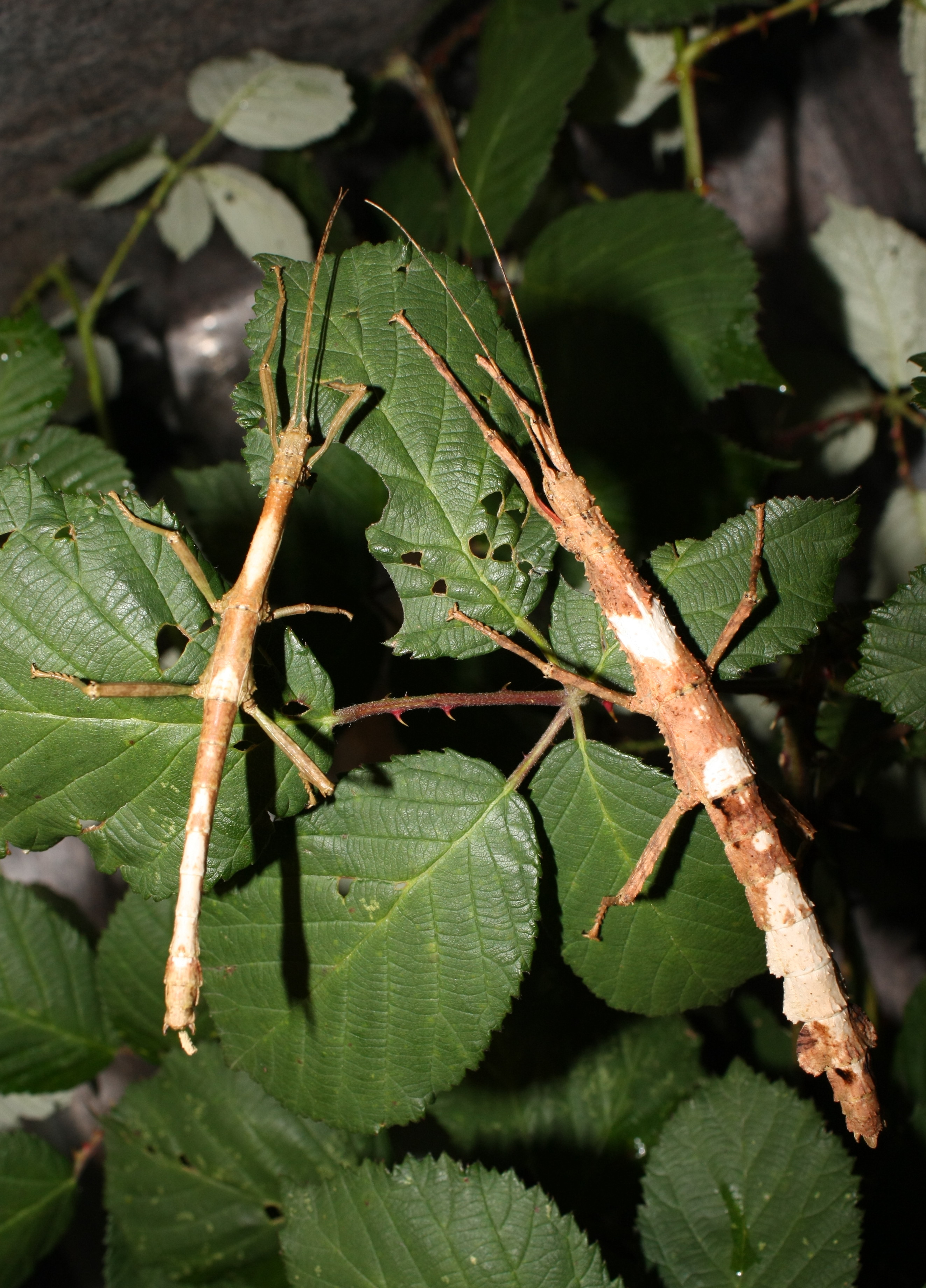
Guadeloupe stick insects Lamponius guerini, copyright Drägüs.


Belongs within: Phasmatodea.

The Pseudophasmatidae are a group of stick insects in which the femora of the fore legs have four distinct edges.

<==Pseudophasmatidae Z04
    |--Pseudophasmatinae WBM03
    |    |--Pseudophasma rufipes WBM03
    |    |--Paraphasma rufipes TW05
    |    `--Anisomorpha WBM03
    |         |--A. buprestoides K91
    |         `--A. ferruginea WBM03
    `--Xerosomatinae Z04
         |--Xerosomatini Z04
         `--Hesperophasmatini Z04
              |--Hesperophasma Rehn 1904 Z04
              |--Rhynchacris Redtenbacher 1908 Z04
              |--Taraxippus Moxey 1971 Z04
              |--Agamemnon Z04
              `--Lamponius Stål 1875 [incl. Antillophilus Carl 1913, Hypocyrtus Redtenbacher 1908] Z04
                   |--*L. guerini (Saussure 1868) [=Pygirhynchus guerini] Z04
                   |--*Antillophilus’ brevitarsus Carl 1913 Z04
                   `--*Hypocyrtus’ substrumosus Redtenbacher 1908 Z04

*Type species of generic name indicated

REFERENCES

[K91] Key, K. H. L. 1991. Phasmatodea (stick-insects). In: CSIRO. The Insects of Australia: A textbook for students and research workers vol. 1 pp. 394–404. Melbourne University Press: Carlton (Victoria).

[TW05] Terry, M. D., & M. F. Whiting. 2005. Mantophasmatodea and phylogeny of the lower neopterous insects. Cladistics 21: 240–257.

[WBM03] Whiting, M. F., S. Bradler & T. Maxwell. 2003. Loss and recovery of wings in stick insects. Nature 421: 264–267.

[Z04] Zompro, O. 2004. A key to the stick-insect genera of the ‘Anareolatae’ of the New World, with descriptions of several new taxa (Insecta: Phasmatodea). Studies on Neotropical Fauna and Environment 39 (2): 133–144.

Platycraninae

Mating pair of peppermint stick insects Megacrania batesii, photographed by The b@t.


Belongs within: Phasmatodea.

The Platycraninae is a group of stick insects found mostly in the Pacific Islands. Members of the Platycraninae are stout, with shortened or vestigial wings, and antennae of moderately length (Brock & Hasenpusch 2009). The peppermint stick insect Megacrania batesii of New Guinea and adjoining regions receives its vernacular name in reference to the smell of the defensive fluid produced from glands on the prothorax.

<==Platycraninae BH07
    |--Graeffea BH07
    |--Davidrentzia Brock & Hasenpusch 2007 BH07
    |    `--*D. valida Brock & Hasenpusch 2007 BH07
    |--Anophelepis Westwood 1859 [incl. Carnacia Sjöstedt 1918] BH07
    |    `--A. telesphorus Westwood 1859 [incl. Carnacia obscura Sjöstedt 1918] BH07
    |--Echetlus Stål 1875 BH07
    |    |--E. fulgens Zompro 2004 Z04
    |    `--E. peristhenes (Westwood 1859) BH07
    `--Megacrania Kaup 1871 BH07
         |--M. alpheus (Westwood 1859) BH07
         |--M. batesii (Kirby 1896) BH07
         `--M. wegneri K91

*Type species of generic name indicated

REFERENCES

[BH07] Brock, P. D., & J. W. Hasenpusch. 2007. Studies on the Australian stick insects (Phasmida), including a checklist of species and bibliography. Zootaxa 1570: 1–81.

[K91] Key, K. H. L. 1991. Phasmatodea (stick-insects). In: CSIRO. The Insects of Australia: A textbook for students and research workers vol. 1 pp. 394–404. Melbourne University Press: Carlton (Victoria).

[Z04] Zompro, O. 2004. A key to the stick-insect genera of the ‘Anareolatae’ of the New World, with descriptions of several new taxa (Insecta: Phasmatodea). Studies on Neotropical Fauna and Environment 39 (2): 133–144.

Last updated: 26 May 2022.