Showing posts with label Sapindales. Show all posts

Acer

Vineleaf maple Acer cissifolium, copyright Qwert1234.


Belongs within: Sapindales.

Acer, the maples, is a genus of trees and shrubs found in temperate regions of the Northern Hemisphere (Hickman 1993).

Characters (from Hickman 1993): Leaf simple or pinnately compound. Inflorescence with flower clusters drooping, generally appearing before or with emerging leaves. Fruit paired, each with elongate wing ribbed on the proximal side.

<==Acer
    |--A. arcticum CBH93
    |--A. buergerianum [incl. A. trifidum] LO98
    |--A. campestre ZB01
    |--A. caudatum O88
    |--A. circinatum H93
    |--A. cissifolium LO98
    |--A. glabrum H93
    |    |--A. g. var. glabrum H93
    |    |--A. g. var. diffusum H93
    |    |--A. g. var. greenei H93
    |    `--A. g. var. torreyi H93
    |--A. macrophyllum H93
    |--A. mono T03
    |--A. monspessulanum H91
    |--A. negundo O01
    |    |--A. n. var. negundo H93
    |    `--A. n. var. californicum H93
    |--A. nigrum MS98
    |--A. palmatum LO98
    |--A. platanoides RB05
    |--A. pseudoplatanus D01
    |--A. rubrum ZB01
    |--A. rufinerve LO98
    |--A. saccharinum O01
    |--A. saccharum O01
    |--A. sempervirens SL06
    |--A. sieboldianum S00
    |--A. subintegrilobum Ettingshausen 1886 F71
    |--A. subproductum Ettingshausen 1886 F71
    |--A. tataricum S-TG10
    `--A. turkestanicum P93

*Type species of generic name indicated

REFERENCES

[CBH93] Collinson, M. E., M. C. Boulter & P. L. Holmes. 1993. Magnoliophyta (‘Angiospermae’). In: Benton, M. J. (ed.) The Fossil Record 2 pp. 809–841. Chapman & Hall: London.

[D01] Doweld, A. B. 2001. The systematic relevance of fruit and seed structure in Bersama and Melianthus (Melianthaceae). Plant Systematics and Evolution 227: 75–103.

[F71] Fletcher, H. O. 1971. Catalogue of type specimens of fossils in the Australian Museum, Sydney. Australian Museum Memoir 13: 1–167.

[H93] Hickman, J. C. (ed.) 1993. The Jepson Manual: Higher Plants of California. University of California Press: Berkeley (California).

[H91] Hubálek, Z. 1991. Biogeographic indication of natural foci of tick-borne infections. In: Dusbábek, F., & V. Bukva (eds) Modern Acarology: Proceedings of the VIII International Congress of Acarology, held in České Budĕjovice, Czechoslovakia, 6–11 August 1990 vol. 1 pp. 255–260. SPB Academic Publishing: The Hague.

[LO98] Lack, H. W., & H. Ohba. 1998. Die Xylothek des Chikusai Kato. Willdenowia 28: 263–276.

[MS98] Margulis, L., & K. V. Schwartz. 1998. Five Kingdoms: An Illustrated Guide to the Phyla of Life on Earth 3rd ed. W. H. Freeman and Company: New York.

[O88] Ohba, H. 1988. The alpine flora of the Nepal Himalayas: an introductory note. In: Ohba, H., & S. B. Malla (eds) The Himalayan Plants vol. 1. The University Museum, University of Tokyo, Bulletin 31: 19–46.

[O01] Ozman, S. K. 2001. The life history and population development of Rhyncaphytoptus negundivagrans Farkas (Acari: Diptilomiopidae). In: Halliday, R. B., D. E. Walter, H. C. Proctor, R. A. Norton & M. J. Colloff (eds) Acarology: Proceedings of the 10th International Congress pp. 352–354. CSIRO Publishing: Melbourne.

[P93] Pittaway, A. R. 1993. The Hawkmoths of the Western Palaearctic. Harley Books: Colchester.

[RB05] Ruczyński, I., & W. Bogdanowicz. 2005. Roost cavity selection by Nyctalus noctula and N. leisleri (Vespertilionidae, Chiroptera) in Białowieża Primeval Forest, eastern Poland. Journal of Mammalogy 86 (5): 921–930.

[SL06] Schulz, H.-J., & P. Lymberakis. 2006. First contribution to the knowledge of the Collembola fauna of the White Mountains (Lefká Óri) in west Crete (Insecta, Collembola, Isotomidae). Senckenbergiana Biologica 86 (2): 229–234.

[S00] Siddiqi, M. R. 2000. Tylenchida: Parasites of plants and insects 2nd ed. CABI Publishing: Wallingford (UK).

[S-TG10] Simova-Tošić, D., D. Graora, R. Spasić & D. Smiljanić. 2010. Oligotrophus betheli Felt (Diptera: Cecidomyiidae), a new species in the fauna of Europe. Arch. Biol. Sci. 62 (4): 1219–1221.

[T03] Tsurusaki, N. 2003. Phenology and biology of harvestmen in and near Sapporo, Hokkaido, Japan, with some taxonomical notes on Nelima suzukii n. sp. and allies (Arachnida: Opiliones). Acta Arachnologica 52: 5–24.

[ZB01] Zhang, N., & M. Blackwell. 2001. Molecular phylogeny of dogwood anthracnose fungus (Discula destructiva) and the Diaporthales. Mycologia 93 (2): 355–365.

Citroideae

Orangeberry Glycosmis pentaphylla, copyright Krzysztof Ziarnek, Kenraiz.


Belongs within: Rutaceae.
Contains: Citrus.

The Citroideae are a group of trees and shrubs (rarely lianas) in which the fruit is a hesperidium, a type of berry with a thick, spongy rind and the flesh divided into segments.

<==Citroideae [Aurantioideae, Clauseneae, Clauseninae, Limonioideae] MS06
    |  i. s.: Limonia B00
    |           |--L. acidissima B00
    |           `--L. alata K73
    |--Glycosmis MS06
    |    |--G. macrocarpa SR07
    |    |--G. macrophylla LK14
    |    |--G. pentaphylla MS06
    |    `--G. trifoliata LK14
    `--Citreae MS06
         |--Aegle [Balsamocitrinae] MS06
         |    `--A. marmelos MS06
         `--+--Clausena MS06
            |    |--C. brevistyla B00
            |    `--C. excavata MS06
            `--Citrinae MS06
                 |--+--Citrus MS06
                 |  `--Poncirus trifoliatus MS06 [=Citrus trifoliata LO98]
                 `--+--Pleiospermium alatum MS06
                    `--+--Severinia buxifolia MS06
                       `--Atalantia MS06 [incl. Eremocitrus B88]
                            |--A. ceylanica MS06
                            `--A. glauca [=Eremocitrus glauca] B88

*Type species of generic name indicated

REFERENCES

[B88] Bouček, Z. 1988. Australasian Chalcidoidea (Hymenoptera): A biosystematic revision of genera of fourteen families, with a reclassification of species. CAB International: Wallingford (UK).

[B00] Braby, M. F. 2000. Butterflies of Australia: their identification, biology and distribution vol. 1. CSIRO Publishing: Collingwood (Victoria).

[K73] Krishnan, M. 1973. An ecological survey of the larger mammals of peninsular India (continued). Journal of the Bombay Natural History Society 69 (3): 469–501.

[LO98] Lack, H. W., & H. Ohba. 1998. Die Xylothek des Chikusai Kato. Willdenowia 28: 263–276.

[LK14] Lyons, M. N., G. J. Keighery, L. A. Gibson & T. Handasyde. 2014. Flora and vegetation communities of selected islands off the Kimberley coast of Western Australia. Records of the Western Australian Museum Supplement 81: 205–244.

[MS06] Muellner, A. N., V. Savolainen, R. Samuel & M. W. Chase. 2006. The mahogany family "out-of-Africa": divergence time estimation, global biogeographic patterns inferred from plastid rbcL DNA sequences, extant, and fossil distribution of diversity. Molecular Phylogenetics and Evolution 40 (1): 236–250.

[SR07] Sankar, R. V., K. Ravikumar, N. M. Ganesh Babu & D. K. Ved. 2007. Botany of Anapady MPCA, Palghat district, Kerala with special emphasis on species of conservation concern. Bulletin of the Botanical Survey of India 49: 165–172.

Boronieae

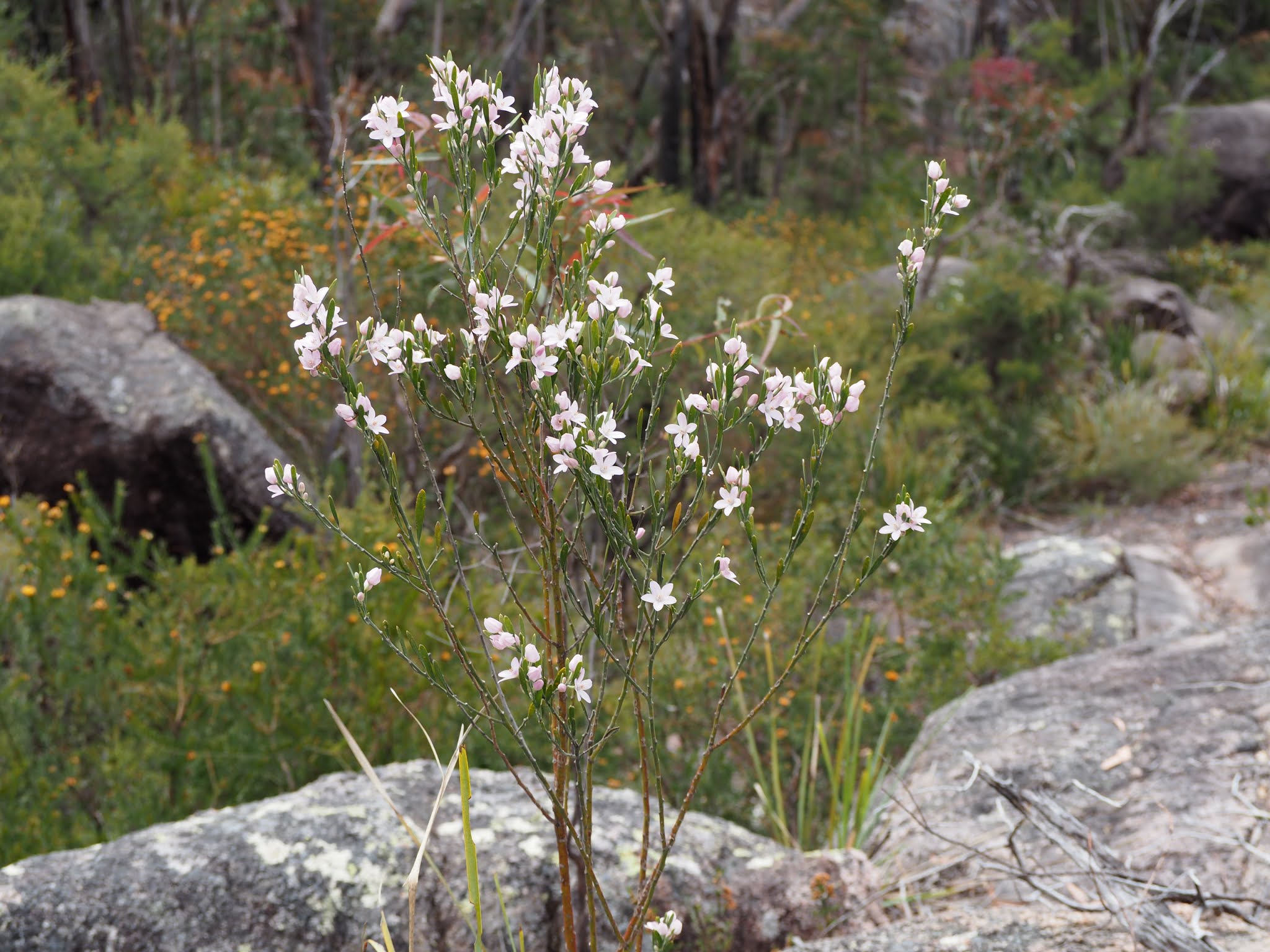
Pink wax flower Eriostemon australasius, copyright Geoff Derrin.


Belongs within: Zanthoxyleae.
Contains: Boronia.

The Boronieae are a group of mostly small to medium-sized shrubs that are usually found growing in open woodlands.

<==Boronieae [Eriostemoninae]
    |  i. s.: Boronia B12
    |         Zieria S87
    |           |--Z. arborescens WB-P93
    |           |--Z. laevigata C08
    |           |--Z. pilosa H87a
    |           `--Z. smithii H87a
    |                |--Z. s. var. smithii S87
    |                `--Z. s. var. macrophylla S87
    |--Eriostemon MS06
    |    |--E. alpinus [=Phebalium squamulosum var. alpinum] S87
    |    |--E. australasius [incl. E. lanceolatus] TW07
    |    |--E. brevifolius MS06
    |    |--E. buxifolius H87a
    |    |--E. correifolius [=Asterolasia correifolia; incl. A. muellerii] S87
    |    |--E. crowei [=Crowea saligna] S87
    |    |    |--E. s. var. saligna S87
    |    |    `--‘Crowea’ s. var. exalata S87
    |    |--E. falcatus M93
    |    |--E. nodiflorus GK00
    |    |    |--E. n. ssp. nodiflorus GK00
    |    |    `--E. n. ssp. lasiocalyx GK00
    |    |--E. ovatifolius [=Phebalium ovatifolium] S87
    |    |--E. ozothamnoides [=Phebalium ozothamnoides] S87
    |    |--E. phylicifolius [=Phebalium phylicifolium] S87
    |    |--E. trachyphyllus S87
    |    `--E. trymalioides [=Asterolasia trymalioides] S87
    `--+--Correa [Correinae] MS06
       |    |--C. aemula S87
       |    |--C. alba H87a
       |    |--C. lawrenciana S87
       |    |--C. pulchella MS06
       |    `--C. speciosa C08
       |         |--C. s. var. speciosa S87
       |         |--C. s. var. cardinalis S87
       |         `--C. s. var. mormalis TW07
       `--+--Chorilaena [Nematolepidinae] MS06
          |    `--C. quercifolia MS06
          `--+--Diplolaena [Diplolaeninae] MS06
             |    |--D. dampieri MS06
             |    `--D. grandiflora KM08
             `--Phebalium Vent. 1804 MS06, A61
                  |--P. ambiguum G04
                  |--P. brachycalyx G04
                  |--P. canaliculatum G04
                  |--P. denticulatum H87b
                  |--P. filifolium G04
                  |--P. glandulosum C08
                  |--P. nudum Hook. 1843 A61
                  |--P. rotundifolium C08
                  |--P. squameum SN08
                  |--P. tuberculosum M93
                  `--P. woombye MS06

*Type species of generic name indicated

REFERENCES

[A61] Allan, H. H. 1961. Flora of New Zealand vol. 1. Indigenous Tracheophyta: Psilopsida, Lycopsida, Filicopsida, Gymnospermae, Dicotyledones. R. E. Owen, Government Printer: Wellington (New Zealand).

[B12] Braby, M. F. 2012. The butterflies of El Questro Wilderness Park, with remarks on the taxonomy of the Kimberley fauna, Australia. Records of the Western Australian Museum 27 (2): 161–175.

[C08] Cambage, R. H. 1908. Notes on the native flora of New South Wales. Part VI. Deepwater to Torrington and Emmaville. Proceedings of the Linnean Society of New South Wales 33 (1): 45–65, pls 1–2.

[G04] Gibson, N. 2004. Flora and vegetation of the Eastern Goldfields Ranges: part 7. Middle and South Ironcap, Digger Rock and Hatter Hill. Journal of the Royal Society of Western Australia 87 (2): 49–62.

[GK00] Gibson, N., & G. J. Keighery. 2000. Flora and vegetation of the Byenup-Muir reserve system, south-west Western Australia. CALMScience 3 (3): 323–402.

[H87a] Haviland, E. 1887a. Flowering seasons of Australian plants. No. I—List of plants indigenous in the neighbourhood of Sydney, flowering during July. Proceedings of the Linnean Society of New South Wales, series 2, 1 (4): 1049–1051.

[H87b] Haviland, E. 1887b. Flowering seasons of Australian plants. No. II. Proceedings of the Linnean Society of New South Wales, series 2, 1 (4): 1103–1104.

[KM08] Keighery, G. J., & W. Muir. 2008. Vegetation and vascular flora of Faure Island, Shark Bay, Western Australia. Records of the Western Australian Museum Supplement 75: 11–19.

[M93] Mollemans, F. H. 1993. Drummondita wilsonii, Philotheca langei and P. basistyla (Rutaceae), new species from south-west Western Australia. Nuytsia 9: 95–109.

[MS06] Muellner, A. N., V. Savolainen, R. Samuel & M. W. Chase. 2006. The mahogany family "out-of-Africa": divergence time estimation, global biogeographic patterns inferred from plastid rbcL DNA sequences, extant, and fossil distribution of diversity. Molecular Phylogenetics and Evolution 40 (1): 236–250.

[SN08] Schmidt, E. R., & T. R. New. 2008. The Psocoptera (Insecta) of Tasmania, Australia. Memoirs of Museum Victoria 65: 71–152.

[S87] Stirling, J. 1887. Notes on the Rutaceae of the Australian Alps. Proceedings of the Linnean Society of New South Wales, series 2, 1 (4): 1052–1058.

[TW07] Thongphak, D., & Q. Wang. 2007. Taxonomic revision of the longicorn beetle genus Uracanthus Hope 1833 (Coleoptera: Cerambycidae: Cerambycinae: Uracanthini) from Australia. Zootaxa 1569: 1–139.

[WB-P93] Walter, D. E., & V. M. Behan-Pelletier. 1993. Systematics and ecology of Adhaesozetes polyphyllos sp.nov. (Acari: Oribatida: Licneremaeoidea), a leaf-inhabiting mite from Australian rainforests. Canadian Journal of Zoology 71: 1024–1040.

Sapindales

Titoki Alectryon excelsus, copyright Tatters.


Belongs within: Malvidae.
Contains: Rutaceae, Meliaceae, Simaroubaceae, Anacardiaceae, Burseraceae, Acer, Dodonaea.

The Sapindales are a clade of flowering plants whose members often accumulate noxious secondary metabolites. Members include the Sapindaceae, a family of woody plants with often spiral, pinnately-compound leaves with subopposite leaflets and a terminal rhachis tip (Angiosperm Phylogeny Website). The Aceroideae (maples) and Hippocastanoideae (horse-chestnuts) have each been treated as separate families by some authors. Aceroideae have fruit that are samaras, with seeds contained with nutlets attached to a fibrous wing. Fruits of Hippocastanoideae are capsules that dehisce into three valves. Other members of the Sapindales include Nitraria, a genus of often spiny, pubescent shrubs found in arid regions of the Old World.

Characters (from Angiosperm Phylogeny Website): Interesting secondary compounds, ethereal oils, myricetin present; mucilage cells present; branching from previous innovation, petioles leaving a prominent scar; leaves spiral, odd-pinnately compound, leaflets opposite, vernation conduplicate; inflorescence branches, at least, cymose; twice as many anthers as sepals; tapetal cells polyploid; nectary well developed; carpels equal to and opposite petals, or 3, odd member adaxial, stigmatic head from postgenitally united free carpel tips; ovules few/carpel, epitropous, nucellar cap present; exotegmen not fibrous.

<==Sapindales [Rutineae]
    |  i. s.: Biebersteinia [Biebersteiniaceae] T00
    |         Tepuianthus [Tepuianthaceae] T00
    |         Peganaceae T00
    |           |--Malacocarpus T00
    |           |--Peganum harmala T00, C55a
    |           `--Tetradiclis T00
    |         Choerospondias axillaris WM09, D07
    |--+--+--Rutaceae MS06
    |  |  `--+--Meliaceae MS06
    |  |     `--Simaroubaceae MS06
    |  `--+--+--Anacardiaceae MS06
    |     |  `--Burseraceae MS06
    |     `--Nitraria [Nitrariaceae] WM09
    |          |--N. billardierei KM08
    |          |--N. retusa WM09
    |          `--N. schoberi B14
    `--Sapindaceae [Xanthoceraceae, Xanthocerataceae] MS06
         |  i. s.: Cardiospermum D01
         |           |--C. grandiflorum H06
         |           `--C. halicacabum LK14
         |         Serjania polyphylla D01, SWK87
         |         Diploglottis diphyllostegia W01
         |         Sapindopsis GT02
         |           |--S. alpina GT02
         |           `--S. cordata Fontaine 1889 CBH93
         |         Lepisanthes LK14
         |           |--L. fruticosa K03
         |           `--L. rubiginosa LK14
         |         Crossonephelis palawanicus H03
         |         Lepidopetalum subdichotomum B00b
         |         Nephelium K03
         |           |--N. lappaceum K03
         |           `--N. ramboutan-ake K03 [=Litsea ramboutan-ake L00]
         |         Distichostemon YY22
         |         Cupania J87
         |           |--C. americana J87
         |           |--C. anacardioides C16
         |           |--C. semiglauca [=Guioa semiglauca] MB08
         |           |--C. triquetra SWK87
         |           `--C. vernalis B04
         |         Filicium decipiens T00, SR07
         |         Tina Schultes in Roemer & Schultes 1819 A-R03
         |           `--*T. thouarsiana (Camb.) Capuron 1969 [=Cupania thouarsiana] A-R03
         |         Gelonium Gaertner 1791 (n. d.) A-R03
         |           `--*G. cupanioides Gaertner 1791 (n. d.) [=Molinaea cupanioides, Tina gelonium] A-R03
         |         Molinaea laevis Willdenow 1799 A-R03
         |         Allophyllus MM96
         |           |--A. abyssinicus PB27
         |           |--A. cobbe MS06
         |           |--A. crassinervis J87
         |           |--A. edulis H11
         |           |--A. occidentalis MM96
         |           `--A. rigidus J87
         |         Harpullia MS06
         |           |--H. arborea MS06
         |           |--H. hillii B00b
         |           |--H. pendula B00b
         |           `--H. ramiflora B00b
         |         Cupaniopsis WM09
         |           |--C. anacardioides WM09
         |           |--C. dunnii [=Cupania dunnii Maiden & Betche 1908] MB08
         |           |--C. serrata MB08
         |           `--C. wadsworthii MB08
         |         Atalaya LK14
         |           |--A. hemiglauca LK14
         |           |--A. salicifolia LK14
         |           `--A. variifolia LK14
         |         Ganophyllum falcatum LK14
         |         Guioa acutifolia B00b
         |         Heterodendron B00b
         |           |--H. diversifolium B00b
         |           `--H. oleifolium BR65
         |         Litchi chinensis B00b
         |         Sarcopteryx B00b
         |           |--S. martyana B00b
         |           `--S. stipata B00b
         |         Arytera B00b
         |           |--A. divaricata B00b
         |           `--A. pauciflora B00b
         |         Paullinia pinnata C06, C55b
         |         Dipterodendron elegans H11
         |         Talisia olivaeformis F11
         |         Sapindospermum CBH93
         |         Wehrwolfea Erwin & Stockey 1990 CBH93
         |         Bohlenia CBH93
         |         Diplopeltis Endl. 1837 KC01
         |           `--D. stuartii MLP09
         |         Phaeocarpus Mart. & Zucc. 1824 KC01
         |         Schleichera oleosa M72
         |--Aceroideae [Aceraceae] T00
         |    |--Dipteronia sinensis D01
         |    |--Acer T00
         |    `--Negundoides acutifolia Lesquereux 1868 CBH93
         |--Sapindus F71 [Sapindoideae T00]
         |    |--S. drummondii DD06
         |    |--S. emarginatus S72
         |    |--S. gossei Ettingshausen 1886 F71
         |    |--S. laurifolius M72
         |    `--S. mukorossi LO98
         |--Koelreuteria CD07 [Koelreuterioideae T00]
         |    |--K. annosa Brown 1956 B56
         |    |--K. elegans B00b
         |    |--K. nigricans B56
         |    `--K. paniculata Laxm. 1753 CD07
         |--Hippocastanoideae [Hippocastanaceae] T00
         |    |--Billia columbiana T00, R96
         |    `--Aesculus T00
         |         |--A. californica H93
         |         |--A. carnea D37
         |         |--A. glabra V72
         |         |--A. hippocastanum D37
         |         |--A. pavia D37
         |         `--A. turbinata LO98
         `--Dodonaeoideae [Dodonaeae] T00
              |--Dodonaea A61
              `--Alectryon Gertn. 1788 C06, A61
                   |--A. connatus LK14
                   |--A. coriaceus B00b
                   |--A. excelsus Gaertn. 1788 A61
                   |--A. grandis Cheesem. 1912 [=A. excelsus var. grandis Cheesem. 1892] A61
                   |--A. kimberleyanus LK14
                   |--A. oleifolius KM08
                   `--A. subcinereus B00a

*Type species of generic name indicated

REFERENCES

[A-R03] Acevedo-Rodríguez, P. 2003. (1592) Proposal to conserve the name Tina (Sapindaceae) with a conserved type. Taxon 52: 373–374.

[A61] Allan, H. H. 1961. Flora of New Zealand vol. 1. Indigenous Tracheophyta: Psilopsida, Lycopsida, Filicopsida, Gymnospermae, Dicotyledones. R. E. Owen, Government Printer: Wellington (New Zealand).

[BR65] Black, J. M., & E. L. Robertson. 1965. Flora of South Australia. Part IV. Oleaceae–Compositae. W. L. Hawes, Government Printer: Adelaide.

[B14] Bouchard, P. (ed.) 2014. The Book of Beetles: A lifesize guide to six hundred of nature's gems. Ivy Press: Lewes (United Kingdom).

[B00a] Braby, M. F. 2000a. Butterflies of Australia: their identification, biology and distribution vol. 1. CSIRO Publishing: Collingwood (Victoria).

[B00b] Braby, M. F. 2000b. Butterflies of Australia: their identification, biology and distribution vol. 2. CSIRO Publishing: Collingwood (Victoria).

[B04] Brown, B. V. 2004. Revision of the subgenus Udamochiras of Melaloncha bee-killing flies (Diptera: Phoridae: Metopininae). Zoological Journal of the Linnean Society 140: 1–42.

[B56] Brown, R. W. 1956. New items in Cretaceous and Tertiary floras of the western United States. Journal of the Washington Academy of Sciences 46 (4): 104–108.

[C16] Cambage, R. H. 1916. Notes on the native flora of tropical Queensland. Journal and Proceedings of the Royal Society of New South Wales 49 (3): 389–447, pls 57–61.

[C55a] Candolle, A. de. 1855a. Géographie Botanique Raisonée: Ou exposition des faits principaux et des lois concernant la distribution géographique des plantes de l’époque actuelle vol. 1. Librairie de Victor Masson: Paris.

[C55b] Candolle, A. de. 1855b. Géographie Botanique Raisonée: Ou exposition des faits principaux et des lois concernant la distribution géographique des plantes de l’époque actuelle vol. 2. Librairie de Victor Masson: Paris.

[CD07] Cantino, P. D., J. A. Doyle, S. W. Graham, W. S. Judd, R. G. Olmstead, D. E. Soltis, P. S. Soltis & M. J. Donoghue. 2007. Towards a phylogenetic nomenclature of Tracheophyta. Taxon 56 (3): E1–E44.

[C06] Cheeseman, T. F. 1906. Manual of the New Zealand Flora. John Mackay, Government Printer: Wellington.

[CBH93] Collinson, M. E., M. C. Boulter & P. L. Holmes. 1993. Magnoliophyta (‘Angiospermae’). In: Benton, M. J. (ed.) The Fossil Record 2 pp. 809–841. Chapman & Hall: London.

[D07] Dash, S. S. 2007. Useful plants of Kabi Sacred Grove, Sikkim. Bulletin of the Botanical Survey of India 49 (1-4): 79–88.

[D37] Dobzhansky, T. 1937. Genetics and the Origin of Species. Columbia University Press: New York.

[DD06] Doty, J. B., & R. C. Dowler. 2006. Denning ecology in sympatric populations of skunks (Spilogale gracilis and Mephitis mephitis) in west-central Texas. Journal of Mammalogy 87 (1): 131–138.

[D01] Doweld, A. B. 2001. The systematic relevance of fruit and seed structure in Bersama and Melianthus (Melianthaceae). Plant Systematics and Evolution 227: 75–103.

[F71] Fletcher, H. O. 1971. Catalogue of type specimens of fossils in the Australian Museum, Sydney. Australian Museum Memoir 13: 1–167.

[F11] Fraga, R. M. 2011. Family Icteridae (New World blackbirds). In: Hoyo, J. del, A. Elliott & D. A. Christie (eds) Handbook of the Birds of the World vol. 16. Tanagers to New World Blackbirds pp. 684–807. Lynx Edicions: Barcelona.

[GT02] Gomez, B., F. Thévenard, M. Fantin & L. Guisberti. 2002. Late Cretaceous plants from the Bonarelli Level of the Venetian Alps, northeastern Italy. Cretaceous Research 23: 671–685.

[H03] Heads, M. 2003. Ericaceae in Malesia: vicariance biogeography, terrane tectonics and ecology. Telopea 10 (1): 311–449.

[H06] Henderson, L. 2006. Comparisons of invasive plants in southern Africa originating from southern temperate, northern temperate and tropical regions. Bothalia 36 (2): 201–222.

[H93] Hickman, J. C. (ed.) 1993. The Jepson Manual: Higher Plants of California. University of California Press: Berkeley (California).

[H11] Hilty, S. L. 2011. Family Thraupidae (tanagers). In: Hoyo, J. del, A. Elliott & D. A. Christie (eds) Handbook of the Birds of the World vol. 16. Tanagers to New World Blackbirds pp. 46–329. Lynx Edicions: Barcelona.

[J87] Judd, W. S. 1987. Floristic study of Morne La Visite and Pic Macaya National Parks, Haiti. Bulletin of the Florida State Museum—Biological Sciences 32 (1): 1–136.

[KM08] Keighery, G. J., & W. Muir. 2008. Vegetation and vascular flora of Faure Island, Shark Bay, Western Australia. Records of the Western Australian Museum Supplement 75: 11–19.

[KC01] Kirk, P. M., P. F. Cannon, J. C. David & J. A. Stalpers. 2001. Ainsworth & Bisby's Dictionary of the Fungi 9th ed. CAB International: Wallingford (UK).

[K03] Kulip, J. 2003. An ethnobotanical survey of medicinal and other useful plants of Muruts in Sabah, Malaysia. Telopea 10 (1): 81–98.

[L00] Labillardiere, C. 1800. Mémoire sur deux espèces de litchi des Molluques. Bulletin des Sciences, par la Societé Philomathique de Paris 2 (45): 161.

[LO98] Lack, H. W., & H. Ohba. 1998. Die Xylothek des Chikusai Kato. Willdenowia 28: 263–276.

[LK14] Lyons, M. N., G. J. Keighery, L. A. Gibson & T. Handasyde. 2014. Flora and vegetation communities of selected islands off the Kimberley coast of Western Australia. Records of the Western Australian Museum Supplement 81: 205–244.

[MB08] Maiden, J. H., & E. Betche. 1908. Notes from the Botanic Gardens, Sydney. No. 13. Proceedings of the Linnean Society of New South Wales 33: 304–319.

[MLP09] McKenzie, N. L., S. van Leeuwen & A. M. Pinder. 2009. Introduction to the Pilbara Biodiversity Survey, 2002–2007. Records of the Western Australian Museum Supplement 78 (1): 3–89.

[M72] Mitra, S. N. 1972. Observations on the vegetation of the Upper Damodar catchment area. Journal of the Bombay Natural History Society 69 (1): 17–25.

[MM96] Mound, L. A., & R. Marullo. 1996. The thrips of Central and South America: an introduction (Insecta: Thysanoptera). Memoirs on Entomology, International 6: 1–487.

[MS06] Muellner, A. N., V. Savolainen, R. Samuel & M. W. Chase. 2006. The mahogany family "out-of-Africa": divergence time estimation, global biogeographic patterns inferred from plastid rbcL DNA sequences, extant, and fossil distribution of diversity. Molecular Phylogenetics and Evolution 40 (1): 236–250.

[PB27] Pilsbry, H. A., & J. Bequaert. 1927. The aquatic mollusks of the Belgian Congo, with a geographical and ecological account of Congo malacology. Bulletin of the American Museum of Natural History 53 (2): 69–602, pls 10–77.

[R96] Righi, G. 1996. Colombian earthworms. Studies on Tropical Andean Ecosystems 4: 485–607.

[SR07] Sankar, R. V., K. Ravikumar, N. M. Ganesh Babu & D. K. Ved. 2007. Botany of Anapady MPCA, Palghat district, Kerala with special emphasis on species of conservation concern. Bulletin of the Botanical Survey of India 49: 165–172.

[S72] Satakopan, S. 1972. Keys to the identification of plant remains in animal droppings. Journal of the Bombay Natural History Society 69 (1): 139–150.

[SWK87] Snyder, N. F. R., J. W. Wiley & C. B. Kepler. 1987. The Parrots of Luquillo: Natural history and conservation of the Puerto Rican parrot. Western Foundation of Vertebrate Zoology: Los Angeles.

[T00] Thorne, R. F. 2000. The classification and geography of the flowering plants: dicotyledons of the class Angiospermae (subclasses Magnoliidae, Ranunculidae, Caryophyllidae, Dilleniidae, Rosidae, Asteridae, and Lamiidae). The Botanical Review 66: 441–647.

[V72] Voss, E. G. 1972. Michigan Flora. Part I. Gymnosperms and Monocots. Cranbrook Institute of Science and University of Michigan Herbarium.

[W01] Walter, D. E. 2001. Achilles and the mite: Zeno’s paradox and rainforest mite diversity. In: Halliday, R. B., D. E. Walter, H. C. Proctor, R. A. Norton & M. J. Colloff (eds) Acarology: Proceedings of the 10th International Congress pp. 113–120. CSIRO Publishing: Melbourne.

[WM09] Wang, H., M. J. Moore, P. S. Soltis, C. D. Bell, S. F. Brockington, R. Alexandre, C. C. Davis, M. Latvis, S. R. Manchester & D. E. Soltis. 2009. Rosid radiation and the rapid rise of angiosperm-dominated forests. Proceedings of the National Academy of Sciences of the USA 106 (10): 3853–3858.

[YY22] Yampolsky, C., & H. Yampolsky. 1922. Distribution of sex forms in the phanerogamic flora. Bibliotheca Genetica 3: 1–62.

Last updated: 8 August 2021.

Rhus

Smooth sumac Rhus glabra, photographed by Richtid.


Belongs within: Anacardiaceae.

Rhus, the sumacs, is a genus of shrubs and small trees found in subtropical and warm temperate regions of the world. The fruits of some species, such as the tanner's sumac R. coriaria, are used for spice. However, others such as the poison ivy R. toxicodendron can cause a severe allergic reaction. Rhus coriaria has also been used as a tanning agent or a source for dye.

Characters (from Flora of China): Deciduous shrubs or trees, polygamous or dioecious. Leaves imparipinnately compound; leaf rachis sometimes winged; leaflets petiolate or sessile, with serrate or entire margin. Inflorescence terminal, paniculate or thyrsoid, floral subtending bracts persistent or deciduous. Flowers functionally unisexual or bisexual, 5-merous. Ovary 1-locular and 1-ovulate; styles 3, often united basally. Drupe globose, slightly compressed, mixed glandular pubescent and pilose, red at maturity; exocarp and mesocarp united; mesocarp glutinous, red.

<==Rhus
    |--R. ambigua [incl. R. toxicodendron var. radicans] LO98
    |--R. antigua GT02
    |--R. caudata H03
    |--R. copallina MS06
    |--R. coriaria R-CT01
    |--R. glabra B75
    |--R. glaucescens BBO01
    |--R. integrifolia B38
    |--R. javanica [incl. R. semialata] LO98
    |--R. lancea BBO01
    |--R. lucidum A81
    |--R. mysorensis BBO01
    |--R. ovata H93
    |--R. problematodes CV06
    |--R. sylvestris [=R. silvestris] LO98
    |--R. toxicodendron C55
    |--R. trilobata [incl. R. trilobata var. anisophylla, R. trilobata var. malacophylla, R. trilobata var. quinata] H93
    |--R. tripartita RBA00
    |--R. typhina NDA05
    |--R. verniciflua LO98
    |--R. vernix V72
    `--R. volkii CV06

*Type species of generic name indicated

REFERENCES

[A81] Adler, H. 1881. Les Cynipides. 1re partie. Introduction. La génération alternante chez les cynipides, traduit et annoté par J. Lichtenstein, suivi de la classification des cynipides d'après le Dr G. Mayr. C. Coulet: Montpellier.

[BBO01] Begerow, D., R. Bauer & F. Oberwinkler. 2001. Muribasidiospora: Microstromatales or Exobasidiales? Mycological Research 105 (7): 798–810.

[B38] Blackman, M. W. 1938. New species of Cactopinus Schwarz (Coleoptera: Scolytidae). Proceedings of the Entomological Society of Washington 40 (6): 151–157.

[B75] Bowles, J. B. 1975. Distribution and biogeography of mammals of Iowa. Special Publications, The Museum, Texas Tech University 9: 1–184.

[C55] Candolle, A. de. 1855. Géographie Botanique Raisonée: Ou exposition des faits principaux et des lois concernant la distribution géographique des plantes de l’époque actuelle vol. 2. Librairie de Victor Masson: Paris.

[CV06] Craven, P., & P. Vorster. 2006. Patterns of plant diversity and endemism in Namibia. Bothalia 36 (2): 175–189.

[GT02] Gomez, B., F. Thévenard, M. Fantin & L. Guisberti. 2002. Late Cretaceous plants from the Bonarelli Level of the Venetian Alps, northeastern Italy. Cretaceous Research 23: 671–685.

[H03] Heads, M. 2003. Ericaceae in Malesia: vicariance biogeography, terrane tectonics and ecology. Telopea 10 (1): 311–449.

[H93] Hickman, J. C. (ed.) 1993. The Jepson Manual: Higher Plants of California. University of California Press: Berkeley (California).

[LO98] Lack, H. W., & H. Ohba. 1998. Die Xylothek des Chikusai Kato. Willdenowia 28: 263–276.

[MS06] Muellner, A. N., V. Savolainen, R. Samuel & M. W. Chase. 2006. The mahogany family "out-of-Africa": divergence time estimation, global biogeographic patterns inferred from plastid rbcL DNA sequences, extant, and fossil distribution of diversity. Molecular Phylogenetics and Evolution 40 (1): 236–250.

[NDA05] Nickrent, D. L., J. P. Der & F. E. Anderson. 2005. Discovery of the photosynthetic relatives of the "Maltese mushroom" Cynomorium. BMC Evolutionary Biology 5: 38.

[R-CT01] Ragusa-di Chiara, S., & H. Tsolakis. 2001. Phytoseiid faunas of natural and agricultural ecosystems in Sicily. In: Halliday, R. B., D. E. Walter, H. C. Proctor, R. A. Norton & M. J. Colloff (eds) Acarology: Proceedings of the 10th International Congress pp. 522–529. CSIRO Publishing: Melbourne.

[RBA00] Rifai, L. B., M. Abu Baker & Z. S. Amr. 2000. Ecology, distribution and status of the rock hyrax, Procavia capensis syriaca, in Jordan. Zoology in the Middle East 21: 19–26.

[V72] Voss, E. G. 1972. Michigan Flora. Part I. Gymnosperms and Monocots. Cranbrook Institute of Science and University of Michigan Herbarium.

Last updated: 9 August 2021.

Simaroubaceae

Tree of heaven Ailanthus altissima, photographed by Russ Kleinman.


Belongs within: Sapindales.

The Simaroubaceae are a family of mostly tropical or subtropical trees and shrubs. Well-known members include the tree of heaven Ailanthus altissima, historically grown as an ornamental but now widely regarded as an invasive weed outside its range in temperate east Asia. The bitterwood Quassia amara produces bitter compounds in its bark and wood that are used for medicinal purposes and as a flavouring for drinks.

Characters (from Peng & Thomas): Trees or shrubs usually with bitter bark. Leaves alternate, sometimes opposite, pinnate to unifoliolate or rarely simple; stipules present or absent. Inflorescences axillary, racemose, paniculate, cymose, rarely spicate. Flowers generally small, bisexual or unisexual (occasionally andromonoecious, functionally dioecious, or distinctly dioecious), often with rudiments of opposite sex, actinomorphic. Calyx of 4 or 5(-8) sepals, imbricate or valvate. Petals usually 4 or 5(-8), free, imbricate or valvate. Stamens same number as petals and alternate with them, or twice as many as petals (or more); filaments free, base often with an appendage; anthers oblong, versatile, bicelled, with a longitudinal slit. Disk usually present, sometimes a gynophore or androgynophore. Gynoecium weakly united at base, or virtually free, usually 2-5-carpellate; ovary superior, with axile placentation; ovules 1 or 2 per locule, apical or basal; style connate or free; stigmas 2-5. Fruit a "drupe" or "samara," actually 1-5 fruitlike monocarps produced per flower, each a druparium or a samarium; endosperm present or absent; embryo straight or curved, with thick cotyledons.

<==Simaroubaceae
    |--+--Soulamea soulameoides MS06
    |  `--+--Quassia MS06
    |     |    |--Q. amara MS06
    |     |    `--Q. borneensis H03
    |     `--Simarouba MS06
    |          |--S. amara SWK87
    |          `--S. glauca MS06
    `--Ailanthus MS06
         |--A. altissima MS06
         |--A. confucii MS06
         |--A. eureka Brown 1956 B56
         |--A. excelsa SK02
         |--A. glandulosa RS99
         |--A. lesquereuxi B56
         |--A. malabaricus M94
         `--A. triphysa LK14

Simaroubaceae incertae sedis:
  Picrasma H03
    |--P. quassioides [incl. P. ailanthoides] LO98
    `--P. selleana J87
  Brucea javanica LK14
  Pongelion YY22
  Castela Turp. 1806 (nom. cons.) [Castelinae] MF68
    |--C. sect. Castela [incl. Castelaria Small 1911, Neocastela Small 1911] MF68
    |    |--*C. depressa MF68
    |    |--C. calcicola MF68
    |    |--C. coccinea MF68
    |    |--C. erecta MF68
    |    |--C. jacquinifolia MF68
    |    |--C. peninsularis MF68
    |    |--C. spinosa MF68
    |    |--C. tortuosa MF68
    |    `--C. tweedii MF68
    |--C. sect. Eremacantha Moran & Felger 1968 MF68
    |    `--C. (sect. *E.) polyandra Moran & Felger 1968 MF68
    `--C. sect. Holacantha (Gray) Moran & Felger 1968 [=Holacantha Gray 1854] MF68
         |--C. emoryi (Gray) Moran & Felger 1968 [=*Holacantha emoryi Gray 1854] MF68
         `--C. stewartii (Muller) Moran & Felger 1968 [=Holacantha stewartii Muller 1941] MF68
  Castelaria YY22
  Marupa YY22
  Picrolemma YY22
  Eurycoma longifolia YY22, K03
  Hannoa YY22
  Amaroria YY22
  Hebonga YY22
  Picrocardia YY22
  Perriera YY22
  Ailanthoxylon indicum Prakash 1959 CBH93
  Simaba ferruginea BV09
  Kirkia Oliv. 1868 [Kirkiaceae] KC01
    `--K. dewinteri CV06
  Chaneya CD02
  Raskya CD02

*Type species of generic name indicated

REFERENCES

[B56] Brown, R. W. 1956. New items in Cretaceous and Tertiary floras of the western United States. Journal of the Washington Academy of Sciences 46 (4): 104–108.

[CD02] Clifford, H. T., & M. E. Dettmann. 2002. A winged fruit from the Tertiary of Queensland. Memoirs of the Queensland Museum 48: 79–83.

[CBH93] Collinson, M. E., M. C. Boulter & P. L. Holmes. 1993. Magnoliophyta (‘Angiospermae’). In: Benton, M. J. (ed.) The Fossil Record 2 pp. 809–841. Chapman & Hall: London.

[CV06] Craven, P., & P. Vorster. 2006. Patterns of plant diversity and endemism in Namibia. Bothalia 36 (2): 175–189.

[H03] Heads, M. 2003. Ericaceae in Malesia: vicariance biogeography, terrane tectonics and ecology. Telopea 10 (1): 311–449.

[J87] Judd, W. S. 1987. Floristic study of Morne La Visite and Pic Macaya National Parks, Haiti. Bulletin of the Florida State Museum—Biological Sciences 32 (1): 1–136.

[KC01] Kirk, P. M., P. F. Cannon, J. C. David & J. A. Stalpers. 2001. Ainsworth & Bisby's Dictionary of the Fungi 9th ed. CAB International: Wallingford (UK).

[K03] Kulip, J. 2003. An ethnobotanical survey of medicinal and other useful plants of Muruts in Sabah, Malaysia. Telopea 10 (1): 81–98.

[LO98] Lack, H. W., & H. Ohba. 1998. Die Xylothek des Chikusai Kato. Willdenowia 28: 263–276.

[LK14] Lyons, M. N., G. J. Keighery, L. A. Gibson & T. Handasyde. 2014. Flora and vegetation communities of selected islands off the Kimberley coast of Western Australia. Records of the Western Australian Museum Supplement 81: 205–244.

[M94] May, B. M. 1994. An introduction to the immature stages of Australian Curculionoidea. In: Zimmerman, E. C. Australian Weevils (Coleoptera: Curculionoidea) vol. 2. Brentidae, Eurhynchidae, Apionidae and a chapter on immature stages by Brenda May pp. 365–728. CSIRO Australia.

[MF68] Moran, R., & R. Felger. 1968. Castela polyandra, a new species in a new section; union of Holacantha with Castela (Simaroubaceae). Transactions of the San Diego Society of Natural History 15 (4): 31–40.

[MS06] Muellner, A. N., V. Savolainen, R. Samuel & M. W. Chase. 2006. The mahogany family "out-of-Africa": divergence time estimation, global biogeographic patterns inferred from plastid rbcL DNA sequences, extant, and fossil distribution of diversity. Molecular Phylogenetics and Evolution 40 (1): 236–250.

[RS99] Rossman, A. Y., G. J. Samuels, C. T. Rogerson & R. Lowen. 1999. Genera of Bionectriaceae, Hypocreaceae and Nectriaceae (Hypocreales, Ascomycetes). Studies in Mycology 42: 1–248.

[SWK87] Snyder, N. F. R., J. W. Wiley & C. B. Kepler. 1987. The Parrots of Luquillo: Natural history and conservation of the Puerto Rican parrot. Western Foundation of Vertebrate Zoology: Los Angeles.

[SK02] Sumithramma, N., A. R. V. Kumar, K. Chandrashekara & D. Rajagopal. 2002. Plant selection for nesting by Oecophylla smaragdina, Hymenoptera: Formicidae: do physical features affect the choice of the plant? Journal of the Bombay Natural History Society 99 (3): 408–412.

[YY22] Yampolsky, C., & H. Yampolsky. 1922. Distribution of sex forms in the phanerogamic flora. Bibliotheca Genetica 3: 1–62.

Last updated: 8 August 2021.

Zanthoxyleae

Japanese pepper Zanthoxylum piperitum, photographed by Karl Gercens.


Belongs within: Rutaceae.
Contains: Boronieae.

The name 'Zanthoxyleae' is here being applied to a clade corresponding to the 'Euodia alliance' of Kubitzki et al (2011), as the Zanthoxyleae as previously recognised are paraphyletic with regard to other tribes within the Rutaceae. Members of the Euodia alliance are found mostly in the Old World, with only the genus Zanthoxylum present in the New World. Zanthoxylum is pantropical; the fruit of some species of this genus such as Z. piperitum are used to make Sichuan pepper. The white sapote Casimiroa edulis is cultivated for its edible fruit. The Diosmeae are a southern African clade with connected ovarioles and exalbuminous seeds. Melicope is a genus of trees and shrubs found in tropical Asia and Australasia with 1- or 3-foliolate leaves and tetramerous flowers with minute sepals and inflexed apices to the petals (Allan 1961).

Characters (from Kubitzki et al. 2011): Mostly rainforest trees or shrubs; flowers mostly (5-)4-merous, diplo-(haplo-)stemonous; ovarioles distinct or basally connate and stylodia joined in a common style, or gynoecium syncarpous; ovules 2, 1, or rarely more than 2; fruits dehiscing or drupaceous; dorsilateral endocarp in dehiscent fruits usually discharged with seed; ventral endocarp sometimes well developed; seeds with or rarely without sclerotesta, sometimes with sarcotesta, albuminous or exalbuminous.

<==Zanthoxyleae [Euodiinae, Toddalieae, Toddalioideae]
    |--Zanthoxylum MS06
    |    |--Z. ailanthoides [=Zanthoxilon ailanthoides] LO98
    |    |--Z. brachyacanthum B00a
    |    |--Z. clava-herculis R56
    |    |--Z. haitiense J87
    |    |--Z. martinicense SWK87
    |    |--Z. monophyllum MS06
    |    |--Z. nitidum BB07
    |    |--Z. ovalifolium B00a
    |    |--Z. parviflorum LK14
    |    |--Z. piperitum AO03
    |    |--Z. tetraphyllum J87
    |    `--Z. veneficum S91
    `--+--+--Diosmeae MS06
       |  |    |--Calodendrum [Calodendrinae] MS06
       |  |    |    `--C. capensis MS06
       |  |    `--+--Adenandra [Diosminae] MS06
       |  |       |    `--A. uniflora MS06
       |  |       `--Phellodendron [Phellodendrinae] MS06
       |  |            `--P. amurense MS06 [incl. Evodia glauca LO98]
       |  `--+--+--Pilocarpus [Cusparieae, Pilocarpinae] MS06
       |     |  |    `--P. pennatifolius MS06
       |     |  `--Choisya [Choisyinae] MS06
       |     |       |--C. mollis MS06
       |     |       `--C. ternata B00a
       |     `--Toddaliinae MS06
       |          |  i. s.: Toddalia hofmannii JD05
       |          |--Casimiroa edulis MS06
       |          `--+--Skimmia anquetilia MS06
       |             `--Dictamnus [Dictamninae] MS06
       |                  `--D. albus H91
       `--+--+--Boronieae MS06
          |  `--+--Sarcomelicope simplicifolia MS06
          |     `--Melicope Forster & Forster 1776 MS06, A61
          |          |--M. bonwickii B00a
          |          |--M. elleryana BH07
          |          |--M. micrococca B14
          |          |--M. parvula Buchanan 1888 (n. d.) A61
          |          |--M. rubra B00a
          |          |--M. simplex Cunn. 1839 [incl. Astorganthus huegelii Endl 1843] A61
          |          |--M. ternata Forster & Forster 1776 (see below for synonymy) A61
          |          `--M. vitifolia B00a
          `--+--Lunasia [Lunasiinae] MS06
             |    `--L. amara MS06
             `--Flindersia MS06
                  |--F. australis MS06
                  |--F. bennettii B00a
                  |--F. bourjotiana H42
                  |--F. brayleana Z94
                  |--F. collina B00a
                  |--F. ifflaiana B00a
                  |--F. laevicarpa B00a
                  |--F. maculosa B00b
                  |--F. oppositifolia B00a
                  |--F. pimenteliana B00a
                  `--F. schottiana NC91

Melicope ternata Forster & Forster 1776 [incl. M. ternata var. grandis Cheeseman 1887, Entoganum laevigatum Gaertn. 1788, M. mantelli Buchanan 1871, M. ternata var. mantelli (Buchanan) Kirk 1889] A61

*Type species of generic name indicated

REFERENCES

[A61] Allan, H. H. 1961. Flora of New Zealand vol. 1. Indigenous Tracheophyta: Psilopsida, Lycopsida, Filicopsida, Gymnospermae, Dicotyledones. R. E. Owen, Government Printer: Wellington (New Zealand).

[AO03] Aoki, T., K. O’Donnell, Y. Homma & A. R. Lattanzi. 2003. Sudden-death syndrome of soybean is caused by two morphologically and phylogenetically distinct species within the Fusarium solani species complex—F. virguliforme in North America and F. tucumaniae in South America. Mycologia 95 (4): 660–684.

[BB07] Baishya, A. K., & P. J. Bora. 2007. Cross community ethno-medico botany of Dibru-Saikhowa Biosphere Reserve, Assam. Bulletin of the Botanical Survey of India 49: 121–154.

[B14] Bouchard, P. (ed.) 2014. The Book of Beetles: A lifesize guide to six hundred of nature's gems. Ivy Press: Lewes (United Kingdom).

[B00a] Braby, M. F. 2000a. Butterflies of Australia: their identification, biology and distribution vol. 1. CSIRO Publishing: Collingwood (Victoria).

[B00b] Braby, M. F. 2000b. Butterflies of Australia: their identification, biology and distribution vol. 2. CSIRO Publishing: Collingwood (Victoria).

[BH07] Brock, P. D., & J. W. Hasenpusch. 2007. Studies on the Australian stick insects (Phasmida), including a checklist of species and bibliography. Zootaxa 1570: 1–81.

[H42] Hill, G. F. 1942. Termites (Isoptera) from the Australian Region (including Australia, New Guinea and islands south of the Equator between 140°E. longitude and 170°W. longitude). Commonwealth of Australia Council for Scientific and Industrial Research: Melbourne.

[H91] Hubálek, Z. 1991. Biogeographic indication of natural foci of tick-borne infections. In: Dusbábek, F., & V. Bukva (eds) Modern Acarology: Proceedings of the VIII International Congress of Acarology, held in České Budĕjovice, Czechoslovakia, 6–11 August 1990 vol. 1 pp. 255–260. SPB Academic Publishing: The Hague.

[J87] Judd, W. S. 1987. Floristic study of Morne La Visite and Pic Macaya National Parks, Haiti. Bulletin of the Florida State Museum—Biological Sciences 32 (1): 1–136.

[JD05] Junge, F. W., M. Dolezych, H. Walther, T. Böttger, A. Kühl, L. Kunzmann, P. Morgenstern, T. Steinberg & R. Stange. 2005. Ein Fenster in Landschaft und Vegetation vor 37 Millionen Jahren: Lithologische, sedimentgeochemische und paläobotanische Befunde aus einem Paläoflusssystem des Weißelsterbeckens. Mauritiana 19 (2): 185–273.

[LO98] Lack, H. W., & H. Ohba. 1998. Die Xylothek des Chikusai Kato. Willdenowia 28: 263–276.

[LK14] Lyons, M. N., G. J. Keighery, L. A. Gibson & T. Handasyde. 2014. Flora and vegetation communities of selected islands off the Kimberley coast of Western Australia. Records of the Western Australian Museum Supplement 81: 205–244.

[MS06] Muellner, A. N., V. Savolainen, R. Samuel & M. W. Chase. 2006. The mahogany family "out-of-Africa": divergence time estimation, global biogeographic patterns inferred from plastid rbcL DNA sequences, extant, and fossil distribution of diversity. Molecular Phylogenetics and Evolution 40 (1): 236–250.

[NC91] Nielsen, E. S., & I. F. B. Common. 1991. Lepidoptera (moths and butterflies). In: CSIRO. The Insects of Australia: A textbook for students and research workers 2nd ed. vol. 2 pp. 817–915. Melbourne University Press: Carlton (Victoria).

[R56] Reed, C. F. 1956. Hyla cinerea in Maryland, Delaware, and Virginia, with notes on the taxonomic status of Hyla cinerea evittata. Journal of the Washington Academy of Sciences 46 (10): 328–332.

[S91] Sankowsky, G. 1991. New food plants for some Queensland butterflies. Australian Entomological Magazine 18 (1): 9–19.

[SWK87] Snyder, N. F. R., J. W. Wiley & C. B. Kepler. 1987. The Parrots of Luquillo: Natural history and conservation of the Puerto Rican parrot. Western Foundation of Vertebrate Zoology: Los Angeles.

[Z94] Zimmerman, E. C. 1994. Australian Weevils (Coleoptera: Curculionoidea) vol. 2. Brentidae, Eurhynchidae, Apionidae and a chapter on immature stages by Brenda May. CSIRO Australia.

Last updated: 24 March 2021.

Guareeae

Kohekohe Dysoxylum spectabile, photographed by Phil Bendle.


Belongs within: Meliaceae.

The Guareeae are a pantropical assemblage of trees recognised as a tribe within the family Meliaceae. Molecular phylogenetic analyses have indicated that the Guareeae as previously recognised are paraphyletic to the tribe Aglaieae (Muellner et al. 2006). A number of species in the clade are used as timber trees such as the rose mahoganies of the genus Dysoxylum and the pink mahoganies of Guarea. Chisocheton is an Indo-Australian genus with large pinnate leaves and narrow, extended flowers with a cylindrical staminal tube and long style (Stevens 1978).

<==Guareeae
    |--Heckeldora staudtii MS06
    |--+--Ruagea pubescens MS06
    |  `--Guarea MS06
    |       |--G. glabra MS06
    |       |--G. guidonia RS99
    |       |--G. macrophylla LR02
    |       |    |--G. m. ssp. macrophylla LR02
    |       |    `--G. m. ssp. tuberculata LR02
    |       |--G. ramiflora SWK87
    |       |--G. silvatica F11
    |       |--G. sphenophylla J87
    |       `--G. trichilioides SWK87
    `--+--Cabralea canjerana MS06
       |--Synoum glandulosum MS06
       |--Dysoxylum Blume 1825 MS06, A61
       |    |--D. acutangulum LK14
       |    |--D. angustifolium P88
       |    |--D. cauliflorum P88
       |    |--D. fraserianum WO92
       |    |--D. gaudichaudianum MS06
       |    |--D. latifolium LK14
       |    |--D. malabaricum SR07
       |    |--D. rufum WS98
       |    |--D. spectabile (Forster) Hooker 1864 (see below for synonymy) A61
       |    `--D. variabile [incl. D. nymanianum, Chisocheton sogerensis Bak. f. 1923] S78
       |--+--Anthocarapa nitidula MS06
       |  `--Aglaieae MS06
       |       |--Aphanamixis polystachya MS06
       |       `--+--+--Lansium domesticum MS06 [=Aglaia domesticum KTG03; incl. A. dokoo KTG03]
       |          |  `--Reinwardtiodendron kinabulense MS06
       |          `--Aglaia MS06
       |               |--A. eleagnoidea MS06
       |               |--A. rivularis K03
       |               |--A. salicifolia P88
       |               |--A. sapindina WO95
       |               `--A. teysmanniana H03
       `--Chisocheton MS06
            |--C. aenigmaticus H03
            |--C. biroi Harms in Sch. & Laut. 1905 (n. d.) S78
            |--C. caroli Harms 1942 S78
            |--C. ceramicus (Miq.) DC. 1878 (see below for synonymy) S78
            |--C. formicarum Harms 1942 S78
            |--C. gliroides Stevens 1975 S78
            |--C. lamekotensis Harms in Diels 1928 (n. d.) S78
            |--C. lasiocarpus (Miq.) Val. 1907 [=Dysoxylum lasiocarpum Miq. 1868] S78
            |--C. ledermannii Harms 1942 (n. d.) S78
            |--C. longistipitatus (Bailey) Smith 1959 (see below for synonymy) S78
            |--C. macrophyllus King 1895 S78
            |--C. montanus Stevens 1975 S78
            |--C. morobeanus Harms 1942 S78
            |--C. novobritannicus Stevens 1975 S78
            |--C. novoguineensis DC. 1903 (see below for synonymy) S78
            |--C. oreophilus Harms 1942 (n. d.) S78
            |--C. pachyrhachis Harms in Sch. & Laut. 1901 [incl. C. gjellerupii Harms 1942] S78
            |--C. pohlianus Harms in Diels 1917 S78
            |--C. sapindinus Stevens 1975 S78
            |--C. sayeri (DC.) Stevens 1975 [incl. Dasycoleum sayeri DC. 1903] S78
            |    |--C. s. var. sayeri (see below for synonymy) S78
            |    `--C. s. var. pilosus (DC.) Stevens 1975 [=C. pilosus DC. 1910] S78
            |--C. schlechteri Harms 1942 S78
            |--C. schoddei Stevens 1975 S78
            |--C. schumannii DC. 1910 (see below for synonymy) S78
            |--C. stellatus Stevens 1975 S78
            |--C. tenuis Stevens 1975 S78
            |--C. torricelliensis Harms 1942 (n. d.) S78
            |--C. trichocladus Harms 1942 S78
            |--C. versteegii DC. 1910 S78
            `--C. weinlandii Harms in Sch. & Laut. 1905 (see below for synonymy) S78

Chisocheton ceramicus (Miq.) DC. 1878 [=Schizocheton ceramicum Miq. 1868; incl. C. doctersii Harms 1942, C. pachycalyx Harms 1942, C. peekelianus Harms 1928] S78

Chisocheton longistipitatus (Bailey) Smith 1959 [=Castanospora longistipitata Bailey 1899; incl. Ch. polyanthus Harms 1901] S78

Chisocheton novoguineensis DC. 1903 [incl. C. forbesii DC. 1903, Dasycoleum forbesii Bak. f. & Norman 1923, C. myrmecophilus Merr. & Perry 1940] S78

Chisocheton sayeri (DC.) Stevens 1975 var. sayeri [incl. C. acariaeanthus Harms 1942, C. archboldianus Merr. & Perry 1940, C. erythranthus Merr. & Perry 1940, C. graciliflorus Harms 1942, C. leptopetalus Harms 1942] S78

Chisocheton schumannii DC. 1910 [incl. C. lauterbachii Harms 1901, Melioschinza macrophylla Sch. 1889, C. macrophyllus (Sch.) Harms 1896 non King 1895] S78

Chisocheton weinlandii Harms in Sch. & Laut. 1905 [incl. C. boridianus Harms 1942, C. eurycalyx Harms 1942, C. frutescens DC. 1914, C. multijugis var. glabrior DC. 1910, C. multijugis DC. 1910] S78

Dysoxylum spectabile (Forster) Hooker 1864 [=Trichilia spectabilis Forster 1786, Hartighsea spectabilis Juss. 1830] A61

*Type species of generic name indicated

REFERENCES

[A61] Allan, H. H. 1961. Flora of New Zealand vol. 1. Indigenous Tracheophyta: Psilopsida, Lycopsida, Filicopsida, Gymnospermae, Dicotyledones. R. E. Owen, Government Printer: Wellington (New Zealand).

[F11] Fraga, R. M. 2011. Family Icteridae (New World blackbirds). In: Hoyo, J. del, A. Elliott & D. A. Christie (eds) Handbook of the Birds of the World vol. 16. Tanagers to New World Blackbirds pp. 684–807. Lynx Edicions: Barcelona.

[H03] Heads, M. 2003. Ericaceae in Malesia: vicariance biogeography, terrane tectonics and ecology. Telopea 10 (1): 311–449.

[J87] Judd, W. S. 1987. Floristic study of Morne La Visite and Pic Macaya National Parks, Haiti. Bulletin of the Florida State Museum—Biological Sciences 32 (1): 1–136.

[KTG03] Kiew, R., L. L. Teo & Y. Y. Gan. 2003. Assessment of the hybrid status of some Malesian plants using Amplified Fragment Length Polymorphism. Telopea 10 (1): 225–233.

[K03] Kulip, J. 2003. An ethnobotanical survey of medicinal and other useful plants of Muruts in Sabah, Malaysia. Telopea 10 (1): 81–98.

[LR02] Lago, J. H. G., & N. F. Roque. 2002. Terpenes from the essential oil of the leaves of Guarea macrophylla Vahl. ssp. tuberculata Vellozo (Meliaceae). Journal of Essential Oil Research 14: 12–13.

[LK14] Lyons, M. N., G. J. Keighery, L. A. Gibson & T. Handasyde. 2014. Flora and vegetation communities of selected islands off the Kimberley coast of Western Australia. Records of the Western Australian Museum Supplement 81: 205–244.

[MS06] Muellner, A. N., V. Savolainen, R. Samuel & M. W. Chase. 2006. The mahogany family "out-of-Africa": divergence time estimation, global biogeographic patterns inferred from plastid rbcL DNA sequences, extant, and fossil distribution of diversity. Molecular Phylogenetics and Evolution 40 (1): 236–250.

[P88] Polunin, I. 1988. Plants and Flowers of Malaysia. Times Editions: Singapore.

[RS99] Rossman, A. Y., G. J. Samuels, C. T. Rogerson & R. Lowen. 1999. Genera of Bionectriaceae, Hypocreaceae and Nectriaceae (Hypocreales, Ascomycetes). Studies in Mycology 42: 1–248.

[SR07] Sankar, R. V., K. Ravikumar, N. M. Ganesh Babu & D. K. Ved. 2007. Botany of Anapady MPCA, Palghat district, Kerala with special emphasis on species of conservation concern. Bulletin of the Botanical Survey of India 49: 165–172.

[SWK87] Snyder, N. F. R., J. W. Wiley & C. B. Kepler. 1987. The Parrots of Luquillo: Natural history and conservation of the Puerto Rican parrot. Western Foundation of Vertebrate Zoology: Los Angeles.

[S78] Stevens, P. F. 1978. Meliaceae. In: Womersley, J. S. (ed.) Handbooks of the Flora of Papua New Guinea vol. 1 pp. 135–174. Melbourne University Press: Carlton South (Australia).

[WO92] Walter, D. E., & D. J. O'Dowd. 1992. Leaf morphology and predators: effect of leaf domatia on the abundance of predatory mites (Acari: Phytoseiidae). Environmental Entomology 21 (3): 478–484.

[WO95] Walter, D. E., & D. J. O'Dowd. 1995. Beneath biodiversity: factors influencing the diversity and abundance of canopy mites. Selbyana 16 (1): 12–20.

[WS98] Walter, D. E., O. Seeman, D. Rodgers & R. L. Kitching. 1998. Mites in the mist: how unique is a rainforest canopy-knockdown fauna? Australian Journal of Ecology 23: 501–508.

Last updated: 8 August 2021.