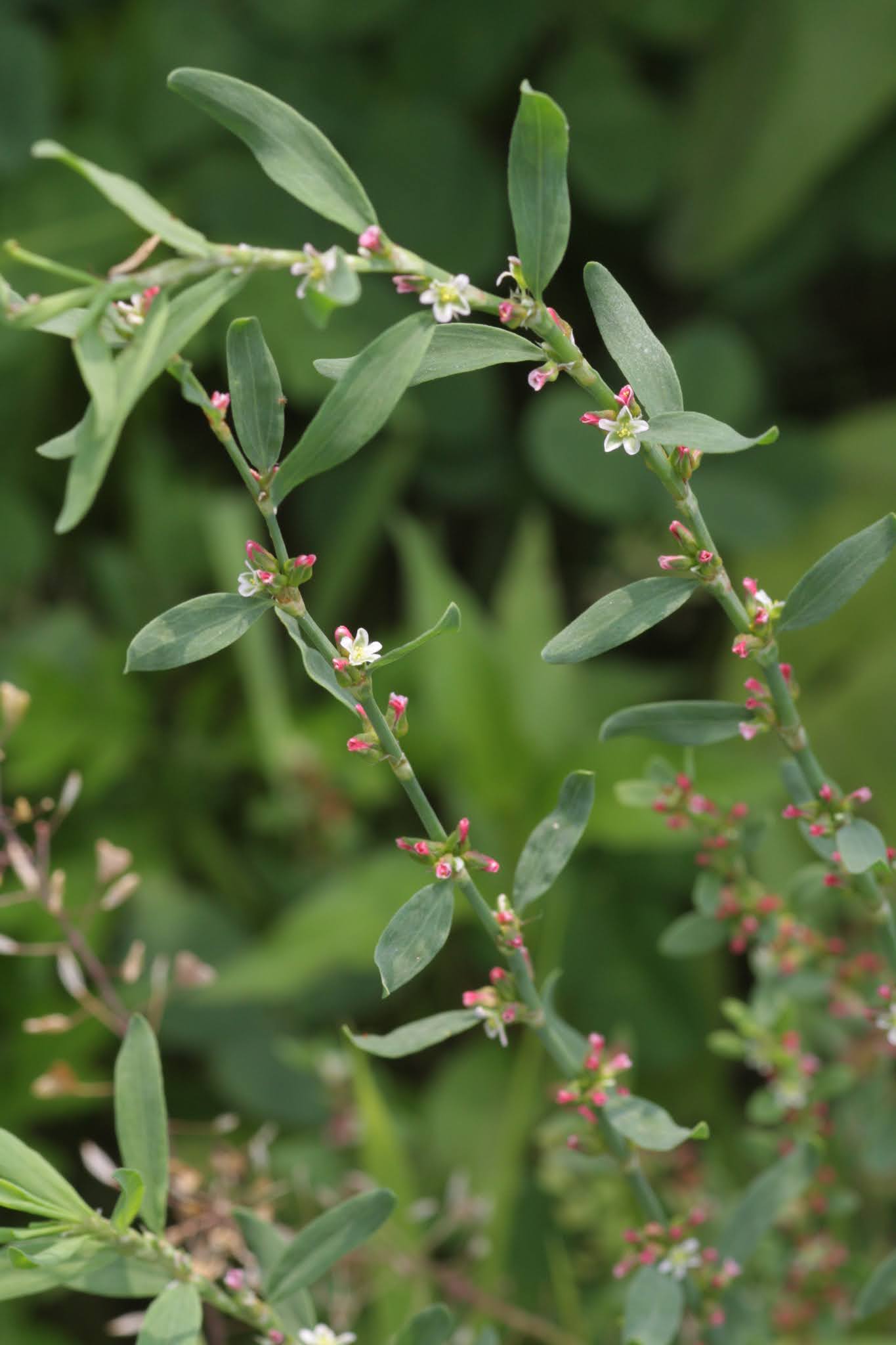
Showing posts with label Caryophyllales. Show all posts

Suaeda

Estuary seablite Suaeda esteroa, photographed by Anthony Valois.


Belongs within: Chenopodiaceae.

Suaeda, seablites and seepweeds, is a cosmopolitan genus of herbs and shrubs found growing in saline and alkaline soils (Hickman 1993).

Characters (from Hickman 1993): Annuals, perennials, or shrubs, glabrous to hairy. Leaves generally alternate; blade entire, sometimes cylindric or upper surface flat, fleshy, generally glaucous, tip acute or pointed. Inflorescence a cyme; clusters sessile, generally arrayed in compound spikes; bracts leaf-like or reduced, bractlets subtending flowers 1–3, minute, membranous; flowers 1–12. Flowers generally bisexual; calyx radial or bilateral, lobes 5, rounded, hooded, keeled, horned, or wing-margined; ovary more or less lenticular, rounded, conic or with a neck-like extension, stigmas 2–4. Fruit an utricle, enclosed in calyx. Seed horizontal or vertical, lenticular or flat.

<==Suaeda Forsskal ex Scopoli 1777 (nom. cons.) [Suaedeae] W84
    |--S. sect. Heterosperma H93
    |    |--S. calceoliformis [incl. S. depressa var. erecta] H93
    |    `--S. esteroa H93
    `--S. sect. Limbogermen H93
         |--S. californica H93
         |--S. moquinii [incl. S. torreyana var. ramosissima, S. torreyana] H93
         `--S. taxifolia [=S. californica var. taxifolia; incl. S. californica var. pubescens] H93

Suaeda incertae sedis:
  *S. vera W84
  S. aegyptiaca (Hasselq.) Zoh. 1957 (see below for synonymy) W84
  S. arbusculoides Smith 1969 W84
  S. articulata CV06
  S. australis (Br.) Moq. 1831 (see below for synonymy) W84
  S. baccifera Pallas 1803 W84
  S. corniculata CS77
  S. divaricata O06
  S. linifolia Pallas 1803 W84
  S. maritima [=Chenopodium maritimum Linnaeus 1753] A61
  S. monoica HSS13
  S. novae-zelandiae Allan 1961 (see below for synonymy) A61
  S. palaestina GR98
  S. salina CV06
  S. suffrutescens RH96

Suaeda aegyptiaca (Hasselq.) Zoh. 1957 [=Chenopodium aegyptiacum Hasselq. 1757, Enchylaena aegyptiaca (Hasselq.) Sprengel 1824; incl. Suaeda baccata Forsskal ex Gmelin 1791] W84

Suaeda australis (Br.) Moq. 1831 [=Chenopodium australe Br. 1810, Chenopodina australis (Br.) Moq. in DC. 1849, Lerchea maritima var. australis (Br.) Kuntze 1891, Schoberia australis (Br.) Meyer ex Steudel 1841, Suaeda maritima var. australis (Br.) Domin 1921; incl. Chenopodium insulare Black 1945] W84

Suaeda novae-zelandiae Allan 1961 [=Su. australis var. nova-zelandica MacKay & Chapman 1954; incl. Salsola fruticosa Forst. f. 1786 non Linnaeus 1763] A61

*Type species of generic name indicated

REFERENCES

[A61] Allan, H. H. 1961. Flora of New Zealand vol. 1. Indigenous Tracheophyta: Psilopsida, Lycopsida, Filicopsida, Gymnospermae, Dicotyledones. R. E. Owen, Government Printer: Wellington (New Zealand).

[CS77] Cramp, S., & K. E. L. Simmons (eds) 1977. Handbook of the Birds of Europe, the Middle East and North Africa: The Birds of the Western Palaearctic vol. 1. Ostrich to Ducks. Oxford University Press: Oxford.

[CV06] Craven, P., & P. Vorster. 2006. Patterns of plant diversity and endemism in Namibia. Bothalia 36 (2): 175–189.

[GR98] Greuter, W., & T. Raus (eds.) 1998. Med-Checklist Notulae, 17. Willdenowia 28: 163–174.

[H93] Hickman, J. C. (ed.) 1993. The Jepson Manual: Higher Plants of California. University of California Press: Berkeley (California).

[HSS13] Hirschfeld, E., A. Swash & R. Still. 2013. The World's Rarest Birds. Princeton University Press: Princeton (New Jersey).

[O06] Outes, F. F. 1906. Instrumentos y armas neolíticos de Cochicó (Provincia de Mendoza). Anales del Museo Nacional de Buenos Aires, serie 3, 6: 277–286.

[RH96] Remaudière, G., & S. E. Halbert. 1996. American species of the genus Brachyunguis Das (Homoptera: Aphididae), including two new species. Proceedings of the Entomological Society of Washington 98 (2): 249–255.

[W84] Wilson, P. G. 1984. Chenopodiaceae. In: George, A. S. (ed.) Flora of Australia vol. 4. Phytolaccaceae to Chenopodiaceae pp. 81–317. Australian Government Publishing Service: Canberra.

Nepenthes

Low-level pitcher of Nepenthes macfarlanei, copyright Alexey Yakovlev.


Belongs within: Caryophyllales.

Nepenthes, the tropical pitcher plants, is a genus of shrubs and lianas found in the Indo-Australian region and Madagascar that have leaves ending in tendrils bearing fluid-filled pitchers that capture insects and other small animals for nutriment.

Characters (from Flora of China): Lianas or shrubs to 20 m, sometimes only weakly woody, dioecious, carnivorous. Stem simple or branched, erect, climbing, or procumbent, cylindric or triangular in cross section, glabrous or pubescent. Leaves alternate, petiolate or sessile; midvein prolonged into a tendril, apex of tendril usually developing into a dimorphic pitcher with a lid usually projecting over mouth and a spur inserted at base of lid. Pitchers toward base of plant ovoid, facing inward, with 2 fringed wings, tendril ventral, uncoiled; pitchers toward apex of plant cylindric or funnelform, facing outward, wings generally unfringed or reduced to ridges, tendril dorsal, coiled. Inflorescence terminal (appearing leaf opposed because of continued axillary growth), racemose, or with secondary branches 2-flowered or cincinni, usually sparsely bracteate. Flowers regular; perianth in 1 whorl of (3 or)4 tepals. Male flowers with 4-24 anthers; filaments united into a column; pistils inconspicuous. Female flowers with inconspicuous anthers; pistils (3 or)4; ovary superior, stipitate or not, ovoid-globose or tetragonal-terete, rarely obdeltoid, (3 or)4-loculed; placentation axile; ovules numerous, in many rows; style very short to obsolete; stigma disclike, (3 or)4-lobed. Capsule (3 or)4-valved, leathery or woody, loculicidally dehiscent. Seeds numerous, usually hairlike; embryo straight; endosperm fleshy.

<==Nepenthes [Nepenthaceae]
    |--N. albo-marginata P88
    |--N. ampullaria KTG03
    |--N. bicalcarata P88
    |--N. boschiana H03
    |--N. danseri H03
    |--N. gracilis KTG03
    |--N. × hookeriana [N. ampullaria × N. rafflesiana] KTG03
    |--N. khasiana MR07
    |--N. lowii P88
    |--N. macfarlanei P88
    |--N. madagascariensis FOK96
    |--N. melamphora H04
    |--N. mirabilis H03
    |--N. pervillei FOK96
    |--N. rafflesiana KTG03
    |--N. rajah P88
    |--N. sanguinea P88
    |--N. sumatrana H03
    |--N. tobaica FOK96
    |--N. treubiana H03
    `--N. × trichocarpa [N. ampullaria × N. gracilis] KTG03

*Type species of generic name indicated

REFERENCES

[FOK96] Fashing, N. J., B. M. OConnor & R. L. Kitching. 1996. Adaptations for swimming in the genus Creutzeria (Astigmata: Histiostomatidae). In: Mitchell, R., D. J. Horn, G. R. Needham & W. C. Welbourn (eds) Acarology IX vol. 1. Proceedings pp. 385–388. Ohio Biological Survey: Columbus (Ohio).

[H04] Haeckel, E. 1899–1904. Kunstformen der Natur. Bibliographisches Institut: Leipzig und Wien.

[H03] Heads, M. 2003. Ericaceae in Malesia: vicariance biogeography, terrane tectonics and ecology. Telopea 10 (1): 311–449.

[KTG03] Kiew, R., L. L. Teo & Y. Y. Gan. 2003. Assessment of the hybrid status of some Malesian plants using Amplified Fragment Length Polymorphism. Telopea 10 (1): 225–233.

[MR07] Mao, A. A., & R. A. Ranyaphi. 2007. Seed viability studies in Nepenthes khasiana Hook.f.: comparison of in vivo and in vitro seed germination. Bulletin of the Botanical Survey of India 49: 89–94.

[P88] Polunin, I. 1988. Plants and Flowers of Malaysia. Times Editions: Singapore.

Opuntia

Opuntia engelmannii, copyright Pschemp.


Belongs within: Opuntioideae.

Opuntia, the prickly pears, is a genus of cacti with stems divided into flattened cladodes; circumscription of the genus is problematic and it may not be monophyletic as currently recognised (Griffiths & Porter 2009).

Opuntia
    |--O. chaffeyi GP09
    |--O. erinacea GP09
    |    |--O. e. var. erinacea [incl. O. ursina] H93
    |    `--O. e. var. utahensis [incl. O. rhodantha, O. xanthostemma] H93
    |--O. macbrideii GP09
    |--O. robusta GP09
    |--+--O. decumbens GP09
    |  `--O. pubescens GP09
    |--+--O. excelsa GP09
    |  `--O. pycnantha GP09
    |--+--O. eichios GP09
    |  |--O. galapageia GP09
    |  |--O. megasperma GP09
    |  `--O. sulfurea GP09
    |--+--O. depressa GP09
    |  `--+--O. megacantha GP09
    |     |--O. pittieri GP09
    |     |--O. schumanni GP09
    |     `--+--O. ficus-indica GP09
    |        `--O. tomentosa GP09
    `--+--O. boldingii GP09
       |--O. santa-rita GP09
       `--+--O. aureispina GP09
          |--O. camanchica GP09
          |--O. macrocentra GP09
          |--O. strigil GP09
          `--+--O. engelmannii GP09 [incl. O. phaeacantha var. discata H93, O. lindheimeri H06]
             `--O. phaeacantha GP09 (see below for synonymy)

Opuntia incertae sedis:
  O. articulata EL98
  O. aurantiaca H06
  O. basilaris H93
    |--O. b. var. basilaris [incl. O. basilaris var. ramosa, O. whitneyana] H93
    |--O. b. var. brachyclada [incl. O. humistrata] H93
    `--O. b. var. treleasei H93
  O. chlorotica H93
  O. curvospina H93
  O. demissa H93
  O. elatior H90
  O. exaltata H06
  O. ficus-barbarica Y98
  O. fragilis H93
  O. fulgida H06
  O. helleri RJ11
  O. humifusa [incl. O. compressa] H90
  O. junctolineela C90
  O. lepticollis OB11
  O. littoralis [incl. O. semispinosa] H93
  O. mesacantha R35
  O. microdasys H90
  O. × occidentalis H93
  ‘Cactus’ opuntia C55
  O. oricola H93
  O. paraguayensis [incl. O. bonaerensis] H90
  O. polyacantha CL86
  O. soehrensii EL98
  O. spinosior LW70
  O. spinosissima SS96
  O. spinulifera H06
  O. streptacantha H90
  O. stricta H90
    |--O. s. var. stricta [incl. O. bentonii, O. inermis] H90
    `--O. s. var. dillenii H90
  O. tenuispina H90
  O. triacantha SS96
  O. × vaseyi (see below for synonymy) H93
  O. verschaffeltii EL98
  O. vulgaris [incl. O. monacantha] H90
  O. wentiana F11

Opuntia phaeacantha GP09 [incl. O. phaeacantha var. major H93, O. mojavensis H93, O. littoralis var. piercei H93]

Opuntia × vaseyi [O. littoralis × O. phaeacantha; =O. littoralis var. vaseyi; incl. O. littoralis var. austrocalifornica, O. occidentalis var. covillei] H93

*Type species of generic name indicated

REFERENCES

[C55] Candolle, A. de. 1855. Géographie Botanique Raisonée: Ou exposition des faits principaux et des lois concernant la distribution géographique des plantes de l’époque actuelle vol. 2. Librairie de Victor Masson: Paris.

[CL86] Collins, E. I., & R. W. Lichvar. 1986. Vegetation inventory of current and historic black-footed ferret habitat in Wyoming. Great Basin Naturalist Memoirs 8: 85–93.

[C90] Crawford, C. S. 1990. Scorpiones, Solifugae, and associated desert taxa. In: Dindal, D. L. (ed.) Soil Biology Guide pp. 421-475. John Wiley & Sones: New York.

[EL98] Eggli, U., & B. E. Leuenberger. 1998. On colour forms of Opuntia weberi (Cactaceae) with notes on the typification of the name. Willdenowia 28: 175–180.

[F11] Fraga, R. M. 2011. Family Icteridae (New World blackbirds). In: Hoyo, J. del, A. Elliott & D. A. Christie (eds) Handbook of the Birds of the World vol. 16. Tanagers to New World Blackbirds pp. 684–807. Lynx Edicions: Barcelona.

[GP09] Griffith, M. P., & J. M. Porter. 2009. Phylogeny of Opuntioideae (Cactaceae). International Journal of Plant Sciences 170 (1): 107–116.

[H90] Harden, G. J. (ed.) 1990. Flora of New South Wales vol. 1. New South Wales University Press.

[H06] Henderson, L. 2006. Comparisons of invasive plants in southern Africa originating from southern temperate, northern temperate and tropical regions. Bothalia 36 (2): 201–222.

[H93] Hickman, J. C. (ed.) 1993. The Jepson Manual: Higher Plants of California. University of California Press: Berkeley (California).

[LW70] Lowe, C. H., J. W. Wright, C. J. Cole & R. L. Bezy. 1970. Natural hybridization between the teiid lizards Cnemidophorus sonorae (parthenogenetic) and Cnemidophorus tigris (bisexual). Systematic Zoology 19 (2): 114–127.

[OB11] Orenstein, R. I., & D. Brewer. 2011. Family Cardinalidae (cardinals). In: Hoyo, J. del, A. Elliott & D. A. Christie (eds) Handbook of the Birds of the World vol. 16. Tanagers to New World Blackbirds pp. 330–427. Lynx Edicions: Barcelona.

[R35] Rayment, T. 1935. A Cluster of Bees: Sixty essays on the life-histories of Australian bees, with specific descriptions of over 100 new species. Endeavour Press: Sydney.

[RJ11] Rising, J. D., A. Jaramillo, J. L. Copete, P. G. Ryan & S. C. Madge. 2011. Family Emberizidae (buntings and New World sparrows). In: Hoyo, J. del, A. Elliott & D. A. Christie (eds) Handbook of the Birds of the World vol. 16. Tanagers to New World Blackbirds pp. 428–683. Lynx Edicions: Barcelona.

[SS96] Simberloff, D., & P. Stilling. 1996. How risky is biological control? Ecology 77 (7): 1965–1974.

[Y98] Yannitsaros, A. 1998. Additions to the flora of Kithira (Greece) I. Willdenowia 28: 77–94.

Polygonum

Common knotgrass Polygonum aviculare, copyright Dalgial.


Belongs within: Polygonaceae.
Contains: Polygonum sect. Persicaria, Polygonum sect. Aconogonon, Polygonum sect. Bistorta.

Polygonum, the knotweeds, is a cosmopolitan genus of herbs, shrubs and vines most diverse in northern temperate regions. Leaves are generally petioled and between 5 to 35 cm long in members of the subgenus Persicaria whereas they are more or less sessile and less than five centimetres long in species of the subgenus Polygonum (Hickman 1993).

Characters (from Hickman 1993): Annual, perennial, shrub or vine. Stem prostrate to erect, or climbing, or floating, <3 m. Leaves generally cauline, alternate, sessile or petioled, stipules fused, sheathing stem above nodes, generally scarious or membranous; blade sometimes obviously jointed to stipule sheath. Inflorescence unit a 1–8-flowered cluster, these arrayed singly or in head-like to open panicles. Flower with perianth lobes generally 5; stamens 3–8, filaments generally wider at base. Fruit generally ovoid, 3-angled, sometimes round, flat, indented; shiny to dull, brown to black.

<==Polygonum Linnaeus 1753 A61
    |--P. subg. Polygonum H93
    |    |  i. s.: P. bolanderi H93
    |    |         P. paronychia H93
    |    |         P. shastense H93
    |    |--P. sect. Polygonum H93
    |    |    |--P. arenastrum [incl. P. montereyense] H93
    |    |    |--P. argyrocoleon H93
    |    |    |--P. aviculare H93
    |    |    |--P. marinense H93
    |    |    |--P. patulum H93
    |    |    |--P. prolificum H93
    |    |    |--P. ramosissimum H93
    |    |    `--P. robertii H93
    |    |--P. sect. Duravia H93
    |    |    |--P. bidwelliae H93
    |    |    |--P. californicum H93
    |    |    `--P. parryi H93
    |    `--P. sect. Monticola non Monticola Soares 1944 (ICZN) nec Boie 1822 (ICZN) nec Nalivkin 1930 (ICZN) H93
    |         |--P. douglasii H93
    |         |    |--P. d. ssp. douglasii [incl. P. douglasii var. latifolium] H93
    |         |    |--P. d. ssp. austiniae H93
    |         |    |--P. d. ssp. johnstonii [incl. P. sawatchense] H93
    |         |    |--P. d. ssp. majus H93
    |         |    `--P. d. ssp. spergulariiforme H93
    |         |--P. minimum H93
    |         `--P. polygaloides H93
    |              |--P. p. ssp. polygaloides H93
    |              |--P. p. ssp. confertiflorum H93
    |              |--P. p. ssp. esotericum H93
    |              `--P. p. ssp. kelloggii H93
    `--P. subg. Persicaria H93
         |  i. s.: P. barbatum Linnaeus 1753 H78 [=Persicaria barbata LK14]
         |         ‘Persicaria’ bistorta V09
         |         P. chinense Linnaeus 1753 H78 [=Persicaria chinensis D07]
         |         P. glabrum VB02 [=Persicaria glabra K10]
         |         ‘Persicaria’ glacialis O88
         |         P. nepalense Meissn. 1826 H78 (see below for synonymy)
         |         ‘Persicaria’ odorata H90
         |--P. sect. Persicaria H93
         |--P. sect. Aconogonon H93
         |--P. sect. Bistorta H93
         `--P. (sect. Cephalophilon) capitatum H93 [=Persicaria capitata H90]

Polygonum incertae sedis:
  P. acuminatum H70
  P. benguetense Merr. 1915 H78
  P. chilense D03
  P. cumingianum [incl. P. celebicum] H78
  P. dumetorum C55
  P. emarginatum C55
  P. fagopyrum C55
  P. longisetum DeBr. in Miq. 1854 H78
  P. maritimum C55
  P. minus Huds. 1762 H78
  P. paniculatum [incl. P. polyanthos] H78
  P. perfoliatum Linnaeus 1762 H78
  P. plebeium [incl. P. aviculare var. dryandri] C06
    |--P. p. var. plebeium PP07
    `--P. p. var. indica PP07
  P. pubescens H78
  P. runcinatum Don 1825 H78
  P. salicifolium BG96
  P. senegalense GC05
  P. serrulatum A27
  P. sieboldi F92
  P. tataricum C55
  P. thunbergi F92
  P. viviparum CS77

Polygonum nepalense Meissn. 1826 H78 [=Persicaria nepalensis O88; incl. P. alatum Buch.-Ham. ex Spreng. 1827 H78, P. microcephalum var. papuanum Warb. 1893 H78]

*Type species of generic name indicated

REFERENCES

[A61] Allan, H. H. 1961. Flora of New Zealand vol. 1. Indigenous Tracheophyta: Psilopsida, Lycopsida, Filicopsida, Gymnospermae, Dicotyledones. R. E. Owen, Government Printer: Wellington (New Zealand).

[A27] Andersen, J. C. 1927. Popular names of New Zealand plants. Part 2. Transactions and Proceedings of the New Zealand Institute 57: 905–977.

[BG96] Baka, Z. A., & H. B. Gjaerum. 1996. Egyptian Uredinales. 1. Rusts on wild plants from the Nile Delta. Mycotaxon 60: 291–303.

[C55] Candolle, A. de. 1855. Géographie Botanique Raisonée: Ou exposition des faits principaux et des lois concernant la distribution géographique des plantes de l’époque actuelle vol. 2. Librairie de Victor Masson: Paris.

[CS77] Cramp, S., & K. E. L. Simmons (eds) 1977. Handbook of the Birds of Europe, the Middle East and North Africa: The Birds of the Western Palaearctic vol. 1. Ostrich to Ducks. Oxford University Press: Oxford.

[D07] Dash, S. S. 2007. Useful plants of Kabi Sacred Grove, Sikkim. Bulletin of the Botanical Survey of India 49: 79–88.

[D03] Dusén, P. 1903. The vegetation of western Patagonia. In: Scott, W. B. (ed.) Reports of the Princeton University Expeditions to Patagonia, 1896–1899 vol. 8. Botany pp. 1–34. The University: Princeton (New Jersey).

[F92] Fan Z. 1992. Key to the Common Flies of China 2nd ed. Science Press: Beijing.

[GC05] Granjon, L., J.-F. Cosson, E. Quesseveur & B. Sicard. 2005. Population dynamics of the multimammate rat Mastomys huberti in an annually flooded agricultural region of central Mali. Journal of Mammalogy 86 (5): 997–1008.

[H70] Hammer, M. 1970. A few oribatid mites from Easter Island. Pacific Insects 12 (2): 279–289.

[H90] Harden, G. J. (ed.) 1990. Flora of New South Wales vol. 1. New South Wales University Press.

[H78] Henty, E. E. 1978. Polygonaceae. In: Womersley, J. S. (ed.) Handbooks of the Flora of Papua New Guinea vol. 1 pp. 222–248. Melbourne University Press: Carlton South (Australia).

[H93] Hickman, J. C. (ed.) 1993. The Jepson Manual: Higher Plants of California. University of California Press: Berkeley (California).

[K10] Keighery, G. 2010. The naturalised vascular plants of the Pilbara region, Western Australia. Records of the Western Australian Museum Supplement 78 (1): 299–311.

[LK14] Lyons, M. N., G. J. Keighery, L. A. Gibson & T. Handasyde. 2014. Flora and vegetation communities of selected islands off the Kimberley coast of Western Australia. Records of the Western Australian Museum Supplement 81: 205–244.

[O88] Ohba, H. 1988. The alpine flora of the Nepal Himalayas: an introductory note. In: Ohba, H., & S. B. Malla (eds) The Himalayan Plants vol. 1. The University Museum, University of Tokyo, Bulletin 31: 19–46.

[PP07] Pandey, R. P., & P. M. Padhye. 2007. Studies on phytodiversity of Arid Machia Safari Park-Kailana in Jodhpur (Rajasthan). Bulletin of the Botanical Survey of India 49: 15–78.

[V09] Verdcourt, B. (ed.) 2009. Additions to the wild fauna and flora of the Royal Botanic Gardens, Kew. XXVI. Miscellaneous records. Kew Bulletin 64 (1): 183–194.

[VB02] Vijay, S. K., & T. N. Bhardwaja. 2002. Vegetation and phenodynamics of wetlands of central Rajasthan. Journal of the Bombay Natural History Society 99 (3): 573–581.

Last updated: 1 January 2021.

Memsembryanthemoideae

Ruschia promontorii, copyright Madabotanik.


Belongs within: Aizoaceae.
Contains: Conophytum, Lithops.

The Mesembryanthemoideae, iceplants or ice-daisies, are a group of flowering plants bearing flowers with many petals in several whorls (Hickman 1993).

<==Mesembryanthemoideae [Aptenioideae, Mesembryanthemaceae, Ruschioideae]
    |--Conicosia [Apatesieae] H93
    |    `--C. pugioniformis [=Mesembryanthemum pugioniforme] H93
    |--Carpobrotus G01 [Carpobroteae H93]
    |    |--C. aequilaterus H90 [=Mesembryanthemum aequilaterale R35]
    |    |--C. candidus KM08
    |    |--C. chilensis [=Mesembryanthemum chilense; incl. C. mellei] H93
    |    |--C. edulis [=Mesembryanthemum edule] H93
    |    |--C. glaucescens P82
    |    `--C. modestus GK00
    |--+--Aptenia cordifolia [=Mesembryanthemum cordifolium] H93
    |  `--Mesembryanthemum H93
    |       |--M. aitonis [=Cryophytum aitonis, Gasoul aitonis] H90
    |       |--M. crystallinum [=Cryophytum crystallinum, Gasoul crystallinum] H90
    |       |--M. noctiflorum D00
    |       |--M. nodiflorum [=Gasoul nodiflorum] H90
    |       |--M. pellitum CV06
    |       |--M. splendens D00
    |       |--M. tegens R35
    |       `--M. tenuifolium D00
    `--Ruschieae H93
         |--Malephora H93
         |    |--M. crocea [=Mesembryanthemum croceum] H93
         |    `--M. engleriana CV06
         |--Delosperma H93
         |    |--D. abyssinicum B06b
         |    |--D. klinghardtianum CV06
         |    `--D. litorale [=Mesembryanthemum litorale] H93
         |--Drosanthemum H93
         |    |--D. floribundum [=Mesembryanthemum floribundum] H93
         |    |--D. hispidum H93
         |    |--D. nordenstamii CV06
         |    `--D. pauper CV06
         `--Ruschia B06a
              |--R. deminuta CV06
              |--R. namusmontana CV06
              |--R. odontocalyx CV06
              |--R. pollardii CV06
              |--R. promontorii Bolus 1929 (see below for synonymy) B06a
              |--R. ruschiana CV06
              |--R. (sect. *Sarmentosae) sarmentosa B06a
              `--R. vulvaria CV06

Mesembryanthemoideae incertae sedis:
  Acrodon purpureostylus B06a
  Synaptophyllum juttae CV06
  Jensenobotrya lossowiana CV06
  Ruschianthus falcatus CV06
  Stoeberia CV06
  Astridia halli CV06
  Cheiridopsis caroli-schmidtii CV06
  Dracophilus delaetinus CV06
  Eberlanzia clausa CV06
  Fenestraria rhopalophylla CV06
  Titanopsis schwantesii CV06
  Trichodiadema littlewoodii CV06
  Amphibolia B06a
    |--A. laevis [incl. A. hutchinsonii (preoc.)] B06a
    `--A. saginata CV06
  Namibia CV06
    |--N. cinerea [incl. N. ponderosa] CV06
    `--N. pomonae CV06
  Schwantesia CV06
    |--S. constanceae CV06
    `--S. succumbens CV06
  Cephalophyllum CV06
    |--C. compressum CV06
    `--C. confusum CV06
  Dinteranthus microspermus CV06
    |--D. m. ssp. microspermus CV06
    `--D. m. ssp. impunctatus CV06
  Ebracteola CV06
    |--E. derenbergiana CV06
    `--E. montis-moltkei CV06
  Psammophora CV06
    |--P. nissenii CV06
    `--P. saxicola CV06
  Psilocaulon CV06
    |--P. gessertianum CV06
    |--P. salicornioides CV06
    `--P. tenue H90
  Brownanthus CV06
    |--B. arenosus CV06
    |--B. namibensis CV06
    `--B. pubescens CV06
  Juttadinteria CV06
    |--J. attenuata CV06
    |--J. ausensis CV06
    |--J. deserticola CV06
    `--J. simpsonii CV06
  Antimima B06a
    |--A. argentea CV06
    |--A. aurasensis CV06
    |--A. buchubergensis CV06
    |--A. dolomitica CV06
    |--A. eendornensis CV06
    |--A. modesta CV06
    `--A. quarzitica CV06
  Conophytum CV06
  Lithops CV06
  Disphyma Brown 1925 H90, A61
    `--D. crassifolium H90
         |--D. c. ssp. crassifolium H90
         `--D. c. ssp. clavellatum H90 (see below for synonymy)
  Micropterum papulosum [=Mesembryanthemum papulosum] H90
  Lampranthus H90
    |--L. multiradiatus H90
    |--L. spectabilis MH98
    `--L. tegens H90
  Sarcozona praecox H90

Disphyma crassifolium ssp. clavellatum H90 [incl. Mesembryanthemum australe Sol. ex Ait. 1789 H90, A61, D. australe (Sol.) Black 1932 A61, D. blackii H90]

Ruschia promontorii Bolus 1929 [=Mesembryanthemum pansifolium ms, Antimima promontoni Desmet 2000 (l. c.; nom. illeg.), A. promontori (l. c.)] B06a

*Type species of generic name indicated

REFERENCES

[A61] Allan, H. H. 1961. Flora of New Zealand vol. 1. Indigenous Tracheophyta: Psilopsida, Lycopsida, Filicopsida, Gymnospermae, Dicotyledones. R. E. Owen, Government Printer: Wellington (New Zealand).

[B06a] Burgoyne, P. M. 2006a. Mesembryanthemaceae. The identity of Ruschia promontorii. Bothalia 36 (2): 163–167.

[B06b] Burgoyne, P. M. 2006b. Review: Plants of the Simen. A flora of the Simen Mountains and surroundings, northern Ethiopia. Bothalia 36 (2): 253.

[CV06] Craven, P., & P. Vorster. 2006. Patterns of plant diversity and endemism in Namibia. Bothalia 36 (2): 175–189.

[D00] Decandolle, C. 1800. Expériences relatives à l'influence de la lumière sur quelques végétaux. Bulletin des Sciences, par la Societé Philomathique de Paris 2 (42): 138–139.

[GK00] Gibson, N., & G. J. Keighery. 2000. Flora and vegetation of the Byenup-Muir reserve system, south-west Western Australia. CALMScience 3 (3): 323–402.

[G01] Grout, T. G. 2001. Advances in understanding the ecology of Euseius (Mesostigmata: Phytoseiidae) species on citrus in southern Africa. In: Halliday, R. B., D. E. Walter, H. C. Proctor, R. A. Norton & M. J. Colloff (eds) Acarology: Proceedings of the 10th International Congress pp. 464–469. CSIRO Publishing: Melbourne.

[H90] Harden, G. J. (ed.) 1990. Flora of New South Wales vol. 1. New South Wales University Press.

[H93] Hickman, J. C. (ed.) 1993. The Jepson Manual: Higher Plants of California. University of California Press: Berkeley (California).

[KM08] Keighery, G. J., & W. Muir. 2008. Vegetation and vascular flora of Faure Island, Shark Bay, Western Australia. Records of the Western Australian Museum Supplement 75: 11–19.

[MH98] Morikawa, H., A. Higaki, M. Nohno, M. Takahashi, M. Kamada, M. Nakata, G. Toyohara, Y. Okamura, K. Matsui, S. Kitani, K. Fujita, K. Irifune & N. Goshima. 1998. More than a 600-fold variation in nitrogen dioxide assimilation among 217 plant taxa. Plant, Cell and Environment 21: 180–190.

[P82] Pickard, J. 1982. Catastrophic disturbance and vegetation on Little Slope, Lord Howe Island. Australian Journal of Ecology 7: 161–170.

[R35] Rayment, T. 1935. A Cluster of Bees: Sixty essays on the life-histories of Australian bees, with specific descriptions of over 100 new species. Endeavour Press: Sydney.

Cerastium

Field chickweed Cerastium arvense, copyright Brewbooks.


Belongs within: Caryophyllaceae.

Cerastium, mouse-ear chickweeds, is a cosmopolitan genus of herbaceous plants most diverse in the northern temperate regions. Widespread species include the field chickweed C. arvense, found in both Eurasia and North America, which is a perennial species with the leaves clustered in axils on flowering stems (Hickman 1993).

Characters (from Hickman 1993): Annual or perennial, erect to mat-forming; taproot or rhizomes present. Leaf blade linear to ovate; vein 1. Inflorescence a cyme, terminal or axillary; flowers few–many, open to tightly dense; pedicels 1–36+ mm. Flower with sepals 5, 3.5–12 mm, free, lanceolate to ovate, hairy to glandular-hairy; petals 0 or 5, 2.5–15 mm, more or less 2-lobed; stamens (5)10; styles 5, 0.5–3.3 mm. Fruit a capsule, cylindrical curved in upper half; teeth 10, spreading to recurved. Seeds several–many, pale brown to reddish brown.

<==Cerastium
    |--C. alpinum CS77
    |--C. amblyodontum Colenso 1895 A61
    |--C. arvense D03
    |--C. beeringianum H93
    |    |--C. b. var. beeringianum H93
    |    `--C. b. var. capillare [incl. C. beeringianum ssp. earlei] H93
    |--C. brachypetallum H91
    |--C. dichotomum H93
    |--C. fontanum PAE98
    |    |--C. f. ssp. fontanum O88
    |    `--C. f. ssp. vulgare [incl. C. fontanum ssp. triviale] H93
    |         |--C. f. ssp. v. var. vulgare O88
    |         `--C. f. ssp. ‘triviale’ var. angustifolium O88
    |--C. glomeratum GK00
    |--C. gracile Dufour 1820 PL04
    |--C. nigrescens CS77
    |--C. semidecandrum G88
    |--C. transsilvanicum H09
    |--C. truncatulum Colenso 1893 A61
    |--C. viscosum C55
    `--C. vulgatum C55

*Type species of generic name indicated

REFERENCES

[A61] Allan, H. H. 1961. Flora of New Zealand vol. 1. Indigenous Tracheophyta: Psilopsida, Lycopsida, Filicopsida, Gymnospermae, Dicotyledones. R. E. Owen, Government Printer: Wellington (New Zealand).

[C55] Candolle, A. de. 1855. Géographie Botanique Raisonée: Ou exposition des faits principaux et des lois concernant la distribution géographique des plantes de l’époque actuelle vol. 2. Librairie de Victor Masson: Paris.

[CS77] Cramp, S., & K. E. L. Simmons (eds) 1977. Handbook of the Birds of Europe, the Middle East and North Africa: The Birds of the Western Palaearctic vol. 1. Ostrich to Ducks. Oxford University Press: Oxford.

[D03] Dusén, P. 1903. The vegetation of western Patagonia. In: Scott, W. B. (ed.) Reports of the Princeton University Expeditions to Patagonia, 1896–1899 vol. 8. Botany pp. 1–34. The University: Princeton (New Jersey).

[GK00] Gibson, N., & G. J. Keighery. 2000. Flora and vegetation of the Byenup-Muir reserve system, south-west Western Australia. CALMScience 3 (3): 323–402.

[G88] Grubb, P. J. 1988. The uncoupling of disturbance and recruitment, two kinds of seed bank, and persistence of plant populations at the regional and local scales. Annales Zoologici Fennici 25: 23–26.

[H09] Heltmann, H. 2009. Der Königstein (Piatra Craiului), die Perle der Burzenländer Gebirge. Mauritiana 20 (3): 515–527.

[H93] Hickman, J. C. (ed.) 1993. The Jepson Manual: Higher Plants of California. University of California Press: Berkeley (California).

[H91] Hubálek, Z. 1991. Biogeographic indication of natural foci of tick-borne infections. In: Dusbábek, F., & V. Bukva (eds) Modern Acarology: Proceedings of the VIII International Congress of Acarology, held in České Budĕjovice, Czechoslovakia, 6–11 August 1990 vol. 1 pp. 255–260. SPB Academic Publishing: The Hague.

[O88] Ohba, H. 1988. The alpine flora of the Nepal Himalayas: an introductory note. In: Ohba, H., & S. B. Malla (eds) The Himalayan Plants vol. 1. The University Museum, University of Tokyo, Bulletin 31: 19–46.

[PAE98] Pakeman, R. J., J. P. Attwood & J. Engelen. 1998. Sources of plants colonizing experimentally disturbed patches in an acidic grassland, in eastern England. Journal of Ecology 86: 1032–1041.

[PL04] Pohl, G., & I. Lenski. 2004. Zur Verbreitung und Vergesellschaftung von Pennisetum orientale Rich. in Nordeuböa (Griechenland) (Poaceae, Paniceae). Senckenbergiana Biologica 83 (2): 209–223.

Last updated: 1 January 2022.

Colobanthus

Antarctic pearlwort Colobanthus quitensis, copyright Patricio Novoa Quezada.


Belongs within: Caryophyllaceae.

Colobanthus is a genus of small tufted herbs found primarily in montane and southern regions of Australasia and South America (Harden 1990).

Characters (from Harden 1990): Small tufted perennial herbs, much branched from base. Leaves sessile, imbricate, narrow-linear to triangular, sometimes rigid and pungent or ending in a fine hair. Flowers bisexual, solitary, on slender or thickened pedicels. Sepals 5, free, acute to obtuse. Petals absent. Stamens usually 5, alternating with sepals. Ovary 1-locular; styles 5. Capsule as long as or longer than calyx, opening by 5 obtuse teeth; seeds ovoid to globose, numerous.

<==Colobanthus Bartl. 1830 A61
    |--C. acicularis Hook. f. 1864 A61
    |--C. affinis (Hook.) Hook. f. 1855 [=Spergula affinis Hook. 1840] A61
    |--C. apetalus (Labill.) Druce 1917 [=Spergula apetala Labill. 1804; incl. C. billardieri Fenzl 1836] A61
    |    |--C. a. var. apetalus A61
    |    `--C. a. var. alpinus (Kirk) Moore in Allan 1961 (see below for synonymy) A61
    |--C. brevisepalus Kirk 1895 A61
    |--C. buchananii Kirk 1895 A61
    |--C. caespitosus Colenso 1895 A61
    |--C. canaliculatus Kirk 1895 [incl. C. squarrosus Cheesem. 1896] A61
    |--C. crassifolius [=Sagina crassifolia D’Urville 1826] A61
    |--C. hookeri Cheesem. 1921 (see below for synonymy) A61
    |--C. kerguelensis SBG97
    |--C. masonae Moore in Allan 1961 A61
    |--C. monticola Petrie 1912 A61
    |--C. muelleri Kirk 1895 A61 (see below for synonymy)
    |--C. muscoides Hook. f. 1844 A61
    |--C. nivicola H90
    |--C. pulvinatus Mueller 1855 A61
    |--C. quitensis Bartl. in Presl 1831 A61
    |--C. repens Colenso 1887 A61
    |--C. strictus Cheesem. 1921 [=C. muelleri var. strictus Cheesem. 1906] A61
    `--C. wallii Petrie 1923 [incl. C. mollis Oliver 1926] A61

Colobanthus apetalus var. alpinus (Kirk) Moore in Allan 1961 [=C. billardieri var. alpinus Kirk 1895, C. crassifolius var. alpinus (Kirk) Cheesem. 1925] A61

Colobanthus hookeri Cheesem. 1921 [incl. C. benthamianus Cheesem. 1906 non Fenzl 1836, C. subulatus Hook. f. 1844 non Sagina subulata Urv. 1826] A61

Colobanthus muelleri Kirk 1895 A61 [incl. C. billardieri var. brachypoda Muell. 1864 A61, C. billardieri var. multicaulis Kirk 1895 A61, C. muelleri var. multicaulis C06]

*Type species of generic name indicated

REFERENCES

[A61] Allan, H. H. 1961. Flora of New Zealand vol. 1. Indigenous Tracheophyta: Psilopsida, Lycopsida, Filicopsida, Gymnospermae, Dicotyledones. R. E. Owen, Government Printer: Wellington (New Zealand).

[C06] Cheeseman, T. F. 1906. Manual of the New Zealand Flora. John Mackay, Government Printer: Wellington.

[H90] Harden, G. J. (ed.) 1990. Flora of New South Wales vol. 1. New South Wales University Press.

[SBG97] Starý, J., W. Block & P. Greenslade. 1997. Oribatid mites (Acari: Oribatida) of sub-Antarctic Heard Island. Journal of Natural History 31: 545–553.

Amaranthus

Love-lies-bleeding Amaranthus caudatus, copyright Tubifex.


Belongs within: Amaranthaceae.

Amaranthus, pigweeds, is a cosmopolitan genus of annual herbs of which some species are cultivated as food plants.

Characters (from Hickman 1993): Annual, monoecious or dioecious. Leaves alternate; blade linear to ovate. Inflorescences borne as cymes in dense, spike-like clusters; bract 1, tip generally short-pointed or -spined, generally scarious; bractlets 0–2. Staminate flowers with sepals 3–5, more or less equal, more or less as bracts; stamens (1–)3–5, filaments free; staminodia absent. Pistillate flowers with sepals (3–)5, more or less equal, scarious excludding midvein, fused at base, falling with fruit; ovary compressed-ovoid, styles (2–)3, stigmas slender, papillate, ovule 1, erect. Fruit circumscissile or indehiscent, smooth or inflated-wrinkled; walls membranous to spongy-hardened. Seed 1, lenticular, smooth, reddish to black.

<==Amaranthus
    |--A. albus Y98
    |--A. arenicola H93
    |--A. blitoides H93
    |--A. brownii O94
    |--A. californicus H93
    |--A. caudatus Linnaeus 1753 K78
    |--A. chlorostachys C55
    |--A. cruentus Linnaeus 1759 K78 (see below for synonymy)
    |    |--A. c. var. cruentus C55
    |    `--A. ‘paniculatus’ var. sanguineus C55
    |--A. deflexus Y98
    |--A. dubius Thell. 1912 K78
    |--A. fimbriatus H93
    |--A. flavus C55
    |--A. graecizans AGF98
    |--A. grandiflorus [=A. mitchellii var. grandiflorus] H90
    |--A. hybridus K78
    |--A. hypochondriacus C55
    |--A. interruptus Brown 1810 [=Euxolus interruptus (Brown) Moq. 1849] K78
    |--A. leptostachyus Benth. 1870 K78
    |--A. lividus Linnaeus 1753 K78 [=Euxolus lividus C55; incl. A. blitum H90]
    |    |--A. l. ssp. lividus K78
    |    `--A. l. ssp. polygonoides K78
    |--A. macrocarpus H90
    |    |--A. m. var. macrocarpus H90
    |    `--A. m. var. pallidus H90
    |--A. mitchellii H90
    |--A. muricatus H90
    |--A. pallidiflorus KM08
    |--A. palmeri H93
    |--A. peniculatus M94
    |--A. powellii H93
    |--A. quitensis K78
    |--A. retroflexus Y98
    |--A. spinosus Linnaeus 1753 K78
    |--A. torreyi H93
    |--A. tricolor Linnaeus 1753 (see below for synonymy) K78
    |--A. tristis C55
    |--A. undulatus LK14
    |--A. viridis Linnaeus 1763 K78 (see below for synonymy)
    `--A. watsonii H93

Amaranthus cruentus Linnaeus 1759 K78 [=A. hybridus ssp. cruentus PP07; incl. A. paniculatus Linnaeus 1763 K78, A. hybridus var. paniculatus (Linnaeus) Uline & Bray 1894 K78]

Amaranthus tricolor Linnaeus 1753 [=A. melancholicus var. tricolor (Linnaeus) Moq. 1849; incl. A. gangeticus Linnaeus 1759, A. melancholicus Linnaeus 1753, A. melancholis f. phyllomanica Sch. & Laut. 1900] K78

Amaranthus viridis Linnaeus 1763 K78 [=Euxolus viridis C55; incl. A. gracilis Desf. 1804 K78, A. spinosus f. inermis Laut. & Sch. 1900 K78]

*Type species of generic name indicated

REFERENCES

[AGF98] Abd El-Ghani, M. M., & A. G. Fahmy. 1998. Composition of and changes in the spontaneous flora of Feiran Oasis, S Sinai, Egypt, in the last 60 years. Willdenowia 28: 123–134.

[C55] Candolle, A. de. 1855. Géographie Botanique Raisonée: Ou exposition des faits principaux et des lois concernant la distribution géographique des plantes de l’époque actuelle vol. 2. Librairie de Victor Masson: Paris.

[H90] Harden, G. J. (ed.) 1990. Flora of New South Wales vol. 1. New South Wales University Press.

[H93] Hickman, J. C. (ed.) 1993. The Jepson Manual: Higher Plants of California. University of California Press: Berkeley (California).

[K78] Kanis, A. 1978. Amaranthaceae. In: Womersley, J. S. (ed.) Handbooks of the Flora of Papua New Guinea vol. 1 pp. 12–42. Melbourne University Press: Carlton South (Australia).

[KM08] Keighery, G. J., & W. Muir. 2008. Vegetation and vascular flora of Faure Island, Shark Bay, Western Australia. Records of the Western Australian Museum Supplement 75: 11–19.

[LK14] Lyons, M. N., G. J. Keighery, L. A. Gibson & T. Handasyde. 2014. Flora and vegetation communities of selected islands off the Kimberley coast of Western Australia. Records of the Western Australian Museum Supplement 81: 205–244.

[M94] May, B. M. 1994. An introduction to the immature stages of Australian Curculionoidea. In: Zimmerman, E. C. Australian Weevils (Coleoptera: Curculionoidea) vol. 2. Brentidae, Eurhynchidae, Apionidae and a chapter on immature stages by Brenda May pp. 365–728. CSIRO Australia.

[O94] Otte, D. 1994. The Crickets of Hawaii: origin, systematics and evolution. The Orthopterists' Society: The Academy of Natural Sciences of Philadelphia.

[PP07] Pandey, R. P., & P. M. Padhye. 2007. Studies on phytodiversity of Arid Machia Safari Park-Kailana in Jodhpur (Rajasthan). Bulletin of the Botanical Survey of India 49: 15–78.

[Y98] Yannitsaros, A. 1998. Additions to the flora of Kithira (Greece) I. Willdenowia 28: 77–94.

Minuartia

Spring sandwort Minuartia verna, copyright Anne Burgess.


Belongs within: Caryophyllaceae.

Minuartia is a genus of herbs found in north Africa, southern Asia and North America (Hickman 1993).

Characters (from Hickman 1993): Annual, perennial, erect to mat-forming, taprooted or rhizomed. Leaf blade thread-like to awl-shaped or narrowly oblong; veins or ribs 1–3. Inflorescence a cyme, terminal or axillary; flowers 2–many, open to more or less dense, or flower solitary; peduncles and pedicels 0.5–35+ mm. Flower with hypanthium short, obscure; sepals 5, more or less free, 1.9–7 mm, more or less lanceolate to ovate, glabrous to glandular-hairy; petals 5 or 0, 0.7–10 mm, entire or notched; stamens arising from an obscure to prominent disk; styles 3.0.3–2 mm. Fruit a capsule, narrowly ovoid to widely elliptic; teeth 3, ascending to recurved. Seeds 1–many, reddish tan to reddish, purplish, or blackish brown.

<==Minuartia
    |--M. bulgarica KB96
    |--M. californica [=Arenaria californica; incl. A. pusilla var. diffusa] H93
    |--M. decumbens H93
    |--M. dichotoma C55b
    |--M. douglasii [=Arenaria douglasii; incl. A. douglasii var. emarginata] H93
    |--M. hirsuta KB96
    |    |--M. h. ssp. hirsuta KB96
    |    `--M. h. ssp. falcata KB96
    |--M. howellii [=Arenaria howellii] H93
    |--M. hybrida PT98
    |--M. kashmirica O88
    |--M. montana C55a
    |--M. nuttallii [=Arenaria nuttallii] H93
    |    |--M. n. ssp. nuttallii H93
    |    |--M. n. ssp. fragilis [=Arenaria nuttallii ssp. fragilis] H93
    |    |--M. n. ssp. gracilis [=Arenaria nuttallii ssp. gracilis] H93
    |    `--M. n. ssp. gregaria [=Arenaria nuttallii ssp. gregaria] H93
    |--M. obtusiloba [=Arenaria obtusiloba] H93
    |--M. pusilla [=Arenaria pusilla] H93
    |--M. rosei [=Arenaria rosei] H93
    |--M. rubella [=Arenaria rubella] H93
    |--M. sinaica DH98
    |--M. stolonifera H93
    |--M. stricta H93
    `--M. verna KB96
         |--M. v. ssp. verna KB96
         `--M. v. ssp. collina KB96

*Type species of generic name indicated

REFERENCES

[C55a] Candolle, A. de. 1855a. Géographie Botanique Raisonée: Ou exposition des faits principaux et des lois concernant la distribution géographique des plantes de l’époque actuelle vol. 1. Librairie de Victor Masson: Paris.

[C55b] Candolle, A. de. 1855b. Géographie Botanique Raisonée: Ou exposition des faits principaux et des lois concernant la distribution géographique des plantes de l’époque actuelle vol. 2. Librairie de Victor Masson: Paris.

[DH98] Danin, A., & I. C. Hedge. 1998. Contributions to the flora of Jordan 2. A new species of Satureja (Labiatae) and some new records. Willdenowia 28: 135–142.

[H93] Hickman, J. C. (ed.) 1993. The Jepson Manual: Higher Plants of California. University of California Press: Berkeley (California).

[KB96] Konstantinou, M., & D. Babalonas. 1996. Metal uptake by Caryophyllaceae species from metalliferous soils in northern Greece. Plant Systematics and Evolution 203: 1–10.

[O88] Ohba, H. 1988. The alpine flora of the Nepal Himalayas: an introductory note. In: Ohba, H., & S. B. Malla (eds) The Himalayan Plants vol. 1. The University Museum, University of Tokyo, Bulletin 31: 19–46.

[PT98] Panitsa, M., & D. Tzanoudakis. 1998. Contribution to the study of the Greek flora: flora and vegetation of the E Aegean islands Agathonisi and Pharmakonisi. Willdenowia 28: 95–116.

Chenopodium

Pitseed goosefoot Chenopodium berlandieri, copyright Matt Lavin.


Belongs within: Chenopodiaceae.

Chenopodium, goosefoots, is a cosmopolitan genus of herbs and shrubs that often bear glandular or powdery leaves.

Characters (from Hickman 1993): Annual or perennial, glabrous, glandular, or powdery. Stalk with branches absent to generally more or less spreading. Leaves generally petioled, linear to deltate, entire to lobed, reduced upward; base generally tapered. Inflorescences spheric clusters, spikes, or panicle-like, generally dense; bracts gen absent; flowers generally sessile. Flower with calyx segments generally 5, fused or not, persistent, flat to keeled; stamens generally 5; ovary lenticular to spheric, stigmas 2–5. Seed vertical or horizontal, red-brown to black; wall very thin.

<==Chenopodium Linnaeus 1753 A61
    |--C. album H93 [incl. C. opulifolium H93, C. probstii H90]
    |--C. allanii Aellen 1939 [incl. C. triandrum Rich. 1832 non Forst. f. 1786] A61
    |--C. amaranticolor CR01
    |--C. amboanum CV06
    |--C. ambrosioides [incl. C. anthelminticum] H90
    |--C. atrovirens H93
    |--C. auricomiforme H90
    |--C. auricomum H90
    |--C. berlandieri [incl. C. berlandieri var. sinuatum, C. berlandieri var. zschackei] H93
    |--C. bonus-henricus C06
    |--C. botrys BB01
    |--C. californicum H93
    |--C. carinatum [=Blitum carinatum; incl. B. glandulosum] C06
    |--C. carnosulum H93
    |    |--C. c. var. carnosulum H93
    |    `--C. c. var. patagonicum H93
    |--C. centrorubrum MH98
    |--C. chenopodioides H93
    |--C. cristatum H90
    |--C. curvispicatum H90
    |--C. desertorum H90
    |    |--C. d. ssp. desertorum H90
    |    |--C. d. ssp. anidiophyllum H90
    |    |--C. d. ssp. microphyllum [incl. C. pseudomicrophyllum] H90
    |    |--C. d. ssp. rectum H90
    |    `--C. d. ssp. virosum H90
    |--C. desiccatum H93
    |--C. detestans Kirk 1877 A61
    |--C. erosum H90
    |--C. ficifolium C06
    |--C. foetidum C55b
    |--C. foliosum [incl. C. capitatum, C. overi] H93
    |--C. fremontii H93
    |--C. fruticosum C55a
    |--C. gaudichaudianum KM08
    |--C. giganteum Y98
    |--C. glaucum Linnaeus 1753 H93, A61 (see below for synonymy)
    |--C. graveolens C55b
    |--C. hians H93
    |--C. hybridum C55b
    |--C. incanum [=C. fremontii var. incanum] H93
    |    |--C. i. var. incanum H93
    |    `--C. i. var. occidentale H93
    |--C. incognitum H93
    |--C. leptophyllum H93
    |--C. macrospermum H93
    |    |--C. m. var. macrospermum H93
    |    `--C. m. var. halophilum [incl. C. macrospermum var. farinosum] H93
    |--C. melanocarpum KM08
    |--C. missouriense H93
    |--C. multifidum H93 [=Roubieva multifida Moq. 1834 C55b, C06]
    |--C. murale KM08
    |--C. nevadense H93
    |--C. nitrariaceum B00
    |--C. oahuense MK08
    |--C. pratericola [incl. C. desiccatum var. leptophylloides] H93
    |--C. pumilio Br. 1810 H90, A61
    |--C. purpurascens C55b
    |--C. pusillum Hook. f. 1864 [incl. C. pumilio Hook. f. 1854 non Br. 1810] A61
    |--C. quinoa CR01
    |--C. rubrum [incl. C. humile] H93
    |--C. simplex [incl. C. gigantospermum] H93
    |--C. sooanum RH96
    |--C. strictum H93
    |    |--C. s. var. strictum H93
    |    `--C. s. var. glaucophyllum H93
    |--C. truncatum H90
    |--C. urbicum CA27
    `--C. vulvaria BB01

Chenopodium glaucum Linnaeus 1753 H93, A61 [incl. C. ambiguum Br. 1810 H90, A61, C. glaucum var. ambiguum H90, C. glaucum ssp. salinum H93]

*Type species of generic name indicated

REFERENCES

[A61] Allan, H. H. 1961. Flora of New Zealand vol. 1. Indigenous Tracheophyta: Psilopsida, Lycopsida, Filicopsida, Gymnospermae, Dicotyledones. R. E. Owen, Government Printer: Wellington (New Zealand).

[BB01] Bedrossian, A. G., P. S. Beauchamp, B. Bernichi, V. Dev, K. Z. Kitaw & H. Rechtshaffen. 2001. Analysis of North American Chenopodium botrys essential oil isolation and structure of two new sesquiterpene alcohols. Journal of Essential Oil Research 13: 393–400.

[B00] Braby, M. F. 2000. Butterflies of Australia: their identification, biology and distribution vol. 2. CSIRO Publishing: Collingwood (Victoria).

[C55a] Candolle, A. de. 1855a. Géographie Botanique Raisonée: Ou exposition des faits principaux et des lois concernant la distribution géographique des plantes de l’époque actuelle vol. 1. Librairie de Victor Masson: Paris.

[C55b] Candolle, A. de. 1855b. Géographie Botanique Raisonée: Ou exposition des faits principaux et des lois concernant la distribution géographique des plantes de l’époque actuelle vol. 2. Librairie de Victor Masson: Paris.

[CR01] Chagas, C. M., V. Rossetti, A. Colariccio, O. Lovisolo, E. W. Kitajima & C. C. Childers. 2001. Brevipalpus mites (Acari: Tenuipalpidae) as vectors of plant viruses. In: Halliday, R. B., D. E. Walter, H. C. Proctor, R. A. Norton & M. J. Colloff (eds) Acarology: Proceedings of the 10th International Congress pp. 369–375. CSIRO Publishing: Melbourne.

[C06] Cheeseman, T. F. 1906. Manual of the New Zealand Flora. John Mackay, Government Printer: Wellington.

[CA27] Cockayne, L., & H. H. Allan. 1927. Notes on New Zealand floristic botany, including descriptions of new species, &c. (No. 5). Transactions and Proceedings of the New Zealand Institute 57: 48–72.

[CV06] Craven, P., & P. Vorster. 2006. Patterns of plant diversity and endemism in Namibia. Bothalia 36 (2): 175–189.

[H90] Harden, G. J. (ed.) 1990. Flora of New South Wales vol. 1. New South Wales University Press.

[H93] Hickman, J. C. (ed.) 1993. The Jepson Manual: Higher Plants of California. University of California Press: Berkeley (California).

[KM08] Keighery, G. J., & W. Muir. 2008. Vegetation and vascular flora of Faure Island, Shark Bay, Western Australia. Records of the Western Australian Museum Supplement 75: 11–19.

[MK08] Mockford, E. L., & P. D. Krushelnycky. 2008. New species and records of Liposcelis Motschulsky (Psocoptera: Liposcelididae) from Hawaii with first description of the male of Liposcelis bostrychophila Badonnel. Zootaxa 1766: 53–68.

[MH98] Morikawa, H., A. Higaki, M. Nohno, M. Takahashi, M. Kamada, M. Nakata, G. Toyohara, Y. Okamura, K. Matsui, S. Kitani, K. Fujita, K. Irifune & N. Goshima. 1998. More than a 600-fold variation in nitrogen dioxide assimilation among 217 plant taxa. Plant, Cell and Environment 21: 180–190.

[RH96] Remaudière, G., & S. E. Halbert. 1996. American species of the genus Brachyunguis Das (Homoptera: Aphididae), including two new species. Proceedings of the Entomological Society of Washington 98 (2): 249–255.

[Y98] Yannitsaros, A. 1998. Additions to the flora of Kithira (Greece) I. Willdenowia 28: 77–94.

Maireana

Maireana sedifolia, copyright Stan Shebs.


Belongs within: Chenopodiaceae.

Maireana is an Australian genus of herbs and shrubs bearing fruits with distinctive wings or wing-like outgrowths (Harden 1990).

Characters (from Harden 1990): Perennial shrubs or herbs; dioecious, or all flowers bisexual, or bisexual and female flowers on some plants and bisexual and male flowers on others. Leaves alternate (or rarely opposite), frequently fleshy or succulent, terete, semiterete or flattened. Flowers bisexual and/or unisexual, axillary, solitary or paired, occasionally gathered towards ends of branches into leafy spike-like pseudo-inflorescences. Perianth 5-lobed with or without a tubular base. Stamens 5, opposite perianth lobes. Ovary more or less globose; style with 2 or 3 stigmas. Fruit an utricle surrounded by variously enlarged fruiting perianth with vertical tube and wings or wing-like outgrowths arising from base of perianth lobes; wings sometimes variously adorned with appendages. Seed horizontal to oblique.

<==Maireana
    |--M. amoena [=Kochia villosa var. aphylla] H90
    |--M. aphylla H90
    |--M. appressa [=Kochia tomentosa var. appressa] H90
    |--M. astrotricha [=Kochia astrotricha] H90
    |--M. brevifolia [=Kochia brevifolia; incl. Enchylaena tamariscina, Kochia tamariscina] H90
    |--M. campanulata H90
    |--M. carnosa KM08
    |--M. cheelii [=Kochia cheelii] H90
    |--M. ciliata [=Kochia ciliata] H90
    |--M. coronata [=Kochia coronata] H90
    |--M. decalvans [=Enchylaena decalvans; incl. Kochia tomentosa var. tenuifolia, K. villosa var. tenuifolia] H90
    |--M. enchylaenoides [incl. Duriala crassiloba, Kochia crassiloba, D. villosa] H90
    |--M. eriantha [=Kochia eriantha; incl. K. concava] H90
    |--M. erioclada [=Kochia triptera var. erioclada] H90
    |--M. excavata [=Kochia excavata; incl. K. villosa var. humilis] H90
    |--M. georgei [=Kochia georgei] H90
    |--M. humillima [=Kochia humillima] H90
    |--M. integra [=Kochia integra] H90
    |--M. lanosa [=Kochia lanosa] H90
    |--M. lobiflora [=Kochia lobiflora] H90
    |--M. microcarpa [=Kochia villosa var. microcarpa] H90
    |--M. microphylla [=Kochia microphylla] H90
    |--M. oppositifolia KM08
    |--M. ovata [=Kochia ovata] H90
    |--M. pentagona [=Kochia pentagona] H90
    |--M. pentatropis [=Kochia pentatropis; incl. K. decipiens] H90
    |--M. pyramidata [=Kochia pyramidata] H90
    |--M. radiata [=Kochia radiata] H90
    |--M. rohrlachii [=Kochia rohrlachii] H90
    |--M. schistocarpa H90
    |--M. sclerolaenoides [=Bassia sclerolaenoides, Eriochiton sclerolaenoides] H90
    |--M. sedifolia [=Kochia sedifolia] H90
    |--M. spongiocarpa [=Kochia spongiocarpa] H90
    |--M. stipitata KM08
    |--M. tomentosa [=Kochia tomentosa] H90
    |    |--M. t. ssp. tomentosa H90
    |    `--M. t. ssp. urceolata H90
    |--M. trichoptera [=Kochia excavata var. trichoptera] H90
    |--M. triptera [=Kochia triptera] H90
    |--M. turbinata H90
    `--M. villosa [=Kochia villosa; incl. K. tomentosa var. lindleyana] H90

*Type species of generic name indicated

REFERENCES

[H90] Harden, G. J. (ed.) 1990. Flora of New South Wales vol. 1. New South Wales University Press.

[KM08] Keighery, G. J., & W. Muir. 2008. Vegetation and vascular flora of Faure Island, Shark Bay, Western Australia. Records of the Western Australian Museum Supplement 75: 11–19.

Aizoaceae

New Zealand spinach Tetragonia tetragonioides, copyright Harry Rose.


Belongs within: Phytolaccineae.
Contains: Mesembryanthemoideae.

The Aizoaceae, ice daisies, are a group of primarily subtropical, often more or less succulent plants with radial, daisy-like flowers.

Characters (from Hickman 1993): Annual, perennial, or shrub, generally fleshy. Stem underground or prostrate to erect. Leaves generally simple, generally cauline, generally opposite; stipule generally absent; blade generally glabrous, often glaucous. Infloresnce a cyme or flower solitary. Flower generally bisexual, radial; hypanthium present; sepals 3–8; petals generally many in several whorls, free or fused at base, linear, sometimes absent; stamens 1–many, free or fused in groups, outer often petal-like; nectary a ring or separate glands; pistil 1, ovary superior to inferior, chambers 1–20, placentas generally parietal, styles 0–20, stigmas 1–20. Fruit generally a capsule, opening by flaps or circumscissile, or berry or nut. Seeds 1–many per chamber, often with aril.

<==Aizoaceae [Ficoidaceae, Ficoideae]
    |  i. s.: Dorotheanthus bellidiformis KRH03, PT01
    |         Cleretum KRH03
    |         Glischrothamnus KRH03
    |         Aizoanthemum CV06
    |           |--A. dinteri CV06
    |           |--A. galenioides CV06
    |           `--A. rehmannii [incl. A. membrumconnectens] CV06
    |         Papularia Forssk. 1775 KC01
    |--Sesuvioideae KRH03
    |    |--Sesuvium verrucosum H93
    |    |--Zaleya galericulata M99 [=Trianthema galericulata H90]
    |    |    |--Z. g. ssp. galericulata h90
    |    |    `--Z. g. ssp. australis [=Trianthema australis] H90
    |    `--Trianthema M99
    |         |--T. crystallina VB02
    |         |--T. hereroensis CV06
    |         |--T. patellitecta LK14
    |         |--T. pilosa LK14
    |         |--T. portulacastrum [=Sesuvium portulacastrum] H93
    |         |--T. rhynchoalyptra LK14
    |         |--T. triquetra [incl. T. triquetra var. clavata] H90
    |         `--T. turgidifolia LYG03
    `--+--+--Mesembryanthemoideae KRH03
       |  `--Gibbaeum [Hymenogynoideae] KRH03
       |       `--G. haaglenii KRH03
       `--+--Aizooideae KRH03
          |    |--Cypselea humifusa H93
          |    |--Aizoon CV06
          |    |    |--A. giessii CV06
          |    |    `--A. glinoides F92
          |    `--Gunniopsis H90
          |         |--G. papillata H90
          |         |--G. quadrifida [=Aizoon quadrifidum] H90
          |         `--G. septifraga [=Gunnia septifraga, Neogunnia septifraga; incl. N. drummondii] H90
          `--Tetragonioideae KRH03
               |--Tribulocarpus T00
               `--Tetragonia Linnaeus 1753 A61
                    |--T. diptera KM08
                    |--T. eremaea H90
                    |--T. implexicoma G60
                    |--T. microptera H90
                    |--T. nigrescens H90
                    |--T. rangeana CV06
                    |--T. schenckii CV06
                    |--T. tetragonioides (Pallas) Kuntze 1891 (see below for synonymy) A61
                    `--T. trigyna Banks & Sol. ex Hook. f. 1864 [incl. T. implexicoma var. chathamica Muell. 1864] A61

Tetragonia tetragonioides (Pallas) Kuntze 1891 [=Demidovia tetragonioides Pallas 1781; incl. T. cornuta Gaertn. 1791, T. expansa Murr. 1783, T. halimifolia Forst. f. 1786, T. inermis Muell. 1853] A61

*Type species of generic name indicated

REFERENCES

[A61] Allan, H. H. 1961. Flora of New Zealand vol. 1. Indigenous Tracheophyta: Psilopsida, Lycopsida, Filicopsida, Gymnospermae, Dicotyledones. R. E. Owen, Government Printer: Wellington (New Zealand).

[CV06] Craven, P., & P. Vorster. 2006. Patterns of plant diversity and endemism in Namibia. Bothalia 36 (2): 175–189.

[F92] Fan Z. 1992. Key to the Common Flies of China 2nd ed. Science Press: Beijing.

[G60] Gillham, M. E. 1960. Vegetation of Little Brother Island, Cook Strait, in relation to spray-bearing winds, soil salinity, and pH. Transactions of the Royal Society of New Zealand 88 (3): 405–424.

[H90] Harden, G. J. (ed.) 1990. Flora of New South Wales vol. 1. New South Wales University Press.

[H93] Hickman, J. C. (ed.) 1993. The Jepson Manual: Higher Plants of California. University of California Press: Berkeley (California).

[KM08] Keighery, G. J., & W. Muir. 2008. Vegetation and vascular flora of Faure Island, Shark Bay, Western Australia. Records of the Western Australian Museum Supplement 75: 11–19.

[KC01] Kirk, P. M., P. F. Cannon, J. C. David & J. A. Stalpers. 2001. Ainsworth & Bisby's Dictionary of the Fungi 9th ed. CAB International: Wallingford (UK).

[KRH03] Klak, C., G. Reeves & T. Hedderson. 2003. Unmatched tempo of evolution in southern African semi-desert ice plants. Nature 427: 63–65.

[LYG03] Lambkin, C. L., D. K. Yeates & D. J. Greathead. 2003. An evolutionary radiation of beeflies in semi-arid Australia: systematics of the Exoprosopini (Diptera: Bombyliidae). Invertebrate Systematics 17: 735–891.

[LK14] Lyons, M. N., G. J. Keighery, L. A. Gibson & T. Handasyde. 2014. Flora and vegetation communities of selected islands off the Kimberley coast of Western Australia. Records of the Western Australian Museum Supplement 81: 205–244.

[M99] Matthews, M. 1999. Heliothine Moths of Australia: A guide to bollworms and related noctuid groups. CSIRO Publishing.

[PT01] Pemberton, L. M. S., S.-L. Tsai, P. H. Lovell & P. J. Harris. 2001. Epidermal patterning in seedling roots of eudicotyledons. Annals of Botany 87: 649–654.

[T00] Thorne, R. F. 2000. The classification and geography of the flowering plants: dicotyledons of the class Angiospermae (subclasses Magnoliidae, Ranunculidae, Caryophyllidae, Dilleniidae, Rosidae, Asteridae, and Lamiidae). The Botanical Review 66: 441–647.

[VB02] Vijay, S. K., & T. N. Bhardwaja. 2002. Vegetation and phenodynamics of wetlands of central Rajasthan. Journal of the Bombay Natural History Society 99 (3): 573–581.