Showing posts with label Polyzoa. Show all posts

Cheilostomata

Poricella spatulata, from here.


Belongs within: Bryozoa.
Contains: Calescharidae, Membraniporidae, Electridae, Calloporidae, Bugulidae, Beaniidae, Thalamoporellidae, Lepraliellidae, Smittinidae, Schizoporellidae, Petraliellidae, Phidoloporidae, Cribrilinidae, Hippothoidae.

The Cheilostomata are a group of bryozoans in which the individual zooids are calcareous and box-like, and have a small orifice closed by a hinged, chitinous operculum (Prothero 1998).

<==Cheilostomata [Hincksinidae]
    |--+--Anascina P98
    |  `--Ascophorina P98
    `--Cribrimorphina [Cribrimorpha] P98
         |  i. s.: Cribrilaria R79
         |         Triporula R79
         |         Tremogasterina problematica R79, THG01
         |--Cribrilinidae R79
         |--Hippothoidea R79
         |    |--Hippothoidae THG01
         |    `--Chorizopora Hincks 1879 [Chorizoporidae] THG01
         |         `--*C. brongniartii (Audouin 1826) [=Flustra brongniartii; incl. Berenicea annulata] THG01
         `--Arachnopusioidea R79
              |--Exechonella Duvergier 1921 [Exechonellidae] THG01
              |    |--*E. grandis (Duvergier 1921) [=Cyclicopora grandis] THG01
              |    `--E. brasiliensis Canu & Bassler 1928 THG01
              `--Poricella Canu 1904 [Arachnopusiidae] THG01
                   |--*P. maconnica Canu 1904 THG01
                   |--P. celleporoides THG01
                   |--P. robusta (Hincks 1884) [=Lepralia robusta, Tremogasterina robusta] THG01
                   `--P. spatulata (Canu & Bassler 1929) (see below for synonymy) THG01

Cheilostomata incertae sedis:
  Ogivalina CB01
    |--*O. eximopora Canu & Bassler 1917 CB01
    `--O. dimorpha CB01
  Rimosocella CB01
  Poricellaria CB01
  Mollia CB01
    |--*M. patellaria [=Amphiblestrum patellarium] CB01
    |--M. multijuncta Waters 1879 CB01
    `--M. rossellii Ryland & Hayward 1977 CB01
  Flustridae CB01
    |--Hincksina CB01
    `--Flustra H30
         |--F. aragoi H04
         |--F. gayii H04
         |--F. lineata L02
         `--F. truncata H30
  Chaperiidae CB01
    |--Patsyella tongensis Gordon 1982 CB01
    `--Hagenowinella vaginata CB01
  Calescharidae CB01
  Membrendoecium lagunculum THG01
  Cleidochasmatidae THG01
    |--Yrbozoon Gordon 1989 THG01
    |--Anchicleidochasma Soule, Soule & Chaney 1991 THG01
    |--Calyptooecia Winston 1984 THG01
    |--Fedorella SilĂ©n 1947 THG01
    `--Characodoma Maplestone 1900 THG01
         `--C. glabra Gordon & d’Hondt 1997 THG01
  Gephyrophora Busk 1884 THG01
  Hippoporella Canu 1917 THG01
    `--*H. hippopus (Smitt 1873) [=Lepralia hippopus] THG01
  Stephanollona Duvergier 1921 [incl. Brodiella Uttley & Bullivant 1972] THG01
    |--*S. spinifera Duvergier 1921 THG01
    `--‘Hippoporella’ labiata Hayward & Cook 1983 THG01
  Hippoporidra senegambiensis C79
  Cupuladria [Cupuladriidae] R79
    `--C. biporosa R79
  Tropidozoum cellariiforme C79
  Doryporella alcicornis C79
  Aspidostoma giganteum C79
  Scruparia R79
  Reteporellina evelinae R79
  Euthyroides episcopalis R79
  Catenaria parasitica [=Alysidium parasiticum] R79
  Leptocheilopora tenuilabrosa R79
  Bicellariella ciliata R79
  Membraniporella aragoni R79, KBC03
  Aetea Lamouroux 1812 [Aeteidae, Aeteoidea] THG01
    |--*A. anguina (Linnaeus 1758) [=Sertularia anguina] THG01
    |--A. australis Gordon 1984 THG01
    |--A. ligulata Busk 1852 THG01
    `--A. sica (Couch 1844) THG01
  Membraniporoidea THG01
    |--Membraniporidae THG01
    `--Electridae THG01
  Calloporoidea THG01
    |--Calloporidae THG01
    |--Quadricellariidae THG01
    |    |--Quadricellaria CB01
    |    `--Nellia Busk 1852 THG01
    |         |--*N. oculata Busk 1852 THG01
    |         |--N. tenella CB01
    |         `--N. tenuis Harmer 1926 THG01
    `--Antroporidae THG01
         |--Parantropora Tilbrook 1998 THG01
         |    `--*P. penelope Tilbrook 1998 THG01
         |--Antropora Norman 1903 THG01
         |    |--*A. granulifera (Hincks 1880) [=Membranipora granulifera] THG01
         |    `--A. minor (Hincks 1880) [=Membranipora trifolium var. minor, A. minus (l. c.)] THG01
         `--Aplousina CB01
              |--*A. gigantea CB01
              `--A. disjuncta (Gabb & Horn 1862) (see below for synonymy) CB01
  Buguloidea THG01
    |--Bugulidae THG01
    |--Beaniidae THG01
    |--Synnotum Pieper 1881 [Epistomiidae] THG01
    |    `--*S. aegyptiacum (Audouin 1826) (see below for synonymy) THG01
    `--Candidae THG01
         |--Tricellaria HJ08
         |    |--T. inopinata Hondt & Occhipinti Ambrogi 1985 HJ08
         |    |--T. occidentalis (Trask 1857) HJ08
         |    `--T. ziczac R79
         `--Scrupocellaria van Beneden 1845 THG01
              |--*S. scruposa (Linnaeus 1758) [=Sertularia scruposa] THG01
              |--S. reptans B79
              |--S. scabra R79
              `--S. spatulata (d’Orbigny 1851) [=Cellularia spatulata] THG01
  Microporoidea THG01
    |--Microporidae CB01
    |--Thalamoporellidae THG01
    |--Monoporella Hincks 1881 [Monoporellidae] THG01
    |    `--*M. nodulifera (Hincks 1881) (see below for synonymy) THG01
    |--Steginoporella Smitt 1873 [Steginoporellidae] THG01
    |    |--*S. magnilabris (Busk 1854) [=Membranipora magnilabris] THG01
    |    |--S. buskii Harmer 1900 THG01
    |    |--S. jellyae Tilbrook, Hayward & Gordon 2001 THG01
    |    `--S. lateralis MacGillivray 1895 [=Steganoporella (l. c.) lateralis] THG01
    `--Onychocellidae THG01
         |--Floridinella Canu & Bassler 1917 THG01
         |    `--*F. vicksburgica CB01
         |--Onychocella CB01
         |    |--O. cyclostoma M79
         |    `--O. inarmata Canu & Bassler 1929 CB01
         `--Smittipora Jullien 1882 THG01
              |--*S. abyssicola (Smitt 1873) [=Vincularia abyssicola] THG01
              `--S. cordiformis Harmer 1926 THG01
  Cellaria Ellis & Solander 1786 [Cellariidae, Cellarioidea] THG01
    `--C. punctata (Busk 1852) [=Salicornia punctata; incl. S. gracilis Busk 1852] THG01
  Catenicelloidea THG01
    |--Savignyella Levinsen 1909 [Savignyellidae] THG01
    |    `--*S. lafontii (Audouin 1826) [=Eucratea lafontii, Catenaria lafontii] THG01
    `--Catenicellidae THG01
         |--Vasignyella Gordon 1989 THG01
         |    `--*V. otophora (Kirkpatrick 1890) [=Catenaria otophora, Savignyella otophora] THG01
         `--Catenicella de Blainville 1830 THG01
              |--*C. contei (Audouin 1826) [=Eucratea contei] THG01
              `--C. triangulifera (Harmer 1957) [=Vittaticella triangulifera] THG01
  Reptadeonella Busk 1884 [Adeonidae, Adeonoidea] THG01
    |--*R. violacea (Johnston 1847) [=Lepralia violacea] THG01
    |--R. cellulanus Tilbrook, Hayward & Gordon 2001 THG01
    |--R. fissa (Hincks 1880) (see below for synonymy) THG01
    |--R. levinseni (Borg 1940) THG01
    `--R. novissima Tilbrook, Hayward & Gordon 2001 THG01
  Lepralielloidea THG01
    |--Lepraliellidae THG01
    `--Escharoides Milne Edwards 1836 [Romancheinidae] THG01
         |--*E. coccinea (Abildgaard 1806) [=Cellepora coccinea] THG01
         `--E. longirostris Dumont 1981 THG01
  Smittinoidea THG01
    |--Smittinidae THG01
    |--Metroperiella Canu & Bassler 1917 [Bitectiporidae] THG01
    |    |--*M. lepralioides (Calvet in Jullien & Calvet 1903) [=Schizoporella lepralioides] THG01
    |    `--M. montferrandii (Audouin 1826) [=Flustra montferrandii, Codonellina montferrandii] THG01
    |--Watersipora Neviani 1895 [Watersiporidae] THG01
    |    |--W. arcuata Banta 1969 HJ08
    |    |--W. cucullata B79
    |    |--W. nigra R79
    |    |--W. subovoidea [=Dakaria subovoidea] THG01
    |    `--W. subtorquata (d’Orbigny 1852) HJ08
    `--Teuchoporidae THG01
         |--Osthimosia Jullien 1888 THG01
         |--Lagenicella THG01
         `--Torquatella Tilbrook, Hayward & Gordon 2001 THG01
              |--*T. duolamellata (Scholz 1991) [=Osthimosia duolamellata] THG01
              |--‘Reptescharellina’ cornuta Gabb & Horn 1862 THG01
              `--‘Schizoporella’ dissimilis Osburn 1952 THG01
  Schizoporelloidea THG01
    |  i. s.: Robertsonidra Osburn 1952 THG01
    |           |--*R. oligopus (Robertson 1908) [=Schizoporella oligopus] THG01
    |           `--R. novella Ryland & Hayward 1992 THG01
    |--Schizoporellidae THG01
    |--Petraliellidae THG01
    |--Echinovadoma Tilbrook, Hayward & Gordon 2001 [Echinovadomidae] THG01
    |    `--*E. anceps Tilbrook, Hayward & Gordon 2001 THG01
    |--Nimba Jullien in Jullien & Calvet 1903 [Lacernidae] THG01
    |    |--*N. praetexta Jullien in Jullien & Calvet 1903 THG01
    |    `--N. saxatilis Hayward & Ryland 1995 THG01
    |--Microporella Hincks 1877 [Microporellidae] THG01
    |    |--*M. ciliata (Pallas 1766) [=Eschara ciliata] THG01
    |    `--M. orientalis Harmer 1957 THG01
    |--Calyptotheca Harmer 1957 [Lanceoporidae] THG01
    |    |--*C. wasinensis (Waters 1913) [=Schizoporella nivea wasinensis] THG01
    |    |--C. rupicola Hayward & Ryland 1995 THG01
    |    |--C. tenuata Harmer 1957 THG01
    |    `--C. thornelyae Dumont 1981 THG01
    |--Cosciniopsis Canu & Bassler 1927 [Gigantoporidae] THG01
    |    |--*C. coelatus Canu & Bassler 1927 THG01
    |    |--C. globosa Harmer 1957 THG01
    |    |--C. lonchaea (Busk 1884) (see below for synonymy) THG01
    |    |--‘Gephyrophora’ rubra Osburn 1940 THG01
    |    `--‘Aptonella’ violacea Canu & Bassler 1928 THG01
    `--Hippopodinidae THG01
         |--Thornelya Harmer 1957 THG01
         |    |--*T. ceylonica (Thornely 1905) [=Lepralia ceylonica] THG01
         |    `--T. fuscina Tilbrook, Hayward & Gordon 2001 THG01
         `--Hippopodina Levinsen 1909 THG01
              |--*H. feegeensis (Busk 1884) [=Lepralia feegeensis] THG01
              |--H. iririkensis Tilbrook 1999 THG01
              `--H. viriosa Tilbrook 1999 THG01
  Crepidacantha Levinsen 1909 [Crepidacanthidae, Mamilloporoidea] THG01
    |--*C. poissonii (Audouin 1826) [=Flustra poissonii] THG01
    |--C. carsioseta Winston & Heimberg 1986 THG01
    |--C. crinispina Levinsen 1909 THG01
    `--C. longiseta Canu & Bassler 1928 THG01
  Celleporoidea THG01
    |--Phidoloporidae THG01
    `--Turbicellepora Ryland 1963 [Celleporidae] THG01
         |--*T. coronopus (Wood 1849) [=Cellepora coronopus] THG01
         |--T. ampla (Kirkpatrick 1888) (see below for synonymy) THG01
         `--T. magnicosta BBB-S95
  Tessaradoma boreale R79
  Discoporella d’Orbigny 1852 H15
    `--D. umbellata [=Lunulites umbellata] H15
  Lepralia H15
    |--L. alata H04
    |--L. annulata H04
    |--L. celleporoides H15
    |--L. spinifera H04
    `--L. variolosa H04
  Euthyris obtecta H15
  Hippopetraliella P98
  Cryptosula [Cryptosulidae] HJ08
    |--C. pallasiana (Moll 1803) HJ08
    `--C. zavjalovensis KBC03
  Stichomicropora membranacea H75
  Umbonula H04
    |--U. reticulata H04
    `--U. verrucosa H04
  Cupularia stellata H04
  Farciminaria aculeata H04
  Smittia H04
    |--S. landsborovii H04
    `--S. reticulata H04
  Diachoris H04
    |--D. crotali H04
    `--D. magellanica H04

Aplousina disjuncta (Gabb & Horn 1862) [=Biflustra disjuncta; incl. Membranipora perampla Gabb & Horn 1862] CB01

Cosciniopsis lonchaea (Busk 1884) [=Lepralia lonchaea; incl. Hippaliosina auriculata Hayward 1988, Cosciniopsis fusca Canu & Bassler 1927, Gephyrophora rostrigera Canu & Bassler 1929, Lepralia vestita Hincks 1885] THG01

*Monoporella nodulifera (Hincks 1881) [=Haploporella nodulifera; incl. M. fimbriata carinifera Canu & Bassler 1929] THG01

Poricella spatulata (Canu & Bassler 1929) [=Hiantopora spatulata, Arachnopusia spatulata, Tremogasterina spatulata] THG01

Reptadeonella fissa (Hincks 1880) [=Microporella fissa; incl. Adeona joloensis Bassler 1936, Reptadeonella joloensis, A. porosa Canu & Bassler 1929] THG01

*Synnotum aegyptiacum (Audouin 1826) [=Loricaria aegyptiaca; incl. Gemellaria avicularis Pieper 1881] THG01

Turbicellepora ampla (Kirkpatrick 1888) [=Schizoporella ampla; incl. Stephanosella bernardii Harmer 1957] THG01

*Type species of generic name indicated

REFERENCES

[BBB-S95] Boubezari, K., G. Bitar & D. Bellan-Santini. 1995. Structure et organisation de trois moulières (Mytilus galloprovincialis et Perna perna) de la rĂ©gion d’Alger. MĂ©sogĂ©e 54: 63–72.

[B79] Buss, L. W. 1979. Habitat selection, directional growth and spatial refuges: why colonial animals have more hiding places. In: Larwood, G., & B. R. Rosen (eds) Biology and Systematics of Colonial Organisms pp. 459–497. Academic Press: London.

[C79] Cook, P. L. 1979. Some problems in interpretation of heteromorphy and colony integration in Bryozoa. In: Larwood, G., & B. R. Rosen (eds) Biology and Systematics of Colonial Organisms pp. 193–210. Academic Press: London.

[CB01] Cook, P. L., & P. E. Bock. 2001. Calescharidae, a new family for the Tertiary to Recent genera Caleschara MacGillivray and Tretosina Canu & Bassler (Bryozoa: Cheilostomata). Invertebrate Taxonomy 15: 527–550.

[H04] Haeckel, E. 1899–1904. Kunstformen der Natur. Bibliographisches Institut: Leipzig und Wien.

[H75] Häntzschel, W. 1975. Treatise on Invertebrate Paleontology pt W. Miscellanea Suppl. 1. Trace Fossils and Problematica 2nd ed. The Geological Society of America: Boulder (Colorado), and The University of Kansas: Lawrence (Kansas).

[H15] Harmer, S. F. 1915. The Polyzoa of the Siboga Expedition—Part I. Entoprocta, Ctenostomata and Cyclostomata. E. J. Brill: Leyden.

[H30] Harmer, S. F. 1930. Presidential address. Proceedings of the Linnean Society of London 141: 68–118.

[HJ08] Huisman, J. M., D. S. Jones, F. E. Wells & T. Burton. 2008. Introduced marine biota in Western Australian waters. Records of the Western Australian Museum 25 (1): 1–44.

[KBC03] Kashin, I. A., E. V. Bagaveeva & S. F. Chaplygina. 2003. Fouling communities of hydrotechnical constructions in Nakhodka Bay (Sea of Japan). Russian Journal of Marine Biology 29: 267–283.

[L02] Latreille, P. A. 1802. Histoire Naturelle, générale et particulière des crustacés et des insectes vol. 4. Familles naturelles des genres. F. Dufart: Paris.

[M79] MĂĽller, A. H. 1979. Fossilization (taphonomy). In: Robison, R. A., & C. Teichert (eds) Treatise on Invertebrate Paleontology pt A. Introduction. Fossilisation (Taphonomy), Biogeography and Biostratigraphy pp. A2–A78. The Geological Society of America, Inc.: Boulder (Colorado), and The University of Kansas: Lawrence (Kansas).

[P98] Prothero, D. R. 1998. Bringing Fossils to Life: An introduction to paleobiology. WCB McGraw-Hill: Boston.

[R79] Ryland, J. S. 1979. Structural and physiological aspects of coloniality in bryozoans. In: Larwood, G., & B. R. Rosen (eds) Biology and Systematics of Colonial Organisms pp. 211–242. Academic Press: London.

[THG01] Tilbrook, K. J., P. J. Hayward & D. P. Gordon. 2001. Cheilostomatous Bryozoa from Vanuatu. Zoological Journal of the Linnean Society 131: 35–109.

Fenestrata

Polypora sp., from here.


Belongs within: Stenolaemata.

The Fenestrata are a group of bryozoans known from the Early Ordovician to the Permian. Fenestrates have zoaria arranged in a lacy network with short autozooids on one side of the zoarium, often with a hemiseptum at the base (Prothero 1998).

<==Fenestrata [Fenestrina]
    |--Rhomboclaida [Chainodictyonidae, Phylloporinina] E01
    `--Fenestellina E01
         |  i. s.: Penniretepora lobata Crockford 1941 E01, F71
         |         Alternifenestella Termier & Termier 1971 E01
         |         Fenestella EB01
         |           |--F. fossula F71
         |           |--F. horologia F71
         |           |--F. internata F71
         |           `--F. tenuis EB01
         |--Carnocladia Ernst 2001 [Carnocladiidae] E01
         |    |--*C. fasciculata Ernst 2001 E01
         |    `--C. punctata Ernst 2001 E01
         |--Polypora McCoy 1844 DX84 [Polyporidae E01]
         |    |--P. biarmica W77
         |    |--P. montuosa (Laseron 1918) [=Protoretepora montuosa] F71
         |    |--P. pertinax Laseron 1918 F71
         |    |--P. praepluriformis Morozova 1965 DX84
         |    |--P. stragula White 1874 W77
         |    |--P. virga Laseron 1918 F71
         |    `--P. woodsi [incl. P. tumula Laseron 1918] F71
         `--Acanthocladiidae E01
              |--Septopora Prout 1959 DX84
              |    `--S. robusta Yang & Loo 1962 DX84
              |--Rhombopora Meek 1872 DX84
              |    `--R. pulchra Bassler 1929 DX84
              |--Maychella Morozova 1970 DX84
              |    `--M. qubuensis Yang & Hsia 1975 DX84
              `--Streblascopora Bassler 1952 DX84
                   |--S. marmionensis (Etheridge 1926) [=Streblotrypa marmionensis] F71
                   `--S. multifasciculata DX84

Fenestrata incertae sedis:
  Mackinniella Morozova & Lisitsyn 1996 E01
  Thamniscus E01
  Archimedes wortheni P98
  Fenestrellina P98
    |--F. barringtonensis Crockford 1947 F71
    |--F. cellulosa Crockford 1947 F71
    |--F. exserta (Laseron 1918) [=Fenestella exserta; incl. Fenestella cavea Laseron 1918] F71
    |--F. granulifera F71
    |--F. pectinis P98
    `--F. propinqua F71

*Type species of generic name indicated

REFERENCES

[DX84] Ding Y., Xia G., Duan C., Li W., Liu X. & Liang Z. 1984. Study on the early Permian stratigraphy and fauna in Zhesi district, Nei Mongol Zizhiqu (Inner Mongolia). Bulletin Tianjin Institure Geol. Min. Res. 10.

[EB01] Eckert, J. D., & C. E. Brett. 2001. Early Silurian (Llandovery) crinoids from the Lower Clinton Group, western New York State. Bulletins of American Paleontology 360: 1-88.

[E01] Ernst, A. 2001. Carnocladiidae—a new family of fenestrate bryozoans. Senckenbergiana Lethaea 81 (2): 295-305.

[F71] Fletcher, H. O. 1971. Catalogue of type specimens of fossils in the Australian Museum, Sydney. Australian Museum Memoir 13: 1-167.

[P98] Prothero, D. R. 1998. Bringing Fossils to Life: An introduction to paleobiology. WCB McGraw-Hill: Boston.

[W77] White, C. A. 1877. Report upon the invertebrate fossils collected in portions of Nevada, Utah, Colorado, New Mexico, and Arizona, by parties of the expeditions of 1871, 1872, 1873, and 1874. U.S. Geographical Surveys West of the One Hundredth Meridian 4 (1): 1-219, pls 211-221.

Trepostomata

Heterotrypa frondosa, from Digital Atlas of Ordovician Life.


Belongs within: Cystoporata.

The Trepostomata are a group of bryozoans known from the Ordovician to the Triassic, being particularly abundant during the Ordovician. Massive trepostome colonies form a dominant component of some Ordovician limestones (Prothero 1998).

Characters (from Prothero 1998): Zoarium including three different forms of zooecia: autopores, with large diameter, rounded cross section, short horizontal dividing walls (diaphragms); mesopores located adjacent to autopores, with smaller diameter, more angular cross section, many diaphragms; acanthopores located at junctions between two or more autopores or mesopores, tiny, thick-walled, supporting a small spine.

<==Trepostomata
    |  i. s.: Annuhziopora Vinassa 1920 PP05
    |           `--A. foordi (Nicholson 1879) PP05
    |         Batostoma cornula PP05
    |         Prasopora conoidea P98
    |         Dekayella praenuntia P98
    |         *Monotrypella aequalis SG-M98
    |--Esthonioporina P98
    |    |--Esthonioporidae PP05
    |    `--Dianulites [Dianulitidae] PP05
    |         `--D. petropolitanus PP05 [=Monticulipora petropolitana R66]
    `--+--Amplexoporina P98
       `--Halloporina P98
            |  i. s.: Hallopora H75
            |           `--‘Oldhamia’ pedemontana H75
            |--Mesotrypidae PP05
            |--Hexaporites Pander 1830 [Halloporidae] PP05
            |    `--*H. fungiformis Eichwald 1860 (see below for synonymy) PP05
            `--Heterotrypidae PP05
                 |--Eichwaldopora Pushkin & Popov 2005 PP05
                 |    `--*E. ovulum Pushkin & Popov 2005 [=Monticulipora ovulum] PP05
                 `--Heterotrypa EB03
                      |--H. frondosa EB03
                      `--H. humensis Ross 1961 F71

*Hexaporites fungiformis Eichwald 1860 [=Dianulites petropolitanus var. hexaporites Dybowski 1877, H. hexaporites] PP05

*Type species of generic name indicated

REFERENCES

[EB03] Erickson, J. M., & T. D. Bouchard. 2003. Description and interpretation of Sanctum laurentiensis, new ichnogenus and ichnospecies, a domichnium mined into Late Ordovician (Cincinnatian) ramose bryozoan colonies. Journal of Paleontology 77 (5): 1002–1010.

[F71] Fletcher, H. O. 1971. Catalogue of type specimens of fossils in the Australian Museum, Sydney. Australian Museum Memoir 13: 1–167.

[H75] Häntzschel, W. 1975. Treatise on Invertebrate Paleontology pt W. Miscellanea. Suppl. 1. Trace Fossils and Problematica 2nd ed. The Geological Society of America: Boulder (Colorado), and The University of Kansas: Lawrence (Kansas).

[P98] Prothero, D. R. 1998. Bringing Fossils to Life: An introduction to paleobiology. WCB McGraw-Hill: Boston.

[PP05] Pushkin, V. I., & L. E. Popov. 2005. Two enigmatic bryozoans from the Middle Ordovician of the East Baltic. Palaeontology 48 (5): 1065–1074.

[R66] RegnĂ©ll, G. 1966. Edrioasteroids. In: Moore, R. C. (ed.) Treatise on Invertebrate Paleontology pt U. Echinodermata 3 vol. 1 pp. U136–U173. The Geological Society of America, Inc., and The University of Kansas Press.

[SG-M98] Schäfer, P., & J. A. Grant-Mackie. 1998. Revised systematics and palaeobiogeography of some Late Triassic colonial invertebrates from the Pacific region. Alcheringa 22 (2): 87–122.

Cystoporata

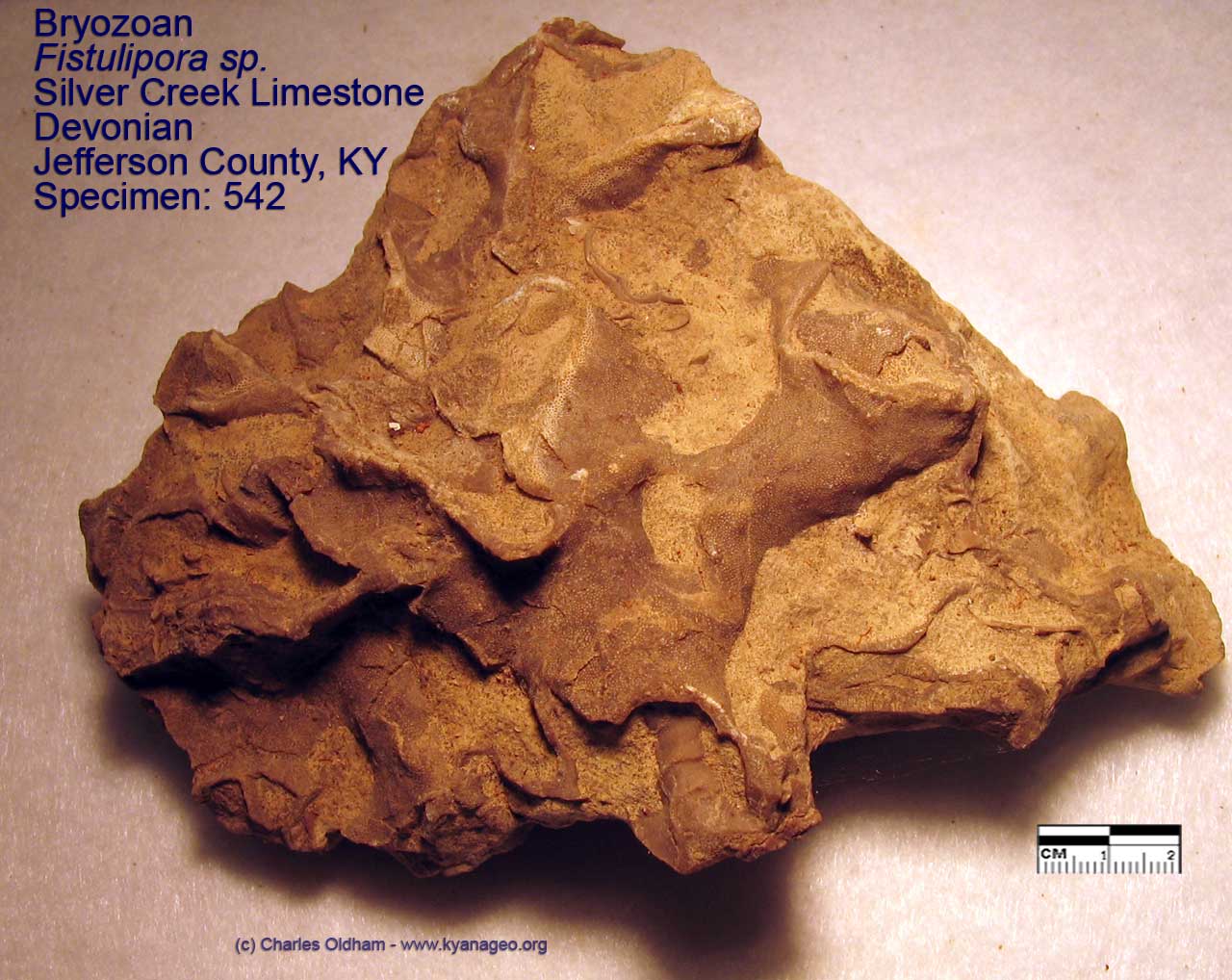
Fistulipora sp., photographed by Charles Oldham.


Belongs within: Stenolaemata.
Contains: Trepostomata.

The Cystoporata are a group of bryozoans known from the Ordovician to the Triassic. Members of this group have curved partitions (cystiphragms) separating zooecia, and often crescentic projections (lunaria) around the apertures (Prothero 1998).

<==Cystoporata
    |--+--Ceramoporina P98
    |  `--Trepostomata P98
    `--Fistuliporidae DX84 [Fistuliporina P98]
         |--Cyclotrypa Ulrich 1856 DX84
         |    `--C. exposita Gorjunova 1970 DX84
         |--Ramipora Toula 1875 DX84
         |    `--R. ambrosoides (Cretnall 1926) [=Aetomacladia ambrosoides] F71
         |--Meekopora Ulrich 1889 DX84
         |    |--M. densa DX84
         |    `--M. incrassata DX84
         |--Coscinotrypa Hall & Simpson 1887 DX84
         |    |--*C. cribriforme Prout 1859 DX84
         |    `--C. reticulata DX84
         `--Fistulipora McCoy 1849 RLS04
              |--F. conica Crockford 1944 F71
              |--F. corticea EB03
              |--F. crassilabiata Bassler 1929 DX84
              |--F. etheridgei Crockford 1947 F71
              |--F. heteromorpha Liu in Ding, Xia et al. 1984 DX84
              |--F. lunatifera Bassler 1929 DX84
              |--F. minisculus DX84
              |--F. stereos DX84
              `--F. zhesiensis Liu in Ding, Xia et al. 1984 DX84

Cystoporata incertae sedis:
  Pseudobatostomella Morozova 1960 [Trematoporidae] DX84
    |--P. neospinigera DX84
    |--‘Batostomella’ roborata DX84
    `--P. spinigera (Bassler 1929) [=Batostomella spinigera] DX84
  Stenoporidae DX84
    |--Stenodiscus Crockford 1945 DX84
    |    |--S. belemnos DX84
    |    |--S. giganteus Yang 1958 DX84
    |    |--S. laeviuscula (Bassler 1929) [=Stenopora laeviuscula] DX84
    |    |--S. lamellaris Yang & Loo 1962 DX84
    |    |--S. moniliformis Crockford 1945 F71
    |    `--S. stanwellensis Crockford 1947 F71
    `--Stenopora Lonsdale 1884 DX84
         |--S. angulata Yang 1958 DX84
         |--S. crinita F71
         |--S. johnstoni Etheridge 1891 F71
         |--S. ovata F71
         |--S. qaganqultensis DX84
         |--S. spicata (Bassler 1929) [=Ulrichotrypa spicata] DX84
         `--S. tasmaniensis F71

*Type species of generic name indicated

REFERENCES

[DX84] Ding Y., Xia G., Duan C., Li W., Liu X. & Liang Z. 1984. Study on the early Permian stratigraphy and fauna in Zhesi district, Nei Mongol Zizhiqu (Inner Mongolia). Bulletin Tianjin Institure Geol. Min. Res. 10.

[EB03] Erickson, J. M., & T. D. Bouchard. 2003. Description and interpretation of Sanctum laurentiensis, new ichnogenus and ichnospecies, a domichnium mined into Late Ordovician (Cincinnatian) ramose bryozoan colonies. Journal of Paleontology 77 (5): 1002-1010.

[F71] Fletcher, H. O. 1971. Catalogue of type specimens of fossils in the Australian Museum, Sydney. Australian Museum Memoir 13: 1-167.

[P98] Prothero, D. R. 1998. Bringing Fossils to Life: An introduction to paleobiology. WCB McGraw-Hill: Boston.

[RLS04] Rigby, J. K., G. A. Linder & C. H. Stevens. 2004. A new occurrence of the “hydrozoan” Radiotrabeculopora reticulata Fan, Rigby, and Zhang, 1991 in the Permian of California. Journal of Paleontology 78 (2): 410-413.

Ctenostomata

Zooids of Victorella pavida, photographed by Michelle Carter.


Belongs within: Bryozoa.
Contains: Vesiculariidae, Alcyonidiidae, Arachnidiidae.

The Ctenostomata are an assemblage of bryozoans in which the walls of the colony are uncalcified, either membranous or gelatinous.

<==Ctenostomata [Ctenostomida]
    |  i. s.: Metalcyonidium gautieri R79
    |         Pseudalcyonidium bobinae R79
    |         Monobryozoon Remane 1936 [Monobryozoontidae] H86
    |           |--M. ambulans Remane 1936 H86
    |           |--M. bulbosum Ott 1972 H86
    |           `--M. limicola R79
    |         Orbignyopora devonica (Richards 1974) BM05
    |         Flustrellidra [Flustrellidridae] WT06
    |           `--F. hispida WT06
    |--Vesicularina H15
    |    |  i. s.: Avenella H15
    |    |         Cryptopolyzoon H15
    |    `--Vesiculariidae H15
    |--Carnosa [Alcyonellea, Carnosina] H15
    |    |--Alcyonidiidae H15
    |    `--Flustrellidae H15
    |         |--Echinella placoides Korotneff 1901 H15
    |         |--Verrucularia v. Suhr 1834 H15
    |         |--Elzerina Lamouroux 1816 H15
    |         |    `--E. blainvillii Lamouroux 1816 (see below for synonymy) H15
    |         `--‘Flustrella’ Gray 1848 non Ehrenberg 1839 H15
    |              |--F. binderi [=Farciminaria binderi] H15
    |              |--F. flabellaria H15
    |              `--F. hispida [incl. F. h. var. cylindrica] H15
    |--Paludicellea [Paludicellina] H15
    |    |  i. s.: Pottsiella H15
    |    |--Arachnidiidae H15
    |    |--Paludicella [Paludicellidae] H15
    |    |    `--P. articulata [=Alcyonella articulata] H15
    |    `--Victorella Saville Kent 1870 [Homodiaetidae, Victorellidae, Victorellides] H15
    |         |--*V. pavida Saville Kent 1870 H15
    |         |--V. bengalensis Annandale 1911 H15
    |         |--V. continentalis Braem 1911 H15
    |         |--‘Paludicella’ muelleri Kraepelin 1887 H15
    |         |--V. sibogae Harmer 1915 H15
    |         `--V. symbiotica Rousselet 1907 H15
    `--Stolonifera [Stoloniferina] H15
         |--Hypophorella expansa H15
         |--Valkeria Fleming 1823 [=Walkeria (l. c.); Valkeriidae] H15
         |    |--V. atlantica Busk 1886 [=Farrella atlantica] H15
         |    |--‘Vesicularia’ cuscuta H15
         |    `--V. tuberosa Heller 1867 [incl. V. uva Waters 1910] H15
         |--Triticella Dalyell 1848 [incl. Cordyle Boeck 1862, Hippuraria Busk 1874; Triticellidae, Tritilellidae] H15
         |    |--*T. flava H15
         |    |--‘Plumatella’ familiaris Gros 1849 [incl. T. korenii] H15
         |    |--T. boeckii Sars 1874 [incl. Hippuraria egertoni Busk 1874] H15
         |    `--‘Hippuraria’ elongata H15
         |--Mimosella Hincks 1851 [Mimosellidae] H15
         |    |--M. bigeminata Waters 1914 H15
         |    |--M. gracilis H15
         |    |--M. radicata KBC03
         |    |--M. tenuis Harmer 1915 H15
         |    `--M. verticillata (Heller 1867) (see below for synonymy) H15
         `--Buskia Alder 1856 [Buskiidae] H15
              |--*B. nitens Alder 1856 H15
              |--‘Vesicularia’ armata Verrill 1874 [=Hippuraria armata] H15
              |--B. australis Jullien 1888 H15
              |--B. pilosa Harmer 1915 H15
              |--B. setigera Hincks 1887 H15
              `--B. socialis Hincks 1887 H15

Elzerina blainvillii Lamouroux 1816 [=Farciminaria blainvillii; incl. Verrucularia dichotoma v. Suhr 1834, Farciminaria dichotoma, Flustrella dichotoma] H15

Mimosella verticillata (Heller 1867) [=Valkeria verticillata, Cuscutaria verticillata ms, Hippuraria verticillata; incl. Lagenella nutans Joliet 1877, Valkeria nutans, Walkeria nutans] H15

*Type species of generic name indicated

REFERENCES

[BM05] Botquelen, A., & E. Mayoral. 2005. Early Devonian bioerosion in the Rade de Brest, Armorican Massif, France. Palaeontology 48 (5): 1057-1064.

[H15] Harmer, S. F. 1915. The Polyzoa of the Siboga Expedition – Part I. Entoprocta, Ctenostomata and Cyclostomata. E. J. Brill: Leyden.

[H86] d’Hondt, J.-L. 1986. Bryozoa. In Stygofauna Mundi: A Faunistic, Distributional, and Ecological Synthesis of the World Fauna inhabiting Subterranean Waters (including the Marine Interstitial) (L. Botosaneanu, ed.) pp. 145-146. E. J. Brill / Dr. W. Backhuys: Leiden.

[KBC03] Kashin, I. A., E. V. Bagaveeva & S. F. Chaplygina. 2003. Fouling communities of hydrotechnical constructions in Nakhodka Bay (Sea of Japan). Russian Journal of Marine Biology 29: 267-283.

[R79] Ryland, J. S. 1979. Structural and physiological aspects of coloniality in bryozoans. In Biology and Systematics of Colonial Organisms (G. Larwood & B. R. Rosen, eds) pp. 211-242. Academic Press: London.

[WT06] Waeschenbach, A., M. J. Telford, J. S. Porter & D. T. J. Littlewood. 2006. The complete mitochondrial genome of Flustrellidra hispida and the phylogenetic position of Bryozoa among the Metazoa. Molecular Phylogenetics and Evolution 40 (1): 195-207.

Bryozoa

Trembling sea mat Victorella pavida, copyright Marine Biological Association of the UK.


Belongs within: Lophotrochozoa.
Contains: Cheilostomata, Phylactolaemata, Stenolaemata, Stoloniferina, Vesiculariidae, Alcyonidiidae, Arachnidiidae.

The Bryozoa, sometimes known as moss animals or lace animals, are aquatic (mostly marine) minute colonial animals with the mouth surrounded by a ring of tentacles (the lophophore) and a U-shaped gut with the anus situated outside the lophophore. The lophophore can be retrated within the tentacle sheath. A single nerve ganglion is present within the coelom, but no vascular, respiratory or excretory system (Prothero 1998). Bryozoan colonies are calcified in the Cheilostomata and Stenolaemata, giving these groups an extensive fossil record. While individual zooecia (zooid body walls) may grow continually in Stenolaemata, the Ctenostomata and Cheilostomata have zooecia that grow to a fixed size and colony growth is by the addition of zooecia (Prothero 1998).

<==Bryozoa [Ectoprocta, Gymnolaemata, Halcyonellea]
    |--+--Cheilostomata P98
    |  `--+--Phylactolaemata P98
    |     `--Stenolaemata P98
    `--Ctenostomata [Ctenostomida] P98
         |  i. s.: Metalcyonidium gautieri R79
         |         Pseudalcyonidium bobinae R79
         |         Monobryozoon Remane 1936 [Monobryozoontidae] H86
         |           |--M. ambulans Remane 1936 H86
         |           |--M. bulbosum Ott 1972 H86
         |           `--M. limicola R79
         |         Orbignyopora devonica (Richards 1974) BM05
         |         Flustrellidra [Flustrellidridae] WT06
         |           `--F. hispida WT06
         |--Stoloniferina H15
         |--Vesicularina H15
         |    |  i. s.: Avenella H15
         |    |         Cryptopolyzoon H15
         |    `--Vesiculariidae H15
         |--Carnosa [Alcyonellea, Carnosina] H15
         |    |--Alcyonidiidae H15
         |    `--Flustrellidae H15
         |         |--Echinella placoides Korotneff 1901 H15
         |         |--Verrucularia v. Suhr 1834 H15
         |         |--Elzerina Lamouroux 1816 H15
         |         |    `--E. blainvillii Lamouroux 1816 (see below for synonymy) H15
         |         `--‘Flustrella’ Gray 1848 non Ehrenberg 1839 H15
         |              |--F. binderi [=Farciminaria binderi] H15
         |              |--F. flabellaria H15
         |              `--F. hispida [incl. F. h. var. cylindrica] H15
         `--Paludicellea [Paludicellina] H15
              |--Arachnidiidae H15
              |--Paludicella [Paludicellidae] H15
              |    `--P. articulata [=Alcyonella articulata] H15
              `--Victorella Saville Kent 1870 [Homodiaetidae, Victorellidae, Victorellides] H15
                   |--*V. pavida Saville Kent 1870 H15
                   |--V. bengalensis Annandale 1911 H15
                   |--V. continentalis Braem 1911 H15
                   |--‘Paludicella’ muelleri Kraepelin 1887 H15
                   |--V. sibogae Harmer 1915 H15
                   `--V. symbiotica Rousselet 1907 H15

Bryozoa incertae sedis:
  Stolella OC02
  Lophopodella carteri R79
  Metrarabdotos CB01
    |--M. micropora GE93
    `--+--M. chipolanum GE93
       `--+--+--M. colligatum GE93
          |  `--+--M. auriculatum GE93
          |     `--M. tenue GE93
          `--+--M. kugleri GE93
             `--+--M. lacrymosum GE93
                `--M. unguiculatum GE93
  Rectonychocella dimorphocella Canu & Bassler 1935 (n. d.) CB01
  Amphiblestrum ovatum Maplestone 1901 CB01
  Semicoscinium tenuiceps EB01
  Constellaria florida EB03
  Rhombotrypa EB03
  Parvohallopora EB03
  Hippoporina perforata KBC03
  Celleporella hyalina KBC03
  Fenestrulina malusii KBC03
  Hippopodinella adpressa R79
  Adeonella C79
  Uscia mexicana C79
  Tendra C79
  Pentapora foliacea R79 [=Lepralia foliacea K92]
  Camptoplites atlanticus R79
  Terebripora d’Orbigny 1842 H75
    `--T. comma R79
  Eurystomella foraminigera R79
  Carbasea indivisa R79
  Kinetoskias R79
  Escharella immisca Bo79
  Forella repens Bu79
  Pherusa tubulosa H15
  Gemellaria loricata BK77
  Schizobrachiella sanguinea BH88
  Schizomavella linearis BH88
  Casteropora vetusta Oehlert 1888 BM05
  Kazakhstanella Nekhoroshev 1956 PP05
  Caberea boryi GD00
  Calpensia nobilis (Esper 1796) (see below for synonymy) H30
  Eschara Linnaeus 1758 H30, L58
    |--E. divaricata Linnaeus 1758 L58
    |--E. fistulosa Linnaeus 1758 L58 [=Cellaria fistulosa H30]
    |--E. foliacea Linnaeus 1758 L58 [=Flustra foliacea H30]
    |--E. fragilis Linnaeus 1758 L58
    `--E. verticillata Linnaeus 1758 L58
  ‘Sertularia’ ciliata Linnaeus 1758 H30, L58
  ‘Sertularia’ eburnea Linnaeus 1758 H30, L58
  ‘Sertularia’ lendigera Linnaeus 1758 H30, L58
  ‘Sertularia’ reptans Linnaeus 1758 H30, L58
  Fredericella sultana KA01
  ‘Lagena’ acuta F71
  Batostomella F71
    |--B. cylindrica Crockford 1941 F71
    `--B. lineata Crockford 1947 F71
  Calopora hattonensis Ross 1961 F71
  Hexagonella F71
    |--H. australe (Cretnall 1926) [=Coscinium australe] F71
    `--H. lineata Crockford 1944 F71
  Dichotrypa fragilis Crockford 1947 F71
  Helicopora australis Etheridge 1921 F71
  Leioclema porosa Crockford 1947 F71
  Minilya duplaris F71
  Protoretepora ampla F71
  Pseudohornera retiformis Crockford 1941 F71
  Ptilopora carinata Crockford 1941 F71
  Saffordotaxis multigranulata (Bretnall 1926) [=Rhombopora multigranulata] F71
  Streblotrypa F71
    |--S. etheridgei Bretnall 1926 F71
    `--S. parallela Crockford 1947 F71
  Haplopoma bimucronatum BBB-S95
  Margaretta ceroeides BBB-S95
  Vinella Ulrich 1890 H75
  Spathipora Fischer 1866 H75
    `--S. prima Voigt 1972 H75
  Penetrantia SilĂ©n 1946 H75
  Harmeriella Borg 1940 H75
  Immergentia SilĂ©n 1946 H75
  Stolonicella schindewolfi M79
  Taeniocellaria setifera M79
  Reteporidea cancellata M79
  Corynotrypa Bassler 1911 [incl. Cochleatina Bykova 1956] LT64
    `--*Cochleatina’ plavinensis Bykova 1956 LT64
  ‘Polytrema’ Risso 1826 nec Rafinesque 1819 nec FĂ©russac 1822 LT64
  Myriaporidae W77
    |--Synocladia King 1849 W77
    |    `--S. biserialis Swallow & Hawn 1858 [incl. S. virgulacea Geinitz 1866] W77
    `--Glauconome Goldfuss 1826 W77
         |--G. nereidis White 1874 W77
         `--G. triliniata W77

Borings: Harmeriella cretacea Voigt 1957 H75
         Immergentia lissajousi Walter 1965 H75
         Penetrantia gosaviensis Voigt & Soule 1973 H75

Calpensia nobilis (Esper 1796) [=Cellepora nobilis; incl. Membranipora bifoveolata, Eschara impressa Moll 1803, Micropora impressa] H30

Elzerina blainvillii Lamouroux 1816 [=Farciminaria blainvillii; incl. Verrucularia dichotoma v. Suhr 1834, Farciminaria dichotoma, Flustrella dichotoma] H15

*Type species of generic name indicated

REFERENCES

[BK77] Barel, C. D. N., & P. G. N. Kramers. 1977. A survey of the echinoderm associates of the north-east Atlantic area. Zoologische Verhandelingen 156: 1–159.

[Bo79] Bosence, D. W. J. 1979. The factors leading to aggregation and reef formation in Serpula vermicularis L. In: Larwood, G., & B. R. Rosen (eds) Biology and Systematics of Colonial Organisms pp. 299–318. Academic Press: London.

[BM05] Botquelen, A., & E. Mayoral. 2005. Early Devonian bioerosion in the Rade de Brest, Armorican Massif, France. Palaeontology 48 (5): 1057–1064.

[BBB-S95] Boubezari, K., G. Bitar & D. Bellan-Santini. 1995. Structure et organisation de trois moulières (Mytilus galloprovincialis et Perna perna) de la rĂ©gion d’Alger. MĂ©sogĂ©e 54: 63–72.

[BH88] Boxshall, G. A., & A. G. Humes. 1988. A new genus of Lichomolgidae (Copepoda: Poecilostomatoida) associated with a phoronid in Hong Kong. Bulletin of the British Museum (Natural History), Zoology Series 54 (6): 301–307.

[Bu79] Buss, L. W. 1979. Habitat selection, directional growth and spatial refuges: why colonial animals have more hiding places. In: Larwood, G., & B. R. Rosen (eds) Biology and Systematics of Colonial Organisms pp. 459–497. Academic Press: London.

[C79] Cook, P. L. 1979. Some problems in interpretation of heteromorphy and colony integration in Bryozoa. In: (G. Larwood & B. R. Rosen, eds) Biology and Systematics of Colonial Organisms pp. 193–210. Academic Press: London.

[CB01] Cook, P. L., & P. E. Bock. 2001. Calescharidae, a new family for the Tertiary to Recent genera Caleschara MacGillivray and Tretosina Canu & Bassler (Bryozoa: Cheilostomata). Invertebrate Taxonomy 15: 527–550.

[EB01] Eckert, J. D., & C. E. Brett. 2001. Early Silurian (Llandovery) crinoids from the Lower Clinton Group, western New York State. Bulletins of American Paleontology 360: 1–88.

[EB03] Erickson, J. M., & T. D. Bouchard. 2003. Description and interpretation of Sanctum laurentiensis, new ichnogenus and ichnospecies, a domichnium mined into Late Ordovician (Cincinnatian) ramose bryozoan colonies. Journal of Paleontology 77 (5): 1002–1010.

[F71] Fletcher, H. O. 1971. Catalogue of type specimens of fossils in the Australian Museum, Sydney. Australian Museum Memoir 13: 1–167.

[GD00] Giribet, G., D. L. Distel, M. Polz, W. Sterrer & W. C. Wheeler. 2000. Triploblastic relationships with emphasis on the acoelomates and the position of Gnathostomulida, Cycliophora, Plathelminthes, and Chaetognatha: a combined approach of 18S rDNA sequences and morphology. Systematic Biology 49: 539–562.

[GE93] Gould, S. J., & N. Eldredge. 1993. Punctuated equilibrium comes of age. Nature 366: 223–227.

[H75] Häntzschel, W. 1975. Treatise on Invertebrate Paleontology pt W. Miscellanea Suppl. 1. Trace Fossils and Problematica 2nd ed. The Geological Society of America: Boulder (Colorado), and The University of Kansas: Lawrence (Kansas).

[H15] Harmer, S. F. 1915. The Polyzoa of the Siboga Expedition—Part I. Entoprocta, Ctenostomata and Cyclostomata. E. J. Brill: Leyden.

[H30] Harmer, S. F. 1930. Presidential address. Proceedings of the Linnean Society of London 141: 68–118.

[H86] d’Hondt, J.-L. 1986. Bryozoa. In: Botosaneanu, L. (ed.) Stygofauna Mundi: A Faunistic, Distributional, and Ecological Synthesis of the World Fauna inhabiting Subterranean Waters (including the Marine Interstitial) pp. 145–146. E. J. Brill/Dr W. Backhuys: Leiden.

[KBC03] Kashin, I. A., E. V. Bagaveeva & S. F. Chaplygina. 2003. Fouling communities of hydrotechnical constructions in Nakhodka Bay (Sea of Japan). Russian Journal of Marine Biology 29: 267–283.

[KA01] Kent, M. L., K. B. Andree, J. L. Bartholomew, M. El-Matbouli, S. S. Desser, R. H. Devlin, S. W. Feist, R. P. Hedrick, R. W. Hoffmann, J. Khattra, S. L. Hallett, R. J. G. Lester, M. Longshaw, O. Palenzuela, M. E. Siddall & C. Xiao. 2001. Recent advances in our knowledge of the Myxozoa. Journal of Eukaryotic Microbiology 48: 395–413.

[K92] Kozloff, E. N. 1992. The genera of the phylum Orthonectida. Cahiers de Biologie Marine 33: 377–406.

[L58] Linnaeus, C. 1758. Systema Naturae per Regna Tria Naturae, secundum classes, ordines, genera, species, cum characteribus, differentiis, synonymis, locis. Tomus I. Editio decima, reformata. Laurentii Salvii: Holmiae.

[LT64] Loeblich, A. R., Jr & H. Tappan. 1964. Sarcodina: chiefly “thecamoebians” and Foraminiferida. In: Moore, R. C. (ed.) Treatise on Invertebrate Paleontology pt C. Protista 2 vol. 2. The Geological Society of America and The University of Kansas Press.

[M79] MĂĽller, A. H. 1979. Fossilization (taphonomy). In: Robison, R. A., & C. Teichert (eds) Treatise on Invertebrate Paleontology pt A. Introduction. Fossilisation (Taphonomy), Biogeography and Biostratigraphy pp. A2–A78. The Geological Society of America, Inc.: Boulder (Colorado), and The University of Kansas: Lawrence (Kansas).

[OC02] Okamura, B., A. Curry, T. S. Wood & E. U. Canning. 2002. Ultrastructure of Buddenbrockia identifies it as a myxozoan and verifies the bilaterian origin of the Myxozoa. Parasitology 124: 215–223.

[P98] Prothero, D. R. 1998. Bringing Fossils to Life: An introduction to paleobiology. WCB McGraw-Hill: Boston.

[PP05] Pushkin, V. I., & L. E. Popov. 2005. Two enigmatic bryozoans from the Middle Ordovician of the East Baltic. Palaeontology 48 (5): 1065–1074.

[R79] Ryland, J. S. 1979. Structural and physiological aspects of coloniality in bryozoans. In: Larwood, G., & B. R. Rosen (eds) Biology and Systematics of Colonial Organisms pp. 211–242. Academic Press: London.

[WT06] Waeschenbach, A., M. J. Telford, J. S. Porter & D. T. J. Littlewood. 2006. The complete mitochondrial genome of Flustrellidra hispida and the phylogenetic position of Bryozoa among the Metazoa. Molecular Phylogenetics and Evolution 40 (1): 195–207.

[W77] White, C. A. 1877. Report upon the invertebrate fossils collected in portions of Nevada, Utah, Colorado, New Mexico, and Arizona, by parties of the expeditions of 1871, 1872, 1873, and 1874. U.S. Geographical Surveys West of the One Hundredth Meridian 4 (1): 1–219, pls 1–21.

Membraniporidae

Colony of Membranipora membranacea, from Frank Emil Moen & Erling Svensen.


Belongs within: Cheilostomata.

The Membraniporidae are a family of cheilostome bryozoans with poorly calcified frontal walls and generally monomorphic zooids, and a twinned ancestrula (the initial pair of zooids in the colony) (Taylor & Monks 1997). The sea-mat Membranipora membranacea is widespread in temperate regions of the Atlantic and Pacific Oceans, where it grows encrusting large algae such as kelp. This species has become a notable invasive species in some regions.

<==Membraniporidae
    |--Acanthodesia Canu & Bassler 1920 THG01
    |--Jellyella Taylor & Monks 1997 THG01
    |    |--*J. eburnea (Hincks 1891) [=Membranipora eburnea] THG01
    |    `--J. tuberculata (Bosc 1802) [=Flustra tuberculata, Membranipora tuberculata, Nichtina tuberculata] THG01
    |--Biflustra d’Orbigny 1852 THG01
    |    |--*B. ramosa (d’Orbigny 1852) [=Membranipora ramosa] THG01
    |    |--B. reticulata Tilbrook, Hayward & Gordon 2001 THG01
    |    `--B. savartii (Audouin 1826) [=Flustra savartii] THG01
    `--Membranipora de Blainville 1830 THG01
         |--M. ansiopoma R96
         |--M. arborescens J79
         |--M. hyadesi R79
         |--M. membranacea (Linne 1767) L70
         |--M. pilosa H15
         |--M. tenella Hincks 1880 [=Electra tenella] THG01
         `--M. wilsonensis Etheridge 1902 F71

*Type species of generic name indicated

REFERENCES

[F71] Fletcher, H. O. 1971. Catalogue of type specimens of fossils in the Australian Museum, Sydney. Australian Museum Memoir 13: 1-167.

[H15] Harmer, S. F. 1915. The Polyzoa of the Siboga Expedition – Part I. Entoprocta, Ctenostomata and Cyclostomata. E. J. Brill: Leyden.

[J79] Jackson, J. B. C. 1979. Morphological strategies of sessile animals. In Biology and Systematics of Colonial Organisms (G. Larwood & B. R. Rosen, eds) pp. 499-555. Academic Press: London.

[L70] Leloup, E. 1970. Recherches sur l’ostreiculture dans le bassin de chasse d’Ostende en 1968. Bulletin de l’Institut Royal des Sciences Naturelles de Belgique 46 (6): 1-24.

[R96] Roff, D. A. 1996. The evolution of threshold traits in animals. Quarterly Review of Biology 71 (1): 3-35.

[R79] Ryland, J. S. 1979. Structural and physiological aspects of coloniality in bryozoans. In Biology and Systematics of Colonial Organisms (G. Larwood & B. R. Rosen, eds) pp. 211-242. Academic Press: London.

Taylor, P. D., & N. Monks. 1997. A new cheilostome bryozoan genus pseudoplanktonic on molluscs and algae. Invertebrate Biology 116 (1): 39-51.

[THG01] Tilbrook, K. J., P. J. Hayward & D. P. Gordon. 2001. Cheilostomatous Bryozoa from Vanuatu. Zoological Journal of the Linnean Society 131: 35-109.

Vesiculariidae

Colony of Amathia distans, photographed by J. Hoover.


Belongs within: Ctenostomata.

The Vesiculariidae are a family of ctenostome bryozoans characterised by the presence of a distinct stolon (Harmer 1915).

Characters (from Harmer 1915): Axis relatively thick, branching, tubular; zooecia directly attached to axis by contracted or expanded base; axis usually divided by diaphragms into internodes, each of which gives off a number of zooecia; budding only from axis. Tentacles usually 8-10. Gizzard generally present.

<==Vesiculariidae [Vesiculariadae]
    |--Vesicularia Thompson 1830 H15
    |    |--*V. spinosa [=Sertularia spinosa] H15
    |    `--V. papuensis Busk 1886 [incl. V. trichotoma Busk 1886] H15
    |--Bowerbankia Farre 1837 H15
    |    |--B. gracilis Leidy 1855 HJ08
    |    |--B. imbricata (Adams 1800) (see below for synonymy) H15
    |    `--B. pustulosa [=Vesicularia pustulosa] H15
    |--Amathia Lamouroux 1912 [=Serialaria Lamarck 1816] H15
    |    |--A. brasiliensis Busk 1886 H15
    |    |--A. convoluta Lamouroux 1816 (see below for synonymy) H15
    |    |--A. distans Busk 1886 [incl. A. acervata Lamouroux 1824] H15
    |    |--A. pruvoti H15
    |    |--A. semiconvoluta H15
    |    |--A. spiralis H15
    |    `--A. vidovici Heller 1867 HJ08
    `--Zoobotryon Ehrenberg 1831 H15
         |--‘Vesicularia’ bilateralis H15
         |--‘Daedalea’ mauritiana H15
         |--Z. pellucidum [incl. Bowerbankia biserialis Hincks 1887] H15
         `--Z. verticillatum della Chiaje 1828 HJ08

Amathia convoluta Lamouroux 1816 [=Serialaria convoluta Lamarck 1816; incl. Sirinx circumplicata ms, Se. crispa Lamarck 1816, A. semispiralis Busk 1886, Se. semispiralis] H15

Bowerbankia imbricata (Adams 1800) [=Sertularia imbricata, Vesicularia imbricata; incl. Bowerbankia caudata Annandale 1911, B. densa Farre 1837] H15

*Type species of generic name indicated

REFERENCES

[H15] Harmer, S. F. 1915. The Polyzoa of the Siboga Expedition – Part I. Entoprocta, Ctenostomata and Cyclostomata. E. J. Brill: Leyden.

[HJ08] Huisman, J. M., D. S. Jones, F. E. Wells & T. Burton. 2008. Introduced marine biota in Western Australian waters. Records of the Western Australian Museum 25 (1): 1-44.

Lepraliellidae

Zooids of Celleporaria cristata, from here.


Belongs within: Cheilostomata.

Lepraliellidae is a family of bryozoans (including both erect and encrusting forms) with relatively smooth frontals and an avicularium set in the proximal ring of the orifice (Gordon 1993).

See also: Taxon of the Week: Lacy Lepraliellidae.

<==Lepraliellidae
    |--Lepraliella granulata Canu & Bassler 1929 THG01
    |--Celleporaria Lamouroux 1826 THG01
    |    |--*C. cristata (Lamark 1816) [=Cellepora cristata] THG01
    |    |--C. aperta (Hincks 1882) THG01
    |    |--C. columnaris (Busk 1881) THG01
    |    |--C. inaudita Tilbrook, Hayward & Gordon 2001 THG01
    |    |--C. mauritiana Hayward 1988 THG01
    |    |--C. palmata PP05
    |    |--C. pilaefera (Canu & Bassler 1929) [=Holoporella pilaefera] THG01
    |    `--C. vagans (Busk 1881) [=Cellepora vagans] THG01
    `--Drepanophora Harmer 1957 THG01
         |--*D. incisor (Thornely 1905) [=Rhynchozoon incisor] THG01
         |--D. corrugata (Thornely 1905) THG01
         |--D. gutta Tilbrook, Hayward & Gordon 2001 THG01
         |--D. indica Hayward 1988 THG01
         |--D. longiuscula Harmer 1957 THG01
         |--D. tuberculata (Osburn 1914) [=Rhynchozoon tuberculatum] THG01
         `--D. verrucosa Winston & Heimberg 1986 THG01

*Type species of generic name indicated

REFERENCES

Gordon, D. P. 1993. Bryozoan frontal shields: studies on umbonulomorphs and impacts on classification. Zoologica Scripta 22 (2): 203-221.

[PP05] Pushkin, V. I., & L. E. Popov. 2005. Two enigmatic bryozoans from the Middle Ordovician of the East Baltic. Palaeontology 48 (5): 1065-1074.

[THG01] Tilbrook, K. J., P. J. Hayward & D. P. Gordon. 2001. Cheilostomatous Bryozoa from Vanuatu. Zoological Journal of the Linnean Society 131: 35-109.

Beaniidae

Colony of Beania hirtissima, from here.


Belongs within: Cheilostomata.

Beaniidae is a family of bryozoans forming reticulate sheets or diffuse uniserial colonies, loosely attached to their substratum or attached by rhizoids (Tilbrook et al. 2001). The frontal surface of the autozooids is generally membranous.

<==Beaniidae
    |--Bugulella clavata Hincks 1887 THG01
    `--Beania Johnston 1840 THG01
         |--*B. mirabilis Johnston 1840 THG01
         |--B. cookae Tilbrook, Hayward & Gordon 2001 THG01
         |--B. discodermiae Harmer 1926 THG01
         |--B. hexamicorum Tilbrook, Hayward & Gordon 2001 THG01
         |--B. hirtissima M62
         |--B. intermedia (Hincks 1881) THG01
         |--B. klugei Cook 1968 [=Bugula klugei] THG01
         `--B. petiolata Harmer 1926 THG01

*Type species of generic name indicated

REFERENCES

[M62] Monniot, F. 1962. Recherches sur les graviers a Amphioxus de la région de Banyuls-sur-Mer. Vie et Milieu 13: 231-322.

[THG01] Tilbrook, K. J., P. J. Hayward & D. P. Gordon. 2001. Cheilostomatous Bryozoa from Vanuatu. Zoological Journal of the Linnean Society 131: 35-109.

Cribrilinidae

Zooids (left) and close-up of primary orifice (right) of Puellina vulgaris, from Tilbrook et al. (2001). Scale bars equal (left) 0.25 mm and (right) 0.05 mm.


Belongs within: Cheilostomata.

The Cribrilinidae are a living family of encrusting bryozoans in which the frontal shield is made up of radiating, hollow spines.

<==Cribrilinidae [Cribrilinoidea, Cribrimorpha]
    |--Cribrilina annulata KBC03
    |--Puellina Jullien 1886 THG01
    |    |--*P. gattyae (Landsborough 1852) [=Lepralia gattyae] THG01
    |    |--P. egretta Ryland & Hayward 1992 THG01
    |    `--P. vulgaris Ryland & Hayward 1992 THG01
    `--Figularia Jullien 1886 THG01
         |--*F. figularis (Johnston 1847) [=Lepralia figularis] THG01
         |--F. fissa H30
         |--F. jucunda Canu & Bassler 1929 THG01
         |--F. lepida Hayward 1988 THG01
         `--F. pulcherrima Tilbrook, Hayward & Gordon 2001 THG01

*Type species of generic name indicated

REFERENCES

[H30] Harmer, S. F. 1930. Presidential address. Proceedings of the Linnean Society of London 141: 68-118.

[KBC03] Kashin, I. A., E. V. Bagaveeva & S. F. Chaplygina. 2003. Fouling communities of hydrotechnical constructions in Nakhodka Bay (Sea of Japan). Russian Journal of Marine Biology 29: 267-283.

[THG01] Tilbrook, K. J., P. J. Hayward & D. P. Gordon. 2001. Cheilostomatous Bryozoa from Vanuatu. Zoological Journal of the Linnean Society 131: 35-109.