Rutelinae

Rose beetle Adoretus versutus, copyright Dominique Poirier-Ducrocq.


Belongs within: Melolonthinae.
Contains: Chrysina, Anoplognathina, Anomala.

The Rutelinae are a group of stout, usually brightly coloured and metallic scarab beetles. The two claws on each leg are unequal in size and independently movable; exceptionally, one of the claws may be lost. The margin of the elytra may carry a membranous fringe but is entirely members in members of the Rutelini and some Anoplognathini. Larvae are found in soil and (where known) feed on organic matter. Adults of several genera feed on foliage and may cause severe defoliation of trees but others are nocturnal and may not feed (Cassis & Weir 1992). The Japanese beetle Popillia japonica is regarded as a severe pest in North America.

Characters (from Cassis & Weir 1992): Adults with head and pronotum lacking prominences; elytra often with membranous margin beneath, pygidium exposed; tarsal claws unequal, large and movable; abdominal spiracles strongly diverging, several lying on abdominal sternites and at least one pair exposed. Larva with head not strongly punctate; apical antennal segment about as wide as penultimate; labrum asymmetrical with deeply pigmented notch on right side of midline; mandible with ventral oval stridulatory area; stridulatory teeth on dorsal edge of maxilla with anteriorly directed points; galea and lacinia fused to form mala; legs large, hind coxa larger than width of clypeus; anal cleft transverse; sternum 9 without raster of longitudinal rows of spines.

<==Rutelinae [Rutelides]
    |--+--Anomala A06
    |  `--Anisoplia A06
    |       |--A. austriaca B28
    |       |--A. (Chaetopteroplia) segetum Herbst 1783 A06
    |       `--A. villosa C01
    `--Adoretus Castelnau 1840 A06, CW92 [Adoretini]
         |--*A. hirtellus Castelnau 1840 HW92 [incl. A. cinerarius A01]
         |--A. aegrotus G89
         |--A. albosetosus [incl. A. hystrix] A01
         |--A. melvillensis Lea 1919 CW92
         |--A. punctipennis [incl. A. cephalotes] A01
         |--A. sinicus Burmeister 1855 A06
         |--A. tenumaculatus B28
         |--A. umbrosus B28
         |--A. versutus B28
         |--A. vestitus A01
         `--A. xanthochrous [incl. A. testaceus] A01

Rutelinae incertae sedis:
  Parisolea F55
  Elcarmeniella Franz 1955 F55
    `--*E. striata Franz 1955 F55
  Leucothyreus MacLeay 1819 F55
    `--L. femoratus Burmeister 1844 F55
  Phalangogonia Burmeister 1844 F55
    |--P. obesa F55
    |--P. parilis F55
    `--P. punctata Franz 1955 F55
  Paracotalpa puncticollis C90
  Popillia T90
    |--P. atrocoerulea AJ30
    |--P. formosana AJ30
    `--P. japonica H-O10
  Heterosternus buprestoides Dupont 1832 B14
  Kibakoganea B14
    |--K. dohertyi B14
    |--K. sexmaculata (Kraatz 1900) B14
    `--K. sinica B14
  Fruhstorferia B14
  Masumotokoganea B14
  Pukupuku B14
  Ceroplophana B14
  Dicaulocephalus B14
  Didrepanephorus B14
  Mimela Kirby 1823 CW92
    |--M. chinensis B66
    |--M. chryseis Bates 1866 B66
    |--M. ignicauda Bates 1866 B66
    |--M. simplex Bates 1866 B66
    `--M. splendens B66
  Trigonochilus A01
    |--T. coriaceus A01
    `--T. politus Arrow 1901 A01
  Rutelini CW92
    |--Chrysophora chrysochlora (Latreille 1811) B14
    |--Chrysina B14
    |--Pelidnota MacLeay 1819 B14, F55
    |    |  i. s.: P. punctata T90
    |    `--P. (Pelidnota) F55
    |         |--P. (P.) punctulata Bates 1888 F55
    |         `--P. (P.) strigosa Laporte 1840 F55
    |--Rutela L02
    |    |--R. chrysis G20
    |    |--R. lineola [=Cetonia lineola] L02
    |    |--R. olivacea [=Cetonia olivacea] L02
    |    |--R. punctata [=Melolontha punctata] L02
    |    `--R. surinamensis [=Cetonia surinamensis] L02
    `--Parastasia Westwood 1841 CW92
         |--*P. canaliculata Westwood 1841 CW92
         |--P. bimaculata B28
         `--P. montrouzieri Fairmaire 1883 CW92
              |--P. m. montrouzieri CW92
              `--P. m. australis Ohaus 1901 CW92
  Anoplognathini CW92
    |  i. s.: Amblochilus Blanchard 1851 CW92
    |           `--*A. bicolor Blanchard 1851 CW92
    |         Amblyterus Macleay 1819 CW92
    |           |--A. cicatricosus (Gyllenhal in Schönherr 1817) (see below for synonymy) CW92
    |           |--A. bundabergensis Carne 1958 CW92
    |           |--A. clypealis Ohaus 1904 CW92
    |           |--A. deuqueti Carne 1958 CW92
    |           |--A. paradoxus Carne 1975 CW92
    |           |--A. simplicitarsus Carne 1958 CW92
    |           |--A. tarsalis Lea 1920 CW92
    |           `--A. tibialis Carne 1958 CW92
    |         Anoplostethus Brullé 1837 (see below for synonymy) CW92
    |           |--*A. opalinus Brullé 1837 (see below for synonymy) CW92
    |           |--A. laetus Rothschild & Jordan 1894 [incl. A. laetus nobilis Benderitter 1924] CW92
    |           `--A. roseus Blanchard 1851 [=A. opalinus Blanchard 1846 non Brullé 1837] CW92
    |         Bilobatus Machatschke 1970 [=Homotropus Waterhouse 1878 non Foerster 1869] CW92
    |           |--*B. luridipennis (Waterhouse 1878) [=*Homotropus luridipennis] CW92
    |           `--B. testaceipennis (Ohaus 1901) [=Homotropus testaceipennis] CW92
    |         Calloodes White 1845 CW92
    |           |--*C. grayianus (White 1845) [=Anoplognathus (*Calloodes) grayianus] CW92
    |           |--C. aeneus Waterh. 1868 M86
    |           |--C. atkinsoni Waterhouse 1868 B14
    |           |--C. nitidissimus Lea 1919 [incl. C. frenchi Ohaus 1912 non Blackburn 1890] CW92
    |           `--C. rayneri Macleay 1864 CW92
    |         Clilopocha Lea 1914 [incl. Dynastomorphus Carne 1954] CW92
    |           |--*C. whiteae Lea 1914 CW92
    |           |--C. angularis (Carne 1954) [=Dynastomorphus angularis] CW92
    |           |--C. mandibularis (Carne 1954) [=Dynastomorphus mandibularis] CW92
    |           |--C. pachypus (Lea 1917) [=Aneurystypus pachypus, *Dynastomorphus pachypus] CW92
    |           `--C. pilosicollis (Lea 1917) [=Aneurystypus pilosicollis] CW92
    |         Dungoorus Carne 1958 CW92
    |           `--*D. murrumbullus Carne 1958 CW92
    |         Eosaulostomus Carne 1956 CW92
    |           |--*E. excisus Carne 1956 CW92
    |           |--E. collaris (Blackburn 1892) CW92 [=Aneurystypus collaris CW92, Saulostomus collaris L19]
    |           |--E. halei Carne 1956 CW92
    |           |--E. mimicus (Lea 1919) [=Saulostomus mimicus] CW92
    |           |--E. norsemanae Carne 1956 CW92
    |           `--E. weiskei (Ohaus 1904) [=Saulostomus weiskei] CW92
    |         Epichrysus White 1841 CW92
    |           `--*E. lamprimoides (White 1841) [=Brachysternus (*Epichrysus) lamprimoides] CW92
    |         Exochogenys Carne 1958 CW92
    |           `--*E. nigripennis (Blanchard 1851) [=Schizognathus nigripennis] CW92
    |         Mesystoechus Waterhouse 1878 CW92
    |           |--*M. ciliatus Waterhouse 1878 CW92
    |           `--M. costatus Carne 1958 CW92
    |         Mimadoretus Arrow 1901 [=Popillia Macleay 1887 non Leach 1826] CW92
    |           |--*M. flavomaculatus (Macleay 1887) [=*Popillia flavomaculata] CW92
    |           |--M. leucothyreus Lea 1919 CW92
    |           `--M. niveosquamosus Lea 1919 CW92
    |         Pseudoschizognathus Ohaus 1904 CW92
    |           |--*P. schonfeldti Ohaus 1904 [incl. P. occidentalis Ohaus 1913] CW92
    |           |--P. lajoyi Ohaus 1913 CW92
    |           `--P. variicollis Ohaus 1904 CW92
    |         Repsimus Macleay 1819 CW92
    |           |--R. manicatus (Swartz 1817) CW92 [=Rutela manicata CW92; incl. Re. femoratus B35]
    |           |    |--R. m. manicatus (see below for synonymy) CW92
    |           |    `--R. m. montanus Lea 1919 CW92
    |           `--R. aeneus (Fabricius 1775) (see below for synonymy) CW92
    |         Saulostomus Waterhouse 1878 CW92
    |           |--*S. villosus Waterhouse 1878 CW92
    |           |--S. brunneoviridis Lea 1920 CW92
    |           |--S. felschei Ohaus 1904 CW92
    |           |--S. monteithi Carne 1985 CW92
    |           `--S. striatus Ohaus 1935 CW92
    |         Trioplognathus Ohaus 1904 CW92
    |           `--*T. griseopilosus (Ohaus 1901) (see below for synonymy) CW92
    |         Wambo Allsopp 1988 CW92
    |           `--*W. puticosus Allsopp 1988 CW92
    |--Anoplognathina CW92
    `--Schizognathus Fischer 1823 [Schizognathina] CW92
         |--*S. macleayi Fischer 1823 CW92
         |--S. apricagger Allsopp 1989 CW92
         |--S. burmeisteri Ohaus 1904 CW92
         |--S. compressicornis Ohaus 1898 CW92
         |--S. lucidus Ohaus 1904 CW92
         |--S. mesosternalis Ohaus 1912 CW92
         |--S. rugulosus Carne 1958 CW92
         `--S. viridiaeneus Ohaus 1904 CW92
  Phyllopertha horticola RD77
  Lachnosterna RD77
    |--L. patruelis B28
    |--L. portoricensis B28
    `--L. smithii [=Phytalus smithii] B28

Amblyterus cicatricosus (Gyllenhal in Schönherr 1817) [=Melolontha cicatricosa; incl. *A. geminatus Macleay 1819] CW92

Anoplostethus Brullé 1837 [=Anoplosternus Guérin-Méneville 1838; incl. Panschizus Blackburn 1888] CW92

*Anoplostethus opalinus Brullé 1837 [=*Anoplosternus opalinus; incl. *Panschizus pallidus Blackburn 1888] CW92

Repsimus aeneus (Fabricius 1775) [=Melolontha aenea; incl. Scarabaeus aeratus Linnaeus 1790, Repsimus purpureipes Macleay 1871] CW92

Repsimus manicatus manicatus (Swartz 1817) [incl. Rutela bracteata Drapeiz 1819, Anoplognathus brownii Macleay 1819, *Repsimus brownii, A. dytiscoides Macleay 1819] CW92

*Trioplognathus griseopilosus (Ohaus 1901) [=Anoplognathus griseopilosus; incl. A. antiquus Arrow 1919] CW92

*Type species of generic name indicated

REFERENCES

[A06] Ahrens, D. 2006. The phylogeny of Sericini and their position within the Scarabaeidae based on morphological characters (Coleoptera: Scarabaeidae). Systematic Entomology 31: 113–144.

[AJ30] Allen, H. W., & H. A. Jaynes. 1930. Contribution to the taxonomy of Asiatic wasps of the genus Tiphia (Scoliidae). Proceedings of the United States National Museum 76 (17): 1–105.

[A01] Arrow, G. J. 1901. Remarks on secondary sexual differences in rutelid Coleoptera, with descriptions of some new forms. Annals and Magazine of Natural History, series 7, 7: 393–401.

[B66] Bates, H. W. 1866. On a collection of Coleoptera from Formosa sent home by R. Swinhoe, Esq., H. B. M. Consul, Formosa. Proceedings of the Zoological Society of London 1866: 339–355.

[B28] Betrem, J. G. 1928. Monographie der Indo-Australischen Scoliiden mit zoogeographischen Betrachtungen. H. Veenman & Zonen: Wageningen.

[B35] Boisduval, J. B. 1835. Voyage de Découvertes de l’Astrolabe. Exécuté par ordre du Roi, pendant les années 1826–1827–1828–1829, sous le commandement de M. J. Dumont d'Urville. Faune entomologique de l'océan Pacifique, avec l'illustration des insectes nouveaux recueillis pendant le voyage vol. 2. Coléoptères et autres ordres. J. Tastu: Paris.

[B14] Bouchard, P. (ed.) 2014. The Book of Beetles: A lifesize guide to six hundred of nature's gems. Ivy Press: Lewes (United Kingdom).

[CW92] Cassis, G., & T. A. Weir. 1992. Rutelinae. In: Houston, W. W. K. (ed.) Zoological Catalogue of Australia vol. 9. Coleoptera: Scarabaeoidea pp. 359–382. AGPS Press: Canberra.

[C90] Crawford, C. S. 1990. Scorpiones, Solifugae, and associated desert taxa. In: Dindal, D. L. (ed.) Soil Biology Guide pp. 421–475. John Wiley & Sones: New York.

[C01] Csiki, E. 1901. Bogarak [Coleopteren]. In: Horváth, G. (ed.) Zichy Jenő Gróf Harmadik Ázsiai Utazása [Dritte Asiatische Forschungsreise des Grafen Eugen Zichy] vol. 2. Zichy Jenő Gróf Harmadik Ázsiai Utazásának Állattani Eredményei [Zoologische Ergebnisse der Dritten Asiatischen Forschungsreise des Grafen Eugen Zichy] pp. 75–120. Victor Hornyánszky: Budapest, and Karl W. Hierseman: Leipzig.

[F55] Franz, E. 1955. Scarabaeidae Rutelinae (Ins. Col.) aus El Salvador. Senckenbergiana Biologica 36: 201–207.

[G89] Gestro, R. 1889. Viaggio ab Assab nel Mar Rosso dei signori G. Doria ed O. Beccari con il R. Avviso “Esploratore” dal 16 Novembre 1879 al 26 Febbraio 1880.—IV. Coleotteri. Annali del Museo Civico di Storia Naturale di Genova, Serie 2a, 7: 5–72.

[G20] Goldfuss, G. A. 1820. Handbuch der Naturgeschichte vol. 3. Handbuch der Zoologie pt 1. Johann Leonhard Schrag: Nürnberg.

[H-O10] Hernández-Ortiz, V. 2010. Pyrgotidae (pyrgotid flies). In: Brown, B. V., A. Borkent, J. M. Cumming, D. M. Wood, N. E. Woodley & M. A. Zumbado (eds) Manual of Central American Diptera vol. 2 pp. 955–961. NRC Research Press: Ottawa.

[L02] Latreille, P. A. 1802. Histoire Naturelle, générale et particulière des crustacés et des insectes vol. 3. Familles naturelles des genres. F. Dufart: Paris.

[L19] Lea, A. M. 1919. Notes on some miscellaneous Coleoptera with descriptions of new species.—Part V. Transactions of the Royal Society of South Australia 43: 166–261, pls 25–27.

[M86] Masters, G. 1886. Catalogue of the described Coleoptera of Australia. Part III. Proceedings of the Linnean Society of New South Wales, series 2, 1 (1): 21–126.

[RD77] Richards, O. W., & R. G. Davies. 1977. Imms' General Textbook of Entomology 10th ed. vol. 2. Classification and Biology. Chapman and Hall: London.

[T90] Tashiro, H. 1990. Insecta: Coleoptera Scarabaeidae larvae. In: Dindal, D. L. (ed.) Soil Biology Guide pp. 1191–1209. John Wiley & Sones: New York.

Last updated: 1 May 2021.
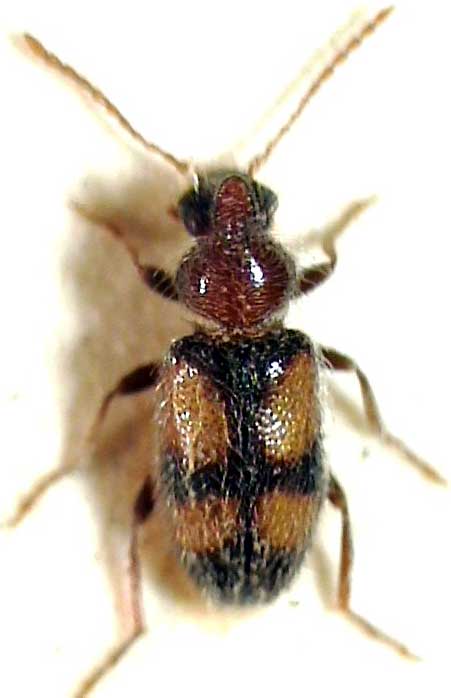
Anthicidae

Notoxus litigiosus, from Dmitry Telnov.


Belongs within: Tenebrionoidea.
Contains: Formicomini, Anthicus.

The Anthicidae are a family of elongate, usually hairy beetles which have the back of the head constricted into a distinct 'neck'. Most species are found in decaying vegetation or leaf litter, and are believed to be scavengers. A number of species of the subfamily Anthicinae are found in association with ants which they resemble in superficial appearance. Members of the subfamily Notoxinae have a tuberculate anterior projection of the pronotum overhanging the head. The Eurygeniinae are commonly found on flowers and have scoop-like mandibles adapted for feeding on pollen (Bouchard 2014). The Lemodinae are an Australasian group with larvae found under bark and in leaf litter; adults are often strikingly coloured (Lawrence & Britton 1991).

Characters (from Lawrence & Britton 1991): Elongate, black, brown, yellow or red, sometimes bicoloured, almost always clothed with decumbent and/or erect hairs. Antennal club, if present, very weak; head usually abruptly constricted behind eyes to form neck, antennal insertions exposed; eyes not to only slightly emarginate; apical segment of maxillary palp slightly to strongly expanded apically, often securiform or cultriform; pronotum without lateral carinae, almost always constricted at middle, near base, or at base and apex; mesepisterna meet or almost meet at middle; penultimate tarsal segment lobed beneath; first two ventrites usually free. Larvae elongate, parallel-sided, lightly sclerotised or occasionally with dark and light pattern dorsally. Antennal sensorium usually broad and dome-like; usually with single pair of well-developed stemmata (occasionally five); median endocarina sometimes present; mandibular mola usually reduced and sub-basal; mala usually simple (occasionally cleft); S9 usually simple (occasionally two basal teeth); urogomphi, if present, often with accessory mesal processes near base; segment 10 more or less transverse, posteroventrally oriented.

Anthicidae
    |--Ischaliinae LB91
    |--Macratria [Macratriinae] LB91
    |    `--M. australis King 1869 M86
    |--Lemodinae B14
    |    |--Lemodinus B14
    |    |--Trichananca B14
    |    |--Lagriomorpha LB91
    |    `--Lemodes B14
    |         |--L. atricollis Oberthür 1884 M86
    |         |--L. coccinea Boheman 1858 B14
    |         |--L. elongata B14
    |         |--L. mastersi Macleay 1872 M86
    |         `--L. splendens B14
    |--Eurygeniinae B14
    |    |--Pergetus campanulatus (LeConte 1874) B14
    |    |--Rilettius B14
    |    |--Qadrius B14
    |    |--Egestriomima LB91
    |    |--Eurygenius wickhami Cockerell 1917 P92
    |    |--Ictistygna LB91
    |    |    |--I. adusta Pascoe 1866 M86
    |    |    `--I. vetula Pascoe 1866 M86
    |    `--Egestria LB91
    |         |--E. griseolineata Fairm. 1879 M86
    |         |--E. pallitibia Fairm. 1879 M86
    |         |--E. suturalis Pascoe 1871 M86
    |         `--E. taeniata Pascoe 1871 M86
    |--Anthicinae B14
    |    |  i. s.: Mecynotarsus LB91
    |    |           |--M. albellus Pascoe 1866 M86
    |    |           |--M. concolor King 1869 M86
    |    |           |--M. kingi Macleay 1872 M86
    |    |           |--M. kreusleri King 1869 M86
    |    |           |--M. mastersi Macleay 1872 M86
    |    |           `--M. ziczac King 1869 M86
    |    |         Tomoderus La Ferté-Sénectère 1848 LB91, H61
    |    |           |--T. microcephalus Pic 1903 H61
    |    |           `--T. vinctus Erichs. 1842 M86
    |    |--Formicomini LB91
    |    `--Anthicini B14
    |         |--Anthicus H61
    |         |--Amblyderus B14
    |         `--Acanthinus B14
    |              |--A. argentinus (Pic 1913) B14
    |              `--A. australiensis B14
    `--Notoxus Geoffroy 1762 H61 [Notoxinae B14]
         |--N. alluaudi Pic 1907 [incl. N. madecassus Pic 1953] H61
         |--N. australasiae Laf. 1848 M86
         |--N. binotatus C01
         |--N. brincki van Hille 1961 H61
         |--N. calcaratus Horn 1884 B14
         |--N. cribripennis B35
         |--N. cucullatus La Ferté-Sénectère 1848 H61
         |--N. ephippium Boisduval 1835 B35
         |--N. guttulatus Buck 1958 H61
         |--N. hiltoni van Hille 1961 H61
         |--N. hirsutus B14
         |--N. inconstans La Ferté-Sénectère 1848 H61
         |--N. litigiosus H61
         |--N. mauritanicus LaFerté-Sénectère 1847 E12
         |--N. monoceros (Linnaeus 1761) K08 [=Anthicus monoceros L02]
         |--N. pantomelas Boisduval 1835 B35
         |--N. pilosus H61
         |--N. porcatus B35
         |--N. pulcher Pic 1901 H61
         |--N. rudebecki van Hille 1961 H61
         |--N. scenicus La Ferté-Sénectère 1848 H61
         `--N. violaceus B35

Anthicidae incertae sedis:
  Zealanthicus sulcatus Werner & Chandler 1995 ED04
  Pseudonotoxus Pic 1899 H61
    |--P. brevis H61
    |--P. photophilus van Hille 1961 H61
    `--P. punctatus Pic 1932 H61
  Endomia Castelnau 1840 [incl. Ochthenomus Schmidt 1842] H61
    |--‘Ochthenomus’ bivittatus Truqui 1855 G89
    |--E. elongata (Pic 1895) [=Ochthenomus elongatus] H61
    |--E. obscura (Pic 1895) [=Ochthenomus obscurus] H61
    `--‘Ochthenomus’ punctatus LaFerté-Sénectère 1847 E12
  Egestrina MC13
  Ischyropalpus nitidulus L86
  Protomacratria P92

*Type species of generic name indicated

REFERENCES

[B35] Boisduval, J. B. 1835. Voyage de Découvertes de l’Astrolabe. Exécuté par ordre du Roi, pendant les années 1826–1827–1828–1829, sous le commandement de M. J. Dumont d'Urville. Faune entomologique de l'océan Pacifique, avec l'illustration des insectes nouveaux recueillis pendant le voyage vol. 2. Coléoptères et autres ordres. J. Tastu: Paris.

[B14] Bouchard, P. (ed.) 2014. The Book of Beetles: A lifesize guide to six hundred of nature's gems. Ivy Press: Lewes (United Kingdom).

[C01] Csiki, E. 1901. Bogarak [Coleopteren]. In: Horváth, G. (ed.) Zichy Jenő Gróf Harmadik Ázsiai Utazása [Dritte Asiatische Forschungsreise des Grafen Eugen Zichy] vol. 2. Zichy Jenő Gróf Harmadik Ázsiai Utazásának Állattani Eredményei [Zoologische Ergebnisse der Dritten Asiatischen Forschungsreise des Grafen Eugen Zichy] pp. 75–120. Victor Hornyánszky: Budapest, and Karl W. Hierseman: Leipzig.

[E12] Evenhuis, N. L. 2012. Publication and dating of the Exploration Scientifique de l’Algérie: Histoire Naturelle des Animaux Articulés (1846–1849) by Pierre Hippolyte Lucas. Zootaxa 3448: 1–61.

[ED04] Ewers, R. M., & R. K. Didham. 2004. A first assessment of New Zealand beetles restricted to large forest areas. Weta 27: 33–40.

[G89] Gestro, R. 1889. Viaggio ab Assab nel Mar Rosso dei signori G. Doria ed O. Beccari con il R. Avviso “Esploratore” dal 16 Novembre 1879 al 26 Febbraio 1880.—IV. Coleotteri. Annali del Museo Civico di Storia Naturale di Genova, Serie 2a, 7: 5–72.

[H61] Hille, J. C. van. 1961. Coleoptera: Anthicidae. In: Hanström, B., P. Brinck & G. Rudebeck (eds) South African Animal Life: Results of the Lund University Expedition in 1950–1951 vol. 8 pp. 217–258. Almqvist & Wiksell: Uppsala.

[K08] Klaus, D. 2008. Triungulinus-Aggregationen von Meloë proscarabaeus L.—Beobachtungen aus Sachsen-Anhalt und Sachsen (Insecta, Coleoptera, Meloidae). Mauritiana 20 (2): 371–380.

[L02] Latreille, P. A. 1802. Histoire Naturelle, générale et particulière des crustacés et des insectes vol. 3. Familles naturelles des genres. F. Dufart: Paris.

[LB91] Lawrence, J. F., & E. B. Britton. 1991. Coleoptera (beetles). In: CSIRO. The Insects of Australia: A textbook for students and research workers 2nd ed. vol. 2 pp. 543–683. Melbourne University Press: Carlton (Victoria).

[L86] Lindquist, E. E. 1986. The world genera of Tarsonemidae (Acari: Heterostigmata): a morphological, phylogenetic, and systematic revision, with a reclassification of family-group taxa in the Heterostigmata. Memoirs of the Entomological Society of Canada 118 (S136): 1–517.

[MC13] Majer, J. D., S. K. Callan, K. Edwards, N. R. Gunawardene & C. K. Taylor. 2013. Baseline survey of the terrestrial invertebrate fauna of Barrow Island. Records of the Western Australian Museum Supplement 83: 13–112.

[M86] Masters, G. 1886. Catalogue of the described Coleoptera of Australia. Part IV. Proceedings of the Linnean Society of New South Wales, series 2, 1 (2): 259–380.

[P92] Poinar, G. O., Jr. 1992. Life in Amber. Stanford University Press: Stanford.

Last updated: 4 April 2022.

Cleridae

Lasiodera rufipes, from Opitz (2019).


Belongs within: Cleroidea.
Contains: Lemidia, Stigmatium, Eleale, Opilo, Aulicus, Tillinae, Clerinae, Necrobia.

The Cleridae, checkered beetles, are a family of elongate, hairy beetles, some if which are brightly coloured. Most clerids are predatory on other insects both as adults and larvae. Members of the family have five-segmented tarsi but the fourth tarsomere is concealed within the third in the Korynetinae. The Hydnocerinae are characterised by enormous eyes and short antennae that are not long enough to reach the base of the pronotum.

Characters (from Lawrence & Britton 1991): Elongate, parallel-sided, clothed with erect, or erect and decumbent, hairs, often either metallic in colour or patterned with red or yellow. Head usually more or less deflexed; eyes usually slightly to strongly emarginate; antennae short; labial palps often enlarged and securiform; pronotum usually without lateral carinae; prosternum well developed in front of coxae; tarsi with one or more segments lobed or with membranous appendages; first tarsal segment sometimes reduced and concealed within tibial apex. Larvae elongate, cylindrical to somewhat flattened, lightly sclerotised except for head, one or more tergal plates on thorax and T9 but cuticle often pigmented with yellow, pink, blue or brown. Head well sclerotised dorsally and ventrally; gula long and narrow; mandible with hyaline process at base; epicranial stem usually absent, median endocarina usually present.

Cleridae [Clerii]
    |--+--Tillinae MW15
    |  `--Clerinae MW15
    `--Korynetinae B14
         |--Pelonium leucophaeum (Klug 1842) B14
         |--Necrobia MW15
         |--Corynetes Mas86
         |    |--C. rufipes [=Anobium rufipes; incl. C. australis] B35
         |    `--C. unicolor Chev. 1878 Mas86
         |--Chariessa B14
         |    |--C. dichroa B14
         |    `--C. elegans Horn 1870 B14
         `--Lasiodera B14
              |--L. rufipes (Klug 1842) [=Enoplium rufipes] B14
              `--L. zonata B14

Cleridae incertae sedis:
  Lemidia LB91
  Phlogistomorpha YHT05
  Phloiocopus tricolor G89
  Tarsobaenus letourneauae DL99
  Phlogistus eximius B70
  Stigmatium ZS10
  Eurymetopum MC94
    |--E. maculatum MC94
    `--E. modestum MC94
  Eleale YHT05
  Allelidea MC13
    |--A. brevipennis Pascoe 1860 Mas86
    `--A. ctenostomoides Waterh. 1836 Mas86
  Opilo Mas86
  Monophylla LB91
  Scrobiger LB91
    |--S. albocinctus Pascoe 1860 Mas86
    |--S. idoneus Newm. 1842 Mas86
    `--S. splendidus Newm. 1840 [incl. S. reichei] Mas86
  Tarsosteninae LB91
    |--Paratillus LB91
    |    |--P. basalis Gorham 1878 Mas86
    |    `--P. carus (Newm. 1840) [=Clerus carus] Mas86
    `--Tarsostenus LB91
         |--T. mastersi Macleay 1872 Mas86
         |--T. pulcher Macleay 1872 Mas86
         |--T. univittatus LB91
         `--T. zonatus Mas86
  Hydnocerinae B14
    |--Hydnocera G01
    |    |--H. bella Westw. 1852 Mas86
    |    `--H. punctipennis G01
    `--Phyllobaenus B14
         |--P. pallipennis (Say 1825) B14
         `--P. verticalis B14
  Enoplium serraticorne [=Tillus serraticornis] L02
  Omadius Mac86
    |--O. olivaceus Westw. 1852 Mas86
    `--O. prasinus Westw. 1852 Mas86
  Natalis Mas86
    |--N. cribricollis Mas86
    |--N. mastersi Macleay 1872 Mas86
    |--N. porcata [incl. N. heros] Mas86
    `--N. titana Thoms. 1860 Mas86
  Orthrius cylindricus Gorham 1876 Mas86
  Cleromorpha novenguttatus (Westw. 1852) [=Clerus novemguttatus] Mas86
  Aulicus Mas86
  Olesterus Mas86
    |--O. australis Mas86
    |--O. cruentatus Chev. 1874 Mas86
    `--O. gracilis Gorham 1876 Mas86
  Eburiphora patricia Mas86
  Tenerus Mas86
    |--T. abbreviatus White 1849 Mas86
    |--T. ruficollis Macleay 1872 Mas86
    `--T. telephroides Pascoe 1860 Mas86
  Pylus Mas86
    |--P. anthicoides Newm. 1842 Mas86
    |--P. bicinctus Newm. 1842 Mas86
    |--P. fatuus [incl. P. ochropus, P. passerinii] Mas86
    `--P. pallipes Macleay 1872 Mas86
  Tanocleria Hong 2002 H02
    `--*T. tenuis Hong 2002 H02
  Lissaulicus laevis G01
  Neohydnus G01
  Mastigus G20
    |--M. palpalis L02
    `--M. spinicornis [=Ptinus spinicornis] L02

*Type species of generic name indicated

REFERENCES

[B35] Boisduval, J. B. 1835. Voyage de Découvertes de l’Astrolabe. Exécuté par ordre du Roi, pendant les années 1826–1827–1828–1829, sous le commandement de M. J. Dumont d'Urville. Faune entomologique de l'océan Pacifique, avec l'illustration des insectes nouveaux recueillis pendant le voyage vol. 2. Coléoptères et autres ordres. J. Tastu: Paris.

[B14] Bouchard, P. (ed.) 2014. The Book of Beetles: A lifesize guide to six hundred of nature's gems. Ivy Press: Lewes (United Kingdom).

[B70] Britton, E. B. 1970. Coleoptera (beetles). In: CSIRO. The Insects of Australia: A textbook for students and research workers pp. 495–621. Melbourne University Press.

[DL99] Dyer, L. A., & D. K. Letourneau. 1999. Relative strengths of top-down and bottom-up forces in a tropical forest community. Oecologia 119: 265–274.

[G89] Gestro, R. 1889. Viaggio ab Assab nel Mar Rosso dei signori G. Doria ed O. Beccari con il R. Avviso «Esploratore» dal 16 Novembre 1879 al 26 Febbraio 1880.—IV. Coleotteri. Annali del Museo Civico di Storia Naturale di Genova, Serie 2a, 7: 5–72.

[G20] Goldfuss, G. A. 1820. Handbuch der Naturgeschichte vol. 3. Handbuch der Zoologie pt 1. Johann Leonhard Schrag: Nürnberg.

[G01] Gorham, H. S. 1901. Descriptions of genera and species of Coleoptera from South Africa (continued). Annals and Magazine of Natural History, series 7, 7: 349–365.

[H02] Hong Y. 2002. Amber Insect of China. Beijing Scientific and Technological Publishing House.

[L02] Latreille, P. A. 1802. Histoire Naturelle, générale et particulière des crustacés et des insectes vol. 3. Familles naturelles des genres. F. Dufart: Paris.

[LB91] Lawrence, J. F., & E. B. Britton. 1991. Coleoptera (beetles). In: CSIRO. The Insects of Australia: A textbook for students and research workers 2nd ed. vol. 2 pp. 543–683. Melbourne University Press: Carlton (Victoria).

[Mac86] Macleay, W. 1886. The insects of the Fly River, New Guinea, "Coleoptera". Proceedings of the Linnean Society of New South Wales, series 2, 1 (1): 136–157.

[MC13] Majer, J. D., S. K. Callan, K. Edwards, N. R. Gunawardene & C. K. Taylor. 2013. Baseline survey of the terrestrial invertebrate fauna of Barrow Island. Records of the Western Australian Museum Supplement 83: 13–112.

[Mas86] Masters, G. 1886. Catalogue of the described Coleoptera of Australia. Part IV. Proceedings of the Linnean Society of New South Wales, series 2, 1 (2): 259–380.

[MW15] McKenna, D. D., A. L. Wild, K. Kanda, C. L. Bellamy, R. G. Beutel, M. S. Caterino, C. W. Farnum, D. C. Hawks, M. A. Ivie, M. L. Jameson, R. A. B. Leschen, A. E. Marvaldi, J. V. McHugh, A. F. Newton, J. A. Robertson, M. K. Thayer, M. F. Whiting, J. F. Lawrence, A. Ślipiński, D. R. Maddison & B. D. Farrell. 2015. The beetle tree of life reveals that Coleoptera survived end-Permian mass extinction to diversify during the Cretaceous terrestrial revolution. Systematic Entomology 40 (4): 835–880.

[MC94] Morrone, J. J., & J. M. Carpenter. 1994. In search of a method for cladistic biogeography: an empirical comparison of component analysis, Brooks parsimony analysis, and three-area statements. Cladistics 10: 99–153.

[YHT05] Yates, C. J., S. D. Hopper & R. H. Taplin. 2005. Native insect flower visitor diversity and feral honeybees on jarrah (Eucalyptus marginata) in Kings Park, an urban bushland remnant. Journal of the Royal Society of Western Australia 88 (4): 147–153.

[ZS10] Zborowski, P., & R. Storey. 2010. A Field Guide to Insects in Australia 3rd ed. Reed New Holland: Sydney.

Last updated: 12 November 2020.

Coccinellidae

Archegleis edwardsi, copyright Derek Boddington.


Belongs within: Coccinelloidea.
Contains: Serangiini, Sukunahikonini, Diomini, Sticholotidini, Telsimiini, Chilocorini, Epilachna, Coccidulini, Noviini, Coccinella, Harmonia, Micraspis.

The Coccinellidae include the ladybirds, mostly predatory beetles that feed on aphids and other plant-sucking insects (though some, such as Epilachna, are phytophagous). Though best known from brightly coloured species, many (if not most) coccinellids are not so colorful. The subfamily Microweisinae includes minute coccinellids with antennal insertions close together between the eyes, and the antennae short and clubbed with at most ten segments. Members of the tribe Microweisini have long and geniculate maxillary palps, and the prosternum is usually lobed in some manner in front of the coxae. The remaining coccinellids were classified by Ślipiński (2007) in a single subfamily Coccinellinae which is less clearly supported morphologically. Many of the most familiar ladybirds belong to the tribe Coccinellini, which includes relatively large coccinellids with a glabrous dorsum that usually bears contrasting markings. The Scymnillini are a tribe of small, glabrous, unicolorous ladybirds with short, flattened legs that are received in impressions on the ventral body surface, found in the Americas and Australia (Ślipiński 2007).

Characters (from Lawrence & Britton 1991): Broadly ovate, moderately to strongly convex, with pseudotrimerous tarsi (segment 3 reduced, segment 2 strongly lobed beneath it). Antennae short, weakly clubbed; apical maxillary palp segment almost always large and securiform; femoral lines on first ventrite and sometimes metasternum. Many larger species glabrous and brightly patterned with red or yellow and black or blue; most smally species more uniformly coloured and finely pubescent. Larvae elongate, oblong or occasionally broadly ovate and slightly to strongly flattened, usually with transverse row of six tubercles or prominences on most abdominal segments, often covered with waxy exudate; some forms spinose above, may be aposematically coloured like many adults. Antennae very short; mandibles often with sub-basal lobe which probably represents a reduced mola; mala obtuse and usually with stylus (specialised setiferous process); paired glandular openings on thorax and abdomen; tibia usually with two to several expanded setae extending beneath tarsungulus. Pupa obtect, partly enclosed within larval skin, which is attached to substrate by anal end.

<==Coccinellidae [Sticholotidinae]
    |--Microweiseinae [Scotoscymninae] S07
    |    |--Serangiini S07
    |    |--Sukunahikonini S07
    |    |--Carinodulina B14 [Carinodulini S07]
    |    |    |--C. burakowskii Ślipiński & Jadwiszczak 1995 B14
    |    |    `--C. ruwenzorii B14
    |    `--Microweiseini S07
    |         |--Microweisea Cockerell 1903 S07
    |         |--Coccidophilus S07
    |         |--Diloponis Pope 1962 S07
    |         `--Hong Ślipiński 2007 S07
    |              `--*H. glorious Ślipiński 2007 S07
    `--Coccinellinae [Chilocorinae, Coccidulinae] S07
         |  i. s.: Promecopharus S07
         |         Ghanius S07
         |         Boschalis S07
         |--Diomini S07
         |--Aspidimerini S07
         |--Sticholotidini S07
         |--Telsimiini S07
         |--Shirozuellini S07
         |--Cryptognathini S07
         |--Hyperaspis [Hyperaspidini] S07
         |    |--H. delicatula Go01
         |    |--H. hottentotta Go01
         |    |--H. pantherina S07
         |    `--H. vinciguerrae S07
         |--Azyini S07
         |    |--Azya S07
         |    `--Pseudoazya S07
         |--Scymnillini [Zilini] S07
         |    |--Scymnillus Casey 1899 S07
         |    |--Zilus Mulsant 1850 S07
         |    |--Cyrema Blackburn 1889 S07
         |    |    `--*C. nigellum Blackburn 1889 S07
         |    `--Bucolellus Blackburn 1889 [incl. Cycloscymnus Blackburn 1892] S07
         |         |--*B. ornatus Blackburn 1889 S07
         |         |--B. concolor (Blackburn 1895) [=Cycloscymnus concolor] S07
         |         |--B. minutus (Blackburn 1892) [=*Cycloscymnus minutus] S07
         |         `--B. punctipennis (Lea 1902) [=Serangium punctipenne, Cycloscymnus punctipennis] S07
         |--+--Chilocorini MW15
         |  `--+--Epilachna MW15
         |     |--Coccidulini MW15
         |     |--Noviini MW15
         |     `--Platynaspis MW15 [Platynaspidini S07]
         |          |--P. cupicola Crotch 1874 Go01
         |          |--P. obscura Gorham 1901 Go01
         |          `--P. rufipennis Go01
         `--Coccinellini [Cydoniinae, Discotomini, Halyziini, Psylloborini, Singhikalini, Tytthaspidini] S07
              |--Coccinella S07
              |--Bullaea lichatschovi S07
              |--Vibidia S07
              |--Seladia S07
              |--Harmonia MW15
              |--Tytthaspis sedecimpunctata S07
              |--Elpis S07
              |--Cheilomenes lunata S07
              |--Antineda Iablokoff-Khnzorian 1982 S07
              |    `--*A. princeps (Mulsant 1850) [=Neda princeps, Archaioneda princeps, Callineda princeps] S07
              |--Australoneda Iablokoff-Khnzorian 1984 S07
              |    `--*A. bourgeoisi (Kerville 1884) [=Neda bourgeoisi] S07
              |--Cleobora Mulsant 1850 [=Cleodora Mulsant 1850 non Péron & Lesueur 1810] S07
              |    `--*C. mellyi (Mulsant 1850) [=*Cleodora mellyi, Halyzia mellyi] S07
              |--Menochilus Timberlake 1943 S07
              |    `--*M. sexmaculatus (Fabricius 1781) (see below for synonymy) S07
              |--Illeis Mulsant 1850 [=Leptothea Weise 1898] S07
              |    |--*I. galbula (Mulsant 1850) [=Psyllobora galbula, I. (*Leptothea) galbula] S07
              |    `--I. flava Pope 1989 [=I. (Leptothea) flava] S07
              |--Synona Pope 1989 [=Synia Mulsant 1850 (preoc.)] S07
              |    |--*S. melanaria (Mulsant 1850) [=*Synia melanaria] S07
              |    `--S. seminigra (Weise 1902) [=Coelophora seminigra, Lemnia (Synia) seminigra] S07
              |--Oenopia Mulsant 1850 S07 [incl. Gyrocaria Timberlake 1943 S07, Paramulsantina Hoang 1982 V96]
              |    |--*O. cinctella Mulsant 1850 S07
              |    |--O. conglobata [incl. Coccinella maculosa] V96
              |    |--O. guttata (Blackburn 1892) [=Coelophora guttata, *Gyrocaria guttata] S07
              |    `--O. pusilla (Weise 1906) (see below for synonymy) V96
              |--Phrynocaria Timberlake 1943 [=Phrynolemnia Iablokoff-Khnzorian 1982] S07
              |    |--*P. congener (Bilberg 1808) [=Coccinella congener, *Phrynolemnia congener] S07
              |    |--P. astrolabiana (Weise 1902) [=Coelophora astrolabiana] S07
              |    `--P. gratiosa (Mulsant 1853) (see below for synonymy) S07
              |--Adalia Mulsant 1846 [=Idalia Mulsant 1846 non Leuckart 1828] S07
              |    |--*A. bipunctata (Linnaeus 1758) [=Coccinella bipunctata, *Idalia bipunctata] S07
              |    |--A. decimpunctata Gu01
              |    |--A. tetraspilota Gu01
              |    `--A. variegata Gu01
              |--Coelophora Mulsant 1850 [incl. Lemnia Mulsant 1850, Microcaria Crotch 1871] S07
              |    |--*C. inaequalis (Fabricius 1775) S07 (see below for synonymy)
              |    |--‘*Lemnia’ fraudulenta Mulsant 1850 S07
              |    |--C. jansoni Crotch 1874 [=Lemnia jansoni, Microcaria jansoni] S07
              |    `--C. mulsanti (Montrouzier 1861) (see below for synonymy) S07
              |--Hippodamia Chevrolat in Dejean 1836 [incl. Adonia Mulsant 1846] S07
              |    |--*H. tredecimpunctata (Linnaeus 1758) [=Coccinella tredecimpunctata] S07
              |    |--H. amoena [incl. H. amoena var. scalaris] C01
              |    |--H. convergens Guérin-Méneville 1842 B14
              |    `--H. variegata (Goeze 1777) S07 (see below for synonymy)
              |--Archegleis Iablokoff-Khnzorian 1984 S07
              |    |--*A. kingi (Macleay 1826) [=Coccinella kingi] S07
              |    |--A. barronensis (Blackburn 1895) [=Cycloneda barronensis, Lemnia barronensis] S07
              |    |--A. delta (Weise 1898) [=Egleis delta; incl. A. crotchi Iablokoff-Khnzorian 1984] S07
              |    |--A. duplicata (Crotch 1874) [=Callineda duplicata] S07
              |    |--A. edwardsi (Mulsant 1850) [=Egleis edwardsi; incl. E. pascoei Crotch 1874] S07
              |    `--A. interrupta (Weise 1927) [=Egleis interrupta] S07
              |--Micraspis S07
              |--Spilindolla Vandenberg & Gordon 1996 VG96
              |    |--*S. vigintiduonotata (Mulsant 1850) (see below for synonymy) VG96
              |    |--S. constellata (Mulsant 1850) [=Egleis constellata] VG96
              |    `--S. darestei (Mulsant 1866) [=Daulis darestei, Cycloneda darestei] VG96
              |--Spiloneda VG96
              |--Cirocolla VG96
              |--Paraneda VG96
              |--Clynis VG96
              |--Mononeda VG96
              |--Neoharmonia VG96
              |--Procula VG96
              `--Cycloneda VG96
                   |--C. graphiptera VG96
                   `--C. sallei VG96

Coccinellidae incertae sedis:
  Pseudoscymnus SS96
  Lasia vigintiquatuorpunctata C01
  Anatis ocellata C01
  Anisostica novemdecimpunctata C01
  Lioadalia S07
    |--L. flavomaculata S07
    `--L. intermedia Crotch 1874 Go01
  Anisolemnia tetrasticta S07
  Thalassa saginata S07
  Monocoryna S07
  Erratodiomus S07
  Thea variegata Go01
  Dysis orientalis Weise 1900 Go01
  Caria welwitschii Crotch 1874 Go01
  Chilomenes Go01
    |--C. geisha Gorham 1901 Go01
    |--C. lunata Go01
    |--C. picticollis Gorham 1901 Go01
    |--C. quadrilineata [=Cydonia quadrilineata] Go01
    `--C. weisei Gorham 1901 Go01
  Chnootriba Go01
    |--C. assimilis Go01
    `--C. similis [=Coccinella similis] Go01
  Ortalia Go01
    |--O. calliops Go01
    |--O. flaveola Go01
    |--O. maeklini Go01
    |--O. pallens [incl. O. guillebeaui] Go01
    `--O. variata Go01
  Aulis annexa Go01
  Cyrtaulis Go01
    |--C. sellata Gorham 1901 Go01
    |--C. sexpustulata Gorham 1901 Go01
    `--C. tristis Gorham 1901 Go01
  Halyzia exiguenotata Gorham 1901 Go01
  Dysis Go01
    |--D. marshalli Gorham 1901 Go01
    `--D. rufocincta Gorham 1901 Go01
  Cydonia Go01
    |--C. circumclusa Go01
    `--C. dorsalis Go01
  Lotis bipunctiger Gorham 1901 Go01

*Coelophora inaequalis (Fabricius 1775) S07 [=Coccinella inaequalis S07; incl. Coe. mastersi Blackburn 1892 S07, Coc. novemmaculata Fabricius 1781 S07, Coc. novempunctata Fabricius 1775 S07, Coc. undecimnotata var. novempunctata C01, Coc. religiosa Lea 1902 S07, Coelophora ripponi Crotch 1874 S07, Coe. veranioides Blackburn 1894 S07]

Coelophora mulsanti (Montrouzier 1861) [=Coccinella (Daulis) mulsanti, Lemnia mulsanti, *Microcaria mulsanti; incl. Coelophora ochracea Mulsant 1866, Coe. mulsanti var. ochracea] S07

Hippodamia variegata (Goeze 1777) S07 [=Coccinella variegata S07, H. (Adonia) variegata S07; incl. H. variegata var. carpini C01, C. mutabilis Scriba 1791 S07, *Adonia mutabilis S07, Hippodamia variegata var. neglecta C01]

*Menochilus sexmaculatus (Fabricius 1781) [=Coccinella sexmaculata, Cheilomenes sexmaculata; incl. Ch. sexmaculata var. australis Weise 1908, Orcus mollipes Oliff 1895, Coccinella quadriplagiata Schönherr 1808, Cheilomenes quadriplagiata, Menochilus quadriplagiatus] S07

Oenopia pusilla (Weise 1906) [=Cycloneda pusilla; incl. Coelophora parvula Sicard 1912, Gyrocaria parvula, Oenopia parvula] V96

Phrynocaria gratiosa (Mulsant 1853) [=Coelophora gratiosa, Lemnia (Phrynocaria) gratiosa; incl. C. elegans Crotch 1874, Phrynocaria gratiosa var. flavoguttata Timberlake 1943, P. gratiosa var. koebelei Timberlake 1943, P. gratiosa var. nigrocincta Timberlake 1943, Coelophora nigrovittata Blackburn 1895, P. gratiosa var. nigrovittata, P. gratiosa var. palens Timberlake 1943] S07

*Spilindolla vigintiduonotata (Mulsant 1850) [=Daulis vigintiduonotata, Cycloneda vigintiduonotata, Leis vigintiduonotata] VG96

*Type species of generic name indicated

REFERENCES

[B14] Bouchard, P. (ed.) 2014. The Book of Beetles: A lifesize guide to six hundred of nature's gems. Ivy Press: Lewes (United Kingdom).

[C01] Csiki, E. 1901. Bogarak [Coleopteren]. In: Horváth, G. (ed.) Zichy Jenő Gróf Harmadik Ázsiai Utazása [Dritte Asiatische Forschungsreise des Grafen Eugen Zichy] vol. 2. Zichy Jenő Gróf Harmadik Ázsiai Utazásának Állattani Eredményei [Zoologische Ergebnisse der Dritten Asiatischen Forschungsreise des Grafen Eugen Zichy] pp. 75–120. Victor Hornyánszky: Budapest, and Karl W. Hierseman: Leipzig.

[Go01] Gorham, H. S. 1901. Descriptions of genera and species of Coleoptera from South Africa (continued). Annals and Magazine of Natural History, series 7, 7: 401–415.

[Gu01] Gupta, S. K. 2001. A conspectus of natural enemies of phytophagous mites and mites as potential biocontrol agents of agricultural pests in India. In: Halliday, R. B., D. E. Walter, H. C. Proctor, R. A. Norton & M. J. Colloff (eds) Acarology: Proceedings of the 10th International Congress pp. 484–497. CSIRO Publishing: Melbourne.

[MW15] McKenna, D. D., A. L. Wild, K. Kanda, C. L. Bellamy, R. G. Beutel, M. S. Caterino, C. W. Farnum, D. C. Hawks, M. A. Ivie, M. L. Jameson, R. A. B. Leschen, A. E. Marvaldi, J. V. McHugh, A. F. Newton, J. A. Robertson, M. K. Thayer, M. F. Whiting, J. F. Lawrence, A. Ślipiński, D. R. Maddison & B. D. Farrell. 2015. The beetle tree of life reveals that Coleoptera survived end-Permian mass extinction to diversify during the Cretaceous terrestrial revolution. Systematic Entomology 40 (4): 835–880.

[SS96] Simberloff, D., & P. Stilling. 1996. How risky is biological control? Ecology 77 (7): 1965–1974.

[S07] Ślipiński, A. 2007. Australian Ladybird Beetles (Coleoptera: Coccinellidae): Their biology and classification. Australian Biological Resources Study: Canberra.

[V96] Vandenberg, N. J. 1996. Notes on Oenopia Mulsant (Coleoptera: Coccinellidae). Proceedings of the Entomological Society of Washington 98 (3): 385–389.

[VG96] Vandenberg, N. J., & R. D. Gordon. 1996. A new genus of Neotropical Coccinellini (Coleoptera: Coccinellidae) related to Olla Casey and allies. Proceedings of the Entomological Society of Washington 98 (3): 541–550.

Last updated: 8 February 2020.

Cucujoidea

Dorsal and ventral views of Propalticus specimen, from here.


Belongs within: Coleoptera.
Contains: Monotomidae, Nitidulidae, Xenoscelinae, Pharaxonothinae, Erotylinae, Cryptophilinae, Languriinae, Loberinae, Cucujidae, Cryptophagidae, Silvanidae, Atomaria, Phalacridae, Laemophloeidae, Brontinae.

The Cucujoidea are an assemblage of beetles characterised by the presence of a ring-type (cucujoid) aedeagus in the male and a more or less cylindrical, pygopod-like tenth abdominal segment in the larva. Larvae also usually have a mandible with a prostheca and an often falcate mala, and may have six stemmata (Lawrence & Britton 1991).

Cucujoids include a number of fungus-feeding beetle families such as the Erotylidae and Cryptophagidae. The Erotylidae also include a number of plant-feeding species that were previously treated as a separate family Languriidae (Leschen 2003). The Hobartiidae are a family of oblong, pubescent fungus-feeding beetles found in Australia and South America, closely related to the pollen-feeding Boganiidae of Australia and southern Africa. Members of these latter two families possess dorsal tubercles on the mandible that fit against lateral cavities on the clypeus (Lawrence & Britton 1991). They are also closely related to the palmetto beetles of the genus Smicrips, a Neotropical group of tiny beetles associated with vegetation, particularly with palms (Bouchard 2014). Members of the Sphindidae and Protosphindus are unusual in feeding exclusively on slime moulds of the Myxomycetes (Bouchard 2014). The Passandridae are found in the tunnels of wood-boring insects on which their larvae develop as ectoparasitoids (Lawrence & Britton 1991).

<==Cucujoidea [Aphidiphagi, Clavicornia, Cucujides, Erotilenae, Silvanides]
    |--+--+--Monotomidae MW15
    |  |  `--Nitidulidae MW15
    |  `--+--Hobartiidae MW15
    |     |    |--Hydnobioides pubescens B14, LB91
    |     |    `--Hobartius [Hobartiinae] MW15
    |     |         |--H. chilensis Tomaszewska & Ślipiński 1995 B14
    |     |         `--H. tasmanicus LB91
    |     `--+--Smicrips [Smicripidae] MW15
    |        |    `--S. palmicola LeConte 1878 B14
    |        `--Boganiidae MW15
    |             |  i. s.: Athertonium LB91
    |             |--+--Boganium B98
    |             |  `--Afroboganium B98
    |             `--Paracucujinae MW15
    |                  |--Metacucujus encephalarti CN91, B98
    |                  `--Paracucujus rostratus Sen Gupta & Crowson 1966 MW15, B14
    `--+--+--Erotylidae [Languriidae] MW15
       |  |    |  i. s.: Hedista [Triplacinae] LB91
       |  |    |         Triplatoma gestroi G01
       |  |    |         Triplax vittipennis Gorh. 1889 G01
       |  |    |         Aulacochilus capensis [=Triplax capensis] G01
       |  |    |         Brachysphoenus Lac. 1842 FS90
       |  |    |           `--B. marginatus Ol. 1791 [incl. B. guadelupensis, B. suturalis] FS90
       |  |    |--Xenoscelinae L03
       |  |    `--+--Pharaxonothinae L03
       |  |       `--+--+--Erotylinae L03
       |  |          |  `--Cryptophilinae L03
       |  |          `--+--Languriinae L03
       |  |             `--Loberinae L03
       |  `--+--Protosphindus [Protosphindinae] MW15
       |     |    |--P. bellus B14
       |     |    `--P. chilensis Sen Gupta & Crowson 1977 B14
       |     `--+--Helotidae MW15
       |        |    |--Neohelota B14
       |        |    `--Helota MW15
       |        |         |--H. fulviventris Kolbe 1886 B14
       |        |         |--H. gemmata B14
       |        |         `--H. gorhami B14
       |        `--+--Ericmodes MW15 [incl. Protocucujus B74; Protocucujidae MW15]
       |           |    |--E. australis Grouv. 1893 M96
       |           |    |--E. fuscitarsis Reitter 1878 B14
       |           |    |--E. nigris B14
       |           |    `--E. sylvaticus MW15
       |           `--Sphindidae MW15
       |                |--Sphindus americanus MW15
       |                `--Aspidiphorus [Aspidiphoridae] LB91
       |                     |--A. humeralis Blackb. 1894 M96
       |                     `--A. orbiculatus V09
       `--+--+--Phloeostichidae [Hymaeinae] MW15
          |  |    |--Rhopalobrachium LB91
          |  |    `--Hymaea MW15
          |  |         |--H. laticollis Carter 1908 C08
          |  |         |--H. magna MW15
          |  |         `--H. succinifera Pascoe 1869 M86
          |  `--+--Cucujidae MW15
          |     `--+--Agapytho [Agapythidae] MW15
          |        |    `--A. foveicollis Broun 1921 B14
          |        `--Priasilphidae [Priasilphinae] MW15
          |             |--Priastichus tasmanicus Crowson 1973 MW15, B14
          |             |--Chileosilpha B14
          |             `--Priasilpha MW15
          |                  |--P. angulata Leschen, Lawrence & Ślipiński 2005 B14
          |                  `--P. obscura MW15
          `--+--+--Cryptophagidae MW15
             |  `--+--+--Silvanidae MW15
             |     |  `--Atomariinae MW15
             |     |       |--Paratomaria crowsoni MW15
             |     |       `--Atomaria MW15
             |     `--Cavognathidae MW15
             |          |--Taphropiestes pullivora (Crowson 1964) B14
             |          |--Cavognatha pullivora MW15, LB91
             |          |--Neocercus LB91
             |          `--Zeonidicola E02
             |               |--Z. chathamensis Watt 1980 E02
             |               `--Z. dumbletonii LB91
             `--+--+--Phalacridae MW15
                |  `--+--Laemophloeidae MW15
                |     `--Propalticidae MW15
                |          |--Slipinskogenia B14
                |          `--Propalticus MW15
                |               |--P. doddi B74
                |               |--P. oculatus Sharp 1879 B14
                |               `--P. simplex LB91
                `--+--+--Brontinae MW15
                   |  `--Cyclaxyra [Cyclaxyridae] MW15
                   |       |--C. jelineki Gimmel, Leschen & Ślipiński 2009 B14
                   |       `--C. politula MW15
                   `--+--Myrabolia [Myraboliidae, Myraboliinae] MW15
                      |    |--M. brevicornis (Erichson 1842) B14 [=Silvanus brevicornis H73]
                      |    |--M. grouvelliana L03
                      |    |--M. haroldiana M96
                      |    |--M. lindensis Blackb. 1892 M96
                      |    `--M. parva Blackb. 1892 M96
                      `--Passandridae [Passandrinae] MW15
                           |--Catogenus rufus MW15
                           |--Ancistria LB91
                           |--Aulonosoma tenebrioides LB91
                           |--Laemotmetus ferrugineus RD77
                           `--Passandra MW15 [incl. Hectarthrum LB91]
                                |--‘Hectarthrum’ angustatum Grouvelle 1889 Gr89
                                |--‘Hectarthrum’ brevifossum Gr89
                                |--P. heros LB91 [=Hectarthrum heros B70]
                                `--P. simplex (Murray 1867) B14 [=Hectarthrum simplex Ge89]

Cucujoidea incertae sedis:
  Tasmosalpingus B14 [Tasmosalpingidae MW15, Tasmosalpinginae] B14
    `--T. quadrispilotus Lea 1919 B14
  Phloiophilus B14 [Phloiophilidae MW15]
    `--P. edwardsii Stephens 1830 B14
  Cybocephalus LB91 [Cybocephalidae MW15, Cybocephalinae]
  Lamingtonium [Lamingtoniidae] L03
    |--L. binnaburense L03
    |--L. loebli Lawrence & Leschen 2003 B14
    `--L. thayerae L03
  Engis australis [=Episcapha australis] B35
  Sinisilvana Hong 2002 [Sinisilvanidae] H02
    `--*S. fushunensis Hong 2002 H02
  Hypocoprus RD77

*Type species of generic name indicated

REFERENCES

[B98] Bellés, X. 1998. A new subgenus and two new species of Sphaericus (Coleoptera: Ptinidae) from Western Australia. European Journal of Entomology 95: 263–268.

[B35] Boisduval, J. B. 1835. Voyage de Découvertes de l’Astrolabe. Exécuté par ordre du Roi, pendant les années 1826–1827–1828–1829, sous le commandement de M. J. Dumont d'Urville. Faune entomologique de l'océan Pacifique, avec l'illustration des insectes nouveaux recueillis pendant le voyage vol. 2. Coléoptères et autres ordres. J. Tastu: Paris.

[B14] Bouchard, P. (ed.) 2014. The Book of Beetles: A lifesize guide to six hundred of nature's gems. Ivy Press: Lewes (United Kingdom).

[B70] Britton, E. B. 1970. Coleoptera (beetles). In: CSIRO. The Insects of Australia: A textbook for students and research workers pp. 495–621. Melbourne University Press.

[B74] Britton, E. B. 1974. Coleoptera (beetles). In: CSIRO. The Insects of Australia: A textbook for students and research workers. Supplement 1974 pp. 62–89. Melbourne University Press.

[C08] Carter, H. J. 1908. Revision of the genus Seirotrana, together with descriptions of new species of other Australian Coleoptera. Proceedings of the Linnean Society of New South Wales 33: 392–422.

[CN91] Cranston, P. S., & I. D. Naumann. 1991. Biogeography. In: CSIRO. The Insects of Australia: A textbook for students and research workers 2nd ed. vol. 1 pp. 180–197. Melbourne University Press: Carlton (Victoria).

[E02] Emberson, R. M. 2002. The beetle (Coleoptera) fauna of the Chatham Islands: additions and corrections. New Zealand Entomologist 25: 69–77.

[FS90] Fleutiaux, E., & A. Sallé. 1890. Liste des coléoptères de la Guadeloupe et descriptions d’espèces nouvelles. Annales de la Société Entomologique de France, 6e série 9: 351–484.

[Ge89] Gestro, R. 1889. Viaggio ab Assab nel Mar Rosso dei signori G. Doria ed O. Beccari con il R. Avviso “Esploratore” dal 16 Novembre 1879 al 26 Febbraio 1880.—IV. Coleotteri. Annali del Museo Civico di Storia Naturale di Genova, Serie 2a, 7: 5–72.

[G01] Gorham, H. S. 1901. Descriptions of genera and species of Coleoptera from South Africa (continued). Annals and Magazine of Natural History, series 7, 7: 349–365.

[Gr89] Grouvelle, A. 1889. Diagnose d'une espèce nouvelle de cucujide. Annales de la Société Entomologique de France, 6e série 9: xxxiii.

[H73] Halstead, D. G. H. 1973. A revision of the genus Silvanus Latreille (s. l.) (Coleoptera: Silvanidae). Bulletin of the British Museum (Natural History): Entomology 29 (2): 39–112.

[H02] Hong Y. 2002. Amber Insect of China. Beijing Scientific and Technological Publishing House.

[LB91] Lawrence, J. F., & E. B. Britton. 1991. Coleoptera (beetles). In: CSIRO. The Insects of Australia: A textbook for students and research workers 2nd ed. vol. 2 pp. 543–683. Melbourne University Press: Carlton (Victoria).

[L03] Leschen, R. A. B. 2003. Erotylidae (Insecta: Coleoptera: Cucujoidea): phylogeny and review. Fauna of New Zealand 47: 1–108.

[M86] Masters, G. 1886. Catalogue of the described Coleoptera of Australia. Part IV. Proceedings of the Linnean Society of New South Wales, series 2, 1 (2): 259–380.

[M96] Masters, G. 1896. Catalogue of the described Coleoptera of Australia. Supplement, part II. Dytiscidae, Gyrinidae, Hydrophyllidae, Staphylinidae, Pselaphidae, Paussidae, Silphidae, Scaphididae, Histeridae, Phalacridae, Nitidulidae, Trogositidae, Colydiidae, Cucujidae, Cryptophagidae, Lathridiidae, Mycetophagidae, Dermestidae, Byrrhidae, Parnidae, Heteroceridae. Proceedings of the Linnean Society of New South Wales 21 (Suppl.): 695–754.

[MW15] McKenna, D. D., A. L. Wild, K. Kanda, C. L. Bellamy, R. G. Beutel, M. S. Caterino, C. W. Farnum, D. C. Hawks, M. A. Ivie, M. L. Jameson, R. A. B. Leschen, A. E. Marvaldi, J. V. McHugh, A. F. Newton, J. A. Robertson, M. K. Thayer, M. F. Whiting, J. F. Lawrence, A. Ślipiński, D. R. Maddison & B. D. Farrell. 2015. The beetle tree of life reveals that Coleoptera survived end-Permian mass extinction to diversify during the Cretaceous terrestrial revolution. Systematic Entomology 40 (4): 835–880.

[RD77] Richards, O. W., & R. G. Davies. 1977. Imms' General Textbook of Entomology 10th ed. vol. 2. Classification and Biology. Chapman and Hall: London.

[V09] Verdcourt, B. (ed.) 2009. Additions to the wild fauna and flora of the Royal Botanic Gardens, Kew. XXVI. Miscellaneous records. Kew Bulletin 64 (1): 183–194.

Last updated: 9 April 2022.