Citroideae

Orangeberry Glycosmis pentaphylla, copyright Krzysztof Ziarnek, Kenraiz.


Belongs within: Rutaceae.
Contains: Citrus.

The Citroideae are a group of trees and shrubs (rarely lianas) in which the fruit is a hesperidium, a type of berry with a thick, spongy rind and the flesh divided into segments.

<==Citroideae [Aurantioideae, Clauseneae, Clauseninae, Limonioideae] MS06
    |  i. s.: Limonia B00
    |           |--L. acidissima B00
    |           `--L. alata K73
    |--Glycosmis MS06
    |    |--G. macrocarpa SR07
    |    |--G. macrophylla LK14
    |    |--G. pentaphylla MS06
    |    `--G. trifoliata LK14
    `--Citreae MS06
         |--Aegle [Balsamocitrinae] MS06
         |    `--A. marmelos MS06
         `--+--Clausena MS06
            |    |--C. brevistyla B00
            |    `--C. excavata MS06
            `--Citrinae MS06
                 |--+--Citrus MS06
                 |  `--Poncirus trifoliatus MS06 [=Citrus trifoliata LO98]
                 `--+--Pleiospermium alatum MS06
                    `--+--Severinia buxifolia MS06
                       `--Atalantia MS06 [incl. Eremocitrus B88]
                            |--A. ceylanica MS06
                            `--A. glauca [=Eremocitrus glauca] B88

*Type species of generic name indicated

REFERENCES

[B88] Bouček, Z. 1988. Australasian Chalcidoidea (Hymenoptera): A biosystematic revision of genera of fourteen families, with a reclassification of species. CAB International: Wallingford (UK).

[B00] Braby, M. F. 2000. Butterflies of Australia: their identification, biology and distribution vol. 1. CSIRO Publishing: Collingwood (Victoria).

[K73] Krishnan, M. 1973. An ecological survey of the larger mammals of peninsular India (continued). Journal of the Bombay Natural History Society 69 (3): 469–501.

[LO98] Lack, H. W., & H. Ohba. 1998. Die Xylothek des Chikusai Kato. Willdenowia 28: 263–276.

[LK14] Lyons, M. N., G. J. Keighery, L. A. Gibson & T. Handasyde. 2014. Flora and vegetation communities of selected islands off the Kimberley coast of Western Australia. Records of the Western Australian Museum Supplement 81: 205–244.

[MS06] Muellner, A. N., V. Savolainen, R. Samuel & M. W. Chase. 2006. The mahogany family "out-of-Africa": divergence time estimation, global biogeographic patterns inferred from plastid rbcL DNA sequences, extant, and fossil distribution of diversity. Molecular Phylogenetics and Evolution 40 (1): 236–250.

[SR07] Sankar, R. V., K. Ravikumar, N. M. Ganesh Babu & D. K. Ved. 2007. Botany of Anapady MPCA, Palghat district, Kerala with special emphasis on species of conservation concern. Bulletin of the Botanical Survey of India 49: 165–172.

Boronieae

Pink wax flower Eriostemon australasius, copyright Geoff Derrin.


Belongs within: Zanthoxyleae.
Contains: Boronia.

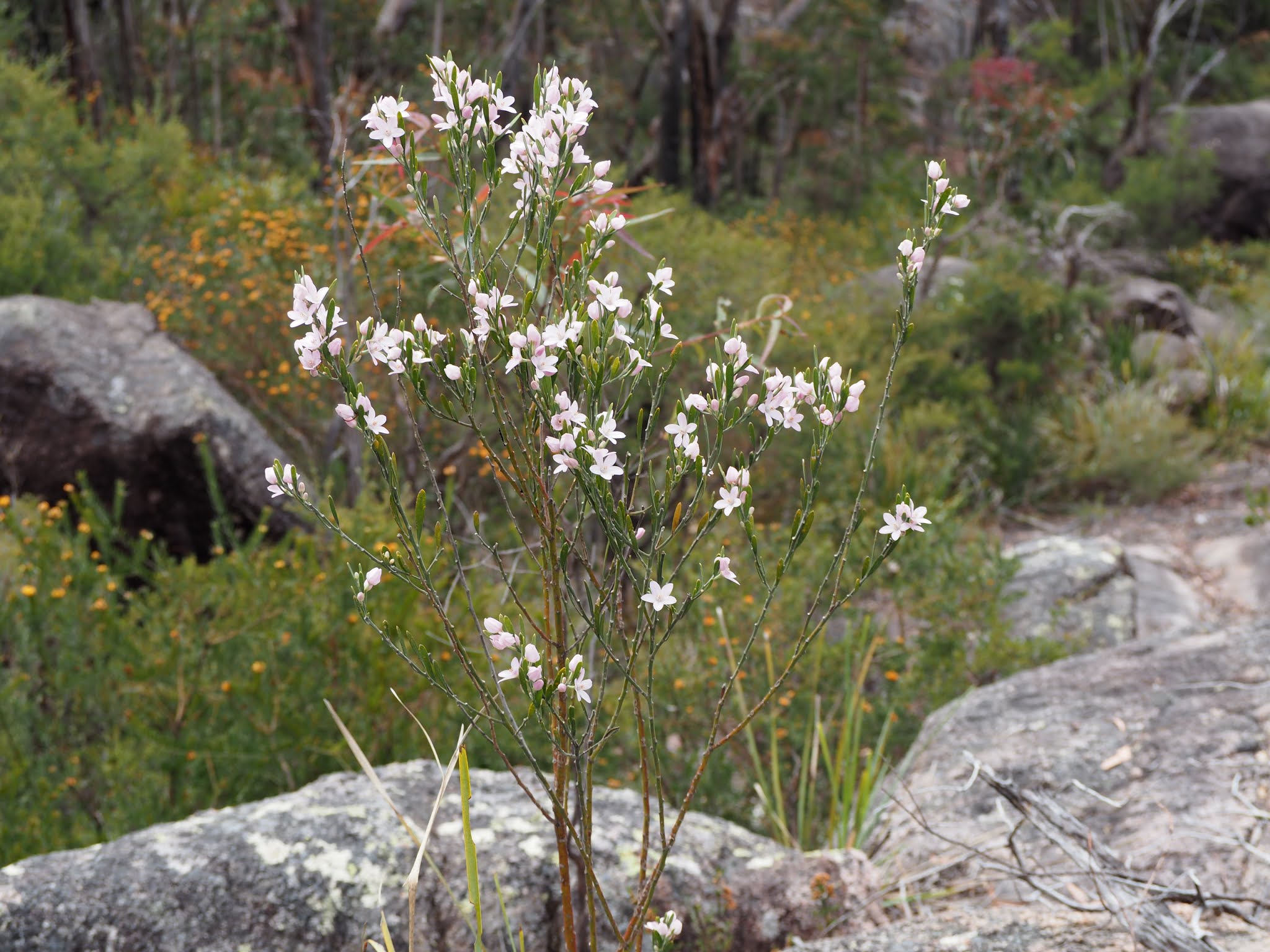
The Boronieae are a group of mostly small to medium-sized shrubs that are usually found growing in open woodlands.

<==Boronieae [Eriostemoninae]
    |  i. s.: Boronia B12
    |         Zieria S87
    |           |--Z. arborescens WB-P93
    |           |--Z. laevigata C08
    |           |--Z. pilosa H87a
    |           `--Z. smithii H87a
    |                |--Z. s. var. smithii S87
    |                `--Z. s. var. macrophylla S87
    |--Eriostemon MS06
    |    |--E. alpinus [=Phebalium squamulosum var. alpinum] S87
    |    |--E. australasius [incl. E. lanceolatus] TW07
    |    |--E. brevifolius MS06
    |    |--E. buxifolius H87a
    |    |--E. correifolius [=Asterolasia correifolia; incl. A. muellerii] S87
    |    |--E. crowei [=Crowea saligna] S87
    |    |    |--E. s. var. saligna S87
    |    |    `--‘Crowea’ s. var. exalata S87
    |    |--E. falcatus M93
    |    |--E. nodiflorus GK00
    |    |    |--E. n. ssp. nodiflorus GK00
    |    |    `--E. n. ssp. lasiocalyx GK00
    |    |--E. ovatifolius [=Phebalium ovatifolium] S87
    |    |--E. ozothamnoides [=Phebalium ozothamnoides] S87
    |    |--E. phylicifolius [=Phebalium phylicifolium] S87
    |    |--E. trachyphyllus S87
    |    `--E. trymalioides [=Asterolasia trymalioides] S87
    `--+--Correa [Correinae] MS06
       |    |--C. aemula S87
       |    |--C. alba H87a
       |    |--C. lawrenciana S87
       |    |--C. pulchella MS06
       |    `--C. speciosa C08
       |         |--C. s. var. speciosa S87
       |         |--C. s. var. cardinalis S87
       |         `--C. s. var. mormalis TW07
       `--+--Chorilaena [Nematolepidinae] MS06
          |    `--C. quercifolia MS06
          `--+--Diplolaena [Diplolaeninae] MS06
             |    |--D. dampieri MS06
             |    `--D. grandiflora KM08
             `--Phebalium Vent. 1804 MS06, A61
                  |--P. ambiguum G04
                  |--P. brachycalyx G04
                  |--P. canaliculatum G04
                  |--P. denticulatum H87b
                  |--P. filifolium G04
                  |--P. glandulosum C08
                  |--P. nudum Hook. 1843 A61
                  |--P. rotundifolium C08
                  |--P. squameum SN08
                  |--P. tuberculosum M93
                  `--P. woombye MS06

*Type species of generic name indicated

REFERENCES

[A61] Allan, H. H. 1961. Flora of New Zealand vol. 1. Indigenous Tracheophyta: Psilopsida, Lycopsida, Filicopsida, Gymnospermae, Dicotyledones. R. E. Owen, Government Printer: Wellington (New Zealand).

[B12] Braby, M. F. 2012. The butterflies of El Questro Wilderness Park, with remarks on the taxonomy of the Kimberley fauna, Australia. Records of the Western Australian Museum 27 (2): 161–175.

[C08] Cambage, R. H. 1908. Notes on the native flora of New South Wales. Part VI. Deepwater to Torrington and Emmaville. Proceedings of the Linnean Society of New South Wales 33 (1): 45–65, pls 1–2.

[G04] Gibson, N. 2004. Flora and vegetation of the Eastern Goldfields Ranges: part 7. Middle and South Ironcap, Digger Rock and Hatter Hill. Journal of the Royal Society of Western Australia 87 (2): 49–62.

[GK00] Gibson, N., & G. J. Keighery. 2000. Flora and vegetation of the Byenup-Muir reserve system, south-west Western Australia. CALMScience 3 (3): 323–402.

[H87a] Haviland, E. 1887a. Flowering seasons of Australian plants. No. I—List of plants indigenous in the neighbourhood of Sydney, flowering during July. Proceedings of the Linnean Society of New South Wales, series 2, 1 (4): 1049–1051.

[H87b] Haviland, E. 1887b. Flowering seasons of Australian plants. No. II. Proceedings of the Linnean Society of New South Wales, series 2, 1 (4): 1103–1104.

[KM08] Keighery, G. J., & W. Muir. 2008. Vegetation and vascular flora of Faure Island, Shark Bay, Western Australia. Records of the Western Australian Museum Supplement 75: 11–19.

[M93] Mollemans, F. H. 1993. Drummondita wilsonii, Philotheca langei and P. basistyla (Rutaceae), new species from south-west Western Australia. Nuytsia 9: 95–109.

[MS06] Muellner, A. N., V. Savolainen, R. Samuel & M. W. Chase. 2006. The mahogany family "out-of-Africa": divergence time estimation, global biogeographic patterns inferred from plastid rbcL DNA sequences, extant, and fossil distribution of diversity. Molecular Phylogenetics and Evolution 40 (1): 236–250.

[SN08] Schmidt, E. R., & T. R. New. 2008. The Psocoptera (Insecta) of Tasmania, Australia. Memoirs of Museum Victoria 65: 71–152.

[S87] Stirling, J. 1887. Notes on the Rutaceae of the Australian Alps. Proceedings of the Linnean Society of New South Wales, series 2, 1 (4): 1052–1058.

[TW07] Thongphak, D., & Q. Wang. 2007. Taxonomic revision of the longicorn beetle genus Uracanthus Hope 1833 (Coleoptera: Cerambycidae: Cerambycinae: Uracanthini) from Australia. Zootaxa 1569: 1–139.

[WB-P93] Walter, D. E., & V. M. Behan-Pelletier. 1993. Systematics and ecology of Adhaesozetes polyphyllos sp.nov. (Acari: Oribatida: Licneremaeoidea), a leaf-inhabiting mite from Australian rainforests. Canadian Journal of Zoology 71: 1024–1040.

Brassicales

Wild mignonette Reseda lutea, copyright Udo Schmidt.


Belongs within: Malvidae.
Contains: Limnanthaceae, Capparaceae, Brassicaceae.

The Brassicales are a clade of flowering plants characterised by the presence of glucosinolates, defensive compounds with a pungent shell and sharp taste.

<==Brassicales [Capparales, Resedales, Rhoeadales]
    |  i. s.: Dressiantha T00
    |         Emblingia T00 [Emblingiaceae APG16, Emblingioideae]
    |         Rhoeo discolor D51
    |--+--+--Bretschneidera [Bretschneideraceae] PT01
    |  |  `--Akania [Akaniaceae, Akaniales] PT01
    |  |       `--A. americana Romero & Hickey 1976 CBH93
    |  `--Tropaeolaceae [Tropaeolales] WM09
    |       |--Magallana T00
    |       |--Trophaeastrum T00
    |       `--Tropaeolum WM09 [incl. Cardamindum D01]
    |            |--T. majus WM09
    |            |--T. peregrinum PT01
    |            |--T. speciosum H59
    |            |--T. tricolor NDA05
    |            `--T. tuberosum H93
    `--+--+--Caricaceae WM09
       |  |    |--Carica papaya WM09 [=Papaya vulgaris C55]
       |  |    |--Cylicomorpha YY22
       |  |    `--Jacartia YY22
       |  `--Moringa [Moringaceae] PT01
       |       |--M. concanensis SDK05
       |       |--M. oleifera LK14
       |       |--M. ovalifolia CV06
       |       `--M. pterygosperma C55
       `--+--Limnanthaceae WM09
          `--+--Setchellanthus [Setchellanthaceae] PT01
             `--+--+--Koeberlinia [Koeberliniaceae, Koeberlinioideae] PT01
                |  |    `--K. spinosa RJ11
                |  |         |--K. s. ssp. spinosa H93
                |  |         `--K. s. ssp. tenuispina H93
                |  `--+--Batis [Bataceae] WM09
                |     |    |--B. argillicola LK14
                |     |    `--B. maritima WM09
                |     `--Salvadoraceae PT01
                |          |--Azima tetracantha T00, M72
                |          |--Dobera T00
                |          `--Salvadora persica T00, PDR05
                |               |--S. p. var. persica PDR05
                |               `--S. p. var. wightiana PDR05
                `--+--+--Tovariaceae [Tovarioideae] PT01
                   |  `--Pentadiplandra [Pentadiplandraceae, Pentadiplandroideae] PT01
                   `--+--+--Capparaceae WM09
                      |  `--Brassicaceae WM09
                      `--+--Gyrostemonaceae PT01
                         |    |--Gyrostemon PT01
                         |    |    |--G. australasicus H90
                         |    |    |--G. ramulosus KM08
                         |    |    |--G. subnudus RL05
                         |    |    `--G. thesioides [=Didymotheca thesioides] H90
                         |    `--Codonocarpus H90
                         |         |--C. attenuatus H90
                         |         |--C. australis C16
                         |         |--C. cotinifolius H90
                         |         `--C. pyramidalis H90
                         `--Resedaceae [Borthwickiaceae, Stixaceae, Stixidaceae] WM09
                              |--Ochradenus baccatus AGF98
                              |--Oligomeris linifolia H93
                              |--Caylusea hexagyna AGF98
                              |--Borthwickia APG16
                              |--Forchhammeria APG16
                              |--Stixis APG16
                              |--Tirania APG16
                              `--Reseda WM09 [incl. Sesamoides D01]
                                   |--R. alba WM09
                                   |--R. complicata F55
                                   |--R. lutea WM09
                                   |--R. luteola C55
                                   `--R. odorata PT01

*Type species of generic name indicated

REFERENCES

[AGF98] Abd El-Ghani, M. M., & A. G. Fahmy. 1998. Composition of and changes in the spontaneous flora of Feiran Oasis, S Sinai, Egypt, in the last 60 years. Willdenowia 28: 123–134.

[APG16] Angiosperm Phylogeny Group. 2016. An update of the Angiosperm Phylogeny Group classification for the orders and families of flowering plants: APG IV. Botanical Journal of the Linnean Society 181: 1–20.

[C16] Cambage, R. H. 1916. Notes on the native flora of tropical Queensland. Journal and Proceedings of the Royal Society of New South Wales 49 (3): 389–447, pls 57–61.

[C55] Candolle, A. de. 1855. Géographie Botanique Raisonée: Ou exposition des faits principaux et des lois concernant la distribution géographique des plantes de l’époque actuelle vol. 2. Librairie de Victor Masson: Paris.

[CBH93] Collinson, M. E., M. C. Boulter & P. L. Holmes. 1993. Magnoliophyta (‘Angiospermae’). In: Benton, M. J. (ed.) The Fossil Record 2 pp. 809–841. Chapman & Hall: London.

[CV06] Craven, P., & P. Vorster. 2006. Patterns of plant diversity and endemism in Namibia. Bothalia 36 (2): 175–189.

[D51] Dobzhansky, T. 1951. Genetics and the Origin of Species 3rd ed. Columbia University Press: New York.

[D01] Doweld, A. B. 2001. The systematic relevance of fruit and seed structure in Bersama and Melianthus (Melianthaceae). Plant Systematics and Evolution 227: 75–103.

[F55] Franz, H. 1955. Dritter Beitrag zur Kenntnis der Caeculidae (Acari). Verhandlungen der Zoologisch-Botanischen Gessellschaft in Wien 95: 9–18.

[H90] Harden, G. J. (ed.) 1990. Flora of New South Wales vol. 1. New South Wales University Press.

[H59] Healy, A. J. 1959. Contributions to a knowledge of the adventive flora of New Zealand, no. 7. Transactions of the Royal Society of New Zealand 86 (1): 113–118.

[H93] Hickman, J. C. (ed.) 1993. The Jepson Manual: Higher Plants of California. University of California Press: Berkeley (California).

[KM08] Keighery, G. J., & W. Muir. 2008. Vegetation and vascular flora of Faure Island, Shark Bay, Western Australia. Records of the Western Australian Museum Supplement 75: 11–19.

[LK14] Lyons, M. N., G. J. Keighery, L. A. Gibson & T. Handasyde. 2014. Flora and vegetation communities of selected islands off the Kimberley coast of Western Australia. Records of the Western Australian Museum Supplement 81: 205–244.

[M72] Mathew, D. N. 1972. The ecology of the baya in Rajampet, Cuddapah Dt., A.P. Journal of the Bombay Natural History Society 69 (1): 188–191.

[NDA05] Nickrent, D. L., J. P. Der & F. E. Anderson. 2005. Discovery of the photosynthetic relatives of the "Maltese mushroom" Cynomorium. BMC Evolutionary Biology 5: 38.

[PT01] Pemberton, L. M. S., S.-L. Tsai, P. H. Lovell & P. J. Harris. 2001. Epidermal patterning in seedling roots of eudicotyledons. Annals of Botany 87: 649–654.

[PDR05] Pradhan, S. G., P. G. Diwakar & K. M. Rao. 2005. Recollection of Cistachne tubulosa (Schrenk) Wight (Orobanchaceae) from Maharashtra after about a century. Bulletin of the Botanical Survey of India 47: 151–152.

[RL05] Rafferty, C., & B. B. Lamont. 2005. Selective feeding by macropods on vegetation regenerating following fire. Journal of the Royal Society of Western Australia 88 (4): 155–165.

[RJ11] Rising, J. D., A. Jaramillo, J. L. Copete, P. G. Ryan & S. C. Madge. 2011. Family Emberizidae (buntings and New World sparrows). In: Hoyo, J. del, A. Elliott & D. A. Christie (eds) Handbook of the Birds of the World vol. 16. Tanagers to New World Blackbirds pp. 428–683. Lynx Edicions: Barcelona.

[SDK05] Sharma, L. K., N. K. Dadhich & A. Kumar. 2005. Plant based veterinary medicine from traditional knowledge of India. Bulletin of the Botanical Survey of India 47: 43–52.

[T00] Thorne, R. F. 2000. The classification and geography of the flowering plants: dicotyledons of the class Angiospermae (subclasses Magnoliidae, Ranunculidae, Caryophyllidae, Dilleniidae, Rosidae, Asteridae, and Lamiidae). The Botanical Review 66: 441–647.

[WM09] Wang, H., M. J. Moore, P. S. Soltis, C. D. Bell, S. F. Brockington, R. Alexandre, C. C. Davis, M. Latvis, S. R. Manchester & D. E. Soltis. 2009. Rosid radiation and the rapid rise of angiosperm-dominated forests. Proceedings of the National Academy of Sciences of the USA 106 (10): 3853–3858.

[YY22] Yampolsky, C., & H. Yampolsky. 1922. Distribution of sex forms in the phanerogamic flora. Bibliotheca Genetica 3: 1–62.

Draba

Mt Lassen draba Draba aureola, copyright John Game.


Belongs within: Brassicaceae.

Draba is a genus of often cushion- or mat-forming herbs found in the Northern Hemisphere and mountains of South America (Hickman 1993).

Characters (from Hickman 1993): Annual to perennia, often cushion- or mat-forming; hairs often branched. Leaves basal and sometimes cauline, entire or shallowly toothed. Flowers with sepal bases equal; petals <10 mm, yellow or white, claw and limb generally distinct. Fruit <30 mm, generally lanceolate to ovate, generally flat parallel to septum, less often partially inflated, sometimes twisted or wavy. Seeds in two rows per chamber; wing generally absent.

<==Draba
    |--D. affghanica O88
    |--D. albertina [incl. D. stenoloba var. nana, D. stenoloba var. ramosa] H93
    |--D. altaica O88
    |--D. amoena O88
    |--D. asterophora H93
    |    |--D. a. var. asterophora H93
    |    `--D. a. var. macrocarpa H93
    |--D. aureola H93
    |--D. breweri H93
    |--D. californica [=D. cuneifolia var. californica] H93
    |--D. cana H93
    |--D. carnosula [=D. howellii var. carnosula] H93
    |--D. cholaensis O88
    |    |--D. c. var. cholaensis O88
    |    `--D. c. var. leiocarpa O88
    |--D. corrugata H93
    |    |--D. c. var. corrugata H93
    |    `--D. c. var. saxosa H93
    |--D. crassifolia H93
    |    |--D. c. var. crassifolia H93
    |    `--D. c. var. nevadensis H93
    |--D. cruciata H93
    |--D. cuneifolia (see below for synonymy) H93
    |--D. densifolia H93
    |--D. elata O88
    |--D. ellipsoidea O88
    |--D. glomerata O88
    |--D. gracillima O88
    |--D. haynaldii H09
    |--D. howellii H93
    |--D. incrassata [=D. lemmonii var. incrassata] H93
    |--D. lasiophylla O88
    |    |--D. l. var. lasiophylla O88
    |    `--D. l. var. leiocarpa O88
    |--D. lemmonii H93
    |--D. lonchocarpa [incl. D. nivalis var. elongata] H93
    |--D. magellanica D03
    |--D. monoensis H93
    |--D. nemorosa H93
    |--D. oligosperma [incl. D. oligosperma var. subsessilis] H93
    |--D. oreades O88
    |--D. paysonii H93
    |    |--D. p. var. paysonii H93
    |    `--D. p. var. treleasei H93
    |--D. praealta H93
    |--D. pterosperma H93
    |--D. reptans [incl. D. micrantha] H93
    |--D. sharsmithii [incl. D. cruciata var. integrifolia] H93
    |--D. sierrae H93
    |--D. staintonii O88
    |--D. subumbellata H93
    |--D. verna [incl. D. verna var. aestivalis] H93
    `--D. williamsii O88

Draba cuneifolia [incl. D. cuneifolia var. integrifolia non D. cruciata var. integrifolia, D. cuneifolia var. sonorae] H93

*Type species of generic name indicated

REFERENCES

[D03] Dusén, P. 1903. The vegetation of western Patagonia. In: Scott, W. B. (ed.) Reports of the Princeton University Expeditions to Patagonia, 1896–1899 vol. 8. Botany pp. 1–34. The University: Princeton (New Jersey).

[H09] Heltmann, H. 2009. Der Königstein (Piatra Craiului), die Perle der Burzenländer Gebirge. Mauritiana 20 (3): 515–527.

[H93] Hickman, J. C. (ed.) 1993. The Jepson Manual: Higher Plants of California. University of California Press: Berkeley (California).

[O88] Ohba, H. 1988. The alpine flora of the Nepal Himalayas: an introductory note. In: Ohba, H., & S. B. Malla (eds) The Himalayan Plants vol. 1. The University Museum, University of Tokyo, Bulletin 31: 19–46.

Capparaceae

Caperbush Capparis spinosa, copyright Joan Simon.


Belongs within: Brassicales.

The Capparaceae are a group of trees, shrubs and herbs, often with spiny stipules on the leaves, found in tropical and subtropical regions of the world (Harden 1990).

Characters (from Harden 1990): Herbs, climbers, shrubs or trees, glabrous or hairy. Leaves alternate, compound or simple and entire to deeply dissected; juvenile leaves often different from the adult foliage; mostly petiolate; stipules usually spiny, sometimes minute or absent. Inflorescence terminal or lateral, racemose or flowers solitary. Flowers usually actinomorphic, bisexual. Sepals mostly 4 in two whorls, the outer 2 free or fused, the inner 2 free. Petals usually 4, equal, free. Stamens 1-many, free or sometimes fused to the gynophore; anthers 2-locular, dehiscing by longitudinal slits. Disc sometimes present between stamens and ovary. Ovary superior, 2-6-carpellate, 1-3-locular, usually on a gynophore, sometimes sessile; ovules 1-many; stigma more or less sessile. Fruit usually a stalked capsule or berry; 1-many-seeded.

<==Capparaceae [Capparidaceae, Capparoideae]
    |--Haptocarpum YY22
    |--Apophyllum anomalum B00
    |--Cercopetalum YY22
    |--Maerua oblongifolia PP07
    |--Poilanedora APG16
    |--Dipterygium T00
    |--Capparites cynphylloides CBH93
    |--Bachmannia Pax 1897 KC01
    |--Keithia Spreng. 1822 KC01
    |--Cadaba LK14
    |    |--C. capparoides LK14
    |    `--C. fruticosa PP07
    |--Crataeva K06
    |    |--C. magna BB07
    |    |--C. religiosa B00
    |    `--C. tapia K06
    `--Capparis RF03
         |--C. aegyptia de Lamarck 1785 [incl. C. spinosa var. aravensis, C. sinaica Veillard in Duhamel 1801] RF03
         |--C. arborea B00
         |--C. atamisquea RJ11
         |--C. canescens B00
         |--C. cartilaginea Decaisne 1835 (nom. cons.) [incl. C. galeata Fresenius 1837, C. inermis Forsskål 1775] RF03
         |--C. dahi Forsskål 1775 RF03
         |--C. decidua PP07
         |--C. flexuosa WM09
         |--C. jacobsii B12
         |--C. lasiantha LK14
         |--C. loranthifolia H90
         |--C. lucida LK14
         |--C. mitchellii LK14
         |--C. nobilis B00
         |--C. pittieiri OV97
         |--C. quiniflora LK14
         |--C. sarmentosa H90
         |--C. sepiaria LK14
         |--C. spinosa RF03
         |    |--C. s. var. spinosa LK14
         |    `--C. s. var. nummularia LK14
         |--C. umbonata B12
         |--C. verrucosa BTA75
         `--C. zeylanica P03

*Type species of generic name indicated

REFERENCES

[APG16] Angiosperm Phylogeny Group. 2016. An update of the Angiosperm Phylogeny Group classification for the orders and families of flowering plants: APG IV. Botanical Journal of the Linnean Society 181: 1–20.

[BB07] Baishya, A. K., & P. J. Bora. 2007. Cross community ethno-medico botany of Dibru-Saikhowa Biosphere Reserve, Assam. Bulletin of the Botanical Survey of India 49: 121–154.

[BTA75] Baker, E. W., D. M. Tuttle & M. J. Abbatiello. 1975. The false spider mites of northwestern and north central Mexico (Acarina: Tenuipalpidae). Smithsonian Contributions to Zoology 194: 1–23.

[B00] Braby, M. F. 2000. Butterflies of Australia: their identification, biology and distribution vol. 1. CSIRO Publishing: Collingwood (Victoria).

[B12] Braby, M. F. 2012. The butterflies of El Questro Wilderness Park, with remarks on the taxonomy of the Kimberley fauna, Australia. Records of the Western Australian Museum 27 (2): 161–175.

[CBH93] Collinson, M. E., M. C. Boulter & P. L. Holmes. 1993. Magnoliophyta (‘Angiospermae’). In: Benton, M. J. (ed.) The Fossil Record 2 pp. 809–841. Chapman & Hall: London.

[H90] Harden, G. J. (ed.) 1990. Flora of New South Wales vol. 1. New South Wales University Press.

[KC01] Kirk, P. M., P. F. Cannon, J. C. David & J. A. Stalpers. 2001. Ainsworth & Bisby's Dictionary of the Fungi 9th ed. CAB International: Wallingford (UK).

[K06] Kwiecinski, G. G. 2006. Phyllostomus discolor. Mammalian Species 801: 1–11.

[LK14] Lyons, M. N., G. J. Keighery, L. A. Gibson & T. Handasyde. 2014. Flora and vegetation communities of selected islands off the Kimberley coast of Western Australia. Records of the Western Australian Museum Supplement 81: 205–244.

[OV97] Ochoa, R., C. Vargas, D. E. Walter & B. M. OConnor. 1997. Two new species of the genus Ceratotarsonemus (Acari: Tarsonemidae). International Journal of Acarology 23 (3): 177–183.

[PP07] Pandey, R. P., & P. M. Padhye. 2007. Studies on phytodiversity of Arid Machia Safari Park-Kailana in Jodhpur (Rajasthan). Bulletin of the Botanical Survey of India 49: 15–78.

[P03] Paul, T. K. 2003. Botanical observations on the Purulia pumped storage hydropower project area, Bagmundi Hills, Purulia district, West Bengal. Bulletin of the Botanical Survey of India 45: 121–142.

[RJ11] Rising, J. D., A. Jaramillo, J. L. Copete, P. G. Ryan & S. C. Madge. 2011. Family Emberizidae (buntings and New World sparrows). In: Hoyo, J. del, A. Elliott & D. A. Christie (eds) Handbook of the Birds of the World vol. 16. Tanagers to New World Blackbirds pp. 428–683. Lynx Edicions: Barcelona.

[RF03] Rivera, D., I. Friis, C. Inocencio, C. Obón, F. Alcaraz & A. Reales. 2003. The typification of Capparis inermis Forssk., C. sinaica Veill. and C. cartilaginea Decne. (Capparaceae). Taxon 52: 307–311.

[T00] Thorne, R. F. 2000. The classification and geography of the flowering plants: dicotyledons of the class Angiospermae (subclasses Magnoliidae, Ranunculidae, Caryophyllidae, Dilleniidae, Rosidae, Asteridae, and Lamiidae). The Botanical Review 66: 441–647.

[WM09] Wang, H., M. J. Moore, P. S. Soltis, C. D. Bell, S. F. Brockington, R. Alexandre, C. C. Davis, M. Latvis, S. R. Manchester & D. E. Soltis. 2009. Rosid radiation and the rapid rise of angiosperm-dominated forests. Proceedings of the National Academy of Sciences of the USA 106 (10): 3853–3858.

[YY22] Yampolsky, C., & H. Yampolsky. 1922. Distribution of sex forms in the phanerogamic flora. Bibliotheca Genetica 3: 1–62.

Cardamine

Alpine bitter-cress Cardamine oligosperma, copyright Walter Siegmund.


Belongs within: Brassicaceae.

Cardamine, bitter-cress, is a genus of herbaceous plants found in most regions of the world (Hickman 1993).

Characters (from Hickman 1993): Annual, biennial or perennial, from taproots, fibrous roots, or tuber-like rhizomes; hairs absent or simple. Leaves entire or palmately or pinnately lobed to compound; rhizome leaves often present, separate from others. Inflorescence bracted or not. Flower with sepals equal at base; petals white to pink or rose. Fruit linear, generally flat; valves generally opening elastically, sometimes by coiling from base; septum margins intruding on valves. SEEDS many, one row per chamber, wingless (rarely more or less margined); embryonic root at edges of both cotyledons.

<==Cardamine Linnaeus 1753 A61
    |--C. amara H64
    |--C. angulata H93
    |--C. bellidifolia H93
    |    |--C. b. var. bellidifolia H93
    |    `--C. b. var. pachypylla H93
    |--C. bilobata Kirk 1899 A61
    |--C. breweri H93
    |    |--C. b. var. breweri H93
    |    `--C. b. var. orbicularis H93
    |--C. bulbosa S72
    |--C. californica [=Dentaria californica] H93
    |    |--C. c. var. californica H93
    |    |--C. c. var. cardiophylla [=Dentaria californica var. cardiophylla] H93
    |    |--C. c. var. cuneata [=Dentaria californica var. cuneata] H93
    |    |--C. c. var. integrifolia [=Dentaria californica var. integrifolia] H93
    |    `--C. c. var. sinuata [=Dentaria californica var. sinuata] H93
    |--C. circaeoides D07
    |--C. cordifolia H93
    |    |--C. c. var. cordifolia H93
    |    `--C. c. var. lyallii H93
    |--C. corymbosa Hook. f. 1844 [=C. hirsuta var. corymbosa Hook. f. 1864] A61
    |--C. debilis Banks ex DC. 1821 (see below for synonymy) A61
    |--C. depressa Hooker 1844 [incl. C. depressa var. acaulis Hoker 1844] A61
    |    |--C. d. var. depressa A61
    |    `--C. d. var. stellata Hooker 1864 [=C. stellata Hooker 1844] A61
    |--C. flexuosa H90 [=C. scutata ssp. flexuosa O88]
    |--C. griffithii O88
    |--C. gunnii H90
    |--C. hirsuta PT01
    |--C. impatiens O88
    |--C. intermedia H90
    |--C. lilacina H90
    |--C. loxostemonoides O88
    |--C. macrophylla O88
    |    |--C. m. ssp. macrophylla O88
    |    `--C. m. ssp. polyphylla O88
    |--C. nuttallii H93
    |    |--C. n. var. nuttallii [incl. C. pulcherrima var. tenella] H93
    |    |--C. n. var. covilleana [incl. Dentaria tenella var. palmata] H93
    |    |--C. n. var. dissecta [=C. tenella var. dissecta] H93
    |    `--C. n. var. gemmata [=Dentaria gemmata] H93
    |--C. occidntalis H93
    |--C. oligosperma H93
    |--C. ovata D03
    |--C. pachystigma [=Dentaria pachystigma] H93
    |    |--C. p. var. pachystigma H93
    |    `--C. p. var. dissectifolia [=Dentaria pachystigma var. dissectifolia] H93
    |--C. paucijuga GK00
    |--C. pensylvanica H93
    |--C. pratensis SBM11
    |--C. scutata O88
    |--C. subcarnosa (Hook. f.) Allan 1961 (see below for synonymy) A61
    |--C. tenuifolia H90
    |--C. trifoliolata O88
    |--C. uniflora (Hook. f.) Allan 1961 (see below for synonymy) A61
    `--C. xanthina Colenso 1899 A61

Cardamine debilis Banks ex DC. 1821 [=C. hirsuta var. debilis Banks ex Hook. f. 1864; incl. Sisymbrium heterophyllum Forst. f. 1786, C. heterophylla (Forst. f.) Schulz 1903 non Wood 1870, C. debilis var. hirtella Schulz 1903, C. debilis var. leiocarpa Schulz 1903, C. debilis proles macrantha Schulz 1903, C. debilis var. macrostylis Schulz 1903] A61

Cardamine subcarnosa (Hook. f.) Allan 1961 [=C. hirsuta var. subcarnosa Hook. f. 1844, C. glacialis var. subcarnosa (Hook. f.) Schulz 1903] A61

Cardamine uniflora (Hook. f.) Allan 1961 [=C. hirsuta var. uniflora Hook. f. 1864, C. heterophylla var. uniflora (Hook. f.) Ckn. 1909] A61

*Type species of generic name indicated

REFERENCES

[A61] Allan, H. H. 1961. Flora of New Zealand vol. 1. Indigenous Tracheophyta: Psilopsida, Lycopsida, Filicopsida, Gymnospermae, Dicotyledones. R. E. Owen, Government Printer: Wellington (New Zealand).

[D07] Dash, S. S. 2007. Useful plants of Kabi Sacred Grove, Sikkim. Bulletin of the Botanical Survey of India 49: 79–88.

[D03] Dusén, P. 1903. The vegetation of western Patagonia. In: Scott, W. B. (ed.) Reports of the Princeton University Expeditions to Patagonia, 1896–1899 vol. 8. Botany pp. 1–34. The University: Princeton (New Jersey).

[GK00] Gibson, N., & G. J. Keighery. 2000. Flora and vegetation of the Byenup-Muir reserve system, south-west Western Australia. CALMScience 3 (3): 323–402.

[H90] Harden, G. J. (ed.) 1990. Flora of New South Wales vol. 1. New South Wales University Press.

[H93] Hickman, J. C. (ed.) 1993. The Jepson Manual: Higher Plants of California. University of California Press: Berkeley (California).

[H64] Hogg, J. 1864. List of rarer phanerogamous plants discovered in the south-east of Durham since 1829. Report of the British Association for the Advancement of Science 33 (Notices and Abstracts): 96.

[O88] Ohba, H. 1988. The alpine flora of the Nepal Himalayas: an introductory note. In: Ohba, H., & S. B. Malla (eds) The Himalayan Plants vol. 1. The University Museum, University of Tokyo, Bulletin 31: 19–46.

[PT01] Pemberton, L. M. S., S.-L. Tsai, P. H. Lovell & P. J. Harris. 2001. Epidermal patterning in seedling roots of eudicotyledons. Annals of Botany 87: 649–654.

[S72] Shields, O. 1972. Flower visitation records for butterflies (Lepidoptera). Pan-Pacific Entomologist 48 (3): 189–203.

[SBM11] Solomon, E. P., L. R. Berg & D. W. Martin (eds) 2011. Biology 9th ed. Brooks/Cole Cengage Learning.

Lepidium

Yellow peppercress Lepidium flavum, copyright Jim Morefield.


Belongs within: Brassicaceae.

Lepidium, pepperworts, is a cosmopolitan genus of herbs and shrubs bearing fruits as flattened capsules containing a single seed per chamber (Hickman 1993).

Characters (from Hickman 1993): Annual to shrub; hairs absent or simple. Basal leaves not rosetted, generally petioled, entire to pinnately lobed; cauline leaves short-petioled to sessile, sometimes clasping or surrounding stem. Flowers small; sepals erect or spreading, oblong to ovate, shed early or persistent; petals linear to obovate, generally white, rarely yellowish, sometimes bristle-like or absent; stamens 6, 4, or 2. Fruit dehiscent, oblong to elliptic or obcordate, flat perpendicular to septum; pedicel cylindric or flat, winged or not. Seeds 1 per chamber, gelatinous when wetted; wing narrow or absent; embryonic root at back of one cotyledon, rarely at edges of both.

<==Lepidium Linnaeus 1753 A61
    |--L. africanum GK00
    |--L. apetalum O88
    |--L. aschersonii H90
    |--L. banksii Kirk 1899 [incl. L. banksii var. ovatum Kirk 1899] A61
    |--L. bidentatum [incl. L. bidentoides] SJP60
    |--L. bipinnatifidum D03
    |--L. bonariense H90
    |--L. campestre C55
    |--L. capitatum O88
    |--L. densiflorum H93
    |    |--L. d. var. densiflorum H93
    |    |--L. d. var. elongatum H93
    |    |--L. d. var. macrocarpum H93
    |    |--L. d. var. pubicarpum H93
    |    `--L. d. var. ramosum H93
    |--L. dictyotum H93
    |    |--L. d. var. dictyotum H93
    |    `--L. d. var. acutidens [=L. oxycarpum var. acutidens] H93
    |--L. didymum K10
    |--L. draba C55
    |--L. fasciculatum H90
    |--L. flavum H93
    |    |--L. f. var. flavum H93
    |    `--L. f. var. felipense H93
    |--L. flexicaule Kirk 1882 (see below for synonymy) A61
    |--L. foliosum G60
    |--L. fremontii H93
    |    |--L. f. var. fremontii H93
    |    `--L. f. var. stipitatum H93
    |--L. graminifolium H91
    |--L. heterophyllum H93
    |--L. hirtum [incl. L. smithii] C06
    |--L. hypenantion H90
    |--L. hyssopifolium H90
    |--L. jaredii H93
    |--L. kawarau Petrie 1885 (see below for synonymy) A61
    |--L. kirkii Petrie 1890 A61
    |--L. lasiocarpum H93
    |--L. latifolium C55
    |--L. latipes H93
    |    |--L. l. var. latipes H93
    |    `--L. l. var. heckardii H93
    |--L. leptopetalum H90
    |--L. lyratogyrum KM08
    |--L. matau Petrie 1887 (see below for synonymy) A61
    |--L. meyenii W92
    |--L. monoplocoides H90
    |--L. montanum H93
    |    |--L. m. var. montanum H93
    |    |--L. m. var. canescens H93
    |    `--L. m. var. cinereum H93
    |--L. muelleri-ferdinandi H90
    |--L. naufragorum NL98
    |--L. nitidum H93
    |    |--L. n. var. nitidum H93
    |    |--L. n. var. howellii H93
    |    `--L. n. var. oreganum H93
    |--L. oblongum H93
    |    |--L. o. var. oblongum H93
    |    `--L. o. var. insulare H93
    |--L. obtusatum Kirk 1892 A61
    |--L. oleraceum Forst. f. 1786 (see below for synonymy) A61
    |--L. oxycarpum H93
    |--L. oxytrichum H90
    |--L. papillosum H90
    |--L. peregrinum H90
    |--L. perfoliatum H93
    |--L. phlebopetalum H09
    |--L. pinnatifidum H93
    |--L. pseudohyssopifolium H90
    |--L. pseudopapillosum H90
    |--L. pseudotasmanicum H90
    |--L. puberulum KM08
    |--L. ramosissimum H93
    |    |--L. r. var. ramosissimum H93
    |    `--L. r. var. bourgeauanum [=L. densiflorum var. borgeauanum] H93
    |--L. rotundum G04
    |--L. ruderale C06
    |--L. sagittulatum H90
    |--L. sativum PT01
    |--L. sisymbrioides Hook. f. 1864 (see below for synonymy) A61
    |--L. strictum H93
    |--L. tenuicaule Kirk 1882 (see below for synonymy) A61
    |--L. thurberi H93
    `--L. virginicum ACW01
         |--L. v. var. virginicum H93
         |--L. v. var. medium H93
         |--L. v. var. pubescens H93
         `--L. v. var. robinsonii H93

Lepidium flexicaule Kirk 1882 [incl. L. incisum Banks & Sol. ex Hook. f. 1853 non Roth 1802, Nasturtium neozelandicum Kuntze 1891] A61

Lepidium kawarau Petrie 1885 [=L. sisymbrioides ssp. kawarau (Petrie) Thellung 1906; incl. L. kawarau var. dubium Kirk 1899, L. sisymbrioides var. dubium (Kirk) Thellung 1906] A61

Lepidium matau Petrie 1887 [=L. sisymbrioides ssp. matau (Petrie) Thellung 1906; incl. L. sisymbrioides ssp. matau var. lobulatum Thellung 1906] A61

Lepidium oleraceum Forst. f. 1786 [=Thlaspi oleraceum Poir. 1806, Nasturtium oleraceum Kuntze 1891; incl. Lepidium oleraceum var. acutidentatum Kirk 1899, L. oleraceum var. frondosum Kirk 1899, L. oleraceum var. serrulatum Thellung 1906] A61

Lepidium sisymbrioides Hook. f. 1864 [=Nasturtium sisymbrioides Kuntze 1891; incl. L. sisymbrioides ssp. solandri var. ovatum Thellung 1906 non L. banksii var. ovatum Kirk 1899, L. solandri Kirk 1882, L. sisymbrioides ssp. solandri (Kirk) Thellung 1906, L. sisymbrioides ssp. solandri var. typicum Thellung 1906] A61

Lepidium tenuicaule Kirk 1882 [incl. L. australe Kirk 1882, L. tenuicaule var. australe (Kirk) Kirk 1899, L. tenuicaule var. minor Cheeseman 1911] A61

*Type species of generic name indicated

REFERENCES

[ACW01] Aguilar, H., C. C. Childers & W. C. Welbourn. 2001. Relative abundance and seasonal occurrence of mites in the family Tydeidae on citrus in Florida. In: Halliday, R. B., D. E. Walter, H. C. Proctor, R. A. Norton & M. J. Colloff (eds) Acarology: Proceedings of the 10th International Congress pp. 376–380. CSIRO Publishing: Melbourne.

[A61] Allan, H. H. 1961. Flora of New Zealand vol. 1. Indigenous Tracheophyta: Psilopsida, Lycopsida, Filicopsida, Gymnospermae, Dicotyledones. R. E. Owen, Government Printer: Wellington (New Zealand).

[C55] Candolle, A. de. 1855. Géographie Botanique Raisonée: Ou exposition des faits principaux et des lois concernant la distribution géographique des plantes de l’époque actuelle vol. 2. Librairie de Victor Masson: Paris.

[C06] Cheeseman, T. F. 1906. Manual of the New Zealand Flora. John Mackay, Government Printer: Wellington.

[D03] Dusén, P. 1903. The vegetation of western Patagonia. In: Scott, W. B. (ed.) Reports of the Princeton University Expeditions to Patagonia, 1896–1899 vol. 8. Botany pp. 1–34. The University: Princeton (New Jersey).

[G04] Gibson, N. 2004. Flora and vegetation of the Eastern Goldfields Ranges: part 7. Middle and South Ironcap, Digger Rock and Hatter Hill. Journal of the Royal Society of Western Australia 87 (2): 49–62.

[GK00] Gibson, N., & G. J. Keighery. 2000. Flora and vegetation of the Byenup-Muir reserve system, south-west Western Australia. CALMScience 3 (3): 323–402.

[G60] Gillham, M. E. 1960. Vegetation of Little Brother Island, Cook Strait, in relation to spray-bearing winds, soil salinity, and pH. Transactions of the Royal Society of New Zealand 88 (3): 405–424.

[H90] Harden, G. J. (ed.) 1990. Flora of New South Wales vol. 1. New South Wales University Press.

[H09] Heterick, B. E. 2009. A guide to the ants of south-western Australia. Records of the Western Australian Museum Supplement 76: 1–206.

[H93] Hickman, J. C. (ed.) 1993. The Jepson Manual: Higher Plants of California. University of California Press: Berkeley (California).

[H91] Hubálek, Z. 1991. Biogeographic indication of natural foci of tick-borne infections. In: Dusbábek, F., & V. Bukva (eds) Modern Acarology: Proceedings of the VIII International Congress of Acarology, held in České Budĕjovice, Czechoslovakia, 6–11 August 1990 vol. 1 pp. 255–260. SPB Academic Publishing: The Hague.

[K10] Keighery, G. 2010. The naturalised vascular plants of the Pilbara region, Western Australia. Records of the Western Australian Museum Supplement 78 (1): 299–311.

[KM08] Keighery, G. J., & W. Muir. 2008. Vegetation and vascular flora of Faure Island, Shark Bay, Western Australia. Records of the Western Australian Museum Supplement 75: 11–19.

[NL98] Norton, D. A., & P. J. de Lange. 1998. Hebe paludosa (Scrophulariaceae)—a new combination for an endemic wetland Hebe from Westland, South Island, New Zealand. New Zealand Journal of Botany 36: 531–538.

[O88] Ohba, H. 1988. The alpine flora of the Nepal Himalayas: an introductory note. In: Ohba, H., & S. B. Malla (eds) The Himalayan Plants vol. 1. The University Museum, University of Tokyo, Bulletin 31: 19–46.

[PT01] Pemberton, L. M. S., S.-L. Tsai, P. H. Lovell & P. J. Harris. 2001. Epidermal patterning in seedling roots of eudicotyledons. Annals of Botany 87: 649–654.

[SJP60] St. John, H. & W. R. Philipson. 1960. List of the flora of Oeno Atoll, Tuamotu Archipelago, south-central Pacific Ocean. Transactions of the Royal Society of New Zealand 88 (3): 401–403.

[W92] Wilson, E. O. 1992. The Diversity of Life. Harvard University Press: Belknap (USA).