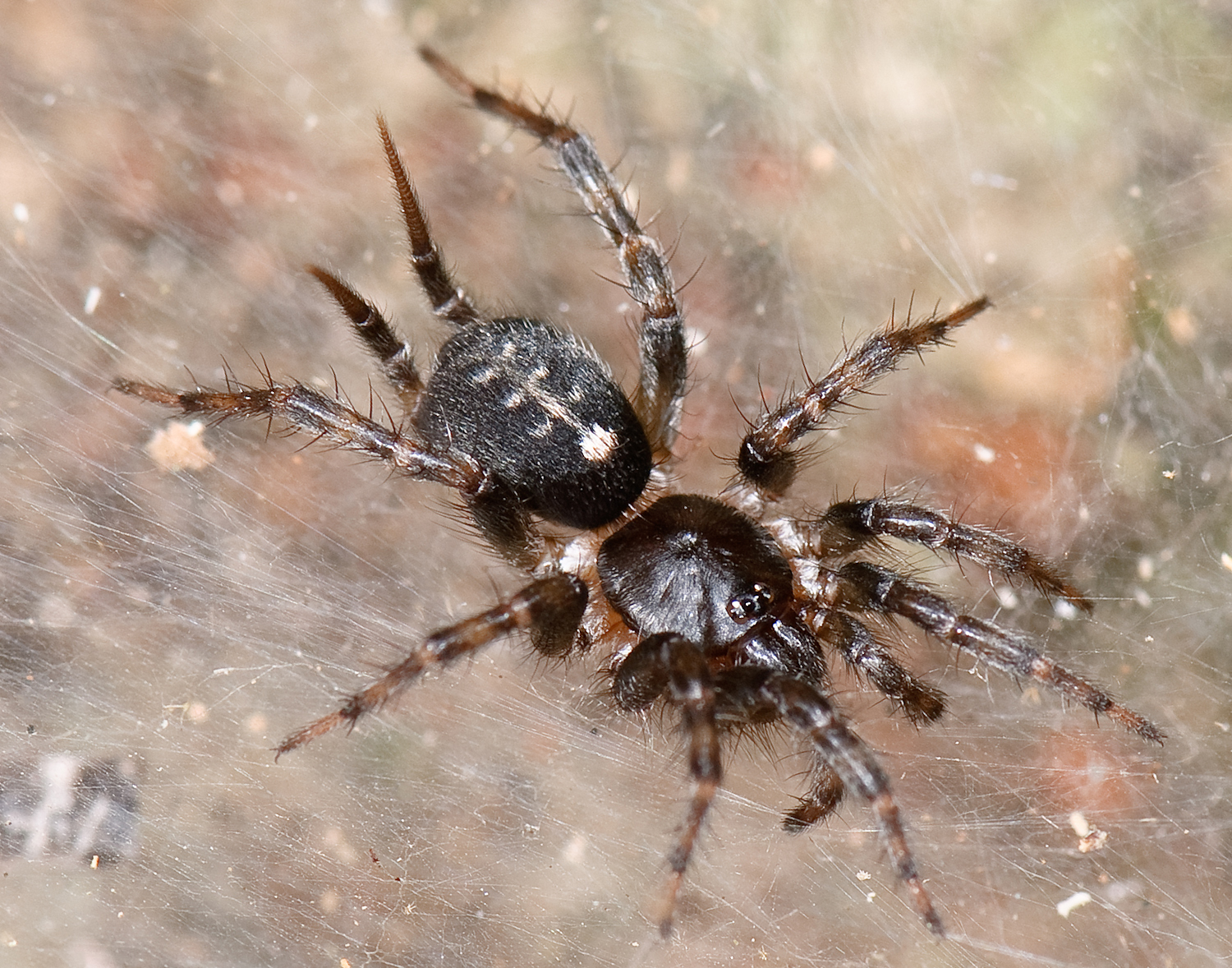
Chthoniidae

Austrochthonius sp., copyright Kristi Ellingsen.


Belongs within: Pseudoscorpiones.
Contains: Tyrannochthoniini.

The Chthoniidae are a group of pseudoscorpions characterised by differing number of segments in the anterior and posterior pairs of legs (five post-coxal segments in legs I and II vs six in legs III and IV) (Muchmore 1990). Three families have been recognised within the superfamily Chthonioidea, the Chthoniidae, Lechytiidae and Tridenchthoniidae, but molecular phylogenetic analysis indicates that the first is paraphyletic to the latter two (Murienne et al. 2008).

<==Chthoniidae [Chthoniinea, Chthonioidea, Heterosphyronida]
    |--Pseudotyrannochthoniinae MHG08
    |    |--Afrochthonius godfreyi MHG08
    |    `--+--Pseudotyrannochthonius MHG08
    |       `--Selachochthonius MHG08
    `--Chthoniinae MHG08
         |--Chthonius Koch 1843 MHG08, H09
         |    |--C. californicus S62
         |    |--C. coecus Packard 1884 HM06
         |    `--C. tetrachelatus M90
         `--+--+--Apochthonius MHG08
            |  `--Kleptochthonius MHG08
            `--+--+--+--Sathrochthonius insulanus MHG08
               |  |  `--Lechytia [Lechytiidae, Lechytiini] MHG08
               |  |       `--L. hoffi MHG08
               |  `--+--Pseudochthonius squamosus MHG08, L88
               |     `--Tridenchthoniidae [Dithidae, Dithinae, Tridenchthoniinae] M90
               |          |--Anaulacodithella MHG08
               |          |--Verrucaditha spinosa M90
               |          `--Tridenchthonius M90
               `--+--Tyrannochthoniini MHG08
                  `--+--Drepanochthonius MHG08
                     `--Austrochthonius Chamberlin 1929 MHG08, HM06 (see below for synonymy)
                          |--*A. chilensis (Chamberlin 1923) [=Chthonius chilensis] HM06
                          |    |--A. c. chilensis HM06
                          |    |--A. c. magalhanicus HM06
                          |    `--A. c. transversus HM06
                          |--A. argentinae HM06
                          |--A. australis HM06
                          |--A. bolivianus HM06
                          |--A. cavicola HM06
                          |--A. easti HM06
                          |--A. iguazuensis HM06
                          |--A. insularis HM06
                          |--A. mordax HM06
                          |--A. muchmorei Harvey & Mould 2006 (see below for synonymy) HM06
                          |--A. paraguayensis HM06
                          |--A. parvus (Mello-Leitão 1939) [=*Cecoditha parva] HM06
                          |--A. persimilis HM06
                          |--A. rapax HM06
                          |--A. semiserratus HM06
                          |--A. strigosus Harvey & Mould 2006 HM06
                          |--A. tullgreni (Beier 1931) [=*Paraustrochthonius tullgreni] HM06
                          `--A. zealandicus HM06
                               |--A. z. zealandicus HM06
                               `--A. z. obscurus HM06

Chthoniidae incertae sedis:
  Chiliochthonius HM06
  Francochthonius HM06
  Malcolmochthonius HM06
  Mexichthonius HM06
  Tyrannochthoniella HM06
  Congochthonius HM06
  Sathrochthoniella HM06
  Aphrastochthonius M90
  Kewochthonius M90
    |--K. amplus Schuster 1962 S62
    |--K. paludis S62
    |--K. spingolus Schuster 1962 S62
    `--K. stanfordianus Chamberlin 1929 S62

Austrochthonius Chamberlin 1929 MHG08, HM06 [incl. Cecoditha Mello-Leitão 1939 HM06, Paraustrochthonius Beier 1931 HM06]

Austrochthonius muchmorei Harvey & Mould 2006 [=Chthonius caecus Tullgren 1909 non Simon 1885, Mundochthonius caecus, Sathrochthonius tullgreni Chamberlin 1962 non Paraustrochthonius tullgreni Beier 1931] HM06

*Type species of generic name indicated

REFERENCES

[H02] Harvey, M. S. 2009. The first Australasian species of the halophilic pseudoscorpion genus Paraliochthonius (Pseudoscorpiones: Chthoniidae). Records of the Western Australian Museum 25 (3): 329–344.

[HM06] Harvey, M. S., & L. G. Mould. 2006. A new troglomorphic species of Austrochthonius (Pseudoscorpiones: Chthoniidae) from Australia, with remarks on Chthonius caecus. Records of the Western Australian Museum 23 (2): 205–211.

[L88] Liebherr, J. K. 1988. General patterns in West Indian insects, and graphical biogeographic analysis of some circum-Caribbean Platynus beetles (Carabidae). Systematic Zoology 37 (4): 385–409.

[M90] Muchmore, W. B. 1990. Pseudoscorpionida. In: Dindal, D. L. (ed.) Soil Biology Guide pp. 503–527. John Wiley & Sones: New York.

[MHG08] Murienne, J., M. S. Harvey & G. Giribet. 2008. First molecular phylogeny of the major clades of Pseudoscorpiones (Arthropoda: Chelicerata). Molecular Phylogenetics and Evolution 49: 170–184.

[S62] Schuster, R. O. 1962. New species of Kewochthonius Chamberlin from California (Arachnida: Chelonethida). Proceedings of the Biological Society of Washington 75: 223–226.

Mygalomorphae

Male Calommata simoni, from Fourie et al. (2011). Scale bar = 5 mm.


Belongs within: Araneida.
Contains: Avicularoidea.

The Mygalomorphae are one of the main clades of spiders, characterised by chelicerae with fangs closing down the longitudinal axis of the body. Members of the families Atypidae and Antrodiaetidae have the cephalic part of the cephalothorax raised and the eyes on a common tubercle whereas in other mygalomorphs the eyes are sessile (Jocqué & Dippenaar-Schoeman 2007).

Synapomorphies (from Jocqué & Dippenaar-Schoeman 2007): Labium and endites with cuspules; sternum with sigilla; anterior median spinnerets absent; anterior lateral spinnerets reduced; posterior lateral spinnerets with three or four segments; number of male palpal sclerites reduced.

<==Mygalomorphae [Fornicephalae, Terretelariae]
    |  i. s.: Megarachne servinei Hünicken 1980 S02
    |         Eodiplurina cockerelli Petrunkevitch 1922 S02
    |         Pelecodon Doleschall 1859 D59
    |           `--*P. sundaicus Doleschall 1859 D59
    |         Hemirrhagus reddelli (Gertsch 1973) G11
    |         Fossilcalcaridae W19
    |--+--Avicularoidea JD-S07
    |  `--Mecicobothriidae JD-S07
    |       |--Megahexura Kaston 1972 JD-S07
    |       |--Hexura Simon 1884 JD-S07
    |       |--Hexurella Gertsch & Platnick 1979 JD-S07
    |       |--Cretohexura coylei Eskov & Zonshtein 1990 S93
    |       |--Cretomegahexura Eskov & Zonshtein 1990 S93
    |       `--Mecicobothrium Holmberg 1882 JD-S07
    |            `--M. thorelli JD-S07
    `--Atypoidea [Atypoidina] JD-S07
         |--Antrodiaetidae JD-S07
         |    |--Aliatypus Smith 1908 JD-S07
         |    |--Atypoides P.-Cambridge 1883 JD-S07
         |    |--Cretacattyma raveni Eskov & Zonshtein 1990 S93
         |    `--Antrodiaetus Ausserer 1871 JD-S07
         |         |--A. pacificus JD-S07
         |         `--A. robustus R14
         `--Atypidae JD-S07
              |--Sphodros Walckenaer 1835 JD-S07
              |--Ambiortiphagus ponomarenkoi Eskov & Zonshtein 1990 S93
              |--Calommata Lucas 1837 JD-S07
              |    `--C. simoni JD-S07
              `--Atypus Latreille 1804 JD-S07
                   |--*A. sultzeri Latreille 1804 C01
                   |--A. affinis Eichwald 1830 S02
                   |--A. bicolor A99
                   `--A. subterraneus [=Aranea subterranea] C01

*Type species of generic name indicated

REFERENCES

[A99] Ax, P. 1999. Das System der Metazoa II. Ein Lehrbuch der phylogenetischen Systematik. Gustav Fisher Verlag: Stuttgart (transl. 2000. Multicellular Animals: The phylogenetic system of the Metazoa vol. 2. Springer).

[C01] Cambridge, F. O. P. 1901. A revision of the genera of the Araneae or spiders with reference to their type species. Annals and Magazine of Natural History, series 7, 7: 51–65.

[D59] Doleschall, C. L. 1859. Tweede Bijdrage tot de kennis der Arachniden van den Indischen Archipel. Verhandelingen der Natuurkundige Vereeniging in Nederlandsch Indie [Acta Societatis Scientiarum Indo-Neêrlandicae] 5 (5): 1–60, pls 1–18.

[G11] Giribet, G. 2011. Shearogovea, a new genus of Cyphophthalmi (Arachnida, Opiliones) of uncertain position of Oaxacan caves, Mexico. Breviora 528: 1–7.

[JD-S07] Jocqué, R., & A. S. Dippenaar-Schoeman. 2007. Spider Families of the World. Royal Museum for Central Africa: Tervuren (Belgium).

[R14] Ramírez, M. J. 2014. The morphology and phylogeny of dionychan spiders (Araneae: Araneomorphae). Bulletin of the American Museum of Natural History 390: 1–374.

[S93] Selden, P. A. 1993. Arthropoda (Aglaspidida, Pycnogonida and Chelicerata). In: Benton, M. J. (ed.) The Fossil Record 2 pp. 297–320. Chapman & Hall: London.

[S02] Selden, P. A. 2002. First British Mesozoic spider, from Cretaceous amber of the Isle of Wight, southern England. Palaeontology 45 (5): 973–983.

[W19] Wunderlich, J. 2019. What is a spider? Cretaceous fossils modify strongly phylogenetics as well as diagnoses of families, superfamilies and even suborders of spiders (Araneida) and other arthropods. Beiträge zur Araneologie 12: 1–32.

Last updated: 16 October 2019.

Liocranidae

Liocranum rupicola, copyright Dennis Schubert.


Belongs within: Gnaphosoidea.

The Liocranidae are a family of ground-hunting spiders found in forest litter. The family as commonly recognised was found by Ramírez (2014) to be polyphyletic and may need to be redefined in the future.

Characters (from Jocqué & Dippenaar-Schoeman 2007): Small to medium-sized; usually eight eyes present in two rows, sometimes reduced to four; legs with two tarsal claws; ecribellate; posterior spinnerets with cylindrical gland spigots; female with posterior median spinnerets flattened; male palp with median apophysis; entelegyne.

<==Liocranidae JD-S07
    |--Cybaeodinae JD-S07
    |    |--Cybaeodes madidus JD-S07
    |    `--Andromma JD-S07
    `--Liocranum Koch 1866 [Liocraninae] JD-S07
         |--L. concolor Kraus 1955 K55
         |--L. giersbergi Kraus 1955 K55
         |--L. rupicola (Walckenaer 1825) K55
         |--L. rutilans K55
         `--L. segmentatum K55

Liocranidae incertae sedis:
  Scotina palliardi (Koch 1881) K02
  Itatsina Kishida 1930 TYM08
  Agraecina R14
  Arabelia R14
  Argistes R14
  Coryssiphus R14
  Hesperocranum R14
  Heterochemmis R14
  Laudetia R14
  Liocranoeca R14
  Liparochrysis R14
  Mesobria R14
  Paratus R14
  Rhaboctesis R14
  Vankeeria R14
  Cteniogaster Bosselaers & Jocqué 2013 R14
    `--C. hexomma R14
  Mesiotelus Simon 1897 MG03
    |--M. kulczynskii Charitonov 1946 MG03
    `--M. tenuissimus (Koch 1866) K55
  Apostenus R14
    |--A. californicus R14
    `--A. fuscus R14

*Type species of generic name indicated

REFERENCES

[JD-S07] Jocqué, R., & A. S. Dippenaar-Schoeman. 2007. Spider Families of the World. Royal Museum for Central Africa: Tervuren (Belgium).

[K02] Koponen, S. 2002. Ground-living spiders in bogs in northern Europe. Journal of Arachnology 30 (2): 262–267.

[K55] Kraus, O. 1955. Spinnen von Korsika, Sardinien und Elba (Arach., Araneae). Senckenbergiana Biologica 36: 371–394.

[MG03] Marusik, Yu. M., & E. F. Guseinov. 2003. Spiders (Arachnida: Aranei) of Azerbaijan. 1. New family and genus records. Arthropoda Selecta 12 (1): 29–46.

[R14] Ramírez, M. J. 2014. The morphology and phylogeny of dionychan spiders (Araneae: Araneomorphae). Bulletin of the American Museum of Natural History 390: 1–374.

[TYM08] Tennent, W. J., M. Yasuda & K. Morimoto. 2008. Lansania Journal of arachnology and zoology—a rare and obscure Japanese natural history journal. Archives of Natural History 35 (2): 252–280.

Last updated: 26 September 2019.

Avicularoidea

Mangrove trapdoor spider Idioctis sp., copyright K. Stenchly.


Belongs within: Mygalomorphae.
Contains: Dipluridae, Hexathelidae, Nemesiidae, Rastelloidina, Theraphosidae.

The Avicularoidea is a clade of mygalomorph spiders in which the male palps have the bulb perpendicular to the cymbium or directed back towards the base. This clade is further divided between the Dipluroidea, with numerous maxillary cuspules on the labium and a prolateral spine on the first tibia of the male, and the Crassitarsae, with a serrula present on the maxilla and small, closely placed posterior lateral spinnerets. Members of the Crassitarsae include the Microstigmatidae, a group of small to medium-sized spiders, found in South Africa and South America, with blunt-tipped or clavate setae covering the body and often encrusted with earth (Jocqué & Dippenaar-Schoeman 2007).

Synapomorphies (from Jocqué & Dippenaar-Schoeman 2007): Abdomen with dorsal scutum; posterior lateral spinnerets close, three articles of posterior lateral spinnerets with spigots; male palp without conductor, axis of palpal bulb orthogonal to cymbial axis or directed towards base, cymbial cavity apically open, incised and membranous.

<==Avicularoidea [Anamae, Bipectina, Orthopalpae, Quadrithelina]
    |--Dipluroidea JD-S07
    |    |--Dipluridae JD-S07
    |    `--Hexathelidae JD-S07
    `--Crassitarsae JD-S07
         |--Nemesioidea JD-S07
         |    |--Nemesiidae JD-S07
         |    `--Microstigmatidae JD-S07
         |         |--Microstigmata Strand 1912 [Microstigmatinae] JD-S07
         |         |--Envia Ott & Höfer 2003 JD-S07
         |         |--Ministigmata Raven & Platnick 1987 JD-S07
         |         |--Pseudonemesia Caporiacco 1955 JD-S07
         |         |--Spelocteniza Gertsch 1982 JD-S07
         |         |--Xenonemesia Goloboff 1989 JD-S07
         |         `--Micromygale Platnick & Forster 1982 [Micromygalinae] JD-S07
         |              `--M. diblemma FF99
         `--+--Rastelloidina JD-S07
            `--Theraphosoidina JD-S07
                 |--Theraphosoidea JD-S07
                 |    |--Theraphosidae JD-S07
                 |    `--Paratropididae JD-S07
                 |         |--Melloina Brignoli 1985 [Glabropelmatinae] JD-S07
                 |         `--Paratropidinae JD-S07
                 |              |--Paratropis Simon 1889 JD-S07
                 |              |--Anisapis Simon 1891 JD-S07
                 |              `--Anisapoides P.-Cambridge 1896 JD-S07
                 `--Barychelidae [Barycheli] JD-S07
                      |  i. s.: Cyphonisia maculipes Strand 1906 JD-S07, J98
                      |         Neodiplothele FM11
                      |         Troglothele coeca (Fage 1929) BB14
                      |         Aurecocrypta JD-S07
                      |         Monodontium JD-S07
                      |         Pisenor JD-S07
                      |         Sipalolasma JD-S07
                      |         Synothele butleri Raven 1994 T13
                      |         Plasistops hispaniolensis Wunderlich 1988 S93
                      |--Sasoninae JD-S07
                      |--Trichopelma BB14 [Trichopelmatinae JD-S07]
                      |    |--T. maddeni Esposito & Agnarsson in Bloom, Binford et al. 2014 BB14
                      |    `--T. nitida Simon 1888 BB14
                      `--Barychelinae [Barycheleae] JD-S07
                           |--Barychelus Simon 1889 JD-S07
                           |--Plagiobothrus Karsch 1892 K92
                           |    `--*P. semilunaris Karsch 1892 K92
                           |--Idioctis R14
                           |    |--I. intertidalis JD-S07
                           |    |--I. ornata Rainbow 1914 R14
                           |    `--I. palmarum R14
                           `--Encyocrypta Simon 1888 M54
                                |--E. ausseri R14
                                |--E. fuliginata R14
                                |--E. fusca (Koch 1873) [=Idiommata fusca] R14
                                |--E. parifusca Main 1954 M54
                                `--E. reticulata R14

*Type species of generic name indicated

REFERENCES

[BB14] Bloom, T., G. Binford, L. A. Esposito, G. A. Garcia, I. Peterson, A. Nishida, K. Loubet-Senear & I. Agnarsson. 2014. Discovery of two new species of eyeless spiders within a single Hispaniola cave. Journal of Arachnology 42 (2): 148–154.

[FF99] Forster, R., & L. Forster. 1999. Spiders of New Zealand and their World-wide Kin. University of Otago Press: Dunedin (New Zealand).

[FM11] Freire-Jr, G. de B., & P. C. Motta. 2011. Effects of experimental fire regimes on the abundance and diversity of cursorial arachnids of Brazilian savannah (cerrado biome). Journal of Arachnology 39 (2): 263–272.

[J98] Jäger, P. 1998. Das Typenmaterial der Spinnentiere (Arachnida: Acari, Amblypygi, Araneae, Opiliones, Pseudoscorpiones, Scorpiones, Uropygi) aus dem Museum Wiesbaden. Jahrbuecher des Nassauischen Vereins fuer Naturkunde 119: 81–91.

[JD-S07] Jocqué, R., & A. S. Dippenaar-Schoeman. 2007. Spider Families of the World. Royal Museum for Central Africa: Tervuren (Belgium).

[K92] Karsch, F. 1892. Arachniden von Ceylon und von Minikoy gesammelt von den Herren Doctoren P. und F. Sarasin. Berliner Entomologische Zeitschrift 36 (2): 267–310.

[M54] Main, B. Y. 1954. Spiders and Opiliones. In: Willis, J. H. (ed.) The Archipelago of the Recherche pp. 37–53. Australian Geographical Society: Melbourne.

[R14] Rainbow, W. J. 1914. Studies in Australian Araneidae, no. 6, the Terretelariae. Records of the Australian Museum 10 (8): 187–270.

[S93] Selden, P. A. 1993. Arthropoda (Aglaspidida, Pycnogonida and Chelicerata). In: Benton, M. J. (ed.) The Fossil Record 2 pp. 297–320. Chapman & Hall: London.

[T13] Taylor, C. K. 2013. Annotated bibliography for Barrow Island terrestrial invertebrates. Records of the Western Australian Museum Supplement 83: 135–144.

Last updated: 16 October 2019.

Theraphosidae

Pink-toe tarantula Avicularia avicularia, from here.


Belongs within: Avicularoidea.
Contains: Oligoxystre.

The Theraphosidae, tarantulas, are a pantropical group of sometimes very large mygalomorph spiders that inhabit silken burrows or retreats. In members of the South American subfamilies Theraphosinae and Aviculariinae, the abdomen bears urticating hairs that are used in defense (Jocqué & Dippenaar-Schoeman 2007).

Characters (from Jocqué & Dippenaar-Schoeman 2007): Medium-sized to very large; eight eyes present in two rows; rastellum absent; labium and endites with numerous cuspules, anterior lobe on endite developed; legs with well-developed scopulae and iridescent claw tufts on leg tarsi and female palpal tarsi, leg tarsi with clavate trichobothria along their length, two or rarely three tarsal claws; four spinnerets present, distal segment of posterior spinnerets digitiform.

<==Theraphosidae [Theraphosoidae]
    |--Eumenophorinae JD-S07
    |--Selenogyrinae JD-S07
    |--Stromatopelminae JD-S07
    |--Thrigmopoeinae JD-S07
    |--Harpactirinae JD-S07
    |    |--Harpactirella JD-S07
    |    |--Brachionopus JD-S07
    |    `--Harpactira pulchripes Pocock 1901 P01
    |--Ischnocolinae BFSJ08
    |    |--Sickius longibulbi Soares & Camargo 1948 BFSJ08
    |    `--Ischnocolus Auss. 1871 T94
    |         |--I. hirsutus B06
    |         `--I. inermis Ausserer 1871 [incl. I. subarmatus Thorell 1891] T94
    |--Ornithoctoninae ZZ08
    |    |--Ornithoctonus Pocock 1892 ZZ08
    |    |--Citharognathus Pocock 1895 ZZ08
    |    |    |--*C. hosei Pocock 1895 ZZ08
    |    |    `--C. tongmianensis Zhu, Li & Song 2002 ZZ08
    |    `--Haplopelma Simon 1892 ZZ08
    |         |--*H. doriae (Thorell 1890) [=Selenocosmia doriae] ZZ08
    |         |--H. hainanum (Liang et al. 1999) [=Selenocosmia hainana, Ornithoctonus hainana] ZZ08
    |         `--H. schmidti von Wirth 1991 (see below for synonymy) ZZ08
    |--Avicularia Lamarck 1818 FNB08 (see below for synonymy)
    |    |--*A. avicularia (Linnaeus 1758) FNB08 (see below for synonymy)
    |    |--‘Mygale’ barbara Lucas 1846 E12
    |    |--‘Mygale’ caementaria C01a
    |    |--‘Eurypelma’ californicum (Ausserer 1871) (n. d.) BFSJ08
    |    |--‘Eurypelma’ doeringii T94
    |    |--A. exilis Strand 1907 J98
    |    |--‘Mygale’ gracilipes Lucas 1846 E12
    |    |--A. lycosiformis (Koch 1842) (n. d.) [=Mygale lycosiformis, Trechona lycosiformis] PCBFF08
    |    |--‘Eurypelma’ minax Thorell 1894 T94
    |    |--‘Mygale’ occidentalis Lucas 1858 SP10
    |    |--‘Aranea’ sauvagesii [=Mygale sauvagesii] L02
    |    |--A. subvulpina Strand 1906 J98
    |    `--A. vestiaria K92
    |--Selenocosmiinae ZZ08
    |    |--Phlogiellus Pocock 1897 ZZ08
    |    |--Yamia Kishida 1920 [incl. Baccallbrapo Barrion & Litsinger 1995] ZZ08
    |    |    |--*Y. watasei Kishida 1920 ZZ08
    |    |    `--Y. bundokalbo (Barrion & Litsinger 1995) JD-S07, ZZ08 [=Baccallbrapo bundokalbo ZZ08]
    |    |--Chilobrachys Karsch 1891 [incl. Musagetes Pocock 1895) ZZ08
    |    |    |--*C. nitelinus Karsch 1891 ZZ08
    |    |    |--C. guangxiensis (Yin & Tan 2000) (see below for synonymy) ZZ08
    |    |    |--C. hubei Song & Zhao 1988 ZZ08
    |    |    `--C. liboensis Zhu & Zhang 2008 ZZ08
    |    `--Selenocosmia Ausserer 1871 (see below for synonymy) ZZ08
    |         |--*S. javanensis (Walckenaer 1837) [=Mygale javanensis] ZZ08
    |         |--S. arndsti (Schmidt & von Wirth 1991) ZZ08
    |         |--S. crassipes Y95
    |         |--S. jiafu Zhu & Zhang 2008 ZZ08
    |         |--S. peerboomi (Schmidt 1999) ZZ08
    |         |--S. stirlingi Hogg 1901 ZZ08
    |         |--S. subvulpina Y95
    |         |--S. xinhuaensis Zhu & Zhang 2008 ZZ08
    |         `--S. xinping Zhu & Zhang 2008 ZZ08
    `--Theraphosinae P-M02
         |  i. s.: Iracema cabocla Pérez-Miles 2000 P-M02
         |         Eupalaestrus P-M02
         |           |--E. campestratus (Simon 1891) MF17
         |           `--E. weijenberghi (Thorell 1894) P-M02
         |         Acanthoscurria Auss. 1871 P-M02, T94
         |           |--A. cordubensis Thorell 1894 T94
         |           |--A. gomesiana J-GP07
         |           |--A. sternalis Pocock 1903 P-M02
         |           `--A. suina Pocock 1903 P-M02
         |         Theraphosa Thorell 1870 JD-S07
         |           `--T. leblondi Latreille 1804 MU90
         |--Paraphysa Simon 1892 FNB08
         |    `--P. scrofa Molina 1788 FNB08
         |--Euathlus Ausserer 1875 FNB08
         |    |--E. vagans [=Eurypelma vagans] R95
         |    `--E. vulpinus (Karsch 1880) FNB08
         `--+--Maraca Pérez-Miles 2006 FNB08
            |    `--M. horrida (Schmidt 1994) FNB08
            |--Kochiana Fukushima & Nagahama 2008 FNB08
            |    `--*K. brunnipes (Koch 1842) (see below for synonymy) FNB08
            |--Plesiopelma Pocock 1901 FNB08
            |    |--P. insulare (Mello-Leitão 1923) FNB08
            |    `--P. longisternale (Schiapelli & Gerschman 1942) FNB08
            |--Homoeomma Ausserer 1871 FNB08
            |    |--H. montanum (Mello-Leitão 1923) FNB08
            |    |--H. stradlingi Pickard-Cambridge 1881 FNB08
            |    `--H. uruguayense (Mello-Leitão 1946) P-M02
            |--+--Melloleitaoina Gerschman & Schiapelli 1960 FNB08
            |  |    `--M. crassifemur Gerschman & Schiapelli 1960 FNB08
            |  `--Tmesiphantes Simon 1892 FNB08
            |       `--T. nubilus Simon 1892 FNB08
            |--Grammostola Simon 1892 FNB08
            |    |--G. actaeon (Pocock 1903) FNB08
            |    |--G. iheringi (Keyserling 1891) FF08
            |    |--G. mollicoma (Ausserer 1875) P-M02
            |    |--G. pulchripes (Simon 1891) P-M02
            |    `--G. schulzei (Schmidt 1994) FF08
            `--+--Cyriocosmus Simon 1903 FNB08
               |    |--C. elegans Simon 1889 FNB08
               |    |--C. nogueiranetoi Fukushima et al. 2005 FNB08
               |    `--C. sellatus (Simon 1889) FNB08
               `--+--Chromatopelma Schmidt 1995 FNB08
                  |    `--C. cyaneopubescens (Strand 1907) FNB08
                  `--Hapalopus Ausserer 1875 FNB08
                       |--H. formosus Ausserer 1875 FNB08
                       `--H. pentaloris (Simon 1888) R95

Theraphosidae incertae sedis:
  Aphonopelma FF08
    |--A. chalcodes Chamberlin 1940 BFSJ08
    |--A. hageni (Strand 1906) [=Eurypelma hageni, Avicularia hageni] J98
    `--A. hentzi (Girard 1852) [=Dugesiella hentzi] BFSJ08
  Selenotholus B96
  Selenotypus plumipes B96
  Sason Simon 1889 [incl. Sarpedon Cambr. 1883 (preoc.)] K92
    `--S. robustum (Cambr. 1883) [=Sarpedon robustum] K92
  Poecilotheria Simon 1885 [incl. Scurria Koch 1850 non Gray 1847] K92
    |--P. fasciata (Latreille 1804) [=Mygale fasciata] K92
    `--P. miranda BB14
  Megaphobema MU90
  Ephebopus MU90
  Hysterocrates [incl. Hysterocratella Strand 1906] J98
    |--H. greeffi (Karsch 1884) [incl. H. maximus Strand 1906] J98
    |--H. robustus Pocock 1899 [incl. H. robustus var. sulcifera Strand 1908, H. robustus sulcifer] J98
    `--H. weileri Strand 1906 [=H. (*Hysterocratella) weileri] J98
  Phormictopus Pocock 1901 MF17
    `--P. cancerides (Latreille 1806) [incl. P. cancerides tenuispina Strand 1906] J98
  Phormingochilus fuchsi Strand 1906 J98
  Lyroscelus Cambridge 1901 B06
    `--*L. bonhotei Cambridge 1901 B06
  Acanthopelma B06
    |--A. maculata Banks 1906 B06
    `--A. rufescens B06
  Cyrtopholis Sim. 1892 T94
    `--C. antillana Thorell 1894 T94
  Lasiodora Koch 1850 T94
    `--L. weijenberghii Thorell 1894 T94
  Lycinus Thorell 1894 T94
    `--*L. longipes Thorell 1894 T94
  Brachypelma Simon 1891 MF17
    |  i. s.: *B. emilia (White 1856) [=Mygale emilia] MF17
    |--B. klaasi (Schmidt & Krause 1994) MF17, FF08
    `--+--B. albiceps Pocock 1903 MF17
       `--+--B. hamorii Tesmoingt, Cleton & Verdez 1997 MF17
          `--+--B. smithi (Pickard-Cambridge 1897) (see below for synonymy) MF17
             `--+--B. auratum Schmidt 1992 MF17
                |--B. baumgarteni Smith 1993 MF17
                `--B. boehmei Schmidt & Klaas 1993 MF17
  Oligoxystre G11
  Catumiri uruguayense Guadanucci 2004 BFSJ08
  Encyocratella olivacea Strand 1907 [incl. Xenodendrophila gabrielli Gallon 2003] BFSJ08
  Holothele rondoni (Lucas & Bücherl 1972) G11
  Guyruita cerrado Guadanucci et al. 2007 G11
  Cyclosterorum elegans V09
  Ceratogyrus bechuanicus Purcell 1902 JD-S07, WS02
  Euphrictus JD-S07
  Annandaliella JD-S07
  Rhechostica R95
    `--‘Eurypelma’ rusticum Simon 1890 R95
  Sericopelma Ausserer 1875 MF17
  Psalmopoeus cambridgei Pocock 1895 MF17
  Bonnetina Vol 2000 MF17
  Ischnocolinopsis acutus Wunderlich 1988 S93
  Citharoscelus C01b

Avicularia Lamarck 1818 FNB08 [=Eurypelma Koch 1850 FNB08, Mygale Lamarck 1802 non Cuvier 1800 FNB08; Aviculariinae P-M02]

*Avicularia avicularia (Linnaeus 1758) FNB08 [=Aranea avicularia FNB08, *Eurypelma avicularia FNB08, *Mygale avicularia FNB08; incl. Avicularia canceridea K92]

Brachypelma smithi (Pickard-Cambridge 1897) [=Eurypelma smithi, Euathlus smithi; incl. B. annitha Tesmoingt, Cleton & Verdez 1997] MF17

Chilobrachys guangxiensis (Yin & Tan 2000) [=Plesiophrictus guangxiensis; incl. C. jingzhao Zhu, Song & Li 2001] ZZ08

Haplopelma schmidti von Wirth 1991 [incl. Selenocosmia huwena Wang et al. 1993, H. huwenum, Ornithoctonus huwena] ZZ08

*Kochiana brunnipes (Koch 1842) [=Mygale brunnipes, Avicularia brunnipes, Eurypelma brunnipes, Mygale brunneipes] FNB08

Selenocosmia Ausserer 1871 [incl. Chilocosmia Schmidt & von Wirth 1992, Phlogius Simon 1887, Selenopelma Schmidt & Krause 1995] ZZ08

*Type species of generic name indicated

REFERENCES

[B06] Banks, N. 1906. Arachnida from the Bahamas. Bulletin of the American Museum of Natural History 22: 185–189.

[BFSJ08] Bertani, R., C. S. Fukushima & P. I. da Silva Júnior. 2008. Mating behavior of Sickius longibulbi (Araneae, Theraphosidae, Ischnocolinae), a spider that lacks spermathecae. Journal of Arachnology 36 (2): 331–335.

[BB14] Bloom, T., G. Binford, L. A. Esposito, G. A. Garcia, I. Peterson, A. Nishida, K. Loubet-Senear & I. Agnarsson. 2014. Discovery of two new species of eyeless spiders within a single Hispaniola cave. Journal of Arachnology 42 (2): 148–154.

[B96] Brunet, B. 1996. Spiderwatch: A Guide to Australian Spiders. Reed New Holland: Sydney.

[C01a] Cambridge, F. O. P. 1901a. A revision of the genera of the Araneae or spiders with reference to their type species. Annals and Magazine of Natural History, series 7, 7: 51–65.

[C01b] Cambridge, F. O. P. 1901b. On a collection of spiders from the Bahama Islands, made by J. L. Bonhote, Esq.; with characters of a new genus and species of Mygalomorphae. Annals and Magazine of Natural History, series 7, 7: 322–332.

[E12] Evenhuis, N. L. 2012. Publication and dating of the Exploration Scientifique de l'Algérie: Histoire Naturelle des Animaux Articulés (1846–1849) by Pierre Hippolyte Lucas. Zootaxa 3448: 1–61.

[FF08] Ferretti, N. E., & A. A. Ferrero. 2008. Courtship and mating behavior of Grammostola schulzei (Schmidt 1994) (Araneae, Theraphosidae), a burrowing tarantula from Argentina. Journal of Arachnology 36 (2): 480–483.

[FNB08] Fukushima, C. S., R. H. Nagahama & R. Bertani. 2008. The identity of Mygale brunnipes C. L. Koch 1842 (Araneae, Theraphosidae), with a redescription of the species and the description of a new genus. Journal of Arachnology 36 (2): 402–410.

[G11] Guadanucci, J. P. L. 2011. Cladistic analysis and biogeography of the genus Oligoxystre Vellard 1924 (Araneae: Mygalomorphae: Theraphosidae). Journal of Arachnology 39 (2): 320–326.

[J98] Jäger, P. 1998. Das Typenmaterial der Spinnentiere (Arachnida: Acari, Amblypygi, Araneae, Opiliones, Pseudoscorpiones, Scorpiones, Uropygi) aus dem Museum Wiesbaden. Jahrbuecher des Nassauischen Vereins fuer Naturkunde 119: 81–91.

[J-GP07] Jiménez-Guri, E., H. Philippe, B. Okamura & P. W. H. Holland. 2007. Buddenbrockia is a cnidarian worm. Science 317: 116–118.

[JD-S07] Jocqué, R., & A. S. Dippenaar-Schoeman. 2007. Spider Families of the World. Royal Museum for Central Africa: Tervuren (Belgium).

[K92] Karsch, F. 1892. Arachniden von Ceylon und von Minikoy gesammelt von den Herren Doctoren P. und F. Sarasin. Berliner Entomologische Zeitschrift 36 (2): 267–310.

[L02] Latreille, P. A. 1802. Histoire Naturelle, générale et particulière des crustacés et des insectes vol. 3. Familles naturelles des genres. F. Dufart: Paris.

[MU90] Marshall, S. D., & G. W. Uetz. 1990. Incorporation of urticating hairs into silk: a novel defense mechanism in two Neotropical tarantulas (Araneae, Theraphosidae). Journal of Arachnology 18: 143–150.

[MF17] Mendoza, J., & O. Francke. 2017. Systematic revision of Brachypelma red-kneed tarantulas (Araneae: Theraphosidae), and the use of DNA barcodes to assist in the identification and conservation of CITES-listed species. Invertebrate Systematics 31: 157–179.

[PCBFF08] Pedroso, D. R., R. L. Cerqueira Baptista & P. S. Fiúza Ferreira. 2008. Trechona rufa (Araneae, Dipluridae): new status, redescription and neotype designation with notes on the genus. Journal of Arachnology 36 (2): 360–367.

[P-M02] Pérez-Miles, F. 2002. The occurrence of abdominal urticating hairs during development in Theraphosinae (Araneae, Theraphosidae): phylogenetic implications. Journal of Arachnology 30 (2): 316–320.

[P01] Pocock, R. I. 1901. Descriptions of some new African Arachnida. Annals and Magazine of Natural History, series 7, 7: 284–288.

[R95] Raven, R. J. 1995. Coxal glands of spiders of the genera Bymainiella, Atrax and Namea (Hexathelidae, Dipluridae, Mygalomorphae). Records of the Western Australian Museum Supplement 52: 67–71.

[SP10] Santos, R., & C. E. Prieto. 2010. Los Assamiidae (Opiliones: Assamiidae) de Río Muni (Guinea Ecuatorial), con la descripción de ocho nuevas especies. Revista de Biologia Tropical 58 (1): 203–243.

[S93] Selden, P. A. 1993. Arthropoda (Aglaspidida, Pycnogonida and Chelicerata). In: Benton, M. J. (ed.) The Fossil Record 2 pp. 297–320. Chapman & Hall: London.

[T94] Thorell, T. 1894. Förteckning öfver Arachnider från Java och närgränsande öar, insamlade af docenten D:r Carl Aurivillius; jemte beskrifingar å några sydasiatiska och sydamerikanska Spindlar. Bihang till K. Svenska Vetenskaps-Akademiens Handlingar 20 pt 4 (4): 1–63.

[V09] Verdcourt, B. (ed.) 2009. Additions to the Wild Fauna and Flora of the Royal Botanic Gardens, Kew. XXVI. Miscellaneous records. Kew Bulletin 64 (1): 183–194.

[WS02] Whitmore, C., R. Slotov, T. E. Crouch & A. S. Dippenaar-Schoeman. 2002. Diversity of spiders (Araneae) in a savanna reserve, Northern Province, South Africa. Journal of Arachnology 30 (2): 344–356.

[Y95] Yen, A. L. 1995. Australian spiders: an opportunity for conservation. Records of the Western Australian Museum Supplement 52: 39–47.

[ZZ08] Zhu, M.-S., & R. Zhang. 2008. Revision of the theraphosid spiders from China (Araneae: Mygalomorphae). Journal of Arachnology 36 (2): 425–447.

Last updated: 12 October 2019.

Dipluridae

Female Ischnothele caudata, copyright Marshal Hedin.


Belongs within: Avicularoidea.

The Dipluridae are a group of mygalomorph spiders that capture prey with a sheet web attached to a funnel-shaped retreat. They are distinguished by an extremely long, widely spaced pair of posterior spinnerets that extend well past the abdomen; the median spinnerets are much shorter but also widely spaced (Jocqué & Dippenaar-Schoeman 2007). Within the family, members of the subfamily Diplurinae have two rows of teeth on the paired claws of the legs; other subfamilies possess a single row of teeth.

Characters (from Jocqué & Dippenaar-Schoeman 2007): Small to large; cephalic region low; eight eyes present in a compact rectangular group; rastellum present, cheliceral furrow with two rows of strong teeth; legs with three tarsal claws; four spinnerets present, widely spaced, posterior pair very long.

<==Dipluridae
    |--Masteriinae JD-S07
    |--Euagrus BS09 [Euagrinae JD-S07]
    |    `--E. chisoseus BS09
    |--Ischnothele Ausserer 1875 PCBFF08 [Ischnothelinae JD-S07]
    |    |--I. annulata Tullgren 1905 FM11
    |    |--I. caudata Ausserer 1875 PCBFF08
    |    |--I. guyanensis B06
    |    `--I. mashonica Pocock 1901 P01
    `--Diplurinae JD-S07
         |  i. s.: Clostes priscus Menge 1869 S02
         |         Diplura Koch 1850 PCBFF08
         |--Pseudatrax Rainbow 1914 [Pseudatraceae] R14
         |    `--*P. moreaui Rainbow 1914 R14
         |--Poikilomorphia Rainbow 1914 [Poikilomorphiae] R14
         |    `--*P. montana Rainbow 1914 R14
         `--Brachytheleae R14
              |--Brachythele chinensis Kulczyński 1901 R14, K01
              `--Euctimena Rainbow 1914 R14
                   `--*E. tibialis Rainbow 1914 R14

Dipluridae incertae sedis:
  Trechona Koch 1850 [incl. Eudiplura Simon 1892, Onysopelma Simon 1864, Pezionyx Simon 1864] PCBFF08
    |--T. rogenhoferi (Ausserer 1871) (n. d.) [=Diplura rogenhoferi, Eudiplura rogenhoferi] PCBFF08
    |--T. rufa Vellard 1924 [=T. venosa rufa] PCBFF08
    |--T. uniformis Mello-Leitão 1935 PCBFF08
    `--T. venosa (Latreille 1832) PCBFF08
  Linothele Karsch 1879 PCBFF08
    |--L. megatheloides Paz & Platnick 1977 PCBFF08
    `--L. sericata (Karsch 1879) [=Trechona sericata] PCBFF08
  Allothele JD-S07
  Thelechoris karschi E95
  Dekana diversicolor K77
  Microhexura montivaga E95
  Namea R95

*Type species of generic name indicated

REFERENCES

[B06] Banks, N. 1906. Arachnida from the Bahamas. Bulletin of the American Museum of Natural History 22: 185–189.

[BS09] Blackledge, T. A., N. Scharff, J. A. Coddington, T. Szüts, J. W. Wenzel, C. Y. Hayashi & I. Agnarsson. 2009. Reconstructing web evolution and spider diversification in the molecular era. Proceedings of the National Academy of Sciences of the USA 106 (13): 5229–5234.

[E95] Elgar, M. A. 1995. The duration of copulation in spiders: comparative patterns. Records of the Western Australian Museum Supplement 52: 1–11.

[FM11] Freire-Jr, G. de B., & P. C. Motta. 2011. Effects of experimental fire regimes on the abundance and diversity of cursorial arachnids of Brazilian savannah (cerrado biome). Journal of Arachnology 39 (2): 263–272.

[JD-S07] Jocqué, R., & A. S. Dippenaar-Schoeman. 2007. Spider Families of the World. Royal Museum for Central Africa: Tervuren (Belgium).

[K77] Koch, L. E. 1977. The taxonomy, geographic distribution and evolutionary radiation of Australo-Papuan scorpions. Records of the Western Australian Museum 5 (2): 83–367.

[PCBFF08] Pedroso, D. R., R. L. Cerqueira Baptista & P. S. Fiúza Ferreira. 2008. Trechona rufa (Araneae, Dipluridae): new status, redescription and neotype designation with notes on the genus. Journal of Arachnology 36 (2): 360–367.

[P01] Pocock, R. I. 1901. Diagnoses of some new species of spiders from Mashonaland. Annals and Magazine of Natural History, series 7, 7: 337–340.

[R14] Rainbow, W. J. 1914. Studies in Australian Araneidae, no. 6, the Terretelariae. Records of the Australian Museum 10 (8): 187–270.

[R95] Raven, R. J. 1995. Coxal glands of spiders of the genera Bymainiella, Atrax and Namea (Hexathelidae, Dipluridae, Mygalomorphae). Records of the Western Australian Museum Supplement 52: 67–71.

[S02] Selden, P. A. 2002. First British Mesozoic spider, from Cretaceous amber of the Isle of Wight, southern England. Palaeontology 45 (5): 973–983.

Last updated: 16 June 2020.

Nemesiidae

Nemesia sp., copyright Ferran Pestaña.


Belongs within: Avicularoidea.
Contains: Anamini.

The Nemesiidae are a fairly generalised family of mygalomorph spiders characterised by a double row of teeth on the paired leg claws, at least in females. They live in silk-lined burrows of various forms, with some species closing their burrow with a lid. In most subfamilies, both males and females have biserially dentate leg claws but in males of the subfamily Bemmerinae the teeth are arranged in an S-shaped row (Jocqué & Dippenaar-Schoeman 2007).

Characters (from Jocqué & Dippenaar-Schoeman 2007): Medium-sized to very large; cephalic region low; eight eyes present in two rows; palpal claw of female with teeth on promargin; tarsi with scopulae, three tarsal claws present or rarely two, paired claws broad, biserially dentate; four spinnerets present, apical segment of posterior spinnerets digitiform.

<==Nemesiidae [Nemesieae]
    |--Bemmerinae JD-S07
    |--Diplothelopsinae JD-S07
    |--Anaminae LP08
    |    |  i. s.: Acanthogonatus LP08
    |    |         Hermacha LP08
    |    `--Anamini MF09
    |--Ixamatus R14 [=Ixalus Koch 1873 (preoc.) R14; Ixamatinae JD-S07]
    |    |--*I. varius (Koch 1873) [=Ixalus varius, Hapalothele varia] R14
    |    |--I. broomii R14
    |    |--I. distinctus Rainbow 1914 R14
    |    `--I. gregorii R14
    |--Pycnothelinae LP08
    |    |--Chaco LP08
    |    |--Hermachura LP08
    |    |--Prorachias LP08
    |    |--Psalistopoides LP08
    |    |--Pselligmus LP08
    |    |--Pycnothele LP08
    |    |--Rachias LP08
    |    |--Stenoterommata LP08
    |    `--Neostothis Vellard 1925 LP08
    |         `--*N. gigas Vellard 1925 LP08
    `--Nemesia Audouin 1826 [Nemesiinae] JD-S07
         |--N. badia R13
         |--N. bristowei Decae 2005 F05
         |--N. caementaria R95
         |--N. corsica Simon 1914 K55
         |--N. dubia K55
         |--N. ibiza Decae 2005 F05
         |--N. kahmanni Kraus 1955 K55
         |--N. randa Decae 2005 F05
         |--N. santeugenia Decae 2005 F05
         |--N. santeulalia Decae 2005 F05
         |--N. seldeni Decae 2005 F05
         `--N. valenciae Kraus 1955 K55

Nemesiidae incertae sedis:
  ‘Trechona’ adspersa Bertkau 1880 PCBFF08
  Stanwellia Rainbow & Pulleine 1918 MF09
    |--S. bipectinata (Todd 1945) [=Aparua bipectinata] PVD10
    |--S. hapua (Forster 1968) [=Aparua hapua] PVD10
    |--S. hollowayi (Forster 1968) [=Aparua hollowayi] PVD10
    |--S. houhora (Forster 1968) [=Aparua houhora] PVD10
    |--S. kaituna (Forster 1968) [=Aparua kaituna] NS00
    |--S. media (Forster 1968) [=Aparua media] PVD10
    |--S. puna (Forster 1968) [=Aparua puna] PVD10
    |--S. regia (Forster 1968) [=Aparua regia] PVD10
    |--S. taranga (Forster 1968) [=Aparua taranga] PVD10
    `--S. tuna (Forster 1968) [=Aparua tuna] PVD10
  Cretamygale Selden 2002 S02
    `--*C. chasei Selden 2002 S02
  Scalidognathus Karsch 1892 K92
    `--*S. seticeps Karsch 1892 K92
  Merredinia Main 1983 MF09
  Pseudoteyl Main 1985 MF09
  Teylini M12
    |--Teyl Main 1975 MF09
    `--Teyloides M12
  Entypesa JD-S07

*Type species of generic name indicated

REFERENCES

[F05] Fernández, J. 2005. Noticia de nuevos táxones para la ciencia en el ámbito Íbero-Balear y Macaronésico. Nuevos táxones animales descritos en la península Ibérica y Macaronesia desde 1994 (IX). Graellsia 61 (2): 261–282.

[JD-S07] Jocqué, R., & A. S. Dippenaar-Schoeman. 2007. Spider Families of the World. Royal Museum for Central Africa: Tervuren (Belgium).

[K92] Karsch, F. 1892. Arachniden von Ceylon und von Minikoy gesammelt von den Herren Doctoren P. und F. Sarasin. Berliner Entomologische Zeitschrift 36 (2): 267–310.

[K55] Kraus, O. 1955. Spinnen von Korsika, Sardinien und Elba (Arach., Araneae). Senckenbergiana Biologica 36: 371–394.

[LP08] Lucas, S. M., V. Passanha, C. R. V. Janini & R. P. Indicatti. 2008. On the genus Neostothis Vellard (Araneae, Nemesiidae). Journal of Arachnology 36 (2): 472–475.

[M12] Main, B. Y. 2012. Description and biogeographic implications of a new species of the Chenistonia maculata group from south-western Western Australia and rediagnosis of Chenistonia (Araneae: Mygalomorphae: Nemesiidae). Records of the Western Australian Museum 27 (2): 176–181.

[MF09] Main, B. Y., & V. W. Framenau. 2009. A new genus of mygalomorph spider from the Great Victoria Desert and neighbouring arid country in south-eastern Western Australia (Araneae: Nemesiidae). Records of the Western Australian Museum 25 (3): 277–285.

[NS00] Nicholls, D. C., P. J. Sirvid, S. D. Pollard & M. Walker. 2000. A list of arachnid primary types held in Canterbury Museum. Records of the Canterbury Museum 14: 37–48.

[PVD10] Paquin, P., C. J. Vink & N. Dupérré. 2010. Spiders of New Zealand: annotated family key and species list. Manaaki Whenua Press: Lincoln (New Zealand).

[PCBFF08] Pedroso, D. R., R. L. Cerqueira Baptista & P. S. Fiúza Ferreira. 2008. Trechona rufa (Araneae, Dipluridae): new status, redescription and neotype designation with notes on the genus. Journal of Arachnology 36 (2): 360–367.

[R14] Rainbow, W. J. 1914. Studies in Australian Araneidae, no. 6, the Terretelariae. Records of the Australian Museum 10 (8): 187–270.

[R95] Raven, R. J. 1995. Coxal glands of spiders of the genera Bymainiella, Atrax and Namea (Hexathelidae, Dipluridae, Mygalomorphae). Records of the Western Australian Museum Supplement 52: 67–71.

[R13] Reuter, O. M. 1913. Lebensgewohnheiten und Instinkte der Insekten bis zum Erwachen der sozialen Instinkte. R. Friedländer & Sohn: Berlin.

[S02] Selden, P. A. 2002. First British Mesozoic spider, from Cretaceous amber of the Isle of Wight, southern England. Palaeontology 45 (5): 973–983.

Last updated: 26 January 2022.