Olinia

Mountain hard pear Olinia emarginata, copyright H. Robertson.


Belongs within: Melastomatineae.

Olinia is an African genus of trees and shrubs bearing paniculate inflorescences with branches ending in clusters of three flowers.

<==Olinia [Oliniaceae]
    |  i. s.: O. acuminata SB09
    |         O. cymosa SB09
    |         O. emarginata SB09
    |         O. ventosa SB09
    |--O. capensis SB09
    |--O. micrantha SB09
    |--O. radiata SB09
    `--+--O. usambarensis Gilg ex Engl. 1894 (see below for synonymy) SB09
       `--+--O. huillensis Welwitsch ex Fern. & Fern. 1962 [=O. rochetiana ssp. huillensis] SB09
          |    |--O. h. ssp. huillensis SB09
          |    |--O. h. ssp. burttdavii Sebola in Sebola & Balkwill 2009 SB09
          |    `--O. h. ssp. discolor (Mildbr.) Sebola in Sebola & Balkwill 2009 (see below for synonymy) SB09
          `--+--O. vanguerioides Baker 1911 SB09
             `--+--O. rochetiana de Jussieu 1846 (see below for synonymy) SB09
                `--O. ruandensis Gilg 1914 [incl. O. macrophylla Gilg 1914] SB09

Olinia huillensis ssp. discolor (Mildbr.) Sebola in Sebola & Balkwill 2009 [=O. discolor Mildbr. 1932, O. rochetiana ssp. discolor] SB09

Olinia rochetiana de Jussieu 1846 [=Tephea aequipetala Delile 1846, O. aequipetala (Delile) Cufod. 1959; incl. O. abyssinica Engl. 1921 (n. n.), O. ternata Gilg ex Engl. 1921 (n. n.)] SB09

Olinia usambarensis Gilg ex Engl. 1894 [=O. rochetiana ssp. usambarensis; incl. O. volkensii Gilg ex Engl. 1895] SB09

*Type species of generic name indicated

REFERENCES

[SB09] Sebola, R. J., & K. Balkwill. 2009. Numerical phenetic analysis of Olinia rochetiana sensu lato (Oliniaceae). Kew Bulletin 64 (1): 95–121.

Trachymedusae

Halicreas minimum, from NOAA Office of Ocean Exploration and Research.


Belongs within: Medusozoa.

The Trachymedusae are a group of hydrozoans lacking a polyp stage to the life cycle. Medusae develop directly from an actinula (Petersen 1979).

Trachymedusae DB07
    |  i. s.: Carmaris glitschi H04
    |         Carmarina hastata H04
    |         Aglantha B26
    |           |--A. digitale C02
    |           `--A. rosea B26
    |         Pantachogon haeckeli LS09
    |         Amphogona apicata PO99
    |--Ptychogastria [Ptychogastriidae] BP00
    |    `--P. asteroides (Haeckel 1879) BP00
    |--Craspedacusta Lankester 1880 G88, P79 [Petasidae DB07]
    |    `--C. sowerbyi G88
    |--Rhopalonematidae DB07
    |    |--Rhopalonema B26
    |    |    |--R. funerarium B26
    |    |    `--R. velatum B26
    |    |--Homoeonema platygonon Browne 1903 BP00
    |    `--Persa incolorata McCrady 1859 BP00
    |--Geryoniidae DB07
    |    |--Geryones elephas H04
    |    `--Liriope DB07
    |         |--L. scutigera B26
    |         `--L. tetraphylla B26
    `--Halicreatidae DB07
         |--Varitentaculata DB07
         `--Halicreas CH97
              |--H. minimum CH97
              `--H. papillosum B26

*Type species of generic name indicated

REFERENCES

[B26] Bigelow, H. B. 1926. Plankton of the offshore waters of the Gulf of Maine. Bulletin of the Bureau of Fisheries 40 (2): 1–509.

[BP00] Bouillon, J., F. Pagès, J.-M. Gili, A. Palanques, P. Puig & S. Heussner. 2000. Deep-water hydromedusae from the Lacaze-Duthiers submarine canyon (Banyuls, northwestern Mediterranean) and description of two new genera, Guillea and Parateclaia. Scientia Marina 64 (Suppl. 1): 87–95.

[CH97] Castro, P., & M. E. Huber. 1997. Marine Biology 2nd ed. WCB McGraw-Hill: Boston.

[C02] Collette, B. B. 2002. Mackerels. Family Scombridae. In: Collette, B. B., & G. Klein-MacPhee (eds) Bigelow and Schroeder’s Fishes of the Gulf of Maine 3rd ed. pp. 516–536. Smithsonian Institute Press: Washington.

[DB07] Daly, M., M. R. Brugler, P. Cartwright, A. G. Collins, M. N. Dawson, D. G. Fautin, S. C. France, C. S. McFadden, D. M. Opresko, E. Rodriguez, S. L. Romano & J. L. Stake. 2007. The phylum Cnidaria: a review of phylogenetic patterns and diversity 300 years after Linnaeus. Zootaxa 1668: 127–182.

[G88] Gray, J. 1988. Evolution of the freshwater ecosystem: the fossil record. Palaeogeography, Palaeoclimatology, Palaeoecology 62: 1–214.

[H04] Haeckel, E. 1899–1904. Kunstformen der Natur. Bibliographisches Institut: Leipzig und Wien.

[LS09] Leclère, L., P. Schuchert, C. Cruaud, A. Couloux & M. Manuel. 2009. Molecular phylogenetics of Thecata (Hydrozoa, Cnidaria) reveals long-term maintenance of life history traits despite high frequency of recent character changes. Systematic Biology 58 (5): 509–526.

[PO99] Pagès, F., & C. Orejas. 1999. Medusae, siphonophores and ctenophores of the Magellan region. Scientia Marina 63 (Suppl. 1): 51–57.

[P79] Petersen, K. W. 1979. Development of coloniality in Hydrozoa. In: Larwood, G., & B. R. Rosen (eds) Biology and Systematics of Colonial Organisms pp. 105–139. Academic Press: London.

Limnomedusae

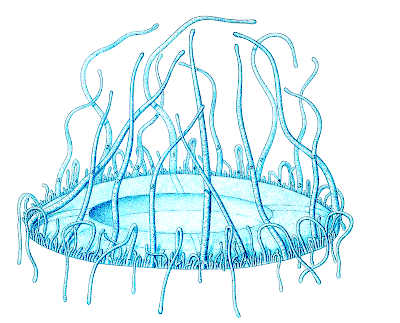
Limnocnida tanganyicae, from Parker (1907).


Belongs within: Medusozoa.

The Limnomedusae are a poorly defined group of hydrozoans with a biphasic life cycle whose medusae have ecto-endodermal statocysts and/or gametogenic tissue along their radial canals, and polyps not covered by a theca (Daly et al. 2007).

Limnomedusae [Limnohydrina] DB07
    |--Vallentinia Browne 1902 P79
    |--Monobrachium Mereschkowsky 1877 P79 [Monobrachiidae DB07]
    |--Scolionema suvaense PP64
    |--Gonionemus Agassiz 1862 P79
    |    `--G. vertens PP64
    |--Olindias Müller 1861 P79 [Olindiasidae DB07]
    |    `--O. phosphorica PP64
    |--Aglauropsis Müller 1865 P79
    |    `--A. aeora LS09
    |--Armorhydra Swedmark & Teissier 1958 CS-P86 [Armorhydridae DB07]
    |    `--A. janowiczi Swedmark & Teissier 1958 CS-P86
    |--Microhydrula CS-P86 [Microhydrulidae DB07]
    |    `--M. pontica CS-P86
    `--Limnocnida Günther 1893 P79 [Limnocnididae G88]
         |--L. tanganyicae LS09
         `--L. victoriae G88

*Type species of generic name indicated

REFERENCES

[CS-P86] Clausen, C., & L. v. Salvini-Plawen. 1986. Cnidaria. In: Botosaneanu, L. (ed.) Stygofauna Mundi: A Faunistic, Distributional, and Ecological Synthesis of the World Fauna inhabiting Subterranean Waters (including the Marine Interstitial) pp. 33–42. E. J. Brill/Dr W. Backhuys: Leiden.

[DB07] Daly, M., M. R. Brugler, P. Cartwright, A. G. Collins, M. N. Dawson, D. G. Fautin, S. C. France, C. S. McFadden, D. M. Opresko, E. Rodriguez, S. L. Romano & J. L. Stake. 2007. The phylum Cnidaria: a review of phylogenetic patterns and diversity 300 years after Linnaeus. Zootaxa 1668: 127–182.

[G88] Gray, J. 1988. Evolution of the freshwater ecosystem: the fossil record. Palaeogeography, Palaeoclimatology, Palaeoecology 62: 1–214.

[LS09] Leclère, L., P. Schuchert, C. Cruaud, A. Couloux & M. Manuel. 2009. Molecular phylogenetics of Thecata (Hydrozoa, Cnidaria) reveals long-term maintenance of life history traits despite high frequency of recent character changes. Systematic Biology 58 (5): 509–526.

[PP64] Peres, J. M., & J. Picard. 1964. Nouveau manuel de bionomie benthique de la mer Mediterranee. Recueil des Travaux de la Station Marine d'Endoume, Bulletin 31 (27): 5–137.

[P79] Petersen, K. W. 1979. Development of coloniality in Hydrozoa. In: Larwood, G., & B. R. Rosen (eds) Biology and Systematics of Colonial Organisms pp. 105–139. Academic Press: London.

Cycloneuralia

Mansonella ozzardi in blood smear, from the Center for Disease Control.


Belongs within: Ecdysozoa.
Contains: Nematomorpha, Kinorhyncha, Priapozoa, Dorylaimia, Enoplia, Desmoscolecida, Monhysterida, Chromadorida, Desmodorida, Araeolaimida, Plectida, Secernentea.

The Cycloneuralia are a clade of worm-like animals in which the brain neuropil forms a ring around the anterior part of the intestinal system. Members include the Nematoda, roundworms, a hyperdiverse group of mostly minute species, though some parasitic forms may reach large sizes. Free-living nematodes have a characteristically eel-like mode of swimming, as the body wall contains longitudinal muscles only and movement is by dorsoventral flexure of these muscles against the outer cuticle and internal hydrostatic pressure. The dorsoventral plane of flexure also means that most nematodes are unusual among animals in characteristically lying on one side during movement (Lorenzen 1986). An early influential classification divided the nematodes between the Secernentea, possessing sensory structures called phasmids, and the Adenophorea, lacking such structures. However, the Secernentea represent a nested clade within the 'Adenophorea', which is no longer recognised as a valid taxon. Instead, molecular analyses strongly support three primarily clades within the nematodes, Dorylaimia, Enoplia and Chromadorea, with the Secernentea a subgroup of the last (Ley & Blaxter 2002).

<==Cycloneuralia [Nematoida] B01
    |--+--Nematomorpha OH17
    |  `--+--Kinorhyncha OH17
    |     `--Priapozoa OH17
    `--Nematoda [Adenophorea, Aphasmidia, Ascaridatina, Nemata, Nematelmia, Nematelminthes, Nemates, Nemathelminthes] OH17
         |  i. s.: Peloderma G01
         |         Caballeronema pseudoargumentosus Mus02
         |         Truttaedacnitis sphaerocephala Mus02
         |         Thynnascaris N02
         |           |--T. aduncum [=Contracaecum aduncum] N02
         |           `--T. habena [=Contracaecum habena] C02a
         |         Hysterothylacium K-M02
         |           |--H. aduncum K-M02
         |           `--H. pelagicum C02b
         |         Contracaecum osculatum Mun02
         |         Spinitectus cristatus K-M02
         |         Benthimermithidae [Benthimermithida] LB02
         |         Rhaptothyreidae [Rhaptothyreida] LB02
         |         Mazamastrongylus odocoilei LB02
         |         Placentonema gigantissimum Gubanov 1951 L86
         |         Histiocephalus bucorvi Gi02
         |         Tanqua tiara Gi02
         |         Cylicodontostomum purvisi Gi02
         |         Agriostomum Gi02
         |         Allodapa suctoria Gi02
         |         Stegophorus Gi02
         |         Striatofilaria Gi02
         |         Setaria digitata B02
         |         Cyathospirura seurati Gi02
         |         Ternidens deminutus Gi02
         |         Streptopharagus pigmentatus Gi02
         |         Gyalocephalus capitatus Gi02
         |         Bunostomum Railliet 1902 C92
         |           `--B. trigonocephalum MM02
         |         Hexametra Gi02
         |         Hyostrongylus rubidus Gi02
         |         Parostertagia heterospiculum Gi02
         |         Ashworthius pattoni Gi02
         |         Hoplodontophorus flagellum Gi02
         |         Paracooperia Gi02
         |         Rhabditolaimus L02a
         |         Ollulanus tricuspis L02a
         |         Probstmayria vivipara MM02
         |         Mesodiplogaster L02a
         |           |--M. biformis Ge02
         |           `--M. lheritieri L02a
         |         Labronema vulvapapillatum L02a
         |         Metadasynemoides cristatus L02b
         |         Acanthonchus duplicatus L02b
         |         Laxus oneistus L02b
         |         Prooncholaimus L02b
         |         Chromadorina L02c
         |           |--C. bioculata L02b
         |           `--C. viridis L02c
         |         Oswaldocruzia leidyi L02b
         |         Paracanthonchus caecus L02b, MV04
         |         Halichoanolaimus sonorus L02b
         |         Aporcellaimellus L02b
         |         Tachygonetria MM02
         |           |--T. robusta MM02
         |           `--T. stylosa MM02
         |         Brumptaemilius MM02
         |         Oxyspirura mansoni MM02
         |         Muellerius capillaris MM02
         |         Discolaimus MM02
         |         Rhadinaphelenchus cocophilus MM02
         |         Folyella dolichoptera L02c
         |         Mansonella Ge02
         |           |--M. ozzardi A71
         |           `--M. perstans Ge02
         |         Pseudorhabdolaimus Soos 1937 E86
         |           `--P. limnophilus Soos 1937 E86
         |         Zeldia punctata GR98
         |         Aduncospiculum halicti GR98
         |         Austronema Cobb 1914 BR05
         |         Longistrongylus curvispiculum KC07
         |         Spiroptera brevisubulata P89
         |         Controtylenchus brevicomi A-B91
         |         Stomachus marinus R59
         |         Ackertia marmotae Webster 1967 MW69
         |         Acarincola hirsutus Warren 1941 S69
         |         Nemavermes mackeei Schram 1973 G88
         |         Cyathostomum Molin 1861 [incl. Trichonema Cobbold 1874 non Ker Gawl. 1802 (ICBN)] C-SCL16
         |         Dorylaimopsis rabalaisi WXH10
         |         Vasostoma longispicula WXH10
         |         Stenolaimus lepturus PP64
         |         Scorpiophagus Størmer 1963 W93
         |           |--S. baculiformis Størmer 1963 W93
         |           `--S. latus Størmer 1963 W93
         |         Pulmostrongylus GC72
         |           |--P. fengi Hsü 1935 GC72
         |           `--P. herpestis (Khera 1956) GC72
         |         Arthrocephalus herpestis Khera 1956 GC72
         |         Diserratosomus mungoosii Mirza 1938 GC72
         |--Enoplea [Penetrantia] LB02
         |    |--Dorylaimia LB02
         |    `--Enoplia LB02
         `--Chromadorea [Chromadoria, Torquentia] LB02
              |  i. s.: Desmoscolecida LB02
              |--Monhysterida LB02
              `--+--Chromadorida LB02
                 `--+--Desmodorida LB02
                    `--+--Araeolaimida LB02
                       `--+--Plectida LB02
                          `--Secernentea LB02

*Type species of generic name indicated

REFERENCES

[A71] Askew, R. R. 1971. Parasitic Insects. Heinemann Educational Books: London.

[A-B91] Athias-Binche, F. 1991. Ecology and evolution of phoresy in mites. In: Dusbábek, F., & V. Bukva (eds) Modern Acarology: Proceedings of the VIII International Congress of Acarology, held in České Budĕjovice, Czechoslovakia, 6–11 August 1990 vol. 1 pp. 27–41. SPB Academic Publishing: The Hague.

[B02] Behm, C. A. 2002. Metabolism. In: Lee, D. L. (ed.) The Biology of Nematodes pp. 261–290. Taylor & Francis: Florence (Kentucky).

[BR05] Bouchet, P., & J.-P. Rocroi. 2005. Classification and nomenclator of gastropod families. Malacologia 47 (1–2): 1–397.

[B01] Budd, G. E. 2001. Tardigrades as 'stem-group' arthropods: the evidence from the Cambrian fauna. Zoologischer Anzeiger 240: 265–279.

[C-SCL16] Cavalier-Smith, T., E. E. Chao & R. Lewis. 2016. 187-gene phylogeny of protozoan phylum Amoebozoa reveals a new class (Cutosea) of deep-branching, ultrastructurally unique, enveloped marine Lobosa and clarifies amoeba evolution. Molecular Phylogenetics and Evolution 99: 275–296.

[C02a] Collette, B. B. 2002a. Toadfishes. Order Batrachoididae. In: Collette, B. B., & G. Klein-MacPhee (eds) Bigelow and Schroeder’s Fishes of the Gulf of Maine 3rd ed. pp. 261–264. Smithsonian Institute Press: Washington.

[C02b] Collette, B. B. 2002b. Dolphinfishes. Family Coryphaenidae. In: Collette, B. B., & G. Klein-MacPhee (eds) Bigelow and Schroeder’s Fishes of the Gulf of Maine 3rd ed. pp. 409–411. Smithsonian Institute Press: Washington.

[C92] Crawford, R. L. 1992. Catalogue of the genera and type species of the harvestman superfamily Phalangioidea (Arachnida). Burke Museum Contributions in Anthropology and Natural History 8: 1–60.

[E86] Eder, R. 1986. Nematoda from continental subterranean aquatic habitats. In: Botosaneanu, L. (ed.) Stygofauna Mundi: A Faunistic, Distributional, and Ecological Synthesis of the World Fauna inhabiting Subterranean Waters (including the Marine Interstitial) pp. 125–132. E. J. Brill/Dr W. Backhuys: Leiden.

[Ge02] Gems, D. 2002. Ageing. In: Lee, D. L. (ed.) The Biology of Nematodes pp. 413–455. Taylor & Francis: Florence (Kentucky).

[GC72] Ghose, R. K., & Y. Chaturvedi. 1972. Extension of range of the mongoose, Herpestes palustris Ghose (Mammalia: Carnivora: Viverridae), with a note on its endoparasitic nematode. Journal of the Bombay Natural History Society 69 (2): 412–413.

[Gi02] Gibbons, L. M. 2002. General organisation. In: Lee, D. L. (ed.) The Biology of Nematodes pp. 31–59. Taylor & Francis: Florence (Kentucky).

[GR98] Giribet, G., & C. Ribera. 1998. The position of arthropods in the animal kingdom: a search for a reliable outgroup for internal arthropod phylogeny. Molecular Phylogenetics and Evolution 9: 481–488.

[G88] Gray, J. 1988. Evolution of the freshwater ecosystem: the fossil record. Palaeogeography, Palaeoclimatology, Palaeoecology 62: 1–214.

[G01] Gupta, S. K. 2001. A conspectus of natural enemies of phytophagous mites and mites as potential biocontrol agents of agricultural pests in India. In: Halliday, R. B., D. E. Walter, H. C. Proctor, R. A. Norton & M. J. Colloff (eds) Acarology: Proceedings of the 10th International Congress pp. 484–497. CSIRO Publishing: Melbourne.

[K-M02] Klein-MacPhee, G. 2002. Cods. Family Gadidae. In: Collette, B. B., & G. Klein-MacPhee (eds) Bigelow and Schroeder’s Fishes of the Gulf of Maine 3rd ed. pp. 223–261. Smithsonian Institute Press: Washington.

[KC07] Krausman, P. R., & A. L. Casey. 2007. Addax nasomaculatus. Mammalian Species 807: 1–4.

[L02a] Lee, D. L. 2002a. Life cycles. In: Lee, D. L. (ed.) The Biology of Nematodes pp. 61–72. Taylor & Francis: Florence (Kentucky).

[L02b] Lee, D. L. 2002b. Cuticle, moulting and exsheathment. In: Lee, D. L. (ed.) The Biology of Nematodes pp. 171–209. Taylor & Francis: Florence (Kentucky).

[L02c] Lee, D. L. 2002c. Behaviour. In: Lee, D. L. (ed.) The Biology of Nematodes pp. 369–387. Taylor & Francis: Florence (Kentucky).

[LB02] Ley, P. de, & M. Blaxter. 2002. Systematic position and phylogeny. In: Lee, D. L. (ed.) The Biology of Nematodes pp. 1–30. Taylor & Francis: Florence (Kentucky).

[L86] Lorenzen, S. 1986. Nematoda: Interstitial nematodes from marine brackish and hypersaline environments. In: Botosaneanu, L. (ed.) Stygofauna Mundi: A Faunistic, Distributional, and Ecological Synthesis of the World Fauna inhabiting Subterranean Waters (including the Marine Interstitial) pp. 133–142. E. J. Brill/Dr W. Backhuys: Leiden.

[MV04] Manylov, O. G., N. S. Vladychenskaya, I. A. Milyutina, O. S. Kedrova, N. P. Korokhov, G. A. Dvoryanchikov, V. V. Aleshin & N. B. Petrov. 2004. Analysis of 18S rRNA gene sequences suggests significant molecular differences between Macrodasyida and Chaetonotida (Gastrotricha). Molecular Phylogenetics and Evolution 30: 850–854.

[MW69] Moss, W. W., & W. A. Webster. 1969. A numerical taxonomic study of a group of selected strongylates (Nematoda). Systematic Zoology 18 (4): 423–443.

[MM02] Munn, E. A., & P. D. Munn. 2002. Feeding and digestion. In: Lee, D. L. (ed.) The Biology of Nematodes pp. 211–232. Taylor & Francis: Florence (Kentucky).

[Mun02] Munroe, T. A. 2002. Herrings. Family Clupeidae. In: Collette, B. B., & G. Klein-MacPhee (eds) Bigelow and Schroeder’s Fishes of the Gulf of Maine 3rd ed. pp. 111–160. Smithsonian Institute Press: Washington.

[Mus02] Musick, J. A. 2002. Sturgeons. Family Acipenseridae. In: Collette, B. B., & G. Klein-MacPhee (eds) Bigelow and Schroeder’s Fishes of the Gulf of Maine 3rd ed. pp. 83–88. Smithsonian Institute Press: Washington.

[N02] Nizinski, M. S. 2002. Sand lances. Family Ammodytidae. In: Collette, B. B., & G. Klein-MacPhee (eds) Bigelow and Schroeder’s Fishes of the Gulf of Maine 3rd ed. pp. 496–505. Smithsonian Institute Press: Washington.

[OH17] Ou, Q., J. Han, Z. Zhang, D. Shu, G. Sun & G. Mayer. 2017. Three Cambrian fossils assembled into an extinct body plan of cnidarian affinity. Proceedings of the National Academy of Sciences of the USA 114 (33): 8835–8840.

[P89] Parona, C. 1889. Sopra alcuni elminti di Vertebrati birmani raccolti da Leonardo Fea. Annali del Museo Civico di Storia Naturale di Genova, Serie 2a, 7: 765–780.

[PP64] Peres, J. M., & J. Picard. 1964. Nouveau manuel de bionomie benthique de la mer Mediterranee. Recueil des Travaux de la Station Marine d'Endoume, Bulletin 31 (27): 5–137.

[R59] Robinson, E. S. 1959. Records of cestodes from marine fishes of New Zealand. Transactions of the Royal Society of New Zealand 86 (1): 143–153.

[S69] Steyskal, G. C. 1969. The mistreatment of the Latin genitive case in forming names of parasites. Systematic Zoology 18 (3): 339–342.

[W93] Wills, M. A. 1993. Miscellania. In: Benton, M. J. (ed.) The Fossil Record 2 pp. 555–560. Chapman & Hall: London.

[WXH10] Wu, X., K. Xu & Y. Huang. 2010. Community structure and spatial distribution of marine benthic nematodes at the late stage of the Yellow Sea macroalgal bloom in 2008. In: China-Russia Bilateral Symposium: Proceedings of the China-Russia Bilateral Symposium of "Comparison on Marine Biodiversity in the Northwest Pacific Ocean", 10–11 October 2010, Qingdao (China) pp. 147–148. Institute of Oceanology, Chinese Academy of Sciences; A. V. Zhirmunsky Institute of Marine Biology, Far East Branch of the Russian Academy of Sciences.

Filifera

Eudendrium racemosum, copyright Peter Schuchert.


Belongs within: Medusozoa.
Contains: Hydractinioidea.

The Filifera are a group of hydrozoans characterised by the possession of filiform tentacles on the feeding polyps, together with desmoneme and eurytele nematocysts (Daly et al. 2007).

Filifera
    |--Eudendriidae [Eudendriida, Eudendrioidea] P79
    |    |--Myrionema Pictet 1893 P79
    |    |    `--M. amboinense T87
    |    `--Eudendrium Ehrenberg 1834 P79
    |         |--E. arbusculum KM17
    |         |--E. armatum PP64
    |         |--E. capillare Alder 1856 VV77
    |         |--E. carneum Clarke 1882 HJ08
    |         |--E. dispar A64
    |         |--E. glomeratum LS09
    |         |--E. racemosum [=Sertularia racemosa] A64
    |         `--E. vaginatum A64
    `--Pandeida P79
         |--Pandeoidea P79
         |    |--Niobia Mayer 1900 [Niobiidae] P79
         |    `--+--Calycopsis BP00 [Calycopsidae P79]
         |       |    `--C. simplex Kramp & Damas 1925 BP00
         |       `--+--Protiara Haeckel 1879 [Protiaridae] P79
         |          `--Pandeidae P79
         |               |--Halitiara Fewkes 1882 P79
         |               |--Paratiara Kramp & Damas 1925 P79
         |               |--Cnidotiara Uchida 1927 P79
         |               `--Leuckartiara BP00
         |                    |--L. brownei Larson & Harbison 1990 BP00
         |                    `--L. octona PP64
         `--+--Bougainvillioidea P79
            |    |--Russelliidae P79
            |    `--+--Perarella DB07 [Cytaeididae P79]
            |       `--Bougainvilliidae P79
            |            |--Clavopsella Stechow 1919 P79
            |            |--Silhouetta Millard & Bouillon 1973 P79
            |            |--Koellikerina Kramp 1939 P79
            |            |--Bimeria Wright 1859 P79
            |            |    `--B. nutans A64
            |            |--Rhizorhagium DB07
            |            |--Velkovrhia Matjašič & Sket 1971 CS-P86
            |            |    `--V. enigmatica Matjašič & Sket 1971 CS-P86
            |            `--Bougainvillia KBC03
            |                 |--B. macloviana PO99
            |                 |--B. muscus LS09
            |                 |--B. ramosa KBC03
            |                 `--B. superciliaris B26
            `--Hydractinioidea P79

Filifera incertae sedis:
  Australomedusidae DB07
  Balella Stechow 1919 P79 [Balellidae DB07]
  Bythotiaridae DB07
  Clathrozoellidae DB07
  Eucodoniidae DB07
  Fabienna [Laingiidae, Laingiomedusae] DB07
    `--F. sphaerica DB07
  Oceanidae DB07
    |--Crucimedusina walcotti (Barbour 1914) NS93
    |--Oceania A64
    |    |--O. armata A64
    |    |--O. cymbaloidea G20
    |    |--O. octona A64
    |    `--O. turrita A64
    `---Turritopsis nutricula A64
  Proboscidactyla S79 [Proboscidactylidae DB07]
    `--P. mutabilis PO99
  Trichydridae DB07
  Podocoryne LS09
    |--P. borealis PO99
    |--P. carnea PP15
    |--P. exigua LS09
    |--P. minuta PO99
    `--P. proboscidea PP64

*Type species of generic name indicated

REFERENCES

[A64] Allman, G. J. 1864. Report on the present state of our knowledge of the reproductive system in the Hydroida. Report of the British Association for the Advancement of Science 33: 351–426.

[B26] Bigelow, H. B. 1926. Plankton of the offshore waters of the Gulf of Maine. Bulletin of the Bureau of Fisheries 40 (2): 1–509.

[BP00] Bouillon, J., F. Pagès, J.-M. Gili, A. Palanques, P. Puig & S. Heussner. 2000. Deep-water hydromedusae from the Lacaze-Duthiers submarine canyon (Banyuls, northwestern Mediterranean) and description of two new genera, Guillea and Parateclaia. Scientia Marina 64 (Suppl. 1): 87–95.

[CS-P86] Clausen, C., & L. v. Salvini-Plawen. 1986. Cnidaria. In: Botosaneanu, L. (ed.) Stygofauna Mundi: A Faunistic, Distributional, and Ecological Synthesis of the World Fauna inhabiting Subterranean Waters (including the Marine Interstitial) pp. 33–42. E. J. Brill/Dr W. Backhuys: Leiden.

[DB07] Daly, M., M. R. Brugler, P. Cartwright, A. G. Collins, M. N. Dawson, D. G. Fautin, S. C. France, C. S. McFadden, D. M. Opresko, E. Rodriguez, S. L. Romano & J. L. Stake. 2007. The phylum Cnidaria: a review of phylogenetic patterns and diversity 300 years after Linnaeus. Zootaxa 1668: 127–182.

[G20] Goldfuss, G. A. 1820. Handbuch der Naturgeschichte vol. 3. Handbuch der Zoologie pt 1. Johann Leonhard Schrag: Nürnberg.

[HJ08] Huisman, J. M., D. S. Jones, F. E. Wells & T. Burton. 2008. Introduced marine biota in Western Australian waters. Records of the Western Australian Museum 25 (1): 1–44.

[KBC03] Kashin, I. A., E. V. Bagaveeva & S. F. Chaplygina. 2003. Fouling communities of hydrotechnical constructions in Nakhodka Bay (Sea of Japan). Russian Journal of Marine Biology 29: 267–283.

[KM17] Korshunova, T., A. Martynov, T. Bakken, J. Evertsen, K. Fletcher, I. W. Mudianta, H. Saito, K. Lundin, M. Schrödl & B. Picton. 2017. Polyphyly of the traditional family Flabellinidae affects a major group of Nudibranchia: aeolidacean taxonomic reassessment with descriptions of several new families, genera, and species (Mollusca, Gastropoda). ZooKeys 717: 1–139.

[LS09] Leclère, L., P. Schuchert, C. Cruaud, A. Couloux & M. Manuel. 2009. Molecular phylogenetics of Thecata (Hydrozoa, Cnidaria) reveals long-term maintenance of life history traits despite high frequency of recent character changes. Systematic Biology 58 (5): 509–526.

[NS93] Nudds, J. R., & J. J. Sepkoski Jr. 1993. Coelenterata. In: Benton, M. J. (ed.) The Fossil Record 2 pp. 101–124. Chapman & Hall: London.

[PO99] Pagès, F., & C. Orejas. 1999. Medusae, siphonophores and ctenophores of the Magellan region. Scientia Marina 63 (Suppl. 1): 51–57.

[PP64] Peres, J. M., & J. Picard. 1964. Nouveau manuel de bionomie benthique de la mer Mediterranee. Recueil des Travaux de la Station Marine d'Endoume, Bulletin 31 (27): 5–137.

[P79] Petersen, K. W. 1979. Development of coloniality in Hydrozoa. In: Larwood, G., & B. R. Rosen (eds) Biology and Systematics of Colonial Organisms pp. 105–139. Academic Press: London.

[PP15] Pisani, D., W. Pett, M. Dohrmann, R. Feuda, O. Rota-Stabelli, H. Philippe, N. Lartillot & G. Wörheide. 2015. Genomic data do not support comb jellies as the sister group to all other animals. Proceedings of the National Academy of Sciences of the USA 112 (50): 15402–15407.

[S79] Shelton, G. A. B. 1979. Co-ordination of behaviour in cnidarian colonies. In: Larwood, G., & B. R. Rosen (eds) Biology and Systematics of Colonial Organisms pp. 141–154. Academic Press: London.

[T87] Trench, R. K. 1987. Dinoflagellates in non-parasitic symbioses. In: Taylor, F. J. R. (ed.) The Biology of Dinoflagellates pp. 530–570. Blackwell Scientific.

[VV77] Vervoort, W., & P. Vasseur. 1977. Hydroids from French Polynesia with notes on distribution and ecology. Zoologische Verhandelingen 159: 1–98.

Hoplocarida

Heterosquilla tricarinata, copyright Svamp.


Belongs within: Eumalacostraca.
Contains: Squillidae, Lysiosquillidae, Gonodactyloidea.

The Hoplocarida, including the mantis shrimps and their fossil relatives, are a group of malacostracan crustaceans bearing a small carapace and at least four free thoracic segments, together with a large abdomen ending in a tail fan.

<==Hoplocarida
    |  i. s.: Neogonodactylus RS10
    |           |--N. bredini SC17
    |           `--N. oerstedii RS10
    |--Perimecturidae [Palaeostomatopoda] BWW93
    |    |--Archaeocaris graffhami Brooks 1962 BWW93
    |    |--Eopteridium striatum Rohdendorf 1970 BWW93
    |    |--Bairdops beargulchensis Schram & Horner 1978 BWW93
    |    `--Perimecturus [incl. Eopterum; Archaeoptera] S77
    |         |--‘Eopterum’ devonicum Rohdendorf 1961 BWW93
    |         `--P. rapax Schram & Horner 1978 BWW93
    |--Aeschronectida G88
    |    |--Kallidechtes [Kallidecthidae] BWW93
    |    |    |--K. eageri Schram 1979 BWW93
    |    |    `--K. richardsoni Schram 1969 BWW93
    |    |--Aratidecthidae BWW93
    |    |    |--Crangopsis BWW93
    |    |    |    |--C. cooperi [=Pygocephalus cooperi] S74
    |    |    |    `--C. eskdalensis (Peach 1882) BWW93
    |    |    `--Aratidecthes johnsoni Schram 1969 BWW93
    |    `--Aenigmacarididae BWW93
    |         |--Joanellia BWW93
    |         |    |--J. elegans (Peach 1883) BWW93
    |         |    `--J. lundi G88
    |         `--Aenigmacaris G88
    |              |--A. cornigerum G88
    |              `--A. minima Schram & Schram 1979 BWW93
    `--Stomatopoda MD01
         |  i. s.: Alima hyalina Leach 1817 C73
         |         Pseudosquillopsis cerisii (Roux 1828) C73
         |         Eurysquilloides [Eurysquilloididae, Eurysquilloidoidea] MD01
         |         Erythrosquillidae [Erythrosquilloidea] MD01
         |--Tyrannophontidae [Archaeostomatopoda] BWW93
         |    |  i. s.: ‘Perimecturus’ pattoni Peach 1908 BWW93
         |    |--Tyrannophontes theridion BWW93
         |    `--Gorgonophontes peleron Schram 1984 BWW93
         `--Unipeltata BWW93
              |--Squillidae BWW93
              |--Bathysquilloidea BWW93
              |    |--Indosquillidae MD01
              |    |--Bathysquilla C73 [Bathysquillidae MD01]
              |    |    |--B. microps (Manning 1961) C73
              |    |    `--B. wetherelli (Woodward 1879) BWW93
              |    `--Sculdidae BWW93
              |         |--Pseudosculda laevis Schluter 1872 BWW93
              |         `--Sculda BWW93
              |              |--S. pennata Münster 1840 BWW93
              |              `--S. syriaca Dames 1886 BWW93
              |--Lysiosquilloidea BWW93
              |    |--Lysiosquillidae C73
              |    |--Coronis C73 [Coronididae MD01]
              |    |    `--C. excavatrix Brooks 1886 C73
              |    |--Nannosquilla C73 [Nannosquillidae MD01]
              |    |    |--N. occulta [=Lysiosquilla occulta] C73
              |    |    |--N. schmitti (Manning 1962) C73
              |    |    `--N. taylori Manning 1969 C73
              |    `--Heterosquilla K-MM02 [Heterosquillidae, Tetrasquillidae MD01]
              |         |--H. armata K-MM02
              |         |--H. brazieri HS01
              |         `--H. tricarinata HS01
              `--Gonodactyloidea BWW93

*Type species of generic name indicated

REFERENCES

[BWW93] Briggs, D. E. G., M. J. Weedon & M. A. Whyte. 1993. Arthropoda (Crustacea excluding Ostracoda). In: Benton, M. J. (ed.) The Fossil Record 2 pp. 321–342. Chapman & Hall: London.

[C73] Camp, D. K. 1973. Stomatopod Crustacea. Memoirs of the Hourglass Cruises 3 (2): 1–100.

[G88] Gray, J. 1988. Evolution of the freshwater ecosystem: the fossil record. Palaeogeography, Palaeoclimatology, Palaeoecology 62: 1–214.

[HS01] Hayward, B. W., A. B. Stephenson, M. S. Morley, W. M. Blom, H. R. Grenfell, F. J. Brook, J. L. Riley, F. Thompson & J. J. Hayward. 2001. Marine biota of Parengarenga Harbour, Northland, New Zealand. Records of the Auckland Museum 37: 45–80.

[K-MM02] Klein-MacPhee, G., & R. S. McBride. 2002. Sea robins. Family Triglidae. In: Collette, B. B., & G. Klein-MacPhee (eds) Bigelow and Schroeder’s Fishes of the Gulf of Maine 3rd ed. pp. 338–345. Smithsonian Institute Press: Washington.

[MD01] Martin, J. W., & G. E. Davis. 2001. An updated classification of the Recent Crustacea. Natural History Museum Los Angeles County, Science Series 39: 1–124.

[RS10] Regier, J. C., J. W. Shultz, A. Zwick, A. Hussey, B. Ball, R. Wetzer, J. W. Martin & C. W. Cunningham. 2010. Arthropod relationships revealed by phylogenomic analysis of nuclear protein-coding sequences. Nature 463: 1079–1083.

[S74] Schram, F. R. 1974. Convergences between Late Paleozoic and modern caridoid Malacostraca. Systematic Zoology 23 (3): 323–332.

[S77] Schram, F. R. 1977. Paleozoogeography of Late Paleozoic and Triassic Malacostraca. Systematic Zoology 26 (4): 367–379.

[SC17] Schwentner, M., D. J. Combosch, J. P. Nelson & G. Giribet. 2017. A phylogenomic solution to the origin of insects by resolving crustacean-hexapod relationships. Current Biology 27: 1818–1824.

Astacidea

Enoplocytia leachii, from here.


Belongs within: Reptantia.
Contains: Astacida, Homarida.

The Astacidea are a clade of decapod crustaceans including the clawed lobsters and crayfish, with most modern representatives having well-developed chelae on the first pereiopods.

Characters (from Amati et al. 2004): Cephalothorax subcylindrical; rostrum and abdomen well developed; frontal portion of carapace not fused with epistome; antennae with five-segmented stalk and scale; third maxilliped pediform; pereiopods chelate, subchelate, or pseudochelate; first pereiopod longest; abdominal pleura well developed; exopods of uropods with diaresis; genital openings coxal.

Astacidea [Astacura, Nephropoidea]
    |  i. s.: Platychelidae BWW93
    |           |--Platypleon nevadense Van Straelen 1936 BWW93
    |           `--Platychela trauthi Glaessner 1931 BWW93
    |         Viriliastacus AFZ04
    |--+--+--Astacida AFZ04
    |  |  `--Homarida DAS03
    |  `--Thaumastochelida DAS03
    |       |--Thaumastochelopsis Bruce 1988 TS03
    |       |--Oncopareia Bosquet 1854 TS03
    |       |    `--O. bredai TS03
    |       `--Thaumastocheles Wood-Mason 1874 [Thaumastochelidae] TS03
    |            |--T. dochmiodon Chan & de Saint Laurent 1999 DAS03
    |            `--T. japonicus TS03
    `--+--Glypheoidea AFZ04
       |    |--Chimaerastacus Amati, Feldmann & Zonneveld 2004 [Chimaerastacidae] AFZ04
       |    |    `--*C. pacifluvialis Amati, Feldmann & Zonneveld 2004 AFZ04
       |    `--+--Neoglyphea inopinata Forest & de Saint Laurent 1975 AFZ04, DAS03
       |       |--Glypheidae FGS04
       |       |    |--Glyphea robusta AFZ04, P98
       |       |    |--Protoclytiopsis antiqua Birshtein 1958 BWW93
       |       |    `--Litogaster von Meyer 1847 [=Lithogaster (l. c.)] FGS04
       |       |         `--L. turnbullensis AFZ04
       |       `--Mecochiridae AFZ04
       |            |  i. s.: ‘Upogebia’ clypeata BWW93
       |            |--Mecochirus AFZ04
       |            |--Meyeria M’Coy 1849 BWW93
       |            `--Pseudoglyphea Oppel 1861 BWW93 [incl. Triasiglyphea van Straelen 1936 AFZ04]
       |                 `--P. mulleri (van Straelen 1936) [=*Triasiglyphea mulleri] AFZ04
       `--Erymoidea AFZ04
            |--Clytiopsis [Clytiopsidae] AFZ04
            |    `--C. argentoratensis Glaessner 1929 BWW93
            `--+--Pemphicidae AFZ04
               |    |--Pseudopemphix Wüst 1903 BWW93
               |    |    `--P. albertii (von Meyer 1840) BWW93
               |    `--Pemphix von Meyer 1840 FGS04
               |         `--P. sueurii (Desmarest 1822) BWW93
               `--Erymidae AFZ04
                    |  i. s.: Lissocardia von Meyer 1851 FGS04
                    |--Eryma von Meyer 1840 AFZ04, TS03
                    `--+--Phlyctisoma AFZ04
                       `--Enoplocytia McCoy 1849 AFZ04, E14
                            |--*E. leachii [=Astacus leachii] E14
                            |--E. terrareginae Etheridge 1914 E14
                            `--E. ventricosa E14

*Type species of generic name indicated

REFERENCES

[AFZ04] Amati, L., R. M. Feldmann & J.-P. Zonneveld. 2004. A new family of Triassic lobsters (Decapoda: Astacidea) from British Columbia and its phylogenetic context. Journal of Paleontology 78 (1): 150–168.

[BWW93] Briggs, D. E. G., M. J. Weedon & M. A. Whyte. 1993. Arthropoda (Crustacea excluding Ostracoda). In: Benton, M. J. (ed.) The Fossil Record 2 pp. 321–342. Chapman & Hall: London.

[DAS03] Dixon, C. J., S. T. Ahyong & F. R. Schram. 2003. A new hypothesis of decapod phylogeny. Crustaceana 76: 935–975.

[E14] Etheridge, R., Jr. 1914. The genus Enoploclytia in the Cretaceous rocks of Queensland. Records of the Australian Museum 10 (9): 271–273, pls 23–24.

[FGS04] Feldmann, R. M., A. A. Garassino & C. E. Schweitzer. 2004. The presumed decapod, Palaeopemphix Gemmellaro, 1890, is a unique member of the Phyllocarida (Palaeopemphicida: Palaeopemphidae). Journal of Palaeontology 78: 340–348.

[P98] Prothero, D. R. 1998. Bringing Fossils to Life: An introduction to paleobiology. WCB McGraw-Hill: Boston.

[TS03] Tshudy, D., & U. Sorhannus. 2003. Hoploparia, the best-known fossil clawed lobster (family Nephropidae), is a “wastebasket” genus. Journal of Crustacean Biology 23 (3): 700–711.