Pelecocrinidae

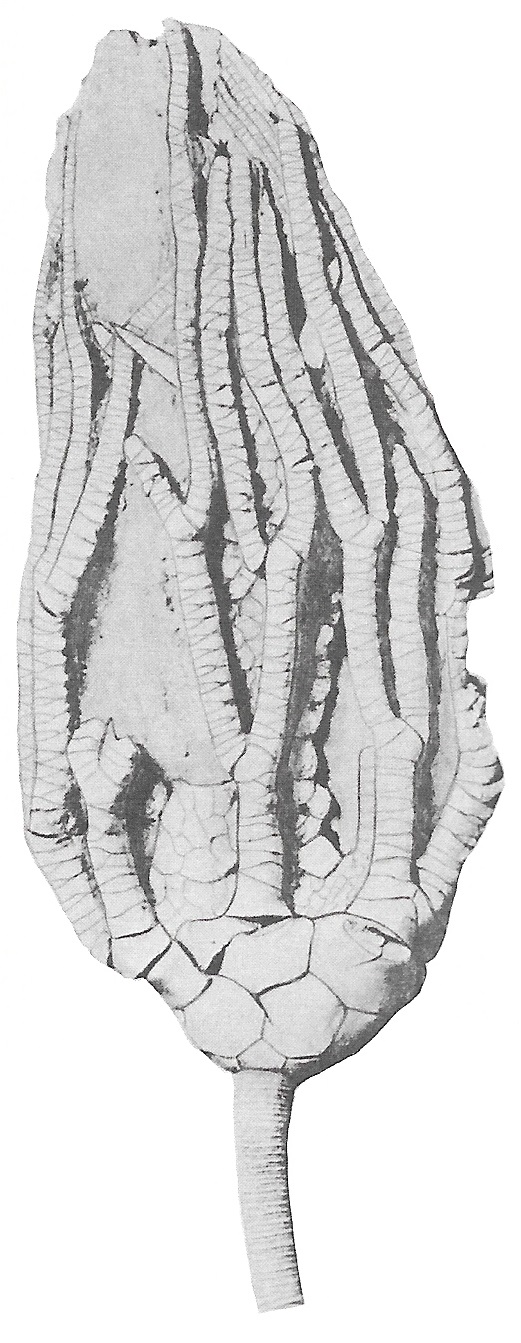
Pelecocrinus insignis, from Moore et al. (1978).


Belongs within: Dendrocrinida.

The Pelecocrinidae are a group of crinoids with tall, ovoid crowns known from the Carboniferous and Permian periods (Moore et al. 1978).

See also: The Pelecocrinidae.

Characters (from Moore et al. 1978): Crown tall, ovoid. Cup low, bowl-shaped, with shallow basal concavity; infrabasals five, rarely four, barely visible or not visible in side view; radial articular facets peneplenary, narrower than radials, inclined slightly to strongly outward-downward, with prominent transverse ridge, interradial notches distinct; three anal plates in cup. Arms isotomous where known, pinnulate, with wedge-shaped brachials.

Pelecocrinidae
    |--Pelecocrinus Kirk 1941 ML78
    |    `--*P. insignis Kirk 1941 ML78
    |--Depaocrinus Wanner 1937 ML78
    |    `--*D. ottowi Wanner 1937 ML78
    |--Exoriocrinus Strimple & Moore 1971 ML78
    |    `--*E. lasallensis (Worthen in Worthen & Meek 1875) [=Poteriocrinus lasallensis] ML78
    |--Forthocrinus Wright 1942 ML78
    |    `--*F. lepidus Wright 1942 ML78
    |--Malaiocrinus Wanner 1924 ML78
    |    `--*M. sundaicus (Wanner 1916) [=Zeacrinus sundaicus] ML78
    `--Tetrabrachiocrinus Yakovlev 1934 [=Heterobrachiocrinus Yakovlev 1938] ML78
         `--*T. fabianii Yakovlev 1934 [=*Heterobrachiocrinus fabianii] ML78

*Type species of generic name indicated

REFERENCES

[ML78] Moore, R. C., N. G. Lane, H. L. Strimple, J. Sprinkle & R. O. Fay. 1978. Inadunata. In: Moore, R. C., & C. Teichert (eds) Treatise on Invertebrate Paleontology pt T. Echinodermata 2. Crinoidea vol. 2 pp. T520–T759. The Geological Society of America, Inc.: Boulder (Colorado), and The University of Kansas: Lawrence (Kansas).

Eotetranychus

Eotetranychus tiliarum, from Plant Parasites of Europe.


Belongs within: Tetranychinae.

Eotetranychus is a genus of spider mites with duplex setae on tarsus I approximate, and empodium comprising three pairs of hairs with the ventral pair slightly stronger (Baker & Pritchard 1960).

Characters (from Baker & Pritchard 1960): Propodosoma with three pairs of dorsal setae. Opisthosoma with two pairs of para-anal setae. Tarsus I with two approximate pairs of duplex setae dorsally. True claw pad-like with terminal pair of tenent hairs. Empodium (excluding legs I and II of male) consisting of three pairs of hairs, ventral pair slightly stronger, without tenent hairs.

<==Eotetranychus Oudemans 1931 H98
    |--E. tiliarum NG96
    `--+--E. carpini NG96
       |    |--E. c. carpini WL09
       |    |--E. c. borealis WL09
       |    `--E. c. vitis WL09
       `--E. coryli NG96

Eotetranychus incertae sedis:
  E. ancora Baker & Pritchard 1960 BP60
  E. baltazari BY99
  E. cactorum Baker & Pritchard 1960 BP60
  E. celtis CK01
  E. cendanai H07
  E. cernuus Baker & Pritchard 1960 BP60
  E. cybebus Baker & Pritchard 1960 BP60
  E. cyphus Baker & Pritchard 1960 BP60
  E. georgicus BP60
  E. hicoriae S91
  E. hirsti WL09
  E. hudsoni Miller 1966 H98
  E. kankitus BY99
  E. lewisi WL09
  E. lomandrae Davis 1968 H98
  E. mandensis G91
  E. mathyssei S91
  E. maxime G91
  E. oryzae BY99
  E. perplexus BP60
  E. pronus Davis 1968 H98
  E. pruni WL09
  E. pseudomori Davis 1968 H98
  E. queenslandicus Manson 1967 H98
  E. sexmaculatus (Riley 1890) [=Tetranychus sexmaculatus] H98
  E. smithi BY99
  E. uncatus WL09
  E. willamettei WL09
  E. yumensis NMF07

*Type species of generic name indicated

REFERENCES

[BP60] Baker, E. W., & A. E. Pritchard. 1960. The tetranychoid mites of Africa. Hilgardia 29 (11): 455–574.

[BY99] Bakker, F. M., & J. S. Yaninek. 1999. Mite pests in tropical agriculture. In: Needham, G. R., R. Mitchell, D. J. Horn & W. C. Welbourn (eds) Acarology IX vol. 2. Symposia pp. 255–263. Ohio Biological Survey: Columbus (Ohio).

[CK01] Charanasri, V., & M. Kongchuensin. 2001. Species and population densities of mites on jujube. In: Halliday, R. B., D. E. Walter, H. C. Proctor, R. A. Norton & M. J. Colloff (eds) Acarology: Proceedings of the 10th International Congress pp. 419–422. CSIRO Publishing: Melbourne.

[G91] Gupta, S. K. 1991. The mites of agricultural importance in India with remarks on their economic status. In: Dusbábek, F., & V. Bukva (eds) Modern Acarology: Proceedings of the VIII International Congress of Acarology, held in České Budĕjovice, Czechoslovakia, 6–11 August 1990 vol. 1 pp. 509–522. SPB Academic Publishing: The Hague.

[H98] Halliday, R. B. 1998. Mites of Australia: A checklist and bibliography. CSIRO Publishing: Collingwood.

[H07] Ho, C.-C. 2007. Crop mite pests of southeast Asia and tropical far east. In: Morales-Malacara, J. B., V. M. Behan-Pelletier, E. Ueckermann, T. M. Pérez, E. G. Estrada-Venegas & M. Badii (eds) Acarology XI: Proceedings of the International Congress pp. 259–266. Instituto de Biología and Faculdad de Ciencias, Universidad Nacional Autónoma de México, Sociedad Latinoamericana de Acarología: México.

[NG96] Navajas, M., & J. Gutierrez. 1996. Molecular phylogeny in spider mites (Tetranychidae). In: Mitchell, R., D. J. Horn, G. R. Needham & W. C. Welbourn (eds) Acarology IX vol. 1. Proceedings pp. 305–308. Ohio Biological Survey: Columbus (Ohio).

[NMF07] Navia, D., G. J. de Moraes & C. H. W. Flechtmann. 2007. Phytophagous mites as invasive alien species: quarantine procedures. In: Morales-Malacara, J. B., V. M. Behan-Pelletier, E. Ueckermann, T. M. Pérez, E. G. Estrada-Venegas & M. Badii (eds) Acarology XI: Proceedings of the International Congress pp. 307–316. Instituto de Biología and Faculdad de Ciencias, Universidad Nacional Autónoma de México, Sociedad Latinoamericana de Acarología: México.

[S91] Sabelis, M. W. 1991. Life-history evolution of spider mites. In: Schuster, R., & P. W. Murphy (eds) The Acari: Reproduction, development and life-history strategies pp. 23–49. Chapman & Hall: London.

[WL09] Walter, D. E., E. E. Lindquist, I. M. Smith, D. R. Cook & G. W. Krantz. 2009. Order Trombidiformes. In: Krantz, G. W., & D. E. Walter (eds) A Manual of Acarology 3rd ed. pp. 233–420. Texas Tech University Press.

Bryobiinae

Clover mite Bryobia praetiosa, copyright Rayanne Lehman.


Belongs within: Tetranychoidea.

The Bryobiinae are a group of spider mites possessing terminal duplex sets on tarsi I–II, tenent hairs on the leg empodia, and unmodified palptarsal eupathidia (Walter et al. 2009).

<==Bryobiinae
    |  i. s.: Aplonobia Womersley 1940 WL09, H98
    |           |--A. citri Meyer 1974 H98
    |           `--A. histricina (Berlese 1910) [=Tetranychopsis histricina; incl. A. oxalis Womersley 1940] H98
    |--Neotrichobia Tuttle & Baker 1968 [Neotrichobiini] BT72
    |    `--*N. arizonensis Tuttle & Baker 1968 BT72
    |--Petrobiini BT72
    |    |--Schizonobia Womersley 1940 BT72
    |    |    `--*S. sycophanta Womersley 1940 BT72
    |    `--Petrobia Murray 1877 H98
    |         |--P. apicalis WL09
    |         |--P. (Tetranychina) harti (Ewing 1909) BWA03, BP60 (see below for synonymy)
    |         |--P. (Petrobia) latens (Müller 1776) BWA03, H98 [=Acarus latens H98; incl. P. cephae Sayed 1946 BP60]
    |         |--P. moutiai Baker & Pritchard 1960 BP60
    |         `--P. zachvatkini BP60
    |--Bryobiini BT72
    |    |--Bryobiella Tuttle & Baker 1968 BT72
    |    |    `--*B. desertorum Tuttle Baker 1968 BT72
    |    |--Pseudobryobia McGregor 1950 BT72
    |    |    |--*P. bakeri McGregor 1950 BT72
    |    |    |--P. canescens Baker & Tuttle 1972 BT72
    |    |    |--P. curiosae BT72
    |    |    |--P. drummondi BT72
    |    |    |--P. ephedrae [=Bryobia ephedrae] BT72
    |    |    |--P. filifoliae [=Bryobia filifoliae] BT72
    |    |    `--P. longisetis BT72
    |    `--Bryobia Koch 1836 H98
    |         |--*B. praetiosa Koch 1836 SB63 [incl. B. pratensis QH01]
    |         |--B. annatensis Manson 1967 SL71
    |         |--B. cristata (Dugès 1834) [=Tetranychus cristata] H98
    |         |--B. eharai G91
    |         |--B. glacialis Berlese 1913 SB63
    |         |--B. graminum WL09
    |         |--B. kissophila Eyndhoven 1955 H98
    |         |--B. redicorzevi RC91
    |         |--B. repensi Manson 1967 H98
    |         |--B. ribis WL09
    |         |--B. rubrioculus (Scheuten 1857) H98 (see below for synonymy)
    |         |--B. speciosa Koch 1838 SB63 [incl. B. nobilis CF77]
    |         |--B. variabilis Manson 1967 SL71
    |         `--B. watersi Manson 1967 SL71
    `--Hystrichonychini BT72
         |--Porcupinychus BT72
         |--Tetranycopsis Canestrini 1889 BT72
         |    |--*T. horridus [=Tetranychus horridus] BT72
         |    `--T. potentilla Baker & Tuttle 1972 BT72
         |--Mcgregorella Baker & Tuttle 1972 BT72
         |    |--*M. incana Baker & Tuttle 1972 BT72
         |    `--M. trifida Baker & Tuttle 1972 BT72
         |--Neopetrobia Wainstein 1956 BT72
         |    |--*N. dubinini Wainstein 1956 BT72
         |    |--N. bouteloua Baker & Tuttle 1972 BT72
         |    `--N. mcgregori BT72
         |--Hystrichonychus McGregor 1950 [incl. Neotetranycopsis Bagdasarian 1951] BT72
         |    |--*H. gracilipes (Banks 1900) [=Tetranychus gracilipes] BT72
         |    |--H. hymenoclea Baker & Tuttle 1972 BT72
         |    |--H. sidae Pritchard & Baker 1955 BT72
         |    `--H. spinosus Tuttle & Baker 1968 BT72
         |--Monoceronychus McGregor 1945 BT72
         |    |--*M. californicus McGregor 1945 BT72
         |    |--M. boreus Krantz 1962 BT72
         |    |--M. bouteloua Baker & Tuttle 1972 BT72
         |    |--M. linki MF07
         |    `--M. mcgregori W87
         |--Georgiobia Wainstein 1960 BT72
         |    |--*G. shirakensis [=Petrobia shirakensis] BT72
         |    |--G. ambrosiae Tuttle & Baker 1968 BT72
         |    |--G. deina BT72
         |    |--G. haplopappi Tuttle & Baker 1968 BT72
         |    `--G. trifida Baker & Tuttle 1972 BT72
         `--Paraplonobia Wainstein 1960 BT72
              |  i. s.: P. coldeniae BT72
              |--P. (Paraplonobia) BT72
              |    |--*P. (P.) echinopsile [=Aplonobia (*P.) echinopsile] BT72
              |    `--P. (P.) bouteloua Baker & Tuttle 1972 BT72
              `--P. (‘Langella’ Wainstein 1961 non Mendes 1961) BT72
                   |--P. (*L.) dyschima [=Aplonobia dyschima] BT72
                   |--P. (L.) allionia Baker & Tuttle 1972 BT72
                   |--P. (L.) artemisia Baker & Tuttle 1972 BT72
                   |--P. (L.) berberis Baker & Tuttle 1972 BT72
                   |--P. (L.) boutelouae BT72
                   `--P. (L.) brickellia Baker & Tuttle 1972 BT72

Bryobia rubrioculus (Scheuten 1857) H98 [=Sannio rubrioculus H98; incl. B. arborea Morgan & Anderson 1957 BP60, B. rubrioculus f. prunicola Mathys 1957 SL71]

Petrobia (Tetranychina) harti (Ewing 1909) BWA03, BP60 [=Neophyllobius harti BP60; incl. Tetranychina agerati Sayed 1946 BP60]

*Type species of generic name indicated

REFERENCES

[BP60] Baker, E. W., & A. E. Pritchard. 1960. The tetranychoid mites of Africa. Hilgardia 29 (11): 455–574.

[BT72] Baker, E. W., & D. M. Tuttle. 1972. New species and further notes on the Tetranychoidea mostly from the southwestern United States (Acarina: Tetranychidae and Tenuipalpidae). Smithsonian Contributions to Zoology 116: 1–37.

[BWA03] Beard, J. J., D. E. Walter & P. G. Allsopp. 2003. Spider mites of sugarcane in Australia: a review of grass-feeding Oligonychus Berlese (Acari: Prostigmata: Tetranychidae). Australian Journal of Entomology 42: 51–78.

[CF77] Canestrini, G., & F. Fanzago. 1877. Intorno agli Acari Italiani. Atti del Reale Istituto Veneto di Scienze, Lettere ed Arti, Serie 5, 4: 69–208, pls 2–7.

[G91] Gupta, S. K. 1991. The mites of agricultural importance in India with remarks on their economic status. In: Dusbábek, F., & V. Bukva (eds) Modern Acarology: Proceedings of the VIII International Congress of Acarology, held in České Budĕjovice, Czechoslovakia, 6–11 August 1990 vol. 1 pp. 509–522. SPB Academic Publishing: The Hague.

[H98] Halliday, R. B. 1998. Mites of Australia: A checklist and bibliography. CSIRO Publishing: Collingwood.

[MF07] Moraes, G. J. de, & C. H. W. Flechtmann. 2007. Phytophagous mites of tropical crops in eastern South America. In: Morales-Malacara, J. B., V. M. Behan-Pelletier, E. Ueckermann, T. M. Pérez, E. G. Estrada-Venegas & M. Badii (eds) Acarology XI: Proceedings of the International Congress pp. 279–288. Instituto de Biología and Faculdad de Ciencias, Universidad Nacional Autónoma de México, Sociedad Latinoamericana de Acarología: México.

[QH01] Qin, T.-K., & R. C. Henderson. 2001. Taxonomy of New Zealand Prostigmata: past, present and future. In: Halliday, R. B., D. E. Walter, H. C. Proctor, R. A. Norton & M. J. Colloff (eds) Acarology: Proceedings of the 10th International Congress pp. 35–39. CSIRO Publishing: Melbourne.

[RC91] Ragusa Di Chiara, S. 1991. Using native phytoseiids in agricultural cropping systems. In: Dusbábek, F., & V. Bukva (eds) Modern Acarology: Proceedings of the VIII International Congress of Acarology, held in České Budĕjovice, Czechoslovakia, 6–11 August 1990 vol. 1 pp. 159–166. SPB Academic Publishing: The Hague.

[SB63] Schweizer, J., & C. Bader. 1963. Die Landmilben der Schweiz (Mittelland, Jura und Alpen): Trombidiformes Reuter, mit 217 Arten und Unterarten und 193 Originalzeichnungen. Denkschriften der Schweizerischen Naturforschenden Gesellschaft [Mémoires de la Société Helvétique des Sciences Naturelles] 84 (2): i–vi, 209–378.

[SL71] Spain, A. V., & M. Luxton. 1971. Catalog and bibliography of the Acari of the New Zealand subregion. Pacific Insects Monograph 25: 179–226.

[W87] Walter, D. E. 1987. Belowground arthropods of semiarid grasslands. In: J. L. Capinera (ed.) Integrated Pest Management on Rangeland: A shortgrass prairie perspective pp. 271–290. Westview Press, Inc.: Boulder (Colorado).

[WL09] Walter, D. E., E. E. Lindquist, I. M. Smith, D. R. Cook & G. W. Krantz. 2009. Order Trombidiformes. In: Krantz, G. W., & D. E. Walter (eds) A Manual of Acarology 3rd ed. pp. 233–420. Texas Tech University Press.
Tuckerella

Tuckerella japonica, from Beard et al. (2012).


Belongs within: Tetranychoidea.

Tuckerella, the peacock mites, is a genus of phytophagous mites characterised by long, flagellate setae on the rear of the opisthosoma.

Characters (from Meyer & Ueckermann 1997): Body oval to elongate; dorsum smooth or reticulated, divided into prodorsum and opisthosoma; dorsal setae mostly large and palmate: 4 pairs on prodorsum and 18 on opisthosoma, which also bears 4 to 7 pairs of long, flagellate caudal setae; prodorsum usually with 2 pairs of eyes, 1 pair on each side, rarely absent; palpus five-segmented, with a dorsal claw on tibia, forming a "thumb-claw" complex; all tarsi with paired uncinate claws and padlike empodia, each with series of tenent hairs; tarsi I and II each with 1 or 2 rodlike solenidia, not associated with setae as duplex sets; female genital aperture subtriangular, not covered by a shield. Male genitalia with a pair of genital stylets flanking the aedeagus.

<==Tuckerella Womersley 1940 [Tuckerellidae] BW05
    |--*T. ornata (Tucker 1926) [=Tenuipalpus ornata] BW05
    |--T. ablutus Chaudhri 1974 MU97
    |--T. anommata Meyer & Ueckermann 1997 MU97
    |--T. channabasavannai Malik & Kumar 1992 MU97
    |--T. coleogynis Jorgensen 1967 MU97
    |--T. delhiensis Ghai & Maninder 1976 MU97
    |--T. elegans Rossi de Simons 1972 MU97
    |--T. eloisae Servin & Otero 1989 MU97
    |--T. equalis Chaudhri 1971 MU97
    |--T. filipina BW05
    |--T. flabellifera Miller 1964 MU97 [=T. flabellifer (l. c.) H98]
    |--T. ghotkiensis Chaudhri 1974 MU97
    |--T. hypoterra McDaniel, Morihara & Lewis 1975 MU97
    |--T. indica Prasad 1973 MU97
    |--T. japonica Ehara 1975 MU97
    |--T. knorri Baker & Tuttle 1975 MU97
    |--T. kumaonensis Gupta 1979 MU97
    |--T. litoralis Collyer 1969 MU97
    |--T. murreensis Chaudhri 1971 MU97
    |--T. nilotica Zaher & Rasmy 1969 MU97
    |--T. pavoniformis (Ewing 1922) [=Eupalopsis parvoniformis] BW05
    |--T. revelata Beard & Walter BW05
    |--T. saetula Chuadhri 1971 MU97
    |--T. spechtae Womersley 1957 BW05
    `--T. xiamenensis Lin 1982 MU97

*Type species of generic name indicated

REFERENCES

[BW05] Beard, J. J., & D. E. Walter. 2005. A new species of Tuckerella (Prostigmata: Tetranychoidea: Tuckerellidae) from Australia with descriptions of all stages and a discussion of the tritonymphal stage. Acarologia 45 (1): 49–60.

[H98] Halliday, R. B. 1998. Mites of Australia: A checklist and bibliography. CSIRO Publishing: Collingwood.

[MU97] Meyer, M. K. P. S., & E. A. Ueckermann. 1997. A review of some species of the families Allochaetophoridae, Linotetranidae and Tuckerellidae (Acari: Tetranychoidea). International Journal of Acarology 23 (2): 67–92.

Acaropsellini

Dorsum of gnathosoma and distal segments of leg I of female Chelacaropsis moorei, from Baker (1949).


Belongs within: Cheyletidae.

The Acaropsellini are a group of cheyletid mites found in association with plants or soil, or occasionally in bird or rodent nests (Bochkov & Fain 2001).

Characters (from Bochkov & Fain 2001): Gnathosoma well developed, about 30% or more length of idiosoma, without protrusions. Gnathosomal apex with or without short median protuberances. Palpal tarsus of female with one well-developed comb-like seta, one slightly barbed dorsal seta and two well-developed sickle-like ventral setae; male with one shortly barbed seta, one short nude seta and two sickle-like setae. Palpal claws slightly curved medially, with teeth, not thickened. All setae of palpal tibia hair-like. Palpal femur with 3 setae, palpal genu with 2 setae, not fused with femur, without protrusions, ventral seta of palpal genu situated at base of segment. Idiosoma ovoid. Eyes present. Shoulder-like projections of idiosoma absent. All idiosomal setae not exceeding half of idiosomal length. Neotrichial setae present or absent. Length of all legs not exceeding idiosomal length. Legs IV normally developed. Tarsi slender, with knobs not extending to pretarsus. Guard seta of tarsus I short, solenidion ω1 situated in basal half of tarsus I. Solenidions on tibia I-II present. Genu I with rod-like solenidion. Seta v1 of tarsus I situated at same level as solenidion ω1 and guard seta. Pretarsus and claws present on all legs. Apical seta of tarsus I normally long. Tarsal setae p' and p" hair-like. Coxae III with 2 setae. Trochanters I-IV with 1 seta. Distance between coxae II and III less than half of idiosomal width.

<==Acaropsellini [Acaropseini] BF01
    |  i. s.: Acaropsis Moquin-Tandon 1863 B49
    |           |--*A. mericourti (Laboulbene 1851) [=Tyroglyphus mericourti; incl. A. pectinata] B49
    |           |--A. aegyptiaca NK94
    |           |--A. callida Kuzin in Rodendorf 1940 B49
    |           |--A. kulagini Rodendorf 1940 B49
    |           |--A. rufus (Karpelles 1884) [=Cheyletus rufus] B49
    |           |--A. sollers Kuzin in Rodendorfg 1940 B49
    |           `--A. travisi Baker 1949 B49
    |--Neoacaropsis Volgin 1962 BF01
    |--Acaropsella Volgin 1962 BF01
    |    `--A. aegyptiaca E-KO07
    |--Acaropsellina Summers 1976 BF01
    |    `--A. docta (Berlese 1886) [=Cheyletus doctus, Acaropsis docta] H98
    |--Paracaropsis Volgin 1969 BF01
    |    `--P. travisi Baker 1949 BF01
    |--Chelacaropsis Baker 1949 BF01
    |    |--*C. moorei Baker 1949 B49
    |    `--C. terrestris Corpuz-Raros & Sott 1977 C-RSV-S88
    `--+--Atarsacheylus BF01
       |--Chelacheles Baker 1958 BF01
       |    `--C. peritremaculatus QA91
       `--Neochelacheles Smiley & Williams 1972 BF01
            `--N. messersmithi Smiley & Williams 1972 BF01

*Type species of generic name indicated

REFERENCES

[B49] Baker, E. W. 1949. A review of the mites of the family Cheyletidae in the United States National Museum. Proceedings of the United States National Museum 99 (3238): 267–320.

[BF01] Bochkov, A. V., & A. Fain. 2001. Phylogeny and system of the Cheyletidae (Acari: Prostigmata) with special reference to their host-parasite associations. Bulletin de l’Institut Royal des Sciences Naturelles de Belgique Entomologie 71: 5–36.

[C-RSV-S88] Corpuz-Raros, L. A., G. C. Sabio & M. Velasco-Soriano. 1988. Mites associated with stored products, poultry houses and house dust in the Philippines. Philippine Entomologist 7 (3): 311–321.

[E-KO07] El-Kammah, K. M., & L. M. I. Oyoun. 2007. Taxonomic records of mite species associated with animal and poultry farms in the Nile delta, vally and N. Sinai Egypt. In: Morales-Malacara, J. B., V. M. Behan-Pelletier, E. Ueckermann, T. M. Pérez, E. G. Estrada-Venegas & M. Badii (eds) Acarology XI: Proceedings of the International Congress pp. 223–232. Instituto de Biología and Faculdad de Ciencias, Universidad Nacional Autónoma de México, Sociedad Latinoamericana de Acarología: México.

[H98] Halliday, R. B. 1998. Mites of Australia: A checklist and bibliography. CSIRO Publishing: Collingwood.

[NK94] Norton, R. A., & J. B. Kethley. 1994. Ecdysial cleavage lines of acariform mites (Arachnida, Acari). Zoologica Scripta 23 (3): 175–191.

[QA91] Quintero, M. T., & H. A. Acevedo. 1991. Studies on deep litter mites on farms in Mexico. In: Dusbábek, F., & V. Bukva (eds) Modern Acarology: Proceedings of the VIII International Congress of Acarology, held in České Budĕjovice, Czechoslovakia, 6–11 August 1990 vol. 1 pp. 443–448. SPB Academic Publishing: The Hague.

Ornithocheyletiini

Ovigerous female of Ornithocheyletia hallae, from Macchioni (2003).


Belongs within: Cheyletiellidae.

The Ornithocheyletiini are a group of cheyletid mites specialised for parasitism on birds, characterised by enlarged tarsal claws with an apical knob on the dorsum of the tarsus almost completely covering the pretarsus and claws (Bochkov & Fain 2001).

Characters (from Bochkov & Fain 2001): Gnathosoma less than 30% of idiosomal length, without protrusions. Gnathosomal apex with short median protuberances. Palpal tarsi with 4-3 short nude setae. Palpal claws curved ventrolaterally, without teeth, not thickened. All setae of palpal tibia hair-like. Palpal femur with three setae, palpal genu with two setae not fused with femur, without protrusions or with small protrusions. Idiosoma ovate. Eyes absent. Shoulder-like projections of idiosoma absent. All idiosomal setae, excluding 15, not exceeding half of idiosomal length. Neotrichial setae absent. Length of all legs not exceeding idiosomal length. Legs IV normally developed. Tarsi thickened with knobs covering pretarsus. Guard seta of tarsus I hair-like, solenidion ω1 situated in apical half of tarsus I. Tibia I with solenidion. Tibia II without solenidion. Genu I with rod-like solenidion or globular. Seta v1 of tarsus I situated at same level as solenidion ω1 and guard seta. Pretarsus and well-developed claws present on all legs. Apical seta of tarsus I normally long. Tarsal setae p' and p" hair-like, but sometimes deeply dissected or feather-like. Coxae III with 2-1 setae. Trochanters III-IV with or without seta. Distance between coxae II and III less than half of the idiosomal width.

<==Ornithocheyletiini [Ornithocheyletiinae]
    |  i. s.: Ornithocheyla Lawrence 1959 S77
    |           `--*O. megaphallos Lawrence 1959 S77
    |--+--Bakericheyla Volgin 1966 BF01
    |  |    |--*B. chanayi (Berlese & Trouessart 1889) S77 [=Cheyletiella chanayi H98, Neocheyletiella chanayi H98]
    |  |    |    |--B. c. chanayi BF01
    |  |    |    `--B. c. latior BF01
    |  |    |--B. africana BF01
    |  |    |--B. benoiti BF01
    |  |    |--B. faini BF01
    |  |    |--B. subquadrata BF01
    |  |    `--B. transvaalica BF01
    |  `--+--Apodicheles Fain 1976 [Apodichelini] BF01
    |     `--Neocheyletiella Baker 1949 [Neocheyletiellini] BF01
    |          |--*N. rohweri Baker 1949 B49
    |          |--N. aegithali Bochkov & OConnor 2003 MB14
    |          |--N. amandavae Fain 1972 MB14
    |          |--N. ardeola Bochkov & Ochoa 2005 MB14
    |          |--N. artami Domrow 1966 H98
    |          |--N. avicola Fain 1972 MB14
    |          |--N. athene Fain & Bochkov 2002 MB14
    |          |--N. canadensis (Banks 1909) [=Cheyletiella canadensis] B49
    |          |--N. heteropalpus (Megnin 1878) (see below for synonymy) B49
    |          |--N. lonchurae Fain & Bochkov 2002 MB14
    |          |--N. macronycha (Megnin 1878) [=Cheyletus macronycha, Cheletiella macronycha] B49
    |          |--N. media Fain 1972 [incl. N. alfortensis Guilhon & Euzeby 1984] MB14
    |          |--N. megaphallos (Lawrence 1959) MB14
    |          |--N. microrhyncha (Berlese & Trouessart 1889) [=Cheyletiella microrhyncha, Cheletiella microrhyncha] B49
    |          |--N. nectarinia Bochkov & OConnor 2003 MB14
    |          |--N. oudemansi Volgin 1969 [incl. N. callawayae Smiley 1970] S77
    |          |--N. parvisetosa Mertins & Bochkov 2014 MB14
    |          |--N. pinguis (Berlese 1889) [=Cheyletiella pinguis, Cheletiella pinguis] B49
    |          |--N. pittae Fain 1972 MB14
    |          |--N. queleae Fain & Bochkov 2002 MB14
    |          |--N. siva Fain 1972 MB14
    |          |--N. smallwoodae Baker 1949 B49
    |          `--N. vestergaardi Smiley 1977 S77
    `--Ornithocheyletia Volgin 1964 BF01
         |--*O. dubinini Volgin 1964 S77
         |--O. aitkeni BF01
         |--O. argentinensis BF01
         |--O. barri Smiley 1977 S77
         |--O. canadensis BF01
         |--O. eulabes BF01
         |--O. francolini BF01
         |--O. garrulax BF01
         |--O. geopeliae BF01
         |--O. gersoni S77
         |--O. granatina BF01
         |--O. hallae BF01
         |    |--O. h. hallae BF01
         |    `--O. h. similis BF01
         |--O. lamprocolius BF01
         |--O. lawrenceae Smiley 1970 H98
         |--O. lepidus BF01
         |--O. leiothrix BF01
         |--O. lichmerae Smiley 1984 [=Orinthocheyletia (l. c.) lichmerae] H98
         |--O. lonchurae Smiley 1984 H98
         |--O. lukoschusi BF01
         |--O. mironovi BF01
         |--O. phylloscopi BF01
         |--O. pinguis BF01
         |--O. psittaci BF01
         |    |--O. p. psittaci BF01
         |    `--O. p. poicephali BF01
         |--O. psittaculae BF01
         |--O. smileyi BF01
         `--O. volgini S77

Neocheyletiella heteropalpus (Megnin 1878) [=Cheyletus heteropalpus, Cheletiella heteropalpa, Cheyletiella heteropalpus] B49

*Type species of generic name indicated

REFERENCES

[B49] Baker, E. W. 1949. A review of the mites of the family Cheyletidae in the United States National Museum. Proceedings of the United States National Museum 99 (3238): 267–320.

[BF01] Bochkov, A. V., & A. Fain. 2001. Phylogeny and system of the Cheyletidae (Acari: Prostigmata) with special reference to their host-parasite associations. Bulletin de l’Institut Royal des Sciences Naturelles de Belgique Entomologie 71: 5–36.

[H98] Halliday, R. B. 1998. Mites of Australia: A checklist and bibliography. CSIRO Publishing: Collingwood.

[MB14] Mertins, J. W., & A. V. Bochkov. 2014. Key to species of the genus Neocheyletiella (Acariformes: Cheyletidae), with description of a new species. Journal of Medical Entomology 51 (6): 1116–1121.

[S77] Smiley, R. L. 1977. Further studies on the family Cheyletiellidae (Acarina). Acarologia 19 (2): 225–241.

Siteroptes

Siteroptes sp., from PaDIL.


Belongs within: Pygmephoroidea.

Siteroptes is an ecologically diverse genus of mites that may exhibit adaptations for carrying spores of fungi used as food (Walter et al. 2009).

<==Siteroptes Amerling 1861 H98
    |--*S. graminisugus (Hardy 1851) [=Acarus graminisugus] SB63
    |--S. avenae (Müller 1905) [=Pediculoides avenae] H98
    |--S. bennetti (Cross & Moser 1971) [=Pygmephorus bennetti, Pygmephorellus bennetti] H98
    |--S. cerealium WL09 [incl. Pediculopsis graminum Reuter 1900 SB63, S. graminum WL09]
    |--S. crossi M83
    |--S. domrowi (Rack 1975) [=Pediculaster domrowi] H98
    |--S. longisetosus M83
    |--S. longisomus WL09
    |--S. queenslandicus Rack 1980 H98
    `--S. reniformis Krantz 1957 H98

*Type species of generic name indicated

REFERENCES

[H98] Halliday, R. B. 1998. Mites of Australia: A checklist and bibliography. CSIRO Publishing: Collingwood.

[M83] Martin, N. A. 1983. Miscellaneous observations on a pasture fauna: an annotated species list. DSIR Entomology Division Report 3: 1–98.

[SB63] Schweizer, J., & C. Bader. 1963. Die Landmilben der Schweiz (Mittelland, Jura und Alpen): Trombidiformes Reuter, mit 217 Arten und Unterarten und 193 Originalzeichnungen. Denkschriften der Schweizerischen Naturforschenden Gesellschaft [Mémoires de la Société Helvétique des Sciences Naturelles] 84 (2): i–vi, 209–378.

[WL09] Walter, D. E., E. E. Lindquist, I. M. Smith, D. R. Cook & G. W. Krantz. 2009. Order Trombidiformes. In: Krantz, G. W., & D. E. Walter (eds) A Manual of Acarology 3rd ed. pp. 233–420. Texas Tech University Press.