Coliiformes

Speckled mousebird Colius striatus, photographed by Jerry Friedman.


Belongs within: Anomalogonatae.

The Coliiformes include the colies or mousebirds, small long-tailed arboreal birds found in sub-Saharan Africa. Though a small group in the modern fauna, represented only by the two genera Colius and Urocolius (treated by some authors as a single genus), fossil representatives of the Coliiformes are known from the Palaeogene of Europe and North America (Mayr 2005).

Synapomorphies (from Mayr 2005): Ulna with very large cotyla ventralis; distal end of femur thickened with large tuberculum musculi gastrocnemialis lateralis; tibiotarsus with both cristae cnemiales and crista patellaris forming continuous ridge circumscribing groove on cranial side of bone, crista cnemialis cranialis continuous with ridge opposite crista fibularis; tarsometatarsus with fossa metatarsi I situated on medial side of shaft; proximal phalanges of fourth toe strongly abbreviated.

<==Coliiformes
    |--Sandcoleidae [Sandcoleiformes] M05
    |    |--Sandcoleus Houde & Olson 1992 M05
    |    |--Anneavis Houde & Olson 1992 M05
    |    `--Eoglaucidium Fischer 1987 M05, M02
    |         `--*E. pallas Fischer 1987 M02
    `--Coliidae M05
         |--+--Eocolius walkeri Dyke & Waterhouse 2001 M05
         |  `--Selmes Peters 1999 M05, M02
         |       `--*S. absurdipes Peters 1999 M02
         `--+--Masillacolius Mayr & Peters 1998 M05, M02
            |    `--*M. brevidactylus Mayr & Peters 1998 M02
            `--+--Oligocolius Mayr 2000 M05
               |    `--*O. brevitarsus Mayr 2000 M02
               |--Primocolius Mourer-Chauviré 1988 M05
               |    |--*P. sigei Mourer-Chauviré 1988 M02
               |    `--P. minor Mourer-Chauviré 1988 M02
               `--+--Urocolius Bonaparte 1854 M05, M02 (see below for synonymy)
                  |    |--U. archiaci (Milne-Edwards 1871) (see below for synonymy) M02
                  |    |--U. indicus HK08 [=U. macrourus indicus KK05]
                  |    `--U. macrourus KK05 [=Colius macrourus FP64]
                  `--Colius Brisson 1760 M05, M02 [incl. Necrornis Milne-Edwards 1871 M02]
                       |--C. colius HK08
                       |--C. hendeyi Rich & Haarhoff 1985 B93
                       |--C. palustris (Milne-Edwards 1871) [=*Necrornis palustris] M02
                       `--C. striatus EA06
                            |--C. s. striatus S05
                            `--C. s. leucotis Rüppell 1839 S05

Urocolius Bonaparte 1854 M05, M02 [incl. Limnatornis Milne-Edwards 1871 M02, Palaeopicus Brodkorb 1952 M02]

Urocolius archiaci (Milne-Edwards 1871) [=Picus archiaci, Colius archiaci, *Palaeopicus archiaci; incl. Picus consobrinus Milne-Edwards 1871, Pa. consobrinus, *Limnatornis paludicola Milne-Edwards 1871, Colus paludicola] M02

*Type species of generic name indicated

REFERENCES

[B93] Brooke, R. K. 1993. Annotated catalogue of the Aves type specimens in the South African Museum. Annals of the South African Museum 102 (10): 327-349.

[EA06] Ericson, P. G. P., C. L. Anderson, T. Britton, A. Elzanowski, U. S. Johansson, M. Källersjö, J. I. Ohlson, T. J. Parsons, D. Zuccon & G. Mayr. 2006. Diversification of Neoaves: integration of molecular sequence data and fossils. Biology Letters 2 (4): 543-547.

[FP64] Fisher, J., & R. T. Peterson. 1964. The World of Birds: A comprehensive guide to general ornithology. Macdonald: London.

[HK08] Hackett, S. J., R. T. Kimball, S. Reddy, R. C. K. Bowie, E. L. Braun, M. J. Braun, J. L. Chojnowski, W. A. Cox, K.-L. Han, J. Harshman, C. J. Huddleston, B. D. Marks, K. J. Miglia, W. S. Moore, F. H. Sheldon, D. W. Steadman, C. C. Witt & T. Yuri. 2008. A phylogenomic study of birds reveals their evolutionary history. Science 320: 1763-1768.

[KK05] Kloet, R. S. de, & S. R. de Kloet. 2005. The evolution of the spindlin gene in birds: sequence analysis of an intron of the spindlin W and Z gene reveals four major divisions of the Psittaciformes. Molecular Phylogenetics and Evolution 36: 706-721.

[M05] Mayr, G. 2005. The Paleogene fossil record of birds in Europe. Biological Reviews 80: 515-542.

[M02] Mlíkovský, J. 2002. Cenozoic Birds of the World. Part 1: Europe. Ninox Press: Praha.

[SO03] Sorenson, M. D., E. Oneal, J. García-Moreno & D. P. Mindell. 2003. More taxa, more characters: The hoatzin problem is still unresolved. Molecular Biology and Evolution 20 (9): 1484-1499.

[S05] Steinheimer, F. D. 2005. Eduard Rüppel’s avian types at the Natural History Museum, Tring (Aves). Senckenbergiana Biologica 85 (2): 233-264.

Accipiter

Northern goshawk Accipiter gentilis, photographed by Elaine R. Wilson.


Belongs within: Accipitridae.
Contains: Circus.

Accipiter is a cosmopolitan genus containing the goshawks and related predators of small birds and mammals. Accipiter species have long shanks, long tails and round, broad wings, and are fast, agile fliers. Molecular data support a close relationship between Accipiter and the harriers of the genus Circus; indeed, the phylogenetic analysis by Jetz et al. (2012) suggests that the latter may even be nested within Accipiter. In this phylogeny, Circus is placed as sister to a clade of relatively large accipiters, including the northern goshawk A. gentilis, the bicoloured hawk A. bicolor and Cooper's hawk A. cooperii. A basal clade includes such species as the collared sparrowhawk A. cirrocephalus, Chinese sparrowhawk A. gularis and besra A. virgatus; members of this clade, found in Asia and Australasia, are dark above (including on the crown) and are often rufous and/or barred on the breast.

<==Accipiter Brisson 1760 CC10 (see below for synonymy)
    |--+--A. soloensis JT12
    |  `--+--A. cirrocephalus (Vieillot 1817) JT12, WS48 (see below for synonymy)
    |     `--+--A. gularis JT12
    |        |    |--A. g. gularis I92
    |        |    `--A. g. iwasakii Mishima 1962 I92
    |        `--A. virgatus JT12
    `--+--+--Circus JT12
       |  `--+--A. gentilis (Linnaeus 1758) JT12, M02 (see below for synonymy)
       |     |    |--A. g. gentilis I92
       |     |    |--A. g. atricapillus A68
       |     |    |--A. g. fujiyamae (Swann & Hartert 1923) I92
       |     |    `--A. g. schvedowi I92
       |     `--+--A. bicolor JT12
       |        `--A. cooperii JT12 [=Falco cooperi Scl66; incl. F. stanleyii Scl66]
       `--+--+--A. tachiro JT12
          |  `--+--A. imitator JT12
          |     `--A. novaehollandiae (Gmelin 1788) JT12, WS48 (see below for synonymy)
          |          |--A. n. novaehollandiae WS48
          |          |--A. n. cooktowni (Mathews 1912) (see below for synonymy) WS48
          |          `--A. n. griseogularis J06
          `--+--*A. nisus (Linnaeus 1758) CC10, JT12, M02 [=Falco nisus M02]
             |    |--A. n. nisus I92
             |    `--A. n. nisosimilis (Tickell 1833) I92
             `--+--+--A. erythronemius Gray 1848 BKB15, Scl66 (see below for synonymy)
                |  `--A. rufiventris BKB15
                `--A. striatus BKB15
                     |--A. s. striatus SWK87
                     |--A. s. velox A68
                     `--A. s. venator SWK87

Accipiter incertae sedis:
  A. albogularis JT12
  A. badius JT12
  A. brachyurus JT12
  A. brevipes JT12
  ‘Nisus’ brutus Sch66
  A. butleri JT12
  A. castanilius Bp. 1853 Scl66
  A. chilensis JT12
  A. chionogaster (Kaup 1851) JT12, Scl66 [=Nisus chionogaster Scl66]
  A. collaris Sclater 1860 Scl66
  A. erythrauchen JT12
  A. erythropus JT12
  A. fasciatus (Vigors & Horsfield 1827) CC10 (see below for synonymy)
    |--A. f. fasciatus CC10
    |--A. f. didimus (Mathews 1912) [=Astur fasciatus didimus] WS48
    |--‘Astur approximans’ insularis Sarasin 1913 S13
    |--A. f. natalis M03
    `--A. f. vigilax CC10
  A. francesiae JT12 [=Nisus francesii Sch66]
    |--A. f. francesii USDI77
    `--A. f. pusillus USDI77
  A. fuscus [=Falco fuscus; incl. F. dubius, F. pennsylvanicus, F. velox] Scl66
  A. griseiceps JT12
  A. gundlachi JT12
    |--A. g. gundlachi HSS13
    `--A. g. wileyi HSS13
  A. haplochrous (Sclater 1859) JT12, S13 [=Astur haplochrous S13]
  A. henicogrammus JT12
  A. henstii JT12
  ‘Nisus’ lantzii Sch66
  A. luteoschistaceus JT12
  A. madagascariensis JT12 [=Nisus madagascariensis Sch66]
  A. melanochlamys JT12
  A. melanoleucus JT12
  A. meyerianus JT12 [=A. fasciatus meyerianus CC10]
  A. minullus JT12
  ‘Nisus’ morelii [=Nisuoides morelii] Sch66
  A. nanus JT12
  A. ovampensis JT12
  A. pectoralis [=Falco pectoralis] Scl66
  A. pileatus [=Falco pileatus] Scl66
  A. poliocephalus JT12
  A. poliogaster JT12
  A. princeps JT12
  A. rhodogaster JT12
  A. rufitorques JT12 [=A. fasciatus rufitorques CC10]
  ‘Astur’ sharpei R87a
  A. tinus [=Falco tinus, Nisus tinus; incl. Accipiter fontanieri] Scl66
  A. torquatus R87a [=Falco (Urospizias) torquatus R87a, Astur torquatus S13]
  A. toussenelii JT12
  A. trinotatus JT12
  A. ventralis Sclater 1866 Scl66

Accipiter Brisson 1760 CC10 [incl. Astur Lacépède 1799 CC10, Leucospiza Kaup 1844 CC10, Nisus Lacépède 1799 B94, Paraspizias Mathews 1915 CC10, Urospiza kaup 1844 CC10; Asturinae, Nisinae]

Accipiter cirrocephalus (Vieillot 1817) JT12, WS48 [=Sparvius cirrhocephalus CC10, *Paraspizias cirrhocephalus CC10; incl. Astur cirrocephalus broomei Mathews 1912 WS48]

Accipiter erythronemius Gray 1848 JT12, Scl66 [=Nisus fringillarius erythronemius Scl66; incl. N. striatus Scl66]

Accipiter fasciatus (Vigors & Horsfield 1827) CC10 [=Astur fasciatus CC10; incl. Astur approximans Vigors & Horsfield 1827 CC10, Astur cruentus Gould 1843 CC10, Accipiter fasciatus cruentus WS48, Astur fasciatus mackayi Mathews 1912 CC10, Astur maculosus Coles 1897 CC10, Falco radiatus Latham 1801 CC10, WS48, Accipiter radiatus SJ85, Astur radiatus R87b, Erythrotriorchis radiatus WS48, *Urospiza radiata CC10, Urospiza fasciata rennelliana Kinghorn 1937 CC10, Erythrotriorchis rufotibia Campbell 1911 WS48]

Accipiter gentilis (Linnaeus 1758) JT12, M02 [=Falco gentilis M02; incl. Ac. gentilis brevidactylus Mourer-Chauviré 1975 M02, F. palumbarius Linnaeus 1758 CC10, L58, *Astur palumbarius CC10]

Accipiter novaehollandiae (Gmelin 1788) JT12, WS48 [=Falco novaehollandiae CC10, *Leucospiza novaehollandiae CC10]

Accipiter novaehollandiae cooktowni (Mathews 1912) [=Astur clarus cooktowni; incl. Astur novaehollandiae alboides Mathews 1912] WS48

*Type species of generic name indicated

REFERENCES

[A68] Ashmole, N. P. 1968. Body size, prey size, and ecological segregation in five sympatric tropical terns (Aves: Laridae). Systematic Zoology 17 (3): 292–304.

[B94] Bock, W. J. 1994. History and nomenclature of avian family-group names. Bulletin of the American Museum of Natural History 222: 1–281.

[BKB15] Burleigh, J. G., R. T. Kimball & E. L. Braun. 2015. Building the avian tree of life using a large-scale, sparse supermatrix. Molecular Phylogenetics and Evolution 84: 53–63.

[CC10] Checklist Committee (OSNZ). 2010. Checklist of the Birds of New Zealand, Norfolk and Macquarie Islands, and the Ross Dependency, Antarctica 4th ed. Ornithological Society of New Zealand and Te Papa Press: Wellington.

[HSS13] Hirschfeld, E., A. Swash & R. Still. 2013. The World's Rarest Birds. Princeton University Press: Princeton (New Jersey).

[I92] Iwahashi, J. (ed.) 1992. Reddo Deeta Animaruzu: a pictorial of Japanese fauna facing extinction. JICC: Tokyo.

[JT12] Jetz, W., G. H. Thomas, J. B. Joy, K. Hartmann & A. Ø. Mooers. 2012. The global diversity of birds in space and time. Nature 491: 444–448.

[J06] Johnstone, R. E. 2006. The birds of Gag Island, Western Papuan islands, Indonesia. Records of the Western Australian Museum 23 (2): 115–132.

[L58] Linnaeus, C. 1758. Systema Naturae per Regna Tria Naturae, secundum classes, ordines, genera, species, cum characteribus, differentiis, synonymis, locis. Tomus I. Editio decima, reformata. Laurentii Salvii: Holmiae.

[M02] Mlíkovský, J. 2002. Cenozoic Birds of the World. Part 1: Europe. Ninox Press: Praha.

[M03] Morcombe, M. 2003. Field Guide to Australian Birds 2nd ed. Steve Parish Publishing.

[R87a] Ramsay, E. P. 1887a. List of Western Australian birds collected by Mr. Cairn, and Mr. W. H. Boyer-Bower, at Derby and its vicinity, with remarks on the species. Proceedings of the Linnean Society of New South Wales, series 2, 1 (4): 1085–1100.

[R87b] Ramsay, E. P. 1887b. Descriptions of Australian birds' eggs. Proceedings of the Linnean Society of New South Wales, series 2, 1 (4): 1141–1152, pl. 19.

[S13] Sarasin, F. 1913. Die Vögel Neu-Caledoniens und der Loyalty-Inseln. In: Sarasin, F., & J. Roux (eds) Nova Caledonia: Forschungen in Neu-Caledonian und auf den Loyalty-Inseln. A. Zoologie vol. 1 pt 1 pp. 1–78, pls 1–3. C. W. Kreidels Verlag: Wiesbaden.

[Sch66] Schlegel, H. 1866. Communication from, on mammals and birds collected in Madagascar. Proceedings of the Zoological Society of London 1866: 419–426.

[Scl66] Sclater, P. L. 1866. On a new species of the genus Accipiter from New Granada. Proceedings of the Zoological Society of London 1866: 302–304.

[SWK87] Snyder, N. F. R., J. W. Wiley & C. B. Kepler. 1987. The Parrots of Luquillo: Natural history and conservation of the Puerto Rican parrot. Western Foundation of Vertebrate Zoology: Los Angeles.

[SJ85] Storr, G. M., & R. E. Johnstone. 1985. Field Guide to the Birds of Western Australia 2nd ed. Western Australian Museum: Perth (Australia).

[USDI77] USDI (United States Department of the Interior). 1977. Endangered and threatened wildlife and plants—republication of list of species. Federal Register 42: 36420–36431.

[WS48] Whittell, H. M., & D. L. Serventy. 1948. A systematic list of the birds of Western Australia. Public Library, Museum and Art Gallery of Western Australia, Special Publication 1: 1–126.

Last updated: 5 August 2019.

Strigiformes

Oriental bay owl Phodilus badius, photographed by Mark Andrews.


Belongs within: Anomalogonatae.
Contains: Tyto, Striginae.

The Strigiformes contain the owls. Living owls are mostly nocturnal, carnivorous birds with large, forward-facing eyes, soft plumage and hooked beaks (Austin 1961).The stem group of the Strigiformes is represented in the Palaeogene of Europe and North America by the families Protostrigidae and Sophiornithidae; crown-group owls differ from the stem group in the presence of a medial tubercle on the proximal tarsometatarsus, and a particularly slender humerus (Mayr 2005). The Protostrigidae are characterised by a greatly widened median condyle on the tibiotarsus, and had the first and second toes strongly developed (Mayr 2005).

<==Strigiformes [Nocturni, Striges]
    |  i. s.: Ornimegalonyx oteroi WH02
    |         Mascarenotus HSS13
    |           |--M. grucheti HSS13
    |           |--M. murivorus HSS13
    |           `--M. sauzieri HSS13
    |--Protostrigidae M05
    |    |--Protostrix mimica FP64
    |    |--Oligostrix Fischer 1983 M05
    |    |    `--*O. rupelensis Fischer 1983 [=O. rupeliensis] M02
    |    `--Eostrix Harrison 1980 M05
    |         |--*E. minima (Wetmore 1938) [=Protostrix minima] M02
    |         `--E. vincenti Harrison 1980 M02
    |--Sophiornithidae M05
    |    |--Sophiornis Mourer-Chauviré 1987 M05
    |    |    `--*S. quercynus Mourer-Chauviré 1987 M02
    |    |--Berruornis Mourer-Chauviré 1994 M05
    |    |    `--*B. orbisantiqui Mourer-Chauviré 1994 M02
    |    |--Palaeotyto Mourer-Chauviré 1987 M05
    |    |    `--*P. cadurcensis Mourer-Chauviré 1987 M02
    |    `--Palaeobyas Mourer-Chauviré 1987 M05
    |         `--*P. cracrafti Mourer-Chauviré 1987 M02
    `--+--Tytonidae [Tytoninae] M05
       |    |--Tyto MMJ03
       |    |--Basityto Mlíkovský 1998 M02
       |    |    `--*B. rummeli Mlíkovský 1998 M02
       |    |--Necrobyas Milne-Edwards 1892 [incl. Paratyto Brodkorb 1970; Necrobyinae] M02
       |    |    |--*N. harpax Milne-Edwards 1892 [incl. N. rossignoli Milne-Edwards 1892] M02
       |    |    `--N. arvernensis (Milne-Edwards 1863) (see below for synonymy) M02
       |    |--Prosybris Brodkorb 1970 M02
       |    |    |--*P. antiqua (Milne-Edwards 1869) [=Strix antiqua; incl. Necrobyas minimus Mourer-Chauviré 1987] M02
       |    |    `--P. media (Mourer-Chauviré 1987) [=Necrobyas medius] M02
       |    `--Phodilus Geoffroy St.-Hilaire 1830 [=Photodilus (l. c.); Phodilinae, Photodilinae] B94
       |         |--P. badius RN72
       |         |    |--P. b. badius RN72
       |         |    |--P. b. arixuthus RN72
       |         |    |--P. b. assimiles RN72
       |         |    |--P. b. parvus RN72
       |         |    `--P. b. saturatus RN72
       |         `--P. prigoginei DL94
       `--Strigidae [Selenornithinae] M05
            |  i. s.: Sceloglaux albifacies (Gray 1844) W04
            |           |--S. a. albifacies HR96
            |           `--S. a. rufifacies HR96
            |         Rhynoptynx MMJ03
            |         Nesasio solomonensis FP64
            |         Ciccaba S55
            |           |--C. albogularis S55
            |           |--C. huhula S55
            |           |--C. nigrolineata S55
            |           |--C. virgata S55
            |           |    |--C. v. virgata FS55
            |           |    `--C. v. centralis FS55
            |           `--C. woodfordi S55
            |                |--C. w. woodfordi S55
            |                `--C. w. umbrina S55
            |         Scotopelia JT12
            |           |--S. bouvieri JT12
            |           |--S. peli A61
            |           `--S. ussheri JT12
            |         Selenornis Mourer-Chauviré 1987 M02
            |           `--*S. henrici (Milne-Edwards 1892) [=Otus henrici, Asio henrici] M02
            |         Nocturnavis Mourer-Chauviré 1987 M02
            |           `--*N. incerta (Milne-Edwards 1892) [=Bubo incertus] M02
            |         Badiostes Ameghino 1894 A94
            |           `--*B. patagonicus Ameghino 1894 A94
            |         Uroglaux dimorpha JT12
            |         Xenoglaux loweryi JT12
            |         Heteroglaux blewitti JT12
            |         Jubula lettii JT12
            |         Gymnoglaux lawrencii JT12
            |--Striginae M02
            `--Palaeoglaux Mourer-Chauviré 1987 [Palaeoglaucinae] M02
                 |--*P. perrierensis Mourer-Chauviré 1987 M02
                 `--P. artophoron Peters 1992 M02

Necrobyas arvernensis (Milne-Edwards 1863) [=Bubo arvernensis, Buteo (l. c.) arvernensis, *Paratyto arvernensis; incl. Necrobyas edwardsi Gaillard 1939] M02

*Type species of generic name indicated

REFERENCES

[A94] Ameghino, F. 1894. Sur les oiseaux fossiles de Patagonie et la aune mammalogique des couches a Pyrotherium. Boletín del Instituto Geográfico Argentino 15 (11-12): 501-602.

[A61] Austin, O. L., Jr. 1961. Birds of the World: A survey of the twenty-seven orders and one hundred and fifty-five families. Paul Hamlyn: London.

[B94] Bock, W. J. 1994. History and nomenclature of avian family-group names. Bulletin of the American Museum of Natural History 222: 1-281.

[DL94] Dinesen, L., T. Lehmberg, J. O. Svendsen, L. A. Hansen & J. Fjeldså. 1994. A new genus and species of perdicine bird (Phasianidae, Perdicini) from Tanzania, a relict form with Indo-Malayan affinities. Ibis 136: 2-11.

[FS55] Felten, H., & J. Steinbacher. 1955. Zur Vogelfauna von El Salvador. Senckenbergiana Biologica 36 (1-2): 9-19.

[FP64] Fisher, J., & R. T. Peterson. 1964. The World of Birds: A comprehensive guide to general ornithology. Macdonald: London.

[HR96] Heather, B. D., & H. A. Robertson. 1996. The Field Guide to the Birds of New Zealand. Viking: Auckland.

[HSS13] Hirschfeld, E., A. Swash & R. Still. 2013. The World's Rarest Birds. Princeton University Press: Princeton (New Jersey).

[JT12] Jetz, W., G. H. Thomas, J. B. Joy, K. Hartmann & A. Ø. Mooers. 2012. The global diversity of birds in space and time. Nature 491: 444-448.

[M05] Mayr, G. 2005. The Paleogene fossil record of birds in Europe. Biological Reviews 80: 515-542.

[MMJ03] Mayr, G., A. Manegold & U. S. Johansson. 2003. Monophyletic groups within ‘higher land birds’ – comparison of morphological and molecular data. Journal of Zoological Systematics and Evolutionary Research 41: 233-248.

[M02] Mlíkovský, J. 2002. Cenozoic Birds of the World. Part 1: Europe. Ninox Press: Praha.

[RN72] Rutgers, A., & K. A. Norris (eds.) 1972. Encyclopaedia of Aviculture vol. 2. Blandford Press: London.

[S55] Steinbacher, J. 1955. Über die Schwanzmauser der Eulen (Strigidae) und Nachtschwalben (Caprimulgidae). Senckenbergiana Biologica 36: 235-240.

[W04] Worthy, T. H. 2004. The Holocene fossil waterfowl fauna of Lake Poukawa, North Island, New Zealand. Tuhinga 15: 77-120.

[WH02] Worthy, T. H., & R. N. Holdaway. 2002. The Lost World of the Moa: Prehistoric life of New Zealand. Indiana University Press: Bloomington (Indiana).

Tyto

Barn owl Tyto alba, photographed by Luc Viatour.


Belongs within: Strigiformes.

Tyto is a cosmopolitan genus containing the barn owls and grass owls. Tyto species have a heart-shaped facial disc and legs longer than their tail, with feathers down to the feet, short thigh feathers and a serrated comb on the claw of the middle toe. The barn owl Tyto alba has been treated as one of the most widespread of all birds, with populations on all continents except Antarctica, but some classifications divide barn owls between a number of species, such as the Australian barn owl T. delicatula and the American barn owl T. furcata. The name 'barn owl' derives from their common usage of barns as nesting sites. The grass owls include the African grass owl Tyto capensis and the eastern grass owl T. longimembris; these are long-legged species adapted for hunting in high grasslands. The masked owls T. novaehollandiae and T. castanops of Australia are similar in appearance to the barn owls but larger and more heavily built (Morcombe 2003).

<==Tyto Billberg 1828 (see below for synonymy) CC10
    |--+--*T. alba (Scopoli 1769) CC10, JT12, CC10 (see below for synonymy)
    |  |    |--T. a. alba CC10
    |  |    |--T. a. affinis L81
    |  |    |--T. a. guatemalae FS55 [=T. perlata guatemalae S18]
    |  |    |--T. a. guttata RN72
    |  |    |--T. a. insularis MS55
    |  |    |--T. a. lulu FST81 [=Strix flammea lulu S13]
    |  |    |--T. a. pratincola L81
    |  |    `--T. a. tuidara [incl. Strix perlata, *Glyphidiura perlata, *Strigymnnhemipus perlatus] CC10
    |  `--+--T. delicatula (Gould 1837) BKB15, CC10 (see below for synonymy)
    |     `--+--T. bargei BKB15
    |        `--T. furcata BKB15
    `--+--+--T. capensis JT12
       |  `--T. longimembris (Jerdon 1839) JT12, WS48 (see below for synonymy)
       |       |--T. l. longimembris G45
       |       `--T. l. walleri G45
       `--+--+--T. castanops BKB15 (see below for synonymy)
          |  `--T. novaehollandiae (Stephens 1826) JT12, WS48 (see below for synonymy)
          |       |--T. n. novaehollandiae M03
          |       `--T. n. melvillensis M03
          `--+--T. multipunctata BKB15
             `--T. tenebricosa JT12

Tyto incertae sedis:
  T. aurantia JT12
  T. balearica Mourer-Chauviré, Alcover et al. 1980 M02
  T. cavatica SWK87
  T. gigantea Ballmann 1973 [incl. T. robusta Ballmann 1973] M02
  T. glaucops JT12
  T. inexspectata JT12
  T. javanica (Gmelin 1788) CC10
  T. manusi JT12
  T. nigrobrunnea JT12
  T. ostolaga BP87
  T. rosenbergii JT12
  T. sanctialbani (Lydekker 1893) [=Strix sanctialbani; incl. T. campiterrae Jánossy 1991] M02
  T. sororcula JT12
  T. soumagnei JT12

Tyto Billberg 1828 [=Hybris Nitzsch 1833; incl. Aluco Fleming 1822 non Link 1807, Dactylostrix Kaup 1852, Eustrinx Webb, Berthelot & Moquin-Tandon 1841, Flammea Fournel 1836, Glaucostrix Gray 1855, Glaux Blyth 1851 non Rylands 1836, Glyphidiura Reichenbach 1840, Scelostrix Kaup 1852, Stridula Selys-Longchamps 1842, Strigymnhemipus Des Murs 1853, Strix Savigny 1809 non Linnaeus 1758, Ulula Nitzsch 1829 non Cuvier 1816; Aluconinae, Flammeinae, Hybreinae] CC10

*Tyto alba (Scopoli 1769) CC10, JT12, CC10 [=Strix alba CC10, *Hybris alba CC10; incl. *Aluco flammea Linné 1766 CC10, B94, *Eustrinx flammea CC10, *Stridula flammea, *Strix flammea non Pontoppidan 1763 CC10, *Ulula flammea CC10, Strix melitensis Lydekker 1891 M02, Tyto melitensis M02, Strix vulgaris CC10, *Flammea vulgaris CC10]

Tyto castanops BKB15 [=Strix castanops CC10, *Dactylostrix castanops CC10, Tyto novaehollandiae castanops CC10]

Tyto delicatula (Gould 1837) BKB15, CC10 [=Strix delicatulus CC10, Aluco delicatula CC10, S. flammea delicatula S13, Tyto alba delicatula CC10; incl. T. alba alexandrae Mathews 1912 CC10]

Tyto longimembris (Jerdon 1839) JT12, WS48 [=Strix longimembris WS48, T. capensis longimembris CC10; incl. S. candida CC10, *Glaucostrix candida CC10, *Glaux candida CC10, *Scelostrix candida CC10, Tyto longimembris maculosa Glauert 1945 WS48]

Tyto novaehollandiae (Stephens 1826) JT12, WS48 [=Strix novaehollandiae WS48; incl. T. novaehollandiae kimberli Mathews 1912 WS48, T. novaehollandiae perplexa Mathews 1912 WS48]

*Type species of generic name indicated

REFERENCES

[B94] Bock, W. J. 1994. History and nomenclature of avian family-group names. Bulletin of the American Museum of Natural History 222: 1–281.

[BKB15] Burleigh, J. G., R. T. Kimball & E. L. Braun. 2015. Building the avian tree of life using a large-scale, sparse supermatrix. Molecular Phylogenetics and Evolution 84: 53–63.

[BP87] Burton, J. A., & B. Pearson. 1987. Collins Guide to the Rare Mammals of the World. Collins: London.

[CC10] Checklist Committee (OSNZ). 2010. Checklist of the Birds of New Zealand, Norfolk and Macquarie Islands, and the Ross Dependency, Antarctica 4th ed. Ornithological Society of New Zealand and Te Papa Press: Wellington.

[FST81] Falla, R. A., R. B. Sibson & E. G. Turbott. 1981. Collins Guide to the Birds of New Zealand and Outlying Islands 2nd ed. with addenda. Collins: Auckland.

[FS55] Felten, H., & J. Steinbacher. 1955. Zur Vogelfauna von El Salvador. Senckenbergiana Biologica 36 (1–2): 9–19.

[G45] Glauert, L. 1945. A Western Australian grass owl. Emu 44: 229–230.

[JT12] Jetz, W., G. H. Thomas, J. B. Joy, K. Hartmann & A. Ø. Mooers. 2012. The global diversity of birds in space and time. Nature 491: 444–448.

[L81] Long, J. L. 1981. Introduced Birds of the World: The worldwide history, distribution and influence of birds introduced to new environments. Reed: Sydney.

[MS55] Mertens, R., & J. Steinbacher. 1955. Die im Senckenberg-Museum vorhandenen Arten ausgestorbener, aussterbender oder seltener Vögel. Senckenbergiana Biologica 36 (3–4): 241–265.

[M02] Mlíkovský, J. 2002. Cenozoic Birds of the World. Part 1: Europe. Ninox Press: Praha.

[M03] Morcombe, M. 2003. Field Guide to Australian Birds 2nd ed. Steve Parish Publishing.

[RN72] Rutgers, A., & K. A. Norris (eds.) 1972. Encyclopaedia of Aviculture vol. 2. Blandford Press: London.

[S13] Sarasin, F. 1913. Die Vögel Neu-Caledoniens und der Loyalty-Inseln. In: Sarasin, F., & J. Roux (eds) Nova Caledonia: Forschungen in Neu-Caledonian und auf den Loyalty-Inseln. A. Zoologie vol. 1 pt 1 pp. 1–78, pls 1–3. C. W. Kreidels Verlag: Wiesbaden.

[SWK87] Snyder, N. F. R., J. W. Wiley & C. B. Kepler. 1987. The Parrots of Luquillo: Natural history and conservation of the Puerto Rican parrot. Western Foundation of Vertebrate Zoology: Los Angeles.

[S18] Stone, W. 1918. Birds of the Panama Canal Zone, with special reference to a collection made by Mr. Lindsey L. Jewel. Proceedings of the Academy of Natural Sciences of Philadelphia 70: 239–280.

[WS48] Whittell, H. M., & D. L. Serventy. 1948. A systematic list of the birds of Western Australia. Public Library, Museum and Art Gallery of Western Australia, Special Publication 1: 1–126.

Last updated: 10 August 2019.

Coraciiformes

European bee-eater Merops apiaster, photographed by Vadim Onishchenko.


Belongs within: Coraciimorphae.
Contains: Coracioidea, Alcedines.

The Coraciiformes are a clade of insectivorous or carnivorous birds supported by molecular analysis. Members of this group exhibit syndactyly (fusion) of at least part of the length of the third and fourth toes. They include the Meropidae, bee-eaters, which are slender, colourful birds with long, acute, down-curved bills found in warmer regions of the Old World.

Coraciiformes
    |--+--Primobucco PB15 [Primobucconidae M05]
    |  |    |--*P. mcgrewi Brodkorb 1970 M09
    |  |    |--P. frugilegus Mayr, Mourer-Chauviré & Weldig 2004 M09
    |  |    `--P. perneri Mayr, Mourer-Chauviré & Weldig 2004 M09
    |  `--+--Coracioidea MM-C00
    |     `--Eocoracias Mayr & Mourer-Chauviré 2000 [Eocoraciidae] MM-C00
    |          `--*E. brachyptera Mayr & Mourer-Chauviré 2000 MM-C00
    `--Alcediniformes [Alcedinides] M04
         |--Quasisyndactylus Mayr 1998 M04
         |    `--*Q. longibrachis Mayr 1998 M02
         `--+--Alcedines M04
            `--Meropidae [Meropes, Meropides] M04
                 |--Nyctyornis Jardine & Selby 1830 JT12, B94 [Nyctiornithidae]
                 |    |--N. amictus JT12
                 |    `--N. athertoni JT12
                 |--Melittophagus FP64
                 |    |--M. bullockoides FP64
                 |    `--M. bulocki A61
                 `--Merops Linnaeus 1758 M02 (see below for synonymy)
                      |  i. s.: M. aegyptius S66
                      |         M. cafer Linnaeus 1758 L58
                      |         M. cinereus Linnaeus 1758 L58
                      |         M. nubicoides JT12
                      |         M. quinticolor W66
                      |         M. radoboyensis (Meyer 1865) (see below for synonymy) M02
                      |         M. revoilii JT12
                      |         M. savignyi S66
                      |         M. vaillantii S66
                      |--+--M. breweri JT12
                      |  `--+--Meropogon forsteni JT12
                      |     `--+--M. bullockoides JT12
                      |        `--M. bulocki JT12
                      `--+--M. boehmi BKB15
                         `--+--+--+--M. gularis BKB15
                            |  |  `--M. muelleri JT12
                            |  `--+--M. hirundineus JT12
                            |     `--+--M. pusillus BKB15
                            |        `--+--M. oreobates BKB15
                            |           `--M. variegatus BKB15
                            `--+--M. albicollis BKB15
                               `--+--M. malimbicus JT12
                                  `--+--M. nubicus JT12
                                     `--+--+--M. orientalis JT12
                                        |  `--+--M. leschenaulti JT12
                                        |     `--M. viridis Linnaeus 1758 JT12, L58
                                        |          |--M. v. viridis W66
                                        |          `--M. v. ferrugiceps Hodgson 1844 W66
                                        `--+--+--M. apiaster Linnaeus 1758 JT12, L58
                                           |  `--M. ornatus Latham 1901 JT12, WS48 (see below for synonymy)
                                           `--+--M. philippinus JT12
                                              `--+--M. persicus JT12
                                                 `--M. superciliosus JT12

Merops Linnaeus 1758 M02 [incl. Apiaster Brisson 1760 B94, Melittotheres Boie 1828 B94, Phlotrus Reichenbach 1852 B94; Apiasteridae, Apiastriidae, Melittotheridae, Phlotridae]

Merops ornatus Latham 1901 JT12, WS48 [incl. M. ornatus shortridgei Mathews 1912 WS48]

Merops radoboyensis (Meyer 1865) [=Fringilla radoboyensis, Batrachites radoboyensis ms, Pelophilus radoboyensis ms] M02

*Type species of generic name indicated

REFERENCES

[A61] Austin, O. L., Jr. 1961. Birds of the World: A survey of the twenty-seven orders and one hundred and fifty-five families. Paul Hamlyn: London.

[B94] Bock, W. J. 1994. History and nomenclature of avian family-group names. Bulletin of the American Museum of Natural History 222: 1–281.

[BKB15] Burleigh, J. G., R. T. Kimball & E. L. Braun. 2015. Building the avian tree of life using a large-scale, sparse supermatrix. Molecular Phylogenetics and Evolution 84: 53–63.

[FP64] Fisher, J., & R. T. Peterson. 1964. The World of Birds: A comprehensive guide to general ornithology. Macdonald: London.

[JT12] Jetz, W., G. H. Thomas, J. B. Joy, K. Hartmann & A. Ø. Mooers. 2012. The global diversity of birds in space and time. Nature 491: 444–448.

[L58] Linnaeus, C. 1758. Systema Naturae per Regna Tria Naturae, secundum classes, ordines, genera, species, cum characteribus, differentiis, synonymis, locis. Tomus I. Editio decima, reformata. Laurentii Salvii: Holmiae.

[M04] Mayr, G. 2004. New specimens of Hassiavis laticauda (Aves: Cypselomorphae) and Quasisyndactylus longibrachis (Aves: Alcediniformes) from the Middle Eocene of Messel, Germany. Courier Forschungsinstitut Senckenberg 252: 23–28.

[M05] Mayr, G. 2005. The Paleogene fossil record of birds in Europe. Biological Reviews 80: 515–542.

[M09] Mayr, G. 2009. Paleogene Fossil Birds. Springer.

[MM-C00] Mayr, G., & C. Mourer-Chauviré. 2000. Rollers (Aves: Coraciiformes s.s.) from the Middle Eocene of Messel (Germany) and the Upper Eocene of Quercy (France). Journal of Vertebrate Paleontology 20 (3): 533–546.

[M02] Mlíkovský, J. 2002. Cenozoic Birds of the World. Part 1: Europe. Ninox Press: Praha.

[PB15] Prum, R. O., J. S. Berv, A. Dornburg, D. J. Field, J. P. Townsend, E. M. Lemmon & A. R. Lemmon. 2015. A comprehensive phylogeny of birds (Aves) using targeted next-generation DNA sequencing. Nature 526: 569–573.

[S66] Schlegel, H. 1866. Communication from, on mammals and birds collected in Madagascar. Proceedings of the Zoological Society of London 1866: 419–426.

[W66] Walden, A. 1866. Notes on birds collected in Tennasserim and in the Andaman Islands. Proceedings of the Zoological Society of London 1866: 537–556.

[WS48] Whittell, H. M., & D. L. Serventy. 1948. A systematic list of the birds of Western Australia. Public Library, Museum and Art Gallery of Western Australia, Special Publication 1: 1–126.

Last updated: 5 August 2019.

Trogonidae

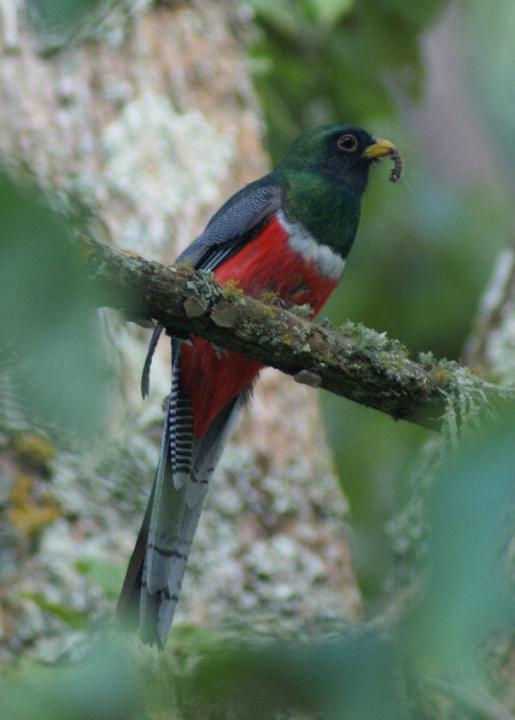
Collared trogon Trogon collaris, photographed by Phil Gunson.


Belongs within: Anomalogonatae.

The Trogonidae includes the trogons, brightly-coloured pantropical frugivorous or insectivorous birds. Trogons are distinguished from all other birds by their heterodactyl foot, with the first and second toes reverted (Mayr 2003).

<==Trogonidae
    |--Priotelus temnurus FP64
    |--Apaloderma Swainson 1833 [incl. Paratrogon Lambrecht 1933; Apalodermatidae] M02
    |    |--A. aequatoriale PT03
    |    |--A. gallica (Milne-Edwards 1871) [=Trogon gallicus, *Paratrogon gallicus] M02
    |    `--A. narina FP64
    |--Pharomachrus M03
    |    |--P. auriceps HK08
    |    |--P. mocinno M03
    |    |    |--P. m. mocinno USDI77
    |    |    `--P. m. costaricensis USDI77
    |    `--P. pavoninus M03
    |--Harpactes Swainson 1833 [Harpactidae] B94
    |    |--H. ardens M03
    |    |--H. erythrocephalus VP89 [=Pyrotrogon erythrocephalus S89]
    |    |    |--H. e. erythrocephalus VP89
    |    |    `--H. e. yamakanensis VP89
    |    |--H. oreskios M03 [=Trogon oreskios W66]
    |    `--H. reinwardtii M03
    `--Trogon Brisson 1760 B94
         |--T. clathratus Salvin 1866 S66
         |--T. collaris SS66
         |--T. curucui SO03
         |--T. elegans FP64
         |--T. massena S66
         |--T. melanocephalus PT03
         |--T. melanurus MMJ03
         |--T. mexicanus FP64
         |--T. personatus HK08
         |--T. puella S66
         |--T. ramonianus [=Aganus ramonianus] SS66
         |--T. variegatus SS66
         |--T. violaceus FS55
         |    |--T. v. violaceus FS55
         |    `--T. v. sallaei FS55
         `--T. viridis M03 [incl. T. melanopterus SS66]

*Type species of generic name indicated

REFERENCES

[B94] Bock, W. J. 1994. History and nomenclature of avian family-group names. Bulletin of the American Museum of Natural History 222: 1-281.

[FS55] Felten, H., & J. Steinbacher. 1955. Zur Vogelfauna von El Salvador. Senckenbergiana Biologica 36 (1-2): 9-19.

[FP64] Fisher, J., & R. T. Peterson. 1964. The World of Birds: A comprehensive guide to general ornithology. Macdonald: London.

[HK08] Hackett, S. J., R. T. Kimball, S. Reddy, R. C. K. Bowie, E. L. Braun, M. J. Braun, J. L. Chojnowski, W. A. Cox, K.-L. Han, J. Harshman, C. J. Huddleston, B. D. Marks, K. J. Miglia, W. S. Moore, F. H. Sheldon, D. W. Steadman, C. C. Witt & T. Yuri. 2008. A phylogenomic study of birds reveals their evolutionary history. Science 320: 1763-1768.

[M03] Mayr, G. 2003. On the phylogenetic relationships of trogons (Aves, Trogonidae). Journal of Avian Biology 34 (1): 81-88.

[MMJ03] Mayr, G., A. Manegold & U. S. Johansson. 2003. Monophyletic groups within ‘higher land birds’ – comparison of morphological and molecular data. Journal of Zoological Systematics and Evolutionary Research 41: 233-248.

[M02] Mlíkovský, J. 2002. Cenozoic Birds of the World. Part 1: Europe. Ninox Press: Praha.

[PT03] Prum, R. O., & R. Torres. 2003. Structural colouration of avian skin: Convergent evolution of coherently scattering dermal collagen arrays. Journal of Experimental Biology 206: 2409-2429.

[S89] Salvadori, T. 1889. Viaggio di Leonardo Fea nella Birmania e nelle regioni vicine. XIX. – Uccelli raccolti nei Monti Carin a nord-est di Tounghoo, nel Pegù presso Rangoon e Tounghoo e nel Tenasserim presso Malewoon. Annali del Museo Civico di Storia Naturale di Genova, Serie 2a 7: 369-438.

[S66] Salvin, O. 1866. Descriptions of eight new species of birds from Veragua. Proceedings of the Zoological Society of London 1866: 67-76.

[SS66] Sclater, P. L., & O. Salvin. 1866. Catalogue of birds collected by Mr. E. Bartlett on the River Uyacali, Eastern Peru, with notes and descriptions of new species. Proceedings of the Zoological Society of London 1866: 175-201.

[SO03] Sorenson, M. D., E. Oneal, J. García-Moreno & D. P. Mindell. 2003. More taxa, more characters: The hoatzin problem is still unresolved. Molecular Biology and Evolution 20 (9): 1484-1499.

[USDI77] USDI (United States Department of the Interior). 1977. Endangered and threatened wildlife and plants - republication of list of species. Federal Register 42: 36420-36431.

[VP89] Viney, C., & K. Phillipps. 1989. Birds of Hong Kong 5th ed. Government Printer: Hong Kong.

[W66] Walden, A. 1866. Notes on birds collected in Tennasserim and in the Andaman Islands. Proceedings of the Zoological Society of London 1866: 537-556.

Teinocoptinae

Female of Teinocoptes vandeuseni, from Klompen (1992).


Belongs within: Sarcoptoidea.
Contains: Notoedres.

Teinocoptinae is a lineage of scabies mites. With the exception of some species of Notoedres, all teinocoptines are parasites of bats (primarily pteropodids).

Characters (from Klompen 1992): Setae c1 and c2 simple, leg setae s I-II and ra I-II spinose; imatures with setae cp reduced; nymphs with delay in addition and weak development of setae f2; tritonymph and female with setae e III-IV absent; female with anus dorsoterminal or terminal, body comparatively high (except in Notoedres subgenus Notoedres); male with free anterior lateral shields, well-developed posterior lateral shields, setae kT III-IV spinose.

<==Teinocoptinae [Bakerocoptidae, Bakerocoptinae, Notoedrinae, Teinocoptidae]
    |--+--Chirophagoides Fain 1963 K92
    |  |    `--*C. mystacopis Fain 1963 [=C. mystacops] K92
    |  `--+--Notoedres K92
    |     `--Chirnyssoides Fain 1959 K92
    |          |--C. (Noctiliocoptes Fain & Lukoschus 1971) K92
    |          |    `--C. (*N.) noctilionis (Dusbabek 1970) [=Notoedres (Bakeracarus) noctilionis] K92
    |          `--C. (Chirnyssoides) [incl. Carollicoptes Fain & Lukoschus 1971] K92
    |               |--+--*C. (C.) caparti Fain 1959 K92
    |               |  `--C. (C.) amazonae Fain 1959 [incl. C. carolliae Fain 1962] K92
    |               `--+--C. (C.) vampyrops Fain & Lukoschus 1975 K92
    |                  `--+--C. (C.) surinamensis Fain & Lukoschus 1971 (see below for synonymy) K92
    |                     `--+--C. (C.) stenoderma Fain & Lukoschus 1975 K92
    |                        `--+--C. (C.) parvisuctus Fain & Lukoschus 1975 K92
    |                           `--+--C. (C.) brasiliensis Fain 1959 K92
    |                              `--+--C. (C.) phyllostomus Fain & Lukoschus 1975 K92
    |                                 `--C. (C.) venezuelae Fain 1959 K92
    `--+--Nycteridocoptes Oudemans 1898 [incl. Bakerocoptes Fain 1962] K92
       |    |  i. s.: N. cynopteri (Fain 1962) [=Bakerocoptes cynopteri] K92
       |    |         N. malayi Fain 1963 K92
       |    |--N. heidemanni Klompen 1992 K92
       |    `--+--+--N. microphallus Fain 1959 [incl. N. microphallus celebensis Fain 1963] K92
       |       |  `--N. rousetti Fain 1958 K92
       |       `--+--N. notopteris Klompen 1992 K92
       |          `--+--N. lavoipierrei Fain 1958 K92
       |             `--+--N. pteropi Rodhain & Gedoelst 1921 [incl. N. pteropodi Rodhain 1923] K92
       |                `--+--N. asiaticus Fain 1959 K92
       |                   `--+--N. macrophallus Fain 1958 K92
       |                      `--+--N. orientalis Fain 1963 K92
       |                         `--+--N. miniopteri Fain 1959 K92
       |                            `--+--*N. poppei Oudemans 1898 K92
       |                               `--+--N. eyndhoveni Fain 1959 K92
       |                                  `--N. hoogstraali Fain 1961 K92
       `--+--Cynopterocoptes Klompen 1992 K92
          |    `--*C. heaneyi Klompen 1992 K92
          `--+--Rousettocoptes Klompen 1992 K92
             |    `--*R. mammophilus Klompen 1992 K92
             `--+--Tychosarcoptes Fain 1976 K92
                |    |--*T. orphanus Fain 1976 K92
                |    |--T. amphipterinon (Klompen, Lukoschus et al. 1984) [=Teinocoptes amphipterinon] K92
                |    `--T. ptenochirus Klompen 1992 K92
                `--+--Chirobia Fain 1959 K92
                   |    |--+--C. thoopterus Klompen 1992 K92
                   |    |  `--+--C. brevior (Fain, Lukoschus & Nadchatram 1982) [=Teinocoptes brevior] K92
                   |    |     `--+--C. cynopteri Klompen, Lukoschus & Nadchatram 1985 K92
                   |    |        |--C. haplonycteris Klompen 1992 K92
                   |    |        |--C. jagori Klompen 1992 K92
                   |    |        `--C. minor Klompen 1992 K92
                   |    `--+--C. angolensis Klompen 1992 K92
                   |       |--C. eonycteris Klompen, Lukoschus et al. 1982 K92
                   |       |--C. rousettus Klompen 1992 K92
                   |       |--C. squamata Fain 1959 K92
                   |       `--+--*C. congolensis Fain 1959 K92
                   |          `--C. otophaga Fain 1959 K92
                   `--Teinocoptes Rodhain 1923 K92
                        |--T. katherinae Mitchell & Fain 1963 K92
                        |--T. strandtmanni Mitchell & Fain 1963 K92
                        |--T. wilsoni Mitchell & Fain 1963 K92
                        |--+--T. vandeuseni Mitchell & Fain 1963 K92
                        |  `--+--T. malayi Fain & Nadchatram 1962 K92
                        |     `--+--+--*T. epomophori Rodhain 1923 K92
                        |        |  `--T. pahangensis Fain, Lukoschus & Nadchatram 1982 K92
                        |        `--+--T. asiaticus Fain & Domrow 1961 K92
                        |           `--+--T. astridae Fain 1959 K92
                        |              `--T. rousetti Fain 1959 K92
                        `--+--+--T. aingworthi Mitchell & Fain 1963 K92
                           |  `--T. philippinensis Klompen 1992 K92
                           `--+--+--T. eonycteris Fain, Lukoschus & Nadchatram 1982 K92
                              |  `--T. johnsoni Fain 1963 K92
                              `--+--T. haymani Fain 1963 K92
                                 `--+--T. eidoloni Fain 1959 K92
                                    `--+--T. donrowi Fain 1961 K92
                                       `--+--T. harpyionycteris (Klompen & OConnor 1987) (see below for synonymy) K92
                                          `--+--T. auricularis Fain 1959 K92
                                             `--T. ituriensis Fain 1967 K92

Chirnyssoides (Chirnyssoides) surinamensis Fain & Lukoschus 1971 [=C. (*Corallicoptes) surinamensis; incl. C. (Co.) zanderyensis Fain & Lukoschus 1971] K92

Teinocoptes harpyionycteris (Klompen & OConnor 1987) [=Chirobia harpyionycteris] K92

*Type species of generic name indicated

REFERENCES

[K92] Klompen, J. S. H. 1992. Phylogenetic relationships in the mite family Sarcoptidae (Acari: Astigmata). Miscellaneous Publications, Museum of Zoology, University of Michigan 180: i-vi, 1-154.