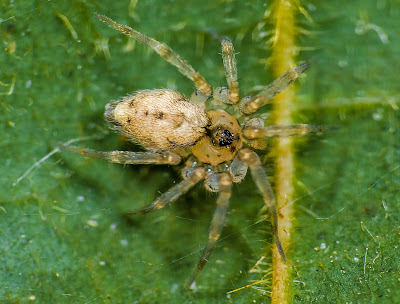
Parafroneta

Parafroneta marrineri female, photographed by S. E. Thorpe.


Belongs within: Linyphiidae.

Parafroneta is a genus of linyphiid spiders endemic to New Zealand in which the male palp is typically long and slender, without significant dilation apically.

<==Parafroneta Blest 1979 PVD10
    |--*P. marrineri (Hogg 1909) PVD10
    |--P. ambigua Blest 1979 PVD10
    |--P. confusa Blest 1979 PVD10
    |--P. demota Blest & Vink 2002 PVD10
    |--P. haurokoae Blest & Vink 2002 PVD10
    |--P. hirsuta Blest & Vink 2003 PVD10
    |--P. insula Blest 1979 PVD10
    |--P. minuta Blest 1979 PVD10
    |--P. monticola Blest 1979 PVD10
    |--P. persimilis Blest 1979 PVD10
    |--P. pilosa Blest & Vink 2003 PVD10
    |--P. subalpina Blest & Vink 2002 PVD10
    |--P. subantarctica Blest 1979 PVD10
    `--P. westlandica Blest & Vink 2002 PVD10

*Type species of generic name indicated

REFERENCES

[PVD10] Paquin, P., C. J. Vink & N. Dupérré. 2010. Spiders of New Zealand: annotated family key and species list. Manaaki Whenua Press: Lincoln (New Zealand).

Laetesia

Laetesia olvidada, copyright Museum of New Zealand Te Papa Tongarewa.


Belongs within: Linyphiidae.

Laetesia is a genus of linyphiid spiders, found in south-east Asia and Australasia, with eyes arranged in two procurved lines.

<==Laetesia Simon 1908 PVD10
    |--L. amoena Millidge 1988 PVD10
    |--L. aucklandensis (Forster 1964) PVD10
    |--L. bellissima Millidge 1988 PVD10
    |--L. chathami Millidge 1988 PVD10
    |--L. distincta Millidge 1988 PVD10
    |--L. forsteri Wunderlich 1976 W76
    |--L. germana Millidge 1988 PVD10
    |--L. intermedia Blest & Vink 2003 PVD10
    |--L. minor Millidge 1988 PVD10
    |--L. mollita Simon 1908 W76
    |--L. nornalupiensis Wunderlich 1976 W76
    |--L. olvidada Blest & Vink 2003 PVD10
    |--L. paragermana Blest & Vink 2003 PVD10
    |--L. peramoena (Pickard-Cambridge 1879) PVD10
    |--L. prominens Millidge 1988 PVD10
    |--L. pseudamoena Blest & Vink 2003 PVD10
    |--L. pulcherrima Blest & Vink 2003 PVD10
    |--L. trispathulata (Urquhart 1886) PVD10 [=Linyphia trispathulata NS00]
    `--L. woomerensis Wunderlich 1976 W76

*Type species of generic name indicated

REFERENCES

[NS00] Nicholls, D. C., P. J. Sirvid, S. D. Pollard & M. Walker. 2000. A list of arachnid primary types held in Canterbury Museum. Records of the Canterbury Museum 14: 37–48.

[PVD10] Paquin, P., C. J. Vink & N. Dupérré. 2010. Spiders of New Zealand: annotated family key and species list. Manaaki Whenua Press: Lincoln (New Zealand).

[W76] Wunderlich, J. 1976. Spinnen aus Australien. 2. Linyphiidae (Arachnida: Araneida). Senckenbergiana Biologica 57 (1–3): 125–142.

Oecobiidae

Wall spider Oecobius navus, copyright Robert Whyte.


Belongs within: Eresoidea.

The Oecobiidae are a cosmopolitan group of small to medium-sized spiders that construct small star-shaped mesh-webs or multilayered webs over cracks or crevices in rocks or walls (Jocqué & Dippenaar-Schoeman 2007).

Characters (from Jocqué & Dippenaar-Schoeman 2007): Small to medium-sized araneomorph spiders; three tarsal claws; cribellate or ecribellate; entelegyne; six or eight eyes; anal tubercle large, two-segmented with a double fringe of curved setae.

<==Oecobiidae
    |--Uroecobiinae JD-S07
    |    |--Urocteana Roewer 1961 JD-S07
    |    `--Uroecobius Jullmann & Zimmermann 1976 JD-S07
    |--Urocteinae [Urocteidae] JD-S07
    |    |--Paruroctea blauvelti Petrunkevitch 1942 S93
    |    `--Uroctea Dufour 1820 JD-S07
    |         `--U. durandi A99
    `--Oecobiinae JD-S07
         |--Paroecobius Lamoral 1981 JD-S07
         |--Platoecobius Chamberlin & Ivie 1935 JD-S07
         `--Oecobius Lucas 1846 PVD10
              |--*O. navus Blackwell 1859 PVD10
              |--O. annulipes Lucas 1846 E12
              |--O. cellariorum JD-S07
              |--O. concinnus (Simon 1893) GLV14
              `--O. domesticus Lucas 1846 E12

*Type species of generic name indicated

REFERENCES

[A99] Ax, P. 1999. Das System der Metazoa II. Ein Lehrbuch der phylogenetischen Systematik. Gustav Fisher Verlag: Stuttgart (transl. 2000. Multicellular Animals: The phylogenetic system of the Metazoa vol. 2. Springer).

[E12] Evenhuis, N. L. 2012. Publication and dating of the Exploration Scientifique de l'Algérie: Histoire Naturelle des Animaux Articulés (1846–1849) by Pierre Hippolyte Lucas. Zootaxa 3448: 1–61.

[GLV14] García, L. F., M. Lacava & C. Viera. 2014. Diet composition and prey selectivity by the spider Oecobius concinnus (Araneae: Oecobiidae) from Colombia. Journal of Arachnology 42 (2): 199–201.

[JD-S07] Jocqué, R., & A. S. Dippenaar-Schoeman. 2007. Spider Families of the World. Royal Museum for Central Africa: Tervuren (Belgium).

[PVD10] Paquin, P., C. J. Vink & N. Dupérré. 2010. Spiders of New Zealand: annotated family key and species list. Manaaki Whenua Press: Lincoln (New Zealand).

[S93] Selden, P. A. 1993. Arthropoda (Aglaspidida, Pycnogonida and Chelicerata). In: Benton, M. J. (ed.) The Fossil Record 2 pp. 297–320. Chapman & Hall: London.

Nicodamidae

Nicodamus mainae, copyright Ron 'n' Beth's Pics.


Belongs within: Neocribellatae.

The Nicodamidae are an Australasian group of spiders that construct small sheet webs close to ground level.

Characters (from Jocqué & Dippenaar-Schoeman 2007): Small to large araneomorph spiders; three tarsal claws; cribellate or ecribellate; entelegyne; eight eyes; male palpal tibia with large dorsal apophysis; tarsi and metatarsi IV lacking trichobothria; chelicerae with one distal tooth on promargin only.

<==Nicodamidae BS09
    |  i. s.: Ambicodamus Harvey 1995 JD-S07
    |           `--A. marae BS09
    |         Dimidamus Harvey 1995 JD-S07
    |         Durodamus Harvey 1995 JD-S07
    |         Litodamus Harvey 1995 JD-S07
    |         Oncodamus Harvey 1995 JD-S07
    |--Megadictyninae [Megadictynidae] PVD10
    |    |--Megadictyna Dahl 1906 BS09, PVD10
    |    |    `--*M. thilenii Dahl 1906 PVD10 [incl. Ihurakius forsteri Marples 1959 NS00]
    |    `--Forstertyna Harvey 1995 PVD10
    |         `--*F. marplesi (Forster 1970) PVD10
    `--+--Novodamus Harvey 1995 BS09, JD-S07
       `--Nicodamus Simon 1887 BS09, JD-S07 [Nicodaminae]
            |--N. bicolor FF99
            `--N. mainae JD-S07

*Type species of generic name indicated

REFERENCES

[BS09] Blackledge, T. A., N. Scharff, J. A. Coddington, T. Szüts, J. W. Wenzel, C. Y. Hayashi & I. Agnarsson. 2009. Reconstructing web evolution and spider diversification in the molecular era. Proceedings of the National Academy of Sciences of the USA 106 (13): 5229–5234.

[FF99] Forster, R., & L. Forster. 1999. Spiders of New Zealand and their World-wide Kin. University of Otago Press: Dunedin (New Zealand).

[JD-S07] Jocqué, R., & A. S. Dippenaar-Schoeman. 2007. Spider Families of the World. Royal Museum for Central Africa: Tervuren (Belgium).

[NS00] Nicholls, D. C., P. J. Sirvid, S. D. Pollard & M. Walker. 2000. A list of arachnid primary types held in Canterbury Museum. Records of the Canterbury Museum 14: 37–48.

[PVD10] Paquin, P., C. J. Vink & N. Dupérré. 2010. Spiders of New Zealand: annotated family key and species list. Manaaki Whenua Press: Lincoln (New Zealand).

Alismatales

Streaked arrowgrass Triglochin striatum, copyright Tim Rudman.


Belongs within: Lilianae.
Contains: Araceae, Alismataceae, Hydrocharitaceae, Potamogetonales.

The Alismatanae are a clade of monocotyledonous flowering plants supported by molecular data, many of which are aquatic or semi-aquatic. Members of the clade have extrorse anthers (releasing pollen outside the flower) and seeds with a large cotyledon.

<==Alismatales [Alismatanae, Helobieae, Juncagineae, Naiadeae, Najadales, Potameae, Zostereae] DS04
    |--Tofieldiaceae DS04
    |    |--Pleea tenuifolia DS04
    |    `--Tofieldia SR07
    |         |--T. calyculata DS04
    |         |--T. glutinosa (Michx.) Persoon 1805 CD07
    |         |--T. occidentalis H93
    |         |--T. palustris H44
    |         `--T. pusilla DS04
    `--+--Araceae SR07
       `--+--Alismataceae DS04
          `--+--Butomales HE80
             |    |--Hydrocharitaceae HE80
             |    |--Limnocharis P88 [Limnocharitaceae W03]
             |    |    |--L. flava W03
             |    |    `--L. humboldtii [=Hydrocleis humboldtii] B78
             |    `--Butomaceae DS04
             |         |--Hydrocleys nymphoides (von Humboldt & Bonpland) Buchenau 1868 HE80
             |         |--Butomus umbellatus SR07, DS04
             |         `--Butomites cretaceus Velenivsky 1889 CBH93
             `--+--Scheuchzeriaceae DS04
                |    |--Tetroncium magellanicum YY22, CL85
                |    `--Scheuchzeria palustris SR07, DS04
                |         |--S. p. ssp. palustris H93
                |         `--S. p. ssp. americana H93
                `--+--Potamogetonales DS04
                   `--Juncaginaceae [Juncaginales] DS04
                        |--Lilaea scilloides H93
                        |--Lamprocarpites nitidus Heer 1882 CBH93
                        `--Triglochin Linnaeus 1753 DS04, ME70
                             |  i. s.: T. concinna H93
                             |           |--T. c. var. concinna H93
                             |           `--T. c. var. debilis H93
                             |         T. maritima DS04 [incl. T. elatum V72]
                             |         T. palustre Linnaeus 1753 ME70
                             |--T. sect. Cycnogeton B78
                             |    |--T. maundii [incl. Maundia triglochinoides] B78
                             |    `--T. procera B78 (see below for synonymy)
                             |         |--T. p. var. procera B78
                             |         |--T. p. var. dubia [=T. dubium] B78
                             |         `--T. p. var. eleutherocarpa B78
                             `--T. sect. Eutriglochin B78
                                  |--T. centrocarpa [incl. T. minutissima, T. nanum, T. trichophora] B78
                                  |    |--T. c. var. centrocarpa B78
                                  |    `--T. c. var. calcitrapa B78
                                  |--T. mucronata B78
                                  `--T. striatum Ruiz & Pav. 1802 B78, ME70 (see below for synonymy)
                                       |--T. s. var. striatum C06
                                       `--T. s. var. filifolium Buch. 1868 [incl. T. triandrum] C06

Alismatales incertae sedis:
  Maundiaceae APG16
  Posidonia S95 [Posidoniaceae APG16]
    |--P. australis PP64
    |--P. oceanica [=Caulinia oceanica] B78
    `--P. sinuosa S95
  Zannichelliaceae HE80
    |--Zannichellia Linnaeus 1753 ME70
    |    |--Z. palustris Linnaeus 1753 ME70
    |    `--Z. pedunculata CS77
    `--Lepilaena Drum. ex Harv. 1855 ME70 [incl. Hexatheca B78]
         |--*L. australis Drum. ex Harv. 1855 ME70
         |--L. bilocularis Kirk 1896 ME70
         |--L. cylindrocarpa [=Zannichellia cylindrocarpa; incl. Hexatheca australis ms] B78
         `--L. preissii ME70 [=Zannichellia preissii C06]

Triglochin procera B78 [incl. Cycnogeton huegelii B78, T. huegelii GK00, C. linearis B78, T. linearis B78]

Triglochin striatum Ruiz & Pav. 1802 B78, ME70 [incl. T. decipiens B78, T. flaccidum Cunn. 1837 ME70, T. montevidense B78]

*Type species of generic name indicated

REFERENCES

[APG16] Angiosperm Phylogeny Group. 2016. An update of the Angiosperm Phylogeny Group classification for the orders and families of flowering plants: APG IV. Botanical Journal of the Linnean Society 181: 1–20.

[B78] Bentham, G. 1878. Flora Australiensis: A description of the plants of the Australian Territory vol. 7. Roxburghiaceae to Filices. L. Reeve & Co.: London.

[CD07] Cantino, P. D., J. A. Doyle, S. W. Graham, W. S. Judd, R. G. Olmstead, D. E. Soltis, P. S. Soltis & M. J. Donoghue. 2007. Towards a phylogenetic nomenclature of Tracheophyta. Taxon 56 (3): E1–E44.

[C06] Cheeseman, T. F. 1906. Manual of the New Zealand Flora. John Mackay, Government Printer: Wellington.

[CL85] Cokendolpher, J. C., & D. Lanfranco L. 1985. Opiliones from the Cape Horn Archipelago: new southern records for harvestmen. Journal of Arachnology 13: 311–319.

[CBH93] Collinson, M. E., M. C. Boulter & P. L. Holmes. 1993. Magnoliophyta (‘Angiospermae’). In: Benton, M. J. (ed.) The Fossil Record 2 pp. 809–841. Chapman & Hall: London.

[CS77] Cramp, S., & K. E. L. Simmons (eds) 1977. Handbook of the Birds of Europe, the Middle East and North Africa: The Birds of the Western Palaearctic vol. 1. Ostrich to Ducks. Oxford University Press: Oxford.

[DS04] Davis, J. I., D. W. Stevenson, G. Petersen, O. Seberg, L. M. Campbell, J. V. Freudenstein, D. H. Goldman, C. R. Hardy, F. A. Michelangeli, M. P. Simmons, C. D. Specht, F. Vergara-Silva & M. Gandolfo. 2004. A phylogeny of the monocots, as inferred from rbcL and atpA sequence variation, and a comparison of methods for calculating jackknife and bootstrap values. Systematic Botany 29 (3): 467–510.

[GK00] Gibson, N., & G. J. Keighery. 2000. Flora and vegetation of the Byenup-Muir reserve system, south-west Western Australia. CALMScience 3 (3): 323–402.

[H44] Hammer, M. 1944. Studies on the oribatids and collemboles of Greenland. Meddelelser om Grønland 141 (3): 1–210.

[HE80] Healy, A. J., & E. Edgar. 1980. Flora of New Zealand vol. 3. Adventive cyperaceous, petalous and spathaceous monocotyledons. P. D. Hasselberg, Government Printer: Wellington (New Zealand).

[H93] Hickman, J. C. (ed.) 1993. The Jepson Manual: Higher Plants of California. University of California Press: Berkeley (California).

[ME70] Moore, L. B., & E. Edgar. 1970. Flora of New Zealand vol. 2. Indigenous Tracheophyta: Monocotyledones except Gramineae. A. R. Shearer, Government Printer: Wellington (New Zealand).

[PP64] Peres, J. M., & J. Picard. 1964. Nouveau manuel de bionomie benthique de la mer Mediterranee. Recueil des Travaux de la Station Marine d'Endoume, Bulletin 31 (27): 5–137.

[P88] Polunin, I. 1988. Plants and Flowers of Malaysia. Times Editions: Singapore.

[SR07] Saarela, J. M., H. S. Rai, J. A. Doyle, P. K. Endress, S. Mathews, A. D. Marchant, B. G. Briggs & S. W. Graham. 2007. Hydatellaceae identified as a new branch near the base of the angiosperm phylogenetic tree. Nature 446: 312–315.

[S95] Scheltema, A. H. 1995. Falcidens poias, a new species of chaetoderm Aplacophora from Rottnest Island, Western Australia (Chaetodermomorpha, Chaetodermatidae). Molluscan Research 16: 45–49.

[V72] Voss, E. G. 1972. Michigan Flora. Part I. Gymnosperms and Monocots. Cranbrook Institute of Science and University of Michigan Herbarium.

[W03] Waterhouse, B. M. 2003. Know your enemy: recent records of potentially serious weeds in northern Australia, Papua New Guinea and Papua (Indonesia). Telopea 10 (1): 477–485.

[YY22] Yampolsky, C., & H. Yampolsky. 1922. Distribution of sex forms in the phanerogamic flora. Bibliotheca Genetica 3: 1–62.

Lilianae

Tasmanian Christmas bell Blandfordia punicea, copyright Natalie Tapson.


Belongs within: Mesangiospermae.
Contains: Alismatales, Pandanales, Dioscoreales, Liliales, Commelinidae, Orchidaceae, Boryaceae, Asteliaceae, Hypoxidaceae, Iridaceae, Hemerocallidaceae, Xanthorrhoea, Asphodelaceae, Amaryllidaceae, Alliaceae, Laxmanniaceae, Asparagaceae, Eriospermum, Ruscaceae, Hyacinthaceae, Agavaceae, Anthericaceae.

The Lilianae, monocotyledons, are a well-defined clade mostly distinguished from other flowering plants by their elongate leaves with parallel veins, and flowers with parts (sepals, petals, etc.) in multiples of three. The embryo bears a single cotyledon, the stem has scattered vascular bundles, and sieve tube plastids bear cuneate proteinaceous crystalloids (Cantino et al. 2007). Under the name Monocotyledoneae, a corresponding clade was defined by Cantino et al. (2007) as the least inclusive clade containing Acorus calamus, Gymnostachys anceps, Tofieldia glutinosa and Lilium superbum. Most recent studies agree in placing the sweet flags Acorus, a genus of rhizomatous plants found in wetlands of Eurasia and North America, as the sister clade to other living monocots.

See also: Reference review: The monocot tree.

Lilianae [Acoranae, Alismatidae, Arecidae, Liliopsida, Monocotyledoneae, Monocotyledones, Nudiflorae, Triurididae] EN20
    |  i. s.: Odyssea R-S02
    |         Syringodium L85
    |           |--S. filiforme CH97
    |           `--S. isoetifolium L85
    |         Acaciaephyllum FPC04
    |         Pennistemon FPC04
    |         Caulinities loipopytis S89
    |--Acorus [Acoraceae, Acorales] CD07
    |    |  i. s.: A. americanus WM14
    |    |--A. calamus Linnaeus 1753 DS04, CD07
    |    `--+--A. gramineus DS04
    |       `--A. tatarinowii DS04
    `--Nartheciidae CD07
         |--Alismatales CD07
         `--Petrosaviidae [Bromelianae, Haemodorales, Liliidae] CD07
              |--Petrosaviaceae [Petrosaviales, Petrosavianae] DS04
              |    |--Japonolirion osense DS04
              |    `--Petrosavia stellaris Becc. 1871 CD07
              `--+--+--Pandanales DS04
                 |  `--Dioscoreales APG16
                 `--Liliiflorae [Baccatae, Capsulares, Chlorophyteae, Coronarieae, Xanthorrheae] J87
                      |  i. s.: Roxburghia [Roxburghiaceae] B78
                      |           `--R. javanica B78
                      |                |--R. j. var. javanica B78
                      |                `--R. j. var. australiana Bentham 1878 [incl. Dioscorea lucida] B78
                      |--Liliales DS04
                      `--+--Commelinidae DS04
                         `--Asparagales (see below for synonymy) DS04
                              |  i. s.: Maianthemum SR07
                              |           |--M. bifolium C55
                              |           |--M. canadense M73
                              |           |    |--M. c. var. canadense V72
                              |           |    `--M. c. var. interius V72
                              |           `--M. dilatatum H93
                              |         Liliacidites RG07
                              |           |--L. intermedius RG07
                              |           |--L. kaitangataensis RG07
                              |           |--L. minutus RG07
                              |           `--L. pollucibilis RG07
                              |--Orchidaceae RG07
                              `--+--+--Boryaceae DS04
                                 |  `--+--+--Asteliaceae RG07
                                 |     |  `--+--Lanaria [Lanariaceae] RG07
                                 |     |     `--Hypoxidaceae RG07
                                 |     `--Blandfordia Smith 1804 (nom. cons.) DS04, CC87 [Blandfordiaceae]
                                 |          |--*B. nobilis Smith 1804 (see below for synonymy) CC87
                                 |          |--B. cunninghamii Lindley 1845 (see below for synonymy) CC87
                                 |          |--B. × flammea-elegans Smith 1874 [B. cunninghamii × B. grandiflora] CC87
                                 |          |--B. grandiflora Br. 1810 (see below for synonymy) CC87
                                 |          `--B. punicea (Labill.) Sweet 1830 (see below for synonymy) CC87
                                 `--+--Cyanastrum SR07
                                    `--+--+--Ixiolirion DS04 [Ixioliriaceae EN20, Ixiolirionaceae]
                                       |  |    `--I. tataricum DS04
                                       |  `--Tecophilaeaceae EN20
                                       |       |--Tecophilaea cyanocrocus DS04
                                       |       `--Eremolirion amboensis [=Cyanella amboensis] CV06
                                       `--+--Doryanthes Corrêa 1802 [Doryanthaceae] EN20
                                          |    |--*D. excelsa Corrêa 1802 (see below for synonymy) EN20
                                          |    `--D. palmeri Hill ex Bentham 1873 (see below for synonymy) EN20
                                          `--+--Iridaceae EN20
                                             `--+--Xeronema Brong. & Gris 1864 ME70 [Xeronemataceae EN20]
                                                |    |--X. callistemon Oliver 1926 ME70
                                                |    |    |--X. c. var. callistemon ME70
                                                |    |    `--X. c. var. bracteosa Moore 1969 ME70
                                                |    `--X. moorei CR00
                                                `--+--+--Hemerocallidaceae EN20
                                                   |  `--+--Xanthorrhoea EN20
                                                   |     `--Asphodelaceae EN20
                                                   `--+--+--+--Amaryllidaceae CR00
                                                      |  |  `--Alliaceae CR00
                                                      |  `--Agapanthus L’Hér. 1788 (nom. cons.) CC87 (see below for synonymy)
                                                      |       |--A. africanus (see below for synonymy) CC87
                                                      |       `--A. praecox Willd. 1809 CC87
                                                      |            |--A. p. ssp. praecox CC87
                                                      |            `--A. p. ssp. orientalis (Leighton) Leighton 1965 (see below for synonymy) CC87
                                                      `--+--+--Laxmanniaceae CR00
                                                         |  `--+--Asparagaceae EN20
                                                         |     `--+--Eriospermum EN20
                                                         |        `--Ruscaceae EN20
                                                         `--+--Themidaceae CR00
                                                            `--+--+--Aphyllanthes EN20 [Aphyllanthaceae CR00]
                                                               |  `--Hyacinthaceae CR00
                                                               `--+--Anemarrhena JS02 [Anemarrhenaceae CR00]
                                                                  |    `--A. asphodeloides JS02
                                                                  `--+--Agavaceae CR00
                                                                     `--+--Behnia EN20 [Behniaceae CR00]
                                                                        `--+--Herreria EN20 [Herreriaceae CR00]
                                                                           `--Anthericaceae DS04

Agapanthus L’Hér. 1788 (nom. cons.) CC87 [Agapanthaceae CR00, Agapantheae]

Agapanthus africanus [incl. A. umbellatus L’Hér. 1788 (nom. illeg.)] CC87

Agapanthus praecox ssp. orientalis (Leighton) Leighton 1965 [=A. orientalis Leighton 1938] CC87

Asparagales [Anthericeae, Asparageae, Bowieae, Caesieae, Euasparageae, Hemerocallideae, Orchidales] DS04

Blandfordia cunninghamii Lindley 1845 [incl. B. grandiflora var. elongata Benth. 1878] CC87

Blandfordia grandiflora Br. 1810 [incl. B. aurea Hook. 1869, B. flammea var. aurea Bailey 1883, B. flammea Lindley ex Paxton 1849, B. intermedia Herbert in Lindley 1845, B. grandiflora var. intermedia (Herbert) Baker 1871, B. princeps Smith 1875, B. flammea var. princeps (Smith) Baker 1876] CC87

*Blandfordia nobilis Smith 1804 [incl. B. nobilis var. imperialis Miller & Norman Taylor in Bailey 1914] CC87

Blandfordia punicea (Labill.) Sweet 1830 [=Aletris punicea Labill. 1805; incl. B. backhousii Lindley 1845, B. grandiflora var. backhousii (Lindley) Hook. 1858, B. marginata Herbert in Lindley 1842, B. grandiflora var. marginata (Herbert) Hook. 1858] CC87

*Doryanthes excelsa Corrêa 1802 [incl. Furcraea australis Haworth 1812, Agave australis (Haworth) Steudel 1821] EN20

Doryanthes palmeri Hill ex Bentham 1873 [=D. excelsa var. palmeri (Hill ex Bentham) Bailey 1883; incl. D. guilfoylei Bailey 1893, D. excelsa var. guilfoylei (Bailey) Bailey 1902, D. larkinii Moore 1885, D. palmeri var. larkinii (Moore) Moore & Betche 1893] EN20

*Type species of generic name indicated

REFERENCES

[APG16] Angiosperm Phylogeny Group. 2016. An update of the Angiosperm Phylogeny Group classification for the orders and families of flowering plants: APG IV. Botanical Journal of the Linnean Society 181: 1–20.

[B78] Bentham, G. 1878. Flora Australiensis: A description of the plants of the Australian Territory vol. 7. Roxburghiaceae to Filices. L. Reeve & Co.: London.

[C55] Candolle, A. de. 1855. Géographie Botanique Raisonée: Ou exposition des faits principaux et des lois concernant la distribution géographique des plantes de l’époque actuelle vol. 2. Librairie de Victor Masson: Paris.

[CD07] Cantino, P. D., J. A. Doyle, S. W. Graham, W. S. Judd, R. G. Olmstead, D. E. Soltis, P. S. Soltis & M. J. Donoghue. 2007. Towards a phylogenetic nomenclature of Tracheophyta. Taxon 56 (3): E1–E44.

[CH97] Castro, P., & M. E. Huber. 1997. Marine Biology 2nd ed. WCB McGraw-Hill: Boston.

[CR00] Chase, M. W., P. J. Rudall, M. F. Fay & K. L. Stobart. 2000. Xeronemataceae, a new family of asparagoid lilies from New Caledonia and New Zealand. Kew Bulletin 55: 865–870.

[CC87] Clifford, H. T., J. G. Conran, J. B. Williams, R. J. F. Henderson, H. J. Hewson, E. M. Watson, G. J. Keighery, D. M. Churchill, I. R. H. Telford, A. Thongpukdee, N. H. Brittan, A. S. George, W. T. Stearn & T. D. Macfarlane. 1987. Liliaceae. Flora of Australia 45: 148–419.

[CV06] Craven, P., & P. Vorster. 2006. Patterns of plant diversity and endemism in Namibia. Bothalia 36 (2): 175–189.

[DS04] Davis, J. I., D. W. Stevenson, G. Petersen, O. Seberg, L. M. Campbell, J. V. Freudenstein, D. H. Goldman, C. R. Hardy, F. A. Michelangeli, M. P. Simmons, C. D. Specht, F. Vergara-Silva & M. Gandolfo. 2004. A phylogeny of the monocots, as inferred from rbcL and atpA sequence variation, and a comparison of methods for calculating jackknife and bootstrap values. Systematic Botany 29 (3): 467–510.

[EN20] Eggli, U., & R. Nyffeler (eds) 2020. Illustrated Handbook of Succulent Plants: Monocotyledons 2nd ed. Springer.

[FPC04] Friis, E. M., K. R. Pedersen & P. R. Crane. 2004. Araceae from the Early Cretaceous of Portugal: evidence on the emergence of monocotyledons. Proceedings of the National Academy of Sciences of the USA 101 (47): 16565–16570.

[H93] Hickman, J. C. (ed.) 1993. The Jepson Manual: Higher Plants of California. University of California Press: Berkeley (California).

[JS02] Jensen, S. R., & J. Schripsema. 2002. Chemotaxonomy and pharmacology of Gentianaceae. In: Struwe, L., & V. A. Albert (eds) Gentianaceae: Systematics and Natural History pp. 573–631. Cambridge University Press: Cambridge.

[J87] Judd, W. S. 1987. Floristic study of Morne La Visite and Pic Macaya National Parks, Haiti. Bulletin of the Florida State Museum—Biological Sciences 32 (1): 1–136.

[L85] Lowry, J. K. 1985. Two new species of Cerapus from Samoa and Fiji (Crustacea: Amphipoda: Ischyroceridae). Records of the Australian Museum 36: 157–168.

[M73] Mason, L. G. 1973. The habitat and phenetic variation in Phymata americana Melin (Heteroptera). Systematic Zoology 22 (3): 271–279.

[ME70] Moore, L. B., & E. Edgar. 1970. Flora of New Zealand vol. 2. Indigenous Tracheophyta: Monocotyledones except Gramineae. A. R. Shearer, Government Printer: Wellington (New Zealand).

[RG07] Ramírez, S. R., B. Gravendeel, R. B. Singer, C. R. Marshall & N. E. Pierce. 2007. Dating the origin of the Orchidaceae from a fossil orchid with its pollinator. Nature 448: 1042–1045.

[R-S02] Russell-Smith, A. 2002. A comparison of the diversity and composition of ground-active spiders in Mkomazi Game Reserve, Tanzania and Etosha National Park, Namibia. Journal of Arachnology 30 (2): 383–388.

[SR07] Saarela, J. M., H. S. Rai, J. A. Doyle, P. K. Endress, S. Mathews, A. D. Marchant, B. G. Briggs & S. W. Graham. 2007. Hydatellaceae identified as a new branch near the base of the angiosperm phylogenetic tree. Nature 446: 312–315.

[S89] Squinabol, S. 1889. Res Ligusticae. VII.—Cenno preliminare sulla flora fossile di Santa Giustina. Annali del Museo Civico di Storia Naturale di Genova, Serie 2a, 7: 73–76.

[V72] Voss, E. G. 1972. Michigan Flora. Part I. Gymnosperms and Monocots. Cranbrook Institute of Science and University of Michigan Herbarium.

[WM14] Wickett, N. H., S. Mirarab, N. Nguyen, T. Warnow, E. Carpenter, N. Matasci, S. Ayyampalayam, M. S. Barker, J. G. Burleigh, M. A. Gitzendanner, B. R. Ruhfel, E. Wafula, J. P. Der, S. W. Graham, S. Mathews, M. Melkonian, D. E. Soltis, P. S. Soltis, N. W. Miles, C. J. Rothfels, L. Pokorny, A. J. Shaw, L. DeGeronimo, D. W. Stevenson, B. Surek, J. C. Villarreal, B. Roure, H. Philippe, C. W. dePamphilis, T. Chen, M. K. Deyholos, R. S. Baucom, T. M. Kutchan, M. M. Augustin, J. Wang, Y. Zhang, Z. Tian, Z. Yan, X. Wu, X. Sun, G. K.-S. Wong & J. Leebens-Mack. 2014. Phylotranscriptomic analysis of the origin and early diversification of land plants. Proceedings of the National Academy of Sciences of the USA 111 (45): E4859–E4868.

Aristidoideae

Aristida stipoides, copyright Roger and Alison Heath.


Belongs within: Poaceae.
Contains: Aristida section Chaetaria.

The Aristidoideae, wiregrasses, are a group of relatively narrow-leaved grasses most commonly found in dry, open habitats.

Characters (from Grass Phylogeny Working Group 2001): Plants annual or perennial, caespitose, herbaceous, xerophytic or less commonly mesophytic. Culms solid or hollow. Leaves distichous; abaxial ligule absent or present as a line of hairs; adaxial ligule a fringed membrane or a fringe of hairs; blades relatively narrow, without pseudopetioles, venation parallel; sheaths non-auriculate. Inflorescences paniculate, bracts outside of the spikelets absent. Spikelets with bisexual florets, glumes 2, female-fertile floret 1, and no rachilla extension, cylindrical or laterally compressed, disarticulating above the glumes; lemma with three awns, the awns separate from each other, or fused below into a twisted column; palea short, less than half the lemma length; lodicules present or rarely absent, when present 2, free, membranous, glabrous, heavily vascularized; stamens 1 to 3; ovary glabrous, apical appendage absent, haustorial synergids absent, styles 2, free, close, stigmas 2. Caryopsis with the hilum short or long-linear; endosperm hard, without lipid, containing compound starch grains; embryo small or large, epiblast absent, scutellar cleft present or absent, mesocotyl internode elongated, embryonic leaf margins meeting. Basic chromosome numbers: x = 11, 12.

<==Aristidoideae [Aristideae]
    |--Sartidia GPWG01
    |--Stipagrostis GPWG01
    |    |--S. damarensis CV06
    |    |--S. garubensis CV06
    |    |--S. gonatostachys CV06
    |    |--S. hermannii CV06
    |    |--S. lanipes CV06
    |    |--S. namibensis CV06
    |    |--S. pellytronis CV06
    |    |--S. plumosa AGF98
    |    |--S. pogonoptila PP07
    |    |--S. ramulosa CV06
    |    |--S. sabulicola CV06
    |    |--S. seelyae CV06
    |    |--S. uniplumus CS77
    |    |--S. vulnerans AGF98
    |    `--S. zeyheri GPWG01
    `--Aristida GPWG01
         |  i. s.: A. adscensionis PP07
         |           |--A. a. var. adscensionis S06
         |           |--A. a. var. breviseta Hackel in Stuckert 1906 S06
         |           |--A. a. var. coerulescens S06
         |           |    |  i. s.: A. a. var. c. f. modestina Hackel in Stuckert 1906 S06
         |           |    |--A. a. var. c. subvar. coerulescens S06
         |           |    `--A. a. var. c. subvar. condensata S06
         |           |--A. a. var. laevis S06
         |           |--A. a. var. modesta S06
         |           `--A. a. var. scabriflora S06
         |         A. arizonica GPWG01
         |         A. basiramea V72
         |         A. californica H93
         |         A. congesta GPWG01
         |           |--A. c. ssp. congesta GPWG01
         |           `--A. c. ssp. barbicollis GPWG01
         |         A. dichotoma V72
         |         A. divaricata H93
         |         A. exserta LK14
         |         A. funiculata PP07
         |         A. holathera LK14
         |         A. inaequiglumis LK14
         |         A. ingrata LK14
         |         A. kimberleyensis LK14
         |         A. longispica V72
         |           |--A. l. var. longispica V72
         |           `--A. l. var. geniculata [incl. A. intermedia] V72
         |         A. mendocina [incl. A. cordobensis] S06
         |         A. murina [=A. pallens var. murina Trin. 1849] S06
         |         A. mutabilis PP07
         |         A. necopina V72
         |         A. oligantha H93
         |         A. orcuttiana H93
         |         A. pallens S06
         |           |--A. p. var. pallens S06
         |           |--A. p. var. intermedia S06
         |           |--A. p. var. macrochaeta Hackel in Stuckert 1906 S06
         |           `--A. p. var. tenuifolia S06
         |         A. perniciosa LK14
         |         A. pruinosa LK14
         |         A. purpurascens V72
         |         A. purpurea GPWG01
         |           |--A. p. var. purpurea GPWG01
         |           |--A. p. var. fendleriana H93
         |           |--A. p. var. longiseta GPWG01
         |           |--A. p. var. nealleyi [incl. A. glauca] H93
         |           |--A. p. var. parishii H93
         |           `--A. p. var. wrightii H93
         |         A. setacea S03
         |         A. setifolia S06
         |         A. spegazzinii S06
         |           |--A. s. var. spegazzinii S06
         |           |--A. s. var. abbreviata S06
         |           `--A. s. var. pallescens S06
         |         A. spiciformis M83
         |         A. stricta CS90
         |         A. ternipes H93
         |           |--A. t. var. ternipes H93
         |           `--A. t. var. hamulosa H93
         |         A. tuberculosa V72
         |--A. sect. Arthratherum B78
         |    |--A. arenaria [=Arthratherum arenarium; incl. Ari. contorta Muell. 1855] B78
         |    |--A. hygrometrica B78
         |    `--A. stipoides B78
         `--A. sect. Chaetaria B78

*Type species of generic name indicated

REFERENCES

[AGF98] Abd El-Ghani, M. M., & A. G. Fahmy. 1998. Composition of and changes in the spontaneous flora of Feiran Oasis, S Sinai, Egypt, in the last 60 years. Willdenowia 28: 123–134.

[B78] Bentham, G. 1878. Flora Australiensis: A description of the plants of the Australian Territory vol. 7. Roxburghiaceae to Filices. L. Reeve & Co.: London.

[CS90] Corey, D. T., & I. J. Stout. 1990. Ground surface arachnids in sandhill communities of Florida. Journal of Arachnology 18: 167–172.

[CS77] Cramp, S., & K. E. L. Simmons (eds) 1977. Handbook of the Birds of Europe, the Middle East and North Africa: The Birds of the Western Palaearctic vol. 1. Ostrich to Ducks. Oxford University Press: Oxford.

[CV06] Craven, P., & P. Vorster. 2006. Patterns of plant diversity and endemism in Namibia. Bothalia 36 (2): 175–189.

[GPWG01] Grass Phylogeny Working Group. 2001. Phylogeny and subfamilial classification of the grasses (Poaceae). Annals of the Missouri Botanical Garden 88 (3): 373–457.

[H93] Hickman, J. C. (ed.) 1993. The Jepson Manual: Higher Plants of California. University of California Press: Berkeley (California).

[M83] Myers, R. L. 1983. Site susceptibility to invasion by the exotic tree Melaleuca quinquenervia in southern Florida. Journal of Applied Ecology 20: 645–658.

[PP07] Pandey, R. P., & P. M. Padhye. 2007. Studies on phytodiversity of Arid Machia Safari Park-Kailana in Jodhpur (Rajasthan). Bulletin of the Botanical Survey of India 49: 15–78.

[S03] Singh, J. N. 2003. Grasses and their hydro-edaphic characteristics in the grassland habitat of Nilgiris Biosphere Reserve, Tamil Nadu. Bulletin of the Botanical Survey of India 45: 143–164.

[S06] Stuckert, T. 1906. Segunda contribución al conocimiento de las gramináceas Argentinas. Anales del Museo Nacional de Buenos Aires, serie 3, 6: 409–555.

[V72] Voss, E. G. 1972. Michigan Flora. Part I. Gymnosperms and Monocots. Cranbrook Institute of Science and University of Michigan Herbarium.