Ceanothus

Littleleaf ceanothus Ceanothus parvifolius, copyright Dcrjsr.


Belongs within: Rhamnaceae.

Ceanothus, California lilac, is a North American genus of shrubs and small trees with showy flowers (Hickman 1993).

Characters (from Hickman 1993): Shrub, small tree, prostrate to erect, thorny or not. Stem with branches generally arranged as leaves. Leaves alternate or opposite, deciduous or evergreen, petioled; blade 1-3-ribbed from base, margin entire or not. Inflorescence generally panicle-like aggregations of umbel-like 3-flowered clusters. Flower generally >5 mm; hypanthium surrounding fleshy disk below ovary base, in fruit thick, not splitting; sepals generally 5, lanceolate-deltate, incurved, colored like petals, persistent; petals generally 5, hooded, white to deep blue; stamens generally 5, opposite petals; ovary superior, 3-lobed. chambers 3, each 1-ovuled, style parts 3. Fruit a capsule, more or less spheric, 3-valved. SEEDS 3, approximately 3 mm, one surface convex.

<==Ceanothus
    |--C. americanus SK93
    |--C. arboreus [incl. C. arboreus var. glabra] H93
    |--C. azureus SK93
    |--C. buxifolius SK93
    |--C. confusus [=C. divergens ssp. confusus] H93
    |--C. cordulatus RJ11
    |--C. crassifolius [incl. C. crassifolius var. planus] H93
    |--C. cuneatus SK93
    |    |--C. c. var. cuneatus [incl. C. cuneatus var. dubius, C. cuneatus var. submontanus] H93
    |    |--C. c. var. fascicularis H93
    |    `--C. c. var. rigidus [incl. C. rigidus var. albus] H93
    |--C. cyaneus H93
    |--C. dentatus [incl. C. dentatus var. floribundus] H93
    |--C. divaricatus SK93
    |--C. divergens H93
    |--C. diversifolius H93
    |--C. fendleri SK93
    |--C. ferrisae H93
    |--C. foliosus H93
    |    |--C. f. var. foliosus H93
    |    |--C. f. var. medius H93
    |    `--C. f. var. vineatus H93
    |--C. fresnensis H93
    |--C. gloriosus H93
    |    |--C. g. var. gloriosus H93
    |    |--C. g. var. exaltatus H93
    |    `--C. g. var. porrectus H93
    |--C. greggii RJ11
    |    |--C. g. var. greggii H93
    |    |--C. g. var. perplexans H93
    |    `--C. g. var. vestitus H93
    |--C. griseus [incl. C. griseus var. horizontalis] H93
    |--C. hearstiorum H93
    |--C. impressus [incl. C. impressus va. nipomensis] H93
    |--C. incanus H93
    |--C. integerrimus [incl. C. i. var. californicus, C. i. var. macrothyrsus, C. i. var. puberulus] H93
    |--C. jepsonii H93
    |    |--C. j. var. jepsonii H93
    |    `--C. j. var. albiflorus H93
    |--C. lemmonii H93
    |--C. leucodermis NT01
    |--C. × lorenzenii H93
    |--C. maritimus H93
    |--C. masonii H93
    |--C. megacarpus H93
    |    |--C. m. var. megacarpus [incl. C. megacarpus var. pendulus] H93
    |    `--C. m. var. insularis H93
    |--C. microphyllus SK93
    |--C. oliganthus [incl. C. oliganthus var. orcuttii] H93
    |--C. ophiochilus H93
    |--C. × otayensis H93
    |--C. palmeri H93
    |--C. papillosus H93
    |    |--C. p. var. papillosus H93
    |    `--C. p. var. roweanus H93
    |--C. parryi H93
    |--C. parvifolius H93
    |--C. pinetorum H93
    |--C. prostratus [incl. C. prostratus var. laxus, C. prostratus var. occidentalis] H93
    |--C. pumilus H93
    |--C. purpureus H93
    |--C. roderickii H93
    |--C. sanguineus SK93
    |--C. sonomensis H93
    |--C. sorediatus SK93 [=C. oliganthus var. sorediatus H93]
    |--C. spinosus H93
    |--C. thyrsiflorus [incl. C. thyrsiflorus var. repens] H93
    |--C. tomentosus [incl. C. tomentosus var. olivaceous] H93
    |--C. velutinus H93
    |    |--C. v. var. velutinus H93
    |    `--C. v. var. hookeri H93
    `--C. verrucosus H93

*Type species of generic name indicated

REFERENCES

[H93] Hickman, J. C. (ed.) 1993. The Jepson Manual: Higher Plants of California. University of California Press: Berkeley (California).

[NT01] Newton, A. F., M. K. Thayer, J. S. Ashe & D. S. Chandler. 2001. Staphylinidae Latreille, 1802. In: Arnett, R. H., Jr & M. C. Thomas (eds) American Beetles vol. 1. Archostemata, Myxophaga, Adephaga, Polyphaga: Staphyliniformia pp. 272–418. CRC Press: Boca Raton.

[RJ11] Rising, J. D., A. Jaramillo, J. L. Copete, P. G. Ryan & S. C. Madge. 2011. Family Emberizidae (buntings and New World sparrows). In: Hoyo, J. del, A. Elliott & D. A. Christie (eds) Handbook of the Birds of the World vol. 16. Tanagers to New World Blackbirds pp. 428–683. Lynx Edicions: Barcelona.

[SK93] Schirarend, C., & E. Köhler. 1993. Rhamnaceae Juss. World Pollen and Spore Flora 17/18: 1–53.

Cryptandra

Bitter cryptandra Cryptandra amara, copyright John Tann.


Belongs within: Rhamnaceae.

Cryptandra is an Australian genus of mostly heath-like shrubs.

Characters (from Harden 1990): Shrubs, mostly heath-like, branchlets often short and spinose. Leaves alternate, generally small and often clustered, lower surface usually whitish tomentose but often concealed by revolute margins. Flowers more or less sessile, crowded at ends of branchlets into spike-like inflorescences or clustered into small heads, each flower surrounded by persistent brown bracts. Flowers usually small, mostly hairy without, glabrous within. Hypanthium tubular, more or less fused to base of ovary but free and produced above ovary and disc, persistent. Sepals short or more or less equal to length of hypanthium, persistent. Petals hooded, usually enclosing anthers. Anthers usually more or less sessile on rim of hypanthium. Disc annular. Capsule enclosed in base of hypanthium.

<==Cryptandra
    |--C. amara C08
    |    |--C. a. var. amara H90
    |    |--C. a. var. floribunda H90
    |    `--C. a. var. longiflora H90
    |--C. arbutiflora OS04
    |    |--C. a. ssp. arbutiflora GK00
    |    `--C. a. ssp. minor GK00
    |--C. buxifolia H90
    |--C. ericifolia M87
    |--C. ericoides H90
    |--C. intonsa G04
    |--C. intratropica LK14
    |--C. lanosiflora H90
    |--C. leucophracta H90
    |--C. longistaminea H90
    |--C. minutifolia G04
    |--C. mutila KM08
    |--C. myriantha OS04
    |--C. propinqua H90
    |--C. pungens OS04
    |--C. scortechinii [=Stenanthemum scortechinii] H90
    |--C. spinescens H90
    |--C. spyridioides G04
    `--C. wilsonii G04

*Type species of generic name indicated

REFERENCES

[C08] Cambage, R. H. 1908. Notes on the native flora of New South Wales. Part VI. Deepwater to Torrington and Emmaville. Proceedings of the Linnean Society of New South Wales 33 (1): 45–65, pls 1–2.

[G04] Gibson, N. 2004. Flora and vegetation of the Eastern Goldfields Ranges: part 7. Middle and South Ironcap, Digger Rock and Hatter Hill. Journal of the Royal Society of Western Australia 87 (2): 49–62.

[GK00] Gibson, N., & G. J. Keighery. 2000. Flora and vegetation of the Byenup-Muir reserve system, south-west Western Australia. CALMScience 3 (3): 323–402.

[H90] Harden, G. J. (ed.) 1990. Flora of New South Wales vol. 1. New South Wales University Press.

[KM08] Keighery, G. J., & W. Muir. 2008. Vegetation and vascular flora of Faure Island, Shark Bay, Western Australia. Records of the Western Australian Museum Supplement 75: 11–19.

[LK14] Lyons, M. N., G. J. Keighery, L. A. Gibson & T. Handasyde. 2014. Flora and vegetation communities of selected islands off the Kimberley coast of Western Australia. Records of the Western Australian Museum Supplement 81: 205–244.

[M87] Mueller, F. von. 1887. Some hitherto undescribed plants of New South Wales. Proceedings of the Linnean Society of New South Wales, series 2, 1 (4): 1105–1110.

[OS04] Obbens, F. J., & L. W. Sage. 2004. Vegetation and flora of a diverse upland remnant of the Western Australian wheatbelt (Nature Reserve A21064). Journal of the Royal Society of Western Australia 87 (1): 19–28.

Coriaria

Tutu Coriaria arborea, copyright Krzysztof Ziarnek, Kenraiz.


Belongs within: Cucurbitales.

Coriaria, tutu, is a genus of shrubs and trees with a disjunct distribution in southern Europe, eastern Asia, New Zealand and Central and South America (Allan 1961).

Characters (from Allan 1961): Subshrubs, shrubs or small trees with quadrangular branchlets and simple opposite or whorled exstipulate leaves. Flowers small, pentamerous, usually in racemes; sepals imbricate, persistent; petals keeled on inside. Stamens 10, free, or the petal-opposed ones adnate; anthers large. Carpels free, 5–10, one-celled; receptacles conical; styles free, elongate. Fruits of 5–10 indehiscent cocci surrounded by the enlarged succulent petals; ovules solitary in each carpel, pendulous. Seeds compressed, with thin endosperm and straight embryos.

<==Coriaria Linnaeus 1753 [Coriariaceae, Coriariales, Coriarieae, Coriariineae] A61
    |--C. angustissima Hook. f. 1864 A61
    |--C. arborea Lindsay 1868 A61
    |    |--C. a. var. arborea A61
    |    `--C. a. var. kermadecensis Oliver 1942 A61
    |--C. kingiana Colenso 1844 (see below for synonymy) A61
    |--C. lurida Kirk 1899 A61
    |--C. nepalensis WM09
    |--C. plumosa Oliver 1942 [incl. C. lurida var. parvifolia Cockayne & Allan 1927] A61
    |--C. pottsiana Oliver 1942 A61
    |--C. pteridoides Oliver 1942 [incl. C. lurida var. acuminata Cockayne & Allan 1927] A61
    |--C. ruscifolia A61
    |--C. × sarlurida Cockayne & Allan 1927 [C. lurida × C. sarmentosa] CA27
    |--C. sarmentosa Forst. f. 1786 [incl. C. tutu Lindsay 1868] A61
    `--C. thymifolia Humb. & Bonpl. ex Willd. 1806 A61

Coriaria kingiana Colenso 1844 [incl. C. thymifolia var. undulata Petrie 1921, C. lurida var. undulata (Petrie) Allan 1931] A61

*Type species of generic name indicated

REFERENCES

[A61] Allan, H. H. 1961. Flora of New Zealand vol. 1. Indigenous Tracheophyta: Psilopsida, Lycopsida, Filicopsida, Gymnospermae, Dicotyledones. R. E. Owen, Government Printer: Wellington (New Zealand).

[CA27] Cockayne, L., & H. H. Allan. 1927. Notes on New Zealand floristic botany, including descriptions of new species, &c. (No. 5). Transactions and Proceedings of the New Zealand Institute 57: 48–72.

[WM09] Wang, H., M. J. Moore, P. S. Soltis, C. D. Bell, S. F. Brockington, R. Alexandre, C. C. Davis, M. Latvis, S. R. Manchester & D. E. Soltis. 2009. Rosid radiation and the rapid rise of angiosperm-dominated forests. Proceedings of the National Academy of Sciences of the USA 106 (10): 3853–3858.

Santalales

Decaisnina signata, copyright Greg Calvert.


Belongs within: Gunneridae.
Contains: Olacaceae, Aquilapollenites, Santalaceae, Loranthus, Amyema.

The Santalales are a clade of flowering plants supported by molecular analyses whose members produce small flowers with a valvate perianth and stamens with anther sacs and filaments (Nickrent et al. 2005). A large proportion of its members, including such forms as the sandalwoods and mistletoes, are at least partially parasitic on other plants.

<==Santalales [Santaliflorae] APG16
    |--Balanophoraceae [Balanophoreae] NDA05
    |    |  i. s.: Rhopalocnemis H03
    |    |         Ditepalanthus H03
    |    |         Exorhopala H03
    |    |         Corynaea YY22
    |    |         Lathrophytum YY22
    |    |         Ombrophytum YY22
    |    |         Balanopollis minutus Salard-Cheboldaeff 1978 CBH93
    |    |--Lophophytum YY22 [Lophophytoideae T00]
    |    |--Mystropetalon NDA05 [Mystropetaloideae T00]
    |    |    `--M. thomii NDA05
    |    |--Sarcophytoideae T00
    |    |    |--Chlamydophytum T00
    |    |    `--Sarcophyte T00
    |    |--Helosidoideae [Scybalioideae] T00
    |    |    |--Scybalium YY22
    |    |    `--Helosis [incl. Durogaster Lloyd 1919] KC01
    |    |         `--H. brasiliensis KC01
    |    |--Dactylanthoideae T00
    |    |    |--Hachettia austrocaledonica T00, NDA05
    |    |    `--Dactylanthus Hooker 1859 A61
    |    |         `--D. taylori Hooker 1859 A61
    |    `--Balanophoroideae T00
    |         |--Langsdorffia T00
    |         |--Thonningia T00
    |         `--Balanophora fungosa H03
    |              |--B. f. ssp. fungosa H03
    |              `--B. f. ssp. indica H03
    `--+--Santalaceae NDA05
       `--+--Schoepfia [Schoepfiaceae] NDA05
          |    |--S. jasminodora SDT88
          |    `--S. schreberi NDA05
          `--Loranthaceae [Loranthoideae] B12
               |--Oryctanthus YY22
               |--Struthanthus YY22
               |--Phthirusa YY22
               |--Macrosolen platyphyllus [=Elytranthe platyphylla] P88
               |--Nuytsia floribunda RL05
               |--Agelanthus discolor CV06
               |--Alepis flavida (Hooker) Van Tieghem 1894 BS01, A61 (see below for synonymy)
               |--Ileostylus micranthus (Hooker) Van Tieghem 1894 BS01, A61 (see below for synonymy)
               |--Amylotheca dictyophleba B00b
               |--Benthamina alyxifolia B00b
               |--Gaiadendron H11
               |--Psittacanthus H11
               |--Loranthus A61
               |--Amyema B12
               |--Gothanipollis CBH93
               |--Spinulaepollis arceuthobioides CBH93
               |--Expressipollis striatus CBH93
               |--Aciella Tiegh. 1894 KC01
               |--Dendrophagus Toumey 1900 KC01
               |--Lepidella Tiegh. 1911 KC01
               |--Atkinsonia Muell. 1865 KC01
               |    `--A. ligustrina F08
               |--Tupeia Cham. & Schlecht. 1828 A61
               |    `--T. antarctica (Forster) Cham. & Schlecht. 1828 (see below for synonymy) A61
               |--Elytranthe Blume 1830 A61
               |    `--E. adamsii (Cheesem.) Engl. 1897 (see below for synonymy) A61
               |--Lysiana LK14
               |    |--L. exocarpi B00b
               |    `--L. spathulata LK14
               |--Peraxilla BS01
               |    |--P. colensoi (Hooker) Van Tieghem 1894 BS01, A61 (see below for synonymy)
               |    `--P. tetrapetala Van Tieghem 1894 BS01, A61 (see below for synonymy)
               |--Phrygilanthus Eichl. 1868 A61
               |    |--P. raoulii (Van Tieghem) Engl. 1897 [=Mullerina raoulii Van Tieghem 1895] A61
               |    `--P. tenuiflorus (Hooker) Engl. 1897 (see below for synonymy) A61
               |--Muellerina B00a
               |    |--M. celastroides B00a
               |    `--M. eucalyptoides [=Phrygilanthus eucalyptoides] B00b
               |--Loranthacites CBH93
               |    |--L. catterallii Srivastava 1969 YB02
               |    `--L. succineus Conwentz 1886 CBH93
               |--Diplatia B00a
               |    |--D. furcata B00a
               |    |--D. grandibractea LK14
               |    `--D. tomentosa B00b
               |--Dendropemon J87
               |    |--D. bistratus J87
               |    |--D. parvifolius J87
               |    `--D. pycnophyllus J87
               |--Dendrophthoe NDA05
               |    |--D. acacioides VT13
               |    |--D. curvata B00a
               |    |--D. falcata KJ05
               |    |--D. glabrescens B12
               |    |--D. homoplastica B00b
               |    |--D. odontocalyx LK14
               |    |--D. pentandra NDA05
               |    `--D. vitellina B00a
               `--Decaisnina LK14
                    |--D. angustata LK14
                    |--D. biangulata LK14
                    |--D. brittenii LK14
                    |    |--D. b. ssp. brittenii LK14
                    |    `--D. b. ssp. speciosa LK14
                    `--D. signata LK14
                         |--D. s. ssp. signata LK14
                         `--D. s. ssp. cardiophylla LK14

Santalales incertae sedis:
  Helixanthera coccinea P88
  Opiliaceae T00
    |--Opilia amentacea VT13
    |--Cansjera leptostachya LK14
    `--Opilioxylon nigerinum Koeniguer 1970 CBH93
  Eremolepidaceae T00
    |--Eubrachion T00
    |--Lepidoceras T00
    `--Antidaphne [incl. Eremolepis] T00
         `--‘Eremolepis’ wrightii J87
  Misodendrum A-LL98 [=Myzodendron A-LL98; Misodendraceae T00, Myzodendraceae]
    |--M. linearifolium de Candolle 1830 [=Angelopogon linearifolius ms, Myzodendron linearifolium] A-LL98
    |    |--M. l. var. linearifolium A-LL98
    |    `--M. l. var. contractum Skottsberg 1913 (see below for synonymy) A-LL98
    |--M. oblongifolium de Candolle 1830 [=Angelopogon heterophyllus ms] A-LL98
    `--M. punctulatum (see below for synonymy) A-LL98
  Olacaceae APG16
  Daenikera NDA05
  Aquilapollenites CBH93

Nomina nuda: Peraxilla haastii [=Elytranthe haastii] C06
             Peraxilla uniflora [=Elytranthe uniflora] C06
             Trilepidea ralphii Van Tieghem 1895 C06

Alepis flavida (Hooker) Van Tieghem 1894 BS01, A61 [=Loranthus flavidus Hooker 1853 A61, Elytranthe flavida (Hooker) Engl. 1897 A61; incl. L. polychroa Colenso 1885 C06, Alepis polychroa (Colenso) Van Tieghem 1895 C06]

Elytranthe adamsii (Cheesem.) Engl. 1897 [=Loranthus adamsii Cheesem. 1881, Trilepidea adamsii (Cheesem.) Van Tieghem 1894] A61

Ileostylus micranthus (Hooker) Van Tieghem 1894 BS01, A61 [=Loranthus micranthus Hooker 1853 A61; incl. Viscum antarcticum Cunn. 1839 non Forster 1786 A61, Ileostylus kirkii Van Tieghem 1895 A61]

Misodendrum linearifolium var. contractum Skottsberg 1913 [=M. linearifolium f. monoica Skottsberg 1913 (n. n.)] A-LL98

Misodendrum punctulatum [incl. Mi. punctulatum var. magellanicum de Candolle 1830, Mi. rioquinoense Kuntze 1893, Myzodendron rioquinoense] A-LL98

Peraxilla colensoi (Hooker) Van Tieghem 1894 BS01, A61 [=Loranthus colensoi Hooker 1844 A61, Elytranthe colensoi (Hooker) Engl. 1897 A61]

Peraxilla tetrapetala Van Tieghem 1894 BS01, A61 [=Loranthus tetrapetalus Murr. 1774 A61, Elytranthe tetrapetala (Murr.) Engl. 1897 A61; incl. L. decussatus Kirk 1871 A61, Peraxilla decussata C06, L. fieldii Buchan. 1884 A61, Neamyza fieldii Van Tieghem 1895 C06, L. punctatus Col. 1883 A61, Elytranthe punctata C06, Peraxilla punctata C06]

Phrygilanthus tenuiflorus (Hooker) Engl. 1897 [=Loranthus tenuiflorus Hooker 1853, Hookerella tenuiflora (Hooker) Van Tieghem 1895] A61

Tupeia antarctica (Forster) Cham. & Schlecht. 1828 [=Viscum antarcticum Forster 1786; incl. T. cunninghamii Miq. 1844, V. pubigerum Cunn. 1839, T. pubigera Miq. 1844, T. undulata Colenso 1884] A61

*Type species of generic name indicated

REFERENCES

[A61] Allan, H. H. 1961. Flora of New Zealand vol. 1. Indigenous Tracheophyta: Psilopsida, Lycopsida, Filicopsida, Gymnospermae, Dicotyledones. R. E. Owen, Government Printer: Wellington (New Zealand).

[APG16] Angiosperm Phylogeny Group. 2016. An update of the Angiosperm Phylogeny Group classification for the orders and families of flowering plants: APG IV. Botanical Journal of the Linnean Society 181: 1–20.

[A-LL98] Arroyo-Leuenberger, S., & B. E. Leuenberger. 1998. Type specimens of names in Misodendraceae at the Berlin-Dahlem herbarium (B). Willdenowia 28: 249–252.

[BS01] Bannister, P., & G. L. Strong. 2001. The distribution and population structure of the temperate mistletoe Ileostylus micranthus in the Northern Cemetery, Dunedin, New Zealand. New Zealand Journal of Botany 39: 225–233.

[B00a] Braby, M. F. 2000a. Butterflies of Australia: their identification, biology and distribution vol. 1. CSIRO Publishing: Collingwood (Victoria).

[B00b] Braby, M. F. 2000b. Butterflies of Australia: their identification, biology and distribution vol. 2. CSIRO Publishing: Collingwood (Victoria).

[B12] Braby, M. F. 2012. The butterflies of El Questro Wilderness Park, with remarks on the taxonomy of the Kimberley fauna, Australia. Records of the Western Australian Museum 27 (2): 161–175.

[C06] Cheeseman, T. F. 1906. Manual of the New Zealand Flora. John Mackay, Government Printer: Wellington.

[CBH93] Collinson, M. E., M. C. Boulter & P. L. Holmes. 1993. Magnoliophyta (‘Angiospermae’). In: Benton, M. J. (ed.) The Fossil Record 2 pp. 809–841. Chapman & Hall: London.

[CV06] Craven, P., & P. Vorster. 2006. Patterns of plant diversity and endemism in Namibia. Bothalia 36 (2): 175–189.

[F08] Fletcher, J. J. 1908. Notes and exhibits. Proceedings of the Linnean Society of New South Wales 33: 344.

[H03] Heads, M. 2003. Ericaceae in Malesia: Vicariance biogeography, terrane tectonics and ecology. Telopea 10 (1): 311–449.

[H11] Hilty, S. L. 2011. Family Thraupidae (tanagers). In: Hoyo, J. del, A. Elliott & D. A. Christie (eds) Handbook of the Birds of the World vol. 16. Tanagers to New World Blackbirds pp. 46–329. Lynx Edicions: Barcelona.

[J87] Judd, W. S. 1987. Floristic study of Morne La Visite and Pic Macaya National Parks, Haiti. Bulletin of the Florida State Museum—Biological Sciences 32 (1): 1–136.

[KJ05] Katewa, S. S., A. Jain, B. L. Chaudhary & P. Galav. 2005. Some unreported medicinal uses of plants from the tribal area of Southern Rajasthan. Bulletin of the Botanical Survey of India 47 (1-4): 121–130.

[KC01] Kirk, P. M., P. F. Cannon, J. C. David & J. A. Stalpers. 2001. Ainsworth & Bisby's Dictionary of the Fungi 9th ed. CAB International: Wallingford (UK).

[LK14] Lyons, M. N., G. J. Keighery, L. A. Gibson & T. Handasyde. 2014. Flora and vegetation communities of selected islands off the Kimberley coast of Western Australia. Records of the Western Australian Museum Supplement 81: 205–244.

[NDA05] Nickrent, D. L., J. P. Der & F. E. Anderson. 2005. Discovery of the photosynthetic relatives of the "Maltese mushroom" Cynomorium. BMC Evolutionary Biology 5: 38.

[P88] Polunin, I. 1988. Plants and Flowers of Malaysia. Times Editions: Singapore.

[RL05] Rafferty, C., & B. B. Lamont. 2005. Selective feeding by macropods on vegetation regenerating following fire. Journal of the Royal Society of Western Australia 88 (4): 155–165.

[SDT88] Schaefer, C. W., W. R. Dolling & S. Tachikawa. 1988. The shieldbug genus Parastrachia and its position within the Pentatomoidea (Insecta: Hemiptera). Zoological Journal of the Linnean Society 93: 283–311.

[T00] Thorne, R. F. 2000. The classification and geography of the flowering plants: dicotyledons of the class Angiospermae (subclasses Magnoliidae, Ranunculidae, Caryophyllidae, Dilleniidae, Rosidae, Asteridae, and Lamiidae). The Botanical Review 66: 441–647.

[VT13] Vigilante, T., J. Toohey, A. Gorring, V. Blundell, T. Saunders, S. Mangolamara, K. George, J. Oobagooma, M. Waina, K. Morgan & K. Doohan. 2013. Island country: aboriginal connections, values and knowledge of the Western Australian Kimberley islands in the context of an island biological survey. Records of the Western Australian Museum Supplement 81: 145–182.

[YY22] Yampolsky, C., & H. Yampolsky. 1922. Distribution of sex forms in the phanerogamic flora. Bibliotheca Genetica 3: 1–62.

[YB02] Yi, S., & D. J. Batten. 2002. Palynology of Upper Cretaceous (uppermost Campanian-Maastrichtian) deposits in the South Yellow Sea Basin, offshore Korea. Cretaceous Research 23: 687–706.

Nepenthes

Low-level pitcher of Nepenthes macfarlanei, copyright Alexey Yakovlev.


Belongs within: Caryophyllales.

Nepenthes, the tropical pitcher plants, is a genus of shrubs and lianas found in the Indo-Australian region and Madagascar that have leaves ending in tendrils bearing fluid-filled pitchers that capture insects and other small animals for nutriment.

Characters (from Flora of China): Lianas or shrubs to 20 m, sometimes only weakly woody, dioecious, carnivorous. Stem simple or branched, erect, climbing, or procumbent, cylindric or triangular in cross section, glabrous or pubescent. Leaves alternate, petiolate or sessile; midvein prolonged into a tendril, apex of tendril usually developing into a dimorphic pitcher with a lid usually projecting over mouth and a spur inserted at base of lid. Pitchers toward base of plant ovoid, facing inward, with 2 fringed wings, tendril ventral, uncoiled; pitchers toward apex of plant cylindric or funnelform, facing outward, wings generally unfringed or reduced to ridges, tendril dorsal, coiled. Inflorescence terminal (appearing leaf opposed because of continued axillary growth), racemose, or with secondary branches 2-flowered or cincinni, usually sparsely bracteate. Flowers regular; perianth in 1 whorl of (3 or)4 tepals. Male flowers with 4-24 anthers; filaments united into a column; pistils inconspicuous. Female flowers with inconspicuous anthers; pistils (3 or)4; ovary superior, stipitate or not, ovoid-globose or tetragonal-terete, rarely obdeltoid, (3 or)4-loculed; placentation axile; ovules numerous, in many rows; style very short to obsolete; stigma disclike, (3 or)4-lobed. Capsule (3 or)4-valved, leathery or woody, loculicidally dehiscent. Seeds numerous, usually hairlike; embryo straight; endosperm fleshy.

<==Nepenthes [Nepenthaceae]
    |--N. albo-marginata P88
    |--N. ampullaria KTG03
    |--N. bicalcarata P88
    |--N. boschiana H03
    |--N. danseri H03
    |--N. gracilis KTG03
    |--N. × hookeriana [N. ampullaria × N. rafflesiana] KTG03
    |--N. khasiana MR07
    |--N. lowii P88
    |--N. macfarlanei P88
    |--N. madagascariensis FOK96
    |--N. melamphora H04
    |--N. mirabilis H03
    |--N. pervillei FOK96
    |--N. rafflesiana KTG03
    |--N. rajah P88
    |--N. sanguinea P88
    |--N. sumatrana H03
    |--N. tobaica FOK96
    |--N. treubiana H03
    `--N. × trichocarpa [N. ampullaria × N. gracilis] KTG03

*Type species of generic name indicated

REFERENCES

[FOK96] Fashing, N. J., B. M. OConnor & R. L. Kitching. 1996. Adaptations for swimming in the genus Creutzeria (Astigmata: Histiostomatidae). In: Mitchell, R., D. J. Horn, G. R. Needham & W. C. Welbourn (eds) Acarology IX vol. 1. Proceedings pp. 385–388. Ohio Biological Survey: Columbus (Ohio).

[H04] Haeckel, E. 1899–1904. Kunstformen der Natur. Bibliographisches Institut: Leipzig und Wien.

[H03] Heads, M. 2003. Ericaceae in Malesia: vicariance biogeography, terrane tectonics and ecology. Telopea 10 (1): 311–449.

[KTG03] Kiew, R., L. L. Teo & Y. Y. Gan. 2003. Assessment of the hybrid status of some Malesian plants using Amplified Fragment Length Polymorphism. Telopea 10 (1): 225–233.

[MR07] Mao, A. A., & R. A. Ranyaphi. 2007. Seed viability studies in Nepenthes khasiana Hook.f.: comparison of in vivo and in vitro seed germination. Bulletin of the Botanical Survey of India 49: 89–94.

[P88] Polunin, I. 1988. Plants and Flowers of Malaysia. Times Editions: Singapore.

Opuntia

Opuntia engelmannii, copyright Pschemp.


Belongs within: Opuntioideae.

Opuntia, the prickly pears, is a genus of cacti with stems divided into flattened cladodes; circumscription of the genus is problematic and it may not be monophyletic as currently recognised (Griffiths & Porter 2009).

Opuntia
    |--O. chaffeyi GP09
    |--O. erinacea GP09
    |    |--O. e. var. erinacea [incl. O. ursina] H93
    |    `--O. e. var. utahensis [incl. O. rhodantha, O. xanthostemma] H93
    |--O. macbrideii GP09
    |--O. robusta GP09
    |--+--O. decumbens GP09
    |  `--O. pubescens GP09
    |--+--O. excelsa GP09
    |  `--O. pycnantha GP09
    |--+--O. eichios GP09
    |  |--O. galapageia GP09
    |  |--O. megasperma GP09
    |  `--O. sulfurea GP09
    |--+--O. depressa GP09
    |  `--+--O. megacantha GP09
    |     |--O. pittieri GP09
    |     |--O. schumanni GP09
    |     `--+--O. ficus-indica GP09
    |        `--O. tomentosa GP09
    `--+--O. boldingii GP09
       |--O. santa-rita GP09
       `--+--O. aureispina GP09
          |--O. camanchica GP09
          |--O. macrocentra GP09
          |--O. strigil GP09
          `--+--O. engelmannii GP09 [incl. O. phaeacantha var. discata H93, O. lindheimeri H06]
             `--O. phaeacantha GP09 (see below for synonymy)

Opuntia incertae sedis:
  O. articulata EL98
  O. aurantiaca H06
  O. basilaris H93
    |--O. b. var. basilaris [incl. O. basilaris var. ramosa, O. whitneyana] H93
    |--O. b. var. brachyclada [incl. O. humistrata] H93
    `--O. b. var. treleasei H93
  O. chlorotica H93
  O. curvospina H93
  O. demissa H93
  O. elatior H90
  O. exaltata H06
  O. ficus-barbarica Y98
  O. fragilis H93
  O. fulgida H06
  O. helleri RJ11
  O. humifusa [incl. O. compressa] H90
  O. junctolineela C90
  O. lepticollis OB11
  O. littoralis [incl. O. semispinosa] H93
  O. mesacantha R35
  O. microdasys H90
  O. × occidentalis H93
  ‘Cactus’ opuntia C55
  O. oricola H93
  O. paraguayensis [incl. O. bonaerensis] H90
  O. polyacantha CL86
  O. soehrensii EL98
  O. spinosior LW70
  O. spinosissima SS96
  O. spinulifera H06
  O. streptacantha H90
  O. stricta H90
    |--O. s. var. stricta [incl. O. bentonii, O. inermis] H90
    `--O. s. var. dillenii H90
  O. tenuispina H90
  O. triacantha SS96
  O. × vaseyi (see below for synonymy) H93
  O. verschaffeltii EL98
  O. vulgaris [incl. O. monacantha] H90
  O. wentiana F11

Opuntia phaeacantha GP09 [incl. O. phaeacantha var. major H93, O. mojavensis H93, O. littoralis var. piercei H93]

Opuntia × vaseyi [O. littoralis × O. phaeacantha; =O. littoralis var. vaseyi; incl. O. littoralis var. austrocalifornica, O. occidentalis var. covillei] H93

*Type species of generic name indicated

REFERENCES

[C55] Candolle, A. de. 1855. Géographie Botanique Raisonée: Ou exposition des faits principaux et des lois concernant la distribution géographique des plantes de l’époque actuelle vol. 2. Librairie de Victor Masson: Paris.

[CL86] Collins, E. I., & R. W. Lichvar. 1986. Vegetation inventory of current and historic black-footed ferret habitat in Wyoming. Great Basin Naturalist Memoirs 8: 85–93.

[C90] Crawford, C. S. 1990. Scorpiones, Solifugae, and associated desert taxa. In: Dindal, D. L. (ed.) Soil Biology Guide pp. 421-475. John Wiley & Sones: New York.

[EL98] Eggli, U., & B. E. Leuenberger. 1998. On colour forms of Opuntia weberi (Cactaceae) with notes on the typification of the name. Willdenowia 28: 175–180.

[F11] Fraga, R. M. 2011. Family Icteridae (New World blackbirds). In: Hoyo, J. del, A. Elliott & D. A. Christie (eds) Handbook of the Birds of the World vol. 16. Tanagers to New World Blackbirds pp. 684–807. Lynx Edicions: Barcelona.

[GP09] Griffith, M. P., & J. M. Porter. 2009. Phylogeny of Opuntioideae (Cactaceae). International Journal of Plant Sciences 170 (1): 107–116.

[H90] Harden, G. J. (ed.) 1990. Flora of New South Wales vol. 1. New South Wales University Press.

[H06] Henderson, L. 2006. Comparisons of invasive plants in southern Africa originating from southern temperate, northern temperate and tropical regions. Bothalia 36 (2): 201–222.

[H93] Hickman, J. C. (ed.) 1993. The Jepson Manual: Higher Plants of California. University of California Press: Berkeley (California).

[LW70] Lowe, C. H., J. W. Wright, C. J. Cole & R. L. Bezy. 1970. Natural hybridization between the teiid lizards Cnemidophorus sonorae (parthenogenetic) and Cnemidophorus tigris (bisexual). Systematic Zoology 19 (2): 114–127.

[OB11] Orenstein, R. I., & D. Brewer. 2011. Family Cardinalidae (cardinals). In: Hoyo, J. del, A. Elliott & D. A. Christie (eds) Handbook of the Birds of the World vol. 16. Tanagers to New World Blackbirds pp. 330–427. Lynx Edicions: Barcelona.

[R35] Rayment, T. 1935. A Cluster of Bees: Sixty essays on the life-histories of Australian bees, with specific descriptions of over 100 new species. Endeavour Press: Sydney.

[RJ11] Rising, J. D., A. Jaramillo, J. L. Copete, P. G. Ryan & S. C. Madge. 2011. Family Emberizidae (buntings and New World sparrows). In: Hoyo, J. del, A. Elliott & D. A. Christie (eds) Handbook of the Birds of the World vol. 16. Tanagers to New World Blackbirds pp. 428–683. Lynx Edicions: Barcelona.

[SS96] Simberloff, D., & P. Stilling. 1996. How risky is biological control? Ecology 77 (7): 1965–1974.

[Y98] Yannitsaros, A. 1998. Additions to the flora of Kithira (Greece) I. Willdenowia 28: 77–94.

Polygonum

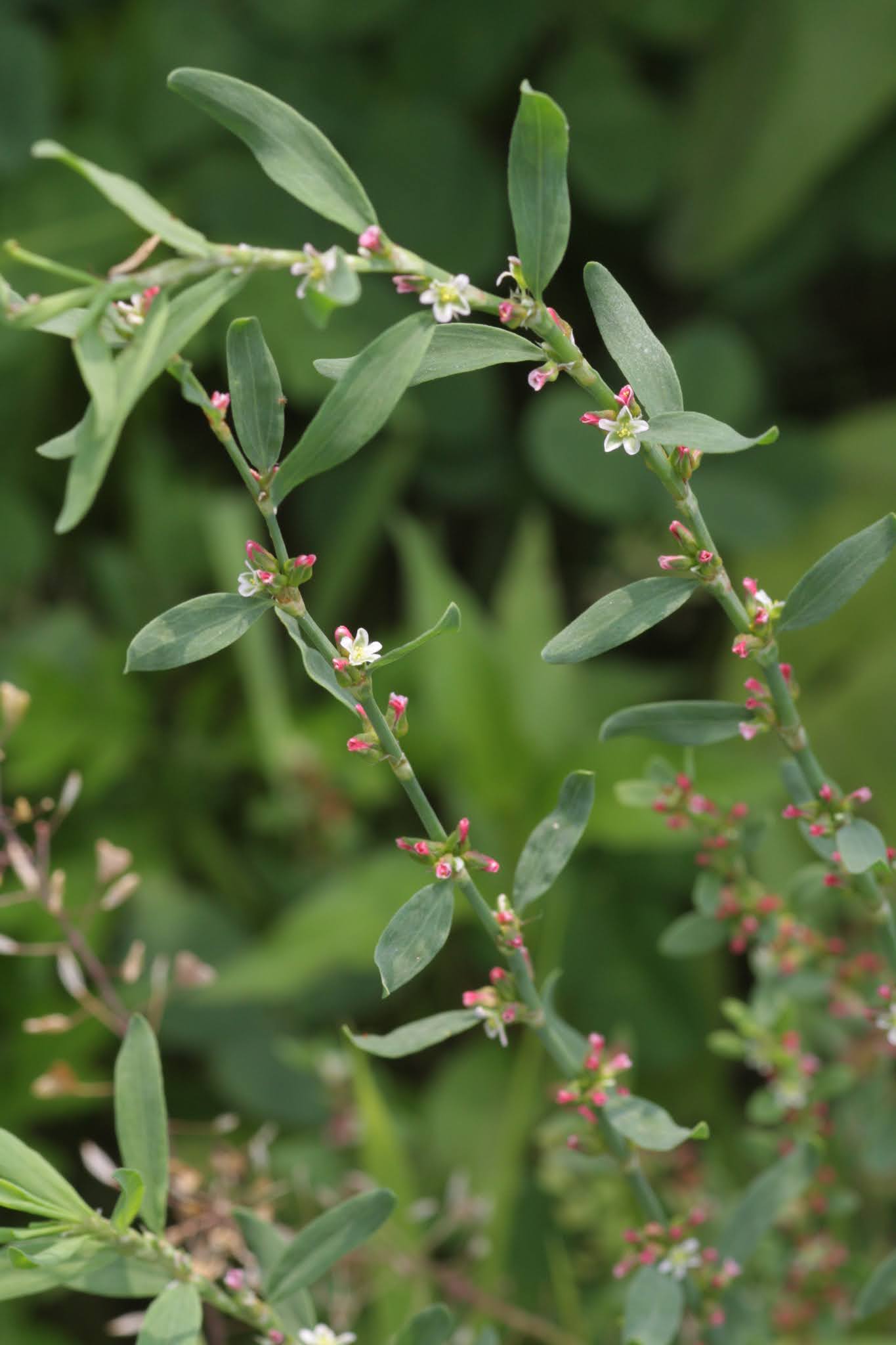
Common knotgrass Polygonum aviculare, copyright Dalgial.


Belongs within: Polygonaceae.
Contains: Polygonum sect. Persicaria, Polygonum sect. Aconogonon, Polygonum sect. Bistorta.

Polygonum, the knotweeds, is a cosmopolitan genus of herbs, shrubs and vines most diverse in northern temperate regions. Leaves are generally petioled and between 5 to 35 cm long in members of the subgenus Persicaria whereas they are more or less sessile and less than five centimetres long in species of the subgenus Polygonum (Hickman 1993).

Characters (from Hickman 1993): Annual, perennial, shrub or vine. Stem prostrate to erect, or climbing, or floating, <3 m. Leaves generally cauline, alternate, sessile or petioled, stipules fused, sheathing stem above nodes, generally scarious or membranous; blade sometimes obviously jointed to stipule sheath. Inflorescence unit a 1–8-flowered cluster, these arrayed singly or in head-like to open panicles. Flower with perianth lobes generally 5; stamens 3–8, filaments generally wider at base. Fruit generally ovoid, 3-angled, sometimes round, flat, indented; shiny to dull, brown to black.

<==Polygonum Linnaeus 1753 A61
    |--P. subg. Polygonum H93
    |    |  i. s.: P. bolanderi H93
    |    |         P. paronychia H93
    |    |         P. shastense H93
    |    |--P. sect. Polygonum H93
    |    |    |--P. arenastrum [incl. P. montereyense] H93
    |    |    |--P. argyrocoleon H93
    |    |    |--P. aviculare H93
    |    |    |--P. marinense H93
    |    |    |--P. patulum H93
    |    |    |--P. prolificum H93
    |    |    |--P. ramosissimum H93
    |    |    `--P. robertii H93
    |    |--P. sect. Duravia H93
    |    |    |--P. bidwelliae H93
    |    |    |--P. californicum H93
    |    |    `--P. parryi H93
    |    `--P. sect. Monticola non Monticola Soares 1944 (ICZN) nec Boie 1822 (ICZN) nec Nalivkin 1930 (ICZN) H93
    |         |--P. douglasii H93
    |         |    |--P. d. ssp. douglasii [incl. P. douglasii var. latifolium] H93
    |         |    |--P. d. ssp. austiniae H93
    |         |    |--P. d. ssp. johnstonii [incl. P. sawatchense] H93
    |         |    |--P. d. ssp. majus H93
    |         |    `--P. d. ssp. spergulariiforme H93
    |         |--P. minimum H93
    |         `--P. polygaloides H93
    |              |--P. p. ssp. polygaloides H93
    |              |--P. p. ssp. confertiflorum H93
    |              |--P. p. ssp. esotericum H93
    |              `--P. p. ssp. kelloggii H93
    `--P. subg. Persicaria H93
         |  i. s.: P. barbatum Linnaeus 1753 H78 [=Persicaria barbata LK14]
         |         ‘Persicaria’ bistorta V09
         |         P. chinense Linnaeus 1753 H78 [=Persicaria chinensis D07]
         |         P. glabrum VB02 [=Persicaria glabra K10]
         |         ‘Persicaria’ glacialis O88
         |         P. nepalense Meissn. 1826 H78 (see below for synonymy)
         |         ‘Persicaria’ odorata H90
         |--P. sect. Persicaria H93
         |--P. sect. Aconogonon H93
         |--P. sect. Bistorta H93
         `--P. (sect. Cephalophilon) capitatum H93 [=Persicaria capitata H90]

Polygonum incertae sedis:
  P. acuminatum H70
  P. benguetense Merr. 1915 H78
  P. chilense D03
  P. cumingianum [incl. P. celebicum] H78
  P. dumetorum C55
  P. emarginatum C55
  P. fagopyrum C55
  P. longisetum DeBr. in Miq. 1854 H78
  P. maritimum C55
  P. minus Huds. 1762 H78
  P. paniculatum [incl. P. polyanthos] H78
  P. perfoliatum Linnaeus 1762 H78
  P. plebeium [incl. P. aviculare var. dryandri] C06
    |--P. p. var. plebeium PP07
    `--P. p. var. indica PP07
  P. pubescens H78
  P. runcinatum Don 1825 H78
  P. salicifolium BG96
  P. senegalense GC05
  P. serrulatum A27
  P. sieboldi F92
  P. tataricum C55
  P. thunbergi F92
  P. viviparum CS77

Polygonum nepalense Meissn. 1826 H78 [=Persicaria nepalensis O88; incl. P. alatum Buch.-Ham. ex Spreng. 1827 H78, P. microcephalum var. papuanum Warb. 1893 H78]

*Type species of generic name indicated

REFERENCES

[A61] Allan, H. H. 1961. Flora of New Zealand vol. 1. Indigenous Tracheophyta: Psilopsida, Lycopsida, Filicopsida, Gymnospermae, Dicotyledones. R. E. Owen, Government Printer: Wellington (New Zealand).

[A27] Andersen, J. C. 1927. Popular names of New Zealand plants. Part 2. Transactions and Proceedings of the New Zealand Institute 57: 905–977.

[BG96] Baka, Z. A., & H. B. Gjaerum. 1996. Egyptian Uredinales. 1. Rusts on wild plants from the Nile Delta. Mycotaxon 60: 291–303.

[C55] Candolle, A. de. 1855. Géographie Botanique Raisonée: Ou exposition des faits principaux et des lois concernant la distribution géographique des plantes de l’époque actuelle vol. 2. Librairie de Victor Masson: Paris.

[CS77] Cramp, S., & K. E. L. Simmons (eds) 1977. Handbook of the Birds of Europe, the Middle East and North Africa: The Birds of the Western Palaearctic vol. 1. Ostrich to Ducks. Oxford University Press: Oxford.

[D07] Dash, S. S. 2007. Useful plants of Kabi Sacred Grove, Sikkim. Bulletin of the Botanical Survey of India 49: 79–88.

[D03] Dusén, P. 1903. The vegetation of western Patagonia. In: Scott, W. B. (ed.) Reports of the Princeton University Expeditions to Patagonia, 1896–1899 vol. 8. Botany pp. 1–34. The University: Princeton (New Jersey).

[F92] Fan Z. 1992. Key to the Common Flies of China 2nd ed. Science Press: Beijing.

[GC05] Granjon, L., J.-F. Cosson, E. Quesseveur & B. Sicard. 2005. Population dynamics of the multimammate rat Mastomys huberti in an annually flooded agricultural region of central Mali. Journal of Mammalogy 86 (5): 997–1008.

[H70] Hammer, M. 1970. A few oribatid mites from Easter Island. Pacific Insects 12 (2): 279–289.

[H90] Harden, G. J. (ed.) 1990. Flora of New South Wales vol. 1. New South Wales University Press.

[H78] Henty, E. E. 1978. Polygonaceae. In: Womersley, J. S. (ed.) Handbooks of the Flora of Papua New Guinea vol. 1 pp. 222–248. Melbourne University Press: Carlton South (Australia).

[H93] Hickman, J. C. (ed.) 1993. The Jepson Manual: Higher Plants of California. University of California Press: Berkeley (California).

[K10] Keighery, G. 2010. The naturalised vascular plants of the Pilbara region, Western Australia. Records of the Western Australian Museum Supplement 78 (1): 299–311.

[LK14] Lyons, M. N., G. J. Keighery, L. A. Gibson & T. Handasyde. 2014. Flora and vegetation communities of selected islands off the Kimberley coast of Western Australia. Records of the Western Australian Museum Supplement 81: 205–244.

[O88] Ohba, H. 1988. The alpine flora of the Nepal Himalayas: an introductory note. In: Ohba, H., & S. B. Malla (eds) The Himalayan Plants vol. 1. The University Museum, University of Tokyo, Bulletin 31: 19–46.

[PP07] Pandey, R. P., & P. M. Padhye. 2007. Studies on phytodiversity of Arid Machia Safari Park-Kailana in Jodhpur (Rajasthan). Bulletin of the Botanical Survey of India 49: 15–78.

[V09] Verdcourt, B. (ed.) 2009. Additions to the wild fauna and flora of the Royal Botanic Gardens, Kew. XXVI. Miscellaneous records. Kew Bulletin 64 (1): 183–194.

[VB02] Vijay, S. K., & T. N. Bhardwaja. 2002. Vegetation and phenodynamics of wetlands of central Rajasthan. Journal of the Bombay Natural History Society 99 (3): 573–581.

Last updated: 1 January 2021.