Scyliorhinus

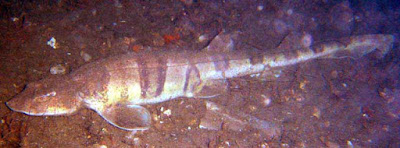
Dogfish Scyliorhinus canicula, copyright Joe.


Belongs within: Carcharhiniformes.

Scyliorhinus is a genus of catsharks with the second dorsal fin much smaller than the first, and labial furrows present on the lower jaw only (Compagno 1984).

Characters (from Compagno 1984): Body not tadpole-shaped, moderately stout to slender and cylindrical or spindle-shaped, tapering considerably to caudal fin; body firm and thick skinned, with well-calcified dermal denticles; stomach not inflatable; tail moderately long, length from vent to lower caudal origin between 3/5 to 3/4 of snout-vent length. Head slightly to moderately depressed, narrowly rounded and not wedge-shaped in lateral view; head short, less than 1/5 of total length in adults; snout short, less than 3/4 of mouth width, thick, and slightly flattened, bluntly pointed in lateral view; snout not expanded laterally, rounded-parabolic in dorsoventral view; ampullal pores not greatly enlarged on snout; nostrils not enlarged to moderately enlarged, with incurrent and excurrent apertures only slightly open to exterior; anterior nasal flaps more or less triangular, sometimes slightly elongated, without a prominent barbel, well separated from each other and ending somewhat anterior to mouth but close together and reaching it in S. canicula; internarial space 0.3 to 0.8 times in nostril width; nasoral grooves usually absent except S. canicula in which broad grooves are present; eyes dorsolateral on head, broad subocular ridges present below eyes; mouth angular or broadly arched, moderately long, with lower symphysis somewhat behind upper so that upper teeth are well-exposed in ventral view (except S. canicula, in which upper teeth are obscured by lower jaw); labial furrows present along lower jaw only, these short to moderately long; vestigial uppers occasionally prsent; branchial region not greatly enlarged, distance from spiracles to fifth gill slits 1/2 to 2/5 head length; gill slits lateral on head. Two dorsal fins present, with the second considerably smaller than the first; origin of first dorsal varying from over last half of pelvic bases to over pelvic free rear tips; origin of second dorsal over last third of anal base to slightly behind anal insertion; pectoral fins large, their width about as great or considerably greater than mouth width. Inner margins of pelvic fins more or less fused over claspers in adult males, forming an 'apron'; claspers short, relatively thick, and distally pointed or rounded, extending less than half their lengths behind the pelvic fin tips; anal fin moderately large but not greatly elongated, subequal to pelvic and first dorsal fins but much larger than second dorsal, its base length 1.3 to 2.4 times the second dorsal base; origin of anal well behind pelvic bases, and insertion separated from lower caudal origin by a space varying from half as long to slightly longer than the anal base; caudal fin short and fairly broad, between 1/4 to 1/5 to less than 1/5 of total length in adults. No crests of denticles on the caudal margins; supraorbital crests present on cranium. Colour pattern extremely variable, ranging from simple dark saddles, reticulating dark bars, or large dark spots on a light background to combinations of light and dark spots and saddles.

<==Scyliorhinus Blainville 1816 (see below for synonymy) C84
    |--*S. canicula (Linnaeus 1758) C84 (see below for synonymy)
    |--S. besnardi Springer & Sadowsky 1970 [=S. retifer besnardi] C84
    |--S. boa Goode & Bean 1896 [=S. retifer boa] C84
    |--S. capensis (Smith in Müller & Henle 1838) [=Scyllium capense] C84
    |--S. cervigoni Maurin & Bonnet 1970 C84
    |--S. garmani (Fowler 1934) [=Halaelurus garmani] C84
    |--S. haeckelii (Ribeiro 1907) [=Catulus haeckelii, S. retifer haeckelii; incl. S. fernandezi Weibezahn 1953] C84
    |--S. hesperius Springer 1966 C84
    |--S. meadi Springer 1966 [=S. retifer meadi] C84
    |--S. retifer (Garman 1881) [=Scyllium retiferum] C84
    |--S. stellaris (Linnaeus 1758) (see below for synonymy) C84
    |--S. torazame (Tanaka 1908) [=Catulus torazame; incl. S. rudis Pietschmann 1908] C84
    `--S. torrei Howell-Rivero 1936 [incl. Catulus boae Sanchez-Roig 1931] C84

Nomina nuda: Squalus (Scyliorhinus) breviculus Blainville 1816 C84
             Squalus (Scyliorhinus) lambarda Blainville 1816 C84
             Squalus (Scyliorhinus) myops Blainville 1816 C84
             Squalus (Scyliorhinus) punctatus Blainville 1816 non Scylliorhinus punctatus Gilchrist 1914 C84
             Squalus (Scyliorhinus) punctulatus Blainville 1816 C84
             Squalus (Scyliorhinus) unicolor Blainville 1816 C84
             Squalus (Scyliorhinus) variegatus Blainville 1816 C84

Scyliorhinus Blainville 1816 [=Scylliorhinus Blainville 1825, Scylliorhynchus (l. c.), Scylliorhynus (l. c.); incl. Alphascyllium Leigh-Sharpe 1926, Betascyllium Leigh-Sharpe 1926, Catulus Smith 1837 non Kniphof 1759, Scyllium Cuvier 1817] C84

*Scyliorhinus canicula (Linnaeus 1758) C84 [=Squalus canicula C84, Scyllium canicula S93; incl. Scyllium acutidens Vaillant 1888 C84, Scylliorhinus canicula var. albomaculata Pietschmann 1907 C84, Squalus catulus Linnaeus 1758 C84, Catulus duhamelii Garman 1913 C84, Sq. elegans Blainville 1825 C84, Scyllium spinacipellitum Vaillant 1888 C84]

Scyliorhinus stellaris (Linnaeus 1758) [=Squalus stellaris, Poroderma stellare; incl. Scyllium acanthonotum Filippi & Verany 1853] C84

*Type species of generic name indicated

REFERENCES

[C84] Compagno, L. J. V. 1984. FAO Species Catalogue vol. 4. Sharks of the World: An annotated and illustrated catalogue of shark species known to date. Part 2—Carcharhiniformes. United Nations Development Programme, Food and Agriculture Organization of the United Nations: Rome.

[S93] Schultze, H.-P. 1993. Patterns of diversity in the skulls of jawed fishes. In: Hanken, J., & B. K. Hall (eds) 1993. The Skull vol. 2. Patterns of Structural and Systematic Diversity pp. 189–254. The University of Chicago Press.

Triakidae

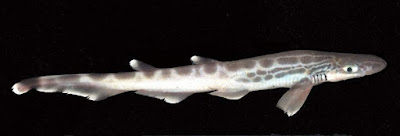
Starry smooth-hound Mustelus asterias, copyright Hans Hillewaert.


Belongs within: Carcharhiniformes.

The Triakidae, houndsharks, are a group of small to medium-sharks that are most diverse in waters of the continental shelf, often at or close to the bottom of the water column (Compagno 1984).

Characters (from Compagno 1984): Head without laterally expanded blades; eyes elongated and fusiform, horizontally oval, or slitlike, with lengths over 1.5 to 2.5 times height; nictitating eyelids external, transitional or internal; spiracles present and small to moderately large; anterior nasal flaps varying from elongated to lobular to vestigial, rarely barbel-like; internarial width about 0.5 to 3.0 times in nostril width; labial furrows moderately long to very long; teeth small to moderately large, with acute and narrow to moderately large cusps and lateral cusplets in some species, but with these structures reduced or absent in others; teeth with strong basal ledges and grooves; teeth cuspidate and not bladelike, compressed and bladelike, or thickened and molariform; usually similar in both jaws but differentiated in a few species; posterior teeth not comblike; tooth rows 18 to 42/27 to 106. Precaudal pits absent. First dorsal fin moderately large to very large but not keel-like, usually much shorter than caudal fin; first dorsal base well ahead of pelvic bases, usually closer to pectoral bases than to pelvics but sometimes slightly closer to pelvics; midpoint of first dorsal base always in front of pelvic origins; pectoral fins with radials confined to bases of fins; ventral caudal lobe varying from absent to well-developed; no undulations or ripples in dorsal caudal margin. Neurocranium with supraorbital crests; vertebral centra with strong, wedge-shaped intermedial calcifications. Valvular intestine with a spiral valve of 4 to 11 turns. Some species with variegated colour patterns, most without them.

<==Triakidae [Emissolidae, Eugaleidae, Galei, Galeorhinoidae, Iagini, Musteli, Scylliodontes, Scylliogaleidae, Triakiana]
    |--Paratriakis bettrechiensis Herman 1977 CDZ93
    |--Furgaleus Whitley 1951 [=Fur Whitley 1943 non Jones 1940] C84
    |    `--*F. macki (Whitley 1943) [=*Fur macki; incl. Fur ventralis Whitley 1943, Furgaleus ventralis] C84
    |--Gogolia Compagno 1973 C84
    |    `--*G. filewoodi Compagno 1973 C84
    |--Scylliogaleus Boulenger 1902 C84
    |    `--*S. quecketti Boulenger 1902 C84
    |--Hypogaleus Smith 1957 C84
    |    `--H. hyugaensis (Miyosi 1939) (see below for synonymy) C84
    |--Hemitriakis Herre 1923 C84
    |    |--*H. leucoperiptera Herre 1923 [=Triakis leucoperiptera] C84
    |    `--H. japanica (Müller & Henle 1839) [=Galeus japanicus, Galeorhinus japanicus] C84
    |--Iago Compagno & Springer 1971 C84
    |    |--*I. omanensis (Norman 1939) [=Eugaleus omanensis, Galeorhinus omanensis] C84
    |    `--I. garricki Fourmanoir & Rivaton 1979 C84
    |--Galeorhinus Blainville 1816 (see below for synonymy) C84
    |    |--*G. galeus (Linnaeus 1758) (see below for synonymy) C84
    |    |--G. minutissimus (Arambourg 1952) CDZ93
    |    `--G. mustelus D56
    |--Triakis Müller & Henle 1838 [=Triacis Gill 1862] C84
    |    |--T. (Triakis) C84
    |    |    |--*T. (T.) scyllium Müller & Henle 1839 [=T. scyllia; incl. Hemigaleus pingi Evermann & Shaw 1927] C84
    |    |    `--T. (T.) semifasciata Girard 1854 (see below for synonymy) C84
    |    `--T. (Cazon de Buen 1959) C84
    |         |--T. (C.) acutipinna Kato 1968 C84
    |         |--T. (C.) maculata Kner & Steindachner 1866 (see below for synonymy) C84
    |         `--T. (C.) megalopterus (Smith 1849) (see below for synonymy) C84
    `--Mustelus Linck 1790 (see below for synonymy) C84
         |--*M. mustelus (Linnaeus 1758) (see below for synonymy) C84
         |--M. antarcticus Günther 1870 [incl. Emissola ganearum Whitley 1945, E. maugeana Whitley 1939] C84
         |--M. asterias Cloquet 1821 (see below for synonymy) C84
         |--M. californicus Gill 1864 C84
         |--M. canis (Mitchill 1815) B02 [=Squalus canis C84; incl. *Allomycter dissutus Guitart 1972 C84]
         |--M. dorsalis Gill 1864 C84
         |--M. fasciatus (Garman 1913) [=Galeorhinus fasciatus; incl. M. striatus Devincenzi 1920] C84
         |--M. griseus Pietschmann 1908 [incl. Cynias kanekonis Tanaka 1916, M. kanekonis] C84
         |--M. henlei (Gill 1863) [=Rhinotriacis henlei, Triakis henlei] C84
         |--M. higmani Springer & Lowe 1963 C84
         |--M. lenticulatus Phillipps 1932 C84
         |--M. lunulatus Jordan & Gilbert 1883 C84
         |--M. manazo Bleeker 1854 C84
         |--M. mento Cope 1877 [incl. M. abbotti Evermann & Radcliffe 1917, M. edulis Perez Canto in Philippi 1887] C84
         |--M. mosis Hemprich & Ehrenberg 1899 C84
         |--M. norrisi Springer 1940 C84
         |--M. palumbes Smith 1957 C84
         |--M. punctulatus Risso 1826 [incl. M. mediterraneus Quignard & Capape 1972] C84
         |--M. schmitti Springer 1940 C84
         `--M. whitneyi Chirichigno 1973 C84

Galeorhinus Blainville 1816 [incl. Eugaleus Gill 1864, Galeus Cuvier 1817 non Rafinesque 1810, Notogaleus Whitley 1943] C84

*Galeorhinus galeus (Linnaeus 1758) [=Squalus galeus; incl. Galeus australis Macleay 1881, Galeorhinus australis, Galeus canis Bonaparte 1834, Galeus chilensis Perez Canto 1886, Galeorhinus chilensis, Galeus communis Owen 1853, Carcharhinus cyrano Whitley 1930, Galeus linnei Malm 1877, Galeus molinae Philippi 1887, Galeus nilssoni Bonaparte 1846, Squalus rhinophanes Peron 1807, Galeorhinus rhinophanes, Notogaleus rhinophanes, Galeorhinus vitaminicus de Buen 1950, Galeus vulgaris Fleming 1828, Galeus zyopterus Jordan & Gilbert 1883, Galeorhinus zyopterus] C84

Hypogaleus hyugaensis (Miyosi 1939) [=Eugaleus hyugaensis; incl. Galeorhinus (*Hypogaleus) zanzibariensis Smith 1957] C84

Mustelus Linck 1790 [=Mustellus Fischer 1813; incl. Allomycter Guitart 1972, Cynias Gill 1903, Emissola Jarocki 1822, Galeus Leach 1818 nec Rafinesque 1810 nec Cuvier 1817, Murmille Setna & Sarangdhar 1946, Myrmillo Gistel 1848, Pleuracromylon Gill 1864, Rhinotriacis Gill 1863] C84

Mustelus asterias Cloquet 1821 [incl. Squalus albomaculatus Plucar 1845, S. edentulus Doderlein 1881, S. hinnulus Blainville 1825, Mustelus plebejus Bonaparte 1834, M. stellatus Risso 1826,] C84

*Mustelus mustelus (Linnaeus 1758) [=Squalus mustelus; incl. Mustelus equestris Bonaparte 1834, Mustelus laevis Linck 1790, Mustellus levis Risso 1826, Mustelus vulgaris Cloquet 1821] C84

Triakis (Cazon) maculata Kner & Steindachner 1866 [=T. maculatus; incl. Mustelus nigromaculatus Evermann & Radcliffe 1917] C84

Triakis (Cazon) megalopterus (Smith 1849) [=Mustelus megalopterus; incl. M. natalensis Steindachner 1866, Triakis natalensis, M. nigropunctatus Smith 1952] C84

Triakis (Triakis) semifasciata Girard 1854 [=T. semifasciatum; incl. T. californicus Gray 1851 (n. n.), Mustelus felis Ayres 1854, T. felis] C84

*Type species of generic name indicated

REFERENCES

[B02] Branstetter, S. 2002. Smooth dogfishes. Family Triakidae. In: Collette, B. B., & G. Klein-MacPhee (eds) Bigelow and Schroeder’s Fishes of the Gulf of Maine 3rd ed. pp. 37–38. Smithsonian Institute Press: Washington.

[CDZ93] Cappetta, H., C. Duffin & J. Zidek. 1993. Chondrichthyes. In: Benton, M. J. (ed.) The Fossil Record 2 pp. 593–609. Chapman & Hall: London.

[C84] Compagno, L. J. V. 1984. FAO Species Catalogue vol. 4. Sharks of the World: An annotated and illustrated catalogue of shark species known to date. Part 2—Carcharhiniformes. United Nations Development Programme, Food and Agriculture Organization of the United Nations: Rome.

[D56] Dawes, B. 1956. The Trematoda with special reference to British and other European forms. University Press: Cambridge.

Galeus

Blackmouth catshark Galeus melastomus, photographed by Pierluigi Angioi.


Belongs within: Carcharhiniformes.

Galeus is a genus of catsharks with a caudal crest of enlarged denticles and large pectoral fins (Compagno 1984).

Characters (from Compagno 1984): Body not tadpole-shaped, slender and subcylindrical to rather compressed, tapering slightly to considerably to caudal fin; body firm and thick-skinned, with well-calcified dermal denticles; stomach not inflatable; tail varying from fairly short to moderately long, length from vent to lower caudal origin about 2/5 to 5/6 of snout-vent length. Head slightly depressed, narrowly pointed-rounded in lateral view and somewhat wedge-shaped or not; head short to moderately long, between 1/4 and 1/5 to less than 1/5 of total length in adults; snout fairly short, to moderately elongated, 2/3 to about equal to mouth width, thick to rather thin and flattened, bluntly to almost acutely pointed in lateral view; snout not expanded laterally, broadly to narrowly rounded-parabolic and usually bell-shaped in dorsoventral view; ampullal pores not greatly enlarged on snout; nostrils of moderate size, with incurrent and excurrent apertures only partly open to exterior; anterior nasal flaps broadly triangular and rather low, without barbels, well separate from each other and falling well anterior to mouth; internarial space about 0.7 to 1.2 times the nostril width; no nasoral grooves; eyes virtually lateral on head, subocular ridges below eyes narrow or obsolete; mouth angular or semiangular, moderately long, with lower symphysis well behind upper so that upper teeth are exposed in ventral view; labial furrows present along both upper and lower jaws, these very short to moderately long but ending well behind level of upper symphysis of mouth; branchial region not greatly enlarged, distance from spiracles to fifth gill slits 1/3 to 1/2 of head length; gill slits lateral on head. Two equal-sized dorsal fins present, origin of first varying from over the first third of the pelvic bases to about over their insertions; origin of second dorsal varies from about over to slightly behind the anal midbase; pectoral fins large, their width somewhat less to considerably greater than mouth width; inner margins of pelvic fins not fused or variably fused and forming an 'apron' over claspers in adult males; claspers short to moderately long, fairly thick and distally pointed and often twisted, extending from less than a fifth to about half of their lengths behind the pelvic fin tips; anal fin large and more or less elongated, about as large as pelvic fins or larger, and considerably larger than the dorsals; its base length 1.6 to slightly over 3 times second dorsal base; origin of anal close to far behind pelvic bases, and its insertion separated from lower caudal origin by a narrow notch to a broad space nearly equal to the anal base; caudal fin more or less elongated, over or somewhat less than a fourth of total length in adults. A well-developed crest of denticles on the dorsal caudal margin and sometimes the upper edge of the caudal peduncle, and in some species on the preventral margin and lower edge of the caudal peduncle, dorsal crest flat on its upper surface and symmetrical; small median denticles. between upper crest denticles usually in less than five rows; supraorbital crests absent from cranium. Colour light grey or brown, with or without a conspicuous colour pattern of dark saddles and blotches.

<==Galeus Rafinesque 1810 [incl. Figaro Whitley 1928, Pristidurus Bonaparte 1838, Pristiurus Bonaparte 1834] C84
    |--*G. melastomus Rafinesque 1810 C84 (see below for synonymy)
    |--G. arae (Nichols 1927) (see below for synonymy) C84
    |--G. boardmani (Whitley 1928) [=Pristiurus (*Figaro) boardmani; incl. Figaro boardmani socius Whitley 1939] G84
    |--G. eastmani (Jordan & Snyder 1904) [=Pristiurus eastmani] G84
    |--G. murinus (Collett 1904) [=Pristiurus murinus, G. melastomus murinus; incl. P. jenseni Saemundsson 1922] C84
    |--G. nipponensis Nakaya 1975 C84
    |--G. piperatus Spriner & Wagner 1966 C84
    |--G. polli Cadenat 1959 C84
    |--G. sauteri (Jordan & Richardson 1909) [=Pristiurus sauteri] C84
    `--G. schultzi Springer 1979 C84

Nomina nuda: Galeus catulus Rafinesque 1810 C84
             Galeus mustelus Rafinesque 1810 C84
             Galeus vulpecula Rafinesque 1810 C84

Galeus arae (Nichols 1927) [=Pristiurus arae; incl. G. arae antillensis Springer 1979, G. cadenati Springer 1966, G. arae cadenati] C84

*Galeus melastomus Rafinesque 1810 C84 [incl. Squalus annulatus Nilsson 1832 C84, Scyllium artedii Risso 1820 C84, Pristiurus atlanticus Vaillant 1888 C84, Squalus (Scyliorhinus) delarochianus Blainville 1816 (n. n.) C84, Scyllium melanostomum Bonaparte 1834 C84, Pristiurus melanostomus PP64, Sq. prionurus Otto 1821 C84, Pristiurus souverbiei LaFont 1866 C84]

*Type species of generic name indicated

REFERENCES

[C84] Compagno, L. J. V. 1984. FAO Species Catalogue vol. 4. Sharks of the World: An annotated and illustrated catalogue of shark species known to date. Part 2—Carcharhiniformes. United Nations Development Programme, Food and Agriculture Organization of the United Nations: Rome.

[PP64] Peres, J. M., & J. Picard. 1964. Nouveau manuel de bionomie benthique de la mer Mediterranee. Recueil des Travaux de la Station Marine d'Endoume, Bulletin 31 (27): 5–137.

Apristurus

Brown catshark Apristurus brunneus, from the US National Oceanic and Atmospheric Administration.


Belongs within: Carcharhiniformes.

Apristurus is a genus of catsharks with a broad, flattened head and long snout (Compagno 1984).

Characters (from Compagno 1984): Body not tadpole-shaped, stocky and more or less compressed, increasing in height up to the pectoral and trunk region and tapering posteriorly; body very soft and flabby, with thin skin and weakly calcified dermal denticles; stomach not inflatable; tail short, length from vent to lower caudal origin about 2/5 to 3/5 of snout-vent length. Head greatly depressed, pointed and wedge-shaped in lateral view, rather elongated, but usually slightly less than 1/4 of total length in adults; snout elongated, about equal to mouth width or greater, greatly flattened, narrow and pointed in lateral view; snout expanded laterally, narrowly spade-shaped to broadly spatulate and usually more or less bell-shaped in dorsoventral view; ampullal pores enlarged and prominent on snout; nostrils more or less enlarged, with incurrent and excurrent apertures broadly open to exterior; anterior nasal flaps reduced to angular lobes, without barbels, widely separate from each other and falling far anterior to mouth; internarial space 0.8 to 1.7 times the nostril width; no nasoral grooves; eyes dorsolateral on head, broad subocular ridges present below eyes; mouth angular or broadly arched, with lower symphysis well behind upper so that upper teeth are exposed in ventral view; labial furrows present along both upper and lower jaws, these long and reaching nearly or quite to level of upper symphysis of mouth; branchial region not greatly enlarged, distance from spiracles to fifth gill slits less than half head length; gill slits lateral on head. Two dorsal fins present, equal-sized or with the second dorsal larger than the first; origin of first dorsal varying from over the pelvic midbases to over the pelvic free rear tips; origin of second dorsal about over or slightly behind the anal midbase, anal fin enlarged and more or less elongated, larger than pelvic and dorsal fins, base length at least twice second dorsal base; origin of anal just behind pelvic bases, and insertion separated from lower caudal origin by a narrow notch; pectoral fins variable in size, their width less to greater than mouth width; inner margins of pelvic fins not fused over claspers in adult males; claspers short, thick, and distally pointed, not extending more than 2/3 of their lengths behind the pelvic fin tips and sometimes not extending past their tips. Caudal fin more or less elongated, over a fifth and often over a fourth of total length. A crest of enlarged denticles absent or variably developed on the dorsal caudal margin; supraorbital crests absent from cranium. No colour pattern, uniformly jet black, brownish-black, brown, pinkish or whitish.

<==Apristurus Garman 1913 [=Apristurius (l. c.); incl. Compagnoia Springer 1979, Parapristurus Fowler 1934] C84
    |--*A. indicus (Brauer 1906) [=Scylliorhinus indicus] C84
    |--A. atlanticus (Koefoed 1932) [=Scylliorhinus atlanticus] C84
    |--A. brunneus (Gilbert 1892) [=Catulus brunneus] C84
    |--A. canutus Springer & Heemstra in Springer 1979 C84
    |--A. herklotsi (Fowler 1934) [=Pentanchus herklotsi] C84
    |--A. investigatoris (Misra 1962) [=Pentanchus (Parapristurus) investigatoris] C84
    |--A. japonicus Nakaya 1975 C84
    |--A. kampae Taylor 1972 C84
    |--A. laurussoni (Saemundsson 1922) [=Scyllium laurussoni] C84
    |--A. longicephalus Nakaya 1975 C84
    |--A. macrorhynchus (Tanaka 1909) [=Scyliorhinus macrorhynchus] C84
    |--A. maderensis Cadenet & Maul 1966 C84
    |--A. manis (Springer 1979) [=Parmaturus (*Compagnoia) manis] C84
    |--A. microps (Gilchrist 1922) [=Scylliorhinus microps] C84
    |--A. nasutus de Buen 1959 C84
    |--A. parvipinnis Springer & Heemstra in Springer 1979 C84
    |--A. platyrhynchus (Tanaka 1909) [=Scyliorhinus platyrhynchus] C84
    |--A. profundorum (Goode & Bean 1896) [=Scylliorhinus profundorum] C84
    |--A. riveri Bigelow & Schroeder 1944 C84
    |--A. saldanha (Barnard 1925) [=Scylliorhinus saldanha] C84
    |--A. sibogae (Wber 1913) [=Scyliorhinus sibogae] C84
    |--A. sinensis Chu & Hu 1981 C84
    |--A. spongiceps (Gilbert 1895) [=Catulus spongiceps, Parapristurus spongiceps, Pentanchus spongiceps] C84
    |--A. stenseni (Springer 1979) [=Parmaturus (Compagnoia) stenseni] C84
    `--A. verweyi (Fowler 1934) [=Pentanchus verweyi] C84

*Type species of generic name indicated

REFERENCES

[C84] Compagno, L. J. V. 1984. FAO Species Catalogue vol. 4. Sharks of the World: An annotated and illustrated catalogue of shark species known to date. Part 2—Carcharhiniformes. United Nations Development Programme, Food and Agriculture Organization of the United Nations: Rome.

Halaelurus

Tiger catshark Halaelurus natalensis, copyright S. du Preez.


Belongs within: Carcharhiniformes.

Halaelurus is an Indo-Pacific genus of catsharks with a relatively short snout and caudal fin (Compagno 1984).

Characters (from Compagno 1984): Body not tadpole-shaped, slender to moderately stout and cylindrical or fusiform, tapering slightly or moderately to caudal fin; body firm and thick-skinned, with dermal denticles well-calcified or weakly so; stomach not inflatable; tail fairly short to rather long, length from vent to lower caudal origin about 2/5 of total length, to about equal to snout-vent length. Head moderately to considerably depressed, narrowly rounded to wedge-shaped in lateral view; head short to moderately long, between 1/4 and 1/5 to less than 1/5 of total length in adults; snout short to moderately long, less than 4/5 of mouth width, thick and slightly flattened, bluntly to narrowly pointed in lateral view; snout not expanded laterally, rounded, parabolic, pointed, or somewhat bell-shaped in dorsoventral view; ampullal pores not greatly enlarged on snout; nostrils of moderate size, with incurrent and excurrent apertures only partly open to exterior; anterior nasal flaps broadly triangular, narrow and elongated, or reduced and pointed, without barbels, well separate from each other and falling slightly to considerably anterior to mouth; internarial space about 0.6 to 1.1 times nostril width; no nasoral grooves; eyes dorsolateral on head, broad subocular ridges present below eyes; mouth angular, semiangular, or rounded, short to moderately long, with lower symphysis well behind upper so that upper teeth are exposed in ventral view; labial furrows present along both upper and lower jaws, these short to very short and occasionally absent, ending well behind level of upper symphysis of mouth when present; bronchial region not greatly enlarged distance from spiracles to fifth gill slits 1/3 to slightly less than 3/5 of head length; gill slits lateral or dorsolateral on head. Two dorsal fins present, about equal-sized or with the second slightly smaller or larger than first; origin of first dorsal varying from slightly in front of the pelvic midbases to about over their insertions; origin of second dorsal varies from slightly in front of anal midbase to about over anal insertion; pectoral fins moderately large, their width subequal to or somewhat greater than mouth width; inner margins of pelvic fins not fused over claspers in adult males; claspers moderately long, fairly slender to moderately stout, and distally pointed, extending about half of their lengths behind the pelvic fin tips; anal fin moderately large but not greatly elongated, about as large as pelvic fins or slightly smaller or larger, subequal to or larger than the dorsals, its base length subequal to about twice the second dorsal base; origin of anal well behind pelvic bases, and insertion separated from lower caudal origin by a narrow to very broad space less than a fourth to over the length of the anal base; caudal fin short and broad to narrow and moderately elongated, between 1/4 and 1/5 to less than 1/5 of total length in adults; no crests of denticles on the caudal margins. Supraorbital crests absent from cranium. Colour light grey or brown to blackish without markings, or variably patterned with dark spots, saddles and vertical bars.

<==Halaelurus Gill 1862 [incl. Gammascyllium Leigh-Sharpe 1926] C84
    |--*H. buergeri (Müller & Henle 1838) [=Scyllium buergeri, H. burgeri] C84
    |--H. alcocki Garman 1913 (n. d.) C84
    |--H. boesemani Springer & D’Aubrey 1972 C84
    |--H. canescens (Günther 1878) [=Scyllium canescens] C84
    |--H. dawsoni Springer 1971 C84
    |--H. hispidus (Alcock 1891) [=Scyllium hispidum] C84
    |--H. immaculatus Chu & Meng 1982 C84
    |--H. lineatus Bass, D’Aubrey & Kistnasamy 1975 C84
    |--H. lutarius Springer & D’Aubrey 1972 C84
    |--H. natalensis (Regan 1904) [=Scyllium natalense] C84
    `--H. quagga (Alcock 1899) [=Scyllium quagga] C84

*Type species of generic name indicated

REFERENCES

[C84] Compagno, L. J. V. 1984. FAO Species Catalogue vol. 4. Sharks of the World: An annotated and illustrated catalogue of shark species known to date. Part 2—Carcharhiniformes. United Nations Development Programme, Food and Agriculture Organization of the United Nations: Rome.

Percomorpharia

White bass Morone chrysops, from the US Fish and Wildlife Service.


Belongs within: Acanthomorphata.
Contains: Gerreidae, Labridae, Uranoscopiformes, Centrarchiformes, Serraniformes, Pempheridae, Epigonidae, Pentacerotidae, Ephippiformes, Spariformes, Malacanthidae, Pomacanthidae, Haemulidae, Caesionidae, Lutjanidae, Sillago, Emmelichthyidae, Lobotidae, Sciaenidae, Leiognathidae, Chaetodontidae, Acanthuriformes, Tetraodontiformes, Lophiiformes, Priacanthidae, Cepolidae, Siganidae.

The Percomorpharia are a major clade of acanthomorph fishes united by molecular data (Betancur-R. et al. 2013).

Percomorpharia [Epigonoidei] B-RB13
    |  i. s.: Dinopercidae B-RB13
    |           |--Centrarchops chapini SC07
    |           `--Dinoperca petersi SC07
    |         Rhenanoperca minuta Gaudant & Micklich 1990 M09
    |--+--Gerreidae ND13
    |  `--Labriformes [Labroidea, Labroidei] B-RB13
    |       |  i. s.: Pseudosphaerodon antiquus Casier 1966 P93
    |       |--Labridae ND13
    |       |--Tortonesia [Tortonesidae] P93
    |       |    `--T. esilis Sorbini 1983 P93
    |       `--Odacidae B-RB13
    |            |--Odax cyanomelas CC98
    |            |--Olistherops R13
    |            `--Coridodax R13
    `--+--+--Uranoscopiformes ND13
       |  `--Centrogenys [Centrogeniidae] ND13
       |       `--C. vaigiensis (Quoy & Gaimard 1824) M58 (see below for synonymy)
       `--+--+--Centrarchiformes ND13
          |  `--+--Serraniformes ND13
          |     `--+--+--+--Percophidae ND13
          |        |  |  |    |--Acanthaphritis ND13 [incl. Pteropsaron R13]
          |        |  |  |    |    `--A. unoorum ND13
          |        |  |  |    `--Hemerocoetinarum apertus (Schwarzhans 1980) P93
          |        |  |  `--Creediidae [Limnichthyidae] ND13
          |        |  |       |--Limnichthys ND13
          |        |  |       |--Chalixodytes chameleontoculus LM13
          |        |  |       |--Creedia clathrisquamis Ogilby 1898 R13
          |        |  |       `--Schizochirus R13
          |        |  `--Pempheriformes B-RB13
          |        |       |--Pempheridae ND13
          |        |       `--Glaucosoma [Glaucosomatidae, Glaucosomidae] ND13
          |        |            |--G. buergeri Richardson 1845 (see below for synonymy) M01
          |        |            |--G. hebraicum ND13
          |        |            |--G. magnificum (Ogilby 1915) M01
          |        |            `--G. scapulare Ramsay 1881 M01
          |        `--+--+--Howella Ogilby 1899 ND13, P93 [Howellidae]
          |           |  |    |--H. brodiei (Ogilby 1899) LD09
          |           |  |    |--H. parina LM13
          |           |  |    `--H. zina ND13
          |           |  `--+--Epigonidae B-RB13
          |           |     |--Ostracoberyx [Ostracoberycidae] ND13
          |           |     |    |--O. dorygenys ND13
          |           |     |    `--O. pattersoni Nolf 1988 P93
          |           |     `--Acropomatidae ND13
          |           |          |--Neoscombrops pacificus LM13
          |           |          `--Acropoma ND13
          |           |               |--A. antiqua Schwarzhans 1985 P93
          |           |               |--A. japonica ND13
          |           |               `--A. lepidotus (Agassiz 18330 P93
          |           `--+--+--Pentacerotidae ND13
          |              |  `--Banjos [Banjosidae] ND13
          |              |       `--B. banjos ND13
          |              `--+--Malakichthys ND13
          |                 |    |--M. elegans ND13
          |                 |    |--M. griseus SC07
          |                 |    `--M. wakiyae I00
          |                 |--+--Avitolabrax denticulatus Takai 1942 P93
          |                 |  `--Lateolabrax Bleeker 1857 LD09, P93 [Lateolabracidae B-RB13]
          |                 |       `--L. japonicus (Cuvier 1828) LD09
          |                 `--Polyprionidae ND13
          |                      |--Stereolepis Ayres 1859 ND13, P93
          |                      |    |--S. doederleini I00
          |                      |    `--S. gigas ND13
          |                      `--Polyprion Oken 1817 P93
          |                           |--P. americanus (Bloch & Schneider 1801) K-M02b
          |                           `--P. oxygeneios SC07
          `--+--Moronidae ND13
             |    |--Dicentrarchus labrax (Linnaeus 1758) LD09
             |    |--Palaeoperca proxima Nicklich 1985 P93
             |    `--Morone ND13 [incl. Roccus K-M02a]
             |         |  i. s.: M. americana (Gmelin 1789) K-M02a [incl. Labrax mucronatus P61]
             |         |         M. eschmeyeri Nolf & Lapierre 1979 P93
             |         |         M. vogdtii (Bogatshov 1942) P93
             |         |--M. saxatilis (Walbaum 1792) ND13, K-M02a [=Roccus saxatilis K-M02a]
             |         `--+--M. chrysops ND13
             |            `--M. mississippiensis ND13
             `--+--Ephippiformes ND13
                `--+--+--+--Spariformes ND13
                   |  |  `--+--Malacanthidae ND13
                   |  |     `--+--Pomacanthidae ND13
                   |  |        `--+--Haemulidae ND13
                   |  |           `--+--Caesionidae ND13
                   |  |              `--Lutjanidae ND13
                   |  `--+--+--Sillago ND13
                   |     |  `--Emmelichthyidae ND13
                   |     `--Callanthiidae ND13
                   |          |--Grammatonotus ND13
                   |          |    |--G. macrophthalmus I00
                   |          |    `--G. surugaensis ND13
                   |          `--Callanthias Lowe 1839 S61
                   |               |--C. ruber (Rafinesque 1810) [incl. *C. paradiseus Lowe 1839] S61
                   |               |--C. allporti Gunther 1876 S61
                   |               `--C. legras Smith 1947 S61
                   `--+--+--+--Lobotidae ND13
                      |  |  `--Sciaenidae ND13
                      |  `--+--+--Leiognathidae ND13
                      |     |  `--Chaetodontidae ND13
                      |     `--Monodactylidae ND13
                      |          |--Schuettea scalaripinnis Steindachner 1866 K01
                      |          |--Pasaichthys pleuronectiformis Blot 1969 P93
                      |          |--Psettopsis subarcuatus (de Blainville 1818) P93
                      |          |--Monodactylus ND13
                      |          |    |--M. argenteus (Linnaeus 1758) [=Chaetodon argenteus, Psettus argenteus] M58
                      |          |    |--M. kottelati Pethiyagoda 1991 K01
                      |          |    `--M. sebae ND13
                      |          `--Bramichthys R13
                      `--+--Acanthuriformes ND13
                         `--+--+--+--Tetraodontiformes ND13
                            |  |  `--Lophiiformes ND13
                            |  `--Caproidae [Caproidei] ND13
                            |       |--Capros aper (Linnaeus 1758) LD09
                            |       `--Antigonia ND13
                            |            |--A. capros Lowe 1843 MK-M02
                            |            |--A. combatia MK-M02
                            |            |--A. rubescens ND13
                            |            `--A. veronensis Sorbini 1983 P93
                            `--+--+--Priacanthidae ND13
                               |  `--Cepolidae ND13
                               `--+--Siganidae ND13
                                  `--Scatophagidae ND13
                                       |--Scatophagus P93
                                       |    |--S. argus (Linné 1766) [=Chaetodon argus] M58
                                       |    `--S. frontalis Agassiz 1835 P93
                                       `--Selenotoca ND13
                                            |--S. multifasciata (Richardson 1846) LD09 (see below for synonymy)
                                            `--S. papuensis Fraser-Brunner 1938 M58

Centrogenys vaigiensis (Quoy & Gaimard 1824) M58 [=Scorpaena vaigiensis M58, Centrogenys (Myriodon) waigiensis M58; incl. Centropristes scorpaenoides Cuvier & Valenciennes 1829 M58, Gennadius stoliczae JR10, Sebastes stoliczae JR10]

Glaucosoma buergeri Richardson 1845 [incl. G. fauvelii Sauvage 1881, G. taeniatus Fowler 1934] M01

Selenotoca multifasciata (Richardson 1846) LD09 [=Scatophagus multifasciatus M58; incl. Se. multifasciata aetatevarians G75, Sc. tetracanthus Fowler 1928 M58]

*Type species of generic name indicated

REFERENCES

[B-RB13] Betancur-R., R., R. E. Broughton, E. O. Wiley, K. Carpenter, A. López, C. Li, N. I. Holcroft, D. Arcila, M. Sanciangco, J. C. Cureton, II, F. Zhang, T. Buser, M. A. Campbell, J. A. Ballesteros, A. Roa-Varon, S. Willis, W. C. Borden, T. Rowley, P. C. Reneau, D. J. Hough, G. Lu, T. Grande, G. Arratia & G. Ortí. 2013. The tree of life and a new classification of bony fishes. PLoS Currents Tree of Life April 18 2013. doi: 10.1371/currents.tol.53ba26640df0ccaee75bb165c8c26288.

[CC98] Choat, J. H., & K. D. Clements. 1998. Vertebrate herbivores in marine and terrestrial environments: a nutritional ecology perspective. Annual Review of Ecology and Systematics 29: 375–403.

[G75] Grant, E. M. 1975. Guide to Fishes. The Co-ordinator-General’s Department: Brisbane (Australia).

[I00] Imamura, H. 2000. An alternative hypothesis on the phylogenetic position of the family Dactylopteridae (Pisces: Teleostei), with a proposed new classification. Ichthyological Research 47 (3): 203–222.

[JR10] Jordan, D. S., & R. E. Richardson. 1910. Check-list of the species of fishes known from the Philippine archipelago. Bureau of Printing: Manila.

[K-M02a] Klein-MacPhee, G. 2002a. Temperate basses. Family Moronidae. In: Collette, B. B., & G. Klein-MacPhee (eds) Bigelow and Schroeder’s Fishes of the Gulf of Maine 3rd ed. pp. 374–389. Smithsonian Institute Press: Washington.

[K-M02b] Klein-MacPhee, G. 2002b. Wreckfishes. Family Polyprionidae. In: Collette, B. B., & G. Klein-MacPhee (eds) Bigelow and Schroeder’s Fishes of the Gulf of Maine 3rd ed. pp. 389–391. Smithsonian Institute Press: Washington.

[K01] Kottelat, M. 2001. Monodactylidae. Moonfishes. In: Carpenter, K. E., & V. H. Niem (eds) FAO Species Identification Guide for Fishery Purposes. The Living Marine Resources of the Western Central Pacific vol. 5. Bony fishes part 3 (Menidae to Pomacentridae) pp. 3216–3220. Food and Agriculture Organization of the United Nations: Rome.

[LM13] Lautredou, A.-C., H. Motomura, C. Gallut, C. Ozouf-Costaz, C. Cruaud, G. Lecointre & A. Dettai. 2013. New nuclear markers and exploration of the relationships among Serraniformes (Acanthomorpha, Teleostei): the importance of working at multiple scales. Molecular Phylogenetics and Evolution 67: 140–155.

[LD09] Li, B., A. Dettaï, C. Cruaud, A. Couloux, M. Desoutter-Meniger & G. Lecointre. 2009. RNF213, a new nuclear marker for acanthomorph phylogeny. Molecular Phylogenetics and Evolution 50: 345–363.

[M09] Mayr, G. 2009. Paleogene Fossil Birds. Springer.

[M01] McKay, R. J. 2001. Glaucosomatidae. Pearl perches. In: Carpenter, K. E., & V. H. Niem (eds) FAO Species Identification Guide for Fishery Purposes. The Living Marine Resources of the Western Central Pacific vol. 5. Bony fishes part 3 (Menidae to Pomacentridae) pp. 3205–3209. Food and Agriculture Organization of the United Nations: Rome.

[MM09] Moore, J. A., & G. Klein-MacPhee. 2002. Boarfishes. Family Caproidae. In: Collette, B. B., & G. Klein-MacPhee (eds) Bigelow and Schroeder’s Fishes of the Gulf of Maine 3rd ed. pp. 310–311. Smithsonian Institute Press: Washington.

[M58] Munro, I. S. R. 1958. The fishes of the New Guinea region: a check-list of the fishes of New Guinea incorporating records of species collected by the Fisheries Survey Vessel “Fairwind” during the years 1948 to 1950. Papua and New Guinea Agricultural Journal 10 (4): 97–369 (reprinted 1958. Territory of Papua and New Guinea Fisheries Bulletin no. 1).

[ND13] Near, T. J., A. Dornburg, R. I. Eytan, B. P. Keck, W. L. Smith, K. L. Kuhn, J. A. Moore, S. A. Price, F. T. Burbrink, M. Friedman & P. C. Wainwright. 2013. Phylogeny and tempo of diversification in the superradiation of spiny-rayed fishes. Proceedings of the National Academy of Sciences of the USA 110 (31): 12738–12743.

[P93] Patterson, C. 1993. Osteichthyes: Teleostei. In: Benton, M. J. (ed.) The Fossil Record 2 pp. 621–656. Chapman & Hall: London.

[P61] Price, E. W. 1961. North American monogenetic trematodes IX. The families Mazocraeidae and Plectanocotylidae. Proceedings of the Biological Society of Washington 74: 127–156.

[R13] Regan, C. T. 1913. The classification of the percoid fishes. Annals and Magazine of Natural History, series 8, 12: 111–145.

[S61] Smith, J. L. B. 1961. Fishes of the family Anthiidae from the western Indian Ocean and the Red Sea. Ichthyological Bulletin 21: 359–369.

[SC07] Smith, W. L., & M. T. Craig. 2007. Casting the percomorph net widely: the importance of broad taxonomic sampling in the search for the placement of serranid and percid fishes. Copeia 2007 (1): 35–55.

Epilobium section Lysimachion

Epilobium cinereum, copyright Krzysztof Ziarnek, Kenraiz.


Belongs within: Onagraceae.

The section Lysimachion of the genus Epilobium includes annual and biennial willowherbs in which the calyx is more or less tubular and the corolla is regular.

<==Epilobium sect. Lysimachion A61
    |--E. ser. Dermatophyllae A61
    |    |--E. brevipes Hooker 1855 non E. nummularifolium var. brevipes Hooker 1852 A61
    |    |--E. crassum Hook. f. 1855 A61
    |    |--E. dawbinii Allan 1961 A61
    |    |--E. erubescens Haussknecht 1884 [incl. E. erubescens var. suberecta Kirk 1899] A61
    |    |--E. forbesii Allan 1961 A61
    |    |--E. glabellum Forst. f. 1786 (see below for synonymy) A61
    |    |--E. gracilipes Kirk 1895 A61
    |    |    |--E. g. var. gracilipes A61
    |    |    `--E. g. var. concinnum Allan 1961 A61
    |    |--E. krulleanum Haussknecht 1884 A61
    |    |--E. matthewsii Petrie 1921 [incl. E. arcuatum Petrie 1913 non Lév. 1907] A61
    |    |--E. melanocaulon Hook. 1848 A61
    |    |    |--E. m. var. melanocaulon [incl. E. m. var. typicum Ckn. & Allan 1926] A61
    |    |    `--E. m. var. viride Ckn. & Allan 1926 non E. pedunculare var. viride Ckn. 1918 A61
    |    |--E. microphyllum Rich. 1832 A61
    |    |    |--E. m. var. microphyllum A61
    |    |    `--E. m. var. prostratum Petrie 1912 non E. prostratum Warb. 1893 A61
    |    |--E. novae-zelandiae Haussknecht 1884 (see below for synonymy) A61
    |    |--E. polyclonum Haussknecht 1884 [=E. melanocaulon var. polyclonum (Haussknecht) Cheesem. 1906] A61
    |    |--E. porphyrium Simpson & Thomson 1945 A61
    |    |--E. pycnostachyum Hauss. 1879 A61
    |    |--E. rostratum Cheesem. 1896 A61
    |    |    |--E. r. var. rostratum A61
    |    |    `--E. r. var. pubens Petrie 1913 non E. pubens Rich. 1832 A61
    |    |--E. rubro-marginatum Ckn. 1916 A61
    |    |--E. simulans Allan 1961 A61
    |    `--E. vernicosum Cheesem. 1896 A61
    |--E. ser. Microphyllae A61
    |    |--E. alsinoides Cunningham 1839 (see below for synonymy) A61
    |    |--E. antipodum Petrie 1914 A61
    |    |--E. chloraefolium Hauss. 1879 [incl. E. chloraefolium var. verum Ckn. 1918] A61
    |    |    |--E. c. var. chloraefolium A61
    |    |    `--E. c. var. kaikourense Ckn. 1918 A61
    |    |--E. cockaynianum Petrie 1909 A61
    |    |--E. confertifolium Hook. f. 1844 A61
    |    |--E. elegans Petrie 1897 A61
    |    |--E. findlayi Allan 1961 [incl. E. confertifolium f. laxa] A61
    |    |    |--E. f. var. findlayi A61
    |    |    `--E. f. var. pubescens Allan 1961 A61
    |    |--E. hectori Hauss. 1884 A61
    |    |--E. insulare Haussknecht 1884 A61
    |    |--E. perplexum Kirk 1899 A61
    |    |--E. pictum Petrie 1896 A61
    |    |--E. rotundifolium Forst. f. 1786 A61
    |    |--E. tasmanicum Haussknecht 1884 A61 [=E. confertifolium var. tasmanicum C06]
    |    |--E. tenuipes Hook. f. 1852 [=E. confertifolium var. tenuipes Hook. f. 1864; incl. E. nanum Colenso 1894] A61
    |    |--E. thymifolium Cunningham 1839 A61
    |    `--E. wilsonii Petrie 1923 A61
    |         |--E. w. var. wilsonii A61
    |         `--E. w. var. pallidum Simpson & Thomson 1940 A61
    |--E. ser. Similes A61
    |    |--E. billardierianum Sér. in DC. 1828 (see below for synonymy) A61
    |    |--E. chionanthum Hauss. 1879 A61
    |    |--E. cinereum Rich. 1832 (see below for synonymy) A61
    |    |--E. erectum Petrie 1902 [incl. E. junceum var. macrophyllum Haussknecht 1884, E. junceum f. macrophylla] A61
    |    |--E. hirtigerum Cunn. 1839 A61 (see below for synonymy)
    |    |--E. pallidiflorum Sol. ex Cunn. 1839 (see below for synonymy) A61
    |    `--E. pubens Rich. 1832 (see below for synonymy) A61
    |         |--E. p. var. pubens A61
    |         |--E. p. var. astonii Allan 1961 A61
    |         `--E. p. var. strictum Allan 1961 A61
    `--E. ser. Sparsiflorae A61
         |--E. caespitosum Haussknecht 1884 A61
         |--E. linnaeoides Hook. f. 1844 A61
         |--E. macropus Hook. 1852 A61
         |--E. nerterioides Cunn. 1839 (see below for synonymy) A61
         |    |--E. n. var. nerterioides A61
         |    |--E. n. var. angustum Cheesem. 1925 [=E. nummularifolium var. angustum Cheesem. 1906] A61
         |    `--E. n. var. minimum (Kirk) Ckn. 1909 [=E. nummularifolium var. minimum Kirk 1899] A61
         |--E. nummularifolium Cunn. 1839 (see below for synonymy) A61
         |--E. pedunculare Cunn. 1839 (see below for synonymy) A61
         |    |--E. p. var. pedunculare A61
         |    |--E. p. var. brunnescens Ckn. 1918 A61
         |    |--E. p. var. minutiflorum Ckn. 1918 A61 [=E. brunnescens var. minutiflorum W91]
         |    `--E. p. var. viride Ckn. 1918 A61
         |--E. pernitens Ckn. & Allan 1926 A61
         `--E. purpuratum Hook. f. 1864 A61

Epilobium alsinoides Cunningham 1839 [incl. E. atriplicifolium Cunningham 1839, E. haloragifolium Cunningham 1839] A61

Epilobium billardierianum Sér. in DC. 1828 [incl. E. billardierianum f. major, E. billardierianum f. simplex, E. tetragonum Hook. f. 1852] A61

Epilobium cinereum Rich. 1832 [=E. junceum f. cinerea Haussknecht 1884; incl. E. junceum var. campestre ms, E. junceum f. canescens Haussknecht 1884, E. confertum Cunningham 1839, E. junceum f. glabrescens Haussknecht 1884, E. incanum Cunningham 1839, E. junceum Sprengel 1825 (n. d.), E. puberulum, E. junceum f. teucriifolia Haussknecht 1884, E. virgatum Cunningham 1839] A61

Epilobium glabellum Forst. f. 1786 [incl. E. glabellum f. major non E. billardierianum f. major, E. glabellum f. minor] A61

Epilobium hirtigerum Cunn. 1839 A61 [=E. junceum var. hirtigerum Hook. f. 1852 A61; incl. E. brasiliense Haussknecht 1879 R77, E. junceum var. limosum ms A61]

Epilobium nerterioides Cunn. 1839 [=E. nummularifolium var. nerterioides (Cunn.) Hook. f. 1852; incl. E. pedunculare var. aprica Hauss. 1884, E. komarovianum Lév. in Fedde 1908] A61

Epilobium novae-zelandiae Haussknecht 1884 [incl. E. parviflorum Simpson & Thomson 1943 non Schreb. 1771, E. pratense Simpson 1952] A61

Epilobium nummularifolium Cunn. 1839 [incl. E. nummularifolium var. brevipes Hooker 1852, E. nummularifolium f. umbrosa] A61

Epilobium pallidiflorum Sol. ex Cunn. 1839 [incl. E. macranthum Hook. 1840; incl. E. pallidiflorum f. laxa non E. confertifolium f. laxa, E. pallidiflorum f. stricta non E. pubens var. strictum Allan 1961] A61

Epilobium pedunculare Cunn. 1839 [=E. nummularifolium var. pedunculare (Cunn.) Hook. f. 1852; incl. E. pedunculare var. laxa nec E. confertifolium f. laxa nec E. pallidiflorum f. laxa] A61

Epilobium pubens Rich. 1832 [incl. E. pubens f. major nec E. billardierianum f. major nec E. glabellum f. major, E. pubens f. minor non E. glabellum f. minor] A61

*Type species of generic name indicated

REFERENCES

[A61] Allan, H. H. 1961. Flora of New Zealand vol. 1. Indigenous Tracheophyta: Psilopsida, Lycopsida, Filicopsida, Gymnospermae, Dicotyledones. R. E. Owen, Government Printer: Wellington (New Zealand).

[C06] Cheeseman, T. F. 1906. Manual of the New Zealand Flora. John Mackay, Government Printer: Wellington.

[R77] Raven, P. H. 1977. Onagraceae. Flora Malesiana, Series I—Spermatophyta, Flowering Plants 8 (2): 98–113.

[W91] Williams, P. A. 1991. Subalpine and alpine vegetation of granite ranges in western Nelson, New Zealand. New Zealand Journal of Botany 29: 317–330.